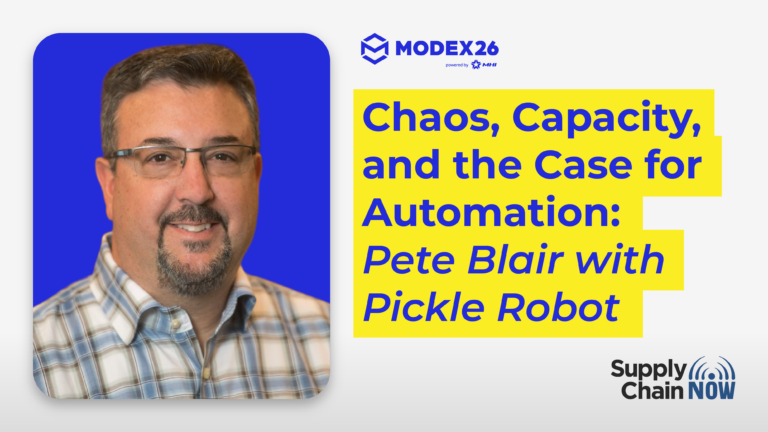
Chaos, Capacity, and the Case for Automation: Pete Blair with Pickle Robot
At MODEX 2026 in Atlanta, the energy was unmistakable. With thousands of supply chain professionals gathered, one theme echoed across conversations: uncertainty is no longer episodic. It’s constant and seemingly endless. In a candid discussion with Scott Luton, Pete Blair, VP of Product & Marketing at Pickle Robot, unpacked how organizations are navigating volatility, workforce challenges, and the growing role of automation in keeping operations moving.
Navigating Tariffs and a Moving Target
If there’s one word defining today’s global supply chain environment, it’s unpredictability. Blair points to tariffs as a prime example; and not just their presence, but their volatility.
“The biggest thing we see… is the chaos of tariffs. It’s not so much that customers have to pay tariffs or not pay tariffs, it’s that they don’t know how to plan,” Blair explains.
That lack of predictability is forcing organizations to rethink their networks in real time. Companies are shifting sourcing strategies, standing up temporary distribution centers in new geographies, and even making drastic decisions about whether importing goods makes financial sense at all.
What’s particularly challenging isn’t the cost itself. But rather, it’s the inability to forecast. Supply chains, while resilient, aren’t designed for abrupt swings like tariffs being applied and removed within days (or sometimes even hours). As a result, leaders are left managing a system where yesterday’s plan may already be obsolete.
Data Tells the (Bumpy) Story
Blair highlights how data is revealing just how erratic operations have become. Volume spikes and dips are no longer seasonal; instead, they’re reactive.
“We’re looking at the data… and you see things like, ‘Hey, your daily unload volume’s way off or way up. What’s going on?’ And it’s the spiky nature of what’s happening that really challenges the operators,” he notes.
Organizations are accelerating shipments one week, then pulling back the next, often in response to shifting trade policies or geopolitical developments. The result is a whiplash effect that makes planning incredibly difficult.
This reinforces a critical takeaway: visibility alone isn’t enough. Companies need the ability to act on that data quickly and with confidence.
The Labor Equation: A Structural Challenge
Beyond tariffs and trade, workforce dynamics remain one of the most pressing challenges in supply chain operations.
Warehouse and logistics roles, especially physically demanding ones like unloading floor-loaded trailers, are becoming increasingly difficult to fill. Blair paints a vivid picture: workers inside metal containers in triple-digit temperatures, manually handling every box. It’s tough work, and fewer people are signing up for it.
At the same time, demographics are shifting. The existing workforce is aging, and younger generations are showing little interest in entering the field in certain roles. Add in competition from large-scale operators and the labor pool becomes even tighter.
The implications are clear: companies must find new ways to maintain throughput and efficiency without relying solely on human labor.
Automation Steps In (But It’s a Journey)
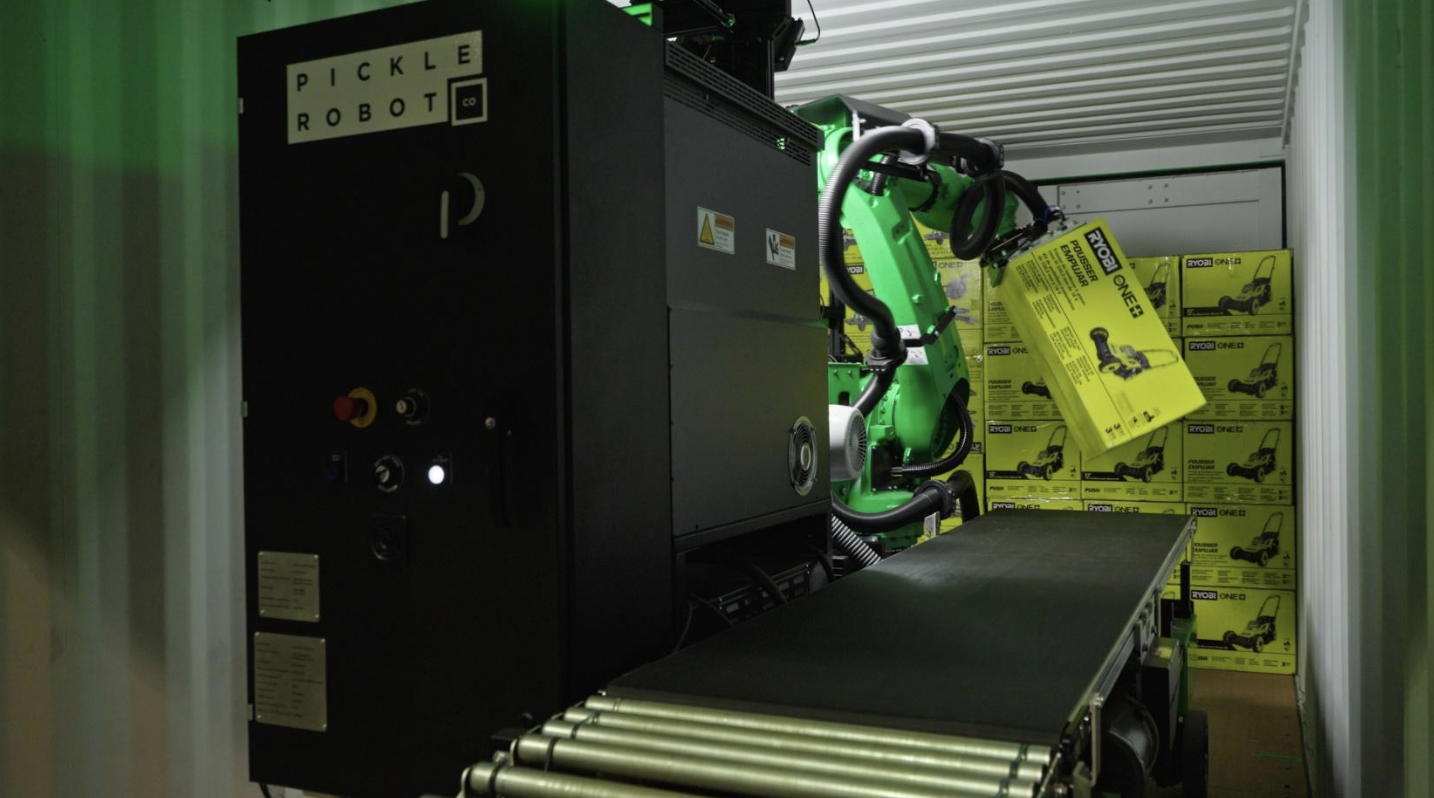
This is where automation, particularly robotics, is gaining momentum. At its core, Pickle Robot focuses on automating one of the most labor-intensive tasks in the warehouse: unloading trucks.
But as Blair explains, the journey isn’t about flipping a switch. Rather, it’s about evolving capabilities over time.
Early use cases, like unloading structured import containers, are relatively predictable. The next frontier is far more complex: handling parcel trailers filled with a chaotic mix of shapes, sizes, and packaging types.
“It’s not so much a new product that we are developing for trailer unload as it is a constant evolution…we improve the hardware and most importantly the AI and software to serve more customers, handle more complex loads, and get into new markets,” Blair says.
This progression mirrors a broader trend in supply chain technology: incremental innovation that steadily expands applicability while improving performance.
Knowing the Limits Builds Trust
One of the more refreshing aspects of Blair’s perspective is a willingness to acknowledge where technology isn’t ready. Yet.
Some use cases remain beyond current capabilities. Rather than aggressively and perhaps unrealistically overpromising, Blair emphasizes transparency with customers.
That approach builds credibility in an industry where trust is everything. By clearly defining what automation can and cannot do today, companies position themselves as long-term, trusted partners rather than short-term vendors.
A Bold Prediction: Consolidation Ahead
Looking to the future, Blair offers a sobering outlook. He predicts that within the next two years, at least one major, household-name logistics player could disappear due to mounting pressures.
From geopolitical volatility to competitive disruption, the landscape is shifting quickly. Blair draws a parallel to the fall of legacy retail giants, reminding us that even dominant players aren’t immune to change.
The message for supply chain leaders? Adaptation isn’t optional.
The Bottom Line: Embrace Change, Build Resilience
The conversation at MODEX 2026 underscores a pivotal moment for the industry. Supply chains are being tested on multiple fronts (think policy, labor, operational complexity & more) all at once.
Yet within that disruption lies opportunity.
Organizations that embrace data-driven decision-making, invest in scalable automation, and remain agile in the face of uncertainty will be best positioned to thrive. As Blair’s insights make clear, the future of supply chain won’t be defined by stability. But it certainly will be defined by how well companies respond when stability disappears.
Where to Learn More
Connect with Pete Blair on LinkedIn. Learn more about how Pickle Robot deploys its technology in days and not months, integrating seamlessly into existing warehouse operations – – handling the chaos while your team focuses on what matters: https://www.picklerobot.com/.
More Blogs
The 3 Critical Questions Enterprise Shippers Ask Me About AI