[00:00:00] Amber Salley: small businesses these days, they’re hearing a lot about the AI hype.
[00:00:05] So when they bring consultants in, it’s to say, “Hey, how can I build an AI competency? they need to take a step back and just look at how you’re actually managing your supply chain first, and have the consultancy use their experience in companies like, like yours to identify what you could start doing today
[00:00:41] Scott W. Luton: Hey, good morning, good afternoon, good evening, wherever you may be. Scott Luton with you here on Supply Chain Now. Welcome to today’s show. Folks, I’m really looking forward to today’s show. We’re taking on a rather unique topic, at least here at Supply Chain Now. The world of consulting, as we all know, really supply [00:01:00] chain and otherwise, it sure has been thrown for a big loop in recent years, right?
[00:01:04] Well, today we are gonna be talking with a wonderful leader who has some very intriguing perspective really on a variety of topics related to what the world of consulting is going through. Hey, what’s the reality look like when it comes to the consulting model disruption right now? How is the current landscape changing traditional consulting economics?
[00:01:26] And for all of our operators out there, what should you keep in mind as you look to hire been-there-done-that help in the next few months? Well, we’re gonna dive into all that and much, much more. So stick around for a great conversation that I promise you is gonna offer up tons of actionable insights by the truckload.
[00:01:44] So I wanna welcome in our guest here today. I wanna introduce her. Our guest is a supply chain executive and advisor with 25 years of experience really at the intersection of business strategy, digital transformation, and emerging technology. [00:02:00] Our guest has advised more than 1,000 C-suite executives, really with one big common thread: helping them to cut through the complexity and make decisions that move business forward.
[00:02:13] And our guest’s career spans both sides of the proverbial table, practitioner and advisor. From hands-on transformation work at IBM and Accenture to nearly 12 years as a Gartner analyst observing hundreds of transformations succeed and fail, to building market shaping frameworks, at GAIN Systems.
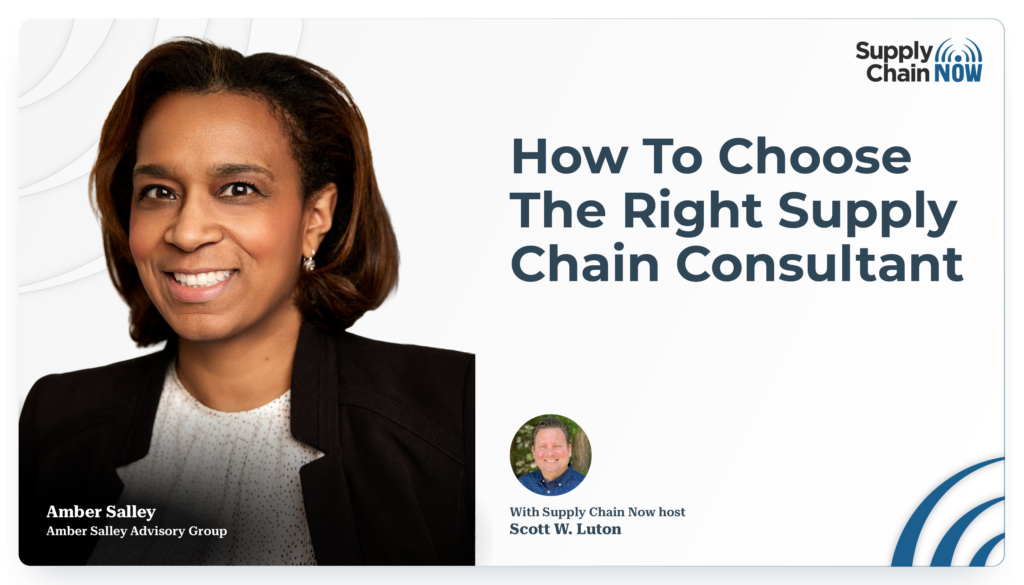
[00:02:35] You could say that our guest has developed a perspective that is both strategic but also grounded in what actually works. So let’s welcome in Amber Salley, founder and managing director of the Amber Salley Advisory Group. Amber, how you doing today?
[00:02:52] Amber Salley: Uh, I’m doing really good, Scott. It’s good to see you again
[00:02:55] Scott W. Luton: You as well. I have really enjoyed our conversations both in front of the [00:03:00] camera, so to speak, and behind the camera. And, uh, I tell you what, just reading through, uh, your, uh, background a bit, you have, you have had an incredible career and you, you’ve worn so many hats. I can’t wait for today’s discussion
[00:03:14] Amber Salley: Yeah. Yeah. And I, I’m really excited to share my story, what I’ve learned over my 25 years of being in this crazy world of supply chain
[00:03:24] Scott W. Luton: It is indeed. Well, before we get there, and especially before we start really lifting up the hood and, and getting, uh, some inside baseball on what the consulting world’s going through, you know I wanna start with a fun warm-up question. And to that end, I found out a very unique personal factoid about you, Amber, in our, in our green room conversation, one that I don’t think I’ve met a single individual that can make this same claim.
[00:03:51] So we hear, Amber, and please verify this for us, we won’t make any false claims, that you that you have visited [00:04:00] all seven wonders of the world. Is that right, Amber?
[00:04:04] Amber Salley: Yes, that, that is right. I have been to all seven
[00:04:07] Scott W. Luton: That is remarkable. I’m jealous already. So let me ask you, it’s not a fair question, but, and, and it’s not about the being the best one, but what of all those seven… And folks, if you, uh, if you’re, if you’re like me and I was like trying to in my head name them all off, I’m gonna do that really quick and please correct my pronunciation.
[00:04:27] So you got the Great Wall of China, you got Petra there in Jordan, you got the Colosseum in Rome. Some folks I think have the pyramids rather than the Colosseum. Uh, Chichen Itza in Mexico. Is that right, Amber?
[00:04:40] Amber Salley: Yeah, that’s right
[00:04:41] Scott W. Luton: Piku- Picchu in Peru. Uh, that incredibly captivating Christ the Redeemer statue in Brazil, and of course the beautiful Taj Mahal in India.
[00:04:51] So Amber, I’m, I’m telling you, I don’t know how you’re gonna pick this, but what was your, one of your favorite visits there?
[00:04:57] Amber Salley: I’d say full [00:05:00] experience, Machu Picchu in Peru. I traveled there with a friend from college and some of her friends, and there are two ways to get to the actual Machu Picchu site. You can either fly into Cusco, the town near Machu Picchu, and take a train in, and it ends up being a one-day trip, or you can do a backpacking trip through the trail itself.
[00:05:25] Yes. And my friends and I did the trail back when I was younger, so I could actually deal with the travels of the trail. But it was wonderful. The– You’re so high up in the air that at night you can see so many stars ’cause there’s no light pollution. And, and we went down when it was the Peruvian summertime too, so a little bit closer to the, um, I guess, certain types of stars.
[00:05:49] And then once you finally get to where Machu Picchu is, when you turn a corner and then you actually see the site, it’s so amazing.
[00:05:57] It’s breathtaking You [00:06:00] paint quite a picture and issue such a challenge all of us should, should strive to visit these wondrous places. Um, so we’re gonna have, we’re gonna have– you’re gonna have to have a new travel diary with us, Amber, because, um, that’s those seven sites. But, but you know, you’ve been all over the place in your current role, um, as an advisor.
[00:06:20] Scott W. Luton: Lots of terrific events and all, so you’re gonna have to have a travel blog. Uh, we’ll see if we can get to work on that. but kidding aside and travel aside, um, as I was touching on earlier, you’ve had an incredible and an intriguing background and professional journey. We might– we’ll be here all day, uh, to hit all the chapters.
[00:06:37] But, you know, if you think of a short list of key highlights that especially might help us all, uh, watching or listening better understand your worldview, what would be on that short list?
[00:06:48] Amber Salley: Yeah. So the start of my career as a practitioner working at, at IBM and in the early days of the integrated supply chain. So seeing that [00:07:00] integrated supply chain come together and not realizing it when I was there about how mature it was, how high functioning it was. So I was able to learn about the ins and outs of the supply chain from a very well-wan– well-run supply chain, which has just led me throughout my, my career.
[00:07:18] Um, other highlights are the years that I spent in advisory being able, you, you mentioned Scott talking to over 1,000 executives. Uh, it probably had over 5,000 conversations total with, um, different, uh, supply chain software vendors, investors during my time there. So again, just seeing the wide spectrum of where people are in their supply chain journeys has also informed my view and how I think about where we’re going to next with supply chains.
[00:07:52] Scott W. Luton: You know, on, on that wide spectrum, you know, that is, um, mo- you know, tons and tons of practitioners [00:08:00] are, are watching and listening to us, and, and they know what I’m gonna say. But I think in this modern age, which of course the pandemic certainly, um, uh, opened a lo- shed a lot of light globally on this incredible industry that we call home, I think a lot of folks, uh, have marveled on just how wide that spectrum is and how deep in terms of everything that has to take place for us, you know, modern consumers to enjoy the conveniences.
[00:08:28] And, you know, when you think about, um, all the challenges, you know, the timeless challenges and the new challenges of the, you know, golden age of supply chain tech or, and geopolitically, you name it, you know, we could, we could, we could have eureka moments for three weeks straight and still be at the tip of the iceberg, huh?
[00:08:47] Amber Salley: Right, right. And I think that this conversation that we’re going to have about consulting is so timely because one reason why we see different, um, specialized consulting [00:09:00] firms appear is because no two supply chains are the same, and there are very distinct nuances for different supply chains in different industries, sub-industries, so on and so forth, regions, you name it.
[00:09:16] That it would be very, very hard for one person to say, “Hey, I can help any kind of supply chain,”
[00:09:22] Scott W. Luton: Amber,
[00:09:23] Amber Salley: is not one kind of supply chain.
[00:09:24] Scott W. Luton: that’s right. It’s such a great point. And folks, it’s such an important point we’ve made here time and time again. You know, specialization’s really important. You gotta see a consultants and advisors and really ask the tough questions and make sure they’re a great fit for your organization. I know I’m preaching to the choir.
[00:09:41] All y’all know that, but it just, it reminds me for the millionth time. Uh, all right, Amber, I wanted to ask you a tough question on the front end. but you spent time at Big Blue. What a fascinating place. you know, I’m a big– I mean, it’s amazing just how instrumental IBM has been to industry and certainly, uh, industry across the states here, and [00:10:00] space program, you name it.
[00:10:02] It’s hit a few speed bumps, uh, here this year. You know, its stock has certainly seen better days. You– We’re, we’re recording this in, in mid to late July, right? Um, and you know, some analysts have even been suggesting, again, that Big Blue might consider, you know, breaking up, breaking the company up a bit. So I don’t know.
[00:10:22] I’m not gonna, uh, subscribe to any of the hyperbolic statements out there, but as a, as a, you know, alum of IBM and as a current advisor and observer in industry, your thoughts on where IBM is and where it, it may be going?
[00:10:35] Amber Salley: Yeah, sure, sure. So, uh, let me preface this by saying that I spent five years here at the start of my career, and I loved working at IBM. I worked with some of the smartest people I’ve ever worked with. And if you look now at where some of my former colleagues have ended up in their careers, lots of senior leaders in all different kinds of organizations who all got [00:11:00] their start in– at IBM and in the IBM supply chain.
[00:11:04] So, uh, I wanna give credit to what IBM was able to build over all of these years, building great leaders, great, great minds. And I worked in the PCD division, the Personal Computing Division, the division that manufactured laptops and PCs. That was the piece that was sold to Lenovo about 20 years ago or, or so.
[00:11:27] So I have a lot of friends at Lenovo as well.
[00:11:30] Scott W. Luton: Okay yes, yes. But what I wanted to say, great place to work. And when we think about the news that, that’s come out, the news specifically is that, uh, IBM pre-announced their Q2 revenue of 17.5 billion, which was about 700 million short of consensus. And the, the CEO, um, Arvind Krishna, a-admitted that IBM was just missing signals and got [00:12:00] their, eyes off the ball for a little bit, and that’s what affected them.
[00:12:04] Amber Salley: But if we look at what actually happened, it was that a lot of IBM customers were shifting the spend they might have had on IBM software and services to other spend on things like memory chips and services and other hardware in anticipation of price increases and supply constraints. So it’s a supply chain story at the end of the day, right?
[00:12:32] Right? Uh, people thinking yeah
[00:12:36] Scott W. Luton: roads lead back. I- am I right, Amber?
[00:12:38] Amber Salley: Yes. Yes. Yes. So this isn’t a story that demand for IBM software or services has actually declined. It’s just more of a story of their customers holding ex- back spend for the time being so they could purchase these other things, right? So, uh, one thing that we could possibly [00:13:00] theorize is that in the next few quarters, those customers will invest what they intend to invest this quarter into the IBM investment.
[00:13:11] Um, but we won’t know that until we get further into the future. And when we also think about what happened to, um, IBM, there, there are the two big forces that were impacting them. One is the investment on software that’s being impacted everywhere, and the investment on services that are being impacted everywhere, which IBM has both of.
[00:13:39] So it could be seen more as right now maybe they’re just the most visible organization that’s being impacted by these forces, right? And IBM’s always pivoted, right? They’ve always been an organization that’s– It’s over 100 years old, and you don’t maintain that, uh, [00:14:00] dominance in the market without knowing how to pivot and how to adjust.
[00:14:04] Scott W. Luton: That’s right. So you see it more as a bit of a, a pendulum, uh, and would you say, You know, you read headlines these days, and folks, we’ve talked about this before, you can’t stop at a headline. You gotta dive in deep, right? cause y- y- we know the news cycles.
[00:14:22] But I think, Amber, I’m hearing you say, “Hey, this is a, a, organization with lot- lots of longevity, lots of success.”
[00:14:30] And much like we see in our economic trends, you know, consumers shift from goods to services, and that’s, that’s a bit of a pendulum. We’re seeing somewhat of a s- a similar pendulum effect here with IBM,
[00:14:43] and to give it time, let’s see where the second half of the year takes us with Big Blue. Would you
[00:14:48] Amber Salley: Yeah. And, and I’ll add as well to your point, I mean, IBM is everywhere and people don’t realize it, right? I was reading an article that said that every time you go to an ATM and do a transaction there, [00:15:00] IBM is making some kind of money off of that, right? Because a lot of the, a lot of those, um, machines are run on IBM mainframes.
[00:15:07] And that’s just one example. There are probably other examples that I’m not aware of where every time that transaction happens, IBM is actually benefiting from it.
[00:15:15] Scott W. Luton: that’s something. You know, uh, one quick aside, and I promise folks we’re getting into the state of the consulting industry, but, uh, I know we’ve got, uh, a shared military, uh, journey in, in history, Amber. And I remember when I first joined the Air Force, uh, I was 17 when I went through basic training, and that was some long time ago.
[00:15:34] Uh, and when I, when I arrived at my first PCS, my, first permanent station, it was, uh, Shaw Air Force Base in Sumter, South Carolina. And I was one of the many, many airmen that probably put a, a fourth of my take-home into a new car. So I’d go to the ATM, which is what reminded me of this little story, and you could still get $5 out of the ATM.
[00:15:56] Times have changed a lot. Now that’s like the standard fee in many places. [00:16:00] But I would go get five bucks and then go to Subway if I didn’t feel like the chow hall. But times have changed indeed.
[00:16:07] Um, okay, let’s get into the central theme we’re ex- uh, talking about here today, and thanks for your thoughts on IBM.
[00:16:14] We’ll all keep our finger on the pulse there. But
[00:16:16] I wanna shift over really to truly the state of the consulting industry. So folks, we all know, right, AI has disrupted, gosh, everything. Really the modern age of technology has diser- disrupted so much here, good, bad, and, and, and somewhere in between, but in particular the consulting industry, right?
[00:16:36] We’ve all read the reports. We’ve all spoken to our in- brilliant consulting friends. Uh, and Amber, you, you’ve got some unique perspective as we’ve already touched on, ’cause you’ve sat in these four different seats, you know, practitioner at IBM, consultant at Booz and, and Accenture, analyst at Gartner, vendor executive at, at GAINS.
[00:16:55] So from your unique vantage point, what do you see that, that is [00:17:00] actually happening to the consulting model right now? And just how much of it, uh, how much is it AI versus something else that may have already been breaking?
[00:17:11] Amber Salley: Mm-hmm. Yeah, sure. So just to give a little bit more detail on my background in consulting, um, for, for the audience, I started my consulting career at, at Booz & Company, which used to be a part of Booz Allen Hamilton. And around the time that I joined, um, Booz & Company, which was the strategy piece, the management, um, the consult– management consulting strategy piece, um, split off from Booz Allen Hamilton, which did a lot of government, consulting.
[00:17:40] And I was part of what was the, called then the IT strategy group. So I worked with CIOs, their direct reports around strategies related to IT and IT trends. Then, uh, when I moved over to Accenture, same thing. I was part of the [00:18:00] management, the strategy group there, but covering supply chain strategies. So I would work with, say, Fortune 500 companies on their, investment plans around supply chains.
[00:18:14] And the, the big shift between the two was that Accenture also had an implementation arm as well, right? So, so the consulting there was a combination of the management and the implementation side of things. So when we– when I think about the 15, 20 so years ago that I was in management consulting to where we are now, I see that the model was starting to shift.
[00:18:39] There was already pressure on the model years ago, maybe even before COVID, we started s- to see pressure on the model. But AI is just accelerating that, that, that, that force of change. ‘Cause if we think about strategy consulting firms and the value that they have brought in the past, a lot of the [00:19:00] value was helping you think through how you can modernize your operations.
[00:19:05] What are some of the levers that you can start to pull to reduce cost or, um, eliminate value leakage? But a lot of those approaches now are, are pretty standardized, right? You can buy a, a book on Amazon that can tell you the best-in-class ways to do planning, execution, so on and so forth. So there’s really not anything differentiating the vendors that much these days.
[00:19:34] What differentiates them now is, is their brand Right? And maybe the, the bodies that they bring, the team that they, that they bring with them. Maybe you do see some differentiation with regard to what we talked about earlier of the specialization around industry verticals or any regulatory challenges that a supply chain might have.
[00:19:53] But net-net, there’s not a lot of differentiation across all the [00:20:00] vendors. So then the pressure just started to become, well, who says they can produce this at the lowest cost and actually deliver at that, at that low cost?
[00:20:09] we started to see that the bookings started to decline for the different consulting firms, and we started seeing, um, lots of projects that were trying to be drawn out and, and staffed with, with different, with more heads to raise the overall value of the project So with ex– AI coming in and AI promising to do a lot of that junior level work, right?
[00:20:46] The model is starting to in a way collapse on itself because why would a company pay for all these hours of these junior consultants to do all of this work that can be done in a shorter period of time now with, with [00:21:00] AI?
[00:21:00] Scott W. Luton: Yep. So Amber, what I’m hearing, and correct me if I’m wrong, what I’m hearing is especially, uh, large chunks and cores of the established consulting model, especially th- uh, on the senior side of the, uh, of the billable work, that model has been crumbling and breaking a bit over time. And then maybe what sped up the, what we’re seeing now, all the disruption in consulting now, is the emergence and the fast maturing emergence of AI, which is kind of taking the legs out of the more of the junior work where maybe that was, uh, uh, nothing– There’s no such thing, I don’t think, of eas- as easy money.
[00:21:43] But maybe that was easy… It was more very reliable revenue, uh, that was helping these, you know, many organizations weather the traditional disruption to that part of the model that had been evolving. Is that a good way of putting it?
[00:21:57] Amber Salley: Yeah, that’s, that’s a good way of putting it. That is a good, a [00:22:00] good way of putting it. I mean, I think als- I’d also say that given my experience and what I saw on the strategy side of consulting, then the consulting firms didn’t always actually have to produce outcomes, right? There was one project that I was on at one of my firms, I won’t say which one, where we had, um, a project, and at the time it was the firm’s, as far as I knew, the firm’s largest project ever.
[00:22:24] And I was on the project for a couple of months, and then I, and then I rolled off. I mean, we had tons of work streams across the entire organization. And I still kept in touch with people from the project after I left. And after ab- about six months, I asked one of the other consultants, “Ooh, so what happened with that project?
[00:22:41] Did they take any of the recommendations and actually implement them?” And what I was told was no. At the end of the day, they didn’t. You know, the, the CEO was delivered this package of recommendations, but chose to not actually execute them because then [00:23:00] the CFO and the CMO were going to get, be upset because they were upset in the apple cart, I guess.
[00:23:07] So the decision was made to not move forward with anything, right? And that’s not unheard of in the world of consulting
[00:23:16] Scott W. Luton: I was about to say, I, I think I’ve heard that story, uh, a time or two and how it ends. Um, Amber, let me ask you this. Uh, you know, it is intriguing. I think of conversations I had when I first came into manufacturing, especially related to technology projects and, and big, you know, transformational projects of that.
[00:23:37] But we know fast forwarding, I, I, I keep going back in my time machine today. Uh, Amber, you kind of pulled it out of me, I guess. But fast-forward to today, you know, supply chain technology software buyers, we know they’re shying away from those lumbersome or lumbering $2 million, 18-month, 24-month, you know, implementations, right?
[00:23:59] So I wanna ask you, [00:24:00] you’ve got a good- you’ve got a, a finger on the pulse of the market like few do. What are buyers asking for instead? And as it relates back to the consulting industry that we’re putting a magnifying glass on today, what does that do to, uh, cons- the traditional consulting economics?
[00:24:16] Amber Salley: Mm-hmm. Yeah. So what buyers want now are, are quick wins. They want bite-size pieces of technology that they can easily pluck in to a part of the organization and see, uh, big results. This is where I see the need for consultants, and maybe this ties a little bit back to the last question of moving away from just doing this broad strategy or this, um, this specific implementation to helping companies understand what decisions are you making that drive the most value or the most impact to [00:25:00] reaching your corporate goals and objectives.
[00:25:02] And maybe the consultancy would help with defining what those goals and objectives should be. But what they also need to start doing is thinking of what decisions are you making? How should you be, be making them differently? And if the answer to making them differently is possibly yes, then you can think about which technology is out there that can help you with that one decision to make that decision better, right?
[00:25:27] So if we move– If we start to see companies wanting to move towards that model, then the older consultancy model of these big teams with these 18-month-plus implementations that are, um, millions and millions of dollars are going to go away. Because now leaders and boards want to see return on investment quickly, and the old model did not allow for that,
[00:25:51] Scott W. Luton: Yep.
[00:25:53] Amber Salley: right?
[00:25:53] Scott W. Luton: And, and thankfully, uh, going back to your first one, one of your key points you made about quick wins, uh, it’s really [00:26:00] fascinating. You know, I, I know there’s been numerous eras when I say the, the golden age of supply chain tech. It depends on who you talk to probably, and who knows what’s around the corner.
[00:26:09] But it’s been fascinating to see tech- um, so many technology providers, uh, cite this need and this market shift mo- you know, from the lumbering, really expensive long-term implementations to, hey, implement this in, in a quarter or less. Uh, and in that quarter, you know, make, uh, make, make returns and savings and capabilities that will pay for the next, you know, the, uh, the next go round.
[00:26:35] Your thoughts?
[00:26:35] Amber Salley: Yeah. The flywheel effect. Yes, for sure. The flywheel effect, definitely, definitely. What– On the– So on the technology side and how this is going to be impacting, um, consulting again is if we think of the evolution of software engineering and the evolution of hyperscale cloud platforms, the barrier to entry for a new entrant is [00:27:00] very, very low, right?
[00:27:03] Um, so there are a lot of new vendors entering the market who are coming in saying, “I can solve that one discrete problem.” Um, uh, and the buyers are starting to become aware of these vendors and are starting to push the consultants towards helping them understand who could, who could I be using? Is it, is it who I already have in place today, right?
[00:27:33] Am I– Are there capabilities that I didn’t know that I had access to? Because a, a byproduct of the ability to build more faster is that these established platforms can add more features and functions to their platform at a faster rate. So now you have customers who are either buying technology and they don’t know what they’re fully buying, right?
[00:27:57] Or they have access to things that they don’t know they have access [00:28:00] to, they get pushed to them over time,
[00:28:02] Scott W. Luton: Hmm
[00:28:03] Amber Salley: right? So having a consultant come in and help them understand, um, what did I maybe get pushed to me that I can start to use now, help me through that change management process, ’cause that’s something that consultants can put a lot more emphasis on now, is helping with the change management piece.
[00:28:20] Um, uh, or how can I– Now that I’ve bought something, can you help me figure out what I actually bought?
[00:28:30] Scott W. Luton: That’s so funny. It, it reminds me of the, um, that phrase about, “Hey, we gotta pass the bill so we s- we know what’s in it.” Uh, it’s kind of similar approach there.
[00:28:39] Amber, we, you know, I enjoy our conversations. We could be here for a couple hours. Uh, there’s so much to talk about. It’s, it’s a fascinating time to be in supply chain and technology, certainly in consulting, uh, just in global business.
[00:28:52] So, you know, you’ve said to me in past conversations that consultancies gotta know the technology market [00:29:00] rather than lean on the partnerships that are available out there with big established players, right?
[00:29:06] Amber Salley: Yeah
[00:29:07] Scott W. Luton: Uh, it can be a direct challenge to how a lot of firms make money, kind of going back to the economics.
[00:29:12] What would you suggest has to change or, you know, they, they put the, the closed sign, uh, hang that on the door? What’s gotta change?
[00:29:21] Amber Salley: Yeah. Yeah. So, so to level set on how things are today and how they have been for a while, most consultancies that I covered during my time as an advisor, um, and meaning consulting as well, will have a collection of software vendors that they have established partnerships with. Now, these partnerships could be reseller agreements, right?
[00:29:47] Where the consultancy goes into a client, recommends a vendor. If the client goes to the vendor, then the consultancy gets some kind of compensation for that. There could be a value-added [00:30:00] reseller agreement. Um, and in these different agreements, the consultancies will, in many instances, staff their organization with people who are experts in a particular software.
[00:30:16] And what that then means is that there’s an incentive for the software vendors to push a s- a specific technology. One example from my time as an advisor, this is probably in 2017, 2018, I was talking to a candy manufacturer who had a consultancy come in to talk about supply chain planning, and this consultancy recommended, I, I will say that the product they recommended, they recommended SAP APO.
[00:30:42] And this is wha- this was after SAP had launched SAP IBP. So SAP, I don’t think even wanted people to start to deploy SAP APO, right? And I, and I, when I said this to the person, I always said, “You know, SAP’s not even investing in APO anymore. They’re not adding any new functionality to it.” [00:31:00] Like, the look on this person’s face was like a look of, of surprise.
[00:31:03] But the consultancy that they had engaged with had a lot of people in their environment who knew how to deploy SAP APO and deploy it very well. So it was in this consultancy’s best interest to gear the customer towards SAP APO. But as we are looking at how the technology is rapidly evolving, we just talked through the barrier to entry becoming lower.
[00:31:28] Tt’s consultancies are going to have to become much more aware of who the vast players in the market is, ’cause at the, at the end of the day, if their customers want the consultancy to help them make better decisions, the consultancies have to know which technologies are out there that are purpose-built to solve for that one technology Where I possibly see this going, and we have started to see this a little bit, is the consult- consultancies.
[00:31:56] So we think of [00:32:00] the evolution towards, uh, services and software vendors building what we call composable technology stacks that have independent services that solve discrete problems. The consultancies might work with those vendors to possibly white label those services. So consultancy A might want to bill themselves as a demand forecasting consultancy for consumer goods, where they can just come in, solve a very discrete problem, maybe around new product introduction forecasting and create a supply response, and then white label a particular, um, service that has the logic that’s specific to consumer goods companies, and then maybe even specific to new product introduction.
[00:32:52] And then say as a consultancy, “Hey, we can help solve these problems. We have this technology here that can solve [00:33:00] 95% of the challenges that the kind of company that we try to bring on as a customer needs to have solved.”
[00:33:08] Scott W. Luton: I got a question related to the problems that are solving and the, um, invoices that are then sent, and, you know, this notion of, um, outcomes-based pricing. You know, I’ve met many, many consultants over the years from folks that say, “Hey, just give me access to what you’re spending on shipping, and I’m gonna come in and I’m gonna save you a couple million dollars, and I’ll, I’ll take 25%.”
[00:33:34] But there’s usually there’s a, there’s a hook. You dig a little deeper, there’s a hook, right? You pay up front. But y- the, the truest sense, outcomes-based pricing has not become prevalent for a variety of reasons. When you think about where we are today, and you, we think about all the that you’ve already laid out in this podcast thus far, what’s your take on, outcomes-based [00:34:00] pricing and where it fits into the modern consulting world, I’ll call it?
[00:34:04] Amber Salley: Mm-hmm. Yeah. So to your point, in the past, outcome-based pricing wasn’t, uh, advertised. And one reason is because it’s actually hard to isolate where the value driver of the outcome. Is it the technology? Is it the consultancy? Is it something else in the organization that where something clicked and there were, um, desirable outcomes, um, from there?
[00:34:28] But as we are– Again, I see this as, again, tying things to the c- the services firm or the company helping, or the consultancy helping the company with improving decisions and improving the outcomes of those decisions. And when the consultancy can come in and say, “The decisions that you need to focus on are, you know, these 10, and here is how much these 10, um, influence your EBITDA [00:35:00] or influence your customer service levels,” or some other kind of metric that senior leadership or the board cares about, then you can actually more closely tie the value that the consultant brought to the organization versus everything else.
[00:35:20] Because the consultant says, like, “These 10 decisions help to improve these outcomes,” and you can see those outcomes improve, then it’s easier to make that connection between the guidance given and the results.
[00:35:32] Scott W. Luton: So you see, uh, based on where we are today from a consulting, a technology, a kind of the state of, of global business perspective, that it’s easier for consultants to truly isolate the value they’re creating and take out the, um, outside of our control dynamics. That is probably one reason why outcomes-based pricing never became truly prevalent.
[00:35:57] Um, you’re seeing maybe, [00:36:00] um, a second act or maybe a fifth act for outcomes-based pricing in today’s economy and, and state of business. Is that right?
[00:36:06] Amber Salley: Yeah, yeah. I think that companies now want their partners, regardless of who the partner is, consultancy, software, to have more skin in the game
[00:36:15] Scott W. Luton: Hmm. I like it. Um, all right. So here is, you may have to send me an, uh, uh, an advisory invoice for this next question. I think this is kind of what we’ve been building up to because we got folks tuned in, watching or listening from all around the world in a variety of different chairs and functional aspects.
[00:36:36] Um, but in particular for especially that mid-market operator that have been, that have been with us the whole way thus far. When it bowl, when you bowl everything down, what would your advice be in terms of what they might should do differently when they look to hire, uh, consulting help over the next few months, next quarter or two, or you name it, in the short term?
[00:36:57] What your, what would your advice be?
[00:36:59] Amber Salley: [00:37:00] It would be have the consultancies first
[00:37:08] have you focus on, on, on decisions and decision-making, having them help you understand or think differently about your operating model, um, how you have designed your organizations rather than leaning in with technology. I feel that a lot of, um, mid-market and small businesses these days, they’re hearing a lot about the AI hype.
[00:37:31] So when they bring consultants in, it’s to say, “Hey, how can I build an AI competency? What technologies are out there that can help me quickly get results?” But they need to take a step back and just look at how you’re actually managing your supply chain first, and have the consultancy use their experience in companies like, like yours to identify what you could start doing today [00:38:00] to start to get value tomorrow, and then enhance that with technology over time.
[00:38:05] Scott W. Luton: Hmm
[00:38:05] Amber Salley: Um, a second thing is whenever you start to interview your consultants is try to, try to gauge, um, how they think they can help you in the next couple of weeks versus years. What I’ve started to see is some of these more established consultancies are trying to go downmarket into the mid-market and small business space, because there’s a lot of white space there.
[00:38:29] No one has really served them very well. But these are also, uh, consultancies and service providers that are used to these long drawn out enterprise projects, and it might be hard for them to shift from longer projects to helping you find, um, a result in a couple of, of weeks. So as you’re interviewing consultancies, try to gauge, can they help me very quickly?
[00:38:56] Do they really know how to work with a company like mine, [00:39:00] or do they think they can help me out, but actually end up having a lot of scope creep at the end of the day, right? Or, you know, our government examples, you, uh, signed a statement of work to do this, and then you add on another statement of work that’s twice the cost of what you originally signed up for, right?
[00:39:18] Scott W. Luton: And we’re laughing because it happens. Uh,
[00:39:20] you know, we’ve been there and done that. And i-i- that’s great advice. And, and you may have a third or fourth, but, you know, getting really, asking the tough questions. Um, you know, I talk about this a lot. We, we all tend, I think humans tend to mail in the selection process, whether it’s consultants or technologies or you name it, and often kind of stop with the first person or platform you like,
[00:39:44] and you do that at your own peril.
[00:39:47] Um, because it’s so in, in, and I’m, I’m gonna state the obvious here, but I love your advice there. Figure out where, what quick wins that they truly can deliver in a credible fashion, [00:40:00] time-bound fashion, what’s the return fashion? And you, uh, you’d be surprised, I’ve been surprised, uh, how easier it is to separate the wheat from the proverbial chaff.
[00:40:11] Uh, would you agree with that, Amber? And, and any other advice you’d give for those hardworking operators and
[00:40:17] Amber Salley: Yeah, I, I would agree with that. And the last piece of advice that I’ll say, which just came to my head as you were just, um, sharing your feedback is, um, to your point about don’t just pick whatever technology you see first. The same thing for the vendor, so the, the consultancy. So there might be an instance where you’re deploying a new finance software, and you have a consultancy in that that’s helping that, and then you think, “Okay, well, we’re gonna invest in supply chain software, so let’s have that as well.”
[00:40:45] The finance consultancy might think, “Oh, supply chain, how hard can that be? You know, it’s just forecasting stuff, getting orders out the door. We can do that work as well.” And then push their services into a domain they aren’t very [00:41:00] familiar with. So don’t fall into that trap of thinking, “Okay, they might…
[00:41:03] They say they can do it cheaper ’cause they’re already doing work for us.” Well, to our last point, in the long run, it’s probably not going to be cheaper
[00:41:09] Scott W. Luton: That’s right. Um, there was a famous sci-fi writer, and I can’t think of hi- he actually wrote the book Starship Troopers back in the day. So folks, we’re gonna have to Google this, uh, and a man, maybe Amanda can help me out there. But he, he won, I think, seven Hugo Awards for his sci- largely sci-fi writing.
[00:41:30] And he’s got this great quote because he’s really encouraging humans to be very broad in their experiences and their activities and their knowledge, which I largely subscribe to. And the quote is, uh, “Specialization is for insects,” is what this author said. Now, however, When I have conversations with these brilliant college students that are coming into our industry, “Hey, be well-rounded, understand upstream, downstream, the ecosystem,” all that. So all that’s wonderful. [00:42:00] However, when you’re talking about what we’re talking about, and Amber’s given some great advice here, when you’re talking about technology platform selection and, and certainly consultant selection, specialization, and, uh, as you put it, domain expertise is so critical.
[00:42:16] And better yet, know a lot of times there’s differences in who’s presenting in the selection, the proposal process, and who actually is delivering. And you want to know, you want to know all of that. Is that right, Amber?
[00:42:30] Amber Salley: That is true. Yes. At the end of the day, the consultants want to sell work, right? They want to sell projects. Yep. And so they will put, they will try to razzle-dazzle you, and then you assign the work, and then you find out, “Oh no, that resource is assigned to a project for the next six months, so we’ll give you this person instead.”
[00:42:50] Scott W. Luton: Razzle-dazzle is a great word I hadn’t used in years. Um, thank you for reminding me it’s out there, ’cause that is a bit of a shell game, a little razzle-dazzle, folks. So d- make sure you know with certainty [00:43:00] before you sign that dotted line or, or make any big agreements. Um, Robert Heinlein was the author, thank you, Amanda, was the author I was trying to think of that came up with, that was quoted as saying, uh, “Specialization is for insects.”
[00:43:12] And hey, there’s some truth here when it comes to consulting. Um, okay, so Amber, uh, r- right before we wrap, I wanna make sure folks know how to connect with you and the great work you’re doing, uh, with your firm. I caught, I do a lot of snooping, uh, especially with guests that come on “Supply Chain Now,” and I was reading an interesting LinkedIn post you had shared recently in recent weeks, and you kinda opened it up by saying, “Folks, stop layering AI on top of 1990s foundations.”
[00:43:42] So we all love the 1990s, love the music. Oh man, we had good fun back then. But as it relates to how we’re trying to meet the demands of the modern supply chain, please expound on your, uh, your, what you were screaming into the wilderness.
[00:43:57] Amber Salley: Yeah. Yeah. So [00:44:00] when I look at the marketing that’s coming out now from a lot of the vendors, so again, having spent 12 years in advisory, I got to know a lot of the vendors pretty well. I got to know their projects, their products, um, pretty well. And when I hear the messaging around, “Oh, we all– we’re, we’re, we’re AI native, we have all this AI capability,” sometimes I’m like, “Your, your core platform is 30 years old,” right?
[00:44:28] It was built even before we thought about cloud computing. So yeah, maybe you’re– maybe you have bespoke applications that are, built to be AI native, but at the end of the day, when it comes to the end-to-end platform, it’s not very modern. It, it will make it hard for companies to actually achieve their AI ambition if they engage with this vendor as their sole partner for supply chain.
[00:44:58] You know, when we talk [00:45:00] about this idea of SaaS and SaaS dying, I feel like a lot of the conversation is around SaaS is dying because people are using the frontier models like Claude and Perplexity to build their own applications. You hear about this all the time. When I first heard about this notion of SaaS dying, I looked at it, I looked at it differently, not about build your own application or build your own platform, but more about the platform play itself dying, right?
[00:45:37] Because when I say platform play, what I mean is a lot of your applications, will say that the value they bring is having one common platform that has all of your data for whatever supply chain domain you need the, the technology for. Which was a step up 15, 20 years ago, because your data in your source system, your [00:46:00] ERP, your AS400, was probably wrong.
[00:46:02] So you bring it into this new tool, this platform, and they help you with defining data governance, cleaning up the data, and then you use that data to run your supply chain. But as we’ve seen advances in software engineering, advances in hyperscale cloud computing, the emergence of tools like lakehouse environments
[00:46:27] The, the need for the platform itself is going away because all the enterprise data can be housed in a lakehouse en- environment.
[00:46:36] So what we’re seeing the newer entrants do today is purposefully built the technology stack to not connect to a proprietary database that they would have built that you pull your data into, but rather to connect to these enterprise lakehouses that are maintain the data integrity themselves. And that’s what allows you to do true [00:47:00] data-driven decision-making, right?
[00:47:04] Because now with the applying AI onto ’90s technology stacks, the extent you can do for data-driven is more hypothesis or theory-driven, where you use data to test the hypotheses or test your scenarios. But you’ve already built in bias into how you’re doing this because you’re, you’re the one who’s coming up with the ideas, right?
[00:47:30] And then there’s also bias in your data because you can only have so much data in your platform. But whenever you have this more modern approach is that’s connected to a lakehouse, you just connect your model to all the data that’s available, and you can say to an enterprise, “Put as much data as you can in that data lake, and then we’re gonna let the data lead, and then the data will tell you what options you should be looking at, as opposed to you coming up with your own, um, ideas.”
[00:47:59] [00:48:00] Now, that’s something that you can’t easily do on these older tech, tech stacks.
[00:48:06] And then again, this idea of deploying AI at scale when we hear about agentic systems. Yeah, these older technologies, they can build agentic systems, but could they scale them at the way that they are advertising in their vision?
[00:48:23] Maybe, but with a lot of money,
[00:48:25] Scott W. Luton: Right
[00:48:26] Amber Salley: with a lot of extra investment in it.
[00:48:29] Scott W. Luton: U
[00:48:30] Amber Salley: and, and then again, going back to the topic I’ve talked about a few times of decision impact, being able to understand the, um, impact of decisions, being able to understand and see the cause and effect of, of the decisions and not just see the impact of the decision on the next link in the chain, but on links down the chain.
[00:48:51] And that’s not just like a visibility thing. That also ties into how has the platform been built to give you that ability to [00:49:00] really, um, understand cause-effect, rank them against each other, and do that very, very quickly. These ’90 platforms were going to be challenged doing that
[00:49:11] Scott W. Luton: you know, we don’t want to take the latest and greatest, Ferrari engine and try to stick it into a Model T, right? It’s kind of, uh, and I am not, as y’all can tell with that analogy, I’m not a, uh, automotive guru. But that’s kind of some of what I’m, I’m hearing kind of Amber allude to. And Amber, I really appreciate your, um, helping us, you navigate through an incredible time to be, you know, from a c- from looking at the consulting industry to, of course, global supply chain and, and, um, and, and how those two massive areas interact as we continue to journey forward in this, uh, incredible VUCA environment that we’re all navigating through.
[00:49:53] Um, you’re a bit of a Sherpa, uh, Amber, and I really appreciate you being here to help us, help us better understand [00:50:00] where we are. So let me do this, Amber. How can folks… Folks, Amber is the pride of, of Chicago, but she is on the r- she is out at all these events keynoting, talking with the decision makers, got her finger on the pulse.
[00:50:14] Uh, we, we happen to maybe catch her h- in, in Chicago today, but not tomorrow. How can folks track you down, Amber Salley?
[00:50:20] Amber Salley: Yeah, sure. So, um, the Amber Salley Advisory Group does have a website that is talleyadvisory.com, and you can go there to see some of my, my thoughts, see how I add value to organizations. And in the where will I be next, um, I a- I am keynoting an event here in Chicago at the end of August. Um, end of October, I’m traveling to St.
[00:50:48] Louis to keynote the Tech Chain Conference sponsored by St. Louis, um, University, which is the first, uh, [00:51:00] conference, academic conference that’s geared towards, uh, connecting technology and supply chain together
[00:51:07] Scott W. Luton: Love it. We’ll look for full debriefs on all the great conversations and reactions to your keynotes at those events and many, many others, Amber. And what was that URL again for, uh, the Amber Salley Advisor Group?
[00:51:19] Amber Salley: It’s salleyadvisory.com. And my last name does have an E in between the L and the, and the Y. But regardless of how you spell it without an E, it’ll still direct you to the right page
[00:51:34] Scott W. Luton: Awesome. Wonderful. Uh, big thanks. Uh, I’m looking forward to your next appearance. Amber Salley, founder and managing director of the Amber Salley Advisory Group. Thanks so much for being here, Amber
[00:51:46] Amber Salley: Yeah. Thank you for having me again, Scott. It was great
[00:51:49] Scott W. Luton: It was. Folks, I got, I don’t know, 27 pages of notes here today. Uh, I tell you what, um, and it just comes so naturally to Amber. Y’all, y’all pick up on that. Uh, but folks, y’all know your homework [00:52:00] here today. Uh, I really enjoyed a clear-eyed view of the consulting industry, right? Uh, it was a very unique conversation we hear, we heard here today.
[00:52:08] So whether you’re a consultant or whether you’re, uh, a buyer of consulting services, I hope you, and I think you did get some really actionable perspective here today. But your homework is simple. You gotta take one thing that we learned from Amber Salley here today and do something with it, right?
[00:52:25] Just one thing. Deeds, not words. That’s how we’re gonna continue to make progress and transform this incredible industry that we all call home. So with that said, on behalf of the whole team here at Supply Chain Now, Scott Luton challenging all of our global fam out there, do good, give forward, be the change that’s needed, and we’ll see you next time right back here on Supply Chain Now.
[00:52:44] Thanks, everybody