[00:00:00] Wiley Jones: How do we drive success in these programs and these transformations? And the obligation of leadership, it’s about, creating clarity for their organizations, what great and what success looks like, so that the people inside of the business that are creating and driving these programs, they actually feel like they have a target to track to. If you’re just throwing AI at the wall and seeing what sticks, you might be wasting a bit of shareholder money.
[00:00:22]
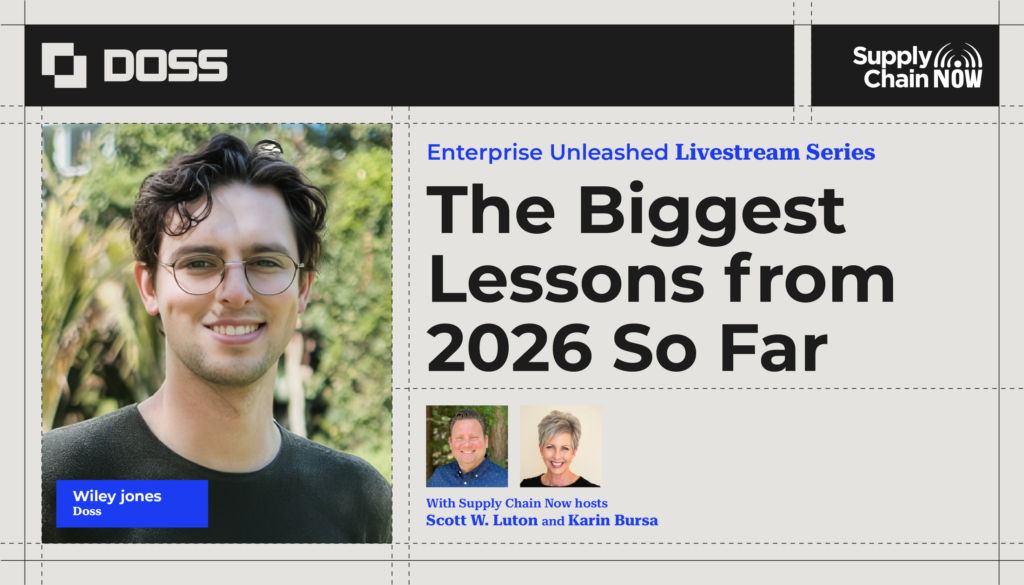
[00:00:35] Scott W. Luton: good morning, good afternoon, good evening, wherever you may be. Scott Luton, Karin Bursa, and the one and only Wiley Jones with you here on Supply Chain Now. Hey, Wiley, welcome back. How you doing?
[00:00:46] Wiley Jones: Hello team. Doing fantastic.
[00:00:50] Scott W. Luton: And I like that haircut, by the way
[00:00:52] Wiley Jones: Very aerodynamic for the fall. Geared up
[00:00:56] Scott W. Luton: Well, I appreciate you fighting, uh, traffic there out on the West Coast to join us once again here today. And I’ll tell you, two of my favorite people, Karin Bursa is back with us. Karin, how you doing?
[00:01:07] Karin Bursa: I’m doing great. Glad to be with you guys today
[00:01:10] Scott W. Luton: Well, terrific.
[00:01:10] Scott W. Luton: And I couldn’t think, uh, I think y’all are gonna be a wonderful one-two punch here as we continue an incredible series that has produced all sorts of, uh, intriguing and thought-provoking moments. We’re talking about our Enterprise Unleashed series here, which has been very popular in 2026, all powered by Wiley and our friends at Doss.
[00:01:30] Scott W. Luton: So folks, through this series, we’ve really dialed it in on real, I’m talking about keeping it real leadership conversations with individuals that have developed a proven track record for unleashing, truly unleashing the power of the enterprise, especially in new innovative ways. Now, today we’re kind of calling time out for a second.
[00:01:49] Scott W. Luton: We got some more good stuff coming, but here after, I don’t know, four or five incredible shows, we’re gonna reflect on a few things. We’re gonna talk about some of the biggest developments in the market since we launched the series. We’re gonna talk about some of the biggest takeaways from the consequential conversations that we’ve been having on this series.
[00:02:07] Scott W. Luton: And we’re gonna take a look at what the most successful companies out there are doing, especially, uh, things in common when it comes to unleashing the power of the enterprise, all that and much, much more. Wiley. See, Karin, you see Wiley’s getting ready. He’s getting jacketed,
[00:02:23] Karin Bursa: see that, yeah. He’s warming up. He’s ready
[00:02:26] Karin Bursa: to go
[00:02:27] Scott W. Luton: So Wiley, you ready for today’s show?
[00:02:28] Wiley Jones: Oh, rock and roll
[00:02:30] Scott W. Luton: And Karin, I know you’re ready. You’re always ready. You ready to go?
[00:02:34] Karin Bursa: Oh, yeah, absolutely. It’s a great time to be in supply chain. Let’s, let’s talk about everything that’s
[00:02:39] Karin Bursa: coming
[00:02:39] Scott W. Luton: sounds terrific. An eight-hour live stream, folks, coming to y’all here today. Only kidding.
[00:02:44] Scott W. Luton: hey, a couple quick level-setting observations here for, especially for our new, newer audience members, because as I mentioned, we got a one-two punch. You know, on Wiley’s end, he grew up in a manufacturing family where he saw firsthand some of the technology limitations of the, uh, tech at the time, right?
[00:03:01] Scott W. Luton: And that has added to his why and his passion for helping companies change the game, especially from an ERP standpoint, all since, uh, 2022. So I’ve really, uh, enjoyed getting to, uh, see that firsthand, especially this year. And Karin, Karin, you and I go back quite some time. I’m gonna keep it at you’ve spent several decades in the C-suite, especially in the supply chain tech industry, focused on helping leaders innovate, deploy, and overcome.
[00:03:29] Scott W. Luton: And again, it’s been really fun to collaborate on endless shows, uh, over that time. So, so I wanna level set on the, the expertise we have between Wiley and Karin. so let’s do this.
[00:03:39] Scott W. Luton: Fun warm-up question, Wiley and Karin, all right? I’ve got a little, uh, w- we had a wonderful bro trip, me and my son, Ben, um, out in Arizona a couple weeks ago, but let me get to why that’s important.
[00:03:52] Scott W. Luton: It, folks, it’s a variety of days here today. It’s National Fufu Day, which is where we celebrate the delicious food from West and Central Africa. So if you hadn’t had it yet, go to your local restaurant, order it up. It’s Presidential Joke Day. I’m gonna leave that one alone. It’s, it’s, uh, it’s Hip Hop Day, uh, which is, it’s interesting.
[00:04:11] Scott W. Luton: G- it, this day goes back to a back to school party held in 1973 in the South Bronx, which is credited for giving birth to this hip hop music genre. How about that? And then, uh, tell you, full of useless knowledge, I guess, it’s Mountain Day in Japan, and that, that’s a big deal because that’s a national public holiday.
[00:04:32] Scott W. Luton: So that’s where I’m gonna tie in my bro trip with my son, Ben, where we went out, get this, we went out to the beautiful Grand Canyon and Monument Valley. We did a bunch of driving. This is my son, Ben. That is a ledge going off the side of the South Rim. I was, uh, I was not brave enough to take a picture there, but my son, Ben, no problem.
[00:04:53] Scott W. Luton: No problem. And the scenery, it looks like AI had a hand in it. The scenery, it was just so perfect. So I wanna use that, Wiley and Karin.
[00:05:02] Scott W. Luton: Use Mountain Day, beautiful Mountain Day in Japan, all our friends out there, and ask each of y’all, starting with you, Wiley, what’s one of your favorite, uh, captivating outdoors moments?
[00:05:13] Wiley Jones: I have a, a similar experience to what you described with the Grand Canyon, but, um, a little bit, uh, north of there at, uh, Zion National Park, which I believe is, uh, just, you know, a couple hours north. And, um, I think, uh, s- someone said it’s like, you know, 250 million years old or something ridiculous like that.
[00:05:34] Wiley Jones: you know, when you look at the, the– that area and you– the expanse of, you know, there’s a famous hike there called Angels Landing, which is quite precarious to get through and it’s, it’s– the payoff is really powerful. Um, at the end, you take this, you know, breathtaking view and, um, it’s– I think it’s a nice reminder that good things take time
[00:05:52] Scott W. Luton: well said. Well said, Wiley. You’re always wise beyond your years, my friend, and I like those anecdotes. Um, and Karin, good things do take time, for sure, even in this age of instant gratification. But your f- one of your favorite outdoors moments, Karin
[00:06:07] Karin Bursa: Well, I grew up at sea level, right? So I, I grew up at the beach in South Florida. Um, in my 20s though, I lived in Denver, and seeing the beautiful Rocky Mountains after not having that be part of, you know, my day-to-day life, uh, before then, um, was just spectacular. So doing all the things, hiking, biking, skiing in the Rocky Mountains was just a wonderful experience
[00:06:32] Scott W. Luton: You, you paint a, uh, quite the mental image. Really both of y’all do.
[00:06:36] Scott W. Luton: All right, so Wiley and Karin, we’ve knocked out the fun warm-up question. We got a lot to get to here today. Um, and Wiley, I’m gonna pose a lot of these questions to you, and of course, I look forward to getting Karin’s, uh, uh, commentary throughout as well.
[00:06:49] Scott W. Luton: But, you know, when you compare today’s enterprise landscape,
[00:06:53] Scott W. Luton: What do you think, uh, has changed the most, number one? And number two, little two-part question, is the market moving faster or slower than you expected, Wiley?
[00:07:03] Scott W. Luton: Your thoughts
[00:07:04] Wiley Jones: I think there’s a quote of, uh, “The future is here, it’s just not evenly distributed.”
[00:07:08] Wiley Jones: I’ve been feeling a little bit of that over the last nine months, and seeing the diffusion of it into different parts of different types of companies has been quite interesting. I think I recently saw something over this last week about, um, you know, stuff related to automated freight booking, items related to companies that were actually going and having…
[00:07:29] Wiley Jones: Uh, I just saw something on my phone literally when I was driving in, um, while I was sitting in lovely traffic, that there was a whole group of people that’s running a very large used car selling operation, um, in Latin America that’s entirely being run by not humans. and I think the observation is that, um, a lot of people are moving from this regime of piloting and experimenting with some of the new tools and technologies that have been introduced in the last few years into now I rely on it to run functional and foundational aspects of my business.
[00:08:01] Wiley Jones: And that is also making its way into larger organizations around the world and not just the small and medium businesses that have the ability to be agile and scrappy. But large scale production enterprise grade implementations of especially AI technology is becoming a thing that runs and drives a large part of a P&L for a big company now, like we’ve seen this in multiple occasions.
[00:08:25] Wiley Jones: And, as the ROI on those becomes more clear, I think that, or, uh, executives around the world are gonna see the delta in what they’re able to deliver with and without it, and they’re gonna– we’re gonna see even more adoption in 2027. Uh, and I think it’s gonna only accelerate.
[00:08:41] Scott W. Luton: Mm. Okay. All right. Let me circle back. That there’s so much fodder there for us to talk about, Karin. But one more thing. In terms of the market, the speed of business, that velocity, is it moving faster or slower than you expected at this point in the year?
[00:08:58] Scott W. Luton: it’s moving too fast to keep up in some parts, and then in other areas, I think I’ve noticed where especially less so for our supply chain friends, more so I think in other industries where they’ve been a little bit more resistant because of the fear of making mistakes.
[00:09:13] Wiley Jones: Um, where I think a lot of supply chain organizations recognize that the inability to move quickly is the most important mistake you can make. And so I think they, uh, I think a lot of supply chain organizations have, uh, opted more for move fast, fail fast, as opposed to, um, let’s take a three-year, you know, waterfall life cycle to try to implement and, uh, transform our businesses.
[00:09:35] Wiley Jones: So it feels like the supply chain world is moving much faster actually than a lot of their peers in this, in this cohort of, you know, kind of this technical revolution we’re seeing.
[00:09:42] Scott W. Luton: I feel that in my bones.
[00:09:44] Scott W. Luton: But React, Karin, when we talked about the biggest, uh, changes in the, in the landscape since the first year, and then of course, touch, touching on the velocity. What’d you hear there from Wiley, and what are you seeing, Karin?
[00:09:54] Karin Bursa: Yeah, I, I totally agree actually with exactly the way Wiley characterized it, that, um, that we are seeing movement very quickly, but also probably a mentality shift or a mind shift that it’s gonna be move fast and it may be fail fast, but we’re gonna learn from it. Um, but at this point, I think that we are seeing a shift that’s going from just AI curiosity to now AI of consequence.
[00:10:25] Karin Bursa: So where can we drive value? Where can we see that tangible impact? And how do we move out of this experimentation mode or this caution mode to where we can actually change the way work gets done
[00:10:39] Wiley Jones: Yep
[00:10:40] Scott W. Luton: Well said, Karin. You know, and I want to add to what some of both your comments. Uh, you know, I saw, I read somewhere in a, a credible, prestigious consulting and, uh, think tank organization, they were pointing out a use case where a healthcare executive made a $100 million investment in AI and did not have the results to point to whether it was successful or not.
[00:11:06] Scott W. Luton: Now, that could be a show in and of itself, but it reminded me kind of like, um, a four-by-four, right? Do you need for a four-by-four transmission? Do you really need it, or are you just gonna sink money in to get it and then never use it, right? Just soak up m-more gas. We’ve got to be smarter, and I think what you are, are pointing to market, the evolution of the market, where business leaders kn- fewer of them are seeing, “Oh, AI is the big shiny object.
[00:11:33] Scott W. Luton: We’re gonna go out there and invest in it and bring it in,” and not, build the most specific and targeted business case for where we’re gonna apply it and where we’re gonna get results. And I think that’s a critical part of why we are where we are. Does that make sense, Wiley and Cor- Wiley, does that make sense to you?
[00:11:51] Wiley Jones: Yeah.
[00:11:52] Wiley Jones: I, I’m, I’m nodding because, um, it’s interesting. I, I get to, I get to play on both sides of this, where in some senses I’m selling a lot. Uh, and we spend a lot of time selling what we build. Um, and at the same time being, uh, in the trenches and in the weeds with our customers, helping them actually deliver the thing that we’re selling them and f- seeing how the practicum of what you actually have to do in order to make the ROI real.
[00:12:17] Wiley Jones: even in our own business, you see the gap between what you sell and what you actually end up delivering. I think that’s quite natural. The thing that’s most interesting is that very regularly the things that organizations come to you and they ask you to help them solve are not the problems they actually have, and they are describing these higher order symptoms and really root, you know, down deep in the bones of the business you recognize, oh, y- you’re wanting to solve an AI problem, uh, related to demand planning and supply chain plan– uh, sup- you know, supply planning.
[00:12:47] Wiley Jones: And actually you just have very, very messy master data and your item master needs to be completely rebuilt. Now we can st- still use AI to deliver a ton of value for reconciliation and cleaning your master data, but actually your demand planning problem is not a demand planning problem. the vehicle for delivery, they– a lot of times they’ll say is AI and, you know, transformation in that sense.
[00:13:06] Wiley Jones: But, the stated problems versus the revealed problems, it’s like going to the doctor and saying, “Hey, I have a headache. You know, give me aspirin.” And they go, “Oh, no, no, no. Well, you actually, yeah, you, you have a, you have a concussion. You got hit over the head with something. You didn’t realize it.” I think observing that with these companies has been so interesting and, um, they– a lot of times they come in the front door looking for AI and they– we, we go out the back looking for, uh, actually delivering something that looks very standard enterprise applications.
[00:13:34] Scott W. Luton: Alright, Karin, really quick. Respond. Wiley gave us a bounty right there. Respond to what we, what you heard Wiley say, Karin
[00:13:42] Karin Bursa: if I recapped what Wiley said, I would say, you know, a lot of times we’re trying to solve symptoms instead of root causes. And, a- and really we have the opportunity now, because of technology and the evolution of technology, to step back and reevaluate our workflows, reevaluate our business process.
[00:14:00] Karin Bursa: Not just automate the old, if you will, the way we’ve done it for 20, 30, 40 years, but to take a fresh look at the work to be done, the outcome we desire, and, um, and rework what those workflows look like. Do things like addressing master data, um, as Wiley, um, mentioned, because so much of that… I love the, the theme of this, this show or this series is unleashing.
[00:14:25] Karin Bursa: And really what we are is unleashing new insights based off of that data about our business, our products, our customers, our go-to-market strategy, and how can we do that better with technology so that our people are making a bigger impact every day. Are we getting faster answers? Are they more confident about the decisions that they’re making?
[00:14:45] Karin Bursa: Can we automate some of these tasks? Those are all questions that we should be asking ourself, but not just simply how do we do the same old thing
[00:14:52] Karin Bursa: faster? Um, it’s how do we get to the outcome that’s desired in a more efficient and
[00:14:59] Karin Bursa: effective
[00:15:00] Scott W. Luton: Yes. And solve the actual problem instead of using a bigger Band-Aid. Well said, Karin. And yeah, I love that verb, unleash. Uh, and by the way, Wiley is the first person to use the word practicum on any Supply Chain Now program. Uh, I’m gonna look that up what that means afterwards. And he had a great quote there.
[00:15:16] Scott W. Luton: William Gibson is who, who is accredited with the quote, “The future is already here. It’s just not evenly distributed.” That was a good one too.
[00:15:24] Scott W. Luton: Um, all right, so Wiley, getting back to reflecting on what we’ve seen and been a part of, um, what’s, what do you v-view as one of the biggest developments in industry since January, especially when it comes to how global supply chain is leveraging AI?
[00:15:40] Wiley Jones: Oh boy, where to even begin? Um, you’re hitting me with the hard ones today. Um, I think the thing that is interesting, it- it’s back to this point of this diffusion where I think that you kind of want to look at who are the early leaders and market leaders in the technology industry that are utilizing these tools that then can diffuse into the fast followers who benefit from that agility.
[00:16:08] Wiley Jones: So I would say that when I’m looking at, you know, even for our own company, who are the companies that we want to model a lot of what we build after, and how do they operate and how are they leveraging these tools? And we go look at, you know, if you’re using, uh, Claude or using, um, OpenAI ChatGPT, inside of those organizations at those companies, they’re using these tools in the most sophisticated manners.
[00:16:31] Wiley Jones: They are pushing them very, very far into the frontier. I spoke with someone who actually works at OpenAI, and they were describing how they have an inbound sales, um, qualification process that normally is managed by a sales team, and their sales team actually, uh, doesn’t touch a lot of the deals.
[00:16:48] Wiley Jones: It is completely touchless. And I was like, “That sounds pretty similar to how a lot of supply chain organizations would love to have inbound order ma- order management and have touchless order management.” And that’s actually a really great benchmark and KPI for supply chain organizations is, uh, you know, how does your order intake work and how much of it can be touchless at certain, you know, order values.
[00:17:07] Wiley Jones: Um, and the ability for us to take the things that these, I would genuinely say, these cutting-edge state-of-the-art organizations are operating for themselves using their own tools and technology, and diffuse that into other parts of different types of functions and verticals. We take a lot of that, that we experiment on with our own organization and figure out how do we bring this into our product and s- how, how do we deliver the same kinds of solutions for businesses that are looking at touchless procurement, managing reconciliation across their, you know, uh, inventory ledger and their financial ledger in a way that is, again, reducing the number of human touches.
[00:17:43] Scott W. Luton: Very simple examples of this. These are, uh, as I think Karin was describing, is we’re moving out of a regime of can we do this curiosity into this actually works, let’s scale it up and put it into a production environment across the whole company so that we can really see material ROI on it. All right. Karin, uh, what would you, uh, deem as being a big development this year, or comment on what we heard there from Wiley?
[00:18:08] Karin Bursa: Well, I mean, there, there’s no question AI is the theme of, of the year of 2026. Um, but, but I do think it is, the ability for AI to eliminate some of the noise so that the business gets more focused on the true signals or the true operating needs, um, versus, uh, you know, getting us distracted and chasing more shiny objects.
[00:18:33] Karin Bursa: Uh, I think that that is, is one area where there is significant value to the business as we look at automation. I lo- I love how Wiley said, you know, a touchless procurement process. I think we’ve got some touchless planning capabilities in other areas of demand and inventory and supply and even in production scheduling.
[00:18:53] Karin Bursa: and those are opportunities for automation. And then there’s other opportunities to augment what our talent is doing. And then back to this unleashing, the opportunity to really unleash some, you know, some time on their calendar to think creatively about problem-solving or product innovation. Um, and I honestly don’t think we’re quite there yet.
[00:19:15] Karin Bursa: I don’t think that we’re reaping those benefits yet, but for the first time, I can see a path where we are able to free up 20% or 30% of, um, you know, of a, a, a highly paid professional in the area of supply chain or planning, um, to be able to think more creatively about how we solve customer needs or how we develop product or drive innovation through our
[00:19:42] Karin Bursa: networks
[00:19:42] Scott W. Luton: Okay. That is, that is some, uh, practical optimism there, Karin. I love it. Um, all right. So, and I would just add a couple m- couple observations. You know, last year with the tariff coming on, coming off, I, I think the mar– after, after all the initial shocks, I think supply chain practitioners found a way to find stability in an instable, um, landscape, given all of that, right?
[00:20:07] Scott W. Luton: And then this year, of course, unfortunately with, with everything going on in the Persian Gulf, um, I think they have si- I see a similar thing, much different, but a similar way of, of being able to find a path forward in, um, an ever more challenging set of circumstances. So we’ll see. But I, I l- I love how, what both of y’all are pointing out and of course, how technology in a much more targeted, innovative way continues to make, give more, one of y’all said it, give our team members, the beautiful human element, a more successful day, day in, day out.
[00:20:39] Scott W. Luton: Um, okay, so that’s just the opening salvo, folks. Now we’re getting into some of our favorite moments from a series of incredible conversations here. Now, we try to do the impossible, Wiley and Karin, right? Uh, a month or two ago, we tried to take all those five conversations we’ve had so far on Enterprise Unleashed and write a blog article on some of the key takeaways, including this great quote from Wiley, uh, quote, “When we talk about technology innovation, we end up talking a lot about how we can work together better as people,” end quote.
[00:21:10] Scott W. Luton: I love that. We’re gonna try to do the impossible again today, Wiley, because we’re gonna try to get three of your favorite takeaways from five really big conversations. Yes, it’s an unfair premise, but we’re gonna do it anyway. So we’re gonna get your takeaway by takeaway, then I’m gonna get Karin’s comments on each of these reflections.
[00:21:30] Scott W. Luton: So up first, Wiley, when you think about the conversations, and by the way, I’ve got some, some snackables from each of our guests, so I’m gonna sprinkle that in, uh, as time permits. But Wiley, what is your first favorite takeaway from Enterprise Unleashed thus far?
[00:21:44] Wiley Jones: I kind of draw the line through every conversation, it’s back to that, the quote that was up there, um, around culture and people and that the, the humans are being put increasingly at the center, of these organizations. Which is– It’s funny that in the world of, you know, agentic software and agentic applications and AI, that it’s actually making the humans even more, more important, which is, uh, there’s some irony in that it feels like.
[00:22:12] Wiley Jones: But what is, I think, really empowering that I have been able to observe is that, the questions that we have to ask of ourselves of who are we as a company? Who are we as a business? Why do– Why are we here? What are we doing? what do we believe? What are our values? Therefore, how do we operate?
[00:22:29] Wiley Jones: Therefore, how do we go out in the market and win and accomplish our goals? Um, those questions become even more important to have clear and salient answers on, and they will define the way that these organizations leverage technology. And without having clear answers to those things, organizations will struggle to succeed.
[00:22:46] Wiley Jones: And I, and I think that that’s, um, there’s something that’s really powerful and beautiful about that, I think
[00:22:51] Scott W. Luton: I completely echo that, Wiley, and culture was a big part, big common theme throughout these conversations. Karin, weigh in. What’d you hear there, and, and what’s your take?
[00:23:00] Karin Bursa: I really like that. And, and I know I mentioned it already, but I like this unleashed, right? We’re unleashing productivity, we’re unleashing creativity in the business, um, as every business tries to differentiate itself. Um, I, I think that, you know, most businesses are limited by friction or manual handoffs or brittle systems that they’ve been using for decades, and it makes the work harder than it needs to be.
[00:23:25] Karin Bursa: You know, we’re, we’re tying people down with spreadsheets or manual processes, and if we can eliminate that aspect of it, then, you know, that information or that data becomes information and insights faster so that they can do the job at hand, do what only they can do. Um, a- and I think that that’s, that’s an exciting place to be.
[00:23:47] Karin Bursa: A- and we’re… The industry is moving in that direction quickly, but we need to be willing to reevaluate how work is done and to eliminate some of the brittle systems that are slowing us down. And, you know, one place we can all look is where we’re plugging our business practices and processes with spreadsheets.
[00:24:09] Karin Bursa: Those are manual handoffs. and those are, are clear indicators of opportunities that, um, exist in every business
[00:24:17] Wiley Jones: Yeah
[00:24:17] Scott W. Luton: Agreed. And it’s, it’s interesting. Uh, we very purposefully l- uh, named this series with the unleashing verb. However, kind of in your response there, Wiley and Karin were doing our best to leash friction and headaches and arrest spreadsheets and, and some of our manual work, right? That’s a good thing to do as we unleash the, the human spirit and innovative spirit.
[00:24:43] Scott W. Luton: Um, all right, really quick. Speaking of people, one of our favorite sessions, all of them are, were, were our favorite sessions, but, uh, Jindra, uh, Zitek said, quote, “I’m a big believer in people. I think systems come next. You need the systems and tools because otherwise you can’t scale.” Uh, so people, systems, and tools.
[00:25:02] Scott W. Luton: And Jindra, Wiley, kind of to your point, he harped on culture and people and people and culture, and that was a great, great, uh, great episode.
[00:25:11] Scott W. Luton: Um, all right, so Wiley, key takeaway number two, what would that be?
[00:25:16] Wiley Jones: this is a conversation with, uh, Garuth that I think back to when one of the initial conversations around what is our obligation as leaders, um, in these organizations, and how do we define culture, um, and lead through action to then create culture and make it so that as, as Karin was saying, is that, um, we can create the operating principles and the framework for the business that allows us to take survival needs and move above that in every regime possible.
[00:25:45] Wiley Jones: And that begins with what decisions do we make? What do we choose to work on? What do we not choose to work on? What systems and tools and business processes do we want to say are sufficiently automated or sufficiently low friction, or the ones that we wanna go in and stamp out and actually make better so that people can move from being on their back foot and reacting into proactivity?
[00:26:08] Wiley Jones: if people are, you know– I think the way I describe this in our own company is if people are holding the hot pan, like they’re not gonna be able to sit there and actually go in and do the work to make that so that they can have systems that allow them to move from this regime of survival. And I think that the conversation with Garuth really focused on the obligation to drive change this way actually comes from leaders, and you can’t expect anyone else in the organization to be, to be that catalyst.
[00:26:32] Scott W. Luton: All right. Wiley, good stuff. And we got a little treat from Garuth here in a second. But Karin, r- react to that, especially as I’m sitting here with a hot pan.
[00:26:40] Karin Bursa: totally agree. I mean, leadership is responsible for developing a culture and, and deciding what that culture is gonna be. And then we have to equip our team members to live and contribute, if you will, in that culture. Um, and, and you know, one way we do that is with the technology that we provide for them to use.
[00:27:00] Karin Bursa: But that, that culture, you can’t abdicate that. You’ve got to be intentional about it and create an environment where that can thrive and grow and, um, you know, become something truly unique and exciting where people enjoy coming to work every day. Even when the work is ha- is hard sometimes, they know that they’re making an impact.
[00:27:20] Karin Bursa: Um, and that’s what, um, you know, gets them to lean in and contribute, uh, to the evolution of the
[00:27:27] Karin Bursa: business
[00:27:27] Scott W. Luton: And that is an owner’s own leadership. That is leadership responsibility and the, the, you know, leadership responsibilities in general, also a big theme throughout all these conversations, ’cause as what I like to say, just my opinion, all too often we have more leadership problems than we have technology problems, and we’ve got to recognize those.
[00:27:46] Scott W. Luton: Um, all right. So Wiley, you referenced Garuth, and he, I think, was our first guest on “Enterprise Unleashed.” Now Garuth, just so y’all know, with 8090 Industries, but also former SpaceX, former Blue Origin, very smart guy, a lot like Wiley and Karin. So I love this quote here from Garuth. Uh, quote, “AI isn’t here to replace people manufacturing.
[00:28:07] Scott W. Luton: It’s here to make them radically more productive. There’s never been a shortage of work, only a shortage of time,” end quote. All right. So we’ve gotten your first two takeaways, Wiley. I want to get to your third takeaway. And again, this is, all these are unfair questions ’cause we’d be here for several hours to really maybe get them all out.
[00:28:26] Scott W. Luton: But what comes to mind, Wiley?
[00:28:28] Wiley Jones: I think the, the last one is a takeaway, um, not through a specific conversation, but similar to what you described around how do we, how do we drive success in these programs and these transformations? And you mentioned the example of the healthcare executive that spent a pretty large number of dollars on something that they couldn’t measure the results on.
[00:28:48] Wiley Jones: I think that staying back, you know, kind of back to, uh, what we were describing a moment ago around the obligation of leadership, it’s about, um, creating clarity for their organizations, what great and what success looks like, so that the people inside of the business that are creating and driving these programs, they actually feel like they have a target to track to.
[00:29:07] Wiley Jones: And culture, as kind of the foundation of why we’re doing what we’re doing and how we’re doing it. the clarity that then follows that’s required from leadership is what are we exactly going to do, and what are the definitions of what will make that great? And that’s again back to this obligation of leadership.
[00:29:25] Wiley Jones: But as a conversation throughout this, which is if you’re just throwing AI at the wall and seeing what sticks, you, you, you are going to spend a lot of, you know, what is it? Uh, you, you might be wasting a bit of shareholder money.
[00:29:35] Scott W. Luton: Right. But we’ll s- sign us up. If that’s how you want to spend the money, we’ll find a way to, to help you out. Um, all right, Karin, one of the notions that Wiley just, just brought up that’s one of my favorites is clarity, right? And communicating clarity to workforces and organizations on so many different levels is so critical, especially as we move faster and faster in today’s, um, high-velocity environment.
[00:30:02] Scott W. Luton: But your thoughts, Karin?
[00:30:04] Karin Bursa: Yeah, I, I think that that’s really important. If we all know where we’re going, then we’re gonna look for the best course of action to get us there. And, um, this theme of velocity as well, so decision velocity. I don’t care what role you are in, in a company, the ability to confidently make a decision, um, is important at all levels, whether you are the CEO of the company or it’s your third day out of college on a new job.
[00:30:30] Karin Bursa: Um, just knowing with clarity where we’re going or what the outcome is we’re driving towards, but also confidence in the information that we’re looking at or the insights, uh, that we’re working with, that, that changes how quickly a business can move. And what that equates to eventually is how much inventory we have to store in our network, right?
[00:30:53] Karin Bursa: If I can make decisions faster, if my manufacturing operation can be more responsive and agile, then I don’t need to buffer with as much inventory. Um, and so that allows the business to get leaner, and w- leaner with intention and confidence so that we can still serve customers at that, you know, 99% service, uh, level that we all wanna be at, and do it in a very profitable way
[00:31:20] Wiley Jones: Yeah
[00:31:21] Scott W. Luton: Well said, Karin. Um, all right, so speaking of, I’m, I’m gonna… That’s a great s- you gave me a great segue, Karin, and I’m gonna use it. Uh, you were talking about, uh, decision-making, decision velocity, and Rick MacDonald, former chief supply chain officer with, uh, the Clorox company, one of our longtime friends, uh, just hosted a, a webinar with him a week or two ago.
[00:31:39] Scott W. Luton: Rick said, quote, “Posi- uh, position AI as decision support, not decision replacement. That distinction matters more than most leaders realize,” end quote. Good stuff from Rick. Um, okay. Wiley, one more thing. Uh, we’ve already touched on this next question I’m gonna ask you, ’cause I wanna ask from both of your purviews, if I use that highfalutin word right, um, what the best companies out there are doing kinda in common to unleash the power of the enterprise.
[00:32:07] Scott W. Luton: So I’m gonna ask you that next. But I would be remiss, and really I’ve got about 17 things on my favorite takeaways from all these episodes, but one of my favorite moments, Wiley, and I should’ve gone back and found the gentleman that posed the question, ’cause we had a very earnest back and forth, um, in the waning moments of one of the shows.
[00:32:25] Scott W. Luton: And basically the gentleman was asking, I wanna say his name was Jeff, but is, he was asking, “Hey, if my management team just doesn’t understand the power of AI, what do I do?” and Wiley, so I pose that question to you, and, and you said after you do all, ev- all the, you know, traditional stuff, building a compelling business case, you know, clearly communicate, all this stuff, right?
[00:32:47] Scott W. Luton: Uh, I think one of your last points was lu- if, if, if after all of that they don’t get it, and you wanna be part of the modern digital transformation of our industry, you might wanna go find an organization that does get it. And Wiley, I don’t wanna put words in your mouth, but that’s as I re-recollected it.
[00:33:02] Scott W. Luton: Is, is that accurate? Is that, would that be your advice today?
[00:33:05] Wiley Jones: I think the, the broader advice is to make sure… A- and I think it’s what, uh, Karin was saying around, um, empowering people to make an impact. but it’s also recognizing for yourself, your own organization, like what is the story that, that you believe will be true about the future? Like where, where do you think the world is going?
[00:33:24] Wiley Jones: And to then vote with your feet and go, go where you think you’re going to be able to open up the throttle and make that impact. And w- with our, with our organizations, uh, and our customers, I think we see something a little similar, which is there are some companies that are not good for us to work with because the things that they want are not things that we think are that useful to go solve and to go work on.
[00:33:50] Wiley Jones: And, you know, and I think the way to describe this back to kind of what you’re saying is, what do we believe to be true about the future, and let’s accelerate the world towards that. the more pithy way of saying it is, you know, be the change you want to see in the world, right? Um, and so, uh, be the acceleration and the impact and the unleashing that you want to see, um, and go, go vote with your feet or, or i- if, if, uh, you know, voting with your words, uh, isn’t enough
[00:34:14] Scott W. Luton: I like it, Wiley. Sounds, sounds very poetic. Um, all right.
[00:34:18] Scott W. Luton: So Karin, I’m gonna reverse the order here, right? Um, we’ve gotten a bunch of Wiley’s favorite takeaways at a high level, and then some very, very, uh, in a detailed manner from five shows that, uh, took a lot of brainpower. These are very smart people, like the two of y’all.
[00:34:36] Scott W. Luton: Um, but when you think of, you know, Karin, you’re, you’re out there, you got your finger on the pulse of companies doing incredible things, both of y’all do. When you think of what the best companies are doing to find, success in this highly VUCA environment, using my favorite acronym, right? And it’s, and there’s, it’s not gonna…
[00:34:53] Scott W. Luton: It might get worse before it gets better in terms of stability and all these other things that we wish we had more of. Um, what do you see the best companies doing that they might have in common when it comes to especially unleashing the power of the enterprise? Karin?
[00:35:07] Karin Bursa: Yeah. And, uh, make one comment on, on what Wiley was saying and, culture goes both ways. So decide if you’re a good match for the culture of the business that you’re in, or, you know, if you want to grow in the direction that that culture is going, um, that’s, that’s fantastic. If it’s not, then decide if it’s the right place for you as a contributor or what truly motivates you.
[00:35:30] Karin Bursa: when I think of the companies that are truly… When I think of them as innovators or the best companies that are embracing new technology right now, they have a willingness to redesign the enterprise workflow. Like, they, they are stepping back to look at the, you know, the most important decisions to be made.
[00:35:52] Karin Bursa: and oftentimes those are the ones closest to a customer and how we serve the market, or they’re close to our product and how we accelerate bringing maybe new product introductions to market or innovation in the marketplace. You decide what those are, but then look at the work to be done in order to achieve that, and don’t be afraid to redesign the work.
[00:36:14] Karin Bursa: Because new and innovative systems, those that, that are not just added, um, you know, or augmenting what they do with AI, but those that are truly architected with an AI backbone as a part of those solutions are gonna help you to, to automate faster and to be more flexible and more resilient in the future.
[00:36:36] Karin Bursa: that’s what I see making a big difference. And it can be in some areas that are really sexy, like product design, but it can also be in areas that you might not consider so sexy, like, um, master data management, the data flow through the business. High-value leverage points for your business because that may serve up, you know, dozens and dozens of different decisions that get made each and every day.
[00:37:00] Karin Bursa: and there’s tremendous value there and kind of fixing that root cause problem is going to unleash, back to unleashing, it’s going to unleash productivity in a lot of different areas for the business
[00:37:11] Scott W. Luton: I wish we could, we had time to dissect your response there, ’cause there’s so many, uh, follow-up thoughts I got. But on the front end, uh, one of the things I heard you say in different words is, you know, as much as we gotta learn how, how to redesign enterprise workflow and those kinds of things, we also gotta unlearn and how to let go of a lot of different things and assumptions we’ve long held that has served the business well.
[00:37:34] Scott W. Luton: And that’s tough to do for humans, I think, for me, at least maybe. Um, all right, so same question, Wiley. When you think of the best of the best companies out there, very successful organizations, what do they have in common in terms of their ability or their approach to unleashing the power of the enterprise?
[00:37:48] Wiley Jones: The correct answer is exactly what Karin said, and so I’m just gonna double down on it, and then I’m going to… I’ll, I’ll maybe provide some specific color on what I think can be tactically useful for the folks listening, because that is, like, what– precisely what she said is, is the correct answer.
[00:38:04] Wiley Jones: And it is a willingness and a curiosity to challenge the base assumptions that we don’t even realize are– that, that we hold, uh, about way, the ways that the business should work or the ways that we do what we’ve always done. And, you know, we talk to so many organizations and we say with, again, healthy curiosity, um, genuine, real curiosity, “Why do you do it like that?”
[00:38:29] Wiley Jones: And they’re like… They kind of look and they’re like, “I don’t know.” And we’re like, “Okay, does, does anyone know?” And they’re like, “No, we, we don’t.” “Oh, well, okay.” And then you kind of peel back the layers slowly over time. Um, and if you remember the, was it the scene from Office Space, the movie, where they’re kind of sitting down and they say, “What do you do here?”
[00:38:45] Wiley Jones: Right? it’s a little bit like that, and you, you kind of peel back the layers and eventually part– you realize there are parts of this that the business has decided to make constraints that in the process because those constraints allowed them to guarantee coherent output at the end of the process.
[00:39:00] Wiley Jones: Back to a business I used to work in where there was a very, very sophisticated, uh, claims management process for, uh, healthcare billing and, um, extremely sophisticated process, but a lot of it was predicated on this old school way of doing stuff that had to do with, um, FTPs, um, if you know what a, you know, a file transfer protocol is, as well as, um, these call bots that you would call in and you’d have to punch in the numbers, and you’d get details about the claim payout for Medicare.
[00:39:26] Wiley Jones: And, we can completely blow up those assumptions now. The world functions in a completely different manner. Um, the world doesn’t run on FTPs anymore, and it turns out that we have these AI agents that actually can talk on the phone to each other, and they– you don’t have to have a human calling a, voice bot.
[00:39:42] Wiley Jones: And so I think the, the willingness and desire for a leadership organization to take the time to understand themselves, be historians and archeologists of how they got to where they are, and then the anthropologists to understand how the humans fit into this future going forward, and then designing a process that challenges those base assumptions with a degree of healthy skepticism of what the tools can do today, but also earnest, you know, earnest optimism that we believe that we can push them to the limits that we haven’t seen before.
[00:40:12] Wiley Jones: I think the combination of all that is, is a recipe for success today.
[00:40:15] Scott W. Luton: I like it. And skepticism, folks, skeptics, that’s not a bad thing. It’s good to have healthy skepticism as we’re, you know, digesting change and getting to the root cause, as we were talking about earlier, and finding out why we do certain things. Sometimes, Wiley and Ka- Karin, in my journey, it’s been because Fred or Janet or Wilma likes it that way, right?
[00:40:39] Scott W. Luton: it reminds me of, uh, my buddy Shannon Vallencourt, uh, Vallencourt’s comment over at lunch a couple weeks ago, uh, ’cause he sees this in organizations. “Oh, it’s great, you got people in there.” But on the other side, it’s like, “Oh, great, you got people in there,” as we look to automate. So anyway, uh, so let’s do this.
[00:40:56] Scott W. Luton: Karin and Wiley, what a great… I tell you, I, I really wish when we’re digesting these series, check out all of these conversations we’re having very easily. We’ll put that in the comments. But I wanna shift the gears to Wiley and Doss really quick, and I think I’ve got an image here, Karin.
[00:41:11] Scott W. Luton: I’m jealous, Karin, ’cause you and I, we did not get our invite to beautiful San Diego. Look at the Doss team having off-site meetings. And Wiley, I heard y’all had, amongst other constructive programming, there was lots of laughs, so I can’t wait to get some, to some of the stories we can’t get to here today.
[00:41:29] Scott W. Luton: But Wiley, when you see all those bright folks that are dedicated to driving change across industry, I want to ask you, as a co-founder and as CEO, what’s one of your favorite accomplishments or innovations that you’re proudest of in recent memory, I guess I’ll call it?
[00:41:47] Wiley Jones: it’s hard to call it a specific because What is it? The, you know, all, all, all of my children are my favorite or whatever, right? Um, uh, I think that it’s really easy to find the impact in all the cases where… An example recently, I saw something actually this morning of, a global rollout, uh, through one of our customer bases, um, through a bunch of procurement automation that’s happening across a number of geos.
[00:42:13] Wiley Jones: I think it’s like seven to 10 countries that this procurement automation’s been rolled out in. And it took the course of, you know, a number of months, but now a procurement life cycle that was being operated by a pretty large organization is being made almost completely, completely touchless. And when I think about that, that’s just one example that’s being operated by a group of, uh, you know, our team members and our customers’ teams.
[00:42:37] Wiley Jones: And seeing the impact of just that in that one specific case, I could go in and pick every single example where we’re going and, you know, doing something similar across all the different customers we work with. there are really magnificent idiosyncratic things about each one that makes it unique and special.
[00:42:55] Wiley Jones: And I think it’s the, you know, you take the time to look at these and all of them end up looking miraculous. And I think the fact that that’s the characteristic of it, tells me that something, that, that, that, that’s the thing that’s worth accomplishing, is that the uniformity of how impactful each one is, uh, and it’s too hard to pick, that tells me we’re doing the, the right thing
[00:43:15] Scott W. Luton: some of the phrases and words you use, Wiley, I’m gonna have to bring my, my Funk & Wagnalls dictionary and set it right here so I can keep up with how smart people talk. But Karin, react to that as a CEO, that the organization’s on the move, they’ve covered so much ground, done a bunch of hiring, got a very talented team, and, and they’re really driving change out in the industry.
[00:43:35] Scott W. Luton: What’d you hear there
[00:43:36] Karin Bursa: the big thing I heard was, and he’s using one example of a touchless, um, procurement process. A- and I think the one thing that every listener can take away from that is that is, the opportunity to eliminate wasted time. So you are giving time back to your business, to your team members to do other things, and wasted time is a very real enterprise problem.
[00:43:59] Karin Bursa: I don’t care if you’re in a small mom-and-pop business or if you’re in… if you’re part of one of the world’s largest businesses, there are areas where black holes where time gets sucked in everywhere. So, um, the opportunity to have a touchless process, to have confidence in the technology that’s running that, to trust your product, um, manufacturing or distribution in that procurement process or your customer and order fulfillment as part of that, that, that those are huge wins.
[00:44:31] Karin Bursa: And reducing those friction points helps us unleash or accelerate the business in new and interesting ways
[00:44:39] Scott W. Luton: Well said, Karin and Wiley. I knew y’all would be a one-two punch, and it’s coming to fruition. Um, all right. I wanna c-call out one more. I got another snackable. Made me have one more too. Uh, the one and only Ben Gordon with Cambridge Capital, who’s got a fascinating story like our other guests, said, quote, “You can’t shrink your way to greatness.
[00:45:00] Scott W. Luton: So yeah, you can use AI to take out some cost, but you can’t shrink your way to greatness. It’s got to be a tool for being able to grow,” end quote. Good stuff there from Ben. Uh, folks, I mentioned a second ago about how you can go back very easily and check out previous episodes of this series and others that we had with, with Wiley and the team.
[00:45:20] Scott W. Luton: supplychainnow.com/doss. Go check it out. So, uh, I’m gonna make sure folks know how to connect with both y’all in just a second. Uh, folks, when it comes to the next installment of Enterprise Unleashed, mark your calendars, September 22nd at 12 noon Eastern Time.
[00:45:38] Scott W. Luton: Uh, and we can’t unleash our guest yet. Can’t unleash… That’s the wrong word. That’s on my mind. Thank you, Karin. Unleash, I’m gonna be talking about unleash 17 more times this afternoon. We can’t unveil our guest just yet, but I promise you it’s gonna be a big one, September 22nd, 12 noon Eastern Time. Um, all right, so let’s do this, Karin.
[00:46:00] Scott W. Luton: Before we find out how folks can connect with Wiley and how they can connect with you, I’ve got one more snackable before we get your key takeaway, and that comes from Zubin Appoo, CEO at WiseTech. This was a great conversation, Wiley. he says, quote, “Many people would see logistics as a boring industry, yet it’s probably the most important industry in the world.
[00:46:23] Scott W. Luton: We take it for granted, just like we take electricity and water for granted,” end quote. And he’s not wrong. And, and one of the great, uh, silver linings to the pandemic is I think folks are starting to connect the dot. Have, have been connecting the dots and taking it for granted less. We’ll hope that sticks.
[00:46:42] Scott W. Luton: We’ll see. Um, all right, so Karin, as expected, Wiley has brought it. You both have brought it here today. I’m gonna ask another unfair question and ask for your favorite takeaway from this conversation with Wiley Jones
[00:46:55] Karin Bursa: Well, my first comment is the supply chain is not boring, but we should all strive to make it boring because that means, that means that things are going really well and, um, with great, you know, great clarity on where we’re going and very few disruptions. So, personally, I think the supply chain is exciting and, and people who are problem solvers, this is the place that you wanna be.
[00:47:17] Karin Bursa: You’re in the right roles. but the conversation today, I think is, is really interesting in that the frontier is moving beyond these isolated use cases to a true enterprise operating impact, right? In, in many areas of the business. So not just in supply chain, not just in procurement or customer order management or, um, inventory optimization, all of these elements are coming together so that we make better decisions, we have faster workflows, we’ve actually got stronger accountability, fewer work- workarounds, and that’s gonna drive our culture in the direction we wanna go, right?
[00:47:57] Karin Bursa: If our people enjoy being part of an organization like that, um, they’re gonna feel, feel empowered, uh, to make an impact. Um, so I think it’s a great time to be in supply chain, but it’s also a, a great time just to be part of, you know, a workforce that’s making changes and that is embracing new opportunities and new technology
[00:48:17] Scott W. Luton: Outstanding. I completely agree with almost every syllable you just shared there, Karin. Um, all right, really quick, folks. I want to make sure, uh, that you know that Doss is the AI-native operations cloud for the physical economy, connecting the flow of goods, dollars, and data. It serves as the operational core around a company’s existing general ledger, managing inventory, orders, procurement, and fulfillment in a single system, all with real-time visibility, automated workflows, and adaptive operations.
[00:48:49] Scott W. Luton: Better yet, Wiley encourages you to kick the tires very hard. Uh, set up a demo. You can venture over to Doss, D-O-S-S, doss.com and learn more. All right. So Wiley, with that in mind, how can folks track you down, my friend?
[00:49:07] Wiley Jones: I think the best way is, uh, go check out what we’re building. Go, go connect with our team. Go and connect with us on LinkedIn. I think right now we’ve had a lot of fun over the last year really focusing on working with consumer goods companies in a way that’s been extremely impactful and personally rewarding.
[00:49:26] Wiley Jones: Going and, uh, walking the aisles of various, uh, grocery stores and saying, “Oh, that’s a customer. Oh, that’s a customer.” And, you know, my wife bringing home a snack, and then I’d be like, “Hey, did, did you know that’s one of our customers?” That’s been the, that’s been one of the most fun parts of the job lately.
[00:49:39] Wiley Jones: Um, but, um, no, legitimately, I think, um, the, the best way to connect with us is really just, you know, come, come reach out, look at what we’re w- writing about, look at what our team’s talking about. If you’re curious about what we’re building or what, what we’re seeing in the market, connect with our organization in any which way and, um, we’ll be happy to talk to you
[00:49:57] Scott W. Luton: Awesome. And again, folks, that is Doss, D-O-S-S, doss.com. Karin Bursa, uh, always a pleasure to collaborate with you. how can folks track you down, Karin?
[00:50:08] Karin Bursa: Yeah, the best way is probably through LinkedIn, or come back here to Supply Chain Now, and I’ll be involved working with Scott on a couple of other topics in the near
[00:50:17] Karin Bursa: future
[00:50:17] Scott W. Luton: there’s no shortage of topics, uh, uh, fascinating topics just like Wiley Jones and what Doss is up to here today. And I’ve really enjoyed, again, collaborating with you, Karin, and, uh, Wiley, once more collaborating with you this year. I really appreciate your thoughtful and very frank and, uh, sharp, uh, perspective on what’s going on and of course, what y’all are doing at Doss.
[00:50:38] Scott W. Luton: So folks, make sure you connect with Wiley and the team. Make sure you connect with Karin Bursa as well. Go check out the previous episodes. I promise you, we’re not gonna let you down. Those were five outstanding conversations here today. Uh, Wiley Jones, I look forward to seeing you again, um, next month, right?
[00:50:55] Wiley Jones: Very soon. It’s gonna be exciting episode
[00:50:57] Scott W. Luton: Safe travels. No rage driving. Just kidding. If y’all know Wiley, there’s no ra- there’s not a rage in any bone in his body, but against, uh, except for against inefficiency, I’m
[00:51:08] Wiley Jones: I was about to say, just, just for, for bad process that leads businesses astray
[00:51:13] Scott W. Luton: Love that. Uh, all right. Big thanks to Wiley Jones, Karin Bursa. Folks, hope you enjoyed this conversation as much as I have, but you know the homework. Gosh, and Karin and Wiley shared a lot of very actionable perspective. Take one thing that we heard here from Wiley and Karin, do something with it.
[00:51:28] Scott W. Luton: Deeds not words, that’s how we’re gonna keep driving the, uh, transformations taking place and unleashing our enterprises, and most importantly, our people. With all that said, on behalf of the Supply Chain Now team, Scott Luton challenging you to do good, give forward, be the change that’s needed. And we’ll see you next time right back here on Supply Chain Now.
[00:51:44] Scott W. Luton: Thanks, everybody.