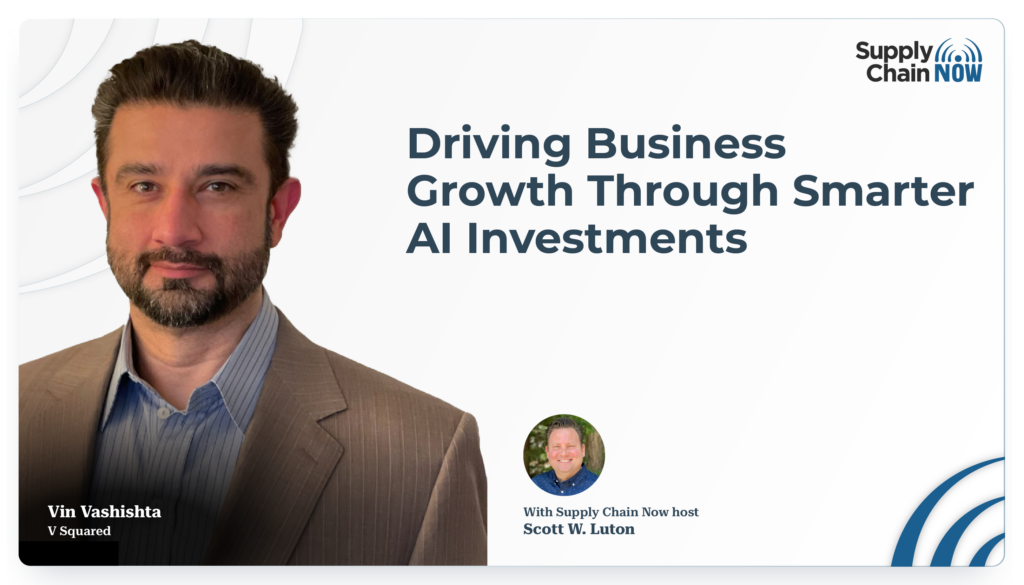
[00:00:00] Vin Vashishta: Everyone’s telling you, you have to do something with AI or you’re, you’re done, you’re cooked, something horrible is gonna happen to your business. In some ways, yes, that’s true. In most ways, no, that’s not true. What businesses have to understand is this whole journey starts with a maturity model, and the first thing any company has to look at is evaluating whether I’m using technology intentionally or unintentionally. Difference between the
[00:00:38] Scott Luton: Hey, good morning, good afternoon, good evening, wherever you may be. Scott Luton and special guest co-host Vin Vashishta with you here on Supply Chain Now.
[00:00:47] Scott Luton: Welcome to today’s show. Vin, welcome back. How you doing today?
[00:00:51] Vin Vashishta: I am good. Thank you for having me
[00:00:54] Scott Luton: Well, hey, you know, uh, I get basically another degree every time I get to spend an hour with you. Uh, and I’m only- Thank you. It is. I’m only halfway kidding. Seriously, you know I’m a big fan. I love how you break things down in this ever more challenging and technological world, and really help, uh, offer guidance to folks no matter where they are on their tech journey.
[00:01:16] Scott Luton: So great to have you back. And today, folks, with Vin Vashishta, we’re diving into several, uh, topics, mainly focused on technology, of course, consumer, uh, innovation, unintended consequences, leadership, all that much, much more. And Vin, a lot of folks may remember you from, uh, a lot of your keynotes and a lot of your other podcast interviews and a lot of your work out there.
[00:01:38] Scott Luton: But for our new audience members, uh, a lot of folks will know you, hopefully will learn you in your role as CEO and AI strategist with V Squared. And this is really cool, Vin, uh, because you’ve shared this with us, so I can say this publicly, and you’ve built a lot of thriving companies in your journey, and you’ve built– you’ve helped clients generate over $4 billion with data and AI.
[00:02:02] Scott Luton: Is that right, Vin?
[00:02:04] Vin Vashishta: That is, we were talking about this a little earlier, trying to tick that number up to five. We got to get the authorizations, but we might be doing it again this year, moving that number up again
[00:02:15] Scott Luton: Man, that’s impressive. And, and look, we’re, I’m not really surprised at all based on all of our conversations that date back several years. And folks, also, you can check out his very popular, uh, courses, which we’re gonna touch on in a second, and his book, From Data to Profit, which you can get wherever you get your favorite books.
[00:02:31] Scott Luton: So then we’re gonna start today’s conversation, one that will offer up tons of actionable insights by the truckload for all of our folks listening or watching or you name it. But we’re gonna start with a fun warm-up question. And today, I believe it’s, it’s, uh, mid-November, right? Mid-November. So, so folks are, unless you’re like me that waits till like the day before Christmas or whatever holiday, you know, that’s when I do my buying.
[00:02:57] Scott Luton: I’m not, we’re not real smart in that regard. But a lot of folks are in holiday season gift buying mode. So I wanna ask you, with that in mind then, what has been your choice here? What’s been one of the, your favorite gifts you’ve ever given or one of your favorite gifts you ever received?
[00:03:13] Vin Vashishta: It’s actually two that are right behind me, sort of back, back there, one up top and one right over my shoulder here. That one’s from a Giants game, just really simple shadow box, great memories, really good game. It was when they won the Wild Card in 2010, they went on to win the World Series. And over the older sh- other shoulder is something a student got for me.
[00:03:36] Vin Vashishta: It, it was pr- probably one of the most thoughtful gifts ever, just from someone who knows me through the courses, knows me a little bit personally, and saw the background and figured, “Okay, I know exactly what to get this person.” So not, you know, not big gifts, but really, really two thoughtful and absolutely my favorites
[00:03:57] Scott Luton: Love it. And of course, on the Giants, uh, tip, uh, actually, I’m not supposed to be talking baseball after our Atlanta Braves had a, had a disappointing postseason. I, I swore it off. So, uh, one, one of the few times I was cheering for you though, so you know
[00:04:13] Scott Luton: Well, I appreciate that. And you know what? As we talk, we’ve talked about on this show before, those Giants teams with any, with Buster Posey and the, just the, the teams that they had back in the day, um, very envious.
[00:04:26] Scott Luton: So I think we’ll, we’ll both be back in the World Series soon, okay?
[00:04:29] Vin Vashishta: I hope so. Really hope
[00:04:30] Scott Luton: so too. Uh, all right. So Vin, we got four big stories to get to, and of course, they’re all fueled by your, uh, big following on social, in particular LinkedIn. And not only have we pulled some key messages you’ve been sharing that we’re gonna get you to expound on, but we also pulled some comments, ’cause I love looking through the comments, the reactions to your posts.
[00:04:50] Scott Luton: So just some good, good stuff there. I’m gonna start with this provocative observation that you shared thanks to, uh, um, using this tweet from our friend at, uh, Kes Kanana. Uh, and the tweet says, “Hey, there’s nothing wrong with your CV, people. Uh, there’s not- nothing wrong with your CV. People are just hiring their friends and relatives.”
[00:05:11] Scott Luton: A lot of us can feel that, baby. But the greater point there is, as you were writing about, is AI and agents really have really broken the hiring process. We’ve got AI-generated resumes. We’ve got automated screening, lots of really bad job postings, whole lot of really frustration on all sides of the equation.
[00:05:32] Scott Luton: So in your view then, as you were sharing this message, what do you see happening? And in particular, how did technology that’s supposed to be making hiring more efficient, more successful for everyone end up making it so much harder?
[00:05:46] Vin Vashishta: I think what’s really important to take away from this, yes, hiring, I think everybody that ex- that’s experienced either side of the hiring process would look at it and say, “This is fundamentally broken.” Technology has been slowly creeping into the hiring process for, uh, almost 20 years. And what’s really important to take away from this is we used to have a fully human system where I dropped off a resume, I would have to go in person or mail in a resume, apply to a job.
[00:06:17] Vin Vashishta: And yes, it was slower, but the process was built for people, and it assumed there were human limits to the number of resumes that you could end up, uh, dropping off in a given day or sending out in a given day. And then we slowly added email. So now I can send out a whole lot more resumes because I have a digital copy of my resume.
[00:06:38] Vin Vashishta: I don’t have to physically go to a place. I can send it out. So digital technology did a lot of optimizing, and it scaled up our capabilities. And now we have agents that can write the entire resume for us, rebuild it specifically for a job. But it’s the same thing on the hiring side. We’ve also had technology come into the hiring side.
[00:07:01] Vin Vashishta: And so we fundamentally changed the hiring marketplace. It used to be a human marketplace primarily driven by people. Now it is primarily driven by agents. It’s primarily driven by r- really AI running in the background. Because of that, we have to rebuild the marketplace, rebuild the workflow and the process for this agentic reality.
[00:07:26] Vin Vashishta: And that’s what I want people to take away, is this isn’t just happening to hiring. Nike very recently had some significant struggles. They’re losing some of their most loyal customers because their sneakers marketplace has been overrun by originally digital bots, now more intelligent agents who are taking all the best sneaker releases and putting them on the resale market.
[00:07:49] Vin Vashishta: Concert tickets, the exact same problem happened to concert tickets. Restaurant reservations are now being overwhelmed by… So look at all of these marketplaces, look at all of these systems that we built for people, assuming people would always be the primary participants in them with people-type limitations.
[00:08:08] Vin Vashishta: Now agents are in there, and we have to rebuild these, just fundamentally rebuild the marketplace for this new reality
[00:08:16] Scott Luton: Yep. Uh, or you can wear cheap sneakers, you can listen to your music at home, and you can, uh, eat and grill at home too, uh, Vin. Is that… That’s
[00:08:28] Scott Luton: not
[00:08:28] Vin Vashishta: an option. Yes, that is, that is an option. It would sort of
[00:08:33] Vin Vashishta: tank many parts of our economy. Taylor Swift would not like you for that, and her Swifties may come after you for saying that
[00:08:39] Scott Luton: I’m only kidding folks, only kidding. But, uh, uh, kidding aside, you know, it really is interesting where we are, and I think one of the shames in all of it, and of course, this isn’t uniquely technology because humans, a lot of human hiring managers did the same thing, is we’re losing outstanding candidates because maybe the agents or humans see a flaw here on the resume or maybe a typo there.
[00:09:04] Scott Luton: Folks, we gotta keep, I think, my view, just my humble opinion, uh, we gotta keep the, the mi- the, uh, major things, the major things and not focus on the minors. Uh, but then one quick follow-up, ’cause I think in the broader sense, the hiring market, of course, is a really important part of global industry, not just supply chain.
[00:09:23] Scott Luton: But with that said, when I think of unintended consequences, because all these companies, if you trust their intentions, just like all the candidates, what, how they’re trying to use, you know, AI and, and, and you trust their intentions, they’re really trying to either hire great talent that fits or get a great job.
[00:09:43] Scott Luton: And I can appreciate and respect that. But there’s a lot of unintended con- consequences at play in what you’re sharing and what you’re writing about. You want to comment on that?
[00:09:52] Vin Vashishta: Yeah, the, the construct is when you look at it, we’re thinking it’s just another technology. It’s only going to disrupt as much as the last one did. And we’re seeing i-in so many different ways, in so many different places, that giving what used to be relatively dumb, relatively rote technology intelligence fundamentally disrupts a lot of our marketplaces.
[00:10:18] Vin Vashishta: I, I gave a seminar about this a couple of weeks ago where I talked about insider trading. That looks a whole lot like someone who has more information than you do. That looks like somebody that has a better predictive and prescriptive model than you do. So this construct that insider trading is only going to happen when we have these illegal things going on, no, you’re going to see traders who have such good models that their advantage over the rest of the marketplace…
[00:10:50] Vin Vashishta: And it’s the same sort of unintended consequence. We’re not thinking how we’ve structured our markets to potentially exclude people, and that will be everything from financial markets to hiring markets. If you don’t have this technology, you may not have equal access, and that’s a huge unintended consequence that we need to address
[00:11:10] Scott Luton: and that really raises the stakes. They were already incredibly raised, but when you think of the d- digital divide and how the, it’s, it’s a lack of access for so many folks, it just makes it that much more important how we’ve got to find these bridges, uh, to, to, to bridge that gap. Um, okay. That was a terrific one.
[00:11:28] Scott Luton: Uh, I want to do this. I want to share a couple comments, and we’re including, folks, you’ll find in the, in the show notes links to the original LinkedIn posts that Vin have ma- uh, Vin made that have, we’ve been using as the fodder for each of these four segments here today, and you’re gonna wanna get, jump in these comments.
[00:11:44] Scott Luton: That’s one of my favorite parts. I wanna share this one first. So Andres, again, we’re talking about, um, how the hiring, the whole hiring market has been displaced here. Andre says, “Any volume game where one side used to have an advantage over the other is seeing this pattern. RFPs and procurement is another one.
[00:12:02] Scott Luton: Commerce is next.” To which you respond, “We’re watching the end of business models that monetize imbalance.” Andre says, “Irrespective of whether that is based on effort or information.” Quick comment there, Vin
[00:12:16] Vin Vashishta: Really important to understand what you monetize in the ecosystems or marketplaces that you participate in. If you look at a consulting company, consulting companies often monetize talent imbalances or information imbalances where they understand things or know how to– They have the people that know how to do the things that you need.
[00:12:38] Vin Vashishta: Those imbalances are going away, and we’re moving towards an outcomes-based economy. And so looking at what you monetize a-and truly understanding if you monetize an imbalance, that business model will very soon be threatened
[00:12:56] Scott Luton: Interesting. Now, we could have a whole sidebar, maybe a couple hours talking about the insurance industry, uh, because, and then how that gets maybe, uh, transformed. But we’ll save that for next time. Uh, good stuff. That was just the first. We got three more segments to go, and I wanna get to this next one here because this was one of my favorite.
[00:13:14] Scott Luton: You know, Vin, you know I’m a big fan. I think I co-chair your, uh, Atlanta Vin Vashishta fan club, but this one was I’m big in Atlanta. I want to be able to say that I’m big in Atlanta
[00:13:25] Scott Luton: Yes, you’re big in Atlanta. So folks, if you’re listening and not watching, Vin posted this comic someone has gotten a new toilet installed, uh, and the person that installed the toilet said to the consumer, “Hey, there’s no handle.
[00:13:39] Scott Luton: You gotta download the Flush Me app.” So folks, if you’re like me, if I’ve gotta download one more app, toilet-related or anything else, I’m gonna lose my mind. And in this post, Vin, beyond the meme, beyond the comic you shared, in your message, you really sh- really questioned why everything from washing machines to coffee makers has really gotta be…
[00:14:02] Scott Luton: Does it really have to be connected, you know, or collecting data, uh, or supposedly, you know, getting smarter? So I’m curious, based on the message, based on the comic, have we reached a point where technology companies are solving problems that consumers never really had?
[00:14:19] Vin Vashishta: Well, there’s always been an imbalance with technology where companies use technology to solve problems that the company has, not necessarily problems that their customers have. And this is a really good example. All of these smart apps, smart appliances. I don’t need a scale to connect to an app in order for it to tell me how much I weigh with the body fat.
[00:14:44] Vin Vashishta: Just give me the raw data. That’s all I want. I understand what businesses get out of this, and they need to think in terms of usability, and they also need to think in terms of alignment. Yes, the business wants recurring revenue. They want a subscription business model to emerge from these partnerships, these apps, the– whatever it is.
[00:15:06] Vin Vashishta: They want to be able to monetize data as well. But you have to do both of those things in alignment with your customer. Does your customer truly want a smart speaker in their room, their office, their kitchen that’s listening to them? They probably don’t. Does your customer want some sort of scale that’s selling their biometric data to third parties?
[00:15:34] Vin Vashishta: No, they probably don’t. But what would we pay for? If you could make health recommendations in real time for me, if I’m on a diet and I’m at a restaurant, if you can send me, “Hey, these are the best things for you in this place right now based on how your healthcare– how your health is shaping up, how your weight loss journey is going.”
[00:16:00] Vin Vashishta: If you can do that, that’s valuable, and I will pay you a subscription, and you can monetize the data without selling it to somebody I don’t trust. You could send that data directly to my healthcare provider, integrating with an EHR system that has all of the barriers and trust and security built in. If you can do that, you align with me.
[00:16:23] Vin Vashishta: If you can’t do that, all of a sudden you’re trying to monetize me in a way that doesn’t align with my best interests. And that’s where companies will really get into trouble in the future, because there’s an entire secondary market. Just like John Deere created an entire secondary market for dumb tractors we are creating a secondary market for dumb devices
[00:16:47] Scott Luton: Well, so quick follow-up based on a couple things you mentioned there. Uh, because, you know, as we all, when we purchase a product, more and more we’re increasingly becoming part of somebody else’s data ecosystem, right? Um, so I’m gonna ask you the obvious question that you’ve kind of spoken to a little bit.
[00:17:04] Scott Luton: Where, where do we draw the line? In a nutshell, where do we draw the line between useful innovation and what you’re talking about, unnecessary intrusion that we don’t value? Worse, that we don’t just not value it, we consider it, consider it a intrusion
[00:17:19] Vin Vashishta: Why would I want you to sell my data to anyone? That’s where I think the line is. If you’re selling my data to anyone who isn’t me or someone that I’ve opted in, my doctor, they can have all the healthcare data they want. That’s a good, really good opt-in. Yes, my doctor can have that. My dentist can have it for my toothbrush if, I mean, whatever it is.
[00:17:45] Vin Vashishta: Yes, they can have it because I trust them. Meta can’t… You– No, don’t sell it to Facebook. Dear Infiniti, I, I drive your car, don’t sell my data to the insurance company who’s going to raise my rates if they see me having to hit the brakes because, well, let’s just say drivers in my city are unpredictable. So let’s, l- let’s draw the line as anything I wouldn’t be okay with. I don’t want you to be able to market better to me. I don’t want anyone to be able to do better marketing for me. I want no marketing. That- that’s truly the, the ideal state is there’s no marketing except for things that I’ve told you I’m interested in.
[00:18:28] Vin Vashishta: If I say, “This is really interest– Like, send me everything about new AI model releases,” oh yeah, I’ll eat that up. I would almost pay you to aggregate that on a daily basis. I pay Bloomberg to send me a lot of information, not quite marketing, but I mean, it’s about companies. So there’s alignment, and then there’s disalignment.
[00:18:48] Vin Vashishta: And I think all we have to do is think rationally. How do we monetize in a way that’s aligned with our customers, our partners, and really just look at it as, as sort of a society issue. Whatever type of surveillance tech you use will be used against you, so let’s not, let’s not throw anything out there that we don’t want to see coming back on us
[00:19:11] Scott Luton: So true, Vin. And you know, I see lots of future consumer rights regulatory conversations because I think all of that space is gonna, going to have to evolve just like this incredible era of technology that’s evolving day by day. So we’ll see how it plays out. Um, all right, I also stole a couple comments from this thought-provoking piece.
[00:19:32] Scott Luton: I’m gonna share those and read those here. So Mark Freeman, and again folks, remember the comic we started this back on, right? ‘Cause it was all about the new toilet. Mark Freeman says, “Hey, I’m so deep in the Apple ecosystem, I would 100% buy a MacBook Flush.” Now Steven says, “I have the iFlush Duo, but make sure you get AppleCare.”
[00:19:55] Vin Vashishta: It’s the truth though. so this is an interesting point because Apple has created trust. But in the announcement that happened a couple of hours ago, Apple’s partnering with LG. LG has been found to be listening in on conversations, to be sort of documenting some of these conversations, and we don’t really understand 100% what they’re using all of this information for.
[00:20:22] Vin Vashishta: So it’s not just the company. It’s not just… I mean, I trust Apple too, because in the past they’ve always done as much as they can to protect my data. But LG hasn’t. And so telling me that you’re building your new smart home devices and ecosystem with an untrusted partner, these are the types of things that we have to think about.
[00:20:44] Vin Vashishta: And it’s a shame because it should just be common sense. I don’t want my TV listening in on me. I, I, I shouldn’t have to opt out of something to stop my TV from advertising to me and from listening in on… I mean, that should be common sense, right?
[00:20:58] Scott Luton: it should be. Uh, so let’s do a little experiment. First off, I wanna, I wanna give a shout-out to, um, Mark and Stephen again. Mark Freeman, Stephen D- uh, Stephen Driggs, y’all need to take it on the road, need to o- have a little com- comedy show. I really appreciated y’all’s, uh, your comments there. Let’s do a little experiment, Vin.
[00:21:17] Scott Luton: So I’m thinking… I’m, I’ve got my watch, my smartwatch. Uh, I’m thinking about what I want for dinner, and I might just place an order. So Vin, let’s see it, let’s see if it pops up a little, uh, a little note about, uh, a new discount or deal or something. We’ll see. Um, all right. So Vin, two down, two to go, but I got a little surprise for you.
[00:21:38] Scott Luton: I got a little surprise. So we’re gonna pretend that the San Francisco Giants 2010 version, uh, are sponsoring today’s podcast, and they’re not, folks, but let’s pretend they are because it gives me an, an excuse to go check out this roster I pulled up because I was disappointed in myself. I could only remember one member off the top of my head being Buster Posey, who crushed my yeah, of course. Yeah but a little, little walk down memory lane, Vin. You know these people. Uh, Aubrey Huff was first base, Freddy Chan- Sanchez, second base. Juan Uribe, short. Pablo Sandoval Oh, Kung Fu Panda. Yes
[00:22:15] Scott Luton: Pat, uh, uh, Burrell, I think was his last name, left field. Uh, Aaron, uh, Rowand, uh, center field. But I go down to the rotation,
[00:22:25] Vin Vashishta: Oh yeah, that pitching rotation was just, oh my goodness
[00:22:30] Scott Luton: Just, just with Lincecum, Matt Cain, Barry Zito, and Madison Bumgarner, just those, and you got a
[00:22:36] Vin Vashishta: And that was the early Mad Bum. That wasn’t even Mad Bum when he, in 2010, that wasn’t even Mad Bum getting good. That was Mad Bum before his prime. And think about the closers that they had.
[00:22:48] Vin Vashishta: Oh my goodness
[00:22:49] Scott Luton: speak… Let me, let me pull that up. I’m glad you mentioned that. Let’s see here. That’s the batting. And I’m, I’m over on baseball-reference.com. Folks, if you’re a big baseball nerd like me, this site is incredible. So let’s see here. The closer, I’m looking at standard pitching.
[00:23:05] Scott Luton: Uh, the closer roster.
[00:23:06] Scott Luton: Brian Wilson had 48 saves that year.
[00:23:08] Vin Vashishta: Yep. That’s it. Isn’t that nuts?
[00:23:12] Scott Luton: And it really is. So folks, uh, if you’re a Giants fan, I’m sure that 2020 team, uh, 2010 team brings a lot of great memories a- as it should, and, uh, we’ll see what baseball team sponsors our next, uh, our next podcast. Okay. All in good fun. Major League Baseball, don’t come after me. We’re having good fun celebrating that team.
[00:23:31] Scott Luton: Uh, all right, so Vin, moving right along. Uh, this next one was more of a, a message. It was, it was less about a visual and more about the message here. So it is about, uh, kinda let’s think, let’s put our inter- enterprise caps on. So we’re approaching 2027. As we know, organizations, they’re wrestling like Dusty Rhodes with some big AI investment decisions, right?
[00:23:55] Scott Luton: Now, you’ve argued that companies shouldn’t build their budgets around the latest model release or technology breakthrough, but around their three to five biggest business opportunities. But as we both know, leaders get that backwards all the time. Why does that happen?
[00:24:11] Vin Vashishta: everyone’s telling especially investors, everyone’s telling you, you have to do something with AI or you’re, you’re done, you’re cooked, something horrible is gonna happen to your business. In some ways, yes, that’s true. In most ways, no, that’s not true. What businesses have to understand is this whole journey starts with a maturity model, and the first thing any company has to look at is evaluating whether I’m using technology intentionally or unintentionally.
[00:24:39] Vin Vashishta: Difference between the two: are you adding it to a workflow knowing what it’s going to do to improve that workflow for your customers or internally, one way or the other? If you’re not, you need to change that. Just switch that one behavior. Don’t look at, you know, sort of crazy business goals. Look at your business goals from last year, this year, next year.
[00:25:03] Vin Vashishta: These are our core strategic goals. What can we get with the cheapest technology possible, which is digital, which is apps, which is basic data gathering? But remember, it’s intentional. So here, you know, we want to grow sales by whatever percentage that you want to grow sales by. Okay, what workflows contribute to growth in sales the most?
[00:25:26] Vin Vashishta: Let’s target those. Is it new features? Can we, can we use AI to deliver high-value features faster? And the answer is yes. In more cases than not, yeah, you can increase the vol- And now you’re like, “Why are we buying these, you know, these coding tokens? Why are we doing it?” Well, because we’re letting our developers now be twenty, thirty, forty, sometimes even fifty percent more productive.
[00:25:52] Vin Vashishta: What does that mean? We see that percentage more features per year, which should correspond with we’re taking advantage of more of our opportunities and we’re getting more revenue in. That’s it. It’s that simple. Why did we introduce coding, AI coding tools? It isn’t because of the hype. It isn’t because they existed.
[00:26:10] Vin Vashishta: It’s because we’ve got this backlog, and we know this is one of our strong levers to grow revenue. Uh, that’s all I want you to do, is think about it that way. And whatever you do, don’t think about it in terms of, “Here’s how much money we’re gonna save.” Don’t think about it that way. Think about it as a growth driver, because AI is expensive, so use it to make sure that as you spend more, more is coming in.
[00:26:39] Vin Vashishta: And when you think about it that way, this should be my lever. Every time I think I need more revenue, pull the lever. And it’s, you know, don’t, don’t treat it like a slot machine Pull the lever like you’re on an assembly line. And you start with, here’s opportunity discovery, here’s our strategic goals. I need this.
[00:27:00] Vin Vashishta: I don’t have anything that can give me the type of growth that I want. Pull the lever. That’s when you pull the lever and you say, what can AI do to move this number right here, this metric, this growth? Run opportunity discovery. Start with your existing strategic goals. Have some smart strategic thinkers in the room, AI strategists, AI product managers, who explain from just a pragmatic perspective, here’s what the future holds, here’s what we can do today, here’s what we can set up for tomorrow.
[00:27:30] Vin Vashishta: They build a roadmap based on what you approve. You do feasibility. You understand what can be built and when it can be built. You deliver quarterly. You break things down so that you’re not waiting two years for this. You should see revenue in three to six months if we’re doing this properly. But you’re also building towards these much bigger long-term goals.
[00:27:54] Vin Vashishta: So just approach it pragmatically and you’ll be in great shape
[00:27:57] Scott Luton: Mm.
[00:27:58] Scott Luton: And we gotta invest in our human team members. That will also unlock all sorts of eureka moments. Of course, we’re gonna touch on that in a bit, bit. You and I both are a bit partial maybe, but, um, but we’re gonna touch on how, folks, you can do that, uh, here towards the end of today’s podcast. Um, all right.
[00:28:16] Scott Luton: So Vin, um, for the sake of time, I’m gonna, I’m gonna skip over the comments from that one ’cause I wanna move to this next meme as we get into the fourth segment here today, and this was a good one. You’ve been really outspoken, Vin, about the limitations of the whole let’s put AI into everything approach.
[00:28:32] Scott Luton: So you’ve got this meme, and I love when you pull your new meme lever. You got, you got a good one there. So you’ve got this, uh, meme on AI adoption, kinda on one pane how it started, on the other pane how it’s going. I’m sharing this kind of for our listeners out there. And on the how it started, you’ve got a headline there s- that says, “Viral Shopify CEO manifesto says AI now mandatory for all employees,” and that was May 2025.
[00:29:02] Scott Luton: And then on the right one, in terms of how it’s going, you’ve got a Shopify CEO that says, and the headline says, uh, “Employee’s slop grenades are making more work for everyone else,” and that was dated September 2026. So first, Vin, speak to this meme and why, not only why it’s kind of, um, a, a good moment of, of, uh, levity, but why, why it’s relevant
[00:29:27] Vin Vashishta: So really good connection between the last one and this one. If you focus on internal improvement and you say everyone now uses AI because, yeah, you get slop grenades. Everyone starts using AI. What are they using it for? They don’t know. They’re using it for everything. Well, I should be making more stuff.
[00:29:45] Vin Vashishta: And it’s not stuff that creates value. It’s not workflows that deliver the type of growth that we’re talking about. So don’t start with these internal initiatives because– And if you think about it, that’s where all your competitors are going. Forget about that. Don’t go in that direction because when you look at their margins, are they really getting any better?
[00:30:05] Vin Vashishta: They’re laying people off to improve margins, and they’re not necessarily laying them off for the reasons that they’re explaining, “Oh, it’s not, it’s AI.” Wait, really? Is it? Because almost all of the companies who lay people off due to AI have started rehiring or have said, “I wish I would have re-skilled these people instead of getting rid of them.”
[00:30:27] Vin Vashishta: Why? Because they have the domain expertise that we need to make AI work. So AI internally requires people. You’re not going to be able to lay people off so that efficiency and productivity gain that everyone’s promising you, it’s not there. Where is the biggest opportunity? And again, it’s this ecosystem business model.
[00:30:49] Vin Vashishta: It’s not in let’s do everything with AI. It’s how can AI generate revenue, and how can we build on this ecosystem? Kind of going back to what we talked about at the very beginning, where we’re going away from imbalance and we’re moving to ecosystem. In an ecosystem business model, everyone’s a partner in delivering an outcome that people in the ecosystem will pay for. That’s where Shopify is going. That’s where almost every company that’s monetizing AI, if you think about agentic commerce, really good example of how do I use an agent, Google’s doing this, to give you my distribution. Google and Walmart are trying to figure this out as we speak. Shopify and Meta are essentially saying, “Hey, if you’re on Shopify, now you can use, you can tie directly into Meta’s agents.
[00:31:43] Vin Vashishta: They’ll be sending you business. You don’t have to do anything. You just keep using Shopify, please.” And you see where the monetization is. Meta makes money, Shopify makes money. Customers get better and easier access to products, and those small businesses that all run on Shopify, that run their retail establishment on Shopify now get access to customers that they would never have been able to get in front of.
[00:32:07] Vin Vashishta: That’s how an ecosystem works, and that’s what we need to be building.
[00:32:10] Scott Luton: Hmm. I li– And, and I know there’s so much more, uh, to this one topic that we could, we could be talking about for six hours, picking your brain on this. But for the sake of time, I wanna share the comments, and I’ve got a couple more questions for you, Vin. Uh, ’cause a lot of folks, I’m gonna go back to this meme.
[00:32:27] Scott Luton: I think this resonated like man- a lot of your stuff does with a lot of folks, and check out these comments. You can always tell when you get one-liners like this. Uh, uh, Nightland s- or, uh, Natine says, “Absolutely. I feel this every day.” Prasad says, “AI slop grenades.” He’s gonna steal that from you. Uh, Ritesh says, “As soon as Tobias,” and I think that’s the Shopify CEO, “As soon as Tobias mentioned a negative-like news, the news became not viral.”
[00:32:56] Scott Luton: Uh, David says, “Sounds like a new hit song, AI slop grenade.” Maybe. Maybe a next Taylor Swift, uh, tune. And then, uh, Five-O’s perfect example to show how not to make adoption faster. Lot of good comments. Little bit of snarkiness in some of those, but hey, it, it, we gotta keep our sense of humor, and I can really appreciate all of that.
[00:33:18] Scott Luton: And that’s just a snippet. There, there were, I think there was like about 100 comments on that one LinkedIn share from our account event. So let me ask you this. We’re gonna talk about your training, popular training programs in just a second, but before we do, um, back to this agentic commerce, a co- uh, just commerce in general, kind of where we are as a society.
[00:33:37] Scott Luton: Um, and of course, it, it’s November, kind of bringing it all the way full circle to the fun warmup question. You got a flurry of, of holiday buying season in what for many is a tough economy. Uh, but in light of technology, in light of the economy, in light of the state of the art, what is one thing, Vin, that you’re gonna be closely watching this holiday season?
[00:34:01] Vin Vashishta: it’s whose agents are running. Everyone has an agent now. E- everyone’s talking about agentic commerce. Everyone’s trying to bring customers into their agentic ecosystem. I’m watching who gets traction, who is being talked about, who’s being used. Because one in three earlier in the year were using an agent for shopping or using AI for shopping.
[00:34:28] Vin Vashishta: We’re probably going to see this holiday season when everything’s said and done, that’s closer to half.
[00:34:32] Scott Luton: Hmm. Wow
[00:34:33] Vin Vashishta: Now, whose agent won? That’s really– This is kind of the, the agentic commerce Super Bowl. Who figured it out and who didn’t? Who lost sales as a result? Who created too much friction? And whose agent didn’t work, didn’t recommend the right gifts, the right, really the, the right thoughtfulness?
[00:34:56] Vin Vashishta: A- and that’s something that agents don’t have. They’re not very thoughtful. So we have a lot of barriers, and that’s what I’m watching. I just want to see who’s removing barriers, not putting new ones up
[00:35:07] Scott Luton: Hmm. And you know, it’s interesting, uh, as you shared how technology just isn’t considerate. It’s not boy- it could be programmed in, I guess, to some degree, uh, and that’s changing every day. But, you know, the empathy, that’s such a human superpower. And when I think of retail, the best people in retail have a lot of empathy for the consumer, whether they’re at the transaction or, or maybe they’re, you know, plotting strategy, and they know that the consumers are the ones, you know, that’s ultimately gonna make or break, uh, their year, their holiday season, you name it.
[00:35:41] Scott Luton: Um, so we shall see. I’m gonna, I, I will be look, I’ll look forward to having you back on after the holiday season, maybe in January when it’s return season, and we’re gonna get your key takeaways from the holiday season 2026. So stay tuned, folks. Um, okay. Vin, a minute ago we talked about how, yes, in this incredible era of technology everywhere, and certainly the golden age of supply chain tech, it’s incredible what, uh, AI and machines and you name it is doing, but we’ve got to invest and empower the human element, and you do this every single day.
[00:36:19] Scott Luton: I’m gonna pull up, your website. We wanna encourage folks to go check out datascience.vin. You’re gonna find training and certification classes and a whole bunch more. Vin, what’s one upcoming offering that has been real- it’s really resonated with, uh, folks in your ecosystem that you wanna call out to people?
[00:36:38] Vin Vashishta: So we’re rebuilding right now the self-paced course offering to be more of a curriculum that teaches really in-demand capabilities that are aligned with careers. That’s what we’re excited about. We want people to use these to access high-value careers. Some of them are even designed to help you target businesses and start something of your own.
[00:37:03] Vin Vashishta: So that’s what I’m most excited about because that’s the hardest piece for a lot of people right now, is they’re worried about losing a job, they’re worried about falling behind, not getting promoted, and they’re worried about how do I reenter the workplace, the workforce with all of these AI and agents, where, where is the future opportunity coming from?
[00:37:22] Vin Vashishta: I’m really looking forward to rebuilding sort of the self-paced offering to be something that can help people accomplish that. But, but more than anything else, obviously next year we start up with a new cohort. I love teaching in person. That is one of my favorite things. I have a ton of people telling me, “I don’t have time for this,” and I just keep saying, “No, no, no, dude, no, it’ll work.
[00:37:44] Vin Vashishta: It’ll work.”
[00:37:44] Scott Luton: So folks, learn more at datascience.vin and check out for some of these new self-paced options coming up soon. Hey, really quick, maybe a stupid question, but I think it’s an interesting one. I won– And, and when you think of agents that are learning regularly, absorbing all this data, but maybe they’re not being intentionally trained on how to work with humans as much as humans are being intentionally trained to work with a- uh, agents, is there a business play for a training academy for all AI agents out there, Vin?
[00:38:20] Vin Vashishta: Well, it’s more of an information play because you don’t specifically teach them the same way you teach people. You want to give them guardrails in a lot of cases instead of trying to make the model do something differently. You want to build the agent to follow a workflow. But workflow reorchestration is a process that people and agents have to participate in.
[00:38:46] Vin Vashishta: It’s not something that an agent can just, “Oh, well, I’m gonna do this all on my own, therefore…” No, you, you never do everything all on your own. That’s not… No one in their right mind does that. I’ve seen that movie. You know, Elon Musk’s credit card goes out on the internet. So it’s, it’s an in- an intentional process where we decide this is how we are going to reorchestrate the workflow, and this is the value we’re expecting that reorchestration to give us.
[00:39:12] Vin Vashishta: So it’s not just, “Hey, we’re throwing agents in there.” And agents aren’t necessarily teaming up with people. Agents, really we haven’t seen that proactive side. We haven’t seen these true multi-agent systems outside of a very small group of companies that have deployed them. And I think what you’re talking about becomes a lot more relevant as we start seeing multi-agent systems, as we start seeing human machine collaboration come up, uh, in, with robotics.
[00:39:43] Vin Vashishta: This will be a much bigger opportunity
[00:39:46] Scott Luton: And it’s coming, folks. You can just look at the re-re, the robotics, the automation, uh, sales numbers. It is amazing where we’re going. So we’ll see, Vin. We shall see. I, I really, a-as always, I really enjoy your perspective and the altitude that you take here, uh, when you join us, uh, for shows. I wanna make sure, uh, again, folks, you can learn more at datascience.vin.
[00:40:08] Scott Luton: But other than that, how can folks track you down, Vin?
[00:40:11] Vin Vashishta: Find me on Sub-Substack. If you just look up Vin Vashishta, if you go to that datascience.vin site, there’s a link to my Substack there. Or if you Google me, ask for Vin’s Substack on ChatGPT or Claude, they’ll get you the right link
[00:40:26] Scott Luton: Outstanding. It’s just that easy. Uh, folks, big thanks to, uh, my friend, the dynamo, uh, the, the great interview as always here today, Vin Vashishta, CEO and AI strategist at V Squared. Vin, really appreciate you taking some time out and, uh, sharing more perspective on these topics today
[00:40:47] Vin Vashishta: Always appreciate you having me. Thank you
[00:40:49] Scott Luton: To our SCN Global fam, hope you enjoyed the conversation. Hope you, whether you’re finding help through Vin’s incredible business or, or other providers out there, I hope you’re investing not only in yourself, but in your teams as we all are working through this incredible time to be in global business really, not just global supply chain.
[00:41:08] Scott Luton: But you know, no matter what school you’re in, we’re giving you some homework here. You got to take one thing that Vin shared here today and do something with it. He shared lots of actionable perspective. And you know we can’t take a deeds not words approach, so check it out and, uh, give us some feedback along the way as well.
[00:41:25] Scott Luton: Uh, with that said, Scott Luton here on behalf of the whole Supply Chain Now team challenging all of y’all out there, do good, give forward, be the change that’s needed. And we’ll see you next time right back here on Supply Chain Now. Thanks everybody.