[00:00:00] Marina Mayer: The one true thing that I hear the most is, “Well, I incorporated it into my business, and now what?” It’s like you have to take a step back and figure out where the AI is actually necessary in your business, and then you start there.
[00:00:12] Marina Mayer: And everybody I’ve talked to, that’s what they continue to say.
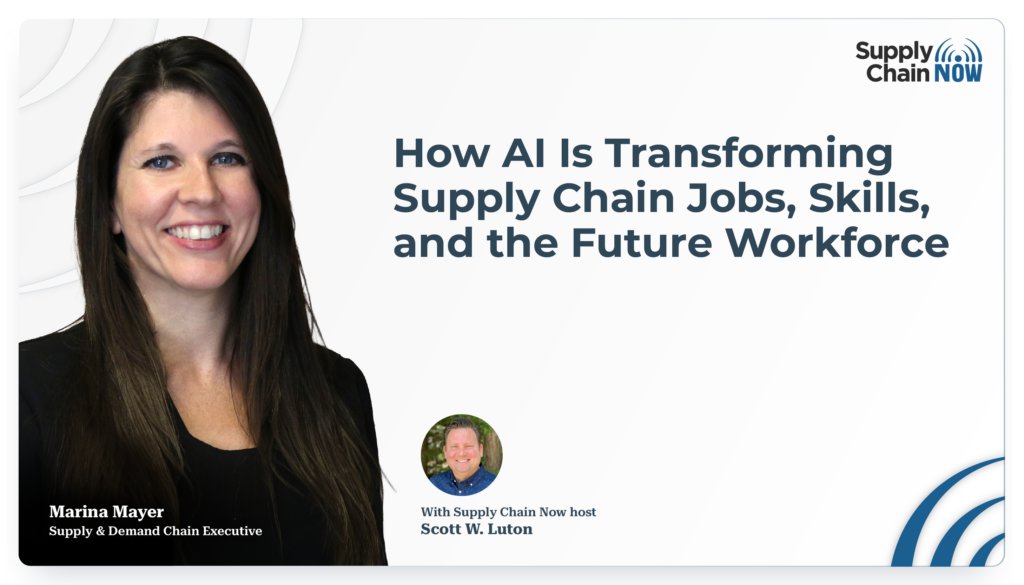
[00:00:28] Scott W. Luton: Hey, good morning, good afternoon, good evening, wherever you may be. Scott Luton and very special guest co-host Marina Mayer with you here on Supply Chain Now. Welcome to today’s show. Hey, Marina, how you doing?
[00:00:40] Marina Mayer: Good. How are you? Thank you so much for having me again
[00:00:43] Scott W. Luton: Well, we had to. You know, you’re, you’re in popular demand, uh, ev- ever since you joined us a couple of times at events and on The Buzz and, and, uh, we had to work fast and furiously through your agent to get you booked,
[00:00:55] Marina Mayer: I don’t know about that, but I’ll go with it.
[00:00:59] Scott W. Luton: Uh, you know, one of the, um, out of all the times we’ve c- we’ve connected out, out across industry, I really enjoyed me and you and Tandria Bellamy getting together on an edition of The Buzz, and it’s great to have you back.
[00:01:12] Marina Mayer: Oh, thank you for having me
[00:01:13] Scott W. Luton: So, but you know what? Me and you got a lot of work to do. We’re diving into a variety of news and perspectives here today, uh, from how manufacturers are upscaling or upskilling, maybe and upscaling maybe, their workforce and how that’s paying off, to building the next generation of the supply chain workforce, to the continued explosion of AI across global industry, to one of my favorite topics, putting AI in the hands of human team members at the edge to drive better decision-making.
[00:01:41] Scott W. Luton: All that and much, much more. Stay tuned, folks, for a fascinating discussion. And Marina, I know you stay busy. It’s great to have you back, but most folks will recognize you as content director of Food Logistics and, uh, at Supply and Demand Chain Executive, as well as co-founder of the Women in Supply Chain Forum.
[00:02:01] Scott W. Luton: But, uh, we’ve got our work cut out for us on a great show here today, huh?
[00:02:05] Marina Mayer: Yes, I’m very excited
[00:02:07] Scott W. Luton: So folks, stick around for a, an outstanding conversation that’s gonna offer up tons of actual insights by the container load. But this is where I want to start, Marina. We were comparing notes. So between the two of us, I think we’ve got, uh, 57 kids, uh, but feels like it some days.
[00:02:23] Marina Mayer: Feels like it.
[00:02:24] Scott W. Luton: Uh, you’ve got a couple. We’ve got three here in the Luton household. And we were kind of comparing notes around, uh, sports mom or sports dad logistics. So Marina, um, tell us, ’cause you’ve got… Your two kids are in, like, 27 sports. Tell us about how the logistics have to work.
[00:02:43] Marina Mayer: I, it i- it is a tight ship. Um, my daughter’s in softball. Um, and she does a softball camp through the high school as well, ’cause it’s summertime. My son is also in baseball and does flag football as well. Um, I was telling you offline, our only free day that we don’t have anything is Monday, and I’m not sure if I need to clean the house or just sit and stare at the wall.
[00:03:09] Marina Mayer: Um, and it’s, the jury’s still out on that, but it, it is a lot, and it, and it takes, you know, all hands on deck. It takes a village. I mean, there’s times when I need to miss a game to drive a child to practice. Um, it helps, my, my husband is an assistant coach for the baseball side of my son and the flag football side of my son, so he’s kinda like overtaken that side, and so I’m in charge of my daughter.
[00:03:33] Marina Mayer: But there are times when it conflicts. And so I have a very, um, lengthy Google Doc that literally outlines where everybody is going to be at what time, and it seems to have worked. This is the second year we did it, and it seems to keep everybody on schedule. So I highly recommend a shared document between all the family members, including the kids that…
[00:03:55] Marina Mayer: You know, both my kids have cellphones. They have access to Google. So like, you know, it
[00:03:59] Marina Mayer: kinda helps them manage stuff too so they know when to be ready and it’s… I highly recommend, but yeah, us sports, us sports parents have to stick together.
[00:04:08] Scott W. Luton: Oh, we do. And we do, and sounds like maybe we, um, we, we take your, your, uh, planning system, we add some bells and whistles, and we roll it out with some AI and, and sell a new platform. How’s that sound, Marina?
[00:04:20] Marina Mayer: I, I’m on board and, and include like reminders of, ” Don’t forget your water bottle,” and, “Don’t forget your cleats,” and, “Is your bag actually in the car that you’re going in?”
[00:04:31] Scott W. Luton: It’s like you just took a sneak peek of, of our life here. Um, you know, our, our three kids are… My, my son’s playing out, uh, trying out, or he, I guess he’s playing football, I guess they’ve already made the team, for the first time ever. So summer practice, like from 8:00 to noon. Um, my middle daughter, uh, Gracie is playing volleyball.
[00:04:52] Scott W. Luton: She loves volleyball. Uh, we’d had a game last night. And then Brantley, our oldest, who’s, uh, soon to be a senior, is all about cheerleading. She’s been cheerleading for a long time, competitive cheering, and, uh, we stay busy. Um, but, you know, I wouldn’t have it any other way, right? Life is meant to be busy, and I tell you, between kids, but also, Marina, global supply chain keeps us pretty busy too, huh?
[00:05:18] Marina Mayer: It definitely does.
[00:05:20] Scott W. Luton: Well, so always something. Always something. And I’m so glad to, um, always compare notes with you. Uh, you’re a, a wonderful reporter and analyst of our industry, and I– and you are constantly churning out, um, folk, uh, perspective and insights and news that folks can’t miss. So I’m stealing a little bit, Marina, from some of your recent articles as we’ve kind of teed up our discussion here today.
[00:05:43] Scott W. Luton: And where I want to start is, uh, I think this, this piece here is a bit of a table setter for today’s discussion as we talk about the continued explosion of AI across industry. Now, Marina, you published data recently that quantifies this explosion of growth and investment and change. Uh, I think you reported that Global Market Insight says that AI in logistics and supply chain is set to grow from its current market value of just over $20 billion, get ready folks, to over $196 billion by
[00:06:16] Marina Mayer: Mm-hmm.
[00:06:17] Scott W. Luton: 2034.
[00:06:18] Scott W. Luton: Tell us more, Marina
[00:06:19] Marina Mayer: So they’re attributing that, and, and for the record, everybody can go to sccexec.com to find that article along with some other things that we post on this topic. But they’re, they’re crediting that to specific AI-enabled solutions. So anything that’s predictive, anything That’s automated, anything that’s autonomous, um, anything that’s adaptable.
[00:06:42] Marina Mayer: And why that’s important is because there’s been several companies that I talk to and, you know, they, they deal with AI. They either deal with it as a customer or they deal with it as the developer. And the one true thing that I hear the most is, “Well, I incorporated it into my business, and now what?” It’s like you have to take a step back and figure out where the AI is actually necessary in your business, and then you start there.
[00:07:05] Marina Mayer: And everybody I’ve talked to, that’s what they continue to say. There are many AI developers and software solution providers that I talk to that say, “My solution is not for your entire company. It’s just for a section of your company. It’s just designed to do just this.” Once you do just that, then it kind of transforms how you operate as a company in other areas.
[00:07:26] Marina Mayer: It’s like a domino effect. So I think that’s really what the growth attribute has to do with, because, you know, there’s, there’s something to be said for automation. There’s something to be said for human workforce. And I think a lot of companies are really trying to showcase and prove, “I need both. I need humans, but I also need AI, and I need the humans to run the AI.”
[00:07:50] Scott W. Luton: You know, it’s so true, and, and, you know, your comments remind me of two thoughts. First off, uh, kind of you’re calling out some of the specific drivers behind the growth. Uh, I think you reported on real-time supply chain visibility, optimized route planning, accurate demand forecasting, and, um, uh, automation in warehouses as some examples, folks.
[00:08:09] Scott W. Luton: Uh, but number two, to your broader point there, uh, the c- a lot of the conversations we’ve had this year here in 2026 have been on, okay, we’re past the AI hype, we’re past the AI pilots. We have, we’ve figured out how to be more targeted in how we incorporate it or bake it kind of more into how we do business, which I find intriguing as well.
[00:08:31] Scott W. Luton: But we are kind of spinning around how to scale it, right? Especially some of the larger organizations. And I think as we continue to crack that part, uh, of, of that current dilemma, um, that’s gonna be rocket fuel to approach that 200, you know, some $200 billion number by 2034. I bet we get there before 2034.
[00:08:54] Scott W. Luton: What do you think?
[00:08:55] Marina Mayer: I do agree with that. I, I mean, I think the last five years from COVID have, are kind of a good example of how fast and how, um, quickly things can change in the supply chain space, um, especially with regards to technology. And so I think that’s just a very loose date. I wouldn’t be surprised if we beat that by, like, 2030
[00:09:18] Scott W. Luton: I’m w- hey, I’m with you. I like how you think, and, uh, I think, I think one last thought there. I think the compounding value of a variety of technologies. Uh, I mean, imagine, uh, you know, w- the quantum era. We were– we’ve been reporting on that a good bit here lately. We have so many things we’re on the verge of, and once they start working together, and once we get really, uh, a lot more, um, uh, use cases out there and a lot more experience of, uh, better targeting, better framing, better, uh, quantifying the value and the why we use in the business, getting more pilots, and then cracking that scale code.
[00:09:55] Scott W. Luton: I’m with you. It might be 2030, it might be 2029, who knows? But, but I wanted to… You, you mentioned something I wanna make sure. So folks, that article you can read a lot more at sdcexec.com. Is that right, Marina?
[00:10:08] Marina Mayer: Correct
[00:10:10] Scott W. Luton: And folks, when you go over there, you better be ready. You need to go ahead and subscribe because Marina, Marina, how many, how many news stories are you publishing a, a week these days?
[00:10:19] Scott W. Luton: It’s gotta be a bunch of them.
[00:10:21] Marina Mayer: Yeah, I think we average about 10 to 12 a day. Um, and that’s not including contributed content or anything like that. It’s just straight up news. But that also goes to prove all of the stuff That’s going on in the industry, all the developments, all of the innovation, um, because when I get bombarded with these emails, then I know that people are doing their jobs.
[00:10:44] Marina Mayer: You know, people are creating and innovating things, and so the supply chain space is moving.
[00:10:48] Scott W. Luton: It is. Uh, it is. Uh, okay, so speaking of moving, I wanna move over to one of our favorite industries, at least one of my favorite industries, and that’s the manufacturing sector, right? I, I’ve really enjoyed the time I’ve spent as a practitioner in that space. I really miss a lot of the people that we would problem solve and grow and innovate with.
[00:11:06] Scott W. Luton: Um, it’s a very special part of our global business, uh, world. Recently, you published an article on Supply & Demand Chain Executive that offered findings from a recent study by, I think it’s Workera. I say, I
[00:11:18] Marina Mayer: What’s that?
[00:11:19] Scott W. Luton: Okay. So Workera, our friends at Workera, entitled The 2026 AI Skills Enterprise Benchmark.
[00:11:26] Scott W. Luton: And one key finding, uh, that I think is really good news is that manufacturers that are committed to structured upskilling, more than just, you know, throwing money and time, right, and, and lip service at it, but really are structuring how they upskill, well, they’re achri- achieving, according to their data, 79% readiness scores, which means if you were like, “Okay, well, that’s great, but what does that mean?”
[00:11:51] Scott W. Luton: Well, that means they’re more prepared than many are out there for workforce transformation. And if we know anything, going back to that first story, we know that technology, tariffs, geopolitics, all these, these crushing factors are transforming not only the jobs and the work themselves, but the workforce.
[00:12:11] Scott W. Luton: Marina, tell us more
[00:12:13] Marina Mayer: So you touched on it precisely, but I think another bullet point from that piece of research that’s important is that 59% of those people interviewed also show confidence in their employees with a, an AI-enabled future. And I think there’s two sides to the coin here. There’s people who say, “Yes, I can use AI, and I understand it, and I’ll implement it.”
[00:12:37] Marina Mayer: And then there’s the people who truly feel confident using it and working with it, because for some time, there were many companies and many workers, especially in manufacturing, who said, “Oh, I’m never g- I’m… There goes my job.” You know? And that’s really just truly not the case. But then you have this benchmark that shows not only are they using it and adapting it, that they feel comfortable as an employee using it and working alongside it.
[00:13:01] Marina Mayer: And I think that that just goes with the upskilling part of it, because you’re taking true veterans in your organization that have the tribal knowledge of your company, your product, how things operate, and, and they’re working alongside AI to kind of maybe streamline their processes and, and continue to grow within the company.
[00:13:22] Marina Mayer: And I think that that is just so important for companies to kind of tackle onto
[00:13:27] Scott W. Luton: That’s right. You know, it, it’s, um, not to oversimplify, but as I think through my own professional journey and I think through some of the, uh, different training I’ve received and, and onboarding I’ve received, and those that are really invested in that and, and, um, and help me, ’cause I’m a slow learner sometimes.
[00:13:46] Scott W. Luton: Let me face it, uh, Marina, I’m not the fastest, uh, uh, uh, thinker out there and doer out there. But those organizations that really invested until the light bulb went off for me, that gives anybody, gave me a lot of confidence then to go and apply it and go be successful in my role. And that’s kind of one of the things I’m hearing you sh- you say.
[00:14:05] Scott W. Luton: It’s not, it’s not good enough these days, especially with, with some of the things we’ve gotta learn to pencil wick a, a pencil whip a t- uh, a list or a checklist, right? We’ve got to invest, make sure it’s sticking. In some cases, like with me, it’s gonna take a couple times of showing, teaching, explaining.
[00:14:22] Scott W. Luton: But that confidence you’re speaking of, that’s what helps move mountains and serves as foundations for layering on more tool, new tools, new, new training and whatnot, huh?
[00:14:34] Marina Mayer: Well, and the confidence part is so key because you’re kind of giving that, those employees the ability to kind of improve and show … And you’re showing as a leader in your company, we really want you to stay and stick around and be a part of our organization for the future. And I think that that speaks volumes for a lot of these companies that are utilizing AI for an upskilling purpose because you are showcasing that.
[00:14:59] Marina Mayer: And I, I just think it’s important
[00:15:01] Scott W. Luton: I’m with you. Uh, but I’m gonna see if Marina agrees with, with me here. Um, for all of you folks out there that you’re kind of, you’re kind of processing this update as that team member, it’s really important. Nothing’s guaranteed in this life and, and, uh, the, for the folks that raise their hand and volunteer, they want to learn new things and apply new things, there’s gonna be so much opportunity, not just now, but moving forward.
[00:15:26] Scott W. Luton: However, comma, if you like to do the same thing over and over again and you really don’t like change or learning new things, it’s gonna be, it’s gonna be, in my view, it’s gonna be more challenging. Marina, would you generally agree
[00:15:40] Marina Mayer: I, completely agree. And, you know, as somebody… I mean, we, we both are in, you know, the journalism field of sorts, and, you know, I, I come from a very print-centric background. I’m gonna show my age here a little bit. So some of these, you know, I hire these new young journalists who come on board and they’re like, “Oh, you know, what about this?
[00:15:59] Marina Mayer: What about this?” And it’s scary. It’s frightening. It’s like, what in the world is this? I, I like the way that?
[00:16:04] Marina Mayer: I’m doing it. But, you know, you have to kind of almost step, take that step back and go, “Okay, teach me. Show me everything just so I understand what I’m up against as, as a human being in this, in this organization.”
[00:16:17] Marina Mayer: Um, and sometimes there are really good technologies and solutions out there that really do help your, your team and they help what you do for your job and they just kind of help move the needle in a lot of ways. So I, I know it’s scary, but you know, you gotta face, you gotta face it
[00:16:33] Scott W. Luton: Hey, we gotta keep it real. We gotta keep it real as we always do. Um, all right, so let’s stick with workforce for a minute. And again, folks, on that last story, you can go visit the whole, uh, read the whole, um, findings from that, that research piece. Uh, visit over at sdc for supply demand chain exec.com, sdcexec.com.
[00:16:56] Scott W. Luton: Okay, so sticking with workforce as a big theme, but kind of broadening out a bit, uh, ’cause I, when I say when, I, I don’t know about you, but when I say supply chain, I mean that very holistically where manufacturing is part of that, right? Uh, let’s see. You, you and I both, uh, were… Marina, you were at MODEX too, right?
[00:17:14] Scott W. Luton: Or were you in
[00:17:15] Scott W. Luton: Vegas that week?
[00:17:16] Marina Mayer: Yeah.
[00:17:17] Marina Mayer: No, I was in Monex.
[00:17:18] Scott W. Luton: I thought so. Uh, well, you and, you and me and 50,000 others were at MODEX, right? Um, so I was able to sit down and chat with my dear friend Dr. Stephanie Thomas, who’s doing big things at the University of Arkansas with, uh, their top-ranked supply chain management program.
[00:17:34] Scott W. Luton: But she also founded and leads a group called WISE, which is a terrific organization that engages, empowers, and connects students interested in supply chain, not just at University of Arkansas, but I think several dozen universities and colleges, which is really cool. So con- I wanna continue a theme from that last article because Stephanie mentioned, and, and she’s in a unique position, you know, class in, class out, year in, year out, plus all the, the hiring managers coming on campus.
[00:18:03] Scott W. Luton: She’s in a unique position, and she mentioned how organizations are not only struggling to adopt emerging technologies, which, you know, some more than others, but they’re also struggling in terms of how to prepare their workforce for the continued transformation ahead, right? And so when I think about that continued transformation, in my mind, I think of bullet points from, uh, my buddy Paul Noble’s recent piece in Forbes, where he cited KPMG research, uh, called Risk Management and Resilience Emerge as Key Concern for Supply Chain Leaders.
[00:18:35] Scott W. Luton: And get this, Marina, KPMG data shows that 73% of businesses are said to be planning a comprehensive transformation of their supply chain operating model within the next one to three years. 73%. That number is up from 11% the year prior. So when I say, and when we talk about continued transformation ahead, there’s not gonna be any shortage of it, folks.
[00:19:00] Scott W. Luton: That’s why it’s so important to, to follow Marina’s advice a minute ago and lean in or lean into this environment we’re in. So two other things, and I’ll get you to get your thoughts here too, Marina. Uh, Stephanie mentioned that organizations beyond those challenges, organizations everywhere also have another big problem.
[00:19:17] Scott W. Luton: They’ve gotta be more intentional about talent and hiring, recruiting, interviewing, getting back to the candidates, right? Moving with some velocity there. And then lastly, she pointed out what she see, uh, uh, in what she sees when it comes to students adopting AI tools and tech faster than educators and employers alike.
[00:19:39] Scott W. Luton: Now, you were kinda mentioning this earlier. Now, that’s gonna be really interesting to see the push to do things better or differently that young talent coming into the industry will continue to deliver. I think it’s gonna be interesting for us. But Marina, your thoughts on any of those topics
[00:19:55] Marina Mayer: I think there’s two sides to this. There’s the one side where companies who are doing the hiring employ AI, and maybe not necessarily in the Right
[00:20:05] Marina Mayer: ways. Um, because I feel like it weeds out people that, you know, have skills that maybe are being overlooked. Um, and I think that’s important for a lot of these young professionals and, and those that are trying to hire young professionals because it’s, it’s… You don’t have that human connection. You don’t have that little bitty piece in their resume that speaks out, “Oh, well, that would work well with this situation.” So maybe they actually would be a fit even though their actual previous titles and companies don’t match up. So I think that’s where AI kind of puts us at a disadvantage.
[00:20:45] Marina Mayer: But at the same time, I do feel, you know, with the article that you had shared, you know, from this, I think the thing that’s important is that a lot of these young professionals already know AI. They don’t need to learn It, They know it. So they are– They have the upper hand. They’re coming into companies saying, “I already know all this stuff.
[00:21:07] Marina Mayer: Just put me in the spot and I’ll run with it, And that’s a huge advantage, um, for a lot of these young professionals because a lot of these companies still don’t have it figured out or, you know, they’re scared to implement it, or they just don’t fully understand how to use it to their advantage. And so, you know, everybody wants to jump on the AI bandwagon, but then once you’re on it’s like, “Well, what do I do now?”
[00:21:29] Marina Mayer: You know?
[00:21:30] Scott W. Luton: It, it, you know, it’s, it’s such an interesting observation that you and Stephanie both have because, um, the generations that are coming into industry now, and this is a generalization, but for the sake of conversation, b- since they are so digitally native and technology native, they certainly, it seems like to me at least, are m- it’s easier th- for them to, and I’m, I’m thinking about th- three kids, it’s easier for them to process how something works, why something works, how to learn it, and then how to jump in and use it.
[00:22:01] Scott W. Luton: And it’s such an interesting superpower of theirs to observe that once… I mean, uh, I think when I think of the, the ever f- uh, faster pace of, of business velocity, and certainly in supply chain, this has got to be one of the, one of the greatest tailwinds, huh?
[00:22:18] Marina Mayer: Yeah. Well, And
[00:22:20] Marina Mayer: I- just look at it, you know, you just look at the general public and even your own kids. You know, we bring home, uh, something that’s electro- has electronic behind it, my kids have it figured out in two seconds. I’m still sitting here trying to figure out what the remote does. And then they’re like, “Well, you don’t need the remote.”
[00:22:36] Marina Mayer: Here’s me like, “What do you mean?” You know? And a- again, I’m aging myself, but again, it’s this, this younger generation, you know, they were, they were trained in school to use certain technology to learn and, and do their work and turn in assignments. And it’s, it’s not the same thing, but they have the advantage.
[00:22:55] Marina Mayer: They bring that skill set that isn’t learned. They already have it.
[00:22:59] Marina Mayer: So all they need to do is just learn how the company operates and go from there
[00:23:06] Scott W. Luton: i- it’s true. And, you know, um, it will definitely… Y- what I’ve heard from a variety, you know, we, we, we do a show, uh, focused on the Now Generation because these folks that you and I both are speaking about, they’re already making their impact made. So when I say next generation, that feels kind of weird to me.
[00:23:23] Scott W. Luton: So we, we went with Now Generation. And, you know, these folks from, from my observations and conversations, they don’t want to work with companies that are doing it like 1986. They want to work with companies that are really leaning into this, this incredible golden age of supply chain tech, number one. And then number two, as Stephanie mentioned, you know, and as you touched on in your last response, it’s not just the workforce and, and, and, and, and the, um, the, the field or the industry transforming.
[00:23:54] Scott W. Luton: How we instruct and teach these generations as they come through our, you know, undergraduate programs or, or even the graduate programs, that’s having to evolve as well. You know? That, that is, that’s remarkable. Um, we’re living in a state of constant transformation, Marina
[00:24:12] Marina Mayer: Well, and I think the thing to note is that there is that gener- generational divide. You know, the baby boomers, they worked because they needed a job. They didn’t care if they liked it. They just knew that they had to have a job. This generation, your millennials, zillenials, jillennials, I don’t even know what they are anymore.
[00:24:30] Marina Mayer: I kind of lose track . But all of these se- very much younger individuals that are entering the workforce, they want a job that’s exciting and fulfilling and where they matter and they make a difference. And so when you bring somebody in and say, “I love your skill set. Can I use it? Here’s how you can help,” that’s exciting to these young people, and I think that’s something to note.
[00:24:54] Marina Mayer: I mean, I, my motto is always hire people who are smarter than me. And, you know, I hire young. I have a millennial on my staff. She’s my hardest worker, but she’s excited. She’s, “I have a new project. Would you like to be my guinea pig?” “Great. Love it.” So, you know, it, it’s just, that’s what I think companies need to keep an eye on.
[00:25:14] Marina Mayer: You know, everybody says, “Oh, millennials don’t work. This generation doesn’t wanna work.” Yeah
[00:25:17] Marina Mayer: they don’t wanna work for a job that they don’t like. That’s not what we’re dealing with Right. now
[00:25:22] Scott W. Luton: Th- that’s right. Th- th- the purpose, big picture, impact, these are things I, I pick up, common themes I pick up from my conversations like you’re, you’re, uh, pointing to. Um, all right, so folks, uh, there’s a little more to that conversation with Dr. Stephanie Thomas. Venture over to supplychainnow.com and you’ll find it in our resource hub.
[00:25:42] Scott W. Luton: Uh, all right, so I wanna go back to some of your reporting, and we’re gonna dial it in on the mid-market or, or at least some of the things that mid-sized businesses are priorit- uh, prioritizing or maybe some things they should be prioritizing. You recently published an interesting read, uh, in Supply and Demand Chain Executive that really explores this topic.
[00:26:01] Scott W. Luton: So Marina, tell us more
[00:26:02] Marina Mayer: So it’s an article or actually a study from American Express that, um, surveyed mid-sized businesses and what we found is that they’re prioritizing AI to help manage their expenses. And what is cool about that is it’s not just their expenses for certain companies, it’s detecting fraud, it’s categorizing receipt data, it’s trying to find where there’s gaps and holes in the system where money is just going down the drain.
[00:26:32] Marina Mayer: And the AI is helping them figure that out so that these businesses can recur some of those expenses back as revenue
[00:26:40] Scott W. Luton: You know, a couple of data points from your, uh, article there that, uh, I think resonated with me is 88% of the businesses from the research agree that their company’s future go- uh, growth depends on getting a better handle on employee spending, right? But, you know, when it comes to better managing employee spending, we’re, you know, we’re using tons and tons of different apps and tools and probably some spreadsheets, uh, and more, and some, and some, um, you know, innovative apps and stuff.
[00:27:11] Scott W. Luton: But also 92% from the same research say that their business is making efforts to consolidate tools this year, uh, which I think is a no-brainer, um, ’cause I think there’s a lot of, there’s a lot of, uh, low-hanging fruit there, Marina
[00:27:26] Marina Mayer: And I think that was my favorite part of the entire survey response because, you know, for the past three, four years, companies are implementing this and they’re implementing this, and it’s doing different things, but people don’t really fully understand what it’s doing. And it’s like at the end of the day, you just want an all-in-one.
[00:27:43] Marina Mayer: You just want all of these to sync up so they can speak to each other and help you efficiently run your business. Um, and so I think that that’s part of the– out of the entire survey, that was, to me, the most exciting part of the, the responses
[00:27:58] Scott W. Luton: Yep. And I got one more nugget that stood out, ’cause that, uh, I love, I’m a big data factoid nerd, and I love how you incorporate that in a lot of your, your, uh, reporting, data-driven observations. Uh, from the same research by American Express that Marina reported on, 40% of companies aren’t using AI in their efforts to better manage these expenses.
[00:28:20] Scott W. Luton: And that, of course, is another big, big low-hanging fruit. So we’ll see how that, that, that evolves, huh?
[00:28:26] Marina Mayer: And I’m hoping, you know, a lot of these mid-sized businesses, you know, they’re kind of– they get stuck in the crosshairs. You know, they don’t have enough money to kind of push the needle, but they’re s- not small enough where they’re scrapped for money. So whatever money is laying around, they are using to innovate.
[00:28:42] Marina Mayer: But, you know, if they would just kind of maybe dig their heels in a little bit more on certain technologies, I think that they could kind of grow a little bit faster
[00:28:50] Scott W. Luton: Yep, no doubt. No doubt. Um, all right. So w- uh, we got a lot more to get to here today. Uh, a couple more things. Uh, and Marina, again, a pleasure to have you back. I wanna revisit one more conversation that we enjoyed at MODEX. And folks, if MODEX and ProMat is not on your radar, I’ve, I’ve, I’ve re- reconnected with Marina at the last two MODEXs and
[00:29:11] Scott W. Luton: Promats. Um, and usually ProMat is bigger than MODEX, but MODEX is growing fast. Again, over 50,000 people in Atlanta at MODEX, uh, in, what was that? March? March this year, is that right?
[00:29:25] Marina Mayer: It seems like forever ago, but yeah,
[00:29:28] Marina Mayer: it was April
[00:29:28] Scott W. Luton: All right. Anyway, uh, I met with, uh, Andre Lucht with Zebra Technologies for a, a very interesting conversation. And my favorite part, other than Andre loves to competitively race dragon boats, which is fascinating, but my favorite part is how he was talking to me about how Zebra works to empower frontline workers with AI and real-time intelligence directly in the palms of their hand via de- devices.
[00:29:55] Scott W. Luton: And he mentioned how we can do a much better job of putting timely information into the hands of workers that are deciding things right there in the moment, like, uh, what truck does a certain pallet need to go into, or what shipper, or, uh, you name it. Frontline AI is what, uh, is kinda how we were, uh, referencing it.
[00:30:14] Scott W. Luton: I think it’s what Zebra calls it. And I love this growing movement to, to put actionable, practical technology on the floor and at the edge of our organizations to help our, uh, help make our workforce’s days easier and more successful. Um, he also referenced how similar approaches can help. You know, we’re going back to, uh, we were talking earlier about onboarding and hiring, all that stuff.
[00:30:38] Scott W. Luton: We talked about how similar approaches can help the training curve for new hires, right? How can we bring those down from, say, 30 to 45 days, which is probably a decent average, uh, you know, depending on your role, to perhaps maybe a couple days, maybe even a few hours, right? Faster onboarding, less frustration, increased success.
[00:30:59] Scott W. Luton: Sign me up for all of that. So Ma- Marina,
[00:31:01] Marina Mayer: thank you
[00:31:02] Scott W. Luton: uh, maybe you too, your thoughts on any of that, uh, from our conversation with Andre?
[00:31:07] Marina Mayer: I mean, I completely agree with that. There’s been so much research on how companies who are in the hiring and onboarding process, how much money they are spending just on that small section of their business. And you have to think every time somebody quits or you have to fire them and replace them, how much money you’re actually spending.
[00:31:26] Marina Mayer: People think, oh, it’s just their salary, but it’s not. There’s so much that goes into it. So streamlining anything with AI to get somebody onboard faster, ’cause at the end of the day, these people wanna be onboarded faster. They don’t… I mean, the training process for everybody is just so grueling. I mean, you meet all these new people, here’s all these new processes, and then day three you’re like, “What in the world did I just learn?”
[00:31:49] Marina Mayer: So if you have something in the palm of your hands, and to go back to that other thing with, with the palm of your hands, there’s so much disruption in today’s day and age. And so one little move or decision can impact a flurry of decision-making after you. And so if they have that assistance in their hand that helps them, that really just expedites the process to they get to a point of recovery before they’re even disrupted
[00:32:17] Scott W. Luton: You know, it’s so true, and, and kinda, uh, uh, the broader point you’re, you’re speaking to there is, you know, we’re going back to decision-making, optimizing decision-making. This has been a timeless pursuit of not just supply chain, but global business. Supply chain just happens to probably be one of the biggest industries that takes millions and millions of decisions, big and small, to make things happen every hour.
[00:32:41] Scott W. Luton: And when I think about, uh, equipping folks, no matter what level of organization or what, what role they play, putting them in position to really make the fastest and the best and the most confident decision, that can look like so many different things. But one, one of the analogies that comes to my mind, uh, Marina, and I don’t know if I’m telling on myself or, uh, uh, I’m hoping folks can relate out there, but think of taxes.
[00:33:05] Scott W. Luton: The US has one of the most complicated tax codes probably in the world, is my hunch. I’ve never filed taxes anywhere else. And so think about all the planning you do date, you know, throughout the year, and, you know, you’re like, “Well, I probably need to balance this off a CPA or do this.” You know, think about that level of complexity and simplifying it down to where you’ve got the answer right there in your hand so that you can get the order out the door or make the decision or, you know, um, might make, make the right tax move.
[00:33:35] Scott W. Luton: I think that is a good analogy, especially for folks that maybe, that in our audience maybe that have had more, um, say, office jobs rather than kind of factory floor jobs, right? Marina, is that a, is that a… Do you feel my pain when it comes to tax stuff?
[00:33:50] Marina Mayer: Yeah, I do feel your pain. And as an adult, you hit it. If you’re not tracking things throughout the year, you’re just setting yourself up for a, a lot of failure when it actually comes time to file because you can’t find what you’re looking for. You don’t remember, um, you know, again, I, I love Google Docs, so I have a Google Doc that I track things.
[00:34:11] Marina Mayer: Um, and you do, you just have to like, you know, every month when you’re doing bills, maybe just kind of take some time and track stuff or put it in a folder somewhere just so that you have it, because it is grueling and you don’t wanna miss anything either. Businesses are no different. You know, you have to take advantage of things, and sometimes there’s tax incentives for a lot of these companies that you may not even realize.
[00:34:34] Marina Mayer: So, you know, you could be spending that time researching to figure out where you can get a break here and there if, if that even exists anymore. I don’t know.
[00:34:42] Scott W. Luton: Well, you know, using technology, no matter what it looks like, to cut through all the noise and complexity for those, uh, uh, incredibly talented, uh, frontline workers that are making, uh, a, a se- every day, they’re making a series of, of small decisions and big decisions, all points in between.
[00:35:00] Scott W. Luton: How can we ensure that they are, they can find– it’s, it’s easier for them to find even more success each and every day. Um, okay. So, uh, folks, you can learn more about that discussion we had with, uh, Andre at Zebra, again, over at the Resource Hub at supplychainnow.com. Uh, all right, so Marina, as we start to come down the, the, the, uh, the, the final curve here at, uh, I’m not sure why a horse racing analogy has come to my brain, but it did.
[00:35:28] Scott W. Luton: I guess it’s the Preakness or maybe the Kentucky Derby. Um, but you’ve got some really big things coming up. Uh, and I wanna start with getting you to tell us about Women in Supply Chain Forum for 2026. Big news there. Tell us more
[00:35:42] Marina Mayer: Yeah, that’s, uh, that’s exciting. It’s in November, November 17th through 19th in Charleston. Um, we’re super excited just because we, you know, we’re a little pound- p- settled now, so, you know, we’ve taken a lot of the lessons learned, feedback from attendees, feedback from speakers, and I feel like we finally have a handle on what we’re supposed to be to the attendees, and I think that that’s important for any show organizer.
[00:36:10] Marina Mayer: Um, so this year’s theme is self-advocacy in the workforce. Um, a lot of women have come to me and say, “You know, I have No?
[00:36:18] Marina Mayer: problem, you know, advocating for somebody else, but when it comes to myself, I don’t know how to do it. I sound like I’m, you know, bragging. I sound, you know, like a child.” All of these things are true, but what’s not true is that you shouldn’t stop doing it because of those reasons.
[00:36:37] Marina Mayer: And so we created this whole branding your self-awareness campaign around this year’s forum, um, so that attendees can kinda learn how to empower themselves, but still take care of other people, you know, still be a mentor to somebody. Um, so I’m super excited. We have Ellen Voie, the founder of the Women in Trucking Association, as our keynote.
[00:36:58] Marina Mayer: Um, we have Wanda Johnson. She is with Deloitte. She needs no introduction, um, but she is our closing keynote to talk about the art of negotiation, which I’m pretty excited about because that’s a big topic with our, a lot of our attendees. And we have Bindiya Vakil. She is the founder of Resilinc, and she’s going to come on to talk about proofing, future-proofing your supply chains and yourself, so I’m pretty excited about that.
[00:37:25] Marina Mayer: And we also have a new mentorship program we’re launching this year. So when you sign up and register to attend, you can register to be a mentor or somebody who needs a mentee, and we do a little matchmaking behind the scenes and kinda set you up into a lightning round of, “Here, meet, meet, meet like five people who could possibly be your mentor or five people that you could possibly be a mentor to.”
[00:37:48] Marina Mayer: And again, that was something that a lot of attendees have come to me and said, “You know, I struggle in this area. I don’t know what to do.” Or in the opposite side, “I have so many years of experience. I would love to, uh, you know, help somebody.” So we kind of made an intentional session out of it so that we can kind of create that avenue.
[00:38:07] Marina Mayer: But it, it’s just, it’s a community, and it’s, it’s fun and, you know, we kept a lot of the things that people liked. We are introducing something new this year called Supply Chain Idol. It’s kind of like our opening night party. Um, we’ll have karaoke and, you know, fun things you can wear and appetizers and dancing.
[00:38:26] Marina Mayer: So it’s just like a break the ice Have fun, network, you know, just, you know, leave your ego at the door, leave your judgment at the door. Um, and then obviously our panel with our four, um, award winners from our Women in Supply Chain Forum Award, which, you know, nominations closed, uh, yesterday actually. So we have close to 350 submissions, which I’m so blessed because we have not had that many submissions since we launched this year one in 2020.
[00:38:57] Marina Mayer: So, um, a lot of new faces are coming through, a lot of regular faces are coming through. I love that there are women out there who are nominating themselves because you are your own best advocate. There’s a lot of men out there who have submitted nominations too, which is also pretty cool. So I don’t have the exact numbers yet, but I’ll share that when we, uh, announce the winners, but I’m pretty excited.
[00:39:20] Scott W. Luton: Millions. T- that’s, that’s the number you take away, folks. Uh, there is tons of, uh, uh, support and height and participation and momentum that y’all have captured at Women in Supply Chain Forum. And folks, you can learn more at womeninsupplychainforum.com. It’s just that easy, right, Marina?
[00:39:38] Marina Mayer: Yeah, just that easy
[00:39:40] Scott W. Luton: And I just wanna double down on something you shared.
[00:39:42] Scott W. Luton: Um, Wanda in particular, I, I’ve been able– I had a chance, um, this year, I think twice, to sit down with Wanda. Uh, uh, and you know, we’ve debated barbecue. We’re both… Uh, let’s see here. Uh, I wanna say Wanda grew up in North Carolina, as I recall, and I grew up in South Carolina, and you know, both claim amongst many other states to be home for the best barbecue, and we, we duked it out, but we came to a common ground, Marina.
[00:40:09] Scott W. Luton: The common ground that Wanda and I came to was as long as there are hush puppies involved, we’ll, we’ll, we’ll, we’ll be okay. We’ll put aside our differences and enjoy, uh, said barbecue and said hush puppies. Can you, can you join that, um, uh, that peace treaty, Marina?
[00:40:25] Marina Mayer: be, I’ll be a part of that. We should have kind of a cook-off in, at the forum
[00:40:29] Marina Mayer: and, and kind of do like a big thing at the party and kind of see what everybody’s taken. I we have a lot of women who love to participate in polls and games and
[00:40:40] Marina Mayer: win prizes, so I, that’s another thing. So, um, yeah, that’d be pretty cool
[00:40:45] Scott W. Luton: Well, uh, it’ll be part of, we’ll bake it into Supply Chain Idol. But regardless, I really appreciate what you’re doing, you and the team there at Women in Supply Chain Forum, and, uh, congrats on your continued growth and success. And folks, come see us. That’s co- uh, what dates again in November? And it’s in Charleston, South Carolina, but what dates, Marina?
[00:41:02] Marina Mayer: November 17th through 19th.
[00:41:04] Scott W. Luton: 17th through 19th. Add that to the calendar, folks. Plenty of time to sign up and register and venture to beautiful Charleston, South Carolina. Uh, okay. So Marina, we have mentioned a couple different ways that folks can connect with some of the things you’re involved in. Uh, of course, the forum, uh, Supply & Demand Chain Executive.
[00:41:22] Scott W. Luton: We mentioned it, that site where you can find this reporting, sdcexec.com. Uh, how about Food Logistics? Where can folks go find your reporting there?
[00:41:32] Marina Mayer: That’s actually the easier website to remember. That’s just foodlogistics.com.
[00:41:36] Scott W. Luton: It is easy. Okay. And then if they want to track you down, I know you’re very active, uh, on social, especially LinkedIn. Uh, is that the best way? How can folks track you down, Marina?
[00:41:46] Marina Mayer: They can find me on LinkedIn or you can email me at mmayer@iron.markets. Um, but yeah, LinkedIn is just as sufficient. Um, my, my email’s everywhere all over the website, so
[00:42:00] Scott W. Luton: Folks, reach out, connect, uh, compare notes with Marina. Have her come in and speak to your organization or your event, and, uh, and definitely don’t miss out on the, the forum here in 2026. Marina Mayer, thank you so much for being here again. I enjoy learning from you and enjoy your perspective, and I’m looking forward to the next one already
[00:42:19] Marina Mayer: Yes, I know. I’m excited. Thank you so much for having me
[00:42:23] Scott W. Luton: so again, big thanks to Marina Mayer, Content Director of Food Logistics and Supply and Demand Chain Executive, also Co-Founder of the Women in Supply Chain Forum. Uh, really appreciate Marina joining, and, uh, we look forward to the next event, which I think we’ve got teed up. And to our SCN Global fam, hope you enjoyed the conversation, but you know your homework you got, and Marina brought it.
[00:42:44] Scott W. Luton: So you’ve got lots of options. You gotta take one thing from all the good stuff Marina shared here today and do something with it. Deeds, not words, folks. And with all of that said, Scott Luton challenging all of our folks out there, do good, give forward, be the change that’s needed. We’ll see you next time right back here on Supply Chain Now.
[00:43:00] Scott W. Luton: Thanks, everybody