[00:00:00] Brandon Wilson: Keep the faith, find a mentor and find your place because this country today needs more veterans in leadership positions. We need more veterans in C-suites. We need more veterans in politics. We need more veterans in any leadership position in the community because I think there’s a sense of common sense that you have and a strength that you have to make this country a better place and where it needs to go. And so be strong on who you are, be confident in who you are and find your new trope because it exists.
[00:00:27] Voice Over: Welcome to the Tango Tango Podcast, real, raw, and unfiltered conversations with veterans and those who support them. Tune in, be inspired and walk away stronger.
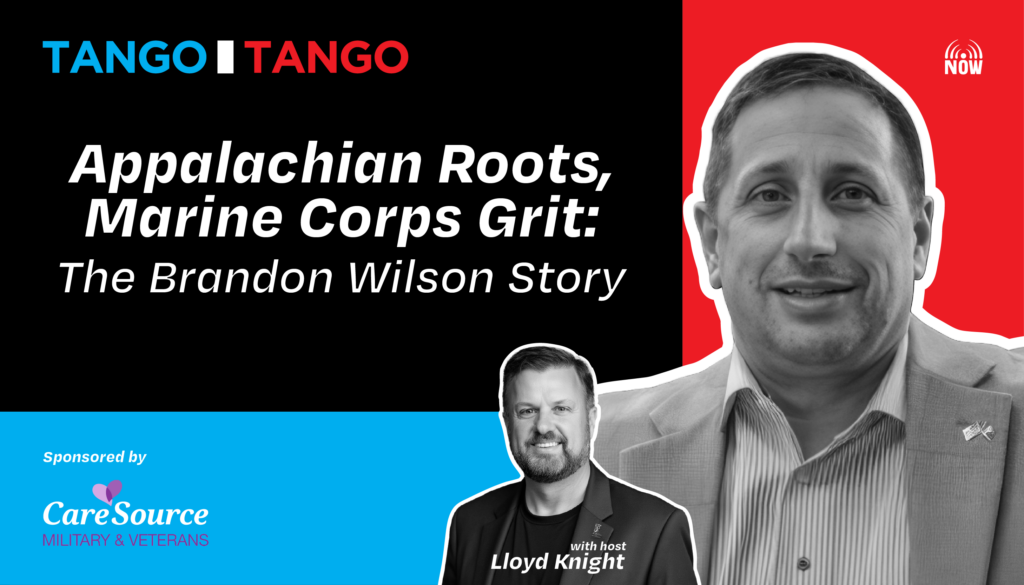
[00:00:42] Lloyd Knight: I’m your host, Lloyd Knight, and this podcast is going to be great. We have one of my good friends and fellow veteran leadership presidential scholar, Brandon Wilson. But before we get into that, I just got to thank my sponsors over at CareSource. So CareSource, you mean a lot to me. You’re not only hosting this podcast, but I’m also one of your clients and I’m absolutely loving the treatment I’m getting with CareSource. Brandon, welcome to the Tango Tango Podcast.
[00:01:11] Brandon Wilson: Awesome, buddy. Thanks. Glad to be here.
[00:01:13] Lloyd Knight: I’m really excited that Brandon’s on here for many reasons. First of all, Brandon is the biggest veteran advocate out there. He’s doing amazing things for veterans and their families in the state of North Carolina and nationally at all levels. And he’s like the Swiss Army knife. He can operate tactically like most Marines, but you can also put him in front of Congress and he’s going to testify and he’s going to get in there and make things happen. But really most of all, I’m excited is Brandon and I bonded on the bus ride, on our very first bus ride at the Bush Institute last year. And Brandon, do you want to let the viewers and listeners know how we bonded?
[00:01:56] Brandon Wilson: I’d sure love too, Lloyd. I think it was sort of divine that we even sat next to each other on that bus. And upon the conversation me and you talking, I think one of us said to the other one, “Well, it didn’t take you as long to get here as it did me. “ I was like, “Well, I don’t know. I think it may have. I actually think I took longer.” And come to find out both of us had applied to the institute not once, not twice, but three times before we were actually chosen. And so we sort of bonded a little bit over the fact that both of us have this sense of resiliency and persistence that we saw as a kindred spirit. Either one of us were willing to give up to get on that bus that day.
[00:02:37] Lloyd Knight: Yeah, your memory is short. We got shot down three times, bud. We applied four times.
[00:02:41] Brandon Wilson: I was going to say, I think it was three times being told no before the fourth time we got in.
[00:02:47] Lloyd Knight: We were going to burn the place down if they didn’t let us in the fourth time. I started feeling like the cheerleader that sat in the back of the parents’ car and getting the text messages that they were turned down each year. Where were you at when you found out you got accepted?
[00:03:03] Brandon Wilson: I was sitting right here in the office I’m in right now. I got the email in and part of me was like, it was a mistake. I don’t think they realized what they just did. Did I really get in or not? Are we sure about this? But I was really excited about it after being turned down three times previously and then the fourth time getting it. Because I thought after the third time, the third was a charm. I’m not willing to get in. And it wasn’t until my good friend, Kim Mitchell, who’s another presidential scholar when I talked to her and said they turned me down for the third time. This is in my cards and she highly encouraged me to apply again. And so I’m glad I did. I’m glad I got to do that because I never would’ve met you. I never would’ve met a lot of other awesome leaders and have learned so much from that institute.
[00:03:47] Lloyd Knight: I’m glad you got into … I think it was divine. As you mentioned, I think it was divine that we sat next to each other and bonded. Our fellow classmate, Mark Riley and Casey were bound. We’re guided by our faith. Yeah, I think it’s amazing. And I think you were such a good fit for the Institute. And one of the things about Brandon, so Brandon is from North Carolina. He’s going to tell a story a little bit. So I can honestly say folks looked at Brandon and they kind of blew him off at first. It was like he’s a Marine that tickled four times and he’s a redneck from North Carolina, but people quickly figuring out that Brandon is a powerhouse. Not only is he doing these big things, but he’s got all these amazing connections. Again, as I mentioned, you’re a Swiss Army knife.
[00:04:37] Lloyd Knight: You can operate in any room. And folks, the 36 classmates, including me, figured out very quickly that they shouldn’t underestimate you. And so we’re going to talk a little bit about your story and how you got to that. So as I mentioned, grew up in North Carolina. What part of North Carolina, Brandon?
[00:04:56] Brandon Wilson: Little town called Brevard, North Carolina, county of Transylvania County, not a big county seat at all. Small town, rural town. Manufacturing and farming was a big part of my bring up there in Brevard. I had a really good childhood. My grandfather was a deacon of a church for over 70 years. So faith was ingrained in me at a early, early age along with my grandfather and father raising me up. Hard work was a big piece of my upbringing. So I was really blessed. I was really blessed in a way that we didn’t have a lot, but we were rich if that makes sense to a lot of people in the world that understands what that means. I was grounded in faith. My grandfather served in World War II as an engineer on a B-24 liberator, dropping bombs on Hitler. My dad served in the Vietnam era in the Air Force.
[00:05:46] Brandon Wilson: He was not a Vietnam veteran. He served all his years in the military state side with the Air Force. My great-grandfather served in World War I for the Army. So we have a rich history of service. None of us were retirees. All of us just did our part of service and did our one or two term enlistments and come home to be servant leaders in our own local communities. But great childhood. I was fortunate enough to play a little bit of sports and I went to Appalachian State on a scholarship and that ended up not being the thing. As you’re well aware of Lloyd, I’m not exactly a large figure. I have a very Napoleon attitude about my foot fight on any good given day, but it was a great experience. I played sports, I hunted, I fished, I was in church, learned the value of selfless leadership and sacrifice.
[00:06:34] Brandon Wilson: And so that sort of just led my way into the Marine Corps and what I’m doing today and leading more myself to the community.
[00:06:43] Lloyd Knight: Well, we’ll get to that story. But first of all, I’ve got to say the real Rudy was a fraud. You are the real Rudy, my friend. It’s not scripted for Hollywood, man. You’re the real deal. So did you play football, Brandon?
[00:06:58] Brandon Wilson: I played football in high school, baseball, basketball.
[00:07:01] Lloyd Knight: So what position? I bet you were a linebacker, were you?
[00:07:04] Brandon Wilson: Sure thing. Yeah. I was more of a pump of Turner and free safety there, Lloyd.
[00:07:09] Lloyd Knight: Okay. I can see you- And that was
[00:07:11] Brandon Wilson: Dangerous.
[00:07:12] Lloyd Knight: I could see you hitting the snot out of people.
[00:07:15] Brandon Wilson: Well, I would try. I would try.
[00:07:18] Lloyd Knight: Yeah, that’s amazing. So you went to Appalachian State. What was your goal at Appalachian State? What were you studying?
[00:07:24] Brandon Wilson: The only reason I went to App State was to play ball. I’m young. I thought I was invincible. I went to App State to play ball and I found out really, really quick that that dream was over when you are as little as I am, regardless of how talented you may be or how much heart you got. Size and speed mean a lot. And so I was really fortunate though that I found that out in a way that wasn’t exactly the way I’d wanted to go. I got injured and realized I couldn’t play anymore. But at the same time, I had a really good friend of mine who was actually a professional hunting guide, a little older gentleman, and he told me, “Hey, come with me on your winter break and you can make a little extra bucks up in Michigan being a hunting guide with me and I’ll pay you.
[00:08:06] Brandon Wilson: “ And I was like, “All right, let’s do that. “ So I did that and that really turned into something that I thought, man, I can get paid to do something that I’ve done all my life, which was hunting. I’m just an old Appalachian boy. And so that led me into dropping out of Appalachia State at the time and going into a short career where I was a professional hunting guide and hunted all over the United States in Michigan, Wisconsin, upstate New York, New Mexico, the coast of North Carolina. And it put me all over the place doing something that I love to do, which was some great stories and just unbelievable people I got to meet along the way.
[00:08:39] Lloyd Knight: Show is your finger.
[00:08:41] Brandon Wilson: There’s my finger.
[00:08:45] Lloyd Knight: Yeah, hunting. So he’s got a great story. If you ever meet Brandon in person, tell him to tell you the story about how he got a finger. It’s the funniest thing that happened in our six months at the Bush Institute. It was a hilarious story at the end of a storytelling block and I can tell you Brandon is the master storyteller. So tell stories better than Andy Griffin. It was one of the funniest stories that I’ve ever heard, but I want to spend the time and get in to talk about your Marine Corps story. So what led you to join the Marines?
[00:09:23] Brandon Wilson: I was really, like I said, I was really blessed and I’d been a hunting guy for probably close to four, four and a half, five years when a childhood friend of mine, a Charlie Bagwell helicopter got shot down in Afghanistan. And when that happened, I come home for his funeral and I just got to thinking, my great-granddaddy served, my granddaddy served, my daddy served. My childhood friend who I grew up with just got killed in Afghanistan. I’ve got to give something back to this community. I’ve been so blessed. I’ve been healthy. I’ve been all over the country hunting for a living as a young 22-year-old, 23-year-old doing all that. And I’m like, “Man, I’ve got to do something.” So that prompted me to join. When Charlie got killed, it prompted me to join. So I went to a recruiting station and walked into an Army recruiter and said, “I want to go to Iraq.
[00:10:12] Brandon Wilson: That’s where I want to go. I want to fight. I want to get revenge on Charlie.” And he looked at me like I was crazy and pretty much said, “Well, you got to do this and you got to do that. And it’s going to take a couple weeks.” And I said, “I don’t think you understand, sir.” I said, “I want to go right now.” And he was like, “No, it’s going to take some time to get through that. “ So I walked out of his office, went to the next door down, which was a Marine Corps recruiting station, walked in there and I said, “Hey, the Army said it’s going to take me three or four weeks to get into the Army and get to Iraq. Can you do better than that? “ And they said, “You walked into the right place.” And I said, “Well, I ain’t kidding.
[00:10:44] Brandon Wilson: When can I go to bootcamp?” They said, “Well, we’ve got a bus leaving on Friday, and this was on a Monday.” And we pushed everything through and I signed up on that Monday and Friday I shipped a Paris Island. And so that’s sort of how it prompted me to get into the Marine Corps a little bit later in life.
[00:11:01] Lloyd Knight: That speaks to the Marine Corps for sure. They make things happen. I always say I love having Marine around me because you guys make stuff happen. I got to take into consideration that is never going to be how I would do it and just to stay out of your way and then I’m probably going to have my feelings heard as well. And then I think that speaks to your character and your personality, Brandon, in a crazy and a solid way as well. So you enlisted in the Marines as an infantryman?
[00:11:32] Brandon Wilson: Yes, sir. I actually went in. I went in open contract and it wasn’t until the end when they come back. And when you do open contract, that’s just dangerous. But I was thinking in my mind, I just want to go. I actually went in as a 0331 machine gunner and I tell people all the time that see me now, I was actually six foot six before I entered the Marine Corps and now I’m 5’5”. But I do think I struck a little since joining the Marine Corps. But yeah, I was a machine gunner my entire time in the Marine Corps. It was a good move for me at that point in my life. It was divine how I got there. I think it was good that I was a little mature. I had a little life experience in me. I think that helped. And I think what the Marine Corps helped develop was a little bit more structure, a little bit more clarity.
[00:12:14] Brandon Wilson: And I think that’s not just the Marine Corps. I think that was how God was working in my life during that time.
[00:12:20] Lloyd Knight: So where was your first studio sergeant?
[00:12:22] Brandon Wilson: A great place. It’s a great tropical place called Camp Lejeune, North Carolina. It’s actually probably should be, also could be considered a combat zone at times, depending on what Saturday night where you’re at. But I spent most of my time, Camp Lejeune, a lot of time in Camp Pendleton, California, spent some time in 29 Palm just because of the workups during the deployment times. Really didn’t have a home base really for a long time. We were moving deployment wise, we were in and out quite a bit. So got to spend some time just a couple times in Iraq, got spent some time in the Ukraine. This was before the Ukraine war, obviously, but I didn’t go anywhere tropical other than Camp Lejeune.
[00:13:01] Lloyd Knight: So Brandon and I would share stories. I would share Air Force stories. He would share Marine stories and it’s like the Air Forces from Mars and the Marines are from Venice. So it was so different. And I remember one of the stories you shared about one of your officers saying like, “Hey, can we have a formation for once where somebody’s not bleeding?”
[00:13:23] Brandon Wilson: That’s
[00:13:23] Lloyd Knight: An
[00:13:23] Brandon Wilson: Accurate statement, yes.
[00:13:25] Lloyd Knight: I was like, “What are you talking about? “ And there’s like, “Oh yeah, all the fighting.” And then Mark Riley, who’s one of our classmates, we get along really well. For those viewers and listeners, he was on the podcast earlier and he was in the band and he was like, “Oh yeah, we used to have formations where people fought.” I was like, “The band?” And he’s like, “Oh yeah, the Drummond Five Corps used to beat the crud out of the band.” So different. What was the best deployment you went on and then what was a deployment that was just horrendous?
[00:13:56] Brandon Wilson: My favorite deployment that one was in the Ukraine. It was something called Operation Sea Breeze. We spent a little over six months there doing joint training tactics with the Maldavians, the Ukrainians, the Macedonians. That was a really cool deployment because that was one of the one times I got to actually spend time with another nation and nations and that had a significant language barrier that we were all allies. And so it was really unique to see how much we had in common as just men serving their country and the time I got to spend in Odessa and the time I got to spend with all those different individuals. I thought that was a really unique experience there with the food that we ate, the time we got to spend on Libo together with one another. There’s some things that are uniform or universal when it comes to men who serve their country and that’s sacrifice and that’s a dark humor that we get.
[00:14:48] Brandon Wilson: It’s the ability to fight each other and still love each other at the same time and the competitive nature that existed amongst all our nations that were working together in that time. It felt like a breath of fresh air for me in my military service time to be with another group of service men and women that shared that and to be able to spend time with them like that outside of combat or deployment like Iraq. And so that was probably my favorite time. I would say one of the tougher times was when we were drawn down out of Iraq. I was attached to a reserve unit at the time and we were winding down the war in Iraq. This was in 2009 and the rules of engagement had changed significantly to where I felt like it was really more unsafe than anything and there was a lot of downtime and I think that traumatized more of our Marines than if we were actually engaged in mission and being mission centric.
[00:15:41] Brandon Wilson: I think that that downtime and that drawdown time and rules of engagement were changing, that transition made it very, very difficult for a lot of the men and women that we were serving with at the time.
[00:15:51] Lloyd Knight: So Brandon, how many years did you spend in the Corps and why did you decide to get out?
[00:15:56] Brandon Wilson: 12 years. My last deployment, I got home and got married. Me and my wife bought a house on the VA home loan, which sort of prompted me into the career that I’m at now. My wife got pregnant and I’d done infantry the entire time and I just didn’t want to be in infantry no more. You spend that long in the Marine Corps and the infantry, you realize things didn’t change. I wasn’t the man I was when I went in when Charlie got killed. I was married, I was getting ready to have a child, just bought a home and I just decided like I can’t do the infantry no more. I want to get out of the infantry. And the Marine Corps at the time weren’t willing to work with me. And it’s always the needs of the Marine Corps, the needs of the nation and I couldn’t get a lateral move out of the infantry no matter what I did.
[00:16:39] Brandon Wilson: And so my contract was up. I dropped to my R time and I got out. I don’t regret it. I would’ve stayed in longer if given the opportunity. But once again, I think God’s just had his hand on me throughout my whole life in a way that’s blessed me. And so it happened for a reason and if it not happened that way, maybe something would’ve went a different direction in my life, but I think I’m exactly where I need to be right now because of that.
[00:17:02] Lloyd Knight: And so did you move back home?
[00:17:03] Brandon Wilson: Yeah. Oh yeah. I’m probably about 45 minutes from where I grew up in a little town called Waynesville, North Carolina. Me and my wife have been there for the past 17 years.
[00:17:12] Lloyd Knight: Yeah, great. So what did your transition look like?
[00:17:15] Brandon Wilson: Transition is difficult. I think transition is difficult for a lot of people. And for those of you who have listened to and have heard or have read anything from Sebastian Younger, I think he puts it in perspective 100%. And I think that when I got out of the Marine Corps, I was lost. You don’t know where you fit back into society and when you lose that brotherhood and sisterhood, which that’s the big thing that people have missed, I think with transition is the military, you have a brotherhood and sisterhood and that’s not tied to an emotion, that’s tied to being part of something bigger than you are and the mission at hand. Whereas friendship is tied to an emotion. It’s, I like you, Lloyd. I think you’re great. The more I hang out with you, the more I like you, the more that we hang out and the more I like you, the more I want to be around you.
[00:18:00] Brandon Wilson: That’s an emotion tied to that where I think brotherhood and sisterhood’s the opposite of that. It could be, I don’t like Mark Riley. I don’t like the fact that he’s taller than me. He’s better looking than me. He was a sergeant major. He can play the drums better than me. I don’t like Mark Riley. I really do, but I’m just using this as an example. But I feel safer and know that in a situation whether we’re out at a restaurant or we’re out in the community, I feel safer knowing if something was to happen, he’s got my back no matter what and I’ve got his back no matter what and we don’t even like each other. So that level of trust and brotherhood and sisterhood, I think Sebastian Younger talks about it better than me is what is missing in transition. And so you feel isolated, you feel withdrawn, you don’t know where you fit into your community.
[00:18:44] Brandon Wilson: I was no different. Nobody’s immune to that. I didn’t know where to fit in. I was cutting meat at a food line, grocery store, trying to figure out what I’m going to do with my life. And I got turned down to getting a sponsorship to go to a police academy and I just didn’t know what I wanted to do and you get to drinking. It’s part of the thing in the Marine Corps. They really, I won’t say they promote it, but it’s a part of that culture and you find solace there and walked into a veteran service office to get that home loan that me and my wife were looking to buy a house and tripped and fell into a Beirut Lebanon Marine, Ronald Putnam. And he said, “What’d you do in the Corps, boy?” And I told him I was a machine gunner and he talked me into filing a little bitty petty disability claim, which was not what I was after at the time, fed that claim and got my home loan stuff squared away.
[00:19:31] Brandon Wilson: And it was about two or three weeks later, he called me up and offered me a part-time job. I was like, “Well, I can get on with this. I can work my angle and hustle for a couple days during the week at this county service office and work the weekends at Food Lion still and work seven days a week because I was hustling. And turn to find out I really liked helping veterans and learning how to file disability claims and 10, 10 easy forums to get into the VA hospital systems and navigating all that for other individuals and offered me that part-time job. And that’s sort of what launched me into my career. During that same time though, I was struggling and if it had not been for my wife really setting me straight on what I wanted out of life and to get me back on track with some mental health and stopping the drinking as much as I was.
[00:20:16] Brandon Wilson: And once again, God put in my path, Ronnie Putnam and gave me a job and give me a career and put me on a new trajectory of a new mission that I had. And that was helping my brothers and sisters who had served in the military. Fast forward, he left to go work for the state and a director position opened up and I was offered to app and I applied, didn’t think I was going to get it. There was over a hundred applicants. They interviewed close to 15 individuals and for whatever reason, they picked this little short Marine to run that office. And that’s how I started as a County Veteran Service Director for Haywood County and did that for five years before I went to work for the state.
[00:20:50] Lloyd Knight: I want to talk about a Marine Corps officer that stopped into your office one day and he just signed his name on the entry log and to come see you. Can you talk a little bit about who that was?
[00:21:04] Brandon Wilson: Yeah, it was a Thursday mid-afternoon and I’m sitting in my office and I had a no-show actually happen with a veteran that was coming to see me. So I was getting caught up on some paperwork there and a guy come in to my secretary there and asked to speak to me and rode his name down and she said, “You have a visit. You got time.” And I said, man, I’m really trying to get caught up with paperwork, but I never said no to anybody that wanted to talk to me. So she sent him over and he opened the door and it was former Marine Corps commandant, General Carl Mundy. I was still fresh out of being out of the military and I popped to attention as soon as I could and it was sort of in like this shock and awe. And he said, “I’ll sit down, sit down.” And we had a great conversation.
[00:21:48] Brandon Wilson: He had heard about some of the great work I was doing for our veterans there in the county. His wife was from Haywood County and that conversation led to a breakfast, which led to a lunch, which led to a couple dinners with his wife and my wife together, his favorite Italian joint Pasquale’s there in Hazelwood. And he become a mentor of mine and he was a mentor of mine for pretty much three years. We talked on a regular basis when I decided to take a move up to the state of North Carolina. We talked about that and he really helped me a lot. I would say not just with my professional development and my career path, but personally in my transition, I think he really understood transitioning out of the Marine Corps into the civilian sector, what needed to happen. And I look back now and can surgically dissect conversations that me and him had and where he took them and now I can see exactly what he was doing to set me up for success or make me feel a certain way about my life decisions.
[00:22:45] Brandon Wilson: And so eternally grateful for General Mundy, funny story about him at Pasquale’s one night. My wife was pregnant, funny man, he said, “You know what you’re having yet?” And I said, “No, we haven’t decided yet if we’re going to find out or not. “ And my wife, she was pretty pregnant at the time. And he said, “Well, you want to know? “ And I said, “Sure.” He said, “Well, look,” he said, “This is going to sound odd.” He said, “But if you let me rub your wife’s belly, then I will let you know if you’re going to have a boy or a girl.” And of course, his wife was slapping. I’m like, “You can’t do that. “ My wife looks at me real funny. I was like, “You let the general rub whatever he wants to. This is the command.” And so sure enough, he rubbed her belly a litle bit and he said, “You’re going to have a girl.” It was about three months later, Daisy Gail Wilson popped out and it was a girl, sure enough.
[00:23:31] Brandon Wilson: It’s just a funny story about General Mundy. He meant a lot to me in my life, still does. And Lloyd, you were with me in Washington DC. Every time I’m in DC, I go to the Army Navy Club and there is a huge photo and portrait of General Mundy that’s been in there for a long time. And every time I’m in DC, I make it a point to go by there and visit General Mundy there with his portrait. I get a picture with me and him. He is buried in Waynesville where my hometown is and I go see him once or twice a year at his grave site, but in DC, always get a picture with me and him on the wall there and send it to both his sons.
[00:24:08] Lloyd Knight: And that was real special to me. So at the Bush Institute, there was a handful of really, really, really special times. One was me and Mark walking midnight in the mall area visiting all the Christian tunks that were set up. And then another one was going with you to the Army Navy Club. We started off with a group of about 15 of us having dinner and then me and Brandon started to look for the portrait because they moved the portrait. Yeah. If you haven’t been to the Army Navy Club, this place is humongous and multi-floor. And so me and Brandon are looking everywhere for this portrait and then we’re asking people and the two of us were the last two standing.
[00:24:48] Brandon Wilson: Yep. But we found them, didn’t we?
[00:24:50] Lloyd Knight: We found them and you told me the whole story and man, that was really special for me as well. So you’re killing it in the state agency there, you’re helping a lot of people. Can you talk about the next role? Because the next role was really a big move up, not only a big move up professionally, but a big move up on scale and the service you were providing and the number of people you were helping.
[00:25:16] Brandon Wilson: I was real fortunate. I spent a lot of time learning VA law and different ways to get veterans their benefits. And at the time the Camp Lejeune water contamination was really, really young. This was in 2010 and there was a lot of things that were still bubbling up, had not become a presumptive condition yet. And I was really fortunate to work with former North Carolina US Senator Richard Burr and some of his committee that he had tasked with trying to figure out what is going on with the Camp Lejeune water, what needs to happen to get the VA to see this as a presumptive condition. So I worked really, really hard on that committee and did a lot of stuff on the background with the Agency of Toxic Substances and Disease Registry. I was winning those claims as a veteran service officer before it was presumptive.
[00:25:59] Brandon Wilson: And so worked a lot with Louisville, Kentucky’s regional office. That’s where most of those claims were done at the time. And it really put me on the map a little bit of how we help rural veterans. And it was one of the times I got to testify before the House Veterans Affairs Committees on rural healthcare and the Camp Lejeune stuff. And there was a gentleman there that was running for the governor of North Carolina, Mr. Pat McCrory, reached out to me after he’d heard that testify. And he said, “When I win governor, are you going to come work for me? “ And I’m like, “Ah, whatever. I’m going to go back to Waynesville and do my thing.” And sure enough, he become governor. And it was shortly after that, I went to work for him, went, worked for the state of North Carolina for the division of Veterans Affairs, was really fortunate to work for another amazing two-star general, Cornell Wilson, as we worked to make the division of Veterans Affairs into the Department of Military and Veterans Affairs.
[00:26:49] Brandon Wilson: So I was really fortunate during that time to work with Mr. Alario Pantano, General Cornell Wilson. We helped develop and take a division of Veterans Affairs and turn it into a true cabinet level agency in the state of North Carolina was a real big part of that. I got to be assistant secretary for Veterans Affairs where we were able to make some really big changes in North Carolina and got to really push projects like the Wartime Veterans Scholarship, the property tax exclusion that existed in North Carolina was a big part of that. The disabled veteran tags in North Carolina was a big part of that. And in training, that was when fast track claims and fully developed claims were being brought up. I got to be a real big part of some of what that looked like with Secretary Shinseki and others at the VA.
[00:27:32] Brandon Wilson: And so it really put me on the map a little bit on how to make change and how to make systems change at a macro level. I can really see that you can make a lot of changes in people’s lives at the county level, which was great and it was really rewarding. But as I have continued to grow up, I think seeing the opportunities to change policy, to change law and to make decisions and to push initiatives that not only change one person’s life, but changes thousands of veterans’ lives and household lives by the work that you do takes a little bit more time. It’s a little bit of a slower burn than seeing it upfront and just filing a claim. But I think that that’s where change is made. And I think that’s where great leaders that I’ve had the opportunity to work with, to work for, to be mentored by has really instilled in me and that is to continue to push systems level changes because that’s where you can really see a lot of change in the way that our veterans community is transitioning out of service and continue to transition after service.
[00:28:33] Lloyd Knight: Yeah, it’s amazing. And you were doing huge things and you can correct me if I’m wrong on this, take the story where it needs to go, but if I remember right, the governor was not reelected.
[00:28:46] Brandon Wilson: Yeah. Well, he was not reelected on some stuff on some foundations and principles that he stood on. I’ll say that I was a little naive when I took that appointment because I figured that veterans was a bipartisan kind of way to look at things and I would be safe, but it is not. If you were appointed by a Republican governor, you are a Republican and if you’re reported by a Democrat governor, you’re a Democrat, no matter what your party affiliation is. And it was unique because Governor Cooper, who come in behind him was going to terminate me because of my political affiliation and I knew him. He was our Speaker of the House. I have a great relationship with him. He’s no longer our governor now. He’s moved on and running for Senate now. But I think it is funny how things work. I was going to be let go of the agency and then ended up being a senior advisor for one of his new teams where I got to sort of put the nail to him a little bit on a couple times.
[00:29:39] Brandon Wilson: And I was like, “Sir, if you’d have just kept me on staff, you could tell me what to do, but you can’t tell me what to do now, all fun.” But there’s a mutual respect and a deep respect for one of both of us. But I think it was a part of God’s plan, Lloyd. I think that when I left that position, I was able to do some freelance consulting for a little bit, went to work for a local management ended Steve for a little bit, but more importantly, applied for a grant for an organization that was not working for at the time against the Asheville Buncombe Community Christian Ministry and Reverend Scott Rogers, the CEO there, which is a faith-based nonprofit. He called me up during that grant application and said, “Brandon, if you guys win the grant, we want to support you. We want to be alongside you and be a part of that grant.
[00:30:24] Brandon Wilson: However, if we win the grant, I want to offer you a job to come to my team and work for me. “ So Lord, it’s the only grant that I’ve ever applied for that I knew I was going to win no matter what. And I did not win the grant for the organization I was working with at the time. I actually lost, but three weeks later, I come to work for ABCCM and I think that’s exactly where I need to be today. Faith is a big part of my life. When I worked for the state of North Carolina, I actually got sued twice for praying in a public setting because there is such thing as separation of church and state. And I can say right now today at ABCCM, we start every meeting with prayer. We end every meeting with prayer and nobody’s looking to sue me for prayer anymore.
[00:31:03] Lloyd Knight: I love how the tide’s turning. We’re seeing NFL athletes praying openly now. I was just at a promotion ceremony for a good friend of mine who pinned on Fullbird Terminal and was very happy that that promotion ceremony started after the national anthem. We had a prayer. And it’s all because of people like us that are not afraid of it. So talk a little bit about what the organization does.
[00:31:29] Brandon Wilson: Yeah. So faith-based nonprofit, we’ve been around since 1969 and way before I even got here. I’m definitely standing on the shoulders of a lot of men and women who come before me here. We are a larger faith-based nonprofit. When most people think of faith-based nonprofits, they don’t think of really large scale, but we have about 400 staff on our team. We have offices across the state of North Carolina from Asheville to Fayetteville to Charlotte, Raleigh, Jacksonville. We have a pretty big portfolio of programs for veterans from housing to employment to suicide prevention to care coordination. But we also have another side of the house where we also provide for civilians as well. And we have four crisis ministries, a jail and reentry program. We have two other transitional housing facilities in addition to our large veterans facility. We have a free medical clinic and it’s not a federally qualified health center.
[00:32:21] Brandon Wilson: I like to always say that. It is a true free medical clinic providing care to those most in need. And so about half of our portfolio is veteran household facing. We’ve grown into that as we have continued to scale programs where the need goes. So really fortunate to be where I’m at right now, surrounding myself with a lot of amazing leaders, some of which are retired colonels, some of which are Lance corporals from the Marine Corps and a lot of them are family members, but it takes a true melting pot for all of us to work together in order to provide the best care we can for our communities.
[00:32:54] Lloyd Knight: We had a lot of discussions to talk about the flooding that happened up in Asheville and that area. And can you talk a litle bit about how your organization stepped and helped with that? And it’s out of the news now and then it’s unfortunate out of the news now because I know a lot of people are still struggling. Can you talk about that as well?
[00:33:13] Brandon Wilson: Yeah. So we were really fortunate not to lose anyone during the hurricane here at ABCCM or was under our care. Our Veterans Restoration Quarters is a 250 bed facility located right next to the Swananoa River. Even though we were outside the 500-year floodplain, up to eight feet of water come into our own space and all of our veterans were evacuated that morning in September. And so they were displaced. Luckily, no one was injured. Everybody’s okay. We took a place in the community. We had two warehouses, one being a larger warehouse, so we activated our churches. We have close to 6,000 unique volunteers a year that comes through. And to see not just ABCCM and what we were able to provide, but how organizations were working together during that aftermath to support individuals, it was remarkable. We had people from New York and Alabama and Florida and all over the place that were sending supplies to our warehouse so we could then deploy them out to those most in need.
[00:34:13] Brandon Wilson: We worked really closely with the state. We worked closely with FEMA, but it was just really an interesting time. The amount of devastation that we saw that we experienced was, it was cataclysmic. I mean, I’m just going to say that it was hurricanes aren’t supposed to happen in the mountains, Lloyd. But we were lucky we are rebuilding the VRQ. We have been really fortunate, I will say that both HUD and FEMA as aggravating as both those agencies can be, we have gotten to a positive resolution with both of those. We were able to purchase a hotel across the street from the VRQ at the time, that’s where all of our veterans are at now. We’re still able to keep the VA grant per diem program intact and being able to keep the integrity of that program going while we are working on rebuilding. FEMA has obligated over 90% back of public assistance for the VRQ with a pretty sophisticated flood mitigation plan that we’re working with that as well.
[00:35:09] Brandon Wilson: And so we’re hoping to break ground on that actually in the next 30 to 45 days and hope to be back in it by next fall. Really fortunate during the hurricane, a lot of great things come out of the hurricane that we were not anticipating. The community coming together like anything else, much like nine eleven that happened. It’s amazing how the community come together on one common goal and one common purpose. I do think it’s a shame that sometimes it takes something major like that or a traumatic event to happen for our nation to come together and communities to come together. But when it does, it’s a beautiful thing. And so we want to ride on that wave and keep that momentum going and just keep that same kind of positive energy and collaboration moving in Western North Carolina. And I think it will. I think that one of the things about Appalachian folks is that’s who we are and it’s our nature.
[00:35:58] Brandon Wilson: We’ve had to go without for so long we’re used to it. Let’s figure it out together. But yeah, we were real fortunate during that time period.
[00:36:05] Lloyd Knight: What are the greater needs now of the Western North Carolina area?
[00:36:09] Brandon Wilson: At the end of the day, affordable housing is a thing. We have lack of housing, much less lack of affordable housing. And so one of the things that ABCCM has taken, that’s why we’re rebuilding the VRQ. And so we’re going to rebuild the VRQ, which is going to create 242 transitional beds, another 65 emergency beds. And with the approval from HUD with the hotel that we just bought, we’re going to have 134 permanent supportive housing units for veterans. And so when you add all those numbers up, you’re pushing on over 400 beds for male veterans as one project. We also have other projects going on with our women and children’s facility. We’re adding 68 more transitional units there and we’re going to add 35 permanent supportive housing units for our females and females with children. A lot of those beds we have at Transformation Village now, which is our female facility.
[00:36:58] Brandon Wilson: A lot of those beds are dedicated beds for female veterans. 20 of those are female veteran beds, but we always have more than 20 female veterans there. It’s just we have 20 dedicated for female veterans. And so I would just say this, continue to think about how you can support Western North Carolina. This recovery effort that we’re in, we’re open for business, but there’s still places and pockets in these hollers that don’t have power. There are still places two years later where bridges have not been rebuilt. There’s people that we take veterans right now that we actually take generators to, multiple generators because generators aren’t meant to run all the time. And so we’ve had to take multiple generators and they’ll run a generator for one week, cut it off and turn the other one on for a week. These are Appalachian hills and hollers where you wouldn’t know they were at even if there was a road there.
[00:37:45] Brandon Wilson: And so continue to keep North Carolina in your prayers, Western North Carolina, your prayers. If you want to get involved, we’d love to show you. It don’t have to be just ABCCM. We are community minded, community based, and it’s taken all of us to get together, but you can obviously anytime visit our website at abccm.org and learn all about that or reach me or reach our team to how you can get involved. Everybody that sends $10 goes a long way in this community. And so there’s nothing less. But the biggest thing you could probably give to us, Lloyd, that I would say is to uplift Western North Carolina in your prayers every night and the people who are here.
[00:38:23] Lloyd Knight: Yeah, absolutely. You’re like me. You’ve got more job titles than the Pope. You’re now a chairperson for a Congressional Veterans Advisory Committee for US Congress. Can you talk a little bit about that?
[00:38:34] Brandon Wilson: North Carolina’s 11th District Congressman currently is Chuck Edwards. I have sat on this congressional committee several times. I sat on it with Blue Dog Democrat, Congressman Heath Schuler, who was a great Tennessee Football Hall of Famer from Swain County. I was fortunate to sit on his congressional committee for a while. He was a awesome individual to work for Congressman Mark Meadows, Trump’s former chief of staff held this seat for a while. I was on his congressional committee and now the seat is held by Congressman Chuck Edwards and it’s a renewed and revamped committee. I think it went several years without it even being in existence after Congressman Meadows left office. For lots of reasons, it did not ever just reactuate itself. I think Congress Edwards reached out to me and said, “Hey, can you lead this effort again since you’ve done it before?” And so I think one of the things, Lloyd, that I’m going to continue to do is regardless of what congressmen is in office, this is a veterans subcommittee on work and congressional committee to support veterans and rural veterans at that in Western North Carolina.
[00:39:38] Brandon Wilson: And so part of me is sort of like taking this by the horns now and saying, if Chuck Edwards, you’re not in office next year or two years from now or five years from now and it’s somebody else, the committee’s still going to be in existence. And I think that’s just being leaders and you don’t have to wait on a politician to have a committee. I think you just take it by the horn and just make it what it needs to be. And when he or she gets into office, you just let them know this is the committee. And we’re sort of thinking about being self-governed in that way, but the idea is to actually give Congressman Edwards raw information about what’s working at the VA, what’s not working at the VA, what are the true needs of veterans in Western North Carolina. I think too many times Congress and VA both will allocate resources and funding to problems that don’t really exist in the ecosystem because they’re looking at data that was data three and four years ago.
[00:40:31] Brandon Wilson: So the more that we can be real and in time with our feedback, with our voices that can help push that resource allocation or funding to organizations to actually address the right things, the better off our veterans community will be. And so that’s sort of what this committee is looking at right now and working with the VA. The VA’s a part of the committee, but it’s a good makeup of folks. We have spouses, we have service members, we have retirees, we have just old grumpy old Marines like myself who just did a sitting time. So it takes all of us, I think, coming together to talk about those things. So yeah, excited about the committee. Just like you said, Lloyd, one of the many hats that both of us wear to help our veterans communities.
[00:41:11] Lloyd Knight: Yeah. Awesome. Amazing. I know both of us have struggle fighting time to relax, but when you do have time, what do you like to do to relax? What are some of your hobbies?
[00:41:22] Brandon Wilson: Well, if I could be anywhere right now other than with you, Lloyd, right now on this podcast, it would be on my boat in Charleston, South Carolina. I have a little center console boat, not a big boat. It’s a little 25 foot little center console boat and I love having it on the water. I like the saltwater better, but we do take it around the lakes here in Western North Carolina quite a bit. But that’s the one thing that I love for me, just personally me from my space. Outside of that, I’m a soccer dad. Both my young girls, my 10-year-old and my 14-year-old are soccer players to the core. And so most weekends we are on the field and I’m hanging out watching soccer all weekend and going to games all over the region. But the boat’s the place that I find my solace.
[00:42:05] Lloyd Knight: Tell our listeners and viewers when you started saving for that boat and then when you purchased that boat.
[00:42:13] Brandon Wilson: I started saving some birthday money when I was 16 years old. I’d always wanted to have a center console boat my entire life and I knew it was expensive. And like I said, I come up with humble beginnings. And so I started saving at 16, birthday money here, tax return here, deployment money here, just hit and miss. And I’d say I’ve had my boat now for close to nine years now, but it took me from 16 to about 38 before I was able to buy the boat that I wanted. And it’s the only thing that I own outright, Lloyd. Everything else in Follow Pieces, I own it, but it is only in my name. Everything else is in my wife’s name and my name, but the boat is in my name. And so my grandfather taught me the value of saving money. And so I think that’s a valuable lesson I hope I can give to my girls.
[00:43:01] Lloyd Knight: And I bet you take real good care of that boat, don’t you?
[00:43:04] Brandon Wilson: Oh yeah. I pay every year to keep it in Charleston, South Carolina in a climate control garage, but just because it’s the one thing that I treasure that much is the material.
[00:43:15] Lloyd Knight: Yeah. I know if you work for something really hard, you’re going to take care of it. I have a pontoon boat that I bought last year, Brandon knows the story. And so you go into that marina, there’s these beautiful expensive boats that are just falling apart because people don’t take care of them. And I’m the kind of guy I’m putting the protectant on my seats every time I go I’m wiping them off every time when you’re from a working class and you have to save money to do something like that. That’s awesome, brother. Well, it’s been so great. I’m not going to say to get to know you because I know all these stories already because we are able to spend some quality time. I can’t wait until I get up to Asheville and come see the facilities and then meet your family. So that’s going to happen in the future.
[00:44:02] Lloyd Knight: But before we close it out, what advice can you offer to a veteran that is maybe struggling right now?
[00:44:08] Brandon Wilson: You went into the military. You’re way more capable of doing great things in the civilian sector and in life in general than you think you are. I think that the confidence that the military instilled in you should just carry you into this transition and know that. Find a mentor. That’s the one thing that I think that really helped me. I was really fortunate to have General Mundy at such an early part of my transition, but look for a mentor, look for another veteran who’s been there that’s done that and attach yourself to him or her and ask questions and let them guide you and be open to that. I mean, if anything else, it’s a conversation that you can have with a brother or sister in arms that you don’t have to worry about judgment. You don’t have to worry about some bias. And you can tell some of those dark jokes too and they’re not going to look at you crazy because they get it and they’ll laugh out loud.
[00:44:58] Brandon Wilson: And so I think that finding that place is important. So I would just say keep the faith, find a mentor and find your place because this country today needs more veterans in leadership positions. We need more veterans in C-suites. We need more veterans in politics. We need more veterans in any leadership position in the community because I think there’s a sense of common sense that you have and a strength that you have to make this country a better place and where it needs to go. And so that’s what I would say. I would say be strong in who you are, be confident in who you are and find your new trope because it exists.
[00:45:34] Lloyd Knight: Great advice, Brandon. And we need more veterans like Brandon Wilson, whether they’re in Western North Carolina or in New York City, we need more Brandons. So with that, I’m going to end the podcast like I always end it. Be like my friend, my good friend Brandon Wilson, be safe, be kind and be remarkable
[00:45:56] Voice Over: The Tango Tango Podcast is proudly sponsored by Supply Chain Now. Join the Tango Tango community for more inspiring stories. Follow us on Facebook, X and LinkedIn. Subscribe to the Tango Tango YouTube channel and follow and listen to Tango Tango wherever you get your podcasts.