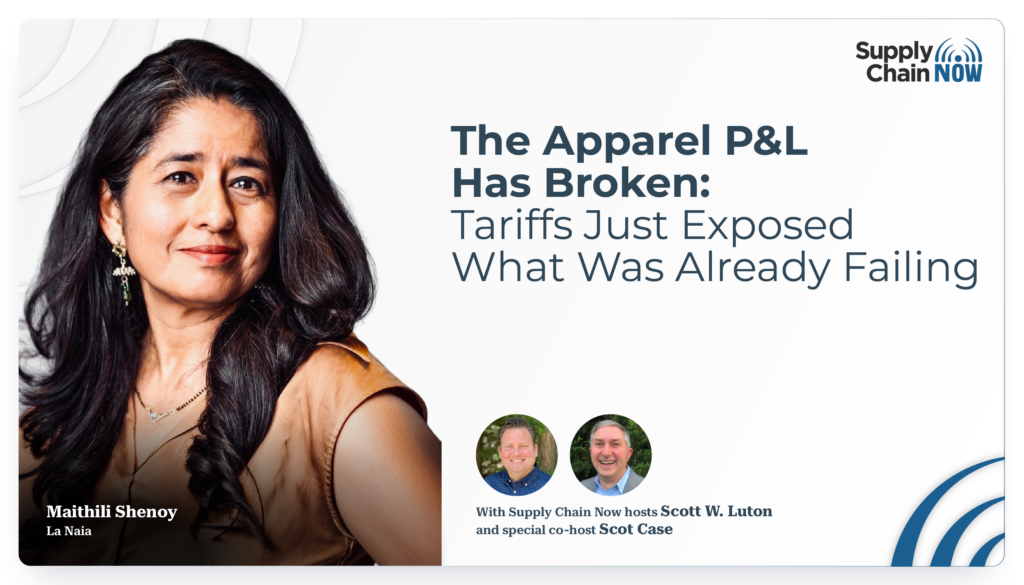
[00:00:00] Maithili Shenoy: When you have excess inventory, you have to clear it out, which requires reductions, and that’s what results in markdowns. But also what it does is it destroys your gross margin dollars. Now, you may say you’ve planned for it, but like I mentioned, it actually has a domino effect where one, it’s continues to strain your margins, but also you’ve gotten into a place where your clearance channel cannot absorb all of this, and so it lands up in landfills, which is why about 120 million metric tons of textiles.
[00:00:28] Maithili Shenoy: That’s about a hundred billion garments. Actually make it into landfill every single year.
[00:00:34] Voice Over: Welcome to Supply Chain Now the number one voice of supply chain. Join us as we share critical news, key insights, and real supply chain leadership from across the globe. One conversation at a time.
[00:00:46] Scott W. Luton: Hey, good morning, good afternoon, good evening, folks.
[00:00:49] Scott W. Luton: Wherever you may be. Scott Luton and special guest, co-host Scot Case with you here on Supply Chain. Now welcome to today’s show. Hey Scot Case, how you doing, my friend?
[00:01:00] Scot Case: I am doing well, Scott. It’s great to be here. I’m really looking forward to this conversation today.
[00:01:05] Scott W. Luton: Me and you. Uh, I tell you what, the last time you joined us was fantastic.
[00:01:10] Scott W. Luton: This could be as equally fantastic or maybe even better, who knows? But folks, today we’ve got a great show teed up. We’re gonna be featuring an industry dynamo that’s truly move mountains, especially in the retail and apparel space. Now we’re gonna be addressing two key questions today and more, but the two key questions, does the longstanding apparel operating model that’s in play really across industry, does it still work today?
[00:01:36] Scott W. Luton: And even better yet, what would it take to fix it? We’re gonna touch on a few examples of organizations that have taken a much different approach than many, and we’re gonna get a snapshot of what. Is to come. All that and much, much more. Stay tuned for a fascinating discussion now, Scot Case, always a pleasure to work with you and collaborate with you.
[00:01:54] Scott W. Luton: Love when you join us here and I tell you, I love your expertise, your what I’ll call savvy perspective and maybe the best of all your sense of humor. Are you ready for this discussion?
[00:02:05] Scot Case: Oh, I am absolutely ready. Sure.
[00:02:08] Scott W. Luton: So let’s waste no more time. Folks stick around for a great conversation. It’s gonna offer up tons of actionable insights by the truckload.
[00:02:16] Scott W. Luton: So I want, wanna welcome in, our wonderful guest joining us here today. Mighty Shenoy brings three decades of enterprise scale experience to the table, including executive leadership roles at Nike and Target now at Nike. This included leading inbound inventory prioritization during COVID era supply chain disruption and commercial expansion in the into emerging markets, meaning establishing new trading terms in Brazil and India, navigating trade backlog in Argentina, and restructuring operating models in Brazil and Mexico.
[00:02:50] Scott W. Luton: Now at Target. Mildly restructured a 40 plus private label sourcing network ahead of tariff escalation, growing Nearshoring share to deliver a hundred. $50 million in mitigation. She currently serves as a board director and strategic advisor, where one of her many immense passions is being able to balance profitability with sustainability.
[00:03:15] Scott W. Luton: I wanna welcome in Mighty Chano, founder and CEO with Lana, uh, Lanaya Collective mightily. How you doing my friend?
[00:03:24] Maithili Shenoy: I’m doing great, Scott. A pleasure to be here.
[00:03:26] Scott W. Luton: Well, I’ll tell you, me and Scot have had this date on the calendar circled in red with some exclamation marks. So Scot, we’re delighted to have Maithili with us, huh?
[00:03:36] Scot Case: Oh, absolutely. I’ve been looking forward to this conversation ’cause she begins with like such a provocative statement. I, I’m just, I’m dying to, to, to, to kick this conversation off.
[00:03:47] Scott W. Luton: Well, you know what, Scot and mildly we’re gonna start in maybe some of the most unlikeliest of places with our fun warmup question, because I don’t think I have brought up a topic like dancing in a long time on an episode, but mildly, you know, it’s not just like fun on the weekends going to a concert and dancing.
[00:04:07] Scott W. Luton: You’re a trained, uh, a trained dancer and instructor. Tell us more mildly.
[00:04:13] Maithili Shenoy: Uh, sure. Well, I started dancing when I was four. Uh, but I’m actually a trained Indian classical dancer. Uh, and then of course, if you are a an Indian dancer, you also do Bollywood. Uh, and so that’s how I started doing Bollywood. But I, I actually went to school in New York, so I had the opportunity to choreograph, uh, the Miss India universe is a few times, and that was super fun.
[00:04:34] Maithili Shenoy: And now, well fast forward later. I live in Austin now, so now I just do Bollywood dance choreography for fun, uh, and for friends, uh, kids’ weddings now.
[00:04:44] Scott W. Luton: Well, gosh, the Miss Universe pageant, I mean, for you to choreograph that, uh, I bet intense pressure you had to, everybody had to nail the moves. You had, you had a lot of pressure to deliver in something like that, huh?
[00:04:55] Maithili Shenoy: Yeah, it’s very similar to a supply chain orchestration, if you kind of think about it.
[00:05:01] Scott W. Luton: All right. So Scot, I think we both got a kick out of her analogy there. Um, but dancing is not a, um, uh, is not new to you either. I think last time, couple last times you joined us a few years back, we talked about our daughters and Taylor Swift concerts that that may involved some dancing Scot Case.
[00:05:20] Scott W. Luton: Huh?
[00:05:21] Scot Case: Uh, there you go. So, you know, I, I’m the, uh, the more, you know, rather than the professional trained, I’m more of the, you know, um, standard dad dance. You know, I can do the little, little shoulder shake in the head nod. Um, but I have to say I absolutely love the classical Indian dance. We’ve got some amazing, uh, friends and, uh, I’ve gotten a little bit of exposure and we’re really looking forward to those, uh, those girls getting married.
[00:05:46] Scot Case: So,
[00:05:47] Scott W. Luton: um,
[00:05:47] Scot Case: yeah, so, so now I know who to go to to learn to dance for the Drew. That’s right, absolutely right there. We’ll talk supply chains and, and dance steps.
[00:05:58] Maithili Shenoy: Just think you’re orchestrating a supply chain, Scott. That’s all you need to do.
[00:06:01] Scott W. Luton: Love it, love it. We got a new go-to, uh, Scot Case. Got a new go-to. Um, alright.
[00:06:06] Scot Case: Absolutely.
[00:06:07] Scott W. Luton: So we’ve got so much more to get into here today and, and mildly I’m so glad. Uh, you know, we, we’ve, we um, we were on a panel together a couple years back and I really enjoyed your perspective then. And then we reconnected a couple months ago and you shared some of what we’re gonna be talking about here today and I was like, man, we gotta get this on the show and better yet, I gotta get Scot Case to join us and we’re gonna have a great conversation.
[00:06:28] Scott W. Luton: So I wanna level set because I shared. You know, uh, in your introduction, which could have been 20 minutes long, I shared just a couple of highlights. Um, if you would share mildly some, uh, a couple of the leadership roles maybe I didn’t touch on, or, or aspects of them I didn’t touch on that really impacted your journey and of course your worldview.
[00:06:50] Maithili Shenoy: Uh, well, a couple come to mind. You did touch on this, but, uh, when I think about the role that I had with, uh, Asia Pacific, Latin America, and Africa, all of that in one geography, and you talked about like, okay, different commercial terms, different trade terms, highly complex supply chains, but honestly what really helped me shape my view was the amazing breadth of cultures.
[00:07:12] Maithili Shenoy: Um. Languages cuisines. Um, and while we may say, well, why did that shape my view? It, it really brings our supply chain to life. When you think about an apparel supply chain, the, the yarn may come from one place. The fabric is made in another place. The trims come from another place, and then all of those have to go into a garment that could be made somewhere else for finally being used somewhere else.
[00:07:34] Maithili Shenoy: And so that appreciation for all that goes into the global supply chain, um, was actually very similar to what I felt I experienced in that was a truly global role that helped me appreciate the diversity and the, just the, the grandness and the in credibility of like the, the world around us. So
[00:07:53] Scott W. Luton: mm-hmm.
[00:07:54] Scott W. Luton: Mighty, I love that answer. And it reminds me of one of my favorite go-to Scot Case. Uh, global supply chain is the greatest team sport in the world, uh, and for many of the reasons that Mighty just shared. But Scot, what’d you hear there? And, and, uh, what do you appreciate about this team?
[00:08:09] Scot Case: Oh, what I love is the amazing complexity that exists.
[00:08:14] Scot Case: Um, all supply chains are uniquely complex, but fashion and textile supply chains bring it to an entirely new level. So, uh, and what’s really been interesting is I’ve gotten to know the way she’s thinking about these things is there are a lot of, uh, new ideas, new metrics, new ways of thinking about it.
[00:08:36] Scot Case: ’cause the world has changed dramatically.
[00:08:39] Maithili Shenoy: And maybe, if I can add, yeah, I was gonna add, like, the other experience, and it ties into this topic, uh, was my target experience. Um, so at Target, I, I, I called it sourcing across 40 plus categories, which in addition to apparel, included home, beauty, sporting goods, you name it.
[00:08:56] Maithili Shenoy: And in that job I had to travel to factories a lot. And what was interesting was that when you go to a beauty factory, a pet’s factory. Plastic crates highly automated. When you’re going to an apparel factory, it’s still extremely manual in nature. So there’s a lot of human effort that actually goes into the shirt that you’re wearing.
[00:09:15] Maithili Shenoy: And then I’d come back home and I’d see all the clearance racks and I’d, you know, we’d all be dealing with the salvage that we have to work through. And so it’d be like, well, there’s so much effort gone into it, and then it still probably doesn’t land where it needs to land. Um, but what actually hit home for me was about a year ago I attended the Global Fashion Agenda, which is this annual sustainability summit in Copenhagen.
[00:09:38] Maithili Shenoy: There was a lot of conversation on recycled and sustainable materials, but there was also one breakout that actually was pivotal for me personally, it was on Europe and extended producer responsibility that now the US states are starting to get after as well, starting with California, which is how do you hold brands accountable for the excess that they’re creating?
[00:09:59] Maithili Shenoy: There was a trader from kana. Who came in there and she was talking about the problem that they’re facing in Ghana with overproduction. 15 million used units are sent out to Ghana every week, which comes to about seven 80 million units per year. So just to put that in perspective, it’s like circling the earth.
[00:10:18] Maithili Shenoy: Like if you were to kind of open up these garments 56 times, that’s how much per year. Um, and uh, they have a saying for these clothes, it’s called aan, which translates to dead white man’s clothes. Okay. Wow. Yes. Um, and so you go to this menta market, which is where these clothes go in, and a couple of things.
[00:10:40] Maithili Shenoy: One is, uh, 40% of these clothes. So 40% of the almost 800 million units that actually get sent to KANA cannot be resold. And so she was actually showing some examples that still to this day are shocking that, uh, we would even try to send those. Um, so 40% cannot be resold. So what starts happening, they start getting into landfill.
[00:11:01] Maithili Shenoy: The landfills in K are full now, or they get burnt, or they just sit in the market, which is, it’s called the K to market the air in and around. Kta Marto market has a hundred times more small microplastics than any other big cities. Hmm. Um, and when you put it all together, the, the impact it’s having, of course on margins for companies.
[00:11:23] Maithili Shenoy: But then, you know, the easy answer is you ship it somewhere else. And really you’re actually impacting the, the living conditions, the health conditions for the places you’re shipping all this to. So that was actually what, so I, you know, and talk about impact, the first role was really more about impact the world around us, right?
[00:11:42] Maithili Shenoy: But this one really hit me home as it someone with 30 plus years in this industry that it’s time we at least bring this conversation to the table.
[00:11:51] Scott W. Luton: Alright, so Scot, um, the two things outta many that stood out and what mildly just shared with us there, number one is in this golden age of supply chain tech, it’s amazing.
[00:12:01] Scott W. Luton: However, the manual contributions of the beautiful human element around the world is still alive and well, even though it’s not top of mind for us, we gotta, we gotta really keep that in mind. I think. And then secondly, and equally as important is, man, she really mentioned a big part of the why in terms of why we need to modernize the model that we’re gonna be getting into and, and a lot more.
[00:12:23] Scott W. Luton: But, uh, what’d you hear there? Uh, mildly, uh, from mildly Scot.
[00:12:27] Scot Case: I, I, I, I think, you know, as the sustainability person, like that’s, I’ve come to these spaces from a sustainability perspective, from a circularity lens and mat the, the language you use to talk about the problem resonates with me. My biggest takeaway when you, um, first started talking with us, and I read your paper, was it’s not that the fashion industry is broken, and it’s not just on that sustainability side, it’s broken on the financial side as well.
[00:13:00] Scot Case: And I think that’s the, the, the part of the conversation I’m most excited to talk about today.
[00:13:06] Scott W. Luton: Me too. Uh, Scot. Well said. And you know, we, we might reference, quote unquote, the paper a couple times. That’s because my league’s put together a, a wonderful research paper that may be published soon, but it really drove the building of this podcast conversation.
[00:13:22] Scott W. Luton: So if, if we were refer to the paper, that’s what we’re talking about. Right. So mildly. Let’s do this. You know, one of the central themes we’re gonna be exploring here today that I think we’ve already shared with the audience, it’s kind of twofold. Does the apparel operating model that’s largely in place globally today, does it still work?
[00:13:40] Scott W. Luton: And if we know the answer to that, which I think folks are starting to already understand your position there, Hey, what would it take to fix it? Right? So we’re let dive in. You, you said that the apparel industry, as we know it today, was built on a world that no longer exists. That’s what we were talking about, maybe pre-show and certainly as part of the, the, the paper.
[00:14:01] Scott W. Luton: Yeah. So I got three key questions as we explore this, right. Let’s start with the first one. So we could probably rattle off a list of things that have changed over the last, you know, several decades. Right? But what would you point to as the key elements, uh, as it relates to the operating model, uh, the three key elements or so that have changed the most mightily?
[00:14:24] Maithili Shenoy: Sure. Um, so actually to understand that you gotta go back in time, um, and I’m gonna take you guys back to the multifier agreement. So if you think about, you know, 30, 35, 40 years ago, there was a multifier agreement in place, which meant that there was a quota system for how much you would bring from which country.
[00:14:42] Maithili Shenoy: And this was largely done to protect domestic industries. There was an agreement then with the World Trade Organization that over the course of 10 years, from 1995 to 2005. This would start getting, uh, reduced and then finally phased out. That was a pivotal moment, but hand in hand with that, China got accepted into the World Trade Organization in 2001.
[00:15:03] Maithili Shenoy: So what happened as a result of it? Right? Uh, the geographic constraints that were there with the quota system over the course from 2001 to 2005, when the MFA also, uh, phased out, basically those constraints went away, and so volume then started going to the lowest cost geographies. And so it started with China, and then as China got more expensive, it started going to other geographies.
[00:15:26] Maithili Shenoy: Now, if you look at the margins for apparel, before all of this, typically most of it was near shore because there was a quota system. It was either onshore or near shore. As a result of it, your markdowns were typically, or your full price sell through was 85 to 90%. So you still had to clear some things out, um, but maybe it was in the 10 to 15% range that you had to offer on sale.
[00:15:49] Maithili Shenoy: Uh, now what also helped in this era was you are a lot more about shaping demand. Digital did not exist in those days, and so a lot of it was how did you actually shape demand, be it creative marketing, media, you know, sponsoring athletes, uh, depending on if what type of a company you are or sponsoring fashion models.
[00:16:06] Maithili Shenoy: So a lot of it was the runways, the media. And so you could shape demand, so you could shape demand, and your lead times were much shorter. So as these changes happened, first you moved to China that is about a 30 day lead or at least 30 days on the water. As China started getting more expensive, well, once you moved to China, your, of course your lead times were longer, so you had to create space in your.
[00:16:29] Maithili Shenoy: Um, in your margins. And so you created that by, or you to still, you know, you had to, you had to mark down things more because your lead times were longer. As you continue to find the lower, uh, lower cost sources, your lead times started getting longer and longer. So from China, it went to Vietnam. From Vietnam, it went to Indonesia, uh, Indonesia to Bangladesh, and now Bangladesh going to Kenya.
[00:16:54] Maithili Shenoy: Uh, you’re starting to see these moves. Now suddenly you’ve got lead times that are, you know, just transit times that are in the 60 to 70 days range, which means your actual total lead times, which when you move to China, were 180 days now are getting into 200 and something day lead times. So you’re basically making a bet on what you’re gonna buy, depending on the month in the season, nine months in advance.
[00:17:18] Maithili Shenoy: And as you’re doing that, your demand side has gotten disrupted as well, because the demand side is no longer predictable. With digital, your demand has already reduced quite a bit or your demand cycle has reduced quite a bit. But social media has changed that significantly so it’s no longer about shaping demand with media runs for the season.
[00:17:40] Maithili Shenoy: It’s actually influenced a lot by peer to peer and at creator speed. So it’s starting to become much more outside a brand’s control. Where a trend can emerge, peak and die between your, so certainly between the six to nine months of your commitment date and your delivery date, but even between your shipment date, if it’s gonna take you three months to just get that product X factory to store.
[00:18:02] Maithili Shenoy: A lot has changed in three months from a demand standpoint. So you’ve lost all your buffers, you had geographic proximity, your cost deflation because now things are getting more expensive in Asia and now tariffs are making it even more expensive. And then your demand predictability as well.
[00:18:18] Scott W. Luton: I feel like you’ve brought us up right to 3:16 PM on the date we’re, we’re capturing this.
[00:18:26] Scott W. Luton: But you know, Scot, uh, kidding aside, she touched on a variety of things that have changed some, you know, a couple decades ago and then some here, you know, this year, this week maybe, um, you know, from, from, uh, sourcing moves China to the digital revolution, to, uh, of course the resulting longer lead times and then longer lead times, and then.
[00:18:47] Scott W. Luton: The unpredictability of when it comes to demand, right? And basically in this industry, folks ha already have had to look into crystal ball in terms of what’s gonna be hot or trendy or what’s gonna sell. And that complexity that know you were excited about, it’s got even more complex. But Scot. What’d you hear there?
[00:19:05] Scot Case: Yeah, absolutely. I, I love kind of this like, gradual evolution of the space that to a certain extent was probably moving slow enough. The industry didn’t fully appreciate, but you know, as we started chasing cheaper and cheaper labor, the time you needed to plan what you were going to sell had to increase.
[00:19:25] Scot Case: Um, so that was, that was interesting. It’s like you need longer and longer lead times. At the same time the social media pops and all of a sudden the. The, the brands are not controlling what’s going to be fashionable this season. It, it’s a bunch of 18 to 20 year olds on TikTok telling the, the industry what’s gonna be important.
[00:19:48] Scot Case: So you’ve got longer lead times and a shorter demand cycle. It’s just, it sounds like a recipe for chaos.
[00:19:56] Maithili Shenoy: Yeah. And if I can add more to it, and this is where the moment here and now, and this is getting even more critical, is your cost equation is changing. Where if you kind of looked at a traditional apparel p and l, you had your first cost, which is the biggest part of it, your tariffs were not that much.
[00:20:13] Maithili Shenoy: Um, your supply chain costs were very predictable. And so then you were, had your markdowns that you could then forecast. Now not only do you have your, uh, labor increasing, which okay, maybe you could predict that. Um, but the tariffs are like, have become, I mean, the volatility we’re seeing in tariffs is, uh.
[00:20:32] Maithili Shenoy: Is unprecedented, but the supply chain, uh, volatility you’re seeing is also unprecedented. And the input costs that you’re seeing, uh, example with the recent Iran war and the impact it’s having on fuel and then the dominant impact that’s, that’s having on apparel inputs, things like that, that maybe historically even when you look back like 40, 50 years have been largely stable, are now, or at least could be forecasted, are now actually disrupting this even more.
[00:21:01] Scott W. Luton: So let me continue. So I’ll tell you, we in just in your last response, kind of both parts, we could have like a webinar series, uh, mildly that that lasts for months. It really is fascinating. But this next question’s not a fair one given the time we’ve got, but call out if you would, some of the key elements of the current and what I gather to be from you, a bit outdated operating model that’s in the apparel industry.
[00:21:26] Scott W. Luton: Would you share a couple key elements and then I’ll get Scot to comment.
[00:21:30] Maithili Shenoy: Yeah, I would say, um, some of the elements that we already talked about it is, um, essentially you commit to a markup upfront. So basically you say, if I’m gonna sell something for $20, I want my, you know, my cost to be X dollars, $10.
[00:21:46] Maithili Shenoy: So I have this markup that I can, a hundred percent markup that I can get on that. Um, so I kind of look at, okay, what is my markup that I can get? What’s the cost that I need to have to get that markup? And then, um, what are my other cost elements to then say, uh, am I, am I good? Am I not in a, in to meet my gross margin requirements?
[00:22:05] Maithili Shenoy: Now, one of the biggest problems here is that, um, your forecasts are always wrong. So you could actually, uh, end up with either excess inventory in the wrong styles or stockouts in the right ones. And so as you look at this, uh, the only lever that you have left is price. And so you mark down your 40% of the excess that you have, and then you just assume.
[00:22:26] Maithili Shenoy: Your lost sales are a part of doing business. But when you actually break down, break this down, really one of the big causes is that a lot of the, um, incentives across the pipe are focused on this rate metric of gross margin rate. And so they don’t actually bring out the nuances of the fact that, um, how much did I actually, uh, land up finally selling on clearance because it’s excess.
[00:22:51] Maithili Shenoy: And so that is waste. So that’s the part that isn’t very clear in how the current operating model works today.
[00:22:56] Scott W. Luton: Mm-hmm. Alright, so Scot, uh, your comments there on some of those key elements of the current model?
[00:23:03] Scot Case: I, it, it is, it is fascinating to me. It’s, it’s a group of people that are all making rational decisions that make sense with the information they have, but when you add up all those rational decisions, you end up with some irrational results.
[00:23:20] Scot Case: And it absolutely fascinates me. But I think, uh, I think maybe there are some solutions we can look to.
[00:23:27] Scott W. Luton: There are, uh, and you know, I also heard lots of calculated bets, uh, there as well. Right. Um, alright, so before we get into the solution mightily, and that’s where I can’t wait to share, uh, kind of a four layered and a loop, uh, uh, a framework here in a minute.
[00:23:42] Scott W. Luton: But first you, you spoke to some of this already, but I wanna make sure we call out, uh, some of the critical areas here because the current model is damaging on a variety of fronts. You’ve mentioned a couple already, I think, but in the research paper you identified four. Would you lay those out for us?
[00:23:58] Scott W. Luton: Minorly.
[00:23:59] Maithili Shenoy: Sure. So the first one is definitely lead time inflation in the forecast trap. When you’re buying something six, nine months in advance, or you’re committing to a forecast months in advance before the product even reaches the floor, um, essentially you are, it’s really hard to, uh, to recover from that.
[00:24:16] Maithili Shenoy: So the recovery path on that becomes difficult. The problem isn’t that forecasts are wrong. Forecasts are always wrong. Uh, the problem is that long lead times that convert forecast error into stranded inventory really doesn’t have a recovery path. So the shorter lead times can help you reduce that forecast error into in-season learnings with the ability to adjust season.
[00:24:39] Maithili Shenoy: Okay. Um, I liken the forecast to be like, if you wanna take a trip out and you’re looking, you’re looking nine months out now you’re gonna go to Japan for the hanami season. You know where you see, uh, the spring flowers bloom, uh, the cherry blossoms, and, um, you have to pack your back today for nine months out.
[00:24:57] Maithili Shenoy: Now you don’t really know, first of all when it’s actually gonna bloom. Because if you actually look at cherry blossoms sometimes it may come early in mid-March and sometimes it may come later in April. Um, and the second piece is you don’t know how warm or cold it’s gonna be. So when you have to make that decision that far in advance, what are you gonna do?
[00:25:14] Maithili Shenoy: Are you gonna pack in your suitcase, everything from your shorts to your, um, you know, to your winter clothes? And are you gonna then go plan on just being in Japan for three weeks? ’cause you don’t really know when it’s gonna hit. Uh, that’s a bit of what you’re dealing with. Um, the second one is the markdown machine, uh, which is, you know, we’ve actually normalized this expense as just like cost of doing business, right?
[00:25:38] Maithili Shenoy: But when you look at the annual markdown cost for the US apparel industry alone, that’s $300 billion, uh, or more. And 86% of retailers say that inventory mis adjustment is the primary driver of this. So long lead times creates excess inventory. Chris, when you have excess inventory, you have to clear it out, which requires reductions, and that’s what results in markdowns.
[00:26:03] Maithili Shenoy: Um, but also what it does it, so it destroys your gross margin dollars. Um, now you may say you’ve planned for it, but like I mentioned, uh, it actually has a domino effect where, um, well, one, it’s continues to strain your margins, but also you’ve gotten into a place where your clearance channel cannot absorb all of this.
[00:26:20] Maithili Shenoy: And so it lands up in landfills, which is why about 120 million metric tons of textiles. That’s about a hundred billion garments actually make it into landfill every single year.
[00:26:32] Scott W. Luton: Mm.
[00:26:32] Maithili Shenoy: So markdowns of the financial symptom, landfill is the physical one. Uh, third one, and this is one that maybe I’d say a lot of companies just ignore, is lost sales, because that cost, the way financials are measured today does not appear in your financials.
[00:26:46] Maithili Shenoy: And so, like I mentioned, excess inventory and stockouts are two sides of the same coin. And so a retailer may have overbought in the wrong styles, but. We ran out of the right ones, um, because some 18-year-old might have said something on, you know, on TikTok, and here you go, you’re stocked out. Uh, but because that revenue was never recorded, um, you don’t actually capture that.
[00:27:08] Maithili Shenoy: That’s, that’s a, a, a loss sale that is a financial loss that you just incurred. And last but not least, and this is one I do feel extremely passionate about, is um, is oftentimes companies only. And so I actually live this, especially, uh, our, our merchants at a valued gross margin percentage. Um, are they equally evaluated on turns?
[00:27:28] Maithili Shenoy: Because inventory is the most expensive asset that most apparel retailers hold. It ties up working capital, it generates carrying costs and it depreciates rapidly. Um, I like I used to like to say, inventory is not like wine. It’s like fish. It really, really stinks with age. And today the stinking fish is treated as a necessity, not a lever.
[00:27:55] Maithili Shenoy: Mm-hmm. So the alternative here, uh, is what I wanna propose is how do you actually not just look at gross margin, but also look at inventory productivity? And if you wanna, we can go into that in more detail,
[00:28:06] Scott W. Luton: really. I, I do. Uh, really quick though. Uh, so Scot, uh, four big damages there. Uh, from lead time to the markdown machine to lost sales to inventory, which, you know, I’ve heard, uh, a similar thing that you shared there.
[00:28:20] Scott W. Luton: Uh, you view it as Phish. A buddy of mine said would always say, think of it as milk, because milk doesn’t last too long either. Mm-hmm. But, um, alright. So Scot, four big impacts, destructive impacts your thoughts.
[00:28:33] Scot Case: Yeah. A, a again, I just remain fascinated with the idea that all of these problems are well known.
[00:28:41] Scot Case: But that no one seems to have ownership of the ultimate problem because they’re all looking at their small piece of the puzzle and they’ve got metrics that they’re using that say, you know what? You’re doing a great job. Congratulations. But at the end of the game, when you start looking at, Hey, how much profit do we actually generate?
[00:29:03] Scot Case: People have an uhoh moment, um, or they look at the landfill or the incineration pile and they go, uhoh, we have a problem. Fascinating challenges.
[00:29:14] Scott W. Luton: It is, uh, and there’s so much opportunity to, uh, transform this and address many of the things that you and Mighty have both have shared. So mightily there is a better way.
[00:29:24] Scott W. Luton: And I think you refer to it as the four S architecture, and I believe it’s four layers plus the loop folks, if y’all kind of think of that visual. Um, so let’s walk through. I’m thinking mighty, if it makes sense. Should we walk through maybe the first couple layers first?
[00:29:40] Maithili Shenoy: Yeah, sounds good. Lemme just reach, uh, re like, at least state all forward, strategize segment, uh, structure and sustain.
[00:29:48] Maithili Shenoy: Um, so if you think about the first two layers, this really has to start with the strategy, um, and defining the intent. And that is the hardest change. And Scot, you hit it right on, uh, which is the metrics where, um, being really clear on what is the key, uh, I’d, I’d say like the, the larger north star for a corporation to aspire to.
[00:30:08] Maithili Shenoy: And hopefully it’s more than just gross margin rate. ’cause unfortunately a lot of companies are way too anchored on that. So replacing that with the two layer metric architecture is what I would propose. Um, Jim Roy or gross margin return on inventory, um, as the key operating bridge metric with return on invested capital as the outcome metric.
[00:30:27] Maithili Shenoy: And we can again, dive into that in more detail. Um, but really having a clear idea of what does success look like for the company And success has to be. Equally balancing margins with turns. So sales margin and turns. All of those have to be in balance for a company to be financially viable and sustainable.
[00:30:47] Maithili Shenoy: And so with that, then, uh, the assortment strategy is a key enabler of this, and it’s built on a distinction between what I call demand shaping versus demand sensing. Um, and, uh, essentially you really need to separate those out because demand sharing items, shaping items are where. You actually create the desire.
[00:31:04] Maithili Shenoy: Uh, you bring in like unique silhouettes and newness. You have collaborations, you have innovations. And so those products, you have the latitude to commit early because the product itself drives the demand. Um, a good example I would give of this, um, you know, in, in the glory days, Nike, footwear, uh, and I would say Nike is coming back.
[00:31:23] Maithili Shenoy: I still have faith in Nike. Um, you know, you know, so like they, it was very much about innovation. Apple is a great example of this. You may not have known you needed the iPhone, but you needed the iPhone. You may have said, I don’t really need AirPods, but once you have it, you are like, okay, so you’re sh So great app Apple.
[00:31:39] Maithili Shenoy: Absolutely. Great example of a company shaping demand. Uh, Nike an example in this industry who’s historically been really good about shaping demand versus demand. Sensing are items where the custom preference may form before or independently of your marketing Think. Core basics, intimates, replenishment, styles or trend responsive items where job, your job is to read signals and respond really fast.
[00:32:04] Maithili Shenoy: So really understanding your assortment and within, and again, it, you, you could have nuance of this, it’s a continuum. It’s not like a company is a demand sensing company versus a shaping company. And apparel company usually has both in their assortment. It may just be, are you where, what part of your assortment is sensing and what part of your assortment is shaping?
[00:32:24] Maithili Shenoy: Because then the supply chain that you need to set up for each of those are gonna be different. Hmm. Um, so, um, one thing that I do wanna call out is sometimes, uh, you might mistake, uh, shaping or newness velocity as Q velocity. And that is not true because a brand that just responds. To try to get after desirability by throwing a whole bunch of SKUs in the market.
[00:32:46] Maithili Shenoy: It’s like throwing spaghetti on a wall and trying to see what sticks. That is not a recipe for success.
[00:32:53] Scott W. Luton: All right. So you spoke a lot there. Uh, I think of that first layer being the strategized layer, um, mightly, right? Yep.
[00:33:00] Maithili Shenoy: Yep.
[00:33:00] Scott W. Luton: Um, but then that second layer being the segment layer. Yes. Would you, uh, dive more into that, and then I’m gonna get Scott’s, uh, comments here.
[00:33:09] Maithili Shenoy: Sure. So the second layer is where you actually translate your assortment strategy into your execution capability. Um, and that’s where you do need to segment it out, because if you think about demand sensing, I’m really responding to demand or to trends. So speed really matters for demand sensing on demand shaping innovation matters, be it in product, in materials, in s in marketing.
[00:33:32] Maithili Shenoy: Now, that doesn’t mean that it’s either or, because the reality is that lead time concept, compressibility needed. You know, in both. It’s just more needed in one versus the other. Um, and uh, and it depends on what you’re trying, what type of products you have. So, um, if you are, uh, you may still have to order on longer lead times if you’re highly performance technical fabrics.
[00:33:56] Maithili Shenoy: ’cause the ecosystem may not reside near shore, but there could be levers you can have. So in that example, yes you have longer lead times. I can’t just compress my full supply chain, but I could stay, I could actually have digital product creation. I could do 3D design, I could do virtual sampling. I could platform my fabric so that I can stage those fabrics so I take less of an inventory risk.
[00:34:18] Maithili Shenoy: All of those are speed levers that can still help if you are sourcing overseas because of constraints that you have in terms of your product and then sourcing decisions, that’s a big shift that needs to be made in here. So as you segment these products. What’s the best place to source from today? Those decisions happen very much on the lowest first cost and really in the future.
[00:34:40] Maithili Shenoy: My proposal is we actually do it based on total cost of ownership. Not just landed cost, but the total cost. That includes, of course, your first cost, your, your duties, your freight, but also your cost of inventory, your cost of markdowns. All of those need to go into it. And last but not least, on the logistics leg, uh, again, by segmenting today’s decisions are much more on how do I get to my lowest cost?
[00:35:05] Maithili Shenoy: And certainly, supply chain is very much seen as. A cost engine? Well, I think, I think of it as a growth and flexibility engine because it’s no longer about how do we cut freight cost. It’s actually about what lead time does each of these segments or each of these products require, uh, to actually deliver to me my optimal total cost and total margins.
[00:35:27] Maithili Shenoy: And so that is the shift that we have to make is this is no longer a traditional supply chain model. It’s actually a commercial model around speed and flexibility that is aligned to the segmentation strategy.
[00:35:40] Scott W. Luton: Alright, Marly, good stuff. A lot of good stuff there. So lemme recap at a high level for folks out there.
[00:35:46] Scott W. Luton: Um, and then Scott, I’m gonna get your comments. So again, we’re talking about regenerative, regenerative. If I said that right, I said that right. Mildy, regenerative retail
[00:35:55] Maithili Shenoy: regenerating apparel. Retail. Yes.
[00:35:57] Scott W. Luton: Thank you. You say it better than me. Oh my gosh. Four layers of,
[00:36:00] Maithili Shenoy: I’ve said it a few times, Scott.
[00:36:03] Scott W. Luton: I can’t get that third R in there.
[00:36:04] Scott W. Luton: Uh, alright, so four layers and a loop. And, and Mildy just walked us through the first two layers, right? So one being strategized, you know, determining your assortment and the intent. And then secondly, the segment, your supply chain to support the strategy, you know, the capability. Um, alright, so we’ve gotten to two, two of the first layers of the four layer bean dip, uh, Scot Case.
[00:36:28] Scott W. Luton: So Scott, talk to us about we, what we heard there in those first two layers.
[00:36:32] Scot Case: I, so I love it. And again, I’m, I’m all for the, we need a 10 part series on this. But what, what I do love is when you listen to what. Um, Ali is actually saying she’s already breaking out, um, a, a new framework for thinking about each aspect of the fashion retail business.
[00:36:54] Scot Case: And she’s beginning to say not all aspects are treated the same. So when you’re, when you’re building out your kind of, your standard products, your, your traditional pair of jeans or something like that, long lead times are still okay. Forecasts are still okay, but when you also want to be responsive to changing trends, then you need the shorter lead times.
[00:37:15] Scot Case: You might wanna think more about near storing. So things are, are already shifting. She’s putting new metrics on the table. So we’re only two layers into this. Um, but each layer has some new metrics that are gonna create some, uh, interesting new opportunities to make better decisions.
[00:37:34] Scott W. Luton: That’s right. And we’re gonna touch on metrics, uh, after we lay out all four layers and then the loop.
[00:37:38] Scott W. Luton: So, um, okay. So Maithili, going back to you. Uh, we started again, strategize, then segment, tell, share with us the next two layers and the before mentioned loop.
[00:37:51] Maithili Shenoy: Sure. Actually, the next layer is where the structure and the metrics are do become critical, because honestly, that’s where I’ve seen in, in most of my experience where transformations die.
[00:38:03] Maithili Shenoy: Um, because unless you actually align the organizational structure and the incentives to support your strategy, um, it actually doesn’t stick. Um, and so that’s where, you know, being clear, uh, on a few elements. One is decision rights. Who owns the in-season chase decisions and who needs to do what? When you see something not tracking in the marketplace, it requires a level of orchestration, not just within the supply chain teams, but company-wide.
[00:38:31] Maithili Shenoy: Um, and oftentimes that’s new muscle, especially the bigger the organization, the harder this gets, uh, which is where organizational design becomes important. I’m not suggesting you have completely separate teams for sensing versus shaping, although one of my roles at Nike was actually setting up the replenishment business model and it was intentionally set up as a separate organization because when you’re doing something new, getting an organization carved out can be helpful.
[00:38:57] Maithili Shenoy: Um, but that said, again, not suggesting that has to be done, but what is really important is that you do have differentiated execution tracks depending on this segment. Um, and then last but not least, and probably the most critical, all, all of this is the incentives. Um, because remember I mentioned that gross margin rate.
[00:39:16] Maithili Shenoy: Uh, well, it’s not just a gross margin rate that’s actually broken out. So if you’re sourcing, you are measured on first cost. And so you will actually make, if you had to make a decision between a product that’s coming out of Bangladesh for let’s say $10 versus a product coming from Mexico versus $10 and 10 cents, you are gonna go.
[00:39:35] Maithili Shenoy: In fact, even if it’s $10 and 1 cent, um, you are gonna go with the Bangladesh, um, because that’s what you’re measured on at the most. You may be measured on landed cost, but what you don’t see is the impact that now you’ve just changed your lead times from 14 days to, you know, a significantly, you mean your transportation lead times have gone from 14 days now to 70 days.
[00:39:55] Maithili Shenoy: Um, and imagine the impact that’s gonna have on your markdowns. So again, sourcing is very much on focus on first cost merchandising is very much focused on the markup and the margin rate In, um, the supply chain teams are very much, transportation is focused on transportation cost. Inventory teams on inventory turns.
[00:40:14] Maithili Shenoy: The only person looking at your gross margin return on inventory at the most is your finance team. Your return on invested capital is only when you’re actually going to talk to your shareholders once a quarter. And so incentives are a huge, huge element of it.
[00:40:31] Scott W. Luton: Alright, so then, uh, let’s talk about the sustain layer, right?
[00:40:36] Scott W. Luton: You, you just were speaking to the, the structure layer. Tell us about the sustain layer mightily.
[00:40:42] Maithili Shenoy: Sure. So the sustain layer, um, actually exists because here’s the reality of it. Even winning models can erode, uh, because discipline drifts, marketplaces can change. Desirability can change something that could be really hot yesterday, may not be hot today, or what’s hot today may not be hot tomorrow.
[00:41:01] Maithili Shenoy: So most operating models and frameworks just assume that once it’s done and it’s implemented, it’s done. Um, but actually two things are really important here. So one is the durability of the business model. And the durability of the cost base. So on the business model, that governance cadence to make sure that the brand is still, uh, delivering what it intended to do, uh, that intentionality check, uh, is an important piece.
[00:41:26] Maithili Shenoy: So once a quarter, are we still meeting our desirably? Our, our, our balance of shaping versus sensing as we intended to, uh, is a, is a key element of it. And if it’s not, then what is changing and what can we do to adjust it? A, a great example of this is Lululemon. Uh, probably one of the hardest brands out there, you know, five, 10 years ago.
[00:41:48] Maithili Shenoy: And what you can see here now is that they’re struggling because they’ve flooded so much into the market, uh, that there’s a lot of inventory that they’ve now trained. Um, trained, uh, consumers to go look at the, we made too much and just wait for it. ’cause they know it’s gonna come on sale. Not saying that, you know, again, it’s a great, uh, great retailer, but a good example of having, now they’re having to reassess and get back to the basics.
[00:42:11] Maithili Shenoy: But the second piece is the durability of the cost base, and that’s where circularity definitely comes in because the reality is that, uh, your inputs are changing. We just haven’t seen that yet. Um, we’ve talked about, you know, your inputs are getting more expensive, but if you fast forward 10, 15 years.
[00:42:29] Maithili Shenoy: Your inputs are gonna get more expensive, uh, because the resources on this earth are constrained. So the more that you can extend your life, be it with repair, be it with resale, be it with takebacks and recycling capabilities, those are all gonna be important elements of keeping your business model going, but also bringing back your inputs in a more sustainable manner so you’re not just dependent on virgin inputs in the future.
[00:42:53] Maithili Shenoy: So that’s where the loop comes in, because honestly, when you start getting to the sustain the element, especially the second element I’m talking about, has to go feed right back into your strategy. Because, and again, this is, this is something that I think most apparel brands are not yet realizing because they only look at their sales as what they sold.
[00:43:13] Maithili Shenoy: Well, 20 to 30% of our brand sales are now getting into resale. And so it’s important that as you actually look at your total market and your market share, you also account for that in your financials.
[00:43:25] Scott W. Luton: Okay, so strategize segment was the first two, the last couple layers that Maithili just spoke to. Structure as a third, your organization and incentives the lock as she, uh, had referred to it earlier.
[00:43:39] Scott W. Luton: And then lastly, sustain that durability of the business model and of the cost structure. And then she mentioned, I’m gonna try, try to say it again. That a regenerative loop. Did I say that right? That time? I think I did. Yes, you
[00:43:52] Maithili Shenoy: did.
[00:43:54] Scott W. Luton: Syllables and English. They’re not, uh, not, I’m not too talented at, um, alright.
[00:43:58] Scott W. Luton: Scot Case, um, weigh in on what we heard on those last two layers. And of course the loop.
[00:44:05] Scot Case: So the, the beauty of the model that she’s built is that, you know, they are interconnected pieces. And what is particularly fascinating is unlike I think the historic model, which just made an assumption that everything is gonna stay the same.
[00:44:23] Scot Case: And that we’re always gonna chase the lower costs and that we’re always just gonna find ways to improve planning. Um, I think what’s beautiful about this model is it assumes that the fashion industry is dynamic. And it assumes things are gonna be constantly changing. So the model itself, this feedback loop, this constant analysis of, Hey, are we getting it right?
[00:44:47] Scot Case: Hey, what has changed recently? Hey, what do we control? What do we not control? All of these pieces are creating a, a much more interesting, sophisticated, and ultimately profitable model for the industry.
[00:45:02] Scott W. Luton: Hmm. Well said Scot Case. Uh, alright, so mildly, uh, I think I lifted this quote from your research paper.
[00:45:11] Scott W. Luton: I think, uh, and you may have said it in maybe the pre-show, but I, ’cause I wrote it down ’cause I wanted to quote you, uh, quote a framework without a measurement as a philosophy end quote. We need to say that louder for the folks in the back, I think. Uh, but mildly, you’ve already touched on a couple of thoughts from a metric standpoint, but I, I wanna make sure we, we have a nice fine point on, on the pin here and we spike the football.
[00:45:37] Scott W. Luton: What metrics would leadership utilize in this new model? What’s maybe the most critical ones? Modeling?
[00:45:44] Maithili Shenoy: Yeah. So I really look at this as a two layer metric architecture. Uh, one is the gross margin, uh, return on inventory investment. And so that one is an operational metric and it’s critical. And then the layer two is the return on invested capital, but let’s.
[00:46:00] Maithili Shenoy: Um, into each of these in more detail. So layer, layer one, like I said, is Jim Roy, as, as it’s known or gross margin return on inventory investment. What it really does is measures gross margin dollars generated per dollar of average inventory investment. And so why it’s important is it actually connects the income statement to the balance sheet with a single number.
[00:46:23] Maithili Shenoy: Um, but here’s, here’s why it matters. So you just think about business A and business B are both running at a 38% gross margin rate while business A is running 38% gross margin with 3.2 inventory turns, which means that generating $2 and 16 cents per inventory investment that they’ve made, gro business B is running 38% gross margin again, but at six turns, which means they’re actually generating $5 and 10 cents.
[00:46:54] Maithili Shenoy: For every investment that they’ve made, uh, in inventory that they’ve made. Now you just think about that, that’s almost two x dollars that they’re generating. Now, why does that matter? Because at inventory, if I’m not gonna have it clogged up in my operating expenses, I can actually use it to invest into marketing, to invest into technology infrastructure.
[00:47:14] Maithili Shenoy: All those ai, all these things that we’re saying we need money to invest into cashflow is really important to do that. And so Jim Roy at least gives you your core operating bridge to say, am I actually being productive in my inventory?
[00:47:27] Voice Over: Hmm.
[00:47:28] Maithili Shenoy: Um, now why is return on invested capital important? Because it matches the rate that the enterprise has to generate on all of their capital investment.
[00:47:35] Maithili Shenoy: So, which includes, you know, things from your operations as well. So most mid-market apparel retailers run between eight to 12%. Um, but when you kind of think of it best in class, like it really gets into, you wanna be able to return more than what is your cost of capital? Hmm. Um, and so typically most companies use at 12% cost of capital.
[00:47:57] Maithili Shenoy: Um, so really the higher invest, return invested capital you can generate, that means the more, um, financially, uh, sustainable, uh, the business is. And so that’s why both of these are important. I’d say Jim Roy is, is more tangible for a merchant. Um, ROIC is more for your C-suite and your financial team to look at, are the rest of my investments.
[00:48:20] Maithili Shenoy: You think about your distribution network, all of those, are they also yielding, um, the, the, the returns that they, that we expect them to?
[00:48:29] Scott W. Luton: Alright, so Scott, case, I’m going to, uh, put in an application with Business B, uh, in, in Maithili’s. Example number one, uh, I’m probably
[00:48:37] Scot Case: gonna investing in Business B.
[00:48:39] Scott W. Luton: There you go.
[00:48:39] Scot Case: Absolutely.
[00:48:41] Scott W. Luton: So your thoughts on what we heard there are metrics wise from Maithili.
[00:48:45] Scot Case: So I, again, you know, the, the beauty of this is, um, creating metrics that everybody understands how they contribute to those metrics. So they’re metrics of the whole system, the whole business. And those are much more valuable metrics than if people are just looking at a tiny piece where you end up with misaligned incentives.
[00:49:08] Scot Case: And so the idea to have some common incentives just, just makes good sense. Mm.
[00:49:13] Scott W. Luton: Yep.
[00:49:14] Scot Case: Um, and I think, you know, investors listening to this episode, Scott, should be writing you commission checks because the investors, uh, are now going to be able to ask some better questions of those in the retail and fashion industry.
[00:49:28] Scott W. Luton: I like how you think Scott and Maithili. Of course. Uh, alright, so let’s do this. You’ve mentioned, uh. And I, I gotta make my, my daughters proud and nail this pronunciation, Lululemon. Uh, mildly in Scott, no lie. Uh, a couple years ago when that first hit the radar, I was interviewing, I think a returns leader, Scott, and he had a couple things he was gonna talk about, and I thought it was Lululemon, like more French, so I’m just gonna get myself in trouble.
[00:49:58] Scott W. Luton: So, so mild. You mentioned, you touched on, on, on some of the things they’re doing and, and, and, and, uh, challenges that really they’re having, they’re trying to overcome. But you’ve also, you, you’ve looked at several public companies and, and they’re public information to glean a few key observations, uh, related to these organizations that are, uh, largely taking a different approach.
[00:50:18] Scott W. Luton: What else comes to mind you wanna share?
[00:50:20] Maithili Shenoy: Um, sure. So, uh, a few companies come to mind. Obviously the, one of the most, uh, publicized one is Inditex, Zara. Um, and they truly are the, the complete real world expression of how this velocity driven model. Uh, functions because if you look at their results, I’m just quoting 2024 now, uh, 57.8% gross margin inventory cost is 7.2% of sales against an industry average of 13 to 15% of sales.
[00:50:46] Maithili Shenoy: So obviously their cost of inventory is much lower and their return on invested capital at 20%. Um, and so when you actually look at their model, um, the, the, these results don’t just happen by accident because they, their model is centered around the fundamental principle that markdowns are not inevitable, and that you could address them with speed and flexibility.
[00:51:09] Maithili Shenoy: So they actually accept higher unit costs in exchange for lead times. Um, and so the, and you know, and then the proof of the pudding is the full price sell through, right? ’cause that’s what we said. This is about the full price sell through exceeds 80%. So in fact, the recent, uh, reports have full price sell throughs at about 85%.
[00:51:28] Maithili Shenoy: So remarkable. Um, you know, uh, example of someone who’s really. Doing this well, but I also wanna give a few more examples. Um, do you want me to talk about them now or?
[00:51:39] Scott W. Luton: Sure, sure. Uh, a bit. And I bet I know a couple, uh, of the companies you’re gonna cite, but please go ahead.
[00:51:45] Maithili Shenoy: Uh, well one that comes to mind, uh, so, you know, obviously you got Zara who, or tech, who’s done this really well, but one who actually struggled and is now transitioned well is Abercrombie and Fitch.
[00:51:56] Maithili Shenoy: Um, because if you think about their model, um, they’re a great example of a company through the 2010s. There were textbook example of really being focused on markdowns, markdown dependent model retailer, broad assortments, deep upfront commitments, heavy promotions. And, uh, they actually reset their strategy, what they call the always forward plan.
[00:52:17] Maithili Shenoy: Um, and essentially when public saying, Hey, we are gonna be much tighter about an inventory discipline, smaller initial buy, and then in season we are gonna chase what’s actually proven demand. They reduced their reliance on broad discounting and re really, and in repositioned their brand, uh, to be much more of a full price based brand, a full price based brand.
[00:52:39] Maithili Shenoy: And the results have been fascinating. So their operating margin was 1% in FY 2021 and they ended FY 2025 with 15% operating margin on a revenue growth from $3 billion to nearly 5 billion. So just incredible, uh, freed up their crash flow, cash flow to be about a billion dollars. So, amazing example of a company that, yes, it was a multi dire transition.
[00:53:05] Maithili Shenoy: ’cause these things take time. Um, and whenever you’re going through transitions like this, you are gonna have a dip. Uh, the important thing is having a forward-looking enough strategy and then really seeing consistent with their strategy. And they’re a great example of one that has done that. And then you have Ralph Lauren who is, uh, who’s also now.
[00:53:25] Maithili Shenoy: Doing something similar where they’re kind of transitioning into this shift so it can be done. It takes time, it takes a forward-looking strategy and it takes sticking to the strategy. And yes, while you’re going through that, you’re gonna have cups with Wall Street and it’s staying sticking to it as these hiccups are happening.
[00:53:45] Scott W. Luton: Mm-hmm. Mildly. Um. You know, one of the things that certainly comes out across examples and really comes out across your perspective is the intention, uh, intentionality of the strategy and of the change and of the transformation. Um, it’s okay to have trade-offs as long as you’re aware and you’re very intentional where those, those trade-offs are taking place.
[00:54:05] Scott W. Luton: But Scott, um, alright, so she mentioned Inditex slash Zara, uh, Lululemon earlier. I said it right this time, Amanda. Don’t make fun of me. Uh, Abra, Abercrombie and Fitch. And then the last one was, uh, Ralph Lauren. But what’d you hear there, Scott? Case
[00:54:22] Scot Case: I, again, and, and I, I know I’m probably just singing the praises too much, but, but I’m in love with this model because, you know, until recently people thought the path to success was chasing cheaper labor and chasing cheaper material costs.
[00:54:36] Scot Case: And what we’re hearing from these examples is that that’s not actually the secret sauce anymore. If it ever was, the secret sauce is actually having a deeper understanding of the financial impacts of each of these decisions. The, the inventory decision, specifically the speed of, of product to market as another key indicator.
[00:54:58] Scot Case: And so it’s really not just, you know, chasing cheaper. Turns out that doesn’t really work, that creates all sorts of problems. Um, but being a much more sophisticated financial modeler and then getting the incentives aligned to hit those numbers, um, it’s a, a, a, for me, a very different twist on what we’ve all heard is the business model in the fashion industry.
[00:55:23] Scott W. Luton: That’s right Scott. Uh, good stuff there. Um, alright, so mildly, um, I don’t wanna open a big can of worms ’cause we could talk about probably reverse and returns for a long time. I know we could have given, uh, your perspective and Scott’s perspective, um, but, you know, you’ve been, you know, you’ve got a pretty unique pos uh, perspective mildly given your journey weigh in with just a couple of observations on reverse logistics and returns management.
[00:55:47] Scott W. Luton: Would you?
[00:55:48] Maithili Shenoy: Absolutely. So returns in apparel have grown to astronomical levels over the past decade, and there is the, the reasons are layered in this as well. Uh, first and foremost, digital growth, um, you know, even within a brand fit can be inconsistent across silhouettes. So when you’re buying online, it’s really hard to know for that particular silhouette, what’s my right size.
[00:56:09] Maithili Shenoy: And so customers land up buying multiple sizes. They’ll buy a size two and a size four, and let’s see what, you know, sometimes they might even buy a two, four and a six. Uh, that’s, that’s another Lululemon problem. By the way, I span four sizes in Lululemon. Wow. Don’t ask me how, um, yeah. Depending on the product.
[00:56:26] Maithili Shenoy: Mm-hmm. So, um, so what do you do? You buy multiple and then you return. So that’s the nature of digital apparel shopping. Now, um, second social media, uh, people are literally buying to just post it. They’re not buying it for the closet. They wear it, they photograph it and they return it. And so that’s become normalized behavior.
[00:56:45] Maithili Shenoy: I don’t agree with it, but it’s fact. Um, and then third, probably the most imp impactful one, and this was actually in a Wall Street Journal article just this past week, uh, is the impact that GLP one drugs are having where returns have increased by over 50%, uh, year on year in apparel, because women are going from a size 15 to a size eight in a span of months.
[00:57:08] Maithili Shenoy: Mm. Uh, now you think about a target return policy where if it’s private label, which 75% plus of target apparel is private label, you have one year to return it. You can literally go, you know, reduce. Many, many sizes in that one year. Um, and so that’s causing, you know, resulting in entire wardrobes that don’t fit and returns that are spiking.
[00:57:28] Hmm.
[00:57:28] Maithili Shenoy: Now here’s where apparel is uniquely challenged compared to other industries where, um, when a return comes in, you don’t know if it’s been worn. So you do need to do more, more research or more discovery to see has that been won? Is it resellable, is it not? And the labor required to authenticate that, refurbish it process, it often costs more than the margin you may recover on that resell.
[00:57:49] Maithili Shenoy: So what happens? Companies send it to clearance channels, um, or worst case they recycle it or destroy it. Um, and so that’s a cost structure problem. I know that sits in the sustained layer, but certainly returns are making this even more of an issue. And then, you know, you mentioned reverse logistics.
[00:58:08] Maithili Shenoy: Obviously when you think about margins that, that apparels work on, apparel products work on. Margins can get eroded very quickly in reverse logistics.
[00:58:17] Scott W. Luton: Hmm. All right. Uh, that was a rapid fire a bit, Scot Case. What’d you hear?
[00:58:22] Scot Case: I, I, I love it. I so in, in part. I, I guess this might be my optimistic nature. Um, but given the new approach that MAT has been explaining to us, it sounds to me like it’s creating some new opportunities for the brands, the retailers, to bake this returns challenge into the planning phase.
[00:58:46] Scot Case: And just understand this is now part of the industry that was not necessarily true 10, 15, 20 years ago. And so I have hope that, uh, some of the challenges that remain and that Mat was just sharing with us, um, that those are actually through this kind of review loop that she, and I’ve forgotten the right term, um, but the, um, that extra looping piece of the puzzle, um, that we will continue speaking all of the financial models, so that, that makes sense as well.
[00:59:18] Maithili Shenoy: Hmm.
[00:59:18] Scot Case: Um, but again, that, you know. The ability to predict sudden consumer behavior changes just never existed. Yeah. So GLP one few people, were gonna think of that 10 years ago, but when you’ve built a more flexible and adaptive fashion business model, you just shrugged that off as yet another curve ball the industry throws you.
[00:59:41] Maithili Shenoy: Yes. And actually a GLP one is a great example of, because the way you plan your sizes is looking at the historical sizes, size runs that you have, right? Um, it’s already been disrupted now with returns, but when you think about like, actually this is gonna take at least a few years to normalize because we just got, you know, the pre option from the
[00:59:59] Scot Case: right,
[00:59:59] Maithili Shenoy: the shot option.
[01:00:00] Maithili Shenoy: Like more people are getting access to GLP ones. The more that get access your size curves are dramatically changing. And unless you actually build for that now. You are gonna be left with a lot of, of the larger sizes and completely stocked out of the smaller ones. And the unfortunate thing, remember I mentioned when you plan, we don’t actually, you know, the most planning models work is they don’t actually capture lost sales.
[01:00:24] Maithili Shenoy: So you may not even capture those lost sales because of the smaller sizes, because again, all your energy goes just into assuming that those last sales are lost, lost. Um, where actually that’s a, that’s gonna be a pretty important nuance to consider in apparel, even for like what assortments are coming in for the next season, much less next year.
[01:00:48] Scott W. Luton: Mm-hmm. Alright, so mildly we could talk for a couple more hours. I wish we had a couple more hours with you and Scott, but that’s a great segue some of your perspective there. ’cause, ’cause on, on one hand you were kind of talking about what’s to come. So if you, when you think about the next two to three years, uh, mildly.
[01:01:05] Scott W. Luton: W give us some, I hope your crystal ball is working. Give us some, uh, predictions maybe of what we’ll see in the apparel industry.
[01:01:12] Maithili Shenoy: Um, I think the next two, three years are gonna be a bifurcation moment. Some brands are gonna move towards this, what I call this velocity driven model or regenerative apparel retail model.
[01:01:23] Maithili Shenoy: Um, others are gonna guess could stay locked into the gross margin percentage because that’s how they’ve always done things. And the market is gonna price and Wall Street is gonna price us through strategies very differently. We’ve already seen that, right? Abercrombie and Fitch that I mentioned transitioned.
[01:01:38] Maithili Shenoy: And the equity market has rerated them as one of the best performing stocks of 2023 in detect trends at multiple premium multiples. Ralph Lauren is building its integrity. Like I said, it’s fresh, free cash flow is compounding and the market starts rewarding that. Um, on the other side are brands that are still optimizing for rate.
[01:01:56] Maithili Shenoy: They’re still working in this legacy supply chain model of planning based on historicals, uh, chasing first cost, committing to long lead times. Um, that’s gonna be a challenge because tariff volatility, whether we like it or not, is here to stay input. Volatility is here to stay. Every year. We say this is the year of the supply chain disruption, but next year is gonna be better.
[01:02:18] Maithili Shenoy: But I, I don’t know, the last six years I should have taught us something that something else is gonna come next year. We just don’t know it. Demand volatility is here to stay and returns, unfortunately are here to stay. And if we continue in this model, markdowns are here to stay and are growing. So the winners are the ones who will see this clearly.
[01:02:38] Maithili Shenoy: Speed focus, inventory productivity as levers of capital efficiency, not just first cost, gross margin, return on inventory, investment, ROIC as the key metrics. And in, uh, in the two to three years, I will see this gap. I hope I, I actually predict this gap is gonna continue widening.
[01:02:57] Scott W. Luton: Mm-hmm.
[01:02:57] Maithili Shenoy: And those companies that focus on sales margin and terms are gonna be the winners and the laggers are gonna be left behind or they’re gonna get acquired.
[01:03:08] Scott W. Luton: Yeah. Folks, uh, the costs and the risks of being a laggard in industry continue to rise, um, at an incredible hockey stick trajectory. Um, alright. So Scott, case two part question here. Uh, I’d love for you to comment on some bold predictions there that mildly shared. And then secondly, and this is the toughest question, I think probably of the hour and some change, is what is your absolute favorite takeaway that mildly has shared with us here today?
[01:03:35] Scott W. Luton: So, two-parter. Your thoughts, Scott.
[01:03:38] Scot Case: Wow. I guess so with, with part one, um, I, I love the idea that, you know, a adapt or die is basically what I heard. Yeah. Um, the world has shifted. You better have a business model that has shifted along with it. Um, I think the only piece I didn’t hear, um, Matt, um, specifically mention is it’s very likely there are new businesses being started based on this new framework and new, and the advantage of starting something new is you don’t have that transition cost.
[01:04:07] Scot Case: So I think that’s the, a, another big fear that’s out there. So, so I think that’s, that’s a key piece. The biggest takeaway. Um, I, I really think, Scott, you picked up on it early when you, when you mentioned the quote, a framework without metrics is just a philosophy. You know, as someone who entered this space from a sustainability perspective, and oh my gosh, look at this waste.
[01:04:29] Scot Case: And, you know, there’s all sorts of reasons this waste exists and somebody should fix it. Or they’re evil people that are ignoring the waste. And, and, no, no, no. What, what my biggest takeaway here is, you know what, um, it’s a bunch of incredibly well-intentioned people that have not had the right business framework and the right metrics to make decisions that benefit the whole.
[01:04:53] Scot Case: And by benefiting the whole, we’re talking about. Increasing profits increasing, um, the, the money that ends up in investors’ hands and decreasing the waste that’s generated by the system. Mm. So I love the fact that the philosophy aligns, um, but I love even more the fact that there are metrics that are driving the outcomes that people in the sustainability world or the finance world.
[01:05:21] Scot Case: Want to see
[01:05:22] Scott W. Luton: Scot Case? I think you nailed it and there was a lot of competition for your favorite key takeaway. I’ve, I really enjoyed, I don’t know by my measure, uh, about 47 key points that Maithili has shared. Um, but you know, we’re gonna have to have you back, uh, Maithili Shenoy as I know you’re gonna have more and more conversations with the, the research paper and the framework.
[01:05:42] Scott W. Luton: Um, so let’s make sure we can help, uh, folks find you and have conversations. I know you, this is, if y’all can’t tell, uh, actually both mildly and Scott are very passionate about the topics we worked our way through here today. But mildly, let’s start with you. How can folks connect with you? My.
[01:05:58] Maithili Shenoy: Yeah, the best way to connect with me, uh, on this topic is on LinkedIn.
[01:06:02] Maithili Shenoy: Uh, I have been posting about this and will continue to be very active posting about, uh, this topic on LinkedIn. Uh, and then really more to come on, this is, uh, partnering with Columbia University, uh, a, a professor from there, Nicole de SIUs, to bring much more of a analytical bent, uh, to this white paper to support each of the case studies that we talked about.
[01:06:23] Maithili Shenoy: Uh, and so that should be coming, uh, as well. And that will be posted on LinkedIn as well.
[01:06:27] Scott W. Luton: Outstanding model. You know, we’ve had some outstanding students, uh, and uh, graduates from Columbia University join us, uh, a few months back and, uh, it is amazing some of the things they’re doing and we gotta learn more about this initiative too, Maithili.
[01:06:41] Scott W. Luton: So come on back. Uh, really appreciate your time here today. Let’s make sure Scott, case folks can connect with you as well, my friend. How easy is it to do just that?
[01:06:50] Scot Case: You know, I, I, I like math. I am also a LinkedIn person. There’s one T in Scott. Scot Case, if you can’t find me directly, just find her LinkedIn page ’cause I’m gonna be the first person to applaud a lot of what she’s sharing.
[01:07:05] Scott W. Luton: That makes it easy. I love that. Uh, if folks, make sure you find and connect and follow both, um, mildly Shenoy and Scot Case on LinkedIn and probably some other social platforms. Uh, alright, so big thanks. Mildly Shenoy, founder and CEO with Lanaya Collective. Maithili, I tell you, uh, I think you, it’s fair to say that you’ve given me and Scott and probably our, our SC and global fam out there, lots of things to think about and hopefully better yet act on.
[01:07:33] Scott W. Luton: But mildly, thanks for being here. A
[01:07:35] Maithili Shenoy: true pleasure being here. Thank you Scott and Scott.
[01:07:38] Scott W. Luton: Scott and Scot. I tell you what, uh, Scot Case I knew again, I, I really appreciate and I learned from all of the, the wonderful co-hosts that, uh, have the pleasure of working with. And when I started talking with Maithili, I’m like, you know what?
[01:07:52] Scott W. Luton: We gotta have Scot Case join us ’cause I know this is right up his alley. And Scott, I really enjoyed your perspective. You shared here today. Thanks so much for being here.
[01:08:00] Scot Case: No, thank you so much and I am thrilled that you introduced me to Maithili. Um, so this, there’s so much cool stuff here. So Scott, as always, you have the coolest guests on this show.
[01:08:11] Scot Case: Thank you for having me too.
[01:08:12] Scott W. Luton: Hey, we gotta write that down. We gotta share it with the world ’cause I agree with you Scot, uh, and folks to our SE and global fam out there, um, I really hope you enjoyed. This very actionable conversation as much as I have. I think also, you know, your homework, right? Uh, mildly and Scot both shared lots of, uh, really actionable perspective.
[01:08:31] Scott W. Luton: You gotta take one thing that we heard here from mildly and from Scot, do something with it. Deeds, not words. That’s how we’re gonna continue to transforming global business, global supply chain and leave no one behind. And with all that said, Scott Luton here on behalf of the Supply Chain Now, team Challenge.
[01:08:47] Scott W. Luton: You do good, give forward, be the change that’s needed, and we’ll see next time right back here on Supply Chain Now. Thanks everybody.
[01:08:56] Voice Over: Join the Supply Chain Now community. For more supply chain perspectives, news and innovation, check out supplychainnow.com. Subscribe to Supply Chain Now on YouTube and follow and listen to Supply Chain Now wherever you get your podcasts.