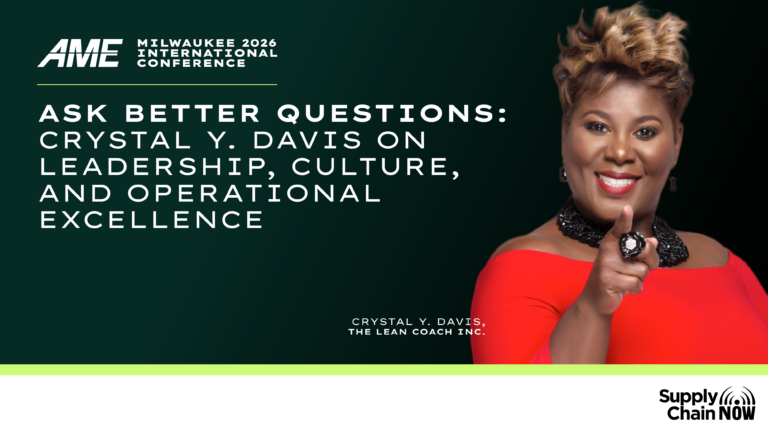
Ask Better Questions: Crystal Y. Davis on Leadership, Culture, and Operational Excellence
In today’s manufacturing environment, leaders face no shortage of challenges. Geopolitical uncertainty, workforce pressures, rapidly evolving technology, and increasingly complex supply chains are making operational excellence more difficult to achieve. And sometimes, the biggest obstacle is how organizations approach the problems they’re trying to solve.
That’s a central message from Crystal Y. Davis, Founder and CEO of The Lean Coach Inc., a consultancy focused on operational excellence, leadership development, coaching, training, and artificial intelligence.
At the Association for Manufacturing Excellence (AME) International Conference 2026 in Milwaukee, Davis reconnected with Supply Chain Now Founder and CEO Scott Luton for a wide-ranging conversation about leadership, organizational culture, and continuous improvement.
The two are longtime industry colleagues, with Davis having joined Supply Chain Now numerous times as both a guest and co-host. Their familiarity made for an engaging discussion filled with practical insights and a few laughs.
A Career Built on Continuous Improvement
Davis brings an impressive range of manufacturing and supply chain experience to her work. She spent more than 20 years in the automotive industry with General Motors and Delphi, developing her expertise in engineering, Lean, Six Sigma, and supply chain management. She subsequently helped launch continuous improvement initiatives at Coca-Cola Enterprises before moving into the life sciences sector with Thermo Fisher Scientific.
Those experiences exposed her to everything from high-volume manufacturing to complex distribution networks serving laboratories, universities, and businesses. That breadth of experience has shaped her philosophy about what successful operational excellence actually requires.
Three Foundations for Operational Excellence
When Luton asked Davis to identify the most important ingredients for operational excellence, she offered three interconnected priorities. The first is creating a genuine learning environment.
“I would say the first thing is ensure your organization is a learning environment,” Davis explained.
That requires leaders who are comfortable with vulnerability, willing to challenge their assumptions, and prepared to learn alongside their employees. Sometimes progress requires slowing down long enough to understand the situation properly.
The second priority is understanding how decisions actually get made within an organization.
Davis pointed out that formal processes often differ considerably from what happens in practice. In today’s volatile, uncertain, complex, and ambiguous (VUCA) environment, those differences can create serious problems. Organizations may have enormous amounts of data available, yet still struggle to make timely, effective decisions.
Her third priority is equally fundamental: “Agreeing on the problem that you’re trying to solve.”
Two leaders can examine identical information and reach completely different conclusions about the underlying problem. Without agreement, improvement initiatives can lose direction before meaningful work even begins.
Culture Is What People Actually Do
One of the conversation’s most interesting moments came when Davis challenged conventional thinking about organizational culture. Many companies define culture through mission statements, corporate values, and carefully crafted language on their websites. Davis prefers examining what employees and leaders actually do every day.
“What do we actually do? What is it that we actually do?” she asked.
For Davis, culture is revealed through repeatable patterns of behavior. The important question is whether those behaviors support the organization’s stated values and desired outcomes. She also shared what immediately catches her attention when visiting a manufacturing facility: employees who demonstrate genuine passion for their work.
That passion doesn’t mean everything is running perfectly. It means people care enough to tackle problems and improve their operations, even when circumstances are difficult.
A Small Moment That Revealed a Great Culture
Davis illustrated her point with a memorable experience at a manufacturing facility employing people from approximately 21 different cultural backgrounds. While touring the plant, she had put on her required safety equipment but forgotten to remove her earrings.
An employee who spoke limited English approached her and pointed out the safety violation. Davis immediately removed the earrings and thanked the employee.
What made the interaction especially meaningful was that Davis was serving in a vice president-level role at the time. The employee felt empowered to correct someone in senior leadership because she cared about safety and understood that the rules applied to everyone. There was no fear of retaliation, no hesitation based on organizational hierarchy, and no question about whether speaking up was appropriate.
It’s a powerful example of how healthy cultures operate when employees feel respected, responsible, and empowered.
Why AME Feels Like Family
Davis has been involved with AME for years, and her enthusiasm for the organization remains strong.
“AME is a family,” she explained, describing how the large international conference maintains a welcoming, personal atmosphere.
She especially values the practitioner-to-practitioner learning opportunities and the relationships that develop over time.
Davis also offered practical advice for companies sending teams to industry conferences. Rather than waiting until everyone returns home, she encourages groups to schedule debriefing sessions during the event. Those conversations help attendees share what they’re learning, identify promising ideas, and determine what actions they can collectively implement. It’s an effective way to turn conference enthusiasm into measurable business value.
Interestingly, Davis was particularly excited about attending Milwaukee as a learner. After spending years volunteering, teaching, keynoting and helping others, she wanted time to absorb new ideas herself, especially around AI applications in everyday manufacturing operations.
Start With the Problem, Especially When Considering AI
As the conversation turned toward 2027, Luton asked Davis what advice she would offer leaders navigating today’s difficult operating environment. Her response was simple and powerful.
“Ask better questions.”
Davis specifically challenged the tendency of executives to begin their AI conversations by asking, “What should we be doing with AI?”
She believes leaders should begin by identifying their organization’s most pressing operational problems.
For example, manufacturers facing workforce reductions may still have the same workloads and operational challenges. Rather than immediately pursuing another technology initiative, leaders should determine where employees are struggling and whether AI could help address those specific challenges. Potential applications include data analysis, competitive intelligence, scenario planning, and improving decision-making.
The essential principle is to understand the problem before selecting the solution.
A Timely Lesson for Leaders
Davis’s insights reflect the spirit of AME Milwaukee’s 2026 theme, People First, Progress Together.
Successful organizations create environments where people can learn, challenge assumptions, raise concerns, and participate meaningfully in improvement efforts. They also recognize that leadership requires humility. No executive has every answer, and the people closest to the work often possess insights that cannot be found in a boardroom presentation.
As manufacturers prepare for 2027, Davis offers a particularly valuable reminder: better outcomes frequently begin with better questions.
And sometimes, the smartest thing a leader can do is listen carefully to the answers.
Where to Learn More
We invite you to connect with Crystal Y. Davis on LinkedIn, and be sure to learn more about The Lean Coach via its website: https://crystalydavis.com/
More Blogs

Top Microsoft Dynamics 365 Partners for Distribution and Supply Chain Management