[00:00:00] Beau Higgins: I think if you do that, if you truly put your Marines first and, you know, and you take care of them, the rest will take care of itself, right?
[00:00:10] and that was something I think I learned, like I talk about in high school, right? You know, it’s, it’s be a man for others. and that mentality, that idea of servant leadership is one that I tried to display every day in everything that I did.
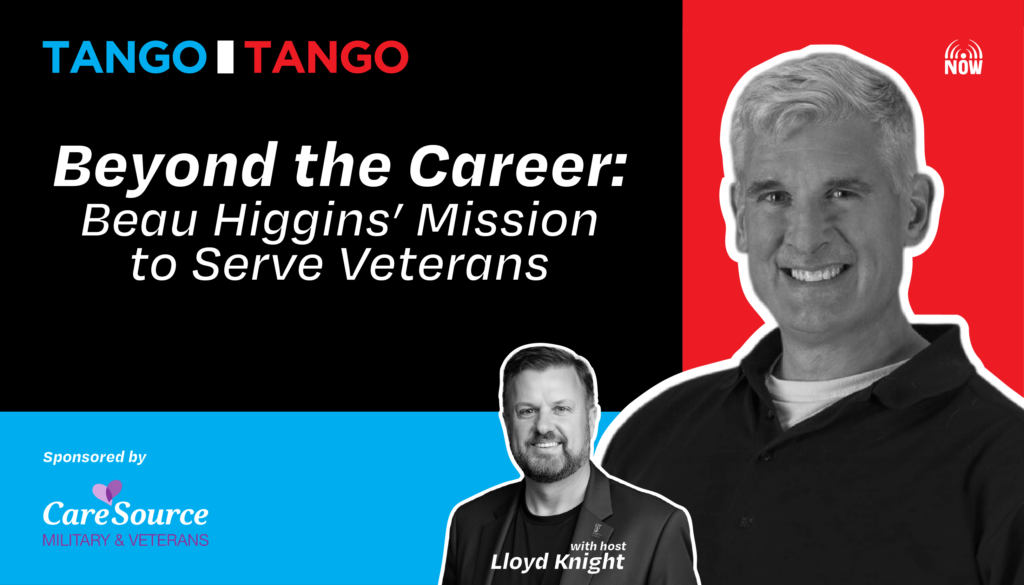
[00:00:38] Lloyd Knight: this episode is brought to us by our brand-new sponsor, the folks at CareSource Military. So interesting enough, you got Bo Higgins in Tampa, uh, today and Lloyd Knight here in Atlanta, and those are the two cities that are doing the, uh, CareSource, trial run for TRICARE.
[00:00:57] So I got Bo Higgins. So Bo is a graduate of the Air and War Staff College, and he’s gonna laugh at that because Bo’s a Marine, a veteran, and I’m starting off that he attended an Air Force school. So Bo, welcome to the Tango Tango
[00:01:11] Podcast.
[00:01:12] Beau Higgins: Awesome. Hey man, Lloyd, a pleasure to be here. Excited to chat and, uh, hopefully share some things that are worthwhile to the audience. Appreciate you doing this. Appreciate CareSource sponsoring
[00:01:22] and, uh, excited to talk a little bit today, man. Good stuff.
[00:01:26] Lloyd Knight: So Bo and I have been running the same
[00:01:27] space for, for many years now, t- too, too many years to actually provide the date. Uh, we’re, we’re old guys,but Bo is doing some amazing things in, in the veteran space and has, has been for a long time. And I was really excited a- about this podcast so I could get to, uh, learn a little bit more about Bo.
[00:01:47] S
[00:01:48] o, uh, Bo, you’re originally from, if, if I get this right, you are a graduate of Jesuit High School in New Orleans,
[00:01:55] Louisiana.
[00:01:56] Beau Higgins: That is correct. Proud grad of Jesuit in New Orleans. My dad went there, my two brothers went there. It’s a, it’s a family tradition, uh, I think in the Higgins family. My grandfather went there, so it’s been, it’s been a long time coming and, and I really, I seriously, I attribute my, my Jesuit education and background, to the success I have today.
[00:02:17] I mean, they’re, the motto, if you will, of the Jesuits is to be a man for others, you know? And, and being able to give back and that idea of giving back and service is something that I feel like was instilled in me at a young age, and hopefully it’s something that I’m carrying on to this day, helping out veterans, you know?
[00:02:33] It’s been, been a journey, but it started with a good base at Jesuit High School in New Orleans. And, uh, Harry Connick Jr. was a classmate of mine in my Jesuit class. That’s why, a
[00:02:40] little factoid for you. There you
[00:02:42] Lloyd Knight: I was gonna ask you if,
[00:02:44] if you knew Harry Connick or if you knew the, uh, Manning brothers
[00:02:48] since, since you
[00:02:49] Beau Higgins: I, I I know Harry. I mean, I, I mean, I knew Harry in high school. We don’t hang out anymore, unfortunately. And I, you know, I know, um…I am friendly with Cooper Manning, the older brother of the
[00:02:58] Lloyd Knight: Yeah.
[00:02:59] Beau Higgins: I don’t know Peyton and Eli, but Cooper Manning and I, he’s actually my brother’s age. So my, my dad coached Cooper Manning in Little League baseball back in the day.
[00:03:09] Everything in New Orleans is very, uh, incestuous, close-knit. So yeah, coaching Little League baseball back in
[00:03:15] the day was our connection to the Manning family growing up. But good stuff. Yep
[00:03:18] Lloyd Knight: Yeah, that’s, that’s pretty cool.
[00:03:20] what did your life look like as a, uh, school-aged kid in, in downtown New Orleans?
[00:03:25] Beau Higgins: I, you know, I mean, I think it’s one of those things you don’t know, uh, your town is any different if that’s all you know. You feel like, I mean, it, New Orleans seems like a normal town when you’re growing up if you have no perspective of what else is out there, right? So, things like Mardi Gras or going to Jazz Fest or going down to French Quarter once in a while or going to the, the flea market, those are just things we did.
[00:03:47] The river and, like, sliding down the river on boxes and, I don’t know. It just, it just, it just, that’s what you do. And t- till you have perspective and leave the town and you realize that other people didn’t quite have the experience growing up that you had, you appreciate the city even more now when I go back, I guess, ’cause it’s, uh, it’s something that is a unique place, right?
[00:04:09] You’re just surrounded by amazing food, amazing music, interesting, entertaining people. there’s always something going on, I mean, whether it be sports-related or history-related, or culture-related. it’s just an amazing, amazing town. Again, and, and, and very family-focused too. I mean, people think of New Orleans, they think Bourbon Street and the craziness, but is, you know, generations of family, and a lot of folks never leave there.
[00:04:37] It’s one of those cities where… I mean, I’m the oldest of five, and my four siblings are still down there. My mom’s still down there. I mean, it’s a, it’s a place where if you’re born there, it’s a good chance you’re gonna, you’re gonna stay there. uh, and just unique in that regard. I mean, family is everything, and family was everything for me growing up.
[00:04:53] You know, we were always at my grandmother’s and my aunts’ and uncles’ and birthday parties, and I have 30-something first cousins. You know, it’s just how it
[00:04:59] was, and you think it’s normal. So yeah, good stuff.
[00:05:02] Lloyd Knight: to leave.
[00:05:02] Uh, you, you left to go to college in, in the University of, of Virginia. So, so why that particular institution?
[00:05:14] Beau Higgins: most of my friends, you know, went to LSU, and that was probably the easy, uh, easy answer, and would’ve been amazingly fun. I, I was looking… I figured, you know, I could always come back, to Louisiana, and, and was looking a little farther away than, than, uh, than LSU. Um, I actually… UVA got on my radar,in a weird way, as probably happens to other kids too, but back in the…
[00:05:37] You know, I graduated high school in ’85, to date myself. in the early ’80s, UVA basketball team had Ralph Sampson. They were really good. and they actually had a Sugar Bowl basketball tournament. So in addition to the Sugar Bowl football game There’s a Sugar Bowl basketball tournament. And my dad was a member of the Sugar Bowl, and UVA played in the Sugar Bowl basketball tournament a couple years in a row.
[00:05:59] And my dad ended up being like the host for the, the UVA basketball team and met Terry Holland, who was their head coach at the time. And I was like a ball boy, got, you know, a ceremonial ball boy for the team, and they got on my radar. You know, they were really good. And the next thing you know, it’s like I- it was on my list of schools to apply to.
[00:06:16] And, uh, yeah, ended up being a, a amazing experience. You know, I ended up… I, I walked on and played football there, too. I, I… It’s something I, I wanted to… I was interested in trying to play football in college, and w- that wasn’t gonna happen at LSU. And not that I was any good at UVA either, but I did walk on up there for my, my first year, a little over a year,and made the team as a walk-on.
[00:06:36] But, uh, yeah, that was how it got on my radar. And, and, and, uh, again, enough- I would- I don’t regret it for a
[00:06:40] second. It was an amazing place and loved my time there, for sure.
[00:06:44] Lloyd Knight: So what position did you walk
[00:06:46] on as?
[00:06:47] Beau Higgins: Defensive end. candidly, you know, as a walk-on, I was not the greatest player in the world. And I learned after the first year, the guy I played against every day in practice, a guy named Jim Dombrowski, who ended up being a first-round draft pick for the New Orleans Saints, which is a funny story, in itself.
[00:07:02] but you know, it’s one of those things where not only did I realize I wasn’t great, it’s a massive time commitment. you know, it wasn’t like we had NIL money at the time, so I wasn’t getting paid, wasn’t… didn’t have a scholarship. And I was really, really good at the fraternity house. I was an All-American in the fraternity.
[00:07:18] So I found my niche, not on the football field, but in the fraternity house, and, uh, and thrived there,
[00:07:23] uh, more so than the football field. So yeah.
[00:07:26] Lloyd Knight: and what’d you study in
[00:07:27] college?
[00:07:29] Beau Higgins: I was an international relations major, so government international relations. and honestly didn’t know what I wanted to do when I was gonna graduate. Uh, I had no real plan. I mean, I think at some point in my head, I thought I would go back and get my MBA, but I was not a great student, I’ll admit that.
[00:07:46] I, I’m not sure I finished last in my class, but it was, it was in the bottom, you know, 10%, I would venture to say. but I finished in four years, finished on time. I just didn’t have the greatest GPA. Uh, and I, I really, I did not know what I wanted to do. This is ’89 when I’m finishing up. most of my buddies or a lot of my buddies were going, back to grad school to get their MBA or go get their…
[00:08:08] go to law school. and I literally saw the Marine Corps recruiter hanging out on campus one day, of my, you know, my senior year. my dad had been a Marine, an enlisted Marine, so I had that idea of that Marine Corps thing in my head. And I saw the recruiter and started talking to him, and know, I was like, “Yeah, this sounds like a…
[00:08:26] I’ll do this for, you know, I’ll do this Marine Corps thing for a few years and Get out and go get my MBA, and 25 years later, you know, it’s a lot different story. But I, honestly, that was how it all came about. I saw the, the, the, the U- the recruiter at the bookstore at UVA and decided to kind of check it out and see if it would be
[00:08:42] something that would be for me, and ended up being a great fit.
[00:08:44] So yeah, pretty funny.
[00:08:46] Lloyd Knight: yeah,
[00:08:46] I’d say it was a great fit. So the– So you joined the Marines right after college. and if I get– if I remember right, you were the intel officer from the very beginning?
[00:08:56] Beau Higgins: S- yeah, signals intelligence. The way the Marine Corps worked, and, oh, actually back when I came in, there was very few intelligence-related spots. The only intelligence-related spots were signals intelligence. So I was a SIGINT officer, which meant I had Marines that spoke different languages, that were Morse code interceptors, that could analyze signals.
[00:09:16] They could do a bunch of different technical things to, you know, intercept any type of signals out there, right? That’s the goal of SIGINT, is to intercept enemies’ communications. Um, so we learned kind of the big picture to, you know, lead a platoon of those kind of guys into combat. So super cool. Uh, e- you know, ended up being a, a, it’s an interesting field to get into, for sure.
[00:09:37] Later on in, in my Marine Corps career, and the way it works in the Marine Corps, you become a, a generalist as an intel officer more generically, and not just SIGINT. You kind of take all the disciplines underneath you. But initially it was a signals intelligence officer. didn’t know much about it, honestly, before I started off, but I had– My grades were good enough in, uh, in basic school at the Marine Corps to go the SIGINT route.
[00:09:59] And yeah, it was great. No regrets for that at all.
[00:10:02] Lloyd Knight: first assignment?
[00:10:04] Beau Higgins: Uh, first was, first assignment was, uh, was in, in Camp Lejeune, North Carolina. Kind of funny, I, I had my very first tour there, as a second lieutenant, and my very last tour there as a colonel. So I started there and I ended in the, uh, in, in the shores of North Carolina in, in lovely Camp Lejeune. you know, you don’t know any better, once again.
[00:10:23] You, you might, you don’t know any better about bases and stuff. And, and at the time, a bunch of my, you know, knucklehead lieutenant buddies were there and, you know, we, we, it was fun. I mean, a bunch of us piled it out, like, I jokingly used to tell my friends in college, like, “This Marine Corps thing is great.
[00:10:37] It’s like college, but we have guns and they pay us. You know? This is great.” So I had a l- a, a wonderful time. Got to do my first deployment, in the early ’90s. Uh, went over to Somalia on a, on a MEU, a Marine Expeditionary Unit deployment. So, yeah. Great, great, great times in Camp Lejeune.
[00:10:56] Not a lot to do there. It’s kind of in the middle of nowhere. At least it’s on the water. But it’s like Fort Bragg on the water, you know? There’s not a whole lot going on in the
[00:11:04] town. But, uh, it was a good place for sure. My, as lieutenant
[00:11:08] Lloyd Knight:
[00:11:08] So you, your first deployment was in Somalia. What, what did that look like?
[00:11:13] Beau Higgins: you know, I, I, I’ve been to a lot of places. I mean, I’ve been to– I’ve been three tours in Iraq, three tours in Afghanistan, uh, I’ve been to Bosnia. Of them all, Somalia was probably the most primitive, country. I mean, Afghanistan is pretty primitive in, out, in the, in the, you know, the hinterland. But even in the downtown of, like, Mogadishu, I mean, just the, the poverty, it was pretty, pretty grim, right?
[00:11:38] I mean, obviously we’re there because the, of the, the starvation cri- you know, crisis. That was the main purpose we have as humanitarian initially, right? We’re trying to feed the people, but that ended up pissing off the warlords and ended up being a more kinetic, evolution later on. But, you know, with good intent going over there, you know, to feed the world the whole thing, and that turned into more of, of, uh, you know, kinetic operations later on.
[00:12:02] Um, you know, my job as a, as a SIGINT officer, we were trying to intercept the communications of the bad guys, right? So, trying to listen in to the, to the rebel forces and figure out what was going on. I got to travel kind of all over the country and, and see some pretty interesting places and do some interesting things.
[00:12:18] I remember it was really hot, uh, and really dusty, and pretty grim. I mean, it just, I think the people didn’t… There was just, there’s, there was no, national resources there. There was no kind of way to make income, you know. And, like, uh, the, the most of the men, I think all the men were basically unemployed, and they’d wait around till the afternoon.
[00:12:37] They’d chew this, this leaf called khat. It was like this some kind of
[00:12:40] Lloyd Knight: Yeah.
[00:12:41] Beau Higgins: you know, cocaine leaf thing later in the afternoon. And it was just, it was the society there had kind of broken down in a lot of ways, you know. So you’re trying to bring some kind of order to, to the, to chaos over there. But there was a really good real-world mission, I thought, especially for
[00:12:55] a, you know, second lieutenant.
[00:12:56] It was pretty, pretty fascinating.
[00:12:59] Lloyd Knight: So you were there, uh, w- what is it? Maybe a year before Black
[00:13:04] Hawk Down?
[00:13:05] Beau Higgins: Yeah. We were there, we were there probably, I was there ’92 into ‘ 93, right? Or no, I guess ’90, maybe ’93. In ’93, February ’93. So before Black Hawk Down, there had been some, pretty kinetic, uh, events in Somalia before that, but we were there before the, the major
[00:13:21] Black Hawk Down event. Yeah, we were
[00:13:24] Lloyd Knight: Yeah.
[00:13:43] For, for the non-veterans who, who listen and watch this, uh, the podcast, uh, you might be kind of surprised to hear about humanitarian, uh, operations. But even in, in my career, I was at a, uh, a load master flying on cargo planes for, for most of my career. And then, I had a four-year stint where I was, in mobile command and control and, and deploying all over the, the Middle East a- and Africa.
[00:13:51] and w- over half of our mission, especially in the, uh, uh, in the ’90s and, and early 2000s was humanitarian. You know, I, I spent a fair amount of time in, in Mozambique, in, in South Africa doing flood relief. and the rest of it you’re training. the great thing about humanitarian operations and, training is it, it closely mirrors the, the real life thing, you know?
[00:14:15] Except, you know, hopefully nobody’s shooting at you. But y- you’re deployed,there’s this need for intel, there’s this need for logistics, there’s this need for communications and, and it’s a, it’s a great real world training opportunity, the humanitarian
[00:14:28] operations. Plus you’re doing the world a lot of
[00:14:30] good.
[00:14:31] Beau Higgins: That’s a, that’s a, that’s a great point. And I mean, and it’s, it’s funny and I, and I’ll, I’ll flash forward my career like multiple years, but, I was in, um, Australia on 9/11. So when 9/11 happened I was in Australia, and we loaded up the ship, you know, on Sep- on, on September 11th, and we were heading over to Afghanistan.
[00:14:48] We were the first Marines into Afghanistan by November, late October or November of, of ’01. But on the way, we actually stopped in East Timor and did a humanitarian relief operation because they weren’t, they were st- people were still trying to figure out what the heck was going on in Afghanistan, and we had all this humanitarian stuff on board the ships, and it’s like crazy the, the, the flexibility of mission you can have.
[00:15:12] And which is a pretty cool thing to think of, you know? That, that’s what we, we trained for those humanitarian relief exercises as the Marine Corps and as a, as a nation’s military. And, you know, on the way we stopped off in East Timor, did a, dropped off all these boxes that had been donated from churches.
[00:15:26] It was crazy stuff like ThighMasters and I don’t know, but we dropped it all off and built a couple homes, and then on the way to Afghanistan for the next operation, you know. And to be able to pivot and support those, that wide range from fully kinetic to, you know, very much supporting the people is, is a, is pretty cool to have that, that range of options you can provide from your
[00:15:47] military out there on ships.
[00:15:49] So kind of cool.
[00:15:50] Lloyd Knight:
[00:15:50] so you’re advancing up, up to the, uh, the career ladder. You started off as a second lieutenant, fresh out of college, and you, you work your way all the way up to colonel. why were you successful in the Marine Corps?
[00:16:02] Beau Higgins: I mean, it’s a great question and I don’t know if there’s any, you know, one answer. I mean, I, I just tried to, you know, be myself and I always tried to take care of my Marines and sailors, you know, first, right? And I think if you do that, if you truly put your Marines first and, you know, and you take care of them, the rest will take care of itself, right?
[00:16:25] and that was something I think I learned, like I talk about in high school, right? You know, it’s, it’s be a man for others. and that mentality, that idea of servant leadership is one that I tried to display every day in everything that I did. And again, just don’t, you don’t, you don’t make it about yourself.
[00:16:42] I had truly no, plan or, you know, vision that I would stay in the Marine Corps 25 years. If you knew me in college, my friends, they were shocked I joined the Marine Corps, right? So the fact that even in the Marine Corps, it was an amazing story. And then to have that kind of a career, you know, it, it was a blessing.
[00:17:00] But it w- I, I, I attribute it very much– I, well, I had some bosses that were, very forgiving as well, ’cause I did some knucklehead stuff. Uh, I, I had a lot of fun, probably more fun than I should have at times. but again, I, I, I always put my Marines first. and if you do that, like I said, I think that to me was What I, I tried to base my career on, and I think if by doing that, if you take care of your Marines, they’ll take care of you.
[00:17:27] and I saw that, at every, every command, every, every location I went to, if I did right by them, they would do right by me. And, and being right by me meant the unit was successful, and therefore I was successful, and was able to, you know, you know, get promoted and get command and all those great things.
[00:17:43] That’s really the, the, the corner at the base of it, that’s what it’s
[00:17:46] all about.
[00:17:46] Lloyd Knight: so talking about, you know, those ranks. So you had multiple deployments, and I’m gonna ask you about deployments in two questions. What was, tougher? Was it tougher deploying and accomplishing a mission as a junior officer in Iraq or Afghanistan, or was it tougher as a senior officer?
[00:18:06] Beau Higgins: they’re all hard in their own way, right? I think, you know, by the time I was leading, I, I led a deployment into, um, Afghanistan b- and in my la- last years I was in the Marine Corps in, in 2013, ’14. and as a colonel, you just have a lot more responsibility.
[00:18:25] so that’s hard. I mean, you’re able to influence things more, which is great. but you’re not the one, you’re not the doer anymore, right? So, you know, again, as a, as a lieutenant, you’re the doer, right? I’m building the antennas. I’m, I’m, I, I’m, I’m carrying the b- the, the, the, the batteries.
[00:18:42] I’m doing the things, right? You’re out there forward. And as you progress, as, as with anything, the more leadership role, you’re setting the guidance, you’re setting the parameters. So it’s more difficult maybe mentally. I think that’s probably the best way to describe it. the more senior you get, they’re paying you more for your brain than your, than your brawn, right?
[00:19:00] Early on, you have to be smart, but a lot of it’s just, there’s a physical part of it, and it’s a young man’s game, right? You have to be out there leading from the front as a lieutenant, where as a colonel, you need to let your people do their jobs. And it’s not your job anymore to be leading from the front.
[00:19:16] You’re there to, you know… I’m, I’m there as a colonel, I’m the f- I’m, I’m the offensive guard. I’m, I’m the blocker that’s allowing and facilitating the lieutenants and the sergeants to do their job and score the touchdowns. You know, before, when you’re a, when you’re a lieutenant, you’re the one that’s scoring the touchdown, and somebody’s facilitating that for you.
[00:19:33] So over time, it just, your role changes, I think is the biggest thing. But all of them are hard. I mean, none of them are easy. And you don’t, you don’t appreciate it. I mean, in retrospect, it seemed maybe like it was easier to be a lieutenant or, uh, but, you know, but you don’t have that experience till you have that
[00:19:47] experience.
[00:19:48] So, you know, it’s one of those chicken or the egg, right?
[00:19:51] Lloyd Knight: So, so on that note, I was gonna ask you which was tougher, Afghanistan and, and Iraq, between the two. But instead of asking you which was tougher, can you maybe talk a little bit about the operational differences between the deployments in both countries?
[00:20:04] Beau Higgins: I’ll say this, you know, going into Afghanistan in ’01, so right after 9/11 happened, I mean, we were on the ground by late October of ’01. So to be the first Marines on the ground when you had the whole country motivated and behind you was awesome, right? I mean, that to me was probably the pinnacle of my career.
[00:20:31] At, at that time, I was a major, and I was the intelligence officer for our Marine expeditionary unit, and we actually, kind of merged together with some other forces and built a Task Force 58 that was led by General Mattis. We went into Afghanistan as part of Task Force 58. and because we were the– Because everything was so new, I mean, there was no, there was no structure in place for a gr- a big ground war in Afghanistan.
[00:20:58] Like, the, the, the chain of command was like, you know, back in the, back in the day, you know, it was like Dick Cheney was, like, reaching out right down to, like it was very, very, you know, like it was a, it was just a short, uh, you know, like chain of command, right? And it, it was kind of the Wild West back then.
[00:21:12] There were no rules. You’re just trying to figure it out on your own because you didn’t have all the establishment you had. And by the time, you know, fast-forward, you know, get to Iraq, and by the time of my last deployment in Afghanistan, uh, in 2014, 13 years later, there were 16 layers of bureaucracy between your unit and the decision being made, right?
[00:21:32] So, you know, again, but I said, I said Dick Cheney, but Rumsfeld was the guy in charge kind of in Afghanistan in the early days, right? And he very much had his fingerprints on the day-to-day actions. You know, you’re going right to the SecDef almost between, you know, for our, our, you know, briefs were g- It’s just a very different, and I thought super cool, like, because we also, also, because we’re the only ones there, we got all the resources.
[00:21:58] I was getting, for the first time in my life, I had access to P-3s. So like, you know, planes flying with video. At the time, you know, everything is dr- No drones existed back then, right? So these are, these are p- actual manned aircraft going out and getting, you know, footage, reconnaissance footage. We were getting that down to our small unit, right?
[00:22:16] Because we were the only show in town, man. So that was awesome. So I really enjoyed kind of the latitude and freedom and the, the unknown of it all. The longer, you know, the, the later on in life, I felt like you couldn’t do as much as quickly, certainly couldn’t do as much as quickly, uh, as you could in the early days when there was, like, just no, just kind of like, “Hey, figure it out.
[00:22:38] You’re out there. Good luck. We’ll give you a little help if we can,” you
[00:22:41] know? So I really enjoyed that. Yeah
[00:22:44] Lloyd Knight: So Bo, you’re a role model for so many people. Who were your role models while you were in the Corps?
[00:22:52] Beau Higgins: Yeah. I mean, there’s a few of them that I had. And the, and the one that I, I point to a lot is General Dunford, and he’s obviously, you know, he was the, the, the, the, commandant of the Marine Corps and the chairman of the Joint Chiefs of Staff. I, I, I had the opportunity to work with him on my, my second deployment to Iraq in 2004, and he was actually General Mattis’s chief of staff.
[00:23:14] and I was, you know, on the intel side of the house, and, and he just… He was an amazing leader. He was a colonel. He wasn’t even a, a gen- a one-star yet. I think he was a colonel at the time. Maybe he was selected and hadn’t pinned on yet. but he was just one of those guys, and I, I learned so much from him of how to treat people.
[00:23:32] I, I remember distinctly, being there and a- as the intel guy, I had some hot information that I wanted to get up to, to General Mattis, and usually the, the process would go through General Dunford first. And I, I come up to him and I, and I, and he’s, like, having a conversation with some corporal about I, I don’t know what, but I didn’t think it was that important, and I’m trying to, like, butt in to, like…
[00:23:55] ‘Cause I had something that was really important. And he’s like, “Just hang on.” You know, like, it was just, he just, he just, he treated everyone with respect equally from, you know, a lance corporal to a three-star general, right? and that just, it stuck with me. It really, really stuck with me. And then when I got, selected for command as a lieutenant colonel, I remember, reaching out to him just to, uh, you know, and he, at this time, he was a, a one-star, maybe two-star.
[00:24:22] and he had a very, you know, high-pressure job. And I, and I called, like, his office just thinking I was gonna get maybe on his calendar in a month. And basically, his secretary or his, you know, his admin assistant, like, he blocked his calendar that day and said, “There’s nothing more important to me than talking to those Marines that are going into command.”
[00:24:44] And he, like, got rid of other meetings, took an hour to talk to me about command and his philosophy and just… And, like, like t- and, and it’s, it’s time, right? Really, the most valuable asset you have in your life is time. And to see the way he spent his time and what he valued was, amazing to me, and that’s something I try to take away, is taking care of your people, but it’s, it’s, it’s the way you treat everyone the same and take the time to invest in those people, even if there’s, paperwork you gotta do.
[00:25:17] I mean, that’ll, that’ll wait, right? If it’s not a priority. The people are the priority. I think that’s what, what, what really stood out, about him and yeah, he’s, he’s the guy that to this day I still stay in touch with and, and write an occasional letter just to be– just thankful for his leadership and,yeah, and invest- willing to invest in me at the time.
[00:25:35] So yeah, pretty good.
[00:25:37] Lloyd Knight: yeah,
[00:25:37] I got to, uh, meet him when he was chairman with, with my late wife, uh, at, in an event in, in DC. And, and I can tell you he, he, he was so great with the two of us and, and, and just a, a people person and, and I really admire that. So the, uh, yeah, it’s, it’s pretty cool to hear your, your thoughts about him.
[00:25:58] So now you’ve been in the Marines for 25 years. It, it’s– You decide to get out. What did your transition look like, Bo?
[00:26:06] Beau Higgins: being someone, as you know, Lloyd, that is in this business, I definitely did not, have a great transition myself. Now, part of the problem, I was in command when I was transitioning. So I literally, I had a change of command in the morning and I retired in the afternoon. So I was, you know, working in, in command and deployed up to three minute– three months prior to I got out, and in command until the last day, right?
[00:26:29] So try to rationalize it that way a little bit, that I, I did have a, a pretty important job and didn’t have the ability to do some of the things that I would’ve done in retrospect. but that said, I, uh, and I’m– I know I’m the anomaly in, in some ways like this.
[00:26:45] I enjoyed the transition process, ’cause for me, it was just about reaching out and talking to people.
[00:26:51] And that’s what I did, ’cause I, you know, there wasn’t all the pro- there wasn’t a SkillBridge program back then. There wasn’t all these things that we have the benefit of now. you know, my transition plan was basically, okay, I’m gonna start reaching out to friends of mine from college, from high school, family friends, Marines that have gotten out, you know, whatever, and just talk to people and, and see what’s, see what’s up.
[00:27:15] You know, it’s kind of my plan, And it was, networking was my plan, right? ‘Cause I did– I, I kinda had an idea that I wanted to do something in operations. I, I kinda knew I wanted to come back to Tampa, but I really didn’t know what. I didn’t have, like, a, a real focus on exactly what I wanted to do.
[00:27:32] So, I started talking to buddies of mine. You know, I have a buddy of mine in commercial real estate. I’m like, “All right, you’re in commercial real estate. You, you sell buildings. Like, what do you do? What is the job like? what’s a day in the life of a commercial real estate guy?” Right? “Hey, you’re in financial planning.
[00:27:45] I, I, I, I get the concept well. You know, like, what’s the jo- like, what do you do?” You know, and having those conversations with, you know, dozens of people, and that was fun to me, and figuring out what I did like, what I didn’t like, you know, I, you know, figuring out what you don’t wanna do as much as figuring out what you do wanna do, right?
[00:28:05] And that was the ta- You know, I, I, I kind of view transition now, and I, I didn’t necessarily then, but it’s a targeting process, right? You’re just- You’re narrowing down your, your lists and your things you want to do. And once you kind of, you can, once you can figure out what you want to do, then you can really invest all the resources in that.
[00:28:21] But it just takes a while to winnow it down, you know? And like for me, I knew pretty quickly I didn’t want to get in the government sec- you know, sir, go be a GS. I could have easily, as an intel guy, you know, transitioned into the, into the intel GS world or work for a defense contract. I, I didn’t want to do that.
[00:28:38] I wanted something different. I wanted something kind of in operations and, and that’s, you know, again, those conversations are what helped me figure that out and focus on that. And, yeah, so it probably wasn’t the– I didn’t start soon enough, but I think the way I did it is, is a way that is, it’s the right way to do it.
[00:28:59] I should’ve started earlier, I think, and less, what I’m probably trying to say.
[00:29:02] Lloyd Knight: in 2007. So when I retired There were very few,things or programs out there to, to support the transition. A GI Jobs magazine was the one that I used. I would read that thing from front to cover, uh, all the time, every, every magazine episode, and they would go on to feature me years later in the magazine. But, you know, I, I had a– I loved the transition.
[00:29:32] It’s, it’s no wonder that I, I teach it now and, uh, I’m in the business, like you.
[00:29:38] So you– I’m not gonna really talk about that first job you had. You, you had a first job, and then what I wanna know is you ended up getting a job at Amazon and became not only the face of Amazon recruiting, and, uh, I’m gonna say this, this very big thing right now.
[00:29:58] You became the face of, of veteran recruiting, period. ‘Cause at, at the, at the time, Amazon was making a huge investment, much more than any, any other company out there. Amazon was growing rapidly, so you had a big team. You guys were spending lots of money in the business, and, and you, you became, a-again, not only the face of Amazon, but the face of veteran recruiting i-in, in a very big way.
[00:30:25] How did you land that, that job at Amazon? ‘Cause at the time, you didn’t even have any
[00:30:29] recruiting experience.
[00:30:31] Beau Higgins: Yeah, and, and I’ll, I’ll, my, my, I’d have to touch on my first job because it is how I got to my second job. So I, two years at a company called Custom Cable, and we manufactured and installed fiber optic cable. Great first job. Learned a ton. My kids were like, “Dad, you went from being in the Marine Corps to being the cable guy?
[00:30:47] It’s not very cool,” right? You know, so, uh, but after a couple years of it, I, you know, I, I did feel like there was something missing, like a give back factor in it. Like the job was fine, but there was I was missing the something more, right, piece of it. and we actually, at Custom Cable, we sold cable or did some of the install work at a couple of the Amazon facilities in the Tampa area.
[00:31:09] And my boss like, “Hey, figure out how we can sell more cable to Amazon, you know, nationwide.” So I get on LinkedIn as you do, and try to figure out who are my Marine buddies that are at, uh, Amazon, and start reaching out to them saying, “Hey, uh, I haven’t talked to you for a while. How does Amazon buy cable?”
[00:31:26] Lloyd Knight: Okay.
[00:31:27] Beau Higgins: And, and, which is crazy. And then none of them knew that, but my one friend, there, Kathleen Carroll, uh, she was in the HR side of, of Amazon, and she basically, when I called her, it’s like, “Hey, I, you know, I have no clue how Amazon buys cable. However, we are looking to build a, a veteran hiring team right now.
[00:31:47] Jeff Bezos has made a pledge to hire 25,000 veterans over the next three years, and we don’t have a team or a plan. You know, would you be interested in, in joining up and helping us build a team?” And I’m like, yeah, I think so. Sounds pretty good.” You know? And that- that’s really it. Again, it was– I was– I, I called her not looking for that job.
[00:32:05] I called looking for something else, but it led to the conversation about other things, you know? That, that networking thing and timing is just so interesting how that happens. But to have the network in the first place is why I got the job, right? but yeah, got in on the ground floor of building out, Amazon’s veteran hiring team.
[00:32:22] And, and it was, it was critical, and it is critical for any company. You know, we had a, we had a statement from Jeff Bezos. Now, we didn’t have m- we didn’t have a lot of budget or money, but we had Bezos at least saying, “You– This needs to be done,” right? So we had some backing from the man to start this program off.
[00:32:39] So it took us a while to get things going, but, you know, I spent seven years there, and, and the 25,000 pledge we hit. Then we had another pledge to hire 100,000 veterans, which we also hit over a three-year period. So we, we crushed the veteran hiring numbers at Amazon as the, as the company itself grew.
[00:32:56] And we were able and fortunate to really be, I think, at the time, innovators in the space, right? Because, because of our name, because of the investment we had, you know, whe-whether it was skill bridge programs, military spouse programs, student veteran programs, apprenticeship programs. I mean, if there was something or some way to engage the veteran community, we were gonna try.
[00:33:18] and that was really the fun of being at Amazon. They let, they let us beta test a lot of different things. You know,we spend a few thousand dollars here, a few thousand dollars there to see which, you know, which, program or which service or which opportunity was giving us the best ROI, right?
[00:33:34] And I think- To your point though, you know, I, I think Am- I like to believe Amazon became the, you know, the, the premier veteran hiring, program in the, in the country. and one of the things that we also did though was always, and I certainly, you know, talked to a lot of other companies about, “What are you doing?
[00:33:52] You know, what are you doing? How is it working for you? Can I share what… Like, this is what I’ve learned. So if you’re gonna try this, don’t do it this way, ’cause we already, you know, we messed that one up, man. But this one worked pretty good,” you know? So that’s why, you know, obviously we connected, Lloyd. And it’s about, you know, I think that’s the beauty of being in this space and being at Amazon, is that we were– we had the luxury of being, the 20,000, you know, foot gorilla out there, right?
[00:34:14] And, and, and being able to try things and beta test things and learn from that. But also the realization that we couldn’t hire every veteran, and we wanted to support other companies, and we wanted… You know, at the end of the day, all we care about is getting those veterans a job, and the– and a job at the right place for them that’s gonna make them happy.
[00:34:34] So to be at a place like Amazon, especially early on, like they said, the analogy of being in Afghanistan, right? The early days there was– it was just kind of scrappy, and you were figuring it out, and you kind of just threw a lot of stuff on the wall, and you figured out what the best thing was and, and you know, and kept building that, that, that airplane in flight, right?
[00:34:51] A lot of that stuff was. But it was also super collaborative with other companies, and just a fun time to be there. And again, and to be able to hire a lot of veterans and to be able to share information with other companies that were hiring other veterans and watch the whole ecosystem grow from what it was to what it is now is, was great.
[00:35:11] And really, I mean, I– amazing experience. Seven years is a long run at Amazon, but it was a great
[00:35:16] time, and no, no
[00:35:17] regrets, obviously.
[00:35:18] Lloyd Knight: Yeah.
[00:35:32] Yeah, and the ecosystem has grown to what it is today. And it’s– Uh, I, I love the collaboration in, in the space as well. It’s a, it’s a very small space. We, we often kid around and say it’s an incestuous space because it’s so small. There’s, there’s only– less than two– probably 200, veteran affairs managers, ve-veteran recruiters, veter-veteran talent acquisition managers in the entire country.
[00:35:42] And it’s, it’s probably a, a lot less than 200. So the really cool thing is a lot of us get together. You know, I, I host that call every six weeks and, and it is such a neat space that we get together and, and we help each other. Like, we often talk about the good, the bad, and the ugly of the space, who to stay away from, uh, who, who’s doing a, a great job, what events are great, r- ’cause there are so many events.
[00:36:06] Like, we get– You got SOF Week getting ready to come up. Like, “Hey, is it good?” You know, we’ll have those discussions. Military Influencers Conference. Bo and I are getting ready to speak in a, uh, conference in, in, in June in DC. So the, uh– So I love that about the space and, and you were a big part of it, uh, helping the space mature.
[00:36:26] And I used to sit at UPS, and Bo, I was so jealous ’cause, you know, I’m, I’m still in– I’m still the director of global government operations, but I wanna play in the veteran space so badly. Like, right? And UPS hadn’t created a position yet, and I would see everything you guys were doing and, and, and, and I wanted to be a, a, a part of it.
[00:36:46] And even more so, I wanted to do that at the company I’m, I’m working at.
[00:36:55] So I gotta ask you, so d-during your time at Amazon, is this when the famous blazer started happening?
[00:36:59] Beau Higgins: Well, it, it, it was, it’s interesting. So the, the, the jackets, the, the, the Dings by the Higgs and the jackets are actually backed up to, my Marine Corps time. You know, the, um, I spent a year in Afghanistan from ’11 to ’12, uh, and every Sunday they had a bazaar at our base. We were in, in, in downtown, uh, Kabul, uh, NKC, a little base right in downtown.
[00:37:21] And, they said every Sunday they had a bazaar, and they’d have these local Afghan tailors would come, and they could make anything. And I had a handful of jackets made. one was gold with black lapels. That was my New Orleans Saints jacket. I had one made in my high school colors. I had one made LSU colors.
[00:37:37] I had one made UVA colors. I had a bunch of them made. I was there for a year, so I had a lot of time. And I made some for my, my brothers, and I brought them home when I came home for Christmas, and we’d wear them out, and people were like, “How do I get one of these?” I’m like, “You can’t, man. It’s, it’s, uh, my supply chain of a guy’s in Afghanistan.
[00:37:53] He doesn’t have a– You know, it’s not like he has the internet or… You know, it’s, uh, it’s kind of dicey. So I, I can’t… I, you know, I wish I could help you out. Not a thing.” But, kind of fast-forward about a year later, I’m wearing these things out still and,and people are like, “You know, I, I really wanna buy one of these.”
[00:38:07] And I’m like, “I wonder if I can find somebody to, to make these jackets.” So I actually sent out, uh, went on Alibaba. So as an Amazon guy, Alibaba’s gonna arrive like, yes. But I went there and I, I, uh, I put the, a, the, a sample of my jacket out there, and I had three different companies, provide samples back to me.
[00:38:25] It was one in China, uh, one in India, and one in Pakistan, and I liked the one in Pakistan best. And next thing you know, I, you know, I had a partner and we started a website and started selling jackets. So it started from being deployed and probably a little bit based on my growing up in New Orleans and being a little bit, you know, crazy.
[00:38:42] and then I started wearing them to, you know, recruiting events. And it, it has obviously ballooned, uh, and mushroomed from there where I wear them all the time at different events. But, you know, it was– it, it became obviously part of my brand, right? And, and, you know, ’cause you, you go to those recruiting events And, people maybe not– I mean, Bo’s kind of an obscure name, and I’m obviously 6’5″, whatever.
[00:39:04] But still, people, you don’t, you don’t remember a lot. There’s so much going on. But people will remember, “Oh, you were the jacket guy from Amazon.” the jacket guy from Amazon. And that’s how I– It just became part of the brand, and I don’t know, it’s just kind of taken off from there. So now I have a closet full of them, and, uh, I keep adding to them, and it’s just– It was a fun knucklehead thing, and it’s turned into kind of my brand.
[00:39:26] So yeah, pretty
[00:39:27] fun.
[00:39:27] Lloyd Knight: Yeah. Yeah. Yeah, that, that is pretty cool. The, do you st- uh, is that business still out there?
[00:39:34] Beau Higgins: It’s still out there. Diggs by– It’s called Diggs by Lahig. I have a website. I don’t market it much. The, the supply chain to Pakistan takes a while, so it’s like a two-month process. But if you’re– If– I tell anyone, if you’re serious, you know, email me with your, your, your, your, you know, the size you, you are and your color combo, and I can hook it up.
[00:39:52] It is still out there. It’s not something that I market very much just ’cause I’ve had… The supply chain to Pakistan is, is, is not what people want it to be as far as time with this often, and it just, yeah, it’s a kind of a friends and family kind of thing these
[00:40:06] days. But it is still out there, and the website is still up and running.
[00:40:09] So yeah.
[00:40:09] Lloyd Knight: Hey, I, I, I know this logistics company that has colors of brown that might be h- uh, be able to help you with shipping
[00:40:16] and, and the, and the supply
[00:40:18] Beau Higgins: Hey, I, I, I would love that, man. If you, if you have the supply chain hub in, uh, in, in Pakistan you can get me, uh, connected up
[00:40:24] with, that could be sweet. So yeah.
[00:40:27] Lloyd Knight: Yeah, yeah, I, I’ve, you know, I’ve thought about reaching out to you and ordering a jacket. I, uh Like what, what– I’m not the most flamboyant guy in the world, but like a, uh… I’m like, “What, what would I, what kind of colors would, would I…” Like I’m a Boise State Bronco fan, you know? Do I, do I order a blue jacket?
[00:40:44] Do I order an Air Force jacket? so that is, that is really cool.
[00:40:47] I love what you said about branding, developing a personal brand, ’cause that is so important, especially in the, in the business w-we’re, we’re at. can you give some advice to maybe some service members that are getting ready to, uh, separate or, or veterans that are currently in corporate America a-about the importance of developing a personal
[00:41:08] brand?
[00:41:09] Beau Higgins: Yeah, I mean, I, I didn’t– It wasn’t something I set out intentionally to do, but it is super important, and I certainly appreciate it now that I, you know, you, you become known for something in the industry. I think that’s the advice I give to a lot of people. If you want to get into this space, it, it takes a while, right?
[00:41:30] ‘Cause there are a lot of people that wanna be veteran recruiters. There’s a lot of people that wanna go out there and, and do certain things. But to actually get paid for it and to, you know, make it a career, it can be challenging. So I think the thing you, you have to be, have to be willing to volunteer a lot of time first and foremost, right?
[00:41:49] I think that’s part of the branding is being present At events, wherever it may be, being willing to say yes if people ask you to help out at different events, even if they’re small, big, no matter what size. It’s, it’s again, it’s, it’s being present, being engaged, willing to do it for free. You know, it just, it just takes time to get out there and to show people you’re serious, right?
[00:42:11] To show that you’re gonna follow through on the things that, um, that you say you’re gonna do, and helping people out, right? And it’s, And I think at the end of the day, it’s about, you know, about sending the elevator back down and helping people out, right? And if, if your brand is, is not b- about necessarily you trying to be successful, but trying to help other people be successful and, you know, building your brand to sh- spread awareness and to connect people, that resi- you know, that, that, that just comes through, right?
[00:42:40] Again, the i- the idea of being a man for others. I mean, it all comes back to that, and that’s what I like to think my brand is built on. It, it’s the jackets that, that maybe is the, the eye-catcher, is the hook. But underneath it is someone that you know you can count on that’s gonna, you know, if you say, if you said, “Vacay, I’m gonna be there,” I’m gonna be there.
[00:42:58] You know, whether it’s for podcasts, whether it’s for events, whether it’s for speaking a different thing. I just got to speak at a, you know, a graduation ceremony, uh, a few weeks ago with Barron Mills, one of the guys here in Orlando doing some great stuff. And, you know, just, you know, just being available and present and doing the things behind the scenes that nobody sees and, and sending the extra email and, and doing the, you know, just helping people out, you know?
[00:43:21] And that’s, that’s how you build the foundation of your brand is, is, is people starting to trust you, right? That’s what you have to have first. And then the, the jackets and the, all, you know, all that’s the, the flair is easy, you know? That anybody can wear a fun jacket, but you have a jacket and you don’t really deliver,
[00:43:37] then at the end of the day, it’s not gonna get you very far, right?
[00:43:39] Yeah.
[00:43:40] Lloyd Knight: So you did these amazing things at, at, at Amazon. Unfortunately, with downsizing and every- everything, y- you left Amazon, but you went on to, to do some, uh…
[00:43:52] You didn’t leave the space. You’re as big in the space now, uh, as you were, uh, before. And I wanna talk about, in addition to all the, that public speaking that you do and the volunteerism that you still do, you’re involved in, in two different businesses.
[00:44:08] So let’s talk a little bit about OppLine first. How did OppLine happen and, and, and what
[00:44:13] does OppLine do?
[00:44:15] Beau Higgins: Yeah, no. Uh, so we– So to– During my time at Amazon, we actually used OppLine as a tool to help us, find and hire veterans. And I, I remember going to the OppLine team, basically saying, “Look,” you know, and, and Amazon’s unique, right? Because of its size and its brand. You know, our problem wasn’t that we needed to find talent, it was that we had too much talent a lot of time.
[00:44:38] We had too many applicants for every job. And what I told the Op- the OppLine guys was, “Hey, guys, I, I need a people sorter. Can you help me build a people sorter that when I get people in, that I can go in and search by just for, you know, I need a guy with a clearance in DC that has this kind of background?”
[00:44:55] And our internal tools didn’t facilitate that very well. so the OppLine guys had built a amazing system that basically allows a veteran or a military spouse, for free, to align their skills to the job market. and for companies that use it, and, and Amazon is, is currently– uh, we’re working with them right now, but, you know, USAA’s a customer, Boeing, Verizon, J&J, you know, I could go down the line, Nucor Steel.
[00:45:21] We have a lot of big companies that use our tool to help find, veteran talent, right? And that’s what it does, right? On one side of it, for the veteran, for the military spouse, you enter in, you know, your rank, your MOS, your years of service. It will ask you some contextually correct questions, and then will show you how you match the job market.
[00:45:39] And you can search by state, you can search by city, you can search by job type. Super cool tool. And again, for the– and for the company, for the Amazons of the world, you know, most of our recruiters, most of our sourcers aren’t veterans. They have no idea what a 11 Bravo or an 0311 or a, a, you know, boatswain’s mate or a mechanic or a– They, they have no idea.
[00:45:59] A radar operator. They’re like, “Well, why would I hire that person?” Well, you should hire that person for a myriad of reasons, but the tool makes it easy for them to understand and translate how a veteran’s skills, you know, match up to the job descriptions of that company. So just a, a super cool tool built by a bunch of angry NCOs that were defense contractors and, uh, and, and, you know, wanted to figure out a better way to match the job market.
[00:46:23] So we– I used it firsthand at Amazon, and then, um, you know, as I– like I said, I, I left Amazon on my own, on my own timing. Seven years was great could have stayed longer, but I was, I was ready, to do something, something different. I started my own– a, a new LLC called Gigs by Lehiggs. I have Diggs by Lehiggs for jackets.
[00:46:41] I started Gigs by Lehiggs, uh, as an LLC focused on veteran hiring, and OppLine became my, my first customer or client, if you will, and they brought me on. I’ve been working with them now for a little over three years. We’ve been great. And, uh, and continue to grow that. Uh, and again, obviously, anybody interested in learning more,
[00:46:57] we’re always happy to share.
[00:46:58] So yeah, good stuff.
[00:47:00] Lloyd Knight: Great. And how can they find OppLine?
[00:47:03] Beau Higgins: www.oppline.com. It’s O-P-L-I-G-N.com. Check out the website. Uh, I say again, if you’re a veteran or military spouse or a student veteran or anyone in the job market, free resource. We give the tool free to nonprofits, k- you know, nonprofits like FourBlock and Vets in Tech and MOA and VetJobs, all and more.
[00:47:23] NC4ME, I could go down the line. But a bunch of nonprofits use it,to facilitate the veterans they work with to find employment. so we give it free to college and universities. If you’re a college or university that has students, student veterans or even students that are trying to help them find internships or jobs, you know, reach out.
[00:47:41] We’re happy to give it to you for free. Uh, if you’re a company, we can, we can talk about how you can use it to help find and attract more veteran talent. But www.oppline.com and, uh– or reach out to me. Always easy. Yeah.
[00:47:54] Lloyd Knight: Great.
[00:47:54] And the other venture is a military
[00:47:56] veteran?
[00:47:57] Beau Higgins: Yeah. The Military Veteran is also focused on veteran, uh, recruiting. It’s ki- It’s, it’s more of a niche focus, though. So it’s www.themilvet, T-H-E-M-I-L-V-E-T.org, themilvet.org. The MilVet does executive recruiting for veterans, primarily focused on roles in the private equity and venture capital space. and I, I would say our typical profile of a candidate, is someone that did, you know, five or eight years in the military, got out, got their MBA maybe, is working for a, for a Goldman or maybe working for a McKinsey or, you know, in, in consulting or on Wall Street, working in banking maybe, and wants to be an operator again.
[00:48:41] Th-That’s the kind of person we are looking to help facilitate, uh, get, get hired. So we work with private equity, venture capital-backed startup founder kind of companies. Defense tech is a big part of what we’re doing these days, but also traditional roll-ups of HVAC, electrical, plumbing, refrigeration, you know, any kind of the blue-collar space as well.
[00:49:02] but you know, what we’ve found is that, you know, veteran– not surprisingly, veteran leaders have a, a unique ability. You know, if you have your MBA and, and you’re a veteran, not only can you lead the blue-collar workforce You also can talk to the board, you can read a P&L. And if you can do all those things, right, if you can lead up and talk up and have the ability to understand what a, a, you know, profit and loss statement is, and lead the blue-collar force, it’s a pretty unique skill set, but it’s one that’s in super high demand for a lot of these companies that need a new COO, CEO, you know, chief of staff,operator roles like that.
[00:49:35] So that’s what the MilVet does. We also– I host a podcast for them. They have a, uh, they have a, uh, newsletter they put out. They have a job board, all that kind of stuff. So yeah, great organization, being led right now by, uh, Jim Lose, another Marine veteran, uh, Intel guy. So, uh, yeah, great organization and, and growing.
[00:49:53] Small, m- niche, but yeah, great
[00:49:55] outfit. Yep.
[00:49:57] Lloyd Knight: Bo, you’re, you’re staying busier than ever.
[00:50:00] The, uh, uh, outside of staying extremely busy in this, this space, what do you guys like– What do you and your wife like to do for fun?
[00:50:09] Beau Higgins: Yeah, I mean, I, you know, I, I do this. I’m, I’m very involved with the Travis Manion Foundation. We didn’t even talk about that. Travis was one of my Marines at, at Recon Battalion when he was killed. So I’m, I’m very involved as a volunteer with TMF, and I host the 9/11 Heroes Run, which will come up on September 12th this year.
[00:50:24] I just got, asked to join the board of Toys for Tots, so I’m doing stuff with Toys for Tots. but I’m a big runner. I still– Although I, I’m getting a little slower, getting a little older, but, uh, I, I like to run. I like to– I’m happy to, to sit on the beach and, or by the pool and have a beer. And, uh, big football fan, so I’m a Saints fan, LSU fan, UVA fan.
[00:50:42] Looking forward to, you know, this is a kind of a slow time of year for football, right? But ready for that to kind of kick back in again. So I’m a sports nut. and visit my kids. I, I have a daughter in Utah. I got a son in Alabama. Got two that are in college in Orlando and Flori- in Tallahassee. And, uh, so family is huge.
[00:50:59] But I, I’m still doing some running
[00:51:00] and, and trying to get out there and have a little fun. So yeah.
[00:51:03] Lloyd Knight: Nice. Nice. Well, I mentioned I’m a Boise State fan, and I, I think you guys got the best coach,Kellen Moore, so the, uh, I’m excited to see what he’s gonna do for the Saints. So I, I think he’s, he’s– There’s been some positives after that first season.
[00:51:19] Beau Higgins: HooDah, baby. We’re fired up, man. We’re ready for the schedule to get released
[00:51:22] and, uh, see what’s going on this year. I’m ready.
[00:51:25] Lloyd Knight: Y
[00:51:33] eah, and Travis Manion is, is wonderful. It’s a, uh, it’s an organization that was– it’s very near and dear to my heart. My, my late wife was very close to a, uh, that organization. The– Jason Dodge is a, a great friend. He works for that organization. Amy Looney Heffernan was, was absolutely wonderful, uh, to my, my late wife the couple times we met.
[00:51:47] And, and Colonel Manion and, and Amy were both, they, uh, they were keynote speakers at, at different summits, uh, over the years. And, and then we helped launch Travis Manion Foundation, that land. And when I say we, helped launch Travis Manion Foundation here in, in Atlanta. Uh, they g- they got a, a, a great chapter.
[00:52:06] So, so kudos to you for, for working on that, that amazing organization. And the, uh, yeah, I, I, I love it. Look forward to, to seeing you here, Bo, in, in a, uh, a little bit less or, or less than a month,up in, in DC. We’re both speaking at an event. And then Military Influencers Conference is, is down in Tampa again this year, so, uh, we’ll s- we’ll see you there a-as
[00:52:31] well.
[00:52:33] Beau Higgins: Yeah, no, hey, I really appreciate it, Lloyd. Thank you for all you do for the community. I mean, the, the, the, the, the monthly get-together you have for companies. And again, if you, if you don’t know about it, Lloyd has a, a great group of– we– informal group. We get together once a month and talk about veteran hiring.
[00:52:49] Uh, and that was something that you started and have really been valuable to me and, and so many companies that wanna share best practices. And again, I know you have put in the hours behind the scenes volunteering to get where you are today, and it is noted and appreciated, and you’re always willing to, to lend a hand to folks out there in this space.
[00:53:05] So thank you for all that you do. And, uh, yeah, excited to see you at the, the MTAC, uh, event coming up in DC and, uh, down here in Tampa for the MIC, which will be down here in, in, uh, September before you know it.
[00:53:17] So great stuff, and thank you for having me on the show. I really appreciate it, Lloyd
[00:53:20] Lloyd Knight: I appreciate it, Bo. And I’m gonna close it like I close all my podcasts. So be like Bo. Be safe, be kind, and be remarkable