Transcription
SUPPLY CHAIN NOW | SUPPLY CHAIN NOW | JINDRA ZITEK
Episode Transcript
This has been generated by AI and optimized by a human.
[00:00:00] Jindra Zitek: Systems can hold you back, sometimes intentionally, sometimes unintentionally. It can be an excuse. but as you can imagine, this impatient, uh, 24, 25-year-old McKinsey consultant, who by then I was losing some hair, maybe thanks to ERP.
[00:00:16] Jindra Zitek: But I was told so many times you cannot get data because of our, and you name it, any of the big black box ERP systems. So that was my first experience with the systems.
[00:00:39] Scott W Luton: Hey, good morning, good afternoon, good evening, wherever you may be. Scott Luton and the one and only Wiley Jones here with you on Supply Chain Now. Wiley, how are you doing? Are you avoiding the heat out here
[00:00:50] Scott W Luton: lately?
[00:00:52] Wiley Jones: Yes. So it’s 9:00 AM here. I’m sure the sun is right over your head at noon where you’re at. Um, but, uh, I rolled into the office today and it was, it was breezy. It was wonderful. So I’m not experiencing the heat that you’re experiencing, that’s for sure.
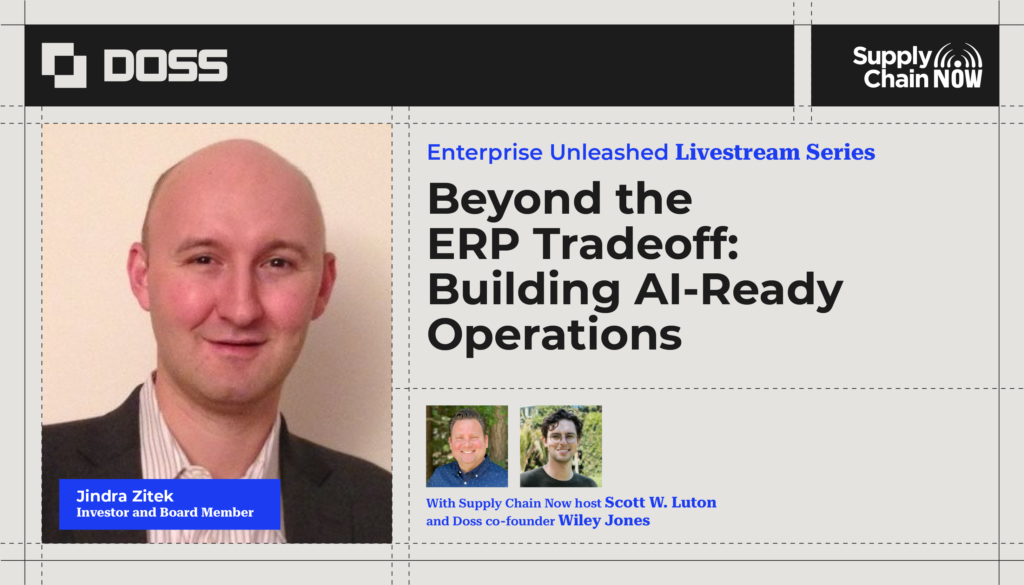
[00:01:06] Scott W Luton: I’m jealous. I am jealous. But– And our guest, I think me and our guest are both experiencing tons of heat as he calls New York City home and we call Atlanta home. But hey, we got a lot of heat getting to the show here today, right? We continue a popular new series for 2026, Enterprise Unleashed, powered by Wiley and all of our friends at Doss.
[00:01:24] Scott W Luton: Now, this outstanding series, and yes, I’m partial, but it’s been really dialed in on real leadership conversations with individuals that have developed a proven track record for truly unleashing the power of the enterprise, especially in new, innovative ways. And today, we have yet another w- another wonderful conversation teed up with a mover and shaker, where we’re gonna be talking about getting past the ERP trade-off and building operations that are truly AI-ready.
[00:01:51] Scott W Luton: Um, by the way, folks, and Wiley, we shared a great blog article here recently, uh, just last weekend as a matter of fact, where we dove into some of the key themes from this big series so far. I think we’re five or six episodes in. And I love this quote from Wiley here. Quote, “When we talk about technology innovation, we end up talking a lot about how we can work together better as people.”
[00:02:13] Scott W Luton: So folks, check out that whole read and I can’t, I already can’t wait, Wiley, to knock out the second half of key takeaways from this series. Are you ready, Wiley, to dive into the show here
[00:02:25] Scott W Luton: today?
[00:02:26] Wiley Jones: Ready to rock
[00:02:28] Scott W Luton: As always.
[00:02:29] Scott W Luton: So with all that said, wanna get to work welcoming our featured guest here today. Jindra Zitek is an industry dynamo, folks. Uh, he is a builder, an operator, an investor, a board member. In fact, get this, Jin- Jindra has transformed organizations in a variety of ways. As a former McKinsey consultant, he led commercial transformations in automotive, tech, and healthcare in Europe, the USA, and in China.
[00:02:57] Scott W Luton: As a C-level leader for a variety of organizations, including his CIO role at Chobani, he drove tech and supply chain transformation during a turnaround situation, get this, creating some 50 million, uh, 50 million in value creation. Or hey, check out his role as chief supply chain officer at HelloFresh, where he helped to scale that business from 1.6 to 3.5 billion just in North America.
[00:03:24] Scott W Luton: as a board member,
[00:03:25] Scott W Luton: advisor, and partner for a wide range of organizations, including current board roles with Hive and SenCargo amongst others. I tell you what, you’re gonna see his passion for building teams and driving impact on full display here today. Let’s welcome in Jindra Zitek
[00:03:41] Scott W Luton: Hey, hey, Jindra. How are you doing, my
[00:03:43] Scott W Luton: friend?
[00:03:44] Jindra Zitek: I’m great. Hi, everyone. Hi, Scott. Hi, Wylie
[00:03:46] Scott W Luton: Great to see you. Wiley, we’ve been looking forward
[00:03:49] Scott W Luton: to this, huh?
[00:03:50] Wiley Jones: yeah. Yinder and I have had many conversations over the last year, and I’m really excited for one of these to make it onto the show
[00:03:56] Scott W Luton: Hey, me too. And I hear, you know, Wiley’s been telling me, Jindra, that you’ve, you’re, you’ve got this innate ability to unlock codes and puzzles and challenges, so we’re gonna dive into that here today. But first, Wiley and Jindra. Wiley, you know I’m gonna start with my fun warmup question ’cause I wanna get to know Jindra a little bit better outside of leadership, innovation, all that
[00:04:16] Scott W Luton: good stuff. So, uh, Jindra, we’ve done our homework. You are a big global traveler, almost 80 countries in and out. That’s remarkable. You love classical music. You love marathon running, all very competitive there. But what’s probably most important to you is your family, your husband, and your two boys.
[00:04:34] Scott W Luton: Very competitive children, I believe. So tell us what you did last weekend, Jindra
[00:04:39] Jindra Zitek: So great to be here. Thank you Um, this past weekend, which is two days ago, although it seems ages, was, uh, was a quiet one. It was quiet because my eight-year-old went to his first sleepaway camp. Uh, I took him to Northern Minnesota to Spanish immersion camp. So me and my husband had the weekend only with our four-year-old.
[00:05:00] Jindra Zitek: Um, quiet weekend, means I ran two qualification races for New York City marathons on both Saturday and Sunday morning at 8:00 AM before the heat starts. And then we actually marched in New York City Pride on Sunday afternoon. Um, I think it helped build my four-year-old’s ego because we were marching the Fifth Avenue and everybody was clapping, and they thought they are all clapping for him.
[00:05:25] Jindra Zitek: So we had a great time. Thankfully, it wasn’t too hot, actually. It was a very nice, pleasant late June day in New York City.
[00:05:31] Scott W Luton: Love that, Jindra. And Wiley, I don’t know about you, but that makes me feel what I accomplished last weekend. I feel like a laggard now, Wiley. Your
[00:05:40] Scott W Luton: thoughts?
[00:05:40] Wiley Jones: Yeah. Let me think about the relative percentage of miles that I traveled by foot over last weekend as a percentage of what Yinder did. it’s, you know, 0.001 maybe?
[00:05:56] Scott W Luton: Oh my gosh. Well, hey, I’m with you. Uh, and I can’t wait, uh, Jindra, I can’t wait to get into here today. You know, me and Wiley have been talking about this, uh, this edition, and we’re so glad you got some time with us.
[00:06:06] Scott W Luton: So Jindra, let’s do this. Um, you know, we
[00:06:09] Scott W Luton: touched on– I could’ve been introducing you for like
[00:06:11] Scott W Luton: an hour based on all you’ve done. Um, but you’ve operated inside companies with very different views of technology and transformation, right? So I’m curious as we get started here, what experiences most shaped how you think about the relationship,
[00:06:26] Scott W Luton: especially between systems,
[00:06:29] Scott W Luton: people, and operating performance, Jindra?
[00:06:32] Jindra Zitek: So I have a strong opinion on this, as you know. Yeah.
[00:06:37] Jindra Zitek: Um, and that is that the performational outcome is through an outcome of the inputs, and the inputs are people, and systems can enable people or they can hold them back. Bringing it back home to supply chain, I think I shared with you, I grew up on a small farm in the Czech Republic, which my family founded in 1300s, and I always admired my grandfather’s, uh, little sheet where he, all what he was tracking is how much hay do we have, how much wheat do we have , how much food do we have for the pigs and the cows, and then how much output comes out.
[00:07:12] Jindra Zitek: So very simple systems. Um, when I started my career at McKinsey, I very quickly realized that systems can hold you back, sometimes intentionally, sometimes unintentionally. It can be an excuse. but as you can imagine, this impatient, uh, 24, 25-year-old McKinsey consultant, who by then I was losing some hair, maybe thanks to ERP.
[00:07:35] Jindra Zitek: But I was told so many times you cannot get data because of our, and you name it, any of the big black box ERP systems. So that was my first experience with the systems. I also know, kind of growing up a little bit, moving on from McKinsey to my first operational role, um, I was a accidental sort of CIO at Chobani.
[00:07:56] Jindra Zitek: They wanted a business guy to run the IT organization. Um, Chobani grew to one and a half billion plus without an ERP or without a proper ERP, what many would call a, call it. It was thanks to people, right?
[00:08:11] Jindra Zitek: So despite not having the systems. And then HelloFresh, and we will get to it, uh, in a bit later, actually had a large, let’s say, tech stack of multiple tools in supply chain, but even that wasn’t completely sufficient during the pandemic.
[00:08:26] Jindra Zitek: So I’m a big believer in people. I think systems come next. You need the systems, uh, and tools and processes because otherwise you can’t scale. But it’s very important to introduce the systems and tools at the right times when you actually know what the processes are and your organization is mature, uh, mature at some level.
[00:08:45] Scott W Luton: what a great starting point. Uh, and Wiley, I know we’re gonna get into the two operating models in just a second next with you, but how he started that. He and his family started their family farm there in the Czech Republic back in the 1300s, and the, and the visuals and the systems and the straightforward inputs, what a great starting point of this conversation.
[00:09:06] Scott W Luton: What’d you hear, Wiley?
[00:09:08] Wiley Jones: I, I hear, um, something similar to, you know, similar experience for me, where I remember in, uh, in my childhood, my dad working for a, a big, uh, tier one automotive supplier over the years and spending a lot of time in Japan and, you know, in the Detroit areas. Um, similar things where he was describing, “Hey, we, we actually can’t run a lot of the manufacturing processes we wanna run because the systems that we’re using.”
[00:09:33] Wiley Jones: And there were these simple systems on the manufacturing line, but then more complex systems as they thought through costing and accounting, being able to understand, are we making money on the processes that we are introducing? Um, and you know, I’ll, I’ll, uh, save the names of which, as was saying, which big black box ERP systems they were using, but there were a combination of swear words coming from my engineering father about, uh, enterprise systems back in the 2000s.
[00:09:57] Wiley Jones: And I don’t remember, you know, I, I didn’t remember at the time, but I was like, you know, it’s funny many years later, this is what I’m working on
[00:10:03] Scott W Luton: Hey, uh, I bet those were some creative, uh, iterations and combinations.
[00:10:08] Scott W Luton: All right.
[00:10:09] Wiley Jones: Very creative. Very creative
[00:10:10] Scott W Luton: uh, Jindra and Wiley, gosh, on your responses there, I, I can only imagine the stories and what’s been passed down from your families and how important that shapes your leadership worldview. But Wiley, I know you and Jindra have talked a lot about, uh, two operating models in particular.
[00:10:26] Scott W Luton: Where are we going next with
[00:10:27] Scott W Luton: Jindra?
[00:10:28] Wiley Jones: I think the, the thing that he has mentioned a number of times and I think is, is brought up really well here is the, the need to bring in systems at the right time and way that that’s done following the way that the people operate inside of the company, those inputs of people. It ends up looking like two very different company DNAs, where you have these suite-focused organizations that they want to centralize and they want to standardize based on that. then you have the technology-forward organizations that
[00:10:58] Wiley Jones: maybe push into the frontier a bit. They embrace a best-of-breed approach. They do a lot of integrations. They build a lot of stuff themselves. is the– what are these trade-offs? What’s– what am I missing about this? How does each model work?
[00:11:11] Wiley Jones: Where
[00:11:12] Wiley Jones: have you seen them succeed? Where have you seen them break down? Walk me through the, the kind of the dichotomy there.
[00:11:17] Jindra Zitek: Yeah.
[00:11:18] Jindra Zitek: that’s indeed similar to how I see the world. Sometimes you have a big black box, and as an operator or CIO, uh, you have to say, “I can do it as long as,” and again, you name it, SAP, Dynamics, Oracle can do it. And the other times you actually believe that your systems are unique and you wanna assemble an ecosystem or tech stack of 15 different tools in supply chain.
[00:11:44] Jindra Zitek: Ultimately, if you step back, I think both of them have advantages, but both of them have, uh, significant pitfalls because what are these systems here for? Ultimately, they are here to make decisions faster
[00:11:59] Jindra Zitek: so that the business and the people running the business make the right decision. And ultimately, you wanna make the right decision, right?
[00:12:07] Jindra Zitek: And sometimes the reason why you cannot make the right decision is the weakest link, and the weakest link can be either the system or the person. So if I go back to the two archetypes, the black box traditional ERP, it limits you, it slows things down. Uh, I’m sure that many of us have heard we cannot do this because first we have this six months ERP project, then we have another six months ERP project, and then we have to clean it up.
[00:12:32] Jindra Zitek: So if you, Mr. Supply Chain or Mr. CMO, want something to be done, let’s talk about the 2028 roadmap. I’m sure that we have seen it many times. Uh, when it comes to the ecosystem of a variety of different tech tools, which in theory are best of breed and work well together. Well, guess what? Somebody has to integrate them.
[00:12:54] Jindra Zitek: Those integrations fail. While we have this tech stack of 15 tool, the 16th tool is being introduced. And again, you are only as good as your weakest link. That weakest link could be somebody in the procurement department, that could be one of your tools. And you can only imagine when I actually lived through COVID, uh, during one of the eCom– leading e-commerce organizations at that time, how much tech debt and tax we had to pay by having 15 or 18 different, uh, tech tools.
[00:13:24] Jindra Zitek: And we had to bring everybody on a call, literally 40 plus people, uh, every single day for 9:00 AM call for 30 minutes. So both have minuses. Both you can live with, thanks to people, but both can slow you down
[00:13:35] Scott W Luton: Wiley, I know you got another question for Jindra, but I just want to point out, uh, a couple things there. Number one, he’s used the phrase “thanks to the people” twice now. So I already know we’re, um, um, we’re second cousins with Jindra ’cause he’s got a deep appreciation for the workforce out there. and then secondly, you know some of the things he shared in his answer, of course, velocity, decision-making, and focusing and finding out what our weakest links are so we can address them. uh, Wiley, your
[00:14:02] Scott W Luton: thoughts
[00:14:03] Wiley Jones: I think– So this is so interesting that even across both of these, let’s call them extremes. On one hand, you have mass fat fragmentation and decentralization across systems. the other, you have mass consolidation and centralization. Big monolithic system, as you said, says, “Yes, we can do that if it fits into blank.” And that fits into blank based on, let’s call it the 2030 timeline, where we’re gonna move over to our, you know, single source of truth, um, something like that And then on the other hand, it’s a, “Here, let’s add a new tool to solve that specific problem and make sure it’s integrated.” Um, what I’m so interested in is that It sounds like both of them actually result in the same set of trade-offs, which is you’re trying to identify how you want to solve speed and coordination problem with people. And you have to decide as an organization, you wanna solve it with what you described as this
[00:15:01] Wiley Jones: 40-person war room, or do you wanna solve It with, you know, how well you can parallelize and systematize, uh, waterfall-like programs? me through kind of like what are the, what are the gaps between these, and how have you seen organizations try to solve the quality of decision-making and speed of decision-making
[00:15:20] Wiley Jones: in these two different regimes?
[00:15:21] Wiley Jones: ‘Cause it sounds like it’s actually the same set of trade-offs at the end of the
[00:15:23] Wiley Jones: day.
[00:15:24] Jindra Zitek: It is the same set of trade-offs. And ultimately, you pay, I would call it tax, and you can call it coordination tax or people tax for whichever archetype you decide to go for. But if you go for best of breed, and in theory, all of the data is available at the same time on which you want to make a decision, some of the data lives only in people’s heads, so you need to get them on a call.
[00:15:47] Jindra Zitek: And I would actually argue that while best of breed can seem attractive, it’s often more expensive because somebody has to integrate the tool. So you are paying that integration tax once, uh, through your tech budget, which is often harder than if you go with one black box tool. Uh, secondly, you pay with the cost of those 40 people who have to be on that call and who have to share the best knowledge.
[00:16:09] Jindra Zitek: Uh, when it comes to the black box, um, honestly, you end up working with a lot of workarounds around the black box. The black box forces you to look at data a certain way. Um, because that might not be the most user-friendly way of seeing data, you are inefficient. You actually end up doing a lot of shadow IT tools on the side of it because that black box doesn’t meet your needs, and that ultimately sl-slows you down and leads to compromises in other ways.
[00:16:36] Jindra Zitek: So I agree, they might seem very different, but ultimately both slow you down and both cost you the ability to make the right decisions faster and enable, and again, bringing it back to people, sound a little bit repetitive here. But at the end of the day, you want to enable your people to make the right decisions fast and enjoy their jobs and look at the more strategic things which matter
[00:16:57] Scott W Luton: Yendra, I Love it. All right. So, And you mentioned you and both, I think y’all both mentioned the human tax. We’re gonna dive into that in our next segment, so hold that thought. But secondly, bl- not only blessed are the workforce, but certainly blessed are the
[00:17:09] Scott W Luton: integrators, the hardworking integrators that y’all both have referenced
[00:17:12] Scott W Luton: numerous times. Um, Yendra, a two-part question here. So number one, how does, or how much rather, does a company’s self-image shape its systems? And then secondly, what changes when a business sees technology as
[00:17:27] Scott W Luton: a strategic capability versus, you know, a back office service? Your thoughts
[00:17:32] Jindra Zitek: This is a big question
[00:17:35] Jindra Zitek: And, uh, look, if we step back from even technology and supply chain, I am a strong believer that each company has its DNA, and sometimes it’s aligned with a specific function. So there are, and this is well known, there are some organizations which bring in, uh, or grow up great finance people versus HR people versus marketer.
[00:17:58] Jindra Zitek: And there are obviously organizations which,
[00:18:00] Jindra Zitek: um, which bring out, uh, and educate and train great IT people. Ultimately,
[00:18:07] Jindra Zitek: um, I think that if you have people work on one team, and I strongly believe in cross-functional teams, and we can go into details, that to me means people are mixed on the floor together.
[00:18:20] Jindra Zitek: IT person sits next to marketing person, sits next to customer experience person, etc. Good things will happen. while it might seem very, I would say, attractive to say, tech is the kind of differentiator and we are a tech company first and then, and you name it, apparel company second, etc. There is one risk, and the risk I have seen, and I have lived it once, is that if you are in an organization which considers of itself a tech, let’s say tech and apparel organization, and you put the tech people on a pedestal, you treat them differently, you put them on a higher floor in the office.
[00:18:59] Jindra Zitek: I’ve seen a situation where the bins,
[00:19:02] Jindra Zitek: and I’m talking about the trash bins, you know, from our office spaces, the tech people get $80 trash bins versus the marketing ops and HR people get $20 trash bins to their desk. It leads to really bad culture outcomes. So I’ll just pose it there
[00:19:18] Scott W Luton: I like it, Jindra. um, all right? Wiley, we’re about to move into human tax, but I know you’re ready. you probably have a five-minute response on what Jindra just shared, but give me like the the Reader’s Digest response to what he shared there,
[00:19:32] Scott W Luton: Wiley
[00:19:32] Wiley Jones: it’s a follow-up question, very simple.
[00:19:36] Wiley Jones: How does that manifest in the way that they approach building their systems around them? And it’s what you said, the inputs are the people. You know, a tech organizat- an organization that says, “We’re an apparel company second, but a tech company first,” it sounds like they probably
[00:19:52] Wiley Jones: build their systems and they build their organization differently as a result. How do you see that go?
[00:19:58] Jindra Zitek: The, that’s right. And the only way to avoid that is that you have leaders who message to the whole organization at the same time with one voice, one set of goals, and one set of metrics. Because immediately when you move into these are the metrics that matter for the marketing organization versus supply chain versus IT, you end up people kind of looking for the local minimums, looking for things which make a difference in IT.
[00:20:27] Jindra Zitek: I’m gonna build a system which has the highest uptime, uh, most secure, uh, that might not end up being the most usable system, and vice versa. Marketing cares about creativity, but maybe less attribution, which would allow us to measure cost of acquiring customers. It has to start at the top, right? So the leader has to message to the whole organization.
[00:20:49] Jindra Zitek: The whole organization has three goals, three objectives. They are not marketing objectives, not IT objective. They are business objectives
[00:20:57] Scott W Luton: You know, we’re after enterprise success, not fiefdom success, I think, Jindra and Wally. Good stuff there. All right. So I got to get into this human tax disconnected operations. I feel this in our bones, and one of my favorite things we’ve talked about on, you know, for years now is how we can eliminate that human tax, because it’s very real. And when systems cannot handle exceptions, people become that integration layer. Both y’all have kind of referenced that already. Tasks such as checking deductions, confirming
[00:21:27] Scott W Luton: EDI transactions, chasing approvals, um, solving, you know, workarounds, all that is fatiguing. And that’s probably putting it mildly, right?
[00:21:38] Scott W Luton: Creates tons of friction. Uh, so Jindra, how should leaders distinguish between automating jobs and removing work that prevents people from doing their real jobs
[00:21:49] Jindra Zitek: So the easy automation was done, right? So the RPAs
[00:21:56] Jindra Zitek: and other tools are already existing and if we are looking forward, I would say whatever was easy to automate is done and we have to look at what is the next low-hanging fruit, A. B, I would also say
[00:22:07] Jindra Zitek: if you say that you wanna automate a job and there is some resistance in the organization, you will never succeed because somebody can always make an argument, “You automated only 95 or
[00:22:19] Jindra Zitek: 97% of my job, hence I still need to be here, uh, because this specific part of my job has not been automated.”
[00:22:26] Jindra Zitek: So I’m very much in favor of the second, um, making your job easier, allowing people to actually focus on building the relationship with their suppliers, building relationships with their, uh, with the companies that make sure that inbound trucks and outbound trucks depart on time. It’s much easier proposition as opposed to fighting, “Has your job been automated 80% of your time, 90% of your time or 95% of your time?”
[00:22:50] Scott W Luton: All right Wiley. that take your mind and what’s your next question for Yindra?
[00:22:55] Wiley Jones: I, I’m thinking about a literal conversation I had this morning, uh, to this with some, with some customers. So I’m like, my brain is rewiring some stuff. Um, no, I, I think it… the the thing that he, he, uh, described that’s so interesting is kind of like a, a base layer of this that’s quite emotional, and it… a bit of it seems like it’s about, dignity and purpose. And the thing that connects up to is the distinction between efficiency and leverage. And what it sounds like to me is that Yinder is describing leverage, which is how you give people the ability to do more with what they have, as opposed to saying, “We’re gonna take responsibilities away from you.
[00:23:33] Wiley Jones: We’re gonna automate Your job.” Instead it’s, “We’re gonna remove the pain, stress, and frustration so that you can ladder up
[00:23:39] Wiley Jones: what you do more clearly and with higher impact to those business objectives you were describing.” What are the consequences of this, uh, you know, uh, of when we’re, we’re in the work, um, um, you know, what, what are the consequences of this when we don’t get this right? And then what happens when we do
[00:23:55] Wiley Jones: get it right, you know, in, in the world of revenue inventory, um, cost? me
[00:24:01] Wiley Jones: through that.
[00:24:01] Jindra Zitek: That’s absolutely right. The consequence if you are focused on automation is that when you actually deploy the new system, the employees will push back and they will say, “You, Mr. Change Management IT
[00:24:16] Jindra Zitek: or SI,” whoever did that, “do not know that 3% of my job is to manually look whenever on the replenishment side of the aisle some bag runs out, I have to go to the store, and you forgot about that, hence you did not do your job well.”
[00:24:31] Jindra Zitek: If you switch and say, “I’m going to enable you so that you can do the quality controls and you can check, I don’t know, if it was garlic in my distribution centers or something else, and I’m actually allowing you to do that other job better, which only you can do, hence we can serve our customers better.”
[00:24:47] Jindra Zitek: It’s much easier enablement conversation. You actually allow people to focus on what they are better at, what robots truly can’t do, uh, truly can’t do. And you actually even like, in some of the lowest hourly jobs, you signal job security because you are saying, “You will not be removed because I really need you for this task, which I cannot automate away with robots, agentic solutions, etc.”
[00:25:13] Scott W Luton: Hmm.
[00:25:14] Scott W Luton: Um
[00:25:15] Jindra Zitek: I actually like how you call it, Wiley. It’s a lot about dignity, right? And telling them there is a space for you long-term. I’m actually just helping you do your job better and giving you additional tools. In the past might have been ERPs, it might have been some RPAs. Now it’s new agenting tools, which to me is just a new tool at everybody’s disposal
[00:25:34] Scott W Luton: Hmm. All right. Really quick, Wiley. I know you got, uh, you got the next question with, um, uh, Indre here, but I love that he picked up on your phrase earlier, dignity And purpose. I love that. I love us just thinking about that and using that as a central theme in today’s, uh, conversation, especially in light of change and transformation.
[00:25:53] Scott W Luton: All right. So Wiley, where are we going next? Or maybe a third model, huh?
[00:25:57] Wiley Jones: Well, I think that’s kind of where, uh, and, and Ninder’s been hinting at this, which is: we’ve been talking a lot about the way that things have been historically and these new layers of automation that are now possible and this kind of leverage that we can create. We have this ERP monolith, this black box model that we’ve described where it’s a big suite. Then you have the fragmented, uh, best-of-breed stack. What does this new paradigm look
[00:26:22] Wiley Jones: like that’s been emerging as companies are recognizing that agentic systems and modern, modern platforms have capabilities that have never been possible before, especially as it comes to that last mile of capabilities?
[00:26:35] Wiley Jones: You know, the, the, the lower-hanging fruit is getting less low, I guess
[00:26:38] Wiley Jones: is one thing, say a thing, thinking about it. Um, are you, what are you seeing in practice here?
[00:26:44] Jindra Zitek: I’m seeing companies which
[00:26:47] Jindra Zitek: can move faster and where they don’t have to solve
[00:26:51] Jindra Zitek: 100% because the agentic systems can learn, right? And again, like Abel connected with that anecdote I mentioned, you don’t need to solve on the day one 95% of the problem because the agents can figure out when you give them a problem which they have not encountered how to use the historical information to move forward.
[00:27:08] Jindra Zitek: So I think we have this unique time where you don’t have to be bogged down by the system. Um, you’re actually bogged down by people willing to take risks and start building and trusting with decisions only they can make on their factory floors when the purchasing organization. But I see something like a true enablement where as long as you make the mindset shift that, yes, you can put some controls in place, but you can trust your agentic coworker or system or platform to leverage your past decisions because at the end of the day it’s based on historical decisions which you and your team have made.
[00:27:45] Jindra Zitek: You can move faster and you can just assign work and you can come back, uh, after dinner or next day in the morning and the work is done. And again, it allows people to focus on the more strategic and truly relationship-based part of their jobs, which are actually more fulfilling as well
[00:28:02] Wiley Jones: That is– Okay, so th- so you mentioned two parts which I wanna unpack because this is getting really tactical and that’s extremely useful, especially as we think about the, you know, the broader mission of the show, “Enterprise Unleashed,” giving leaders tactics that they can use and translate into their organizations. You said two things, speed and the controls around risk, and how that. unlocks our ability to run small experiments and move quickly. It sounds like there’s a risk of, number one, creating fragmentation. How do we avoid that And then number two, how
[00:28:34] Wiley Jones: do you actually
[00:28:35] Wiley Jones: set up the controls so that you can let someone go and say, “Hey, go run this historical procurement workflow that I’ve done a bunch of times.
[00:28:43] Wiley Jones: Go figure it out. I’m gonna go have dinner with my family and I’ll be back in the morning,” instead of staying late tonight. What does it look like in practice for organizations to get to a place where they can actually deliver that? And then how are they translating that?
[00:28:54] Wiley Jones: into a mindset that the organization can adopt
[00:28:56] Wiley Jones: company-wide?
[00:28:57] Jindra Zitek: Yeah. So in terms of practice and controls, I think the best tool is to give people visibility as to what their agent is doing, right? And again, like if you compare it to the black box, you actually don’t know what’s happening. It’s input and output, and there are a bunch of steps in between. Suddenly you can actually observe if you want to.
[00:29:18] Jindra Zitek: Uh, you ask the agent to give you maximum, uh, flex- maximum visibility as to how it’s making decisions. And what I mean by that, how it’s saying, “I need to change the forecast. I need to order additional volume, and this is how I decide am I go- going to order the extra widgets or whatever it might be from supplier number one versus from supplier number two.”
[00:29:38] Jindra Zitek: So that’s in terms of controls. What was the first part of the question?
[00:29:41] Wiley Jones: First part was then setting that up so that you could have smaller experiments run more quickly through these small experiments in kind of a
[00:29:49] Wiley Jones: bounded controlled environment, and then not risking creating fragmentation as you go through this process
[00:29:55] Jindra Zitek: I think that you now have the whole advantage that you don’t have to put the whole large system in place. So it’s actually more towards small experiments.
[00:30:03] Scott W Luton: More experiments is a great thing, right? It’s funny, um, Wally, you and I both know the one and only Marty Parker, right? Um, we were on an interview the other day, Jindra, uh, this is a former C-level executive industry, and he was reminiscing about years and years ago, they would run two simulations a year,
[00:30:20] Scott W Luton: And wait for the results months and months later. a different place.
[00:30:24] Scott W Luton: all right.
[00:30:24] Jindra Zitek: I also think like it’s very democratizing because anybody in the business can come up with an idea and say, “This is my problem we cannot solve, and it will be bottlenecked at a certain time of the day when it’s about CX.” Or realizing that there is this long tail of exceptions, and it could be something about document ingestion or filling out manual purchase order or making sure that some incomplete orders don’t end up in a black box because they are missing some part of the API, uh, component.
[00:30:56] Jindra Zitek: It’s very enabling, and anybody can come up with that idea, and it’s very easy to test it the next day. You don’t have to like do the full requirement gathering, then give it to somebody, then do unit testing. But literally within a couple days, and this is where the barrier has been removed, you can start testing it and see if it adds value
[00:31:13] Scott W Luton: And of course, Wiley, that adds to the, the big main major common theme of culture that we have touched on every single episode, because when that, that democratization effect that Jindra references, that pulls that alignment, it pulls people together, shows how they, they can make an impact on the organization.
[00:31:33] Scott W Luton: So
[00:31:34] Scott W Luton: Jindra, where should– Two-part question. I love my two, two-part questions, evidently. So where should an operator expect to see hard ROI first? And then secondly, what would you convince or what would convince you rather, that a company is truly creating real operating
[00:31:50] Scott W Luton: leverage rather than running another AI pilot? Your thoughts,
[00:31:55] Wiley Jones: Yeah
[00:31:56] Jindra Zitek: I think that you have to stay honest with what are the metrics and KPIs that move your organization, right? And it could be, it doesn’t have to be immediately. I mean, ideally it’s revenue or cost, but you can look at customer engagement and customer satisfaction. But pick something that isn’t there just like this is the specific experiment and this is how I will measure it, but connect it to order to cash, revenue collection, managing chargebacks and deductions better or vice versa.
[00:32:26] Jindra Zitek: If you are looking at the cost side, making sure that you are actually optimizing your procurement process better, improving your forecasting so that you can order widgets even from the supplier, which is, I don’t know, half a day or one day extra further away. So for me, it comes down to the hard metrics, which by the way should be the same as metrics we used yesterday and observing them and making sure that you can impact them through AI strategies
[00:32:52] Scott W Luton: Love that. And you know, one of the things I heard there, Wiley, before you take the next question with Jindra, is make sure our metrics are rooted in reality and how that business actually runs rather than fairy tale land where we’re listing all these metrics that just isn’t connected to how we run the business or want to run the business. That, that’s what I heard, Wiley. What else did you hear? And let’s roll into our next leadership topic too.
[00:33:17] Wiley Jones: Yeah. What you’re describing, uh, Scott, I, I refer to as spreadsheet engineering.
[00:33:22] Scott W Luton: Hmm
[00:33:22] Wiley Jones: you know, you can, you can make the spreadsheets say whatever you want at the end of the day. Um, but if you go look at it in practice on the floor, go ask your customers, it’s, it’s hard to get those numbers to lie. what, what’s interesting to me is that tying this back to what Yinder said, what’s quite interesting is that is an ability, um, to take what Yinder was describing about looking at historical performance, looking at the things that AI workflows, a- agents, whatever you call it, are actually producing, and then being able to produce a very clear counterfactual. If we hadn’t run this forecast this way as the agent made the ch- suggestions and changes and drove our organization against, how do we think this would have gone? Oh, how much money do we think we would have spent with this vendor if we hadn’t negotiated the prices down using this agentic workflow? I think that a really important part of this is these organizations starting to look at themselves as producing datasets that allow them to measure a counterfactual, um, and validate ROI in practice and not just, uh, again, on, on spreadsheets that they, they can conjure up.
[00:34:28] Wiley Jones: So that’s, uh, the one thing I’ve seen quite often, and I think is a really powerful tactic that comes out of this, and Yinder hit on directly through this conversation.
[00:34:36] Wiley Jones: Um, jumping into kind of the next section, though, on this is, uh, back to a point he made earlier was around cross-functional execution downstream of leadership alignment. do you get in practice, you know, finance, operations, IT? these are, these are not, uh, these are not the op- organizations in the company that are gonna– that, that love hanging
[00:34:55] Wiley Jones: out with each other, um, after work for beers always, right? Um, now, you know, in some companies. But what does effective co-building look like across these organizations when, as we described, these metrics are so intertwined, the experiences for the end, uh, end customer and even the end, you know, users of these
[00:35:11] Wiley Jones: systems inside the organization are so intertwined.
[00:35:14] Wiley Jones: How does co-building work in this AI-native era?
[00:35:17] Jindra Zitek: Uh, you make the people…
[00:35:21] Jindra Zitek: It actually works the same way even before the AI building era. You make them sit together. I’m a big believer in switching where people sit on a regular basis. There is actually, uh, a lot of research now done into this, uh, by Oxford professor, Anat Mike, who was actually my former teacher at LSE and also once my boss.
[00:35:40] Jindra Zitek: And if you move people around, make sure that they have a different neighbor every three to six months, good stuff happens. They’re more likely to collaborate better. You also need to make sure, and this goes back to having one set of goals and one set of metrics, which are organizational metrics, so doing it in a very, um, OKR-ish way and making sure that whether it’s on annual or quarterly basis, people know what their objectives are.
[00:36:07] Jindra Zitek: And you define it, and you make it a, a part of everybody’s, um, everybody’s annual objectives for their success criteria. That makes a huge difference. By the way, I’ll give you a fun fact. It’s also once you ingrain people into this is how we are evaluating, this is how we have to succeed, it’s very difficult to change it and unlearn it.
[00:36:30] Jindra Zitek: So one of the, for me, very difficult exercises at the start of COVID, uh, so let’s call it like late March or early April, was to tell people that the OKRs we put in place, which meant do A, B, C, D, are suddenly not valid. I need you to do something completely different. Simplify product, no additional innovation, ship the product faster.
[00:36:51] Jindra Zitek: It took us like three or four times to message that message before people realized, oh, I will not be evaluated by how much innovation I did, but actually did I get the food to people who cannot go and/or do not want to go to supermarkets. But it’s all about communication, common KPIs across teams. Also, people, especially in early stages of their career, moving laterally, so moving from being a finance person to being a procurement analyst and then maybe having a stint in IT, that creates those strong cross-functional relationships
[00:37:24] Scott W Luton: Indra, on the fir- first part of your response there, you were talking about how difficult it is to
[00:37:29] Scott W Luton: things.
[00:37:30] Wiley Jones: Yeah
[00:37:30] Scott W Luton: a great keynote a year or two ago on leaning into recognizing the challenge, but strengthening your ability, especially in this, this era of constant change, to unlearn and release from the older way of doing things and then to the un- the, um, modern, innovative way. Um, all right. of the major themes of this conversation so far been, you know, creating that alignment and creating that alignment where folks can move fast while maintaining control and the, the T word, the imperative T word of trust and accountability. So I wanna play on that major theme thus far, Indra. How can leaders– What do l- what do middle managers and invi- individual
[00:38:14] Scott W Luton: contributors need from leadership in order to make all of that happen? So number one, we can not only apply the right technology tools to the right problems, but also get out of what a lot of folks are talking about, you know, that pilot
[00:38:31] Scott W Luton: purgatory and scaling, uh, the solutions across enterprise.
[00:38:36] Scott W Luton: Your thoughts?
[00:38:37] Jindra Zitek: I think you need mountain hills and governance around what, um… And this goes back to an earlier question as well.
[00:38:44] Jindra Zitek: What are the guardrails? Like, if everybody can come up with an idea, uh, what can you touch? What you can’t touch? What you should be afraid of? How do we actually monitor the success of a specific agentic project or building a full platform?
[00:38:59] Jindra Zitek: So I think once you say, this is where we are heading, and this goes back to goal and mission and the specific metrics. Once you define the guardrails where you have to operate, it’s actually extremely freeing and satisfying when you then see a senior associate or manager come up with an idea and says, “I wanna do this.
[00:39:19] Jindra Zitek: I’m asking for budget X. This is gonna be the criteria I’m gonna be measured on.” And I’ve seen one or two cases where the person actually six or nine months later is running all of AI across the whole business. So there are many, um, kind of again, if you step back, there are some businesses which are waiting for their chief AI officer, and they are still waiting six months later, nine months later, one year later.
[00:39:41] Jindra Zitek: The organizations I have seen successful in today’s age is where the
[00:39:47] Jindra Zitek: director of operations or director of CX says, “We are growing 3x. I will not be allowed or able to hire three times as many people, and I think I can probably only achieve 20% efficiencies without AI. Let me try experimenting.” That person who is not afraid, who agrees on, ‘Hey, this is what I wanna impact,” who also knows that a mistake will happen, right?
[00:40:09] Jindra Zitek: There might be a specific type of ticket and you can again control for it. You can say if it’s anything health-related or if it’s anything in a different industry like another like important event related, let’s stop it. Let’s pass it to a human agent. Once you establish those guardrails, you can run and then you just measure
[00:40:27] Scott W Luton: I like it. Uh, I’m gonna pose this next question to both of y’all. That’s right, Wiley, I’m posing it to
[00:40:32] Scott W Luton: you as well.
[00:40:33] Wiley Jones: Oof
[00:40:33] Scott W Luton: goes. Hope you can keep up with, uh, Jindra I think you can. Y’all two are two of the smartest folks I think I’ve ever met.
[00:40:40] Scott W Luton: You know, those out there, those practitioners out there that are tuned in,
[00:40:45] Scott W Luton: they really want to change, and they, they’re, they’re in the trenches trying hard to lean into this modern golden era of supply chain tech.
[00:40:53] Scott W Luton: So for any of those companies starting now, what is one workflow or one class of exception,
[00:40:59] Scott W Luton: I’ll call it, that you would target in the first 90 days? And Jindra, you go first
[00:41:04] Jindra Zitek: I would pick something that people hate, where mistakes happen, and what gets often referred to as one of the least popular part of the organization, where if you get stuck there, you don’t get promoted. And that could be
[00:41:20] Jindra Zitek: invoicing, it could be something around document ingestion, it could be manual processing of chargebacks.
[00:41:27] Jindra Zitek: But pick something where ideally you have a large number of employees, so we are not talking about one or two person team and making it 10% more efficient. But pick something that’s not sexy
[00:41:39] Scott W Luton: Yes, I like that. And Wiley’s picking something that people hate, picking something that makes people stay at home or stay at the office and miss dinner at home. Wiley, your
[00:41:48] Scott W Luton: thoughts?
[00:41:49] Wiley Jones: I mean, that’s back to the– I think the thing I was describing earlier around the dignity and purpose. Dignity, purpose, pain, removing pain, those are really powerful, uh, uh, to, to go look for that in your organizations. I think there’s another reference frame to, to steal a lot of what Yndra’s been describing, which is: What are those business objectives?
[00:42:10] Wiley Jones: Let’s say you have three as a company. We need to grow X percent over the next two years. We need to go into new markets, new geos, launch new products. We need to get sharper and have a tighter cost basis on these core evergreen product lines. are the work streams that ladder up to those? In those work streams that ladder up to those, where has– where have we had a hard time with the last mile delivery of a solution because of the complexity of the possible edge cases that can emerge? That is where agents are absolutely out of this world amazing. Go in and find those places where you are stuck
[00:42:45] Wiley Jones: trying to get work streams that ladder up to your business objectives across the finish line, and experiment with workflow automation that’s gonna give people leverage to be able to then close out those items and then drive towards those objectives.
[00:42:58] Wiley Jones: I think that’s the, the kind of the top-down version of what we were
[00:43:01] Wiley Jones: describing earlier of, you know, bottoms-up is go find the pain. Top-down is what are the business objectives and why can’t we hit them?
[00:43:07] Jindra Zitek: 100% agree. Where you have exceptions which previous kind of rounds of automation could not go after, hence you kind of let them be and it creates pain downstream, those are the best candidates as well.
[00:43:18] Scott W Luton: Jindra, what is your advice to those operators out there trying really hard day in and day out to build truly
[00:43:25] Scott W Luton: AI-ready operations today?
[00:43:27] Scott W Luton: I’m gonna go back to the well here. Your thoughts
[00:43:30] Jindra Zitek: Build cross-functional relationships. Find who is smart in your org on AI and make them your friend. It doesn’t have to be IT
[00:43:39] Scott W Luton: I like that. Wiley responded to that really quick
[00:43:43] Wiley Jones: Yeah, cross-functional relationships. building a cross-functional coalition starts with cross-pollination, as simple as what you’re descri- describing moving people around and getting people to share their perspectives and them realizing, “Oh wait, we all have the same problems, and if we actually try this new thing to address them, the business will be better for it.” Um, building coalition is the single most important thing that individual contributors and, and managers can be doing today. And leaders being able to empower and enable those coalitions, um, through top-down clarity of business objectives, like that is the job of leadership in my mind today. Make those business objectives clear and repeat them until you’re blue in the face
[00:44:27] Scott W Luton: I like it.
[00:44:28] Scott W Luton: Indra, look, we gotta make sure. First off, we gotta go through your agent and get you booked for a repeat, uh, appearance here on Supply Chain
[00:44:35] Scott W Luton: Now. I really we– I wish we had
[00:44:37] Scott W Luton: a couple more hours with you, but I wanna make sure folks know how to connect with you and follow all your incredible
[00:44:43] Scott W Luton: work, uh, really across industry. What’s the easiest way that folks can connect with you,
[00:44:48] Scott W Luton: Indra?
[00:44:48] Jindra Zitek: Ping me on LinkedIn or stop me in Central Park when I’m running
[00:44:52] Scott W Luton: Okay.
[00:44:53] Scott W Luton: You don’t really wanna get
[00:44:54] Scott W Luton: stopped in Central Park as you’re, you got your cadence going, do you?
[00:44:59] Jindra Zitek: Vibe er det eneste,
[00:45:01] Jindra Zitek: vibe er alt
[00:45:01] Scott W Luton: me, if it’s me, I’m not sure if I can get going again. Uh, all right. So, uh,
[00:45:08] Scott W Luton: uh, Jindra Zitek, um, again, a pleasure to learn from you here today. We gotta c- bring you back. I love how you started the conversation, not only with your family, but, uh, the family farm in the Czech Republic and the lessons learned, you know, of years ago that are still,
[00:45:25] Scott W Luton: uh, really robustly relevant here today. So thanks so much for being here,
[00:45:30] Scott W Luton: Jindra
[00:45:31] Jindra Zitek: Great to be here. Thank you Scott and Wiley.
[00:45:33] Scott W Luton: We’ll see you soon Oh, Wiley, that was a great one.
[00:45:37] Scott W Luton: we got a lot of gold nuggets from Jindra here today, as promised. still processing some of the, uh, some of what he shared. What are a couple of your favorite key takeaways from today’s conversation?
[00:45:51] Wiley Jones: People and the organizations that are made up of these people need to have clarity from leaders in the company about how the business objectives should drive down into tactical decisions on how systems and technology work. ERP being an example of one of the systems of the past and how this fragmentation of, you know, the
[00:46:18] Wiley Jones: tech stacks, uh, in one, you know, one paradigm, the monolithic systems in another paradigm, um, those were all just tools to then ladder up to business objectives the next section of this, this next journey that we’re going on is we now have new tools that are gonna allow us to challenge the ways that we’ve done this in the past. And leaders still have the same job, which is create clarity about business objectives and create rules of engagement and a tactical control for the organization to operate technology to then meet business objectives.
[00:46:51] Wiley Jones: The pro– As you said, the, the strategies and the execution of this is exactly the same as it was in the past. we just have new tools to do It with now
[00:46:58] Scott W Luton: I like it. I like it. You know, and I wanna, uh, double-click on something both, you know, both of y’all focus so much on the wonderful people, right? Thanks to the people. That was a big theme. you know, when we’re driving change, we gotta keep that in mind as leaders. Hey, the people are the ones delivering the value, creating the value. Why force change upon them? Let’s do it with them, right? In a way that optimizes that phrase you said, I loved it, dignity and purpose. If we only thought about dignity and purpose front and center more often, that’d be, it’d be a better world. Um, all right, Wiley, I’ve got two questions for you. You, you okay if we go over by a minute
[00:47:36] Scott W Luton: or two, Wiley?
[00:47:37] Wiley Jones: Yeah, of course
[00:47:38] Scott W Luton: All right. So we got, I’ve got a key question for you. Uh, and folks, before I share that one, August 11th, 12 noon Eastern Time, we’ve got a superstar joining us. A so b- big superstar we can’t even mention who that is yet. 12 noon, August 11th for the next episode of Enterprise Unleashed. Now, Wiley,
[00:47:56] Wiley Jones: what are you seeing customers there, uh, your Doss, uh, all your wonderful customers at Doss, do differently they design workflows and validate operating processes earlier? you know, where are we And where are we going? Your observations,
[00:48:12] Scott W Luton: Wiley
[00:48:13] Wiley Jones: I think a lot of this ends up looking like a combination of the way that waterfall systems worked in the past and the way that large implementation projects have worked in the past, um, where you still do the– a lot of the discovery. You go out into the organization, you talk to the subject matter experts, you go figure out what we need to accomplish as a business.
[00:48:39] Wiley Jones: Where is that pain? Where– what– oh, this three-way match process that accounts payable and inventory receiving teams hate, let’s go fix that. You still have to go do all that work. The thing that’s different is, is that that last mile of exceptions, the places where you have 50 edge cases, you can collapse the complexity of that now because you have near human intelligence capabilities of these agentic systems.
[00:49:05] Wiley Jones: You don’t have to manually hard code in every single, “Well, if it’s this situation, do this. If it’s that situation, do this.” If it’s– Instead it’s, “Hey, here is our framework.” Agents and, you know, AI systems can now say, “Using this framework, I will make good decisions. And when it reaches this specific edge case, I will then escalate it to a human.” And you can s- you can take all of the energy of defining the possible things that could go wrong and collapse it into a framework of rules instead of forcing every single thing to be delineated and, you know, dictated line by line. That is the thing that we’re seeing the, the complexity collapse around, and it allows implementations to run faster.
[00:49:45] Wiley Jones: But you still have to go to understand the systems. There’s no short– there is no, um, shortcut to comprehension. you have to still go and talk to people and be like, “What’s wrong? What’s broken? Why is it broken?” Still gotta go do that.
[00:49:57] Scott W Luton: There’s no shortcut to comprehension. That’s bad news for some folks out
[00:50:01] Scott W Luton: there . But
[00:50:02] Wiley Jones: Yeah, it is
[00:50:03] Scott W Luton: but, the good news, Wiley, is we have created tons of, um, I’ll call them shortcuts, but better ways for sure that is saving plenty and plenty of time and paving a much better way, a much better path for industry and its highly valuable and appreciated workforce, as we move into what’s next.
[00:50:22] Scott W Luton: So Wiley, really quick, I know, uh, I want to invite folks, uh, we don’t talk about Doss enough on these shows. I really wanna invite folks to come check out Doss, the AI-native operations cloud for the physical economy, the flow of goods, dollars, and data. The platform serves a- as the operational core around a company’s existing general ledger, managing inventory, orders, procurement, fulfillment, all in a single system, all with real-time visibility, automated workflows, and adaptive operations.
[00:50:54] Scott W Luton: You can learn more and take, even take a demo, ask the tough questions at doss.com.
[00:51:01] Scott W Luton: Check it out. Wiley, you, you, uh, feed… I think you get up in the morning, jump out of bed to take on the toughest questions out there. Is that right, Wiley? That’s what I picture
[00:51:10] Wiley Jones: I love the hard questions. I think that’s, um, I think that’s also maybe a thing that, um, Yinder was partially touching on that was a fun piece of this, is that leaders should be the one to take on this ambiguity and the hard questions. And so that’s, that’s my favorite part of my day
[00:51:24] Scott W Luton: I’m with you. I’m with you. And man, was a great guest. I want to thanks, uh, give a big thanks to Jindra Zitek, uh, Zitek, um, for show- joining us here today, sharing his been there, done that perspective. We’re gonna have to have Jindra back soon. Big thanks also, of course, to the one and only Wiley Jones and the Doss team that’s on the move.
[00:51:48] Scott W Luton: Uh, Wiley, big things at Doss. We didn’t get a chance to kind of unpack some of the, uh, the big news, but y’all keep, y’all keep growing and succeeding and tackling and answering those tough questions day by day, huh?
[00:52:01] Wiley Jones: It is a fun challenge every day. There’s a new one. Uh, uh, it, the, the pros and cons of that is that there are new problems to solve and, um, new, new hard questions to answer every day, so
[00:52:13] Scott W Luton: to all of, all of you out there, thank you so much for being here.
[00:52:16] Scott W Luton: big thanks to Amanda and Tricia behind the scenes helping make production happen, and, and tip of the hat to Ashuan as well. Most of all, big thanks to our SCN Global fam for being here with us. Folks, your homework, you know the homework. Number one, I hope you enjoyed the conversation as much as I have.
[00:52:32] Scott W Luton: You might have to go back and give IT
[00:52:32] Scott W Luton: a second listen like I know I’ll have to. But take one thing. Wiley
[00:52:38] Scott W Luton: and Indra offered a ton of actionable perspective here today, right? In some very… That you can utilize in some very difficult, highly change field times.
[00:52:47] Scott W Luton: Take one thing, do something with it, share with your team.
[00:52:50] Scott W Luton: Deeds not words. That’s how we’re gonna continue to drive transformation for our people and our industry. And with that said, Scott Luton on behalf of the Supply Chain Now team challenging you to do good, give forward, be the change that’s needed. Dignity and purpose, folks. Let’s keep that top of mind, and we’ll see you next time right back here on Supply Chain Now.
[00:53:07] Scott W Luton: Thanks, everybody