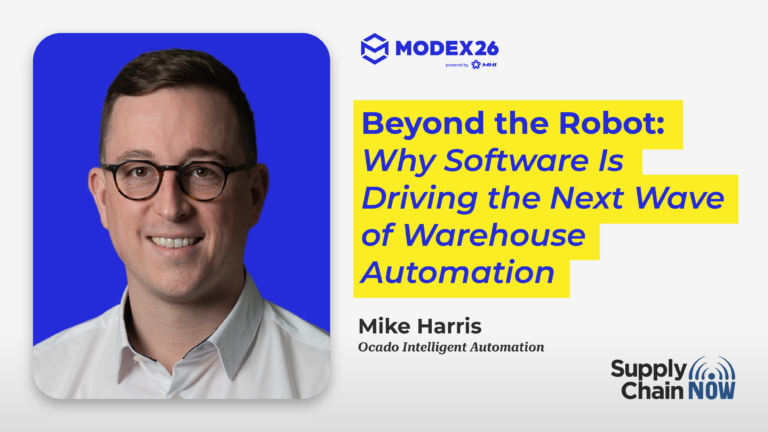
Beyond the Robot: Why Software Is Driving the Next Wave of Warehouse Automation
At MODEX 2026 in Atlanta, Scott Luton caught up with Mike Harris, VP of OMRS at Ocado Intelligent Automation, to explore how robotics, software, and evolving customer expectations are reshaping modern warehouse operations.
While robots may grab the spotlight, Harris makes it clear: the real value lies beneath the surface, as in the intelligence that powers them.
Rising Expectations and the Cost-to-Serve Challenge
Warehouse operators are under increasing pressure from both ends of the supply chain. Costs continue to climb, while customer expectations are rising just as quickly.
“Cost to serve is continuing to increase and customers expect things faster and completely accurate” Harris explains.
This dynamic creates a constant balancing act. Organizations must improve speed and accuracy while controlling costs, a challenge that requires more than incremental improvements. It demands smarter, more adaptive systems.
Flexibility and Long-Term Thinking Take Center Stage
In today’s volatile environment, Harris sees a clear shift in how companies approach automation investments.
“We’re finding that customers are looking to invest in technologies and partners that they want to stay with for a while,” he notes.
Rather than chasing one-off solutions, organizations are prioritizing long-term partnerships and scalable platforms that can evolve with their business. This is especially true in the 3PL space, where operators are under pressure to “sweat the assets”, meaning maximizing the value and return on the solutions and infrastructure deployed.
That means:
- Fitting more customers into existing facilities
- Redeploying automation across different use cases
- Continuously optimizing operations
Flexibility is no longer a nice-to-have. It is now a core requirement.
The Real Differentiator: Software-Led Automation
While autonomous mobile robots (AMRs) are transforming warehouse workflows, Harris emphasizes that hardware alone isn’t enough.
“We believe in the power of software-led automation to achieve the necessary resilience and agility that is required of today’s supply chains,” he says.
This philosophy underpins Ocado’s approach, where software acts as the “brain” orchestrating robots, people, and processes in real time. Enter Ocado IQ, a decision engine designed to optimize operations continuously throughout a shift. Rather than simply assigning tasks, it coordinates workflows, allocates resources, and adapts to changing conditions.
The result? Smarter, more dynamic operations that deliver consistent performance.
From Coordination to Continuous Optimization
Traditional automation often focuses on task execution: moving goods from point A to point B. Ocado IQ goes a step further by optimizing the entire system.
“It’s not just task-level coordination… it’s about dynamic, continuous optimization of your operations,” Harris explains.
This capability is critical in environments where demand fluctuates and conditions change rapidly. By continuously adjusting workflows, organizations can reliably maintain productivity, service levels, and most importantly, shopper trust, even during periods of volatility and disruption.
Benefits:
- Increased reliability, agility and flexibility
- Improved productivity, which is sustainable across peaks and troughs
- Improved accuracy, SLA performance and shopper trust
- Faster, measurable returns on investment
In short, automation becomes a living system, not just a static solution.
Built by Operators, for Operators
One of Ocado’s unique advantages is its dual role as both technology provider and operator.
“Some of your audience members may not know that we are also an operator ourselves, using our own solutions to run e-commerce and fulfillment operations every day. This fuels our commitment to continuous innovation, improvement, and solving real-world challenges.” Harris says.
Having hands-on experience ensures that our solutions are grounded in real-world challenges and tested in real-world environments. If systems underperform, Ocado feels the impact directly, creating a powerful feedback loop that drives continuous improvement.
It’s a model that resonates with customers who benefit from technology shaped by practical, operational insights.
Expanding the Frontier: From Cases to Pallets
Looking ahead, Ocado is extending its capabilities beyond smaller-item automation into larger, more complex workflows.
Harris highlights the company’s new autonomous pallet mover, Porter AMR, which applies the same intelligent orchestration with Ocado IQ to heavier loads and broader use cases. It is the newest product to launch as part of Ocado’s AMR solution suite.
This expansion opens the door to solving a wider range of operational challenges, from pallet handling to case picking, while maintaining the flexibility and optimization that define the platform. Additionally, since both Chuck and Porter AMR share the same software, organizations can run their operations intelligently all in one integrated system.
The Human Factor Still Matters
Amid all the technology, Harris underscores the importance of the people who power supply chains.
One standout moment from MODEX came from customer feedback: “Our associates love using (Ocado’s AMR) Chuck and they tell us about it all the time.”
That kind of response is more than a feel-good story. It’s a critical success factor that fuels the Ocado team forward. Tools that improve the employee experience drive adoption, performance, and ultimately better outcomes for customers.
Final Takeaway: Intelligence Is the New Advantage
As automation continues to evolve, the competitive edge will belong to organizations that harness intelligence, not just machinery.
By combining robotics with advanced software, focusing on flexibility, and grounding continued innovation in real-world operations, companies can meet rising expectations without sacrificing efficiency.
At MODEX 2026, the message from Mike Harris is clear: the future of warehouse automation isn’t just about moving faster. It’s about thinking (and acting) smarter.
Where to Learn More
Connect with Mike Harris on LinkedIn. Ocado Intelligent Automation (OIA) is a global technology developer and operator delivering the world’s most advanced fulfillment operations software, hardware and processes at scale. Learn more here: https://ocadointelligentautomation.com/
More Blogs
How the Delivery Experience Is Not a ‘One Size Fits All’