Intro/Outro (00:02):
Welcome to Supply Chain Now, the number one voice of supply chain. Join us as we share critical news, key insights, and real supply chain leadership from across the globe. One conversation at a time.
Scott Luton (00:14):
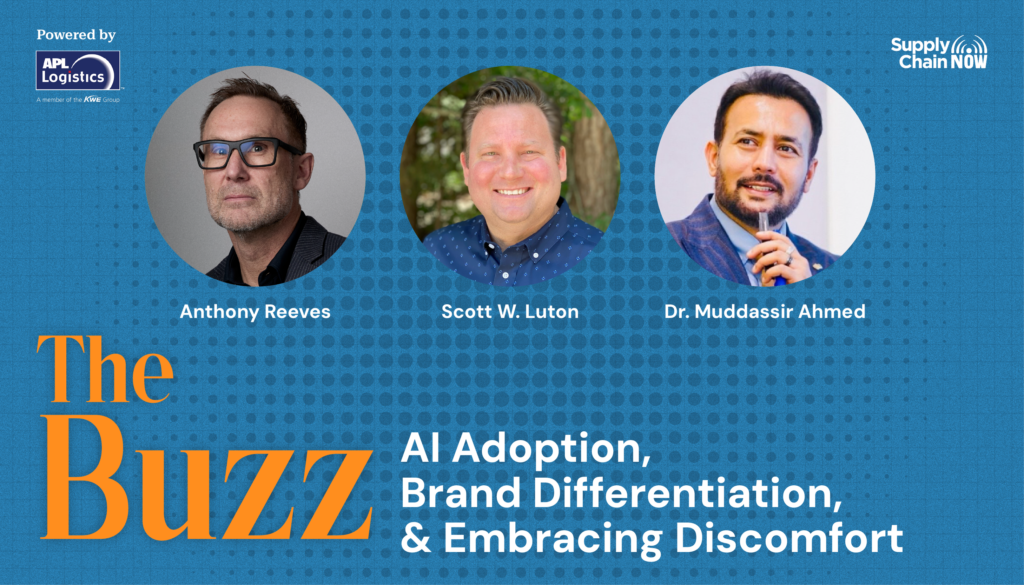
Hey, good morning, good afternoon, good evening, wherever you may be. Scott Luton and very special co-host, Dr. Mudesir Ahmed, all with you here on supply chain now. Welcome to today’s livestream. Mudusir, how are you doing today?
Dr. Muddassir Ahmed (00:28):
I am doing very well, very well. This is sunny day in Birmingham. I’m doing fantastic. How are you?
Scott Luton (00:32):
I’m doing fantastic. We’re still getting a break. We got 127 degree weather coming soon, but we’ve had such a nice extended spring, so it’s been gorgeous. But folks, today it’s the buzz where every Monday at 12 noon Eastern time we discuss a variety of news and developments across global supply chain and business. News that matters is what we like to call it. And the buzz is powered by our friends at APL Logistics all month long in June. APL Logistics is a global supply chain logistics provider specializing in order management solutions operating from 180 locations across 93 countries. To learn more, visit apllogistics.com. Okay, Muna Sierra, we’ve got a lot of stuff to get into here today. We’re going to be talking about the power of decision making optimization. We’re going to be discussing a few of the latest examples of how AI continues to transform supply chain work.
(01:25):
Speaking of AI, we got to learn from the successful AI projects as well as the ones that fail more on that. And we’re going to be revisiting a few 2026 predictions to see what sticks and what didn’t stick all that much, much more. And as if that’s not good enough. About 15 minutes or so, we’re bringing in a special guest, Anthony Reeves with Kohler. He’s also quite an author of a great read we’re going to touch on. You’re going to enjoy Anthony’s invigorating perspective on the power of leaning into being uncomfortable. So Modusir, big show here today. Are you ready to go, my friend?
Dr. Muddassir Ahmed (02:00):
I am super excited. I think the agenda you’ve sent me is right up my street, especially the profile of Anthony. Super impressive. We need more branding expert in supply chain because as you can see, we moan about how people don’t care about us. So we need a branding PR expect to tell us how we can improve our PR within the organization and outside in the world.
Scott Luton (02:19):
So true. We got to tell a better story. I’m looking forward to getting your take on all these topics here today. Folks, Trisha’s already hard at work. She’s dropping a link to our friends at APL Logistics. Go check that out. Alan Jacques is back with us. Hey, he says Scott and Mudusir. Alan, look forward to seeing you in Atlanta soon. And Maria is back from Madrid. Maria, I’d love to get your take on some of these topics we’re talking about here today. So let’s dive in. We got a big show here today. Let’s start with, we’ve got four things we’re going to hit before Anthony joins us Modusir. I’m going to start with our latest edition of WithThat Said, which published over the weekend. We lit off with a very high level summary of three recent articles published to our resource hub and we pointed out how they converged on a key central theme, better decision making.
(03:04):
Yeah, we’ve been talking about it forever. We’ve made some progress but we got more work to do because whether we’re pursuing a safer working environment, the better leveraging of data and AI or preparing for massive growth ahead, the teams that optimize decision quality are most likely to be in a better position than those that don’t. And as we talk about regularly, hey, the human workforce doesn’t have to make all the decisions these days. More and more we can offload tons of decisions and make the tech do the work. So in this edition beyond those great reads, you’re going to find a bevy of tools and resources and some terrific live shows. Give it a read. Let us know what you think. Now, Modusir, I think you’re still dwelling a bit on our previous edition where we talked about the quantum era. Is that right?
Dr. Muddassir Ahmed (03:49):
Absolutely. I think this was one of the first content I have seen in the quantum leap, which is very surprising because a night before I was watching, I watched a channel called Think Big. So there was a professor, a family university, a Japanese professor, and he was talking about how quickly the progress has been made in quantum computing. And if I put it simply, quantum computing is not done in digital on zero, it’s done at the atomic label. That means the world’s most complicated problem, supply chain is one of them I think is there to solve. So we have seen the acceleration, the age of AI. We got to talk about it more, but what’s going to happen with content computing, it will be the leap in I think 100X or 200X, but all of that brings it risk and challenges, which you have rightly mentioned with that said article.
(04:37):
And you’ve mentioned some really good quotes and some good research, some experts in the article, which was a very, very good. And thank you for sharing with me.
Scott Luton (04:45):
Hey, you bet, Mudusir. That’s high praise coming from the one only. Dr. Mudusir Ahmed. So folks, Trisha’s making it easy on all of us. Should drop the link right there to the most recent edition of with that said. And it’s even easier. You can go back and check out all of our previous installments, including the one on the Quantum era because it’s an exciting and a scary time all at once that we’re entering. Absolutely. Okay. Let’s see here. One other thing I wanted to call out that was in this most recent edition. So folks, Paul Delbar is a good friend of the show and he’s launched a terrific news series that centers around a fictional grocery store known as The Corner Market. It’s a blog series. I’m trying to think of the platform its own and Amanda and Tricia helped me out. But I’ve read through the first five chapters and I love the blend of business leadership and personal observations that Paul writes about.
(05:33):
So I want to invite you to check out the corner market and let us know what you think. Okay. So Mudusir, I want to go back to AI and tech and all this stuff. You work with all sorts of supply chain leaders around the globe. I think you’ve got a very unique perspective and point of view. I checked out, of course, a lot of your keynotes in your podcast, which I’m a big fan of. I’m curious to get your take on the topic of how you see AI continuing to transform work, especially supply chain roles. What are some of your thoughts there Moodus here?
Dr. Muddassir Ahmed (06:02):
I think I would say three things and both strategy, technical and execution level, right? There is the progress made within the supply chain tech firm and I do a lot of emergency work like yourself. My mission is basically bring the view of the problem and bring the solution which can solve that problem in the supplies and tech space. There’s a lot of tech available. I don’t want to navigate in companies, but for example, I was collaborating with Project 44. We recently met there in collaboration with them. So they have run a pretty smart decision intelligence platform. In fact, we have built a four curriculum of courses that people go to at Singujo and learn how the agents are really transforming logistics, visibility, execution. The tech is there. Now the question is, what I see industry right now, which is a strategic challenge, is the adoption of it.
(06:47):
And the strategic issue, because I think there’s a desire from supply chain folks and leaders to do it, but it sits at the company level. Let me give you example. So Sensei, which is our AI supply chain, business intelligence and execution layer, which we’ll talk about more later, we pitched to a company, the chief supply chain officer really liked it, but to get it approved it went to a CEO and the CEO said, “Hang on a minute, let’s hold on. Yeah, it makes sense, but I want to look into the AI strategy for the business.” And I’ll get back to you when it is available when we come back when we think about it. So while the supply chain AI and the desire is there and people see the benefit, but at the strategic level, leaders are still not very clear how to go about it.
(07:29):
And they have security concerns, they have compliance concerns and they of course have people concerns to go with it. So that’s the strategy part. Now at the tactical integution label, it’s basically the hype needs to match the expectation. And at the moment it’s not matching. That’s fact. I know all the CEOs and founders like me who’s working in AI will say, “No, no, no. We’re going to come in and we’re going to save 80% of time and you’re creating your RFPs using AI augmentation and it will not take eight to 12 weeks. It’s going to take four to six weeks.” It’s possible. But to make that possible or to make that very specific use case possible, someone within that organization needs to sit with it and with it and run that change management. So there’s a debate of don’t treat AI as a project alone, right?
(08:15):
It should be embedded with the business. It’s not straightforward. I mean, you just want to buy a simple HR software for people to sign up for your holidays or recruitment. It doesn’t happen because it needs to go through four, three or four layers of approval from all the way to the end user up the way to the CTO compliance officer. We have to realize that change management and manage it along with the push. And what I would recommend to the leaders and the users who wants to adopt AI is be more willing to put time and effort in the adoption. AI is magical. It can do fantastic stuff and this worry and this narrative of supply chain will, okay, AI will take over jobs. I know I’m going against everybody or even there’s a CEO of Microsoft AI. He mentioned that all the blue collar jobs, 98% of them will be gone in 18 months.
(09:05):
I think it’s totally wrong. That would not happen. With every technology you’ve seen, starting from manual to paperwork, to the fax machine, to the internet, to mobile, to digitalization, to cloud to right now. What happen is humans adopt technology
Intro/Outro (09:19):
And
Dr. Muddassir Ahmed (09:20):
They get better with time. So the people who might lose the job who are not adopting, they’re waiting and seeing. Don’t be the wait and see person. Be the early mooner, adopt it, adopt your use case and you will become invincible, not for your job, in fact, for the organization.
Scott Luton (09:34):
I like it. Learn and app, learn and apply. Raise your hand, volunteer, work on these new initiatives. But whenever we stop learning and we stop educating ourselves and stop developing new skillsets, hey, we’re in trouble. And as Modusir said, don’t be the wait and see person. All right, so good stuff. I want to offer one last thing. We’re about to bring on an outstanding guest, but Modesir touched on something that I believe is a great opportunity and resource folks out there. So folks, you got to check out Sensei. Dr. Modesir Ahmed spent four years building SEM Dojo into the world’s largest independent supply chain learning platform. Get this. 82 practitioner built courses, 44 best practices, enterprise programs and some of the world’s most successful companies. All that goes into and really fuels Sensei, right? It’s what all that knowledge becomes when combined with AI. So SEM Dojo AI Sensei is a new powerful platform that offers supply chain pros tremendous support in a wide variety of ways.
(10:34):
And hey, just wait, there’s more. MotorSeer’s got a great offer offering Sensei for a special limited time, 49 bucks a month, but it expires July 1st, so you got to act now. Modusir, did I get all that right, my friend?
Dr. Muddassir Ahmed (10:49):
You will get absolutely spot on, nothing to add.
Scott Luton (10:52):
Okay. All right. So folks, go check it out. We’re dropping a link right there in the chat. So speaking of great, great stuff here today on the June 8th edition, 2026 of The Buzz, powered by our forensic APL Logistics. We’ve got a great guest. So get this folks from the Australian Outback to global stages. Anthony Reeves has spent three decades leading brands, teams, and transformation. In fact, he led Amazon’s advertising business from one billion to 20 billion. Goodness. He’s also served as vice president of global brand and creative at Kohler and through WPP worked with brands, including Airbnb, Nike, Verizon, and Microsoft. He’s well known as the strategist that tells companies what AI is doing to their moats and helps leaders navigate change and growth without losing what makes them distinctive. He’s also published a great book, which we’re going to talk on in a minute, Eat the Donkey.
(11:45):
Why great companies embrace discomfort. We’re going to learn more about the colorful title in just a moment, but please join me in welcoming Anthony Reese, Vice President, Global Brand and Creative at Kohler. Hey, hey, Anthony, how you doing, my friend?
Anthony Reeves (11:59):
I’m doing great. Scott, yourself?
Scott Luton (12:01):
I am doing fantastic. I’ll tell you, MotorSeer has got us all charged up, ready to go on this Monday morning. Motors here, we’ve had quite a start, huh?
Dr. Muddassir Ahmed (12:08):
Yes, definitely. Anthony, very impressive profile. I must said the introduction from Scott was brilliant, but I want to give you two compliments to get things going. First of all, the name is brilliant. I’m sure you’re going to explain. And the second part, your reviews, even within the first two months, it’s fantastic. So being a fellow author, I’m also writing a book which I scares about getting good feedback. So many congratulations getting really great reviews.
Anthony Reeves (12:30):
Really appreciate it, Marcia. Thank you very much. As you know, as an author, is it a laborer of love?
Scott Luton (12:35):
Yes. Labor of love indeed. Well, all right. So let’s do this. A fun warmup question now that we’ve exchanged pleasantries and jumping right in. Folks, today is many things. We have World Oceans Day. Every day needs to be that day, I think. We’ve got Eat Flexitarian Day interesting. Thomas Payne Day here in the States and it’s National Best Friends Day. So I want to dial in on that last one, Anthony and Mudusir. I’m going to ask you both, starting with you Anthony, who is one of your go- to buddies that has been there for you through thick and through thin, your diarrhea. Who is that, Anthony?
Anthony Reeves (13:09):
That’s almost like an impossible question. So there’s one person that merely comes to mind and Peter Scribn and I have been friends for decades. He is back in Sydney and he lives there now. We have climbed massive mountains together. We’ve hiked, we’ve solved problems together. We’ve gone through marriages and hard times and we’ve seen kayak through massive, massive swells together. And I think even though I don’t see him as much as I should, without a doubt, if I need something or need to talk to somebody, Peter Scribner is a person that I always go to.
Scott Luton (13:43):
Outstanding. Big shout out to Peter. Thanks for being a great friend out there. The world needs more great friends. All right. So Mudasir, same question. Who’s one of your go- tos?
Dr. Muddassir Ahmed (13:53):
I’ve got hundreds of hundreds of people in my connections and my WhatsApp is full, but there’s only, unlike Anthony, I’ve got four or five friends which I call and my definition of friends is that you can pick up the call anytime and they can pick the call at any time and they’re there for you. So Frank Kashef, he’s in Canada and he’s very different from me. He’s very creative and he’s there to talk about personal stuff, professional stuff. And because he think very differently, he’s always given me a very emotionally intelligence perspective on personal life and work life. And he’s very bad in execution, so I compliment him because I’m good in execution. So big shout out of Kashef. He has been a great friend all my life, known him about, I think I was like 13 since I know him. So more than three decades is amazing.
Intro/Outro (14:37):
Good
Dr. Muddassir Ahmed (14:37):
Guy.
Scott Luton (14:37):
You can’t make old friends.That’s a tremendous, valuable friend of yours there as well, Mudasir and Anthony, good stuff. And I will give a shout out. And it’s like picking your favorite kid. It’s not a fair question, but I do want to give a shout out to my dear friend Trip. I caught up over the weekend, AKA Catfish. He’s been around a long time with me and always appreciate his perspective and its stories. All right. So really quick, before we dive in with Anthony and with Mudasir, I want to call out a couple things here. Number one, I mentioned the corner market. Go check out that series, folks. It’s a really easy but interesting read. And also I want to make sure folks see the link for Sensei, which we touched on earlier that Mudusir and his team have published. Great resource here. And then finally, LK is back the pride of South Georgia.
(15:28):
Great to see you, Larry Klein. I hope you’re doing well, my friend. All right, Mudusir and Anthony. Let’s see here. We’re going to go through three stories and get y’all’s take on these stories. We’re going to start with some caffeine. Reuters is reporting on what Starbucks is doing and now not doing with AI. As Reuters reported on, the coffee and retail giant had rolled out an AI program called Automatic Counting to its North American stores about nine months ago that was really meant to help fix the chain’s persistent product shortages, right? CEO, Brian Nichol, I think I’m saying his last name right, these shortages were a big part of the sales slump that they had been experiencing up until that time. Essentially, it was an app that attempted to help improve Starbucks visibility and accuracy into what was causing the shortages such as miscountered inventory or mislabeled products.
(16:17):
Automatic counting also attempted to eliminate manual work associated with inventory management. Who likes cycle counting? I do not. Some Starbucks employees commented that while they appreciated the intent behind automatic counting, it was failing really in its execution and results. Starbucks announced last week that the program was being terminated and they intend to quote standardize how inventory is counted across coffee houses as we continue to focus on consistency and execution at scale. One last thing before we get Anthony Mutasir’s comments, Brian Nichol, the CEO and the leadership team at Starbucks is making some progress overall in their efforts to turn the company around, including sales growth and stock price gains this year. I’ll think some 26%. So Anthony, my thought is whether it’s AI or not, we’ve got to learn from the projects that work and the initiatives that work and we got to learn maybe even more from those that don’t.
(17:11):
Your thoughts?
Anthony Reeves (17:12):
Yeah. So firstly to Starbucks, you’ve tried something, it didn’t work and moving on. It’s a kudos to them and the decisions have made to move on from that. And coming from my background, even if you think of Amazon and decisions they’ve made over time that have failed, you learn more from that. So if you can remember the Amazon phone, for example, or Amazon restaurants, they failed miserably, but they made the hard call to try something and then cut it off. And there’s a great saying at Amazon, which is treat everything like a two-way door, that you can go through and see what’s on the other side, but when you hate it and don’t like it, make sure that you can always turn around and come back and Starbucks have done that really well.
Scott Luton (17:54):
I like it. And of course, Amazon, they’ve really nailed the art of pilots. Big fan, lots of experiments. I love it. All right, two-way door. Motorcycle, when you think of going back to the Starbucks app that they’ve recently shelved, or just the bigger picture of learning from things that work and those that don’t, your thoughts?
Dr. Muddassir Ahmed (18:11):
I think SN3 set, well done for Starbucks for trying it. And I think that shows a lot about leadership desire, but because I’m an engineer and I’m a tech guy and go through the technicality of the things where I think fails, but if you read through the articles and do the further search, what it appears is, let’s call it the issues on cycle counting or basically the technology not recognizing the different bottles or missing the product in front of the lens is more down to the physical side of the architecture to work. So let’s call it more that AI plus internet of things, right? And this technology I think will improve with the period of time. Let’s think about Google Glass was failed, but now Meta and other people are doing it. So while it failed right now and the people are not happy, I’m pretty sure at some point in future it will work.
Scott Luton (18:59):
Excellent comments to you both there. And Trisha has dropped the link. Go check it out, folks. Don’t take our word for it. Give us your take.
Anthony Reeves (19:05):
Quick question. Do you think it was a human problem that it didn’t work or a technology problem that it didn’t work? I think
Dr. Muddassir Ahmed (19:11):
Based on the research molds look like a technology problem, not reading the product labels correctly, not differentiating between milk and a coffee box.
Scott Luton (19:19):
And also folks, if you could check out the article as I understand it, it was built on basically the team members holding a laptop or a tablet to take a snapshot of their inventory. So it was really, I love the ease and the functionality that they designed it with. However, maybe the technology wasn’t quite there or to what we said earlier maybe user error, user error, huh? A couple quick comments here. Again, folks go check out the article. The Shaw says, “Hey, AI doesn’t fail because of technology. It fails when execution process design and operational realities aren’t considered.” Great reminder that transformation starts with process, not software. Alan says, “Fail fast. I like succeed perspective and define Larry Klein. LK says noth beats human familiarity with the inventory. This allows the employees tasked with using it to monitor the AI tool.” It’s tough. All right.
(20:14):
Lots of Starbucks fans out there. So we got to move to this next story. We got so much to get to here today. Everybody, I don’t know about y’all. I love prediction making and then I love to revisit said predictions. So here’s a blog article from our friends at FourKites that offers up four predictions for 2026. Now, I’m going to hit these at a high level. I’m not going to do it justice. Y’all have to go check out the original blog article, but I’m going to ask Anthony and Mudasir which of these predictions may have been most accurate so far as we almost hit in the halfway mark of the year. So here they are at the high level. Number one, Agentic AI will thrive in the enterprise, but consumers will have to wait as in do mainly to security concerns. We aren’t giving AI agents unrestricted access to the open web and our credit card details when doing things or doing research on things like making travel plans.
(21:01):
Number two, someone will finally ask the uncomfortable questions. Now this has been an interesting one, but for an example from this production, some supply chain organizations want AI to optimize inventory. We’re just talking about it. But at the same time, they keep separate P&Ls across various functional aspects of the enterprise. So the question is, what do we really want to do here? Thirdly, generic AI tools will lose to purpose-built solutions. Then finally, soft skills will matter more than ever because as the article shares “As AI handles more routine tasks, the demand for interpersonal and organizational skills, emotional intelligence, creativity and critical thinking will skyrocket” all good thoughts that are interesting to ponder. So Anthony, of those four, which prediction do you think has come to fruition the most?
Anthony Reeves (21:50):
It’s interesting, Scott. As you’re going through the list, I was writing a few notes down and I thought I had my answer down, but when you got to number four, which is soft skills will matter more. It is the on that I do believe will lead into more as the 2026 continues and 27 into H1 kicks off. There’s a couple of early indicators already, not so much in supply chain, but definitely social media. We’re seeing a big change in social media at the moment with a lot more AI in there and people actually turning away from AI. And the soft skills, especially when you’re interviewing people are going to become a lot harder, but they are the biggest skills to interview against.
Scott Luton (22:28):
Well, I agree with you, Anthony. Mudusir, of those four, which one do you think?
Dr. Muddassir Ahmed (22:32):
I think I would have picked one and three picked because I think in universities and these days they’re talking about power skills because of the age of AI. So power skills are there, but I’m going to pick the second one, the ROI question. I was just example started with a recent example that Microsoft has stopped using Cloud because the cost of tokens was actually more expensive than humans. And even though the IPOs of OpenAI and Cloud is coming soon and SpaceX, but at some point people are going to start, okay, we got hundreds of thousands of budgets, are we seeing the ROI, right? And then I think the CFOs will kick in and they’re going to say, show me the ROI. I think that will happen pretty soon.
Scott Luton (23:10):
Well said. I agree with you both. I agree with you both. And that one about asking the uncomfortable questions, that probably wasn’t as much of a prediction as talking about the newer uncomfortable questions that we need to be asking. I think that’s very accurate, right? I think it’s very accurate, especially given all that modern technology poses here in the golden age of supply chain tech. We’ve got to keep it real with what we really want to do with said technology. All right. So folks, Trisha’s dropped a link there to that blog. And I think this is my friend Andrew. I think this is Andrew. It says, “Do you think we get dazzled by the outcomes and blind to the reality?” By the way, Starbucks coffee isn’t coffee.
Anthony Reeves (23:52):
All
Scott Luton (23:52):
Right, quick- Just
Anthony Reeves (23:53):
On that quick one from Andrew, I’m really curious about the question because the question is interesting is, so Australians firstly are very precious about their coffee. So I’m just going to put that out there very quickly. So the one party totally agrees where Starbucks isn’t quite the quality of coffee like in the UK or Australia, for example. Is Starbucks a seller of coffee or are they a coffee shop?
Scott Luton (24:16):
Interesting.
Anthony Reeves (24:16):
And that will affect supply chain, will affect the customer service, will affect Andrew’s question dramatically and being around Starbucks a lot and because I spent a long time in Seattle, they want that third place, that coffee shop experience and they do that through coffee and that’s where there’s a really big point of the difference in there and how they go to market or how the supply chain works and what you want your staff to do if there’s scanny bags of coffee, but they want to have that coffee shop experience, there’s two different things altogether. I
Scott Luton (24:44):
Think that’s a great point. And Andrew’s great question. Munasia, really quick, your comment.
Dr. Muddassir Ahmed (24:49):
First of all, I’m not a coffee drinker, so I’m indifferent in that. So I probably won’t be able to add a lot of value on this. So
Scott Luton (24:55):
Sorry for that
Dr. Muddassir Ahmed (24:56):
One.
Scott Luton (24:57):
It’s okay. That’s all right. Hey, there’s tons and tons of takes on coffee and then you blend coffee with business and it’s fascinating. I’ll
Dr. Muddassir Ahmed (25:05):
Ad one thing though, because I go to the coffee shops with colleague, drink, I think Kapu if nothing, but the experience of Starbucks as a coffee shop, I definitely agree with Anthony. It’s not for me. It’s not good.
Scott Luton (25:19):
Okay, fair enough. And it’s been evolving. It’s been evolving to be fair. All right, we’ll have to leave it there. We’re keeping our finger on the pulse. It’s fascinating to watch their continued efforts to turning the business around. All right. I got a couple comments. I’m going to come back to those. Good stuff today, Vishal and Andrew and others. Let’s get to this third story. So speaking of great friends, this is Paul Noble there in the middle. Me and him talking a couple years ago, he released a great article, I think, in Forbes and focuses on key takeaways from Gartner Supply Chain Symposium 2026, the gift it keeps on given. I’m going to share a couple nuggets and then Anthony Sara look forward to your perspective here. First off, Gartner research shows that 94% of supply chain organizations want to integrate AI into their operations where they want to bring it in yet only 17% have done so at scale.
(26:05):
First question I think it begs is what the heck is wrong with 6% of folks that don’t want AI? But that might be a different show. Separately, Paul references a popular keynote at the event and writes that AI agents need supply chain data that is different than the human-centric data that has been prevalent for years. AI agents need data that’s connected and contextual and continuous. And then one last nugget that I find interesting is a lot of stuff here in the article. All sites, KPMG’s new report, risk management and resilience emerge as key concern for supply chain leaders. And in that research, 73% of businesses are said to be planning a comprehensive transformation of their supply chain operating model within the next one to three years. That 73% data point is up from only 11% just a year prior. I find that to be very fascinating.
(26:55):
It is also one of the common themes that I heard at Gartner that the winners … Let’s see here. The winners in the current golden age of supply chain tech won’t be those with the most AI. Rather, it’s those that combine a variety of things such as trusted data, faster and more successful decision making and use all of that to create new operating models in supply chain and elsewhere. So there’s a lot here, but Anthony, your thoughts?
Anthony Reeves (27:20):
Not really sure how to … There’s a lot of questions in there. So firstly, my point of view is going to come from the enterprise level and the enterprise level. It’s not going to come from a small business point of view. It’s definitely the larger scale. And the first one is AI needs inputs and needs information. And if your data’s not clean, your data’s not consistent and your data doesn’t work across the board, why start implementing AI when the output is so reliant on the input? The first point you talked about was only 17% have had success with AI programs is we need to think very closely about the reasons why not. And I’m a huge fan of looking at organizational structure and how teams move forward. So at the most basic level, if you want to buy an AI tool, does legal approve it?
(28:05):
Does security approve it? Does IT approve it? Does procurement approve it? And in the past, those teams have been all very, very separate. If you’re at a group level or an organization level and you want to implement something incredibly basic from an AI point of view, you have to go across all those in four individual departments to get approval. That is really hard and takes a long time. Also, our organizational structure systems are built very much on a matrix team and you have jot of dotted lines here or they’re very, very deep organizations and they’re incredibly cumbersome and incredibly slow where AI and technology move very, very fast. So we’re putting our teams in this real tension point where they’ve been asked to use AI and asked to move really fast, but the organizational structure of enterprise unit is incredibly slow. I was going to be very Australian there for a second, but so the annoyance factor of it is frustrating the team.
(29:01):
So all they do is bah out. It’s too hard.
Scott Luton (29:04):
Anthony, you point out some really interesting observations there, especially with what I’ll call velocity differences in different parts of the organization when we’re moving at an overall business velocity, which gets faster by the hour. Modusir, your thoughts on Anthony’s comments or the article in general?
Dr. Muddassir Ahmed (29:21):
This is my favorite topic. I can speak on for more than an hour. So it’s very hard for me to say that what I know recently says in two or three minutes, but I’ll tell you on very important point. Use the word context. So the way what people are using is fleet enterprise data. What they think is, okay, we’ve got too much data and EIP systems and other systems, let’s connect with the large language model and then large language model with some engineering will work and give us the output, what we need and inferences and process mapping and data mining, what do we need? It will not work. And let me tell you what it will not work. The keyword of business context and that part is important. There’s a Concept called RAG, retro augmented generation, which is almost the basis of what we have built for Sensei.
(30:06):
Let me give you a very small example to explain the point I’m making. So for example, you got a lot of inventory data or purchase order data. You can drop that Excel file to your cloud or to your open app or Copilot what we’re using and they say analyze and give me the forecast, give me this analysis or give me change of service. It will do it. It will do a pretty rubbish job. The reason it will do rubbish job for two reasons. It does not have the context of your vertical for pharma, for aerospace, for oil and gas. And secondly, it does not have the expert knowledge. We call it skills in AI. Like any human engineer, you got to train your large language model like a supply chain consultant or the procurement consultant. That’s what we do at Sensei. You can drop Excel file.
(30:48):
We have 187,000 documents we have used using RAC to train the Sensei to think like me, which have a 20 years of experience. And therefore the business context gets established and AI makes sense. So this 70% number will not grow faster unless organization learn how to teach AI that business skills, the vertical skills, the need for the specific output for agents because agent is nothing but some kind of human who’s going to work on input and output, as Anthony said.
Scott Luton (31:19):
I tell you, I, for one, wish I could think more like Mudasir and Anthony here. So y’all are operating above my pay grade and we’re going to have to have y’all back. We could talk for hours probably on just this last article, but I appreciate y’all’s comments and we’re going to keep driving because we got a lot more good stuff to get to. See, I’m going to bring in Vishal’s comment just really quick. AI outcomes will only be as good as the underlying data. Governance and data quality need to be strategic priorities, not afterthoughts. Man, Vishal’s coming on strong here today. Okay. Before we dive into this next segment, we’re about to learn from Anthony’s journey and some of his leadership journey as well. But I want to share a resource from our friends at APL Logistics. I love checklists, folks. I love checklists. A good list.
(32:03):
Amanda does too. And she’ll probably own up to it here in just a second. Our friends at APL Logistics published a neat read that focuses on five signs. Your supply chain has outgrown how it’s managed today. I mean, if you’ve got the national champion Indiana who’s yours football team, we can’t manage them like a peewee football squad, right? Well, check out these.That might be a bit of a stretch, but check out these five things. Let us know what you think and hey, reach out to our friends at APO Logistics who can help you delight customers and unleash your supply chain’s full potential. Okay. Anthony, me and Mudusir are dying to dive deeper into your perspective and expertise here today. And I want to start on a bit of your background. I touched on your background when I introduced you, but I think it’s a lot more important that we expound on that a bit.
(32:47):
Would you please share a few anecdotes from your upbringing, especially given its connection to your book, Eat the Donkey: Why Great Companies Embrace Discomfort, which we’re dropping a link to. Tell us about your background, Anthony.
Anthony Reeves (33:00):
Yeah, thank you, Scott. I grew up with spending immense amount of time in the Australian Outback and we’ve all seen Instagram and TikTok stories about it. I say generally they’re pretty accurate. I grew up in an environment where the nearest store or the nearest gas or petrol station, depending where you are in the world, was like thousands of kilometers or miles away and you really had to plan and make a lot of progress and to consistently move forward. And with the learnings from the Outback, the harshness and the loneliness, as I went through my career and moved to some of the larger boardrooms of the world, those lessons really carried over and those lessons really did me well. There’s a lot about independence, there’s a lot about stubbornness, but the most important is about progress. And having that sense of progress for me is really, really important.
(33:47):
One of the biggest lessons that I don’t think is written in the book, well, I know it’s not written in the book is I remember as a family we pulled into a fishing hole or a dam in the Outback in Northern Territory once and the dad was setting out camp. I set myself and my brother off to go fishing for the night and to go fishing for eat food for the night.
(34:07):
And with that, we went and cast a line. The mosquitoes were horrible. They were probably only inch long and they’ll be bitten everywhere and we weren’t catching any food. And this is a bit of a problem when you try and develop the land as much as possible. And about 30 to 40 feet down, there was a First Nations person who grew up more independent than we were. And he started laughing at us not because we were a couple of white kids that were fishing, it’s because we were fishing entirely the wrong spot. So he dragged us down 30, 40 feet. We cast a line, first catch, we caught the fish, the usual story after that. But the biggest lesson for me wasn’t about the fishing. It wasn’t about anything in that direction. It was really about the ability to learn. And you will pick up learning from everybody in life.
(34:52):
It doesn’t matter who they are, whether they’re a doctor or they’re a rocket scientist or they didn’t graduate high school, you’re guaranteed to learn something from everybody. And that’s the one thing that stuck me through my entire life.
Scott Luton (35:06):
Anthony, I love that. And folks, I want to share, we’ve shared the book. We’re also dropping a link, Eat the Donkey, why great companies embrace discomfort. We’re going to touch on what he means about that attention capturing title in just a second. But Mudusir, I love his key point he made there because we really can, if we’re not humble enough to make sure we can learn from everybody from every walk of life, no matter what they’ve done or haven’t done their career, then I don’t think we’re looking at the world right. What are your thoughts, Musir?
Dr. Muddassir Ahmed (35:34):
No, I absolutely agree with the story and the sentiment here. Again, we’re talking about technology and AI. What is getting more important here is the human emotional intelligence part of it. I recently heard the story that there’s a company called Chewy who basically send a hand painted oil printed picture if the pets pass away because they just want to create emotional connection because that’s the only thing we do. And the danger of if you call somebody … I think I just recently called Oracle Office for some reason and it was like nine different options. And after that, I went to an agent and I’m thinking, “I just want to talk to him and lately.” So it’s annoying as well. So I think big companies basically, and even small, they need to find a way to create this human connection because eventually humans buy from humans.
(36:23):
Don’t give your credit card to AI, you’re going to regret it.
Intro/Outro (36:27):
Yes.
Anthony Reeves (36:28):
That Chewy story is such an amazing story how that as a big brand who relies on so much supply chain and just in time supply chain management truly understand that moment that matters of a pet owner. And when your pet passes away, they’ve realized that that’s a big moment for you and they’ve realized from a marketing point of view is how to be there for somebody and it’s a phenomenal the way the brand does that.
Dr. Muddassir Ahmed (36:53):
I know we are considered of time. I have to ask this question to Anthony because I think I’m dying being he’s a brand, let’s call it champion. He knows how to big brands. So if you have to give one advice to, let’s call it startup owners, how to create. And the problem with technology is you have to set technology, right? But we just talk about human connections, what they have to do to build that human connection and build the brand along with it.
Scott Luton (37:15):
So Modestir. Listen, that’s an excellent question. I’m going to back up for a second because I think what’s important for folks to take Anthony’s response to your question is if they understood a little bit more about his professional journey, because like you said, he’s worked for some brand leaders, industry titans. So from that corporate leadership perspective, Anthony, share a litle bit more about your background, your current role, and to move a serious question, if you had one tip for folks out there.
Anthony Reeves (37:39):
Yeah. So from high school and then college and then onto my career, I grew up as a creative person inside a lot of the world’s largest advertising campaigns. And I hope that you’ve seen some of my work in the past in Super Bowls or Grammys or areas like that. And I’ve been very fortunate. I had a lot of people that have taught me and have had a lot of patience. And as my career grew and I grew further forward, I ended up moving into Amazon for a long time and from that helping Airbnb reemerge through the pandemic, just now really close to bankruptcy to the point they are now. With that and with the lessons I learned from the Outback and to the largest brands, I’ve really become to appreciate there’s only a couple of things that truly matter for a business and that you need to anchor yourself towards.
(38:25):
We touched on this a little bit with Starbucks earlier. If you think about what Amazon is as a company and we know how big Amazon is, like 1.6 million employees globally, their anchor point is not about technology. Their anchor point is not about retail supply chain. Their anchor point is not about AWS and being a great cloud company. They are at their core business wrapped around customer experience. Everything they do evolves around that. And I was so fortunate when I joined Amazon, our neighbor across the way, Tom is a remarkable human being and just a great storyteller. He was employee number five at Amazon. And he can really tell me the stories of when Jeff’s desk was a door taken off the hinges and how customer experience affected Amazon at that point when they were just selling books or the offsites that they did to improve the customer ordering system.
(39:22):
So it did capture your credit card information because Amazon invented that one click ordering and the credit card capturing, but it’s all based on how do they improve that customer experience. Another example that we know well is Kodak is what business is Kodak in because, or were they, I should say, were they in the film business or were they in the image capturing business? And they optimized towards the film business, but they’re really in the image capturing business. And going back to your question about what makes any small founder think about is at your very base level, basics of all level, what do you want to be known famous for? And Airbnb is all about belonging and Amazon is all about customer experience. Starbucks is a coffee shop experience. Kodak thought they were one business and they were actually a different business altogether. And I believe that foundation of the core of that one thing you can drill it down to is really important.
(40:16):
And even from a personal point of view, if you think about yourself outside of your family and your friends, what’s that one thing that you want to hold true to who you are and what makes you strong? A company is no different from that. And that’s the foundational level or the foundation of what a great company will stand at.
Scott Luton (40:34):
I like it. All right. So for the sake of time, we’re going to be moving fast, Mudasir and Anthony moving real fast. We’ve teased this enough though because this phrase, Anthony, when I saw information on your book come across and a message to us, I’m like, “Eat the donkey. What the heck is he talking about? Anthony, tell us more.”
Anthony Reeves (40:52):
Yeah. So my wife and I and a great friend, Nate, battled for a long time over this title and with the title we’re talking about foundations as an individual or as a person has been the core theme and we kept coming back to the fact that as a family, there were times when we had to eat donkey to survive and everything was so remote. There’s stories wrapped around cattle stations and trying to find food and the only piece of food left is what they feed their dogs, but we had to find food and protein in a way that kept us healthy to make that hard decision so we can go on and do something else. And I believe we’re in an environment now where as a big brand and big enterprises and even small ones, we’re not willing to make hard decisions anymore. We’re not willing to say, “If we make this hard decision now, it’s going to be better off serving us down the road later.” And even from an Amazon point of view is Amazon will sacrifice short-term revenue for long-term gain.
(41:47):
They will make hard decisions about missing dollars or missing money so they’ll live for longer in the long run. So in the Outback, we made the hunting donkey and it sucked. It does not taste like chicken in any way, but I’m here to tell the story about it today. And a lot of companies will dive into a revenue pool because it’s an easy decision or we’ll optimize something because it’s an easy decision. But in the long run, that easy decision is actually going to put you out of business.
Scott Luton (42:13):
Well, and that is not an appetizing. There’s so many aspects of what you shared that’s not very appetizing. Anthony, I’m not throwing stones, by the way. I love your humility with how you have taken your upbringing and shared it with folks that are trying to navigate their own challenging times, Anthony. And by the way, my copy’s on the way by Amazon. I wish it happened next week or two. Mudusir, react to what he shared there, especially as we tie it back to the title of the book.
Dr. Muddassir Ahmed (42:41):
Absolutely right. If that is the message, if that’s what you want to send is fine. I mean, I work for Industry 17ALs and I think the difference between, let’s call it agile startup who make good decisions, hard decisions and grow faster and the innovation lacks in big companies, it’s decision latency and they’re not making a hard decision. They’ve got so much data points to make a decision. So by the time they arrive to a decision, the data point, they made the decision are already upsleet and they just can’t make that decision and then the whole cycle starts. So they’re not just not making the hard decision. They’re not just the decision latency is too big. And that’s the same goes for the adoption or any change management recruitment adoption. If you’re going to wait for the 18 months to deploy AI in your company and the price voice is too late, your competition already done it, they’re ahead of you 20 years.
Scott Luton (43:31):
And really it bites you twice because not only is it late and irrelevant, but you’re wasting resources into making a decision that no longer doesn’t even matter. So that’s an excellent point, Modusir. We got so many questions, so little time. Anthony, I’m interested in a key point. I don’t think you’ve made it yet. I think it came in our pre-show conversations where you see AI flattening brands towards sameness. And what I want to ask you is with all the investments that we’re making, not just in supply chain, making global business into AI and automation and the like, how can leaders leverage these technologies without optimizing away the very things that make us in terms of our organizations and our cultures and our products unique? Your thoughts, Anthony.
Anthony Reeves (44:16):
This is a really great question. So thank you. With AI, there’s so many great strengths to it. So have no doubt though I’m a fan of implementing it. The hardest part about AI, especially with media and paid media across the board is every company’s going to have access to the same technology, the same data, the same signals, the same insight, same supply chain, because if you tightening up that supply chain all the way through and optimizing it all the way through, everyone’s going to have that same base core information. So we stick with Starbucks making a bag of coffee for $5 and sell it for $15. Every coffee manufacturer’s going to have that same information, how to do it and how to make it great. When we talked about Chewy early on, we talked about that moment that matters and what makes you distinct as a brand is going to be the strongest part.
(45:00):
If you go back to the foundation of who you are as a company and as a brand is how do you remain distinct? And the best way to do that is like working out what is your foundation and why you matter. And it’s really important to think about that. And I only pull out one other case example and this one that all of us should have heard about is what’s happened to Nike really since about 2021. Since then, they’ve about 64% of their market cap, billions and millions, tens of billions of dollars have disappeared from Nike’s market cap. They brought in a person who was very non-sport and non-Nike and they moved out of brick and mortar retail. They took retail away, the touchy field of Nike. They moved away from sport, they moved towards faster fashion, they moved towards celebrities and they forgot why they were in business in the first place.
(45:47):
Nike doesn’t sell shoes, they don’t sell shirts, they sell motivation.
Intro/Outro (45:52):
At
Anthony Reeves (45:52):
The core of Nike, what Nike is, when you look at the original principles that Bill Bellman built, they’re a motivational brand and they believe in motivation. They’re the ones that help you get out of bed in the morning, lace up your jogging shoes and turn left or turn right or go off to hot yoga or something like that. That’s where Nike belongs and they’ve forgotten that core, that foundation of who they are.
Scott Luton (46:14):
Anthony, we could talk about Nike is a fascinating brand to where they’ve been, where they are and where they’re headed. It really is fascinating business-wise, brand-wise, you name it. All right, Motosir, react really quickly. I’ve got three more questions, I think, maybe 37 more questions for Anthony. React really
Dr. Muddassir Ahmed (46:30):
Quick. One more example I would give substantially the point is the example of Costco is the experience. They lose money on every $1.50 hotdog. And the CEO say, “I’m going to lose millions, but that has not changed.” Because that Hotbox $1.50, it’s not food. It’s basically the human connection of their members who comes in and pay the membership fees and the experience. So when they leave the feel good, I save money on a hot dog, such a small things and on the counter that they make billions in the membership. So is the cash already covered? Brilliant example.
Scott Luton (47:04):
Excellent. Me and Amanda can eat there for I think less than nine bucks. I wouldn’t suggest doing it every night, folks, but it’s a cheap date. All right, let me ask you this. So you’ve worked with brands that consistently have reinvented themselves, Anthony. You touched on a couple I think already. What’s one of the biggest misconceptions that leaders have about innovation and also in this landscape where, sure, there’s some very successful transformations, but there’s also some lot of transformation efforts that fail left and right. Your thoughts, Anthony?
Anthony Reeves (47:34):
Yeah, a couple of things, and I would hate to be a public CEO at the moment. The housing market is flat, interest rates are really high. Every quarter, you got to report to the market of what’s going on. Innovation was not an overnight thing. Innovation is a year process, takes a long time. And even CIOs, the chief innovation officers, they turn their jobs really quickly. They’re not in a job for a long time, like three to four years. And so with that is like, how do you really keep the innovation going through the company? I believe that a great company’s mechanisms and a great company has consistent mechanisms to keep the progress moving forward and they can take a variety of thoughts. The other one is I’m not a fan of principle, or sorry, not a fan of values. If the three of us started the company today, I could probably assume that one value would be assumed best intent or one value would be about building trust and they’re pretty mundane.
(48:27):
But when you work out the foundation of your company, I believe that principles hold to your foundation and values are something that are forced upon people is here’s how you should act or here’s how you behave. And we’re telling employees how to act and how to behave and that’s not really fair on them either. I’m a big fan of principles that help innovation move forward and Amazon has like 16 or 18 principles that hold them true to their foundations as a company. All
Scott Luton (48:53):
Right. So I’m going to see React. I heard a lot about foundational values and how we’ve got to protect that focus and that adhesion to those foundational values. It’s easy, especially given growth and success and lots more leaders and team members joining. It’s easy for those things to get diluted and that’s where some companies will lose their way. But what’d you hear there from Anthony Mudisir?
Dr. Muddassir Ahmed (49:15):
The values, again, is a big text, but I value mold the culture, which that’s the leader’s job, is to establish the culture of whatever they want to create. So take an example of Costco is customer service. They pay more than anybody else to do that, but I’ll have a comment on innovation and the lack of it, which Attorney also touched upon. It’s down to even the bigger element, the bigger organization is they don’t know. So innovation is basically two types. Product-driven innovation like Apple, you create something like iPod, which people know does not exist and then the iPhone. So that’s product middle. And the second is the problem-led innovation. I think companies don’t know which one works for them. If you ask any chief engineer officer, are you going to say, “Oh, I’m going to hear what salespeople say.” But what are you? What’s your thinking of, are you a product-driven innovation leader or you are a customer problem-driven innovation leader?
(50:03):
Lack of clarity is a problem.
Scott Luton (50:04):
Understood.
Anthony Reeves (50:07):
I remember when Amazon first started printing advertising messages on the outside of the box and it’s a really big deal now, it’s gone through the minions and it’s gone through a lot of Acura and car dealerships. And Jeremy, and she was the person that really helped drive this forward, she was never held back from doing it. She was encouraged to do it. And she had to work out when people were picking off a line in an Amazon warehouse at what point the boxes would come through as to how they got involved in areas like that. And she did a very stunning job of owning it from all the way through and was a single threaded leadership that takes it through. But the problem with a lot of innovation now, and especially with AI, there’s too many leaders trying to own it. And when you don’t have that single threaded leadership and the org structure’s not right and therefore the culture is not right because I don’t know who I report to this week, noth’s going to move forward.
Scott Luton (50:59):
I tell you what, we could have three or four more hours and still be scratching the tip of the iceberg on some of these topics. Let’s do this. I want to make sure we get a practical starting point for folks out there, Anthony, folks that are willing to lean into one of your key messages here today, leaning into that strategic discomfort that really drives the book, drives your perspective, it drives success of what you’ve seen firsthand in industry. Where can these folks start? Maybe they’ve been sticking in their comfortability lanes, but now they’re ready to lean into the uncomfortability. Where can they start?
Anthony Reeves (51:35):
We’ve spoken about org, so I’m going to stick with org for a second is I’m a big fan of restacking a team every 12 months and I’m not talking about rolling people out. I’m not talking about anything like that. I’m talking about asking people to do a slightly different job or do their job in a slightly different way than before. And that little bit of restlessness is a little bit of learning and it’s like me fishing in a fishing hole or a dam. It’s like I had to learn to do it a different way and read something a different way and read the water a different way. And restacking a team is very similar to that. From a creative point of view, there’s generally three types of creatives. There’s a designer, there’s an art direct and it’s a writer. And quite often a writer might do a bit of art direction or a designer might do a bit of writing and it’s a great way to shake things up a little bit.
(52:22):
And I would say the same. If someone is in IT, could they do a procurement job just to learn a little bit and help open up their mind and I’m a huge fan of those little restacks that make a big difference.
Scott Luton (52:33):
Anthony, that’s very practical. I love that advice. Very practical. I completely agree with it. Mudasu, you’re shaking your head. Would you agree with his advice,
Dr. Muddassir Ahmed (52:40):
Sir? 100% agree. And I double down on this to drive why there’s the adoption store is change management and okay Adkar is one of the famous change management philosophy. It’s awareness desired knowledge. I’m running a learning platform for last four and a half years. And I can tell you this, there is a hundred times more money available for technology, but literally no money available for awareness, desire and knowledge. And actually that needs to happen first if you want ROI on your hundred million dollar.
Scott Luton (53:06):
Well said. Lots of actionable advice from both of y’all here today. Maybe y’all need to hit the road, have a global roadshow with Mudasir and Anthony. We’ll see. As we start to wrap the conversation, I want to again encourage folks check out Eat the Donkey while great companies embrace discomfort. Look at that quote up at the top. It comes from Rob Schwartz. He says, “A manifesto against average. Read it at your own risk.” That is quite an endorsement. So folks go check it out. All right, really quick. Also, one other thing to check out and encourage folks. We started a new blog post series with our friends at Journal of Business Logistics. They basically have taken big research papers and have bolded down into bite-sized chunks that we’re calling the manager’s cut. So go check out the first one in this series when safety technologies backfire and how can managers prevent it all.
(53:57):
So go check that out folks at the Resource Hub. All right. I want to make sure folks know how to connect with you both. Of course, folks, you know how to get the book. You also know how to tap into Muda Sear’s powerful Sensei platform. We’ve included links for both of that. Anthony, I know you’re doing keynotes left and right. You’re in demand, my friend. That’s a good way to be. If folks want to reach out to you, questions about the book or they want to interview you or set you up for a keynote at their event, you name it. How can folks track you down, Anthony?
Anthony Reeves (54:26):
Thanks, Scott. There’s really two ways. One is I’m very active on LinkedIn, so that’s a very simple and straightforward way. Or Anthonyreeves.co. It’s a. Co, no.com. I hesitated too long and someone else told.com. Anthonyreeves.co is also another great way to reach out to.
Scott Luton (54:43):
Outstanding. Appreciate that. And Tricia’s going to be dropping these links right there. And Dr. Mudasir Ahmed, I’ll tell you what, it’s a pleasure to collaborate with you. It’s great to see you in person in Chicago at the Project 44 event and prior to that at Manifest, I think briefly at Manifest. But really quick, Anthony and to everyone out there, I interviewed a dozen folks or so business leaders, supply chain leaders in Chicago and they all sat in on Mudusir’s certification training. I think it was all focused on AI. And I’m telling you Musir to a person, they were raving about what they received and what you delivered. So for whatever that’s worth, that carries a lot of weight with me. So keep up the great work. How can folks track you down? Mudusir.
Dr. Muddassir Ahmed (55:25):
Well, thank you very much for the endorsement. You send me a personal email. That means a lot. And showing to all my friends and family. Thank you very much. As I said, you’re the real OG influencer, so. So just like LinkedIn, I’m the most active there. So just Google it. You’ll find me, send me a email. I’ll take a lot of time replying or just drop you an email at modus, my first name @estemdugio.com.
Scott Luton (55:49):
Outstanding. And folks, Trisha’s had our hands full. We’ve got Mudisir’s LinkedIn right there. We’ve got Anthony’s URL, Anthonyreeves.co right there. We also have Anthony on LinkedIn and we also have again, the link. Go check out Sensei. Give it a spin. Give Muda Sierra some feedback. Feedback is a blessing, folks. Feedback is a blessing. All right. I want to thank everybody again. Anthony Reeves, VP global brand and creative at Kohler, also a published author. Go get your copy of Eat the Donkey. Thanks for being here, Anthony.
Anthony Reeves (56:20):
Thank you, Scott and Mudus here. It was a pleasure to meet you. Thank you so much.
Dr. Muddassir Ahmed (56:23):
Pleasure.
Scott Luton (56:24):
Have you back soon. And my fantastic co-host, I’ll tell you, we need a couple hours with Dr. Amouda Sir Ahmed, who’s doing some really cool things at SCM Dojo. Thanks for being here, Mudusir.
Dr. Muddassir Ahmed (56:35):
Thank you for being inviting me. It’s lovely to be with you, especially Anthony. Very impressive. Thank you very much.
Scott Luton (56:39):
Thanks to our friends, APL Logistics. Folks, be sure to connect with them at APLlogistics.com. Of course, also big thanks to me and Tricia behind the scenes for helping us with all the production out there. Most importantly, a big thanks to our global audience for being here with us. I know we could hit everybody’s comment and question, but really y’all keep it coming. Folks, you know your homework. Anthony and Mudusir brought it here today. Take just one thing. You can take two. Great. Three even better. But take one thing you heard here today from Anthony and Mudusir. Share it with your team, put it into practice, do something with it. These not words. That’s how we’re going to keep transforming global supply chain, global business, and leave no one behind. And with that said, on behalf of the entire supply chain our team, Scott Lewton challenged you, do a good, give forward, be the change that’s needed.
(57:24):
And we’ll see next time right back here on Supply Chain Now. Thanks everybody.
Intro/Outro (57:29):
Join the Supply Chain Now community for more supply chain perspectives, news and innovation. Check out supplychainnow.com. Subscribe to Supply Chain now on YouTube and follow and listen to Supply Chain Now wherever you get your podcasts.