Scott Luton (00:02):
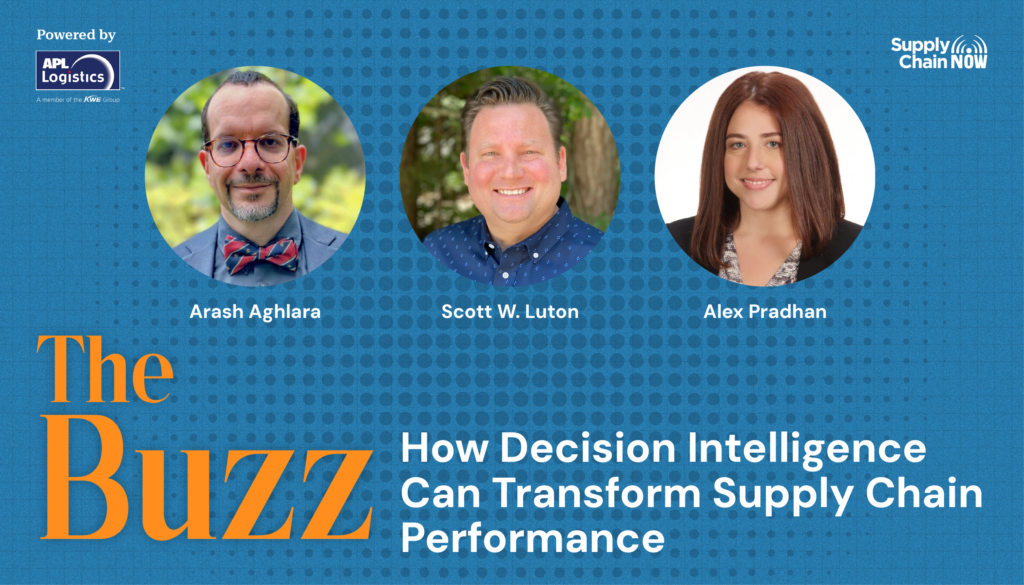
Welcome to Supply Chain Now, the number one voice of supply chain. Join us as we share critical news, key insights, and real supply chain leadership from across the globe. One conversation at a time. Hey, good morning, good afternoon, good evening, wherever you may be. Scott Lewton and Alex Perdan with you here on Supply Chain Now, welcome to today’s live stream. Hey, Alex, how you doing today?
Alex Pradhan (00:26):
I’m doing great. How are you?
Scott Luton (00:28):
I am doing wonderful, wonderful. And it’s a gorgeous day here in Metro Atlanta. It’s a bit cooler, I think, than where you are down in Miami, huh?
Alex Pradhan (00:36):
Yes. It’s always, as I like to say, hot and muggy and miserable during the summer.
Scott Luton (00:42):
Yes. Hot and muggy and miserable. That’s almost alliteration there. We’ll have to do a weather check as we get into the past the summer and into the fall where I’ve been lovely there in Miami. But regardless, folks, on today’s show, you know it’s the buzz where every Monday at 12 noon Eastern time, we discuss a variety of news and developments across global supply chain and business. News that matters is what we like to call it. And folks, all month long, the buzz is powered by our friends at APL Logistics. APL Logistics is a global supply chain logistics provider specializing in order management solutions operating from 180 locations across 93 countries. To learn more, visit apllogistics.com. Okay, so Alex, big show here today. We’re going to be talking about a variety of topics including AI pilot purgatory continues to be a growing problem. Hey, what does MIT say about the state of supply chain omnichannel?
(01:39):
We’re going to find out. How can we transform the supply chain talent shortage into an opportunity? We got some thoughts there and how are leading organizations driving successful decision intelligence strategies? Stay tuned. We’ve got a great expert joining us, all that and much, much more. And as I mentioned, in about 15 minutes or so, we’re bringing in a special guest Arish Aglara, founder and CEO with FlexRole. Now, you’re going to enjoy Irish’s perspective on a variety of topics, especially decision intelligence. So Alex, big, big show here today. Are you ready to go?
Alex Pradhan (02:12):
I’m ready. Let’s do this. I’m excited.
Scott Luton (02:14):
All right. Well, hey, joining me and Alex already. It’s one of my favorite people in the world. Hey, Alan Jacques from beautiful Canada. I think Alan’s coming to Atlanta soon. We’re going to grab a wonderful meal and I’m going to get all your latest perspective, Alan. So great to see you here today. And Alex, before we bring in our guest, and we got a great win here today, Arish Aguara is going to bring it. We got four things to work through. Let’s hit the first one. And as usual, it is our with that said newsletter, which we publish almost every week. Now Alex, we let off this edition with a bit of a recap from a fascinating discussion we had last week on how supply chain leaders must prepare now, not tomorrow, not next week. They got to prepare right now for the onset of quantum computing.
(03:01):
We also included a wonderful resource from our friend, Dr. Mudasir Ahmed, a purpose-trained supply chain AI called Sensei. In this edition, you’re also going to find Abevya tools and resources plus a big week of live programming, including we’ve got a great show coming up, not that one. That’s a great show we had last week. We’ve got a great show, Alex, coming up on June 5th,
Alex Pradhan (03:22):
Which
Scott Luton (03:22):
You’ll find information for. And with that said, it’s all about a frank conversation focused on the truth about entrepreneurship that nobody talks about coming up Friday, June 5th at 12 noon Eastern time. So folks, give it a read, join us for the programs and let us know what you think. So Alex, did you get a chance to read with that said this past weekend?
Alex Pradhan (03:42):
I did. I did. I think anything on emerging technologies, quantum computing is important. I think what I found really interesting is that today we’re seeing supply chain leaders are being bombarded with a lot of information. The market is going through unprecedented technology change and I think as a supply chain leader, they’re asking themselves, where do I prioritize? You hear about AI, gen AI, Gentech AI. And so perhaps my take on the whole quantum computing was a little bit different. I think leaders need to ask themselves, what is your organization’s risk appetite? And what I mean by that is, for example, when I was researching blockchain at Gartner, I would ask companies to rate their risks tolerance on a scale of one to 10. And so if they answered six or below, I would tell them, “This is not for you. Your probability of failure is greater than success.” And so it’s not to say don’t go out there and begin to dip your toes, but just be aware of what your risk appetite is.
(04:39):
And so I think that’s also important to keep in mind. Quantum is no different. Emerging technologies are going to require more than just budget approval, but be mindful of what it means, especially when it comes to a lot of the testing.
Scott Luton (04:52):
Excellent points. Excellent points. As you know, everyone’s risk tolerance is going to be much, much different. And of course, so the strategies to deal with said risk are also going to vary, but I would challenge audience, and we’ll see if Alex agrees with me. She may not. And I’m in trouble if she doesn’t. But I would argue that folks, if you’re leading organizations, whether you’re in supply chain or not, you got to at least have an understanding about what the quantum error poses so you can figure out what are the right steps for you and your organization based on those factors that Alex touched on. Would you agree with that, Alex?
Alex Pradhan (05:26):
Yeah, definitely. I would definitely agree. I think you have to be, to your point, aware doing your research. Yes, completely agree on that.
Scott Luton (05:33):
Excellent, excellent. All right. So folks, again, check out with that said, and again, it comes out almost every single week, almost every single weekend at that. And let us know your take and to make things easier. Let’s see here. Trisha has dropped a direct link right there. Thank you, Tricia. She also dropped our direct link to APL Logistics, our friends there. So check that out. And Rashid is back with us. I hope I said your first name right. Check out what Rashid said. Supply chain leaders must prepare now, not later because the next disruption will not send a calendar invite. I like that. Alex, that is a good one, huh?
Alex Pradhan (06:11):
That’s a good one. That’s a good one. Yes.
Scott Luton (06:13):
Okay. It’s tough, Rashid. All right. Number two, let’s see here. Now I’m going to share this graphic here. I got excited because this was a great conversation. So Alex, you tuned in last week. We had a bunch of folks join us last week for what I thought was a fascinating discussion that Wiley Jones from DOS and I had on our enterprise unleashed series. It focused on Ben Gordon’s perspective. Now, a lot of folks were recognized Ben for all of his investment and advisory work across global supply chain. And Alex, I enjoyed your comments, several of them and we’re laughing folks because it was a lively conversation. But Alex, what was one of your favorite takeaways from our discussion here?
Alex Pradhan (06:56):
Oh my gosh. I mean, as you said, I mean, he has candid views from leadership style, the views of the market. I mean, he covered a lot in 45 minutes. I would say the one thing that stuck out to me, and I actually wrote it down on a sticky note, I have it right here, was simplify, focus, and execute. And I love this. I think this is great advice professionally, personally, and I think for many companies, this is really important not to lose sight of what is that main thing, whether you’re a software provider and you’re trying to hone in on your mode, your competitive advantage or your enterprise. And again, that conversation about there’s so many different types of technologies, which one should you go in and focus on first? So again, really, really liked that take about simplifying focusing and executing. And I thought that was great.
Scott Luton (07:48):
I did too. And I had at least 17 pages of notes. I like that one. I love a good framework and that’s a great framework. I think it’s very universal, simplify, focus, execute. The other thing that he mentioned that I think has lots of different twists on it, but autonomous truth at the core is you can’t shrink your way to greatness. Yes.
Alex Pradhan (08:06):
I
Scott Luton (08:06):
Used to work with a smart individual that would always say, you can’t save your way into sales success, right? Invest, invest, invest. It’s not always dollars. It can be many other things, but it was a great conversation. And folks, tune into the replay. We’re going to be dropping on the podcast channel. You can also go find it over on our YouTube channel currently, but it was a great one with Ben Gordon and Wiley Jones and the team from Doss. Okay. Alex, I got more perspective I don’t want to get from you because coming up here next few weeks, our mutual friend, the one only Laura Cesari, is going to be releasing the 2026 installment of supply chains to admire. And I think this is either the 13th or 14th yearly edition of this research. So Alex, I got to ask you, what is your favorite aspect about this research that’s released each year?
Alex Pradhan (08:55):
Yeah. I mean, the report itself is it’s strong, obviously longstanding report, as you mentioned, based on quantitative data, lots of research, lots of evidence. I personally know that she is pushing to recalibrate the industry’s view of excellence and challenges, obviously the status quo, which is very important in our industry. I think what I’m looking for this report is maybe three different questions. Number one being, what is she seeing in terms of tariff disruptions and AI investment? Is that creating any changes that she’s seen for how companies are performing? And then for those companies that are, I guess let’s use the word winning, what are they doing differently? I mean, I’m not talking about big statements and Laura would never do this that she has digital transformation or change management. But again, what is she seeing that those companies are doing radically different or perhaps it’s not that radical?
(09:49):
And so again, I think this is a great report, comes out. Everyone who’s in supply chain should be reading this and it really just helps you to think about some of those other questions and bring up some great data points.
Scott Luton (10:01):
Alex, I met with Laura last week to kind of go through some of her early key findings here as well as the latest with Ask Laura, which is a platform we’ll touch on in a few weeks. But one thing is for sure, we’ll see if Alex agrees with me here too. Supply chains to Admire will be anything but fluff. It is a no fluff zone and that is one of the things I’ve always appreciated about that and frankly her perspective. So folks, so Alex, would you agree there? You agree with that?
Alex Pradhan (10:28):
Absolutely. Zero fluff. No fluff. Zero.
Scott Luton (10:31):
Negative fluff.
(10:32):
Negative fluff. But folks, I invite you to join me and Laura and maybe I get a special guest or two on June 23rd at 12 noon Eastern time as we dive into key takeaways from this year’s supply chains to admire 2026 and more about this powerful new platform called Ask Laura. So join us then. All right, let’s see here. I want to add Rashid is on it. They say AI is rapidly reshaping supply chains, but a real competitive advantage will come from leaders who know how to connect technology with people, resilience and execution. Alex, that is almost poetic, huh?
Alex Pradhan (11:08):
Yeah, there’s a lot there. I think we should also add data somewhere in there. It’s a good one. And then we’re going to talk about governance too, so I think that’ll be a good segue.
Scott Luton (11:16):
I’m with you. And Rashid adds people development. That’s a good one too.
(11:21):
All right. Tricia has also dropped when you’re talking on B Gordon Enterprise Unleashed episode. You can go check that out here. And one last thing I’m going to mention before we have a great guest join us here today is this comes from our friends at APL Logistics. Now you know how much I love a good list. And by the way, so does Amanda. Big thanks to Amanda and Trish behind the scenes helping us today as always. Our friends at APL Logistics published A Neat Read focused on five signs. Your supply chain has outgrown how it’s managed today. Hey folks, you can’t race a Corvette, but drive it like a Chevette. Alex, have you ever heard of the Chevette?
Alex Pradhan (11:58):
No, I thought you were going to go with Chevy there for a minute, but no, I’ve not.
Scott Luton (12:02):
So I was curious when I first put that together, I was like, “I wonder how many folks have ever heard of a Chevette.” Well, folks think of this. Y’all know the Corvette, big V8 or maybe bigger race car, I’ll call it. And then you got the Chevette, which is a bit like a Pinto, except it came a decade or two later, okay? So you got to unleash the beast, right? Unleash the beast and you’ll check out this great read, practical read from our friends at APL Logistics. All right. Alex, I am really delighted to have this guest here with us today that you found first and you said, “Hey, we got to get in touch with this person’s agent and get him booked on the show.” So that’s what we did.
(12:47):
He was on world tour. We brought him away maybe with the stones. We brought him away here today and I’m going to introduce our guest. Arish is known as the uncle of DI, right? The uncle of Decision Intelligence. He’s the creator of the decision-centric approach and he’s a though leader when it comes to decision intelligence, of course. With over 20 years of experience in various industries, he helps enterprises treat decisions as first class citizens of the organization so they can make optimized, customer centric and situation aware rather business decisions at scale and regulated environments. Please join me in welcoming Arish Aglara, founder and CEO of FlexRole. Hey Arish, how you doing, my friend?
Arash Aghlara (13:31):
Hello there. I’m doing very well. Thank you very much for having me on the show.
Scott Luton (13:35):
We’ve heard so much about you, so your ears may have been burning. And Alex, once you and I got together, we’re like, “Hey, who do we want to have on today’s show?” And you’re like, “I’ve got the perfect guest and I can’t wait to dive in. “That’s kind of how it went, Alex, huh?
Alex Pradhan (13:47):
That’s pretty much how it went. Yes.
Scott Luton (13:50):
And folks, you’re going to find out why in just a minute, but first Arish and Alex, I’ve got a fun and warmup question, then we’re going to touch on four news stories and then we’re going to dive into decision intelligence and much, much more with Alex and Arish. Let’s do this. So today is many things, right? It’s International Children’s Day. It’s National Olive Day. That’s kind of like licorice. Some folks love Olive. Some folks hate Olives. I love Olives. It is Dinosaur Day and it’s also Oscar the Grouch Day. Now everyone knows hopefully who Oscar the Grouch is, that beloved character from Sesame Street. It’s been on TVs for over 50 years, I believe. Now Arish and Alex, did you know the late great Jim Henson who helped create Sesame Street and a lot of the characters got the idea for Oscar the Grouch after an experience with a rude waiter at a restaurant called Oscar’s Salt of the Sea
(14:43):
And they created a character. So folks, that tells me you got to be careful and be nice to people that know how to make TVs and television shows and movies and characters. But I want to ask you this, Arish and Alex. Arish, when I think of Oscar the Grouch, I think of like a lot of folks can be grouchy in the morning and other folks are morning people. So Arish, which are you? Are you a grouch in the morning or you just jump out of bed in the morning, cup of coffee and the world is good?
Arash Aghlara (15:10):
No, I just jump out of the bed and I start my working. Sometimes my wife actually laughs at me. She’s like, “How do you not even having your eyes open and start piping on your computer?” And generally four hours sleep is good for me to go.
Scott Luton (15:23):
Oh, I’m kind of like that Arish. Alex, how about you? Grouchy or morning person?
Alex Pradhan (15:29):
Oh, I’m a morning person. I’ll get grouchy anything after seven, eightish, but no, I’m a morning person. I’m the annoying morning person.
Scott Luton (15:38):
Love
Alex Pradhan (15:38):
It.
Scott Luton (15:39):
Love it. I am too. And maybe I wasn’t always a morning person, but really we’ve got so many blessings that we should appreciate in this world. And for some reason, the first thing in the morning as the sun’s coming up, it really makes me more grateful, I think, and gets me ready for a good day. So Arish and Alex, great to have you both and especially grateful that both of you are fellow morning people as well. All right, folks, we’ve got a lot to get into here today and we’re going to explore how supply chain AI is getting stuck more and more in pilot purgatory as reported by our friends at Cargo Explorer. And in this article, they focus on supply chain brain reporting on a new GEP and University of Virginia Darden Research Report, which is out and it offers up some nuggets that I don’t think is going to surprise a lot of folks, maybe a little bit, but of some 200 supply chain leaders surveyed, fewer than one in 10 have scaled AI pilots into enterprise-wide operations.
(16:34):
In fact, 74%, according to the research, have not moved beyond planning or have created a roadmap for how AI should operate inside the business. Now, I like this quote from the article as I think it relates to an important observation, quote, “Most supply chain AI programs should become more boring before they become more ambitious. Boring is how technology gets adopted,” end quote. Okay. Arish, I’d love to get your take on the news here out of Cargo Explorer.
Arash Aghlara (17:05):
Well, the boring is actually very interesting. So they refer to something called operating model, right? What is interesting about the report is that they actually point out that they can’t really get the AI at the enterprise scale because of lack of that operating model. But what is lagging in this particular report is defining what that operating model looks like. Now, in referencing back to the boring job should be done first, I think that’s really highly related to understanding what AI is supposed to do. If AI is supposed to make decisions, we’re going to talk about that in the decision intelligence section, but nobody thinks of decisions explicitly. They look at processes and data and AI models and all of that and somehow they assume those are decisions. So I think the boring work is to understand and make those decisions visible.
Scott Luton (18:06):
I like it, Arish. And I love how we’re able to more and more automate the boring work and tedious work across the industry. Alex, your thoughts on this article here about pilot purgatory.
Alex Pradhan (18:17):
Yeah, I mean, I think we’re seeing a lot of articles very similar to this one. I mean, I think whatever stat you’re pulling, whether it’s from this article, Gartner, wherever it may be, I think they’re all basically saying the same thing, which is that there’s a conversation where there’s a lot of investment, but there’s not a lot of movement happening. And I think progress has been hindered by that lack of readiness, not because a lack of ideas. And so specifically, I mean, what Arash was talking about is, yes, focus on the boring, on the governance, on what are you trying to focus on? And I think that’s something that in the race to, I don’t know if it’s FOMO, fear of missing out. I think a lot of organizations are skipping through that fundamental, let’s call it the boring, boring step, which is incredibly important.
Scott Luton (19:06):
It is incredibly important. But I love the acronym you mentioned, FOMO. We talk about FOMO all the time. And I think just my take, Arish and Alex, one of the most dangerous dynamics. Actually, it’s one of the best, but it’s also one of the worst dynamics that drives leadership motivations and sometimes day-to-day behavior is that FOMO, right? They see the shiny outcomes or the shiny objects that other organizations are doing with AI and they’re like, “I want that. ” And so they drag it back, invest a few bucks without the targeting and the specificity and the particular case studies needed or problems that we’re going to apply it to. And it can create, in my experience at least, tons and tons of friction because people don’t know what to do with it and they feel the pressure to do something with it. Have you seen that in your journey as well, Arish?
Arash Aghlara (19:56):
Yeah, absolutely. I think actually the report is kind of positive because if you look at, for example, the Oracle report, they say 95% of those AI projects have zero literally value or zero measurement in P&L. So kind of maybe in supply chain, they’re doing better, but at the end of the day, I agree that FOMO drives humanity essentially, not only this particular industry, every human on planet there really want to get to a better position than what they are at this point in time. The big driver of that is FOMO.
Scott Luton (20:31):
Grass is always greener, Alex. Is that right?
Alex Pradhan (20:35):
Not always. Not always greener, but certainly I think again, just going back to looking at some of these different emerging technologies and even nascent technologies, it’s yes, you should be doing your research going and moving forward, but just being mindful it’s about, to your point, looking at your organization and thinking it shouldn’t be about FOMO. FOMO should not be driving your investment decisions. So absolutely.
Scott Luton (21:02):
So true. All right. And by the way, folks, got some good news. If you liked that last article we covered, and especially the main driver of it, that new research of 200 supply chain leaders that GEP and University of Virginia Darden has created and released. Come join us on June 10th at 12 noon Eastern time as we dive into with a couple of the figures that created help create and publish the research. I’ll be joined by Jake Barr, John Wayne Global Supply Chain, and I invite y’all to come join us. Okay, let’s see here. Next up, we’re going to be talking about how MIT defines the current state of supply chain omnichannel and specifically this is from the MIT Center for Transportation Logistics. So Arish and Alex, this research was released in April 2026, so just a couple months ago. It was based on a survey of 647 supply chain professionals and it’s been conducted annually, I think for four or five years now and it’s free to download.
(21:58):
So folks, we’re not going to be able to do it justice in the five minutes or so we spend on it. So go check out the link that Trisha has dropped. A couple of key findings. 81% of those surveyed report ongoing e-commerce growth. That doesn’t surprise many folks, I’m sure. About the same reported that their organizations are implementing new omnichannel distribution strategies, which is about a 10% increase over last year’s findings of organizations doing the same. And going back to growth, the biggest sector’s reporting growth and this reads like my 11th grader shopping list, beauty and personal care, fashion, and toys. So maybe no surprises there, but one of the biggest shifts identified in the research is business leaders are moving from building omnichannel capabilities to optimizing for profitability. And two of the things that I think is good news from the research, I love this really.
(22:48):
Sustainability and returns management are rising in importance. In fact, sustainability made double digit gains year over year in terms of the prioritization that leaders are putting on that topic. Again, there’s a lot to digest from this report. I think it’s a really good one. Tons and tons of findings. Go download the copy and let us know what you think. Arish, what did you see in this research?
Arash Aghlara (23:12):
Well, it’s a very interesting research. I really like it. I have some issues with the research itself, which I’m going to talk about that. But one of the things that is very obvious is that the MIT research is really focusing on the numbers that are flooded in the supply chain, like the prediction accuracy, the forecast, the AI enablement and all of that. But what is lacking is they didn’t name the symptom behind, for example, 50% side complexity of fulfillment of decision making at top challenges. So if we want to look at it from the angle of the research, it’s a very good research. If we want to look at it from the angle of how we can overcome the challenges that research is identifying, there is a very big gap there. And I think one of the things that most of the organizations that we work, supply chain, insurance, banking, even many of these research look at it is that they think and they behave the way that those numbers, accuracy, prediction, forecasts are the decisions.
(24:23):
Unfortunately, that’s not true and that’s really what I see the lag and the gap in these sort of research.
Scott Luton (24:30):
Arish, I appreciate your perspective there. Alex, what’d you see here in this MRT study?
Alex Pradhan (24:35):
One of the clear takeaways was that the commercial models are rapidly outpacing traditional operating models. And I think this is an interesting report to highlight in a way. It doesn’t call that out specifically that way, but I mean, e-commerce at this point is table stakes. You mentioned it’s growing, it’s no surprise there, but I think if you look at what’s happened in the last say five to seven years, and I think a lot of it really the catalyst was COVID where a lot of companies had to evolve very quickly to model or to serve how customers are changing their behavior, their shopping and whatnot. And so I think what you’re seeing is that a lot of that commercial model for many different companies is very rapidly changing, but their operating models, the way that they’re actually operating day-to-day on the supply chain really has not changed.
(25:29):
And so maybe pointing back to what Arash is saying is that I think also evaluating how traditionally not only are they making decisions, but even what are the KPIs that historically we’ve considered are good.
Scott Luton (25:40):
Well said, Alex and Arish. And folks, there’s so much more in this report. I’d love to hear your take and not just today, come back to us next week, email us, you name it, put it on social, but check out the link. Trisha’s dropped the link to the state of supply chain omnichannel report by our friends over there at MIT Center for Transportation and Logistics. Up next, hey, it is like a report heavy edition of the bus. We are going to dive into, we’re going to talk talent, supply chain talent. Now Accenture released a report recently that suggests we can turn lemons into lemonade as it relates to converting the current supply chain talent shortage on so many different levels, turning all that into opportunity. Now bear with me here a minute. I’m going to share some data and then I’m going to share some suggestions.
(26:27):
So Accenture says that based on its proprietary scenario planning model, that demand across core US supply chain occupations is expected to increase by 1.34 million roles or 19% from 2026 to 2035. Over the same period, they’re projecting that the workforce will grow by about 3.2% adding 221,000 workers, right? So that gap, that implied gap between those two numbers reaches almost 1.1 million. Again, no surprises, right? No surprises. That’s just the US. Based on their industry research and the challenges at hand though, Accenture suggests that supply chain leaders do three things. Number one, build talent foresight where demand changes fastest. Number two, redesign work so people and systems scale together. That sounds like harmony to me. Number three, build skills continuously as tasks evolve. By the industry doing so successfully, says Accenture. They see a workforce deficit transforming into a surplus of some 360,000 workers. Now, that’s what I’d call a healthy dose of optimistic thinking, but I like it.
(27:36):
Arish, your thoughts on this piece from Accenture, my friend.
Arash Aghlara (27:40):
It’s actually very interesting. So the labor gap, which is significant 1.3 million positioned by 2023. And then as part of this report, it’s talking about 66% executive leader want to make quicker decision making autonomously. And then that raises the question for me autonomy over what exactly. We don’t know what the decision is. We can get these many people also on board because of the lack of labor. How are we going to survive and how are we going to close this gap without understanding the business decisions we make day over day over day in organizations. Based on actually Bain and Company report, 95% of financial results of organizations are correlated with the decisions they make and execute and that’s really a big gap I see however I look at it.
Scott Luton (28:41):
Arce, you touched on one thing. Alex, Arce touched on one thing where just the tip of the spirit, just the awareness piece, we’ve got to get more folks in the industry so that we can tackle other aspects of the workforce gap because it is so multifaceted. But Alex, what’d you take away from this Accenture piece?
Alex Pradhan (28:58):
Yeah, I thought this was really interesting because today you turn on the news or you really pick up, you’re reading any of these articles that are out there and the headlines is AI is killing jobs. And I don’t know if you guys have seen lately in the news, all these commencement speakers are literally getting booed or saying these sort of things. And then on this side, you have the Accenture report that is being, I guess, optimistic in a way and talking about there’s this one million jobs and this is not a job elimination story. It’s sort of how can we help to augment the worker? But I think the challenge is today that most companies are deploying the AI in a very lazy way and I think it points to the first or the second topic that we were talking about, which is don’t think of AI, you have to focus on the fundamentals first.
(29:50):
And so right now we’re seeing a lot of using this as a headcount substitute but not as a redesign tool. So how do I do the hard work going back to the foundational Redesign for the role itself. Tarash is talking about, what does autonomy even mean? What does that even look like in the day-to-day? And so I think it’s really interesting just to see these two different stories out there. And I think right now companies need to have a very honest internal conversation about what does the role of the planner or how are we going to go ahead and really look at AI?
Scott Luton (30:28):
Alex, well said. Well said, you and Irish both. Next time I digest a report or research, I’m going to wish both of you are with me to help read into what I should be reading into with this research. All right, we got one more story and then we’re going to dive into the uncle of DI and get some really actionable perspective. I look forward to that. One last story though first. This comes to us from our friends at FoodDive. Food Dive is reporting that a protein powder shortage has hit industry, which comes really at the worst time possible because there’s unprecedented demand for protein fortified products. 70% of Americans say they want more protein in their diets as opposed to 59% just four years ago. So whey protein, I think I’m saying that right. Whey protein has been a major input used by protein product producers for years really decades.
(31:18):
Before the modern era though, it was just a cheap byproduct of cheese manufacturing operations, right? Easy to get, cheap to buy, cheap to use, but the current market has changed all that. And the dearth of whey protein supply is leading to higher prices, number one, but as well as new industry investment US dairy producers have recently announced $11 billion in new and expanded manufacturing capacity across 19 states and that’s just here in the US. So Arish, weigh in, no pun intended, into this story from Food Div, my friend.
Arash Aghlara (31:53):
Well, that’s interesting. So it’s kind of becomes at some point boring because everything I look, I look at everything from the decision point of view. Again, this is to me about the decision. And when we talk about the decision, there are different levels of decisions, strategic decision, tactical, operational, et cetera. And nowadays because of the pace of business, really the line between all of these type of decisions are blair. Hence, if you look at this particular piece, you can see do we raise the price? Do we refund it? Do we absorb the cost? We change the market. All of these are decisions that are implicitly someone knows or someone’s try to apply the judgment, the gut feeling to find out the answer. Unless we don’t make these decisions visible and explicit, in my opinion, they cannot find the right answer.
Scott Luton (32:47):
Interesting. I’ll tell you, if y’all can’t tell, Arish is very passionate about decision intelligence and how business leaders make decisions. And we’re going to close. We’re going to connect all those dots in just a minute. Alex, weigh in on the state of way protein amidst the current market conditions.
Alex Pradhan (33:08):
I’m hoping the different producers of protein have been seeing the signals. So you have the GLP-1 prescription data, point of sale trends. So again, getting some of the more mature technologies like demand sensing and seeing the consumer behavior. So going back to you can sense you’re seeing everything that’s happening and then how do you close that gap? But going back to what is that right decision? So if there is a long lead time to produce some of this protein and obviously changing, whether it’s manufacturers or suppliers, take some time. But I think at this point it’s why is this an issue right now? I guess I’m not in the protein business, but I think there is something to be said about. And I think other industries can also learn from this as well as it’s really important for them to be plugged into looking at macroeconomic conditions, macro trends and so on to be able to get in front of these type of issues.
Scott Luton (34:05):
Completely agree. And I would add to that, Alex, every assumption we’ve made, every assumption, including … I mean, think about the folks that have assumed that they’d have ample supply of inexpensive whey protein to put into their products. We’ve got to reevaluate everything right now, especially at the speed that we’re moving. Okay. So in addition to Irish that loves all things decisions, I think our friend Jeremy tuned in via X is all about decision intelligence as well. So Jeremy, stick around.You’re in a perfect place today. I look forward to your feedback throughout. All right. So before we dive into all that, I want to just put a plug in right quick. Folks, if you enjoy shows like today or some of these other shows that we have mentioned here today, go check out all of our upcoming live programming. We’ve got live streams, we’ve got webinars, including coming up on June 16th, we’ve got a great primer.
(34:54):
You probably have heard the news maybe. Maybe you’re one of three people out there that hasn’t. Amazon Supply Chain Services has launched. Come join us on June 16th. You can learn more about what this means to the market. Okay. Now we’re going to move into the Irish Aglara segment here on the buzz for June 1st, 2026. But Alex, before we do that, when we first got talking about your appearance here today, because I’ve loved collaborating with you, I get smarter every conversation I have with one Alex Perdan, but you were telling me about you saw Arish in action at a keynote at a fairly recent event and what he was sharing really captivated some of your thoughts. Tell us more about where you first saw Arish, Alex.
Alex Pradhan (35:36):
Yeah, sure. So it was last year here, Rush speak at DecisionCamp. Just a quick side note, definitely it’s a great conference, it’s free, it’s virtual, really showcases thought leadership in the decision intelligence space. So if you’re listening in, make sure that you join. And so what stuck out to me was that his team is trying to solve what I call the wicked problem and that was disconnected decision experience. And so if you think about what’s happening today in supply chain, the challenge today is that there really isn’t end-to-end context. So decisions don’t know their influence on each other, they can’t adopt to prior decisions or anticipate future paths. And so what’s happening is you have almost a disconnected decision experience. So there’s a series of isolated intelligent actions, but they don’t quite understand or there’s no understanding, there’s no memory. And so what I thought was really interesting that his team was doing it was basically trying to solve this overall, this wicked problem, which I’m sure he can go into a lot more detail.
Scott Luton (36:38):
Wicked problem. I love that, Alex. All right, Arish, tell us more and then we got about 17 questions for you, my friend.
Arash Aghlara (36:46):
Yeah. About the wicked problem. So if someone tells me I can do something, I’ve got to do that thing. And that was the wicked problem. So when you look at the decisions and there are many great vendors out there, but they look at the decisions at point in time that are stateless, you send input, it calculates, it does stuff and returns outcome, but then that becomes kind of a vicious cycle because this decision doesn’t know what happened before it and doesn’t know the upstream, downstream, the influences and the actions that are going to be taken. We were trying to solve this problem and we came with the modeling technique that is called continuous decision model, which allows you to create a decision continuum and all of these decisions sit inside that continuum. They can communicate. It really brings the state and memory to the next decision.
(37:42):
So they become aware of their environment, therefore they can understand upstream, downstream impact, they can adapt to change and all of those good stuff.
Scott Luton (37:52):
And I don’t have to tell Alex or Aris here that when you think about upstream, downstream impact, you industries have to manage that, have to be wary of that and have to be people on the radar how their actions impact things upstream and downstream more so than global supply chain.
Alex Pradhan (38:09):
Yes.
Scott Luton (38:10):
Alex, is that right? Would you agree with that?
Alex Pradhan (38:11):
No, absolutely. And I think that’s what we’re seeing today is that you have decisions are being made about inventory adjustment or, well, that we know carries implications for production rescheduling or delivery reprioritization. And so how do you think about those interactions, the relationships and that context that you need to really understand the coordination that needs to happen? And that to me is what I call about this wicked problem that’s out there because you need to have a semantic understanding of cause, effect, and intent. So a lot of different moving parts, but basically there’s all of these different relationships that are interconnected.
Scott Luton (38:50):
So true. And you think about that universal almost human conversation that I bet all of us have had so often, the workday completes 5:30, 6:00 PM rolls around, “Hey, what do you want to have for dinner?” “I don’t know. I don’t want to make any decisions. You make decisions. “I mean, it’s kind of funny to think about, but apply that to our work environments. There is decision fatigue and decision exhaustion. So I’m looking forward to learning more of your thoughts here, Arish. The uncle of decision intelligence, I love that Arish. I love that sense of humor. Tell us, would you share key components of successful decision intelligence strategies, especially as it applies to supply chain organizations?
Arash Aghlara (39:36):
Yeah, absolutely. Look, so there is no lack of numbers in any industry, particularly in supply chain. It’s flooded with numbers. So prediction, forecast, accuracy, visibility, all of them valuable and important, but successful of a decision intelligence strategy is really beyond those numbers is what you do with those numbers and then it works across four dimensions, the structural, behavioral, operational, architectural dimension. So I’ll go quickly through that. So a structural dimension is if I step back, look at organizations before I go and solve it, decisions are hidden mostly implicit on action and ungoverned. So hidden means that no one knows where it is they can see. Implicit is no one has a formal definition about it. And in organization we haven’t agreed what it is and as organization, how do we approach it? It’s an action because it sits in queue or in dashboard or there is a friction between the outcome of decision and someone takes action and therefore there is no ownership.
(40:48):
No one wants to be owner of something invisible and unclear and that becomes the governance problem. So if you want to really implement a successful strategy, you have to address that from structural, behavioral, operational, and architectural point of view. So you have to make them structurally visible, make sure that a group of them that are correlated or related are actually aligned with business strategy. The behavioral aspect of it is more cultural, that organization’s culture or tolerance really to noise and inconsistency. So we should think about that. Operational side of it is treating numbers prediction forecast as decision, but decision is what do we do with them, who acts, what logic, under what constraints, whose owner, under what accountability and architectural side of it is the technology that allows us to support all of these end-to-end. So we have to have a strategy that addresses these four dimensions.
Scott Luton (41:54):
Arish, I love a good framework and you just laid one out. And Alex, I want to pick up on just one thing he mentioned there that stood out to me. There are so many, especially as you get bigger and bigger as an organization as an ecosystem, there are tons and tons of decisions that are truly hidden and leaders and managers are trying to figure out what drives certain performance. And sometimes I would argue it’s because we really don’t understand why certain decisions are made. And that’s just one element of what Aris shared there. Alex, react to what I’ll call that framework that Aris just presented.
Alex Pradhan (42:28):
Yeah. No, I like that framework. I think when you start to think about where do I focus and it’s not, “Hey, what can I see?” But which decisions are going to create the most value or the risk or cost or service impact, but going ahead and using that framework to help really understand what are those key components ultimately of that decision. So bringing in and not using Russia’s exact words, but more of that business context or giving you a finer view of what is that clarity that you’re going to need so that you can connect your ultimate goal or that decision to real operational implications. I think that’s a really good way for organizations to think about their path when they’re starting out.
Scott Luton (43:13):
Well said, Alex. All right. And Arish, of course, I wish we had a couple hours with you here because I know you could talk about this for a long time and we got about a thousand more questions I want to pose to you, but one of the things I want you to speak to and shine a brighter light on is for years supply chain leaders, we’ve all invested heavily into visibility. How many times you heard that word, right? We’ve made progress. We got still more heavy lifting to do, especially as we get deeper and deeper into our ecosystems. And of course, that’s one reason why we can still struggle when disruptions occur. And it’s also why we oftentimes can’t act fast enough when said disruptions occur. But I want to ask you, Ars, what is the missing link between visibility and truly intelligent decision making?
Arash Aghlara (44:00):
Well, the first thing is defining what intelligence means to that organizations. That’s fair. So assuming leadership or part of that committee, they know what they mean by intelligent. The next step is again, visibility is a number and what do we do with that number? So if we again step back, we can see the gap and that missing gap is to put decisions out of the shadow, make it first class citizens of organizations, which becomes the decision centric approach. Now, decision centric approach closes that gap without that supply chain cannot really close 21% gap between execution and strategy, which Accenture mentioned. So decision centric approach allows you to make decisions visible explicit actions and as the result of that, you have a governance in place. So I think the missing gap missing link is that decision centric approach.
Scott Luton (45:00):
All right Alex, you agree with that? Your thoughts?
Alex Pradhan (45:03):
Yeah. I mean, I think you’ve heard me talk a little bit about this. D companies truly have visibility or not? I understand the high level view where you can see your inventory positions or your orders. So I think of it more as a visibility. It tells you what is happening, what has happened. But when you look at decision intelligence, and I think this is why we’re starting to see so much more of a focus on this, specifically in supply chain, is it tells you what matters, what to do, why to do it, and what happens next. So kind of connecting a bit if you want to think about it, these two different areas. Another way that I like to think about is today, I think many companies are focused on doing things right and fast and we should be focused more on doing the right things and improving efficiency, which again, that’s where a lot of this conversation around decision intelligence is helping to focus more on what I mentioned about doing the right things and improving efficiency.
Scott Luton (46:03):
Yep. And in particular, I’m not sure if we can find it, but I enjoyed your blog article on visibility. You’ve done a couple of them, I know, but a couple months ago, I think last time you joined us in the buzz, we talked about a great read. I want to see if we can’t find that link and drop it. All right. So Arish and Alex, I think earlier in our conversation today, the G word came up, governance. Now, I know by me just saying that you’ve got a portion of industry, a shiver goes up their spine and they’re like, “Oh no, not governance.” But I would argue that is your friend, that is your friend, especially when it comes to this fast moving environment where we’ve got cutting edge technologies, we’re still trying to figure out how to use them, but protect our ecosystems, delight our customers and not create or at least create only the acceptable level of risk that organizations company by company is willing to embrace.
(46:56):
So Arish, as we deploy more AI agent speaking governance across planning, procurement, logistics, customer service, two part question, how should supply chain leaders think about governance and what does good decision governance look like in practice?
Arash Aghlara (47:12):
That’s interesting, right? Because we just talked about the visibility and from the supply chain visibility are those number of numbers that are above fulfillment, stock number, lead time, et cetera. But how about if we look at decision inventory, so we have an inventory of decision, we should have the visibility on that. If you don’t have a visibility on something, you can’t govern it, first of all. So the governance is not a practice of a policy document sitting somewhere or audit trail after the fact or a committee. So a discipline that makes decisions visible, explicitly model, connected, and then once it is visible and explicitly people understand and have a formal definition, then you can find the owner for it. Then you can hold people accountable. I don’t know, Scott, do you know anyone that you say, “I have a thing which is hidden and unclear, you’re the owner and I hold you accountable.” No one agrees to that.
Scott Luton (48:22):
Yeah, that’s right. That’s right. Alex, your thoughts on governance and how good governments looks in practice?
Alex Pradhan (48:30):
I agree with you on companies can’t be thinking about it as a policy exercise, but maybe what I liked Roche was talking about is that it’s a decision architecture exercise. And again, I may not using the exact right words here, but I thought it was really interesting. I wrote it down the visibility of decision inventory or your inventory decisions. I think that’s a really almost like a shift in mindset of how to start to think about what are those decisions that ultimately are going to focus on giving you the, for example, visibility or whatnot. But to me, I think a lot of our conversation as we’re thinking about governance is it points back to, I think earlier in the show, we’re talking about the boring stuff, the unsexy foundational work that companies need to do. So again, I guess this kind of comes back is sometimes we do need to focus on governance and that is really important as a foundational
Scott Luton (49:25):
Yes, undoubtedly governance and compliance. Those are not bad words folks. They’re not bad words, especially I’m kind of kidding aside, when we’re moving this fast, in fact, I have a recurring, I’m not call it a nightmare, but a recurring dream where I’m moving so fast that it creates kind of some fear. And because when you’re moving really fast, you can feel like you’re losing control, you’re losing the ability to keep the ship going in the right direction, whatever it is for you and your organization.That’s where I would argue that a sound approach, governance, a sound aspect of compliance in your strategy, your organization’s going to be able to not just tolerate the higher pace of business today and a faster velocity, but find more success because that velocity is not slowing down. Arish, I really wish I had some more time with you here on the buzz, but I want to do a couple things before we wrap here.
(50:17):
First Arch, tell us more about what you and the FlexRole team are doing.
Arash Aghlara (50:22):
Flex role is a decision intelligence company, help organizations make optimized customer-centric situation over decisions. But what really is interesting for us nowadays in the company as a whole is to make sure that the companies in supply chain in BFSI, they understand the governance is not necessarily the paperwork and it doesn’t need to be the boring job. It can be actually an engineering job. So I have a post about this called pillars of the decision governance. It has the design governance, engineering governance, operational governance. So it has many different aspects to it and in fact, it’s not really a boring job. It is a very hands-on job that you have to go through this. And the way it connects, for example, in compliance maybe in supply chain is very different that it connects to compliance in banking. In supply chain might be your commitment for delivery, right, your SLA that you have with clients.
(51:29):
So all of that comes under the umbrella of the governance. If you don’t have it in place, you can’t guarante that.
Scott Luton (51:36):
I’m sure of one thing, very sure of one thing, maybe two things. I want to have our more shows, Alex. We’ll have to make that happen because there’s so much there we couldn’t get to here today. And then secondly, I love your focus on and helping other organizations optimize their decision intelligence and the incredible factor that is an overall organizational success. So Arish, really appreciate your perspective here today. Let’s make sure folks know how to connect. So it’s flexural.com is your URL. Is that right, Arish?
Arash Aghlara (52:08):
Correct, correct.
Scott Luton (52:09):
And we’re dropping that link right here in the chat, right hereflexrural.com also in the chat. Jeremy, you got some good comments here, including don’t manage from fear, manage from faith and practice. I like that. All right. Arish, how else can folks connect with you beyond your URL? I know you do a lot of stuff across social, a lot of good no fluff on social. How can folks connect with you, Arish?
Arash Aghlara (52:37):
Too easy. Follow me on LinkedIn or Ashaglora@LinkedIn or send me an email orash@flexrule.com. Go easy.
Scott Luton (52:44):
It is easy. It is easy. Now Alex, you’re doing some cool things with Alchemy Advisory whenever you’re not here and writing good stuff and attending great shows like Gartner. How can folks track you down, Alex?
Alex Pradhan (52:58):
Yeah, through LinkedIn. So look up my name on LinkedIn and you’ll find me there and would love to connect and answer any questions.
Scott Luton (53:05):
Outstanding. We’re dropping Irish’s LinkedIn right there and Alex is right there. So you’re one click away from connecting and following both and let’s keep the conversation going. Hey, before we wrap, Arish and Alex, I want to share one more resource for folks. Folks, you know we love sharing resources. You can check out our growing resource hub over at supplychainnow.com. We’ve got a variety of new blog articles focused on our conversations at Modex. 50,000 people came to Atlanta from Modex this year. It’s crazy. Biggest Modex in history. You should check out this great take from Christine Barnhart, a. K.a. The supply chain whisperer on why practicality still reigns supreme. Go check that out, folks. I’m a very practical person, Alex and Irish. Very practical and I think we need an extra dose of practicality in the environment, the business environment here today. These things got to work, folks.
(53:57):
They got to work and we got to be investing in targeted approaches built for success, rather rooted in reality, not in fantasy land and hey, there’s still a good bit of that out there. All right Alex, I got a pop question for you. We’ve heard a lot of good stuff from Arish here today. A lot of wonderful perspective from news to decision intelligence, all points in between. If there’s one thing, if you had on patented key takeaway that you would challenge folks to take from Arish Agalara, the flex rule here today, what would that be, Alex?
Alex Pradhan (54:30):
Yeah, I think from this conversation, and maybe you’ve probably heard that our dialogue is thinking differently. So how should you be? I think companies have traditionally been focused on traditional metrics, traditional ways of looking at what does supply chain success look or even making decisions. And I think to me, just how can you start to think about decision intelligence to support moving forward the craft of the supply chain? So I think overall grabbing all of the different pieces that we talked about today and I would really position or have companies sort of think that way.
Scott Luton (55:05):
Agree with you. There’s a better science and methodology out there to how organizations not only make their decisions, but how do they acquire more intelligence and smarter intelligence and a better framework for making said decisions. And Aris, you’re really speaking to many of those intersections here today. We’ll have to have you back. Arish Aguilara, founder and CEO of FlexRole. Arish, thanks so much for being here, my friend.
Arash Aghlara (55:29):
Thank you very much for having me. Pleasure.
Scott Luton (55:32):
Look forward to having you back along with a big thanks to my wonderful co-host here today, Alex Pradan, who’s doing some really cool things as I mentioned over at Alchemy Advisory. I say that right Alchemy?
Alex Pradhan (55:43):
Yeah, that’s all right. And thank you for having me.
Scott Luton (55:45):
You bet, Alex. Great to see you here today. Enjoyed you and Arish’s perspective. Big thanks folks to our friends at APL Logistics. Be sure to connect with them at APLlogistics.com. Of course, big thanks to Amanda and Tricia behind the scenes. Appreciate what all they do. Most importantly, big thanks to the smartest audience and all of global supply chain for being here with us here today. Folks, hope you enjoyed the show, but you know the challenge. You got to take one thing. Irish and Alex brought a lot of actionable perspective. You got to take one thing they shared, put it into practice, deeds not words. And with that said, on behalf of the entire supply chain now team, Scott Luton challenged you, do good, give forward, be the change that’s needed. We’ll see you next time right back here on Supply Chain Now. Thanks everybody. Join the Supply Chain Now community for more supply chain perspectives, news and innovation.
(56:32):
Check out supplychainnow.com. Subscribe to Supply Chain now on YouTube and follow and listen to Supply Chain Now wherever you get your podcasts.