[00:00:00] Karin Bursa: am I doing something that matters? And the second is, does anybody care? and so helping, especially people who are early in their career, understand how their role and their
[00:00:10] Karin Bursa: contribution connects into the bigger picture, I think is really important.
[00:00:14] Karin Bursa: So am
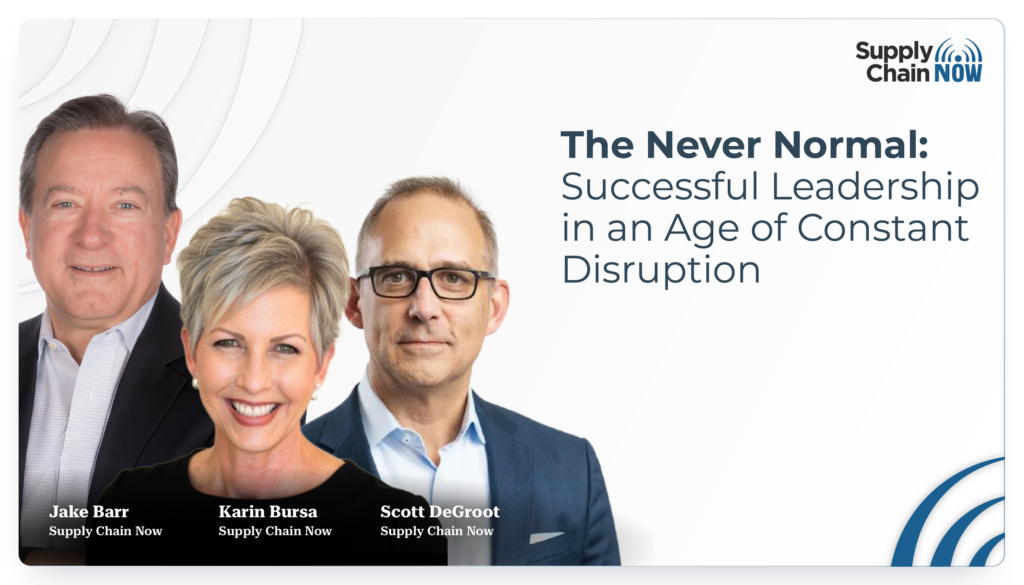
[00:00:28] Scott W. Luton: Hey, good morning, good afternoon, good evening, wherever you are. Scott Luton with you here on Supply Chain Now. folks, in September 2025, we kicked off a new series here at Supply Chain Now that where we gathered a panel of elite supply chain senior leaders, kind of like the A-Team, right?
[00:00:46] Scott W. Luton: Uh, even maybe had B.A. Baracus somewhere driving a van. But we sh- they shared their perspective on a multitude of topics, but they all focused on the big theme of this continued never normal that global business continues to find itself in, right? A never normal that continues to evolve by the day, sometimes by the hour.
[00:01:07] Scott W. Luton: And since that first September installment and all the feedback that we received from it, we’ve endured several installments of the Never Normal series. So
[00:01:16] Scott W. Luton: today, I’m delighted to be with you, along with a few of my smartest friends. I’m telling you,
[00:01:22] Scott W. Luton: some of the best of the best, uh, as I host this newest episode of the series all
[00:01:28] Scott W. Luton: back by popular demand. We’re gonna touch on a variety, a wide
[00:01:32] Scott W. Luton: variety of topics, and even better yet, we want to hear from all of y’all,
[00:01:36] Scott W. Luton:
[00:01:36] Scott W. Luton: with all that said, want to get to work welcoming this special panel comprised of industry leaders that all, also happen to serve as Supply Chain Now co-hosts. Uh, I know you’ve seen them in a variety of our programming.
[00:01:49] Scott W. Luton: You know
[00:01:49] Scott W. Luton: them, you love them, or if you’re like me, y- you know them and love
[00:01:52] Scott W. Luton: them.
[00:01:52] Scott W. Luton: I bet you do too. So I want to welcome in Karin Bursa, CEO of Narakeo, Scott DeGroot, Managing Director of the Global Supply Chain Institute at the University of Tennessee, and Jake Barr, CEO and Principal
[00:02:05] Scott W. Luton: at BlueWorld Supply Chain Consulting. Let’s bring them in
[00:02:08] Scott W. Luton: How we doing today?
[00:02:11] Karin Bursa: Doing great. Doing great. Glad to be here with you and the rest of this esteemed panel
[00:02:17] Scott W. Luton: Man, uh, I got to make sure I got my credentials in order with the
[00:02:20] Scott W. Luton: three of y’all. Uh, hey, Scott McGroot, how you doing?
[00:02:23] Scott DeGroot: Mighty, mighty good, my friend. And, uh, like Karen, it’s, uh, it’s a pleasure to be here and, um, what, what a great group of people h- We have to talk about and with today
[00:02:32] Scott W. Luton: We do, Professor. We do. Uh, and Jake Barr, the John Wayne Global Supply Chain. I’ve spent time with you a little bit this week as well. Wonderful to see you again
[00:02:41] Jake Barr: I am just going to close my mouth and listen to Professor DeGroote
[00:02:49] Scott DeGroot: What do you think the chances, what do you think the chances are, Karin, of
[00:02:53] Scott DeGroot: that
[00:02:53] Karin Bursa: I think they’re pretty slim.
[00:02:54] Scott W. Luton: zero. Yeah, about zero. Zero.
[00:02:57] Scott W. Luton: Um, all right. So we have a very unique, fun warm-up question, Karin, Scott, and Jake. First time we’ve ever done this in,
[00:03:05] Scott W. Luton: we’re approaching episode 1600, so we’ve done a few, quite a few fun
[00:03:08] Scott W. Luton: warm-up questions. So here it is.
[00:03:10] Scott W. Luton: You’ve got choices, folks, optionality. Uh, so pick your favorite one to
[00:03:16] Scott W. Luton: answer. I’m just gonna read through this for folks that may be listening. Option A is best leadership advice you’ve ever received.
[00:03:23] Scott W. Luton: Option B, biggest leadership mistake
[00:03:25] Scott W. Luton: you’ve ever made. Or option C, one habit that makes you a better leader.
[00:03:30] Scott W. Luton: And by the way, if you don’t notice,
[00:03:32] Scott W. Luton: that graphic shows folks moving mountains just like the three of
[00:03:34] Scott W. Luton: y’all do. So, uh, Karin, I’m starting with you, my friend. Which of those questions would you like to address?
[00:03:41] Karin Bursa: I’ll take option A for 500
[00:03:45] Scott W. Luton: Okay. Go right ahead.
[00:03:48] Karin Bursa: Uh, so the best leadership advice. Um, the first part is actually pretty simple, and it. is that the function of leadership is to produce more leaders, not more followers, more
[00:03:58] Karin Bursa: leaders. And that really, um, clicked for me when I connected it to, uh, the fact that, um, analytics offer insights, but
[00:04:09] Karin Bursa: emotions help drive decision-making and
[00:04:13] Karin Bursa: motivate your team. And the most important emotion in business is probably
[00:04:18] Karin Bursa: trust, right? Trust in yourself,
[00:04:20] Karin Bursa: trust in your team, trust that you’ve built the right operating rhythm or model, and trust in the way you make
[00:04:27] Karin Bursa: decisions. And then that has now evolved
[00:04:30] Karin Bursa: into, I think, the ability to connect both the analytics and insights, the emotions,
[00:04:36] Karin Bursa: but to tell the story, understand what those facts and, um, analytics are
[00:04:43] Karin Bursa: telling you, know how to connect it
[00:04:46] Karin Bursa: to the business goals, and help that team that you’re leading understand how it all fits together
[00:04:53] Scott W. Luton: Love it. Facts, not feelings. I kn- I thought you were gonna go there and spike the football on that
[00:04:57] Karin Bursa: know. I know.
[00:04:58] Karin Bursa: Yeah. But I need some feelings in here too, though. When you’re leading, you need that emotion. You got to connect, um, you got to build trust. Um, and I know we say that all
[00:05:07] Karin Bursa: the time, but, um, when you’re in a never normal
[00:05:11] Karin Bursa: world that we live in now, I think trust is even more important than it has been in the past
[00:05:16] Scott W. Luton: That’s right. Uh, the power of empathy comes to my mind. Great stuff there.
[00:05:19] Scott W. Luton: So back to the board. And Karin, if I had $500, you would’ve gotten $1,000. Great work. Uh, all right. So let’s see here. We’re gonna go next to Jake. Jake, your choice of the litter
[00:05:31] Jake Barr: I am never been one to conform, so I’m actually gonna take two of them, Okay?
[00:05:36] Jake Barr: For a thousand. All right. So the first piece is I,
[00:05:39] Scott DeGroot: Extra
[00:05:40] Scott DeGroot: credit, Jake
[00:05:41] Jake Barr: this is why I love Karin so much. Fundamentally, she hit on the, the very basic thing. I– One of the most exceptional pieces of advice I got very early on was my job was to do such an exceptional job at developing my people, they didn’t need me anymore.
[00:05:59] Jake Barr: Because if you do that, if you invest in others as a leader, then it opens up other opportunities for you, right? So you’ve invested in the organization to such an extent that they simply don’t require you to make any of the calls, right? Now, Karin also dropped another bomb there at the end, which is very, very relevant because I also was blessed with another leader that, that told me straight up, “Hey, look, you do not have to be the smartest person in the room.
[00:06:32] Jake Barr: What you have to be is the person that can energize and mobilize people to be able to accomplish the
[00:06:39] Jake Barr: impossible
[00:06:40] Scott W. Luton: Man, we are getting– We might just stay on these three questions the rest of the hour. This is good stuff. Jake, well done. Uh, so Scott, I tell you, usually it’s good to bat in cleanup kind of after everybody’s answered, but, uh, Karin and Jake really set a high bar. Your thoughts on your option, your– But your, your option still, Scott
[00:06:58] Scott DeGroot: Yeah
[00:06:58] Scott DeGroot: no, good. I, I mean, it’s, it’s good stuff and it reminds me, I’m, uh, what habit makes you a better leader? And there’s not just one, of course, but kind of builds off of what Jake and Karin talked about. I was, uh, uh, in charge of, um, all the production planning for, uh, a major product line, um, at Kimberly-Clark a
[00:07:18] Scott DeGroot: number of years ago, and, um, I was really set on being, like, right.
[00:07:24] Scott DeGroot: Like, I was gonna be correct.
[00:07:25] Scott DeGroot: technically correct, mathematically correct. There was gonna be no better answer. I–
[00:07:31] Scott DeGroot: And, uh, you know, after about six months,
[00:07:33] Scott DeGroot: my boss sat me down and he said, “You know, um, it’s good to be right, but not self-righteous.”
[00:07:39] Scott DeGroot: And, and so this i- this idea that,
[00:07:41] Scott DeGroot: uh, like that really hit me just like
[00:07:44] Scott DeGroot: it, it just did y’all.
[00:07:46] Scott DeGroot: And so what, you know, what is, what’s my personal habit from that point forward is, um, take time every day. What am I learning?
[00:07:53] Scott DeGroot: What am I observing? Write it down. Have some sort
[00:07:56] Scott DeGroot: of plan to improve upon this point because, you know, to the
[00:08:00] Scott DeGroot: points that Karin and Jake both made, um, you can be right, but if no one’s listening
[00:08:06] Scott DeGroot: to you, what does it matter,
[00:08:08] Scott DeGroot: I will stick with that one. You know, have some self-awareness and try to improve yourself every day.
[00:08:12] Scott W. Luton: I’m gonna answer a twist
[00:08:14] Scott W. Luton: on option A and option B. And I’ve told this story before, but when I arrived at my first permanent duty
[00:08:19] Scott W. Luton: station in the Air Force way back in
[00:08:22] Scott W. Luton: 1996, so forever ago,
[00:08:24] Scott W. Luton: 30 years ago, first time I really had a, a, a gruff boss.
[00:08:28] Scott W. Luton: I went in my
[00:08:28] Scott W. Luton: first day in the office, first day in our data analyst
[00:08:31] Scott W. Luton: office, and he sits me and my colleague down, we were both probably 18 years old, I turned 18 in basic,
[00:08:37] Scott W. Luton: and one of the first things he says, he looks at me right in the eye and
[00:08:39] Scott W. Luton: he goes, “You will
[00:08:40] Scott W. Luton: fear me.” And his name was Richard, I’ll never forget it.
[00:08:44] Scott W. Luton: And so that taught me a quick lesson I constantly think about. And of course, the era has cha- so much has changed since
[00:08:51] Scott W. Luton: then, but who in their right mind
[00:08:53] Scott W. Luton: would want to
[00:08:53] Scott W. Luton: communicate that on someone’s first day in their
[00:08:57] Scott W. Luton: organization? So, don’t be Richard is one of the best, leadership advices that I’ve
[00:09:03] Scott W. Luton: lived that I’ll never, ever forget in my
[00:09:06] Scott W. Luton: life.
[00:09:06] Scott W. Luton: So, we’re gonna write a book on three of y’all’s responses.
[00:09:09] Scott W. Luton:
[00:09:09] Scott W. Luton: the Never Normal beckons Karin, Scott, Jake. I wanna dive in by
[00:09:14] Scott W. Luton: discussing one really big element of this new reality.
[00:09:18] Scott W. Luton: So, there is widespread discussion, and I’d say probably agreement, about how disruption is now more of a permanent component rather, of the modern supply chain operating model, the modern business operating model
[00:09:32] Scott W. Luton: perhaps, you know, rather than irregular extracurricular challenges
[00:09:36] Scott W. Luton: here and there, right? So I wanna ask you all, starting with Jake, and y’all get ready, I’ma buckle up for Jake. Jake, do you agree, disagree, and why?
[00:09:45] Jake Barr: I I, I can go both ways, Scott. I mean, I… There has always been a constant flow of change that leaders have had to deal with. So to simply say, “Hey, we’re in a unique period,” we’re always in a unique period. leaders always have to deal with change. What has changed is the pace of it, right? So the veracity of what you have to deal with, the, the amount of disruption, all that stuff.
[00:10:17] Jake Barr: But that’s why I kind of was going, “Eh,” you know. No, to say that leaders have to de- you know, are dealing with change is just, it’s untrue because they’ve always had to deal with change. The question is the pace of
[00:10:31] Jake Barr: it. So that’s where I’m, I’m,
[00:10:33] Jake Barr: stuck
[00:10:34] Scott W. Luton: Okay. I like it. I like that. I can, I can, I can roll with that. And I, and you know, you’re keeping it real. There,
[00:10:40] Scott W. Luton: you know, Lord knows
[00:10:41] Scott W. Luton: nothing in this life it feels like is so black and white, right? Little bit of this, little bit of that.
[00:10:46] Jake Barr: I think the pressure cooker of turning the intensity up
[00:10:51] Jake Barr: has caused leaders to behave
[00:10:54] Jake Barr: differently
[00:10:55] Scott W. Luton: Ah.
[00:10:56] Scott DeGroot: Yeah.
[00:10:57] Scott W. Luton: Scott
[00:10:57] Scott DeGroot: Yeah, no, just and I know Karin will as well.
[00:11:00] Scott DeGroot: Uh, I think number one, I
[00:11:02] Scott DeGroot: agree with Jake in terms of this change has always been there and
[00:11:05] Scott DeGroot: leaders have always responded to it. However, the a- the pace of, of disruption and the amplitude of the changes, industrial policy, um,
[00:11:15] Scott DeGroot: uh, of course, w- wars have always– we’ve always had wars.
[00:11:18] Scott DeGroot: But the extent that the pressure on leaders to make decisions in the moment, I think is gr- is greater than ever.
[00:11:24] Scott DeGroot: And I think fundamentally, uh, many organizations, some are getting it right
[00:11:29] Scott DeGroot: but some organizations are, are not responding in a way that allows them to be
[00:11:33] Scott DeGroot: nimble, you know, to learn by doing, to act
[00:11:36] Scott DeGroot: fast, to, to bring analytics, to bring decisions.
[00:11:39] Scott DeGroot: They, they just get stuck like deers in headlights. And, um, I think in that regard, um, you know, we have to prepare ourselves and our organizations if we have business continuity plans and scenario planning and advanced analytics to think through all the various options. We actually have to invest in operationalizing those options.
[00:11:59] Scott DeGroot: It, it can’t sit on a piece of paper or, you know, on a computer screen. Well, if this happens, we’ll do that. Are we capable of doing that? Do we have these supply lines set up? Are they qualified? Do we have the inventory? Are the transport routes in place? Oh, you know, uh, so I think to some degree, people are not really investing deeply enough to be resilient as we would all like to be
[00:12:22] Scott W. Luton: 嗯。
[00:12:22] Karin Bursa: Yeah. I’m gonna ju- I’m jumping in on there because, yeah, I, I mean, I, I agree with, with what both of y’all have said. Um, I think the, the disruptions, you know, the, the, the need, um, for rapid response to a changing business environment has always been there, but our expectations are different now because of technology, so that we expect to be able to respond faster and to take action.
[00:12:51] Karin Bursa: So if I’m working in a culture that is still locked in to, say, a monthly planning cadence and doesn’t have a way to respond in shorter intervals that they’re confident in, that’s a problem. So to me, never normal, um, means in, in the past, supply chain was all about doing
[00:13:12] Karin Bursa: the repetitive things well and
[00:13:14] Karin Bursa: efficiently to, to plan that stable piece of the
[00:13:18] Karin Bursa: business well.
[00:13:19] Karin Bursa: Um, now I think there’s recognition that we can plan around the volatility so that we can
[00:13:26] Karin Bursa: mitigate the risk or we can harness a new opportunity. But to do that means we manage differently, we lead differently, and as Scott
[00:13:36] Karin Bursa: was saying, we use our technology differently as well to support that. You agree, Jake
[00:13:44] Jake Barr: I do, absolutely.
[00:13:45] Jake Barr: I think we have also a fatal flaw in most leaders today because of the amp- amplitude and the veracity of the, the decisions. They have forgotten the ability to separate what is, in my mind, assumptions from facts, right? Because your, your, your everything is moving, so you get amped up on that.
[00:14:12] Jake Barr: The second piece that really I think they’re struggling with to a great extent is the inability to separate decisions into those that are reversible versus irreversible It, it’s like try… Wait, with all of everything, the chaos, et cetera, wait a minute, I’ve, I’ve got to solve for cancer right now.
[00:14:35] Jake Barr: No, you don’t.
[00:14:37] Jake Barr: What is the decision I need to make right
[00:14:41] Jake Barr: now? And if I make it and it’s wrong, is it reversible or not?
[00:14:49] Scott W. Luton: Yes. Jake
[00:14:52] Jake Barr: Oh, Scott
[00:14:53] Scott W. Luton: All right, Scott,
[00:14:54] Scott DeGroot: No, it’s still Luton you should go because we’ll– the three of us can just take your whole
[00:14:58] Scott DeGroot: time
[00:14:59] Scott W. Luton: Well, you know, we gotta get to– So I’ve got about 37 more questions for this great
[00:15:03] Scott W. Luton: panel right here. And by the way, should I s- I wanna add, Scott
[00:15:06] Scott W. Luton: DeGroot, you’ve got the best beach Wi-Fi I’ve ever seen in my life. Uh, it’s– Can y’all relate to that Whenever I go to the
[00:15:13] Scott W. Luton: beach, it’s like everything’s laggy. Scott, it’s like you’re
[00:15:16] Scott W. Luton: at a, at a NBC studio or
[00:15:17] Scott W. Luton: something down there at the beach.
[00:15:19] Scott W. Luton: So next up, I gotta get next up, Scott. We’ll get your, your comment in. But I wanna talk about what might be,
[00:15:25] Scott W. Luton: what is a common challenge, I think, for a lot of our daily leadership
[00:15:28] Scott W. Luton: journeys.
[00:15:28] Scott W. Luton: Kind of plays off of what Jake just shared, leading when we don’t
[00:15:31] Scott W. Luton: have all the answers, right? So all three of y’all
[00:15:35] Scott W. Luton: have led through numerous
[00:15:36] Scott W. Luton: transformations, right? So I wanna ask a couple questions here,
[00:15:39] Scott W. Luton: and Scott, I’m gonna start with you, uh, so you can revisit maybe your last, uh, thought you want to add.
[00:15:44] Scott W. Luton: How do
[00:15:45] Scott W. Luton: leaders and their teams make confident, successful decisions when the future is
[00:15:51] Scott W. Luton: so, uh, unclear and muddy and, and foggy, Scott?
[00:15:55] Scott DeGroot: Yeah. No, it’s great. And it, it does build
[00:15:58] Scott DeGroot: on what, uh, Jake and Karin were just saying, and that is, um, a lot of peop- you have to be comfortable
[00:16:03] Scott DeGroot: leading in ambiguity, and you will have more granular da- we have more granular data than we’ve ever
[00:16:10] Scott DeGroot: had. We’ve had more decision science and speed and scenario planning and supply chain mapping than we’ve ever had.
[00:16:17] Scott DeGroot: And yet,
[00:16:18] Scott DeGroot: leaders will feel uncomfortable in the moment with the gravity of
[00:16:22] Scott DeGroot: the moment in making the decision. And I think to some degree it goes back to maybe, you
[00:16:28] Scott DeGroot: know, the stoic saying of you have to first work on yourself.
[00:16:32] Scott DeGroot: if if what’s causing you
[00:16:34] Scott DeGroot: to be uncomfortable? Is it the pressure? Is it the lack of data?
[00:16:38] Scott DeGroot: I don’t think it’s the lack of
[00:16:39] Scott DeGroot: data. There is something else that’s causing
[00:16:42] Scott DeGroot: leaders to be, um, cautious in the moment. And I think that has a lot
[00:16:46] Scott DeGroot: to do with this idea of
[00:16:48] Scott DeGroot: creating, um, being real, showing up as a real person. “Hey, I don’t have all the answers. The, the decision looks like this. Let’s make that decision.
[00:16:58] Scott DeGroot: Let’s learn by doing.” As Jake said, it’s we’re not curing cancer here. It’s not irreversible. Let’s give it a shot and check our data and make adjustments and then go again. And constantly be learning and doing. I think to some degree, leaders have to have that ability to deal with, um, ambiguity in that way
[00:17:16] Scott W. Luton: Hmm. Scott, good stuff. Uh, Karin, your thoughts?
[00:17:20] Karin Bursa: Yeah. Um, I, I agree completely. And for me at least, confidence doesn’t come from having all the answers, but it does come from knowing the right questions to ask and having a clear decision framework, getting the right people in the room, and having, back to that trust, having enough trust to move forward with a decision even when we don’t know the answer to every variable or every, uh, possible scenario.
[00:17:46] Karin Bursa: So I, I think that you build your decision framework, if you will, um, which for some, some businesses
[00:17:55] Karin Bursa: might be fairly informal. For others, I think is getting more formal and
[00:17:59] Karin Bursa: more structured as we lean into technology more in the future. But, but I do think that the confidence, it’s hard to quantify, but it’s a really important part of the, um, uh, of the process and being able to do that and not expect perfection every time, right?
[00:18:17] Karin Bursa: But to expect to learn when things don’t go well or could go better, what would we do
[00:18:23] Karin Bursa: differently next time we’re faced with a similar challenge?
[00:18:27] Scott W. Luton: Hmm. All right, Jake, you’ve been applauding what we heard there from Scott?
[00:18:31] Scott W. Luton: and Karin. Your take on how leaders and their teams can make better decisions
[00:18:35] Jake Barr: it when savvy leaders are sharing great insights. I mean, they’ve been through the wars. They know what, what we’re talking about here. I mean, at the end of the day, and to build on both of them, you know, a leader is never making bets that we’re gonna be completely right. That’s just not possible, okay?
[00:18:55] Jake Barr: You’re making a bet that the direction is right. You’re playing out, “Hey, what would need to be true for us to be able to accomplish this?” You’re also at the same time asking something as simple as, “Are we positioned to learn fast if we’re wrong?” So that helps to unlock. So Karin hit on something. You know, that level of discomfort, that reason for hesitation is because the leader is unable to let go and let people make those decisions.
[00:19:33] Jake Barr: So instead of trying to say, “No, no, no, no, no. This is too big. I’ve got to… It’s got to be moi, okay? I’ve got to make that call.” Mm-mm. Your job is to say, “Hey, what would be the pivots if it’s not right? Who do I want to be owning certain pieces if we need to pivot so that everybody’s clear? If it goes upside down, this is what we’re gonna do.”
[00:20:00] Jake Barr: So it’s a collection of those things as opposed to saying, “No, no. We’re gonna go into paralysis because I’m not ready
[00:20:07] Jake Barr: to make that call
[00:20:09] Scott DeGroot: Yeah. And there’s, there’s a certain momentum that comes from just taking action, right? Certain advantage that comes from, well, we don’t know all the answers. We absolutely don’t know. But we do know that if we do this tomorrow, we’ll learn a lot more, and then we’ll adjust and we’ll go again. And that momentum comes from that speed that Jake and Karen were talking about
[00:20:28] Karin Bursa: Yeah, that’s so valuable. That’s so valuable, Scott, because, um, it, it’s… You know, one of the first chief supply chain officers
[00:20:35] Karin Bursa: I worked with, um, said something that, that just surprised me because I thought he knew everything, right? And, and he, he came to the table and said, “Look, we didn’t know what we didn’t know.
[00:20:46] Karin Bursa: Now we’ve got new insights. Now we know how
[00:20:49] Karin Bursa: to think about this problem from a different angle.” But his, um, uh, you know, just his, humbleness,
[00:20:56] Karin Bursa: because I didn’t really think he was a very humble person, uh, I… But to say, “Hey, we didn’t know what we didn’t know. Here’s what we’ll
[00:21:03] Karin Bursa: take away from this and where we need to
[00:21:06] Karin Bursa: dig deeper next time,” um, was just a, a big learning moment for all of us
[00:21:10] Jake Barr: And I can assure you that’s a mark of an organization where they’ll, they will lean into experimentation and not fear the
[00:21:18] Jake Barr: outcome
[00:21:20] Scott W. Luton: A-and, and we all know how important experimentation and running pilots, uh, is. You’re gonna win some, you’re
[00:21:25] Scott W. Luton: gonna fail probably a lot more than what you
[00:21:27] Scott W. Luton: win, but fail fast and learn from it and apply and
[00:21:29] Scott W. Luton: move on.
[00:21:30] Scott W. Luton: Dr. Wu, I know
[00:21:31] Scott W. Luton: we’ve, we’ve interacted on social for years.
[00:21:34] Scott W. Luton: Great to have you here. And again, I welcome all of y’all’s takes, uh, on decision-making, on resilience, is where we’re gonna go here in a second. Let us know what you’re seeing, whether you agree with the panel here, the illustrious panel, or if you disagree, that’s fine
[00:21:46] Scott W. Luton: too. Um, All right, so here’s a great question. Karin, Scott, and Jake, y’all have all worked in and worked with some of
[00:21:53] Scott W. Luton: the most successful organizations
[00:21:55] Scott W. Luton: out in
[00:21:55] Scott W. Luton: industry, and I’m really curious, starting with you, Karin, you know, what
[00:21:59] Scott W. Luton: separates, what do you see that separates supply chain organizations that adapt
[00:22:03] Scott W. Luton: quickly and move forward, kind we’re talking about, versus those that struggle in the malaise and the paralysis,
[00:22:09] Scott W. Luton: all that good stuff?
[00:22:10] Scott W. Luton: Karin, tell us
[00:22:11] Karin Bursa: Yeah. Um, actually, it, I, I got this insight, Jake, from
[00:22:15] Karin Bursa: you probably 20 some odd years ago. A- and it was about
[00:22:20] Karin Bursa: trying new things, right? Um, and, um, certainly a lot of, a lot of companies, a lot of culture s- will say, you know, “We, we want the
[00:22:29] Karin Bursa: perfect plan. We want, you
[00:22:31] Karin Bursa: know, we, we want, um, clear certainty on this.”
[00:22:34] Karin Bursa: But perfection is the enemy of
[00:22:37] Karin Bursa: progress. And so from, from a, an operating system or
[00:22:41] Karin Bursa: culture of resilience, it’s, it’s that ability to take in new information
[00:22:48] Karin Bursa: and to make changes faster and to look at how we do this efficiently in the future and not have a culture of blame or politics that, that come into play, and not have it have to be, you know, loaded on the back of our team every single time, right.
[00:23:06] Karin Bursa: We don’t wanna propel the business forward by sucking in all our best resources and spitting out what’s left of them after a big crisis. We wanna build that memory muscle that teaches us to learn as we go, but also to do small course corrections where we can, um, as a part of that. But, but you know, perfection is the enemy of progress.
[00:23:29] Karin Bursa: And if we’re waiting for the perfect pilot, the perfect answer, I got news for you, it rarely
[00:23:34] Karin Bursa: comes. Um, but let’s get back to being directionally correct
[00:23:38] Karin Bursa: and feeling confident about our ability to make course corrections as we go forward.
[00:23:43] Scott W. Luton: If you’re waiting for those things, you’re gonna be like Forrest
[00:23:45] Scott W. Luton: Gump on that bench where he spent seemingly days
[00:23:48] Scott W. Luton: waiting, waiting, waiting. All right, so Jake, your thought in terms of what separates these
[00:23:53] Scott W. Luton: organizations
[00:23:55] Jake Barr: Uh, I’ll piggyback on Karin’s statement because fundamentally to me, the ones that are the absolute top tier are the ones that realize change is every day. And so you are constantly encouraging, enrolling, entrusting your people to actually go find the next piece of change. You’re, you, you realize Improvement is not a destination.
[00:24:24] Jake Barr: It’s merely a stair rung to the next breakthrough, because there’s so many pieces that are gonna change around us, the business model, what products we bring to market, uh, what channels we sell through, all those things. So the way you build that, you build the muscle memory through having them constantly look for, yet again, the next improvement Every single day
[00:24:49] Scott W. Luton: Hmm. Every single day. Every
[00:24:52] Scott W. Luton: single day. All right, so Scott,
[00:24:53] Scott W. Luton: same, same, the core question here, what separates those that adapt quickly, move on,
[00:24:58] Scott W. Luton: and those that just struggle and struggle and struggle?
[00:25:00] Scott DeGroot: Yeah, um, I agree with what’s been said, and will add in the term culture. You know, the culture of the organization, it, it– you can say it’s set at the top, and that’s true, but ultimately everyone in the organization owns the culture. And if the culture is one of blame or of ego or of, um, or of overly focused on individuals rather than team performance, I think that can really slow down an organization because it’s like Richard, you know?
[00:25:29] Scott DeGroot: They operate out of fear. We don’t, we don’t want Richards. But we do, but we do want cultures that recognize, uh, we need to learn a lot more, and the way we will learn is by doing these things and scientifically capturing the result and making adjustments, just like you do in the planned, uh, plan of experiments, and you continue to reward that, um, forward motion.
[00:25:51] Scott DeGroot: And the teams are celebrated, uh, when they both have success and when they maybe don’t have perfect success, but they learned a lot. Learning is this, is the lifeblood of what I think are fast-moving organizations
[00:26:05] Scott W. Luton: Well said, Scott. Well said.
[00:26:07] Scott W. Luton: Has there been a shift in supply chain being an influential role in C-suite in recent years? If yes, how so? If no, what more could be done?” Uh, Jake, you’re nodding your head, so I’m gonna leave it with you.
[00:26:19] Jake Barr: There’s absolutely no question.
[00:26:22] Jake Barr: that, uh, supply chain is more influential in the C-suite, and you see that both in organization design and how C- uh, C-level teams operate. But what– You, you should ask yourself why, And I’ll tell you that it is because we’ve reached this level of new never normal, right?
[00:26:41] Jake Barr: Because we’ve taken and shrunk the distance between having C-suite spend their time appropriately on strategic activities to where the disruption to those strategic plans has become so immense that we have had to closely couple the understanding of operational and can we land the plane? And if we can’t land the plane, what are our alternatives, and how can we pivot?
[00:27:12] Jake Barr: And those who are bringing, I’ll call it. nimble action in change management more into the C-suite than
[00:27:20] Jake Barr: ever before
[00:27:21] Scott W. Luton: And the chief supply chain officer needs to also not just be the bank. Yes, you need to sit at the same seat as the P&L owners and the chief financial officer, and you need to be accountable for revenue and growth as much as you are margin and
[00:27:34] Scott DeGroot: cost savings
[00:27:35] Scott W. Luton: Okay. And Karin, good stuff. What would you add?
[00:27:38] Karin Bursa: I was gonna go where Scott w- where Scott just said. I think that supply chain w- done well, managed well, um, it becomes a differentiator for the business. So how you attack the market, how you harness opportunities, mitigate
[00:27:50] Karin Bursa: risk, it’s a part of everything in the
[00:27:54] Karin Bursa: business. Um, and so I think that
[00:27:56] Karin Bursa: seat at the table is getting broader, wider, and more
[00:28:01] Karin Bursa: of the C-suite is leaning into those discussions, especially since
[00:28:05] Karin Bursa: we can, technology has advanced far enough now where we can speak in both volumetric terms and financial terms.
[00:28:14] Karin Bursa: And the C-suite, their primary language is financial in how we’re running the business. Then you back that up with the, the quantities or volume necessary to achieve
[00:28:26] Karin Bursa: those financial goals, the revenue, the margin, et cetera. So, um, I, I think that,
[00:28:32] Karin Bursa: um, supply chain is very “
[00:28:34] Karin Bursa: influential and deserves a seat at the table and is a part of innovation,
[00:28:39] Karin Bursa: growth, um, All the opportunities that get discussed, um, in those
[00:28:44] Karin Bursa: boardrooms.
[00:28:45] Scott W. Luton: All the things
[00:28:46] Scott W. Luton: Jake, you’re gonna have one more comment
[00:28:48] Jake Barr: I was gonna say, in most large-scale corporations, it’s the biggest billion-dollar brand that hasn’t been leveraged
[00:28:56] Scott W. Luton: Ooh, that’s a great observation. All three of
[00:28:58] Scott DeGroot: I might take that one too, Jake. I’ll write that one down. Yeah. Certainly
[00:29:02] Scott DeGroot: it’s the biggest number of people, you know, the biggest spend almost always
[00:29:07] Scott W. Luton: All right. So folks, y’all know, hopefully, if y’all have tuned in, if it’s your first time, I think hopefully you’re figuring it out today,
[00:29:14] Scott W. Luton: or if you’ve been with us for years, we keep it real around here in the no-fluff zone.
[00:29:18] Scott W. Luton: And one word that has been bandied about for years is resilience, right? I mean, goodness gracious.
[00:29:25] Scott W. Luton: But I want to get past the lip service leadership here today because we got three folks that bit lived it
[00:29:30] Scott W. Luton: and, um, uh, and, and know what it’s like not in concept but in practice. So
[00:29:36] Scott W. Luton: we’ll talk about resilience, uh, for real here in this next section.
[00:29:40] Scott W. Luton: So first up,
[00:29:42] Scott W. Luton: Jake, what does resilience actually look like inside a high-performing team?
[00:29:48] Jake Barr: Oh my goodness, where– how much time do we have left? I
[00:29:51] Scott W. Luton: About two minutes.
[00:29:53] Jake Barr: seriously. Oof. Um, you know, first it looks like fast recovery, not immunity to setback. I mean, think about it A, a resilient team does not wallow in the shortcoming. They are quick and agile at, at saying, “Hey,” as Scott was outlining, “that first effort came up short.
[00:30:19] Jake Barr: Okay, now why and what do we do about it?” It’s about clarity during chaos. Uh, does everyone run around like, you know, chickens with their heads on cut off? Or do they, in the moment, understand, “I’m counting on Scott for this, I’m counting on Karin for this,” and they don’t get into their swim lanes. They know that they have the trust that given what, we need to get done, I can count on, right?
[00:30:50] Jake Barr: It’s having, I’ll call it, um, uh, an emotional shelf life, a- half-life of not wallowing in failure. Guys, we all fail. If you’re not leaning in, then I’m sorry, you’re playing it safe. The, the world of supply chain, the world of business operations is, if you haven’t failed, I’m sorry, you’ve been playing a little too safe,
[00:31:16] Jake Barr: I like it. I like it. All right. Playing– Don’t, don’t play too safe, folks. Don’t play too safe. Uh, Scott, we’re coming to you next. What resilience really looks like in a high-performing
[00:31:26] Scott W. Luton: organization
[00:31:27] Scott DeGroot: Yeah, that’s right. I’m– It was Jake’s comments reminded me, I
[00:31:31] Scott DeGroot: I don’t know, it was on a Ted Lasso comment, you know, and the, the, the goalkeeper makes an error and a goal scored. He said, “I’ve forgotten about it.” What do you mean? “I have the memory of a goldfish. I’m not. lingering on that. I’m thinking about what’s next.”
[00:31:42] Scott DeGroot: And I just remember that quote, uh, have the memory of a goldfish, which is basically no memory other than learning what you’re doing. Yeah, no, it It’s it is right and, you know, you have to invest in that, right? You can s- you can build scenario plans and business continuity plans and, and have all that even with, you know, top-tier network modeling.
[00:32:03] Scott DeGroot: Now you can do this fairly quickly. But if you don’t invest behind the capability to execute that resilience, okay, well, this– these things happened, and it hit our trigger points, and now we need to execute this plan and this play that we should have pre-built. And the organization needs to be rewarded for their ability to do that.
[00:32:23] Scott DeGroot: Which also leads back to a point that Karin made a few moments ago. If you don’t have a structured process, a structured decision-making process at scale and speed to make those decisions daily and weekly, not just monthly and quarterly, then, then you’ll fall behind. And I think that’s what resilience looks like.
[00:32:41] Scott DeGroot: Yes, we constantly absorb the disruption, and we constantly learn from it, and we constantly, through our structured process, use it to get better. ‘Cause what do we want to do? We want to beat the competition because we can do this better than they can
[00:32:56] Scott W. Luton: Hmm. All right, Karin, resilience. What does it look
[00:33:00] Scott W. Luton: like
[00:33:01] Karin Bursa: Yeah. Well, you, you can’t just sprinkle a little
[00:33:03] Karin Bursa: resilience on the top. You’ve got to make it part of the culture, part of,
[00:33:10] Karin Bursa: you know, getting better visibility, more scenario analysis, uh, stronger talent retention and development, um, good
[00:33:18] Karin Bursa: clear decision rights, right?
[00:33:20] Karin Bursa: All of these things have to be built in, and I think we really leaned into this message of resilience, um, strongly as an industry during
[00:33:28] Karin Bursa: COVID. And the biggest,
[00:33:32] Karin Bursa: uh, change at that time wasn’t just responding to what was happening in the global environment, it was a recognition that we weren’t gonna optimize for the least cost in every scenario.
[00:33:45] Karin Bursa: That, that service, multi-sourcing, these things that give us resilience, these levers that we can pull may not result in the lowest cost provider in the market or partner in the marketplace, but they do enable us resilience to deliver on our
[00:34:06] Karin Bursa: promise to our customers for a good quality product in the long run
[00:34:11] Scott W. Luton: Okay
[00:34:12] Scott W. Luton: So one thing that… Go ahead, Jake
[00:34:16] Jake Barr: I’ve got to give a counterweight. Uh, I lo- I love the description of what, uh, a- and the comparison of COVID. But I’m gonna tell you that I want to vomit when I see most organizations. Back to Scott’s point, did they pick up some resilience in the processes they used to get themselves through COVID? Yes.
[00:34:41] Jake Barr: Did they institutionalize and invest back into where it was repeatable muscle memory for what they’re going through now? The answer is vomit. No
[00:34:52] Karin Bursa: Not, yeah,
[00:34:53] Scott DeGroot: Not,
[00:34:54] Scott DeGroot: not– Most of them, didn’t. Some did, but most did not. Agreed.
[00:34:58] Scott W. Luton: let’s everybody keep their
[00:34:59] Scott W. Luton: lunch in their stomach for the rest of the 30 minutes, please, please. Uh,
[00:35:04] Scott W. Luton: All three of y’all touched on
[00:35:05] Scott W. Luton: culture,
[00:35:06] Scott W. Luton: I think all three of y’all did, on your, uh, responses around what resilience looks like. So I, I wanna, I wanna spike the football on this, uh, specific topic. Scott, what role does culture play in organizational
[00:35:19] Scott W. Luton: resilience?
[00:35:20] Scott DeGroot: Well, I think it plays one of the
[00:35:22] Scott DeGroot: paramount roles. I mean, it ultimately drives the, um– It’s gonna drive the talent to come and to stay if they
[00:35:29] Scott DeGroot: feel like they are being valued
[00:35:32] Scott DeGroot: for their ability to act quickly and to respond to change.
[00:35:35] Scott DeGroot: It’s gonna drive the reward structure. Like if I– My
[00:35:39] Scott DeGroot: reward structure is only my individual rewards.
[00:35:42] Scott DeGroot: Did I achieve this metric? And if so, I get a 4% raise instead of a 2% raise. If the reward structure values learning, then that, that builds a culture of, “Hey, We
[00:35:53] Scott DeGroot: wanna win. We wanna beat the competition, and we wanna care about how we do it.”
[00:35:58] Scott DeGroot: And in that environment then, um, experimentation
[00:36:02] Scott DeGroot: thrives. If the environment is one of, um,
[00:36:05] Scott DeGroot: backstabbing and blame and egos,
[00:36:09] Scott DeGroot: uh, then the organization will
[00:36:11] Scott DeGroot: be encouraging you to put your head in the sand and just get along to go along.
[00:36:15] Scott DeGroot: And in that way, you will not be resilient. So I think it’s, um,Thanks for the softball. Yes, I think it’s paramount.
[00:36:22] Scott DeGroot: Maybe, maybe some people will disagree, I don’t know
[00:36:25] Scott W. Luton: Well, really quick, really quick. I’ve, I’ve been in that culture you describe, and, and I, so I can speak firsthand in how deflated not only I was at s- at various points almost every day, but my colleagues. And when there’s all the finger-pointing and blame game and, and it really hurts with, especially in, you think of a, a manufacture organization, you’ve got a bunch of teams and different functional roles that got to come together, solve problems,
[00:36:51] Scott W. Luton: make customers happy, figure stuff out. And Scott,
[00:36:54] Scott W. Luton: I’ve lived through it. I never want to go
[00:36:56] Scott W. Luton: back. And
[00:36:56] Scott W. Luton: I bet folks out there that lived through it, they know how well, how s- critically important culture is to anything,
[00:37:03] Scott W. Luton: including resilience. Um, Karin, your thoughts about culture and resilience. Are they married?
[00:37:09] Karin Bursa: Um, well, I think that if you’ve made a decision that resilience is is something that’s important, to your business, it needs to be part of the culture, and it needs to be wrapped in or woven into everything you do and you can’t, you can’t be looking for, you know, blame placement on, on things when they don’t go well, right?
[00:37:28] Karin Bursa: We need to, we need to reward failure that we learn from or the whole, the fail forward type scenario. If we learn from it, it h- it’s not a total loss.
[00:37:39] Karin Bursa: It’s not a total failure. Um, a- And so I think that, uh, a culture where people
[00:37:44] Karin Bursa: feel comfortable coming and saying, “Hey, this didn’t go well,”
[00:37:48] Karin Bursa: and proactively communicating that is really important. And that may look
[00:37:53] Karin Bursa: like inside your organization, but even more importantly, reaching out to a customer proactively and telling a
[00:38:00] Karin Bursa: customer, Hey, we’ve got a problem. This is how we’ve addressed
[00:38:04] Karin Bursa: it. These are the steps I’m taking to make sure that it doesn’t happen again in the future, but I
[00:38:09] Karin Bursa: wanted to give you the most time possible,” right? So That’s important as well from a
[00:38:14] Karin Bursa: market perspective as well as an internal culture
[00:38:17] Karin Bursa: perspective. And those are the kind of partners I want
[00:38:19] Karin Bursa: to work with.
[00:38:20] Scott W. Luton: I- I’m with you. That’s a great, great call out there. Great call out, uh, because you’re working with the culture of all your suppliers essentially. Uh, Jake, your thoughts, culture, resilience?
[00:38:30] Jake Barr: Karin nailed it. I mean, fundamentally, at the end of the day, when you peel that back, what are we really talking about We’re talking about are we allowing our people to demonstrate what I call adaptive
[00:38:42] Jake Barr: intelligence?
[00:38:44] Jake Barr: Adaptive intelligence, What does that mean? That, that means that actually they’re encouraged to be inquisitive, to ask questions, to sense, interpret, come to you with what they think doesn’t smell right, right. And then aggressively go after change. If the culture’s not resilient and supporting it like Scott, uh, outlined to you earlier, then you, you force people into foxholes. And, and they are not “Look, it may be happening on my shift, but it’s not my responsibility.”
[00:39:22] Scott W. Luton: Yep. Um, all right. So Jake, Scott, and
[00:39:26] Scott W. Luton: Karin, um, we got one more curve ball for y’all before we start talking about teams, uh, the importance of teams that can navigate through all what the never normal
[00:39:34] Scott W. Luton: brings to the table.
[00:39:35] Scott W. Luton: Uh, has geopolitical risks
[00:39:37] Scott W. Luton: become an important consideration in the analytics?
[00:39:40] Scott W. Luton: If so, how would one approach this while planning
[00:39:43] Scott W. Luton: for a resilient supply chain? It’s a great question. So who would like to take a first hack at that before we
[00:39:49] Scott W. Luton: get into the teams?
[00:39:51] Karin Bursa: I’ll take the first. I’ll take the first. Yes. Yes.
[00:39:56] Karin Bursa: I give that a yes.
[00:39:57] Karin Bursa: Um, but absolutely. Um, I mean, geopolitical has always been
[00:40:01] Karin Bursa: a big factor in
[00:40:02] Karin Bursa: how we plan our supply chains. Um, the fact that there are so many things going on right now that have large
[00:40:09] Karin Bursa: impacts, not just regional
[00:40:11] Karin Bursa: impacts on, uh, global supply
[00:40:13] Karin Bursa: chains, I think is very important, And makes it even more
[00:40:18] Karin Bursa: critical for us to build in this
[00:40:20] Karin Bursa: resilience muscle, right?
[00:40:22] Karin Bursa: How do we replan? How do we reschedule? How do we work with suppliers that are not impacted or, or serve customers who are impacted by geopolitical issues?
[00:40:32] Scott DeGroot: Yes. And, and, And
[00:40:35] Scott DeGroot: you know, uh, capability exists to Dr. Bruce’s question, a number of providers, I’m, I’m not here to list them, but big ones that names you would know, will provide you fairly detailed granular data on not just the risk. Is there, um, oh, a policy, trade policy risk or a government turnover or violence?
[00:40:55] Scott DeGroot: But get deeper into the componentry and how much volumetrics is moving out. Everyone’s heard about fertil- if the Gulf, you know, is okay, the Strait is closed. Yeah, oil prices. What about fertilizer? What about chemical substrates? That’s, you know, okay, you need to know what those things are and actively monitor them.
[00:41:12] Scott DeGroot: Um, so I would say many companies are on board with doing that. And if you’re not, then you’re falling behind
[00:41:18] Scott W. Luton: Hmm. And Jake, anything else to add? Karin and, and Scott nailed it pretty good, huh?
[00:41:24] Jake Barr: They’ve nailed
[00:41:24] Jake Barr: it
[00:41:24] Scott W. Luton: Okay, excellent. All right, so get– let’s get into the teams. You know, with the resilience there in mind and many, many other things, the one priority that many organizations are steadily working on, and let’s face it, many aren’t, is building teams that can truly thrive through change.
[00:41:40] Scott W. Luton: So from the, uh, or for rather, the never normal era that we’re all watching unpack hour by hour, what is a newer skill or talent that more supply chain organizations are placing a premium on when hiring? Jake, your thoughts
[00:41:57] Jake Barr: Well, I think what we talked about a few minutes ago comes back to roost as well because this idea of adaptive intelligence, right? So I refer to it as cognitive flexibility. It’s called I am looking for people in my teams that are demonstrating that fear does not exist when change is introduced.
[00:42:21] Jake Barr: They don’t run away from it. They love getting into it and problem-solving, right? Because I think that the piece that most companies get stuck in there is not playing through what the never normal’s going to bring, right? So I’m looking for folks that are flexible, that actually don’t wait for me to bring up, as Scott outlined just a second ago, the four different permutations of, uh, what could go wrong, Right. The chemical availability, right? No, they’ve already taken it upon themselves to dissect that and bring that together. It, it is I hate to say it, but there’s a set of folks that love to get up in every morning, and they love a constant routine. They, they cannot deal with change. They just can’t. It’s not in their DNA.
[00:43:20] Jake Barr: And there’s a set of folks that love getting into some problem to
[00:43:28] Jake Barr: solve
[00:43:29] Scott W. Luton: Right. And there’s folks that love just to stir the pot. They get up each morning to stir the pot in organizations. I, got some neighbors like that. Just kidding, folks. Just kidding. Um, all right, Jake, good stuff there. Keeping it real. Scott, your thoughts on, you know, the, uh, the premiums replacing on certain traits or skill sets that are rather new in the last couple years?
[00:43:50] Scott DeGroot: Yeah, I, I’m– We, we actually study this at, in the university. I’m involved in a couple research projects and, and we’re– that talk about this talent question. And, um, you know, there are really five that are starting to rise to the top as we talk to, um, VPs and chief supply chain officer. One, compelling communication.
[00:44:07] Scott DeGroot: Obviously– Well, I should start with the obvious one. Comfort with data. So they’re comfortable with data, getting all kinds of data that, uh,
[00:44:14] Scott DeGroot: and using an AI. That’s a given, number one. Number
[00:44:16] Scott DeGroot: two, um, they have a, the ability to tell the story. We call that compelling communication. Number three, they’re bringing some level of financial acumen.
[00:44:26] Scott DeGroot: To, to Karin’s point earlier, they’re able to
[00:44:28] Scott DeGroot: speak the language of both supply chain and finance, and they are really, uh, orchestrators. I was thinking about, uh, listening to Jake’s description a moment ago on Nick Green and thinking, you know, he was describing not a job title like raw material, um, inventory, um, analyst.
[00:44:46] Scott DeGroot: No, no. He’s describing job titles that should be called orchestration analyst or orchestrator.
[00:44:53] Scott DeGroot: “Hey, I’m working on problems in this part of the supply chain, and I orchestrate solutions.” and I
[00:44:58] Scott DeGroot: I think that that’s the kind of, um, that’s the
[00:45:00] Scott DeGroot: kind of skills that need to be taught. And if your team doesn’t have them, you’re accountable for bringing your team up t- up to snuff.
[00:45:07] Scott DeGroot: If they, if they don’t, let’s get it to them
[00:45:10] Scott W. Luton: that’s right. And hey, I don’t know if, I hope I’m not breaking the rules, but you know, the University of Tennessee and the Global Supply Chain Institute, they publish all sorts of great research and of course tons of wonderful, uh, training opportunities. Uh, and Scott, I really admire the work you and your colleagues are doing there.
[00:45:25] Scott W. Luton: Uh, so I appreciate your comments. Um, hopefully I didn’t break any rules there. All right, Karin, uh, your thoughts on, uh, on some of the, the, the emphasis, uh, the emphasis we’re putting on certain skill sets when it comes to talent
[00:45:39] Karin Bursa: Yeah, I, I love the list that, that Scott just shared. I wrote this down. I, I read this earlier this week. The demand for supply chain workers with AI skills has
[00:45:50] Karin Bursa: surged 387% since
[00:45:53] Karin Bursa: 2023. So here we are in a dynamic employment environment, supply chain has heightened
[00:45:59] Karin Bursa: awareness, um, but the ability to connect technical fluency with the context of what’s happening in the
[00:46:08] Karin Bursa: supply chain and what the outcome goals are and the business context, that is a really rich, um, skill set.
[00:46:17] Karin Bursa: And the ability to communicate that well,
[00:46:19] Karin Bursa: as Scott said, to tell the story. So it’s not just the data, it’s the context of the business, it’s understanding the business goals and objectives, how they wanna be perceived in the marketplace, and bringing that forward in a story.
[00:46:32] Karin Bursa: So, um, I’m not telling you you have to be an AI expert, but you do need to
[00:46:37] Karin Bursa: be comfortable, fluent in asking the questions and driving the answers And helping your team be more resilient and responsive
[00:46:47] Karin Bursa: to ever-changing business conditions
[00:46:49] Scott DeGroot: All
[00:46:50] Scott DeGroot: right. My finger was up before
[00:46:54] Karin Bursa: We need a
[00:46:54] Scott DeGroot: Jake’s. Karen,
[00:46:55] Scott DeGroot: Karen, she’s 100% right. And, um, now I lost my point. Oh, this idea that, um, if your answer is, “Oh, um, yes, um, important person who I’m now giving this solution to Well, this is what the model said,” or, “We ran it through the algorithm, and We should do B.” If that’s your answer, that’s exactly not what we’re describing here.
[00:47:16] Scott DeGroot: You need to tell the story in a way that the people can understand it, and you need to explain, um, why that– why certain influences were more important in the outcome
[00:47:25] Jake Barr: In a keeping it real moment, there aren’t enough of those folks to go around that Karin is saying. So guess what? Back to our resilient topic a few moments ago. The best of the best from a leadership standpoint are actually teaching it in-house. They’re actually building their own little armies of folks with the skills that Karin is talking about because they can’t find enough of them
[00:47:54] Jake Barr: outside
[00:47:55] Scott W. Luton: Well, and, and to your point, you know, we’ve known for quite some time, years, that we don’t have enough folks, uh, in global supply chain, manufacturing, you name it. In fact, I saw a nugget, uh, a data factoid earlier this week. Despite that being the case, just year-over-year, some organizations point to an over 35% increase in demand in supply chain talent last year to this year.
[00:48:18] Scott W. Luton: So the problem’s getting bigger and bigger. So if you’re not developing your current valuable, uh, beautiful human talent, what are you
[00:48:27] Scott W. Luton: doing? Um, all right. Let’s flip the table, let’s flip the script here a bit because it’s a two-way street, right? It’s not only what we ask and expect and hire in our talent, it’s what they expect in the organization and in their leaders.
[00:48:39] Scott W. Luton: So Scott, what is today’s talent, and you’re probably uniquely situated for this in some ways, what is today’s talent expect from the organizations that hire them,
[00:48:49] Scott W. Luton: that they work in, and from their leaders?
[00:48:51] Scott DeGroot: Well, I would think the first thing that’s rising to the top as we talk to, um, you know, um, students who have three to five years in or MBA students, they want to, they want to be personally valued inside the organization. What does that mean? That means they don’t want some standard rote 20-year-old, um, career development plan.
[00:49:10] Scott DeGroot: They want the, their devel– learning and development, if it’s a lattice, if it’s sideways, if it’s up, to be bespoke to them. Num-number two, they want to have time with their leaders, uh, and they want to be able to, um, be involved in the decision-making. Now, that doesn’t mean you– obviously that doesn’t work just in a matter of most pyra- most organizations are pyramid, but you do have to make time, leaders have to make time to have one-on-one relationships, um, with this talent.
[00:49:42] Scott DeGroot: And number three, they want to they want to see their work being invested in, either invested in learning more. Doesn’t mean every project goes forward. of course, we know that can’t happen. But every project is taken seriously and, um, and therefore they’ll feel valued inside that their work was adding something, to the greater good
[00:50:02] Scott W. Luton: I love it, Scott.
[00:50:03] Scott W. Luton: Um, all right, so Karin, we’re talking talent expectations of their organizations. Your thoughts?
[00:50:08] Karin Bursa: Yeah, I, I think every employee is always asking two things, at least two things. The first is, am I doing something that matters? And the second is, does anybody care? Um, a- and so helping, especially people who are early in their career, understand how their role and their
[00:50:24] Karin Bursa: contribution connects into the bigger picture, I think is really important.
[00:50:28] Karin Bursa: So am I doing something that
[00:50:29] Karin Bursa: matters? And does anybody care? What does
[00:50:32] Karin Bursa: good look like, right? The, um, and, and being able to kind
[00:50:35] Karin Bursa: of coach them through those process and, and, and, um, connect to the ever bigger
[00:50:40] Karin Bursa: goals that we set for the company or the
[00:50:43] Karin Bursa: department or the
[00:50:44] Karin Bursa: project.
[00:50:45] Scott W. Luton: Yep. Excellent answer. Jake your
[00:50:49] Jake Barr: It’s hard to follow these guys. They are on top of their game today. I’m
[00:50:54] Jake Barr: telling you. Right?
[00:50:56] Scott W. Luton: So do you just wanna say,
[00:50:57] Scott W. Luton: uh, what’s that scene from, uh, Catch Me If You Can, um, where the doctors are all
[00:51:03] Scott W. Luton: and, and he– one, one’s trying to get… You know, he’s not a doctor, he’s trying to act like a doctor,
[00:51:08] Scott W. Luton: and, uh, he’s just agreeing with the other, what the other doctors are saying. I forgot what the phrase he’s using.
[00:51:14] Scott W. Luton: Uh, but do you, do you just agree and we wanna move on, Jake?
[00:51:17] Jake Barr: I g- I agree. Let’s move
[00:51:19] Jake Barr: on
[00:51:19] Scott W. Luton: All right, let’s do it. So two– I got two final big questions I’m gonna ask both of y’all.
[00:51:25] Scott W. Luton: And y’all know I’m a big leadership nerd on
[00:51:26] Scott W. Luton: top of other things, birds and supply chains, other things. So what’s one
[00:51:31] Scott W. Luton: leadership trait, and Karin, I’m starting with you, but what’s one leadership trait that
[00:51:35] Scott W. Luton: has become dramatically more important in the last
[00:51:38] Scott W. Luton: few years?
[00:51:40] Karin Bursa: Well, I, I would say storytelling since I’ve, I’ve hit on that
[00:51:43] Karin Bursa: a couple of times. This ability to communicate and, And tell the story,
[00:51:48] Karin Bursa: not just from the data, but connect it into the corporate goals and why, the
[00:51:53] Karin Bursa: why, why are we doing this, uh, becomes very important, and you need to be able to articulate that verbally to, to
[00:52:01] Karin Bursa: lead and inspire your team
[00:52:03] Scott W. Luton: Uh, I think that’s an excellent answer. And it also dawned on me as you were sharing, I concur. That’s what the doctor was trying to get about, get by, by saying with no substance behind it. Uh, but Karin, excellent. Uh, all right. So Scott, when it comes to leadership and what’s really risen to the top in terms of priorities, uh, in the last few years, what would that be, Scott?
[00:52:27] Scott DeGroot: I’m, I– There’s so many, but I’m gonna pick self-awareness. I mean, leaders, uh, need to connect with their teams and with their peers and their bosses in an authentic way. And that means they need to set the ego aside at times, be aware of their impact, of their communication, of their own improvement plan, and, and practice being authentic in the moment.
[00:52:50] Scott DeGroot: So having self-awareness, I think, is a skill that is gonna be vitally important
[00:52:56] Scott W. Luton: I concur. But more importantly, s- seriously, you know, there is, I don’t know about y’all’s take, but there is a dearth of self-awareness in, in the business world. And I think what, what I’ve really enjoyed seeing is the emphasis on, like, emotional intelligence, right? And how folks not only study others, but they study themselves, and how we can be self-aware because it’s so tied to your point, Scott, too, authenticity and, and being genuine and being the kind of folks, uh, the kind of leaders that folks want to work with, work for, and work around.
[00:53:28] Scott W. Luton: Uh, Jake, your thoughts on the leadership traits that are really important now
[00:53:32] Jake Barr: I’ve got to package what you’ve heard from these two colleagues and spin it in a way of, of again, the reality of the new never normal. I, I I think there are too many leaders that are in love with finding the solution to the problem instead of, as I call it, fall in love with, the problem. And here’s why.
[00:53:58] Jake Barr: Because when you fall in love with the problem, you automatically by default are realizing there’s more than a single problem, right? And it’s going to be a cascading thing. And in this situation, this era we’re going through where we’re solving for multi-variable things almost constantly, right? When you fall in love with the problem, you’re not in love with a specific solution.
[00:54:27] Jake Barr: And I don’t think there is a specific solution today. I think the solution is going to continue to vary day to day, week to week, month to month based on what we’re going through. And so it’s a mindset, Scott, of having people say, “No, what I’m really focusing on is getting the organization centered on the problem at hand.”
[00:54:52] Jake Barr: Right? Getting them galvanized around that. It’s clarity. It’s telling them truthfully about where we are and what we aren’t able to do as opposed to the shiny bauble or the object of a solution, right? Because that was right maybe for today, and then tomorrow morning,
[00:55:11] Jake Barr: hmm,
[00:55:11] Jake Barr: not so
[00:55:12] Jake Barr: much
[00:55:12] Scott W. Luton: Right. Jake, excellent. Actually, Jake, Scott, and Karin, excellent comments. And that w- that question could be a six-hour webinar, so I really appreciate, uh, the, the couple of comment, uh,
[00:55:23] Scott W. Luton: uh, components of that you
[00:55:24] Scott W. Luton: shared.
[00:55:25] Scott W. Luton: Uh, all right, so here we go. Big question, Karin, Scott, and Jake. You know, collectively, and don’t ask me about my math, you know we got certain rules w- we don’t break around here, but y’all have collectively led through almost a century of change, disruption, growth, transformation, innovation, you name it.
[00:55:44] Scott W. Luton: And I love how all that comes out in the shows we do together, right? So if you could leave our audience with one big piece of advice for succeeding in a never normal world, what would that be? And I’m gonna start with Jake since he has been struck with
[00:55:59] Scott W. Luton: Scott and Karin. Jake, you’re gonna go first here.
[00:56:02] Scott W. Luton: What would y- your advice be?
[00:56:03] Jake Barr: You know, I think it’s simple. The people, the organizations, um, that are gonna win over the next decade aren’t going to be the ones with, um, the best plans. Plans expire. I, I firmly believe that. I think it’s going to be the ones that are inherently staying so close with their organizations to the problems, being able to take them apart, having the skill sets to be able to do the quick diagnosis, uh, the pivoting, uh, and then bringing to bear change.
[00:56:38] Jake Barr: Uh, those are gonna be the
[00:56:39] Jake Barr: winners
[00:56:40] Scott W. Luton: Yep. I think that’s excellent and astute observation. I concur. Uh, Scott, your thoughts, one piece of
[00:56:47] Scott W. Luton: advice here
[00:56:49] Scott DeGroot: Well, uh, create– put a process in place and then trust the process. Every day is not gonna be a mountaintop moment. Um, we’re gonna work through the, the peaks and the valleys, but if we value learning, we
[00:57:02] Scott DeGroot: value data, we value speed, uh, then we’re gonna value that
[00:57:06] Scott DeGroot: process, and we’re going to know that every day we’re gonna get better, and every day will be a day of, um, improving the whole organization.
[00:57:15] Scott DeGroot: I think that’s the idea of a let’s, let’s just keep going and trust the process. Put a good process in place, and then trust it
[00:57:21] Scott W. Luton: Love it. Lean into that momentum. All right, Karin, you’re the cleanup hitter. Your
[00:57:24] Scott W. Luton: advice
[00:57:24] Scott W. Luton: today.
[00:57:25] Karin Bursa: I
[00:57:25] Karin Bursa: concur. No.
[00:57:29] Scott DeGroot: Yeah, you, have to
[00:57:29] Scott W. Luton: It’s easy to do, isn’t it? It’s
[00:57:31] Scott DeGroot: I concur.
[00:57:32] Karin Bursa: It’s easy, uh, when you’re, when you’re in the number three slot. Um, I, I think, um, you know, I, I’m gonna go back to what we talked about at
[00:57:39] Karin Bursa: the beginning in that the goal of leadership is to create more leaders. So make sure you’re doing that with, with the teams that you’re leading. Make sure that you’re giving them enough autonomy.
[00:57:51] Karin Bursa: They’ve got a clear understanding of what the outcome is that we’re, we’re striving for. Give them some creative space, but let them lean into those things which, um, u- unlocks their human, uh, talents in the table. Because they need to leverage the technology, but the whole goal with technology is really to elevate what our leadership teams are doing, and what our planners are doing, what our supply chain professionals are doing.
[00:58:17] Karin Bursa: We want to reach better decisions faster, um, at a quicker cadence. Um, and so think about creating the leaders, future leaders, not managing
[00:58:29] Karin Bursa: the process all the time.
[00:58:30] Karin Bursa: You, you wanna unlock that
[00:58:32] Karin Bursa: talent
[00:58:33] Scott W. Luton: Man, uh, all three terrific pieces of actionable been-there-done-that advice. I really appreciate that. I wish we had another hour, Jake and Scott and Karin. I’m sure y’all have got meetings to go to.
[00:58:43] Scott W. Luton: So folks, if you enjoyed what we heard there from Jake and Scott and Karin I wanna share one more resource before we get out of here. And, uh, ’cause you’re gonna find our co-host perspective regularly in With That Said. It’s our almost weekly newsletter. It’s chock-full with perspective.
[00:58:59] Scott W. Luton: It’s chock-full with live events,where we want you to come and engage, not, not just absorb what the conversation and best practices, uh, uh, deliver, but we wanna hear from you, get your take on all the topics. we welcome your feedback.
[00:59:12] Scott W. Luton: All right. Big thanks to our panel here today, Karin Bursa, CEO with, uh, Norakio. Karin, wonderful to reconnect and collaborate again. Thank you so much
[00:59:22] Karin Bursa: Hey, thanks for the opportunity to be here with you, Scott, and with my esteemed fellow panelists here. So fun, uh, Jake And
[00:59:29] Karin Bursa: Scott. Enjoyed it
[00:59:31] Scott W. Luton: And you can find Karin right here on LinkedIn. Jake Barr, CEO and principal with Blue World Supply Chain Consulting. Thanks for being here, Jake.
[00:59:41] Jake Barr: It’s always a pleasure, especially with this quality talent. It, it, it made me speechless
[00:59:49] Scott DeGroot: Wow,
[00:59:49] Scott W. Luton: doesn’t happen, that doesn’t happen very often, folks. So check out, uh, we got Jake right there on LinkedIn as well. And Scott DeGroot, uh, managing director, uh, of the Global Supply Chain Institute at the University of Tennessee. Thanks for being here, Scott
[01:00:03] Scott DeGroot: No, no, it was my pleasure. And, uh, I learned something, uh, as I always do with you, Scott, Jake, and Karin, so thank you very much for that
[01:00:10] Scott W. Luton: I did too. I, I gotta get ready. We’re gonna have to– We can’t do this on Fridays anymore. My brain’s almost dead on Fridays. I gotta, y- this has gotta be a Monday conversation. I
[01:00:18] Scott DeGroot: I’m going
[01:00:19] Scott DeGroot: to the beach
[01:00:20] Scott W. Luton: Going to the beach. So folks, uh, before we go, I wanna challenge you. You know, this conversation was very actionable with three of my favorite, uh, three of the smartest people I rub elbows with regularly.
[01:00:32] Scott W. Luton: Hopefully you enjoyed it. Take one thing you heard here from Karin or Scott or Jake. One thing. Share it with your team. Do something with it. Deeds, not words. That’s how we’re gonna continue transforming global supply chain and leave no one behind.
[01:00:45] Scott W. Luton: And with that said, hey, happy Juneteenth, everybody. But most importantly, do good, give forward, be the change that’s needed, and we’ll see you next time right back here on Supply Chain Now. Thanks, everybody