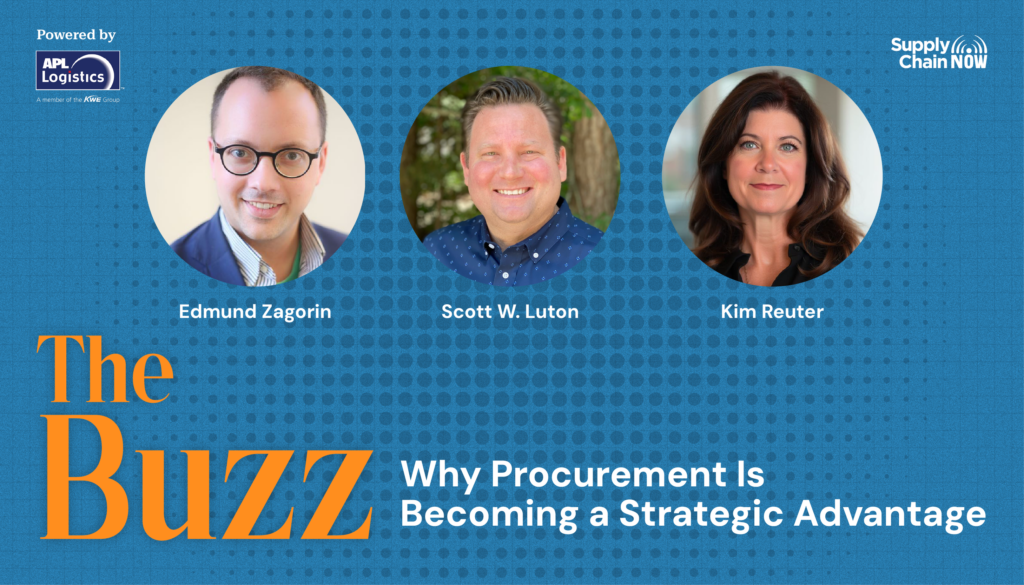
Intro/Outro (00:02):
Welcome to Supply Chain Now, the number one voice of supply chain. Join us as we share critical news, key insights, and real supply chain leadership from across the globe. One conversation at a time.
Scott Luton (00:15):
Hey, good morning, good afternoon, good evening, wherever you may be. Scott Luton and the wonder only Kim Reuter here with you on supply chain now. Welcome to today’s live stream, Kim. How are you doing today?
Kim Reuter (00:25):
I’m doing great. How are you?
Scott Luton (00:26):
I am doing wonderful. I am excited about today’s show. I am not excited about the coming upper 90s, maybe even a hundred temperatures in Metro Atlanta.
Kim Reuter (00:36):
Here we go. That summer in the south, that’s what it’s all about. And remember, it’s not the heat. It’s the humidity.
Scott Luton (00:44):
Whatever it is. I should be used to it. Almost 50 years here, but what can I say? But nevertheless, folks, on a much lighter and cooler note, today folks, it’s the buzz where every Monday at 12 noon Eastern time we discuss a variety of news and developments across global supply chain and business news. That matters is what we like to call it. And all month long in June, the buzz has been powered by our friends at APL Logistics. APL Logistics is a global supply chain logistics provider specializing in order management solutions. They operate from 180 locations across 93 countries and to learn more, visit apllogistics.com. Okay. So Kim, a lot to get to here today. Let’s see here. My short checklist, I got a longer one, but my short one, we’re going to be diving into leaders that are unleashing the enterprise. We’re going to be discussing what AI is great at, but where it has some shortcomings.
(01:37):
We’re going to be looking at a few data points on the state of US manufacturing. We’re going to explore predictive procurement and see what that is all about, all that and much, much more. And Kim, in about 15 minutes or so, we’re bringing in a very special guest from the great city of San Francisco. Edmund Zagarin with Orchestro is here. You’re going to enjoy his perspective for sure. Now, Kim, I laid out some of the things I’m most excited about. What are your thoughts coming into the buzz for June 29th here today?
Kim Reuter (02:07):
So as we’ve talked about previously, we’re coming in to half year. July is right around the corner, right? Yep. It’s time for the supply chain people to start getting ready for peak season if you haven’t started already. So those are the things that are on my mind. Also, we’re at half year for manufacturing. Really looking forward to talking through what’s been going on in that space.
Scott Luton (02:28):
Me too. So my favorites. And yes, we’ve already prerecorded the July 6th edition. That’s what Ken’s referencing. So get ready for that next week, but hopefully me and you are going to be on the beach somewhere, Kim. So anyway, hey, really quick, Tricia says happy buzz day. Say hello. Let us know where you’re watching from. Yes, please do. Please do. And of course, she’s also dropped a link to APLlogistics.com. Hey, Juan. Good afternoon, Juan says from beautiful and warm. Atlanta GA1. Hope this finds you well, my friend. We got to grab lunch again soon. Squared. Bring on the nourishment and the lemonade because it’s the heat. It’s coming in hard. T squared, I’m with you. And thank you for holding down to Fort Force over on YouTube. Stay cool, my friend. Okay. So Kim, we’re knocking out three things before Edmund.
Kim Reuter (03:17):
Zagrin
Scott Luton (03:17):
Joins us here at about 12:15. So let’s dive into the first one and that is for the weekend we released our latest edition of with that said, our almost weekly newsletter, a little bit of flexibility in there. We started with some key takeaways from our enterprise unleashed series here on Supply Chain Now, which I co-host with Wiley Jones from the innovative team over at DOS. Folks, we’ve gotten a ton of feedback about these conversations with some big industry leaders, some heavy hitters. Some of the big themes though. So Kim, check me on this. Some of the big themes, which this article that led off with that said really focused on is number one, technology, don’t get it crooked. Technology is the tool, not the strategy. AI is not a magical universal solvent. It’s not replacing water anytime soon. Number two, culture is operating a system.
(04:09):
Don’t sleep on that. Amidst all the talk about transforming operating models and systems, which we should be doing. We can’t forget ever forget about culture. And third one, there’s others folks who have to go dive in, but the third one, the best strategy that’s laid out in this entire known universe. Well, it’s not worth anything if we aren’t able to act on it. So folks, pivot iceberg here, you can check out some of the key takeaways and a whole bunch more in this edition of what that said. And join us tomorrow where we continue this series at 12 noon Eastern time by bringing in Gendra Zytek. I hope I got that right. Jendra, please don’t hold it against me. I’m going to get it right before we go live tomorrow, I promise. All right. So a lot of stuff there. We could talk about those themes for another hour, but your thoughts, Kim.
Kim Reuter (04:56):
So it’s the age old story, right? So you and I started in this industry when we still used carbon paper. And then we went into the A system and we got computers and paperless entries and the whole supply chain became paperless and we started using data. And even through all of these iterations over all of these decades, every time we introduce a new technology, people get scared. And we have two groups of people. We have the people who are the early adopters who are like, “This is everything and I’m going to go all in on this new technology.” And we have the other end of the pendulum, which are the people who are like, “Hey, I’m never going to do it sticking with my carbon paper.” We both know that those two ends always fail because it’s the meeting in the middle. Technology is and always will be just a tool.
(05:41):
It’s a tool.
Scott Luton (05:42):
Jim, I like it. And it reminds me I’m not going to be able to think of this incredible film producer and director and creator. He’s from Georgia. I’ve got studios here, but he had a wonderful Oscar or Emmy speech a couple years ago. And it was all about, “Hey, join me and meet me in the middle,” where he really was encouraging folks to come from both at the ends of the spectrums and come meet and get stuff done in the middle. And Kim, that is absolutely right. It’s great perspective. And that was Tyler Perry. Thank you, Amanda and Tricia.
Kim Reuter (06:12):
Yeah.
Scott Luton (06:13):
Tyler Perry. If you haven’t seen that folks, go check it out. Kim, well done. As always, I love your perspective. I love your take. You’ve been there and done it over a few years. That’s the best part about it. I’ll tell you what, we got two more things to hit to get to. Tricia dropped a link to, with that said, it’s right there, one click away, folks. And Maria is back with us from beautiful Madrid. Hey, Maria, great to see here, my friend. Give us your take on these topics and let us know what the heat is like in Madrid right now. Gosh, there’s been a European
Kim Reuter (06:43):
Heat way for sure. Yeah. Europe just came off of their big heat.
Scott Luton (06:45):
It’s crazy. It’s crazy.
Kim Reuter (06:47):
It’s been crazy over there. Yeah.
Scott Luton (06:48):
All right. So number two, Kim, and we’re going to have to get Edmond’s take when he joins us because this is really right up his alley. But hey, we posted our latest installment in our ongoing blog series with Dr. Rod Thomas and our friends at the Journal of Business Logistics. So these managers cut research briefing articles or really high level summaries drawn down from pages, long pages and pages of deep industry research. It’s kind of like the Reader’s Digest version or so folks. This last one, all three have been great, but this last one in particular, I loved it focused on how AI performs in a sourcing environment, Kim. So to kind of give you a nutshell here, the researchers essentially used three big AI models. They fed them 123 supplier proposals tied to 31 actual public procurement projects that were all conducted by the state of Ohio a couple years ago.
(07:42):
And then the researchers compared the AI evaluations against the actual human procurement scores. The result at a very, very high level is AI is great at taking on the qualification screening right the front end. But in the critical second stage quote, humans should take the lead in evaluating differentiation. This is where procurement teams assess strategic fit, implementation, realism, innovation, potential, relationship quality, operational flexibility and long-term value creation. These decisions are often embedded in subtle contextual cues that AI systems do not evaluate consistently. All right, Kim, your take on that perspective.
Kim Reuter (08:25):
So I agree with the first part of that in that AI is great at looking at a contract, looking at any sort of data that it can measure and pump through an algorithm and give you a high quality sounding answer. They’re not always high quality, but they sound really high quality when AI gives it to you. But the fact of the matter is, is you cannot replace humans. Everything we do, especially in manufacturing and especially in logistics, is based on relationships. We’ve all been there. We have our special relationships with our special carriers, maybe a specific trucker, a broker, a customs official. Everything in logistics is based on relationships. So while AI is great at kind of pulling up the nuggets that we need to look at, we’re always going to have to have humans to have that human to human interaction. Are we going to get along?
(09:13):
Some of the basic questions are, am I even going to like talking to you on the phone? And that is an important part of a relationship no matter what.
Scott Luton (09:22):
It’s so true. I want to see when the first time one AI platform takes a lunch out of the company refrigerator from the other AI platform and see how that factors over each
Kim Reuter (09:32):
Other. And see how that works out. Yeah, exactly. Performance.
Scott Luton (09:35):
Well, hey folks, kidding aside, hey, go give it a read. Trisha has dropped a link to this particular intriguing perspective and research. Go check it out and look who else is with us. This is Dr. Rod Thomas, his handle, Dr. T, supply chain strategy. I love that. And Rod says, “Hey, Journal of Business equals research that resonates.” Well, hey, we’ve gotten a lot of feedback around this. So Rod, keep up the great work and I look forward to you joining us in a month or two.
Kim Reuter (10:05):
Yeah. It’s a really good read.
Scott Luton (10:06):
I’m with you. I love it when it’s perspective that’s based on actual laboratory work. You take actual projects, feed it in and then do the analysis. So good folks, go check it out and let us know what you think. Okay? All right, one more thing. This is a really important thing folks, really important thing. So let’s see. Last week, my dear friend Enrique Alvarez and our friends at Vector Global Logistics, well, they’ve been hard at work finding ways to help the earthquake victims in Venezuela. And as always, we want to join in the mission and help from how we can. So there’s two main ways that you can help us help serve the ongoing humanitarian missions. Number one is we’re supporting World Central Kitchens. It’s a very powerful nonprofit. Their efforts at identifying local contacts in the affected areas, right so they can get intel, get marshaling points and start to coordinate and continue to coordinate their relief work.
(11:04):
So folks, we’re dropping one link there if you have contacts down in Venezuela that may be precious communication points. Okay? And then number two, we invite you to join in and the information sharing call tomorrow at 11:00 AM Eastern Time. That’s Tuesday, June 30th at 11:00 AM Eastern Time as Enrique, Christie, Nuria and the gang will be hosting a variety of leaders that are involved in recovery operations. You don’t have to show up and commit anything. You don’t have to plan anything. You can join, put your mic on mute if you would like and just learn. Through the course of that, there may be some ways that emerge that you and your supply chain organization or your team can roll up your sleeves and help out. So at the most basic of points, it will offer a well informed perspective of what the need looks like there in Venezuela.
(11:55):
So Kim, we’ve talked about this endlessly, but the global supply chain industry is such a unique position to address disasters, wrongs, issues of our time, you name it. And yet this is the latest. Your thoughts, Kim.
Kim Reuter (12:10):
Supply chain professionals are always in a very unique position to help in times of crisis. And I see a lot of us jump to it. I try to jump into helping out in times of crisis because everything at that time is about logistics. It’s about moving something in or moving something out of a very difficult situation. So if you are in supply chain and there is disasters happening around you, please offer your help because besides a medical professional, you are the second most useful person there. So please always jump in if you can. You have no idea how helpful we are until you’re standing in the middle of it.
Scott Luton (12:48):
Well said, Kim. And to your point, they’ve been doing this type of series for a long time. It’s like a planning/information sharing. They did it as part various times throughout the ongoing Russia and Ukraine war where they were sending containers of need to targeted families. And this one just continues that leveraging logistics, kind of what you just said, Kim. Leveraging logistics for Venezuela. Join us tomorrow at 11:00 AM Eastern time. And again, no expectations. You can show up and put your mic on mute and just soak it in. All right. So Trisha is helping out here as always. She’s dropped a link there. If you have contacts, you might can add to the mission and she dropped the link to the info call right there, one click away. Good stuff, Tricia. All right. So Kim, I am excited about this next couple of segments and I want to welcome a special guest here on the buzz powered by APL Logistics.
(13:44):
So Edmund Zagarin is a proud procurement nerd, love that, obsessed with the power of recommendations to fix broken processes and supply chains. Prior to founding Orchestra, Eben worked as a consultant focused on data-driven supplier negotiations for large healthcare providers, contract manufacturers, and multi-campus retail brands. He’s widely recognized as a thought leader on the emerging role of machine learning and artificial intelligence and procurement, and he’s presented executive briefings on this topic to leadership teams across industry. He’s also been featured by Forbes, shared services and outsourcing network and procure tech. And today he can add supply chain now to that list. So please join me in welcoming Edmund Zagren, founder and chief strategy officer with Archestro. Hey, Edmund, how are you doing today?
Edmund Zagorin (14:33):
Hey, Scott. Great to be here.
Scott Luton (14:35):
Great to see you again. Kim, we’ve been looking forward. We had a little fun in the green room, didn’t
Kim Reuter (14:39):
We? We did. We talked some childhood trauma.
Scott Luton (14:42):
We did with BB Guns and bottle rockets. I’ll tell you what. All right. So
Kim Reuter (14:46):
Edmund
Scott Luton (14:46):
And Kim, we got a lot of good stuff to get into. Edmund, I want to start with a little fun warmup question, okay? So it’s a special anniversary, right? You might say it’s a day that changed the world and I’m not being dramatic. On June 29th, 2007, about six months after it was introduced, Apple’s iPhone goes on sale for the very first time. Despite tech CEOs and analysts and other pundits and analysts downplaying its significance, and you can go see them, go Google them what they thought when it was coming out. The iPhone would deeply resonate, of course, with the market. And get this, they sold a million units in about 75 days and of course, countless million cents. So Edmund, I’m going to ask you and Kim both, starting with you. How did your first smartphone change your life, my friend?
Edmund Zagorin (15:30):
Well, I have to say that, and it’s a little bit of a confession, but I don’t have a great sense of direction. So before getting smartphone, I would have to think very carefully if I was going someplace and I hadn’t been there before, how to get there. I was an avid MapQuest user back when that was the thing, but having a smartphone that just had a map on it changed how I moved through the world and still does. Changed how I drive, changed where I thought I could go, how I estimated travel time. So that was probably the biggest impact just because of some people have an intuitive understanding of how to get around places and that’s not me.
Scott Luton (16:09):
Edmund, that is a great, great take and I feel that one in my bones. Kim, how about you?
Kim Reuter (16:14):
I also have a similar thing with Edmond that I’m perpetually lost, which is interesting to me. But the good news is that if you’re always lost no matter where you are, you’re just always lost. So it’s a constant state and you learn to deal with that. But for me, my first smartphone, I don’t know if we called them smartphones, was a Blackberry. And I think the biggest changer for me was that I was able to work twenty four seven then without a laptop.
Scott Luton (16:37):
Kim, that’s such an interesting observation because it’s good and bad, right? Because back in the day, Edmund and Kim, when you left the office you largely were on private time and these days everything follows you and it’s interesting how we’ve got to work extra hard to protect work and home life. There’s balance, there’s boundaries and all that good stuff, right? It’s
Kim Reuter (16:59):
Good
Scott Luton (16:59):
And bad. Good
Kim Reuter (17:00):
Enough. Very
Scott Luton (17:01):
True. All right Edmund and Kim, thank you all for weighing in on how smartphones … And you know what? What’s interesting is I’m wondering what’s the next iPhone that is really everyone’s going to throw stones at, throw rocks at, and it’s going to change our world. We’ll see. All right. We got a lot to get into here today, folks. I’m so glad to have you here with us Edmund and Kim, great to have you back. So we’re going to knock out three news stories here on the buzz powered by our friends at APL Logistics and then we’re going to dive into Edmund’s perspective on procurement and then some. So first up, I want to take a look at some of the latest data as it relates to the US manufacturing industry. So as reported by supply chain dive, S&P global data shows that the US manufacturing sector has expanded in June at the fastest rate since July 2021.
(17:50):
War and geopolitical related concerns have been a major factor in increasing new factory orders to a four year high yet, the data isn’t all rosy. Growth in the services sector was very sluggish. S&P Global points to rising prices and low consumer confidence as culprits. Additionally, manufacturing employment continues to fall. Leading Chris Williamson with S&P Global to say, quote, “We remain concerned as factory growth continues to be temporarily void by inventory building amid supply fears.” And as we like to point out, as we typically do, this is only one set of data and it should not be considered the absolutely correct measure of what’s going on in manufacturing. Yet S&P Global and ISM provides a couple of our most utilized data sets. So Edmund, when you hear data sets like this and it points to certain things going on in the manufacturing industry, your thoughts, what are you seeing, my friend?
Edmund Zagorin (18:44):
Yeah, I have to say, I would say I’m more optimistic than not when I look at this data and there’s two reasons for that. One is if you think about the past 90 days, what we’ve seen with fuel prices, combination of things with the war and Iran, Straits of Hormuz, some other factors as well, you’ve seen a market that has been able to absorb a tremendous amount of volatility and continue to add capacity. And I think that points to some underlying robustness. The second thing is you’re seeing some of the investments that were made last year and really in the past few years begin to take hold in terms of factories opening, adding jobs, adding manufacturing capacity and that’s really not just creating single factories or single industry growth, but really actually creating a more robust supply ecosystem, especially in places where there’s been a lot of building.
(19:37):
If you look down in Arizona and see what’s happened down there with the chips ecosystem, some of the other places where there’s been big investment in kind of underlying semi, I mean, that’s exciting and it’s exciting to see some of that ecosystem, not just in, again, in single industries or single chains coming to the United States where it hasn’t been in the past.
Scott Luton (19:55):
Very astute. Kim, I knew this was going to be a good co-appearances with you and Edmund. He’s almost as astute as what I gained from you, Kim Reuter. Your thoughts on this dataset from our friends at S&P Global that appeared in supply chain dive?
Kim Reuter (20:10):
True to myself. I have a more pessimistic view of what’s going on here. It’s great that we have more manufacturing, but unemployment is not keeping up with that. And I think part of, to Edmond’s point, a lot of the manufacturing we’re seeing are different types of manufacturing that’s less labor intensive. A lot of that labor intensive manufacturing has moved offshore, but what I see us doing is a lot of hoarding and I think people are and manufacturers and companies are trying to get ahead of peak season that’s coming and because of all the uncertainty people are in this buy-it now, it may not be their later kind of mindset.That
Scott Luton (20:51):
Is another good take. Hoarding. I was hoping that we were done with that term four or five years ago, Edmund and Kim, right? Two good takes there. I appreciate that, Edmund and Kim. And we’re going to keep our finger on the pulse as we work through this VUCA world one day at a time. Really quick, I want to say hello to our friend Andrew from Schropshier, England. I hope I said that right. Andrew. Andrew is a big cyber guru. In fact, he’s joining us I think in October on the buzz. So great to see you, Andrew. And one more thing here, Tricia has dropped the link. You’re going to find links to each of these articles in the chat. Go check it out. Don’t take our award for it, our analysis. You might have your own take and we’d love to hear from you. All right, we’re going to go next to Amazon’s Prime Day Extravaganza.
(21:38):
So folks, this is what I would call one measure of consumer confidence, perhaps. Amazon’s Prime Day Extravaganza, it’s become a four day affair and retail brewer here reports that day one of the four days was successful and it became the biggest online shopping day of 2026 in the US at least as shoppers spent $8.3 billion with online retailers. That’s about a 5.3% jump over day one of Prime Day in 2025. All in all, US shoppers spent $26.4 billion all told on Prime Day. That’s about a 9.3% jump over last year, but you can’t let those numbers mislead you, says one analyst. Sonya Lapinski with Alex Partners, hope I said that right, told Reuters, “It’s really pointing to the fatigued customer or consumer rather. They’re not necessarily spending more. They’re just trying to spread what they have over better deals and discounts.” And two other quick notes, folks.
(22:37):
Number one, JP Morgan reported last week that Amazon has officially surpassed Walmart as America’s largest retailer. How about that? And then secondly, speaking of Amazon, I interviewed Peter Larson with Amazon at Gartner back in May. He’s a key leader when it comes to Amazon supply chain services. Give it a watch. Let us know what you think. Okay. Edmund, I want to know what you splurged on Prime Day last week first and then I want your take on the phenomenon that is Prime Day and what you read into the tea leaves. Your thoughts, Edmund.
Edmund Zagorin (23:09):
I always buy a lot of tea on Prime Day because I like tea. I drink a lot of tea and so you get some good deals on tea for Prime Day. I think retail phenomenons are what power the economy from Black Friday. It’s always been. I think people like a deal. They also like to know that they’re getting a deal and how best to know that. And your friends are doing it and you’re motivated by that kind of energy. In terms of it getting bigger and bigger, I think people like to stock up when they can. As you said, there is some uncertainty. I think consumers feel that too. And I think that when consumers are feeling a little bit anxious, sometimes they actually turn that into a splurging buying, especially if they’re a deal. So if you can get a good price, don’t miss out on that.
Scott Luton (23:54):
Eben, I agree with your key points there. And Kim, as a former Amazonian, is that right? Is that what we call it? Former team member at the Big A, I’m going to be intrigued by your take on this topic in Prime Day. Your thoughts?
Kim Reuter (24:09):
So what I kind of dug out of it was similar to what Edmund said is people are, we’re back to hoarding, right? People are stocking up. We don’t know what’s going to happen. The tariffs, that could happen again at any minute. We don’t know. So people are very uncertain. The other thing I took from this data that I found very interesting was a really big uptick in what I consider DIY purchasing. So tools, lawn and garden, cleaning equipment. These are typically things that people outsource lawn care services, house care services, things like that, hiring a contractor to take care of minor repairs. But when I see these types of things growing 20% plus, that indicates to me that people are probably starting to bring some stuff in- house.
Scott Luton (24:55):
Good stuff. Kim and Edmund, really good stuff. Well, we’re going to keep our finger on the pulse. It’s really interesting. It’s interesting, I think, how Prime Day has evolved, right? I wish I could create Edmund in all of our businesses. I bet we wish we could create our own Prime Day, right? And target-
Kim Reuter (25:10):
Do you know why Prime started?
Scott Luton (25:12):
No, please tell me.
Kim Reuter (25:13):
To empty out the warehouses for holiday.
Scott Luton (25:16):
Okay. That makes sense. Makes sense, Edmund. Makes sense to you.
Edmund Zagorin (25:19):
Makes sense to me.
Kim Reuter (25:22):
It’s that basic. Half here, what do we got sitting around? We got to empty out for peak.
Scott Luton (25:27):
Well, I’m going to come up with, we’ll call it beta day and we’re going to clean out the supply chain now warehouse, right? The best deals all within four days of the year. We’re going to make that happen. All right. So what’s next? What are we talking about next? As we start to turn on Edmund Zager and Boulevard, because this is right up his alley, let’s talk about how technology is continuing to play a big part in the wide world of procurement. Folks, here’s a neat article from our friends that I’m going to call this payments. I doubt they want me to call it PYMTS. I’m going to call it payments where they point to how technology is transforming how procurement gets done and what is prioritized in again, this disruptive world that we all find ourselves in. Now, at the heart of it, they point to how the most important questions in procurement, well, they’re changing.
(26:15):
It used to be, did you negotiate the lowest price? Now, given AI and all the global upheaval that we all feel in our bones, they say it is, did you secure supply before everyone else? And this perspective featured in this article essentially argues that AI and global trade volatility are fundamentally changing procurement from a cost focused function into a strategic competitive advantage. Rather than simply negotiating lowest price, leading technology companies are securing long-term access to scarce resources through multi-year supplier agreements, capacity reservations and upfront investments. Procurement is increasingly becoming a capital allocation decision involving CFOs, treasury, supply chain leaders, and more. Now, the broader takeaway here perhaps, and I can’t wait to get Edmond’s take on this, Kim. The broader takeaway perhaps is as supply constraints and geopolitical uncertainty grow, companies across industries will need to prioritize resilience, strategic partnerships, and guaranteed supply over short-term savings to remain competitive.
(27:21):
So Edmund, can’t wait to get your take on this read here.
Edmund Zagorin (27:25):
Well, Scott, I think it’s a fascinating article and I will say that there are some super interesting observations, but it’s also what’s old is new again, right? Oh, okay. Procurement is now strategic. Have we heard that before? Maybe in the 1990s. So I think there are some observations about how procurement is participating in the internal corporate environment, what the role is, what the expected value contribution of procurement, not just cost savings, but really as a trusted advisor, not just getting the lowest price, but getting the best value, not just getting the best value, but ensuring and ushering continuity of supply, especially during times of volatility. I think one thing that’s interesting to double click on that article is they focus on memory, the memory shortage.
Kim Reuter (28:15):
We’ve
Edmund Zagorin (28:15):
Heard Tim Cook speak to this with the recent price raise for Apple products. I think when you dig into scenarios like that, the one theme that I really think resonates from this article is that the unforgiving need for speed is becoming a ubiquitous pressure not just on operational tempos but on cost. But what does that mean? It means that we’re all actually being forced to pay more to lock in products sooner. And that means that negotiating is increasingly negotiating for when you get product and having that be a component of the negotiation. Now, I will step back and say that something Kim said earlier really resonated, which is that great supply chains run on great supplier relationships. So I’m not sure that everyone’s racing to just lock in the allocation with anyone. I think who you get it from matters. And I think that great suppliers will hold allocation and hold capacity for you if they understand you have a multi-year relationship and a lot of the best companies have been pursuing those multi-year relationships for decades.
(29:15):
So I do think that that has been expanding now. We’re seeing that in new categories of spend. We’re seeing that in transportation, for example, is becoming a much bigger topic this year, especially with tariffs and geopolitical uncertainty. But I think that what this article highlights is that I was at an event recently and a panelist said speed is the only sustainable competitive advantage in an uncertain world. And I think that a lot of supply chain leaders are finding new KPIs to measure what that means within their organization and then apply people, process technology to try and dial that in more and more systematically rather than just firefighting against a memory shortage here or another shortage there.
Scott Luton (29:58):
Edmund, good stuff. Good stuff. And he started with that perspective, Kim, that hey, water is wet. Don’t run with scissors. Don’t eat yellow snow. The obvious stuff has been around for quite some, for years really. Kim, your take on the world of procurement and how it’s transforming.
Kim Reuter (30:16):
So we’re just going to write a PO and maybe we’ll write another PO in six months. Those days are gone. That is to everyone was talking about long-term relationships, creating relationships, spending time getting to know your manufacturers and vendors are really what it’s about now. Another thing I want to bring to the table and kind of flip this on its side a little bit is the unique position that manufacturers are now in. So 20 years ago, a manufacturer maybe only talked to a dozen buyers. Walmart, Target, Amazon, the big through distribution, yada, yada, yada. Now manufacturers are talking to hundreds, if not thousands of buyers. All these merchants who sell through these platforms are individually going to these manufacturers. So the tables have flipped a little bit more. I believe that there is now more demand for manufacturing than there ever has been in the past.
Scott Luton (31:14):
Outstanding, both of your perspectives think you’re offering a bit of a masterclass, but one of the things that brings to my mind is for companies out there, if you’re not investing … My buddy, Mark Preston, Mark, he’s done many things in his career. We were in my first startup together and Mark has spent a ton of time in his career creating and deploying supplier development programs, right? Where ecosystems are getting stronger. It’s not transactional. Now again, these are not cutting edge philosophies, but we all know Edmund and Kim that there’s companies out there that don’t believe in investing in their ecosystems. I think they’re less and less. But kind of going back to what you said, Edmund, what’s old is new again. But if everybody would actually act on best practices, we wouldn’t get in these cycles, I think. I don’t know. Edmund and Kim, a lot of good stuff, folks.
(32:05):
And go check out … Let’s see here. Tricia has dropped a link to this article Big Tech is rewriting procurement and the rest of B2B is next. Go check it out from our friends at Payments. I want to share a quick resource and then we’re going to dive deeper into Edmund and Kim’s procurement perspective. I want to feature this resource from our friends, APL Logistics. Now, we were just talking a minute ago about how key questions continue to change across industry. The real supply chain question for many in leadership isn’t can we see the issue? Rather, it’s can we execute through it without compromising cost service or capital efficiency? That’s where APL Logistics helps customers bridging the space between planning and performance with execution focused supply chain support. Because in today’s environment, execution is not an operational detail. It is true business advantage. You can click on the link that Trish is dropping right there to learn how APO logistics can help you build a resilient supply chain that sticks to the plan.
(33:04):
Wish more folks would stick to the plan, Edmund and Kim. It reminds me of some golf trips I used to plan back in the day for a thousand people. We’d communicated out for months and months in advance. This is the plan. And when we show up there in Myrtle Beach or wherever we were, all of a sudden there was 37 opinions on how that plan must change. Edmund, does that ever happen to you?
Edmund Zagorin (33:26):
Yeah. I think it’s funny. There’s a book that was written in the early ’90s called Shared Minds, which is
Scott Luton (33:31):
Kind
Edmund Zagorin (33:32):
Of a book about collaboration design. And they say that there’s three personas in collaboration design. There’s the person who plans the trip, makes the Google Doc, sets all the reservations and shares it. There’s the person who looks at the Google Doc once and then there’s the person who goes, “What Google Doc?” And shows up and then complains about all the plans that have been made. So I’m a planner. I’m the person that makes the Google Doc, but I appreciate the fact that that is actually how most people interface and then everyone wants to rewrite the decision after it’s made. But
Scott Luton (34:06):
Execution
Edmund Zagorin (34:07):
Matters. It does.
Scott Luton (34:09):
It does. And I feel that I’m going to go check out that study you’re talking about. Kim, you got to kick out of that. It feels like everyone can fit in those three buckets.
Kim Reuter (34:16):
I’ve always been there. Yes, yes. And to Edmond’s point, execution matters. Execution is the only thing that matters because up until execution, it’s just an idea. And that’s always where it falls apart is when the devil’s in the details when you actually try to make it happen. But yeah, I’ve been there so many times and you ask for people for input, you’re like, “Hey, would you like anything? Any special need, blah, blah, blah. No, we’re good. Great.”
Scott Luton (34:39):
And then boom. One more quick aside and then we’re going to get into the seed block here with Edmund Zagarin. I had a dear friend, very smart individual. I’m not going to name the names. He may not appreciate if I do that, but I’ll never forget leaving a meeting one time. We were coordinating amongst all these industry associations. And I was taking, as usual, a highly democratic approach. Everybody get your votes in. We’re going to try to create some consensus, right? And eventually after a couple hours and failing miserably, I got real frustrated. So I left that meeting and he pulled me aside and he said, “Scott, hey, I appreciate how democratic and you want to invite everybody’s opinion on that stuff, but man, sometimes you just got to go all ging as con and let folks know exactly how it’s going to be and march forward.” And that was a terrific, terrific piece of advice to me because sometimes that’s exactly what needs to be done.
(35:28):
All right. Edmund and Kim, we got a lot to get into here today. Edmund, I want to pull up a little memory lane flashback. That’s me and you and leaders from Target, Newell Brands and Okebashi, right? We’re speaking there at Supply Chain USA 2023 in Chicago. I think it might have been Atlanta. Chicago, Atlanta folks, can’t remember. And I’ll tell you what, Edmund, what really sticks out is, and Kim, imagine this. So I’m moderating these four really smart people and we’re getting good feedback from the audience and I encourage all of them to share something, kind of throw the gauntlet down with the last thing they mentioned. Edmund, you about had that whole crowd ready to follow you out and run through brick walls from your challenge to industry. Do you remember this, Edmund? Do you remember this?
Edmund Zagorin (36:12):
I remember it was a fun panel. Yeah.
Scott Luton (36:15):
Well, you delivered as usual. So Edmund, I want to ask you, you continue to speak regularly at a wide array of events, kind of like Kim too. You are in demand, my friend. So let me ask you, those sidebar, those highly valuable sidebar off the record conversations are some of the best reasons to go to events and to speak and to sit on panels and whatnot. This year here in 2026, we’re halfway through. I know what’s a couple topics that are really common themes in those sidebar conversations these days, Edmund.
Edmund Zagorin (36:43):
Yeah. I think when you talk to senior leaders particularly that are building out their organization or charting a digital roadmap, the main topic is how are we going to be measuring the success of procurement as a function, supply chain as a function, not just next year, but five years from now and who should I be hiring now? What should my roles and organizational structure look like? And then how should I be thinking about the now, next, later for having a plan of action to deliver on not just doing the job today, putting out the fire tomorrow, but actually evolving the function and finding new ways of working. That combination for a lot of, especially industries that have been around and have processes that have been around for decades can be daunting, it can feel overwhelming. And so that’s the conversation. Some part of that, whether it’s about who to hire, how to write a job spec, what job roles are going to be most in demand and where to find the right type of candidate, because everyone’s looking for the same thing.
(37:44):
They want to build an A team, right? They want to have A players built an A team. They want to have the right mix of experience. They want to have some digital natives, how to get that working. And then it’s also about this shift, which I think the article that we talked about earlier speaks to, but it’s this macro shift and you’re right, that quote, “The future is here, it’s just not evenly distributed.” It’s still necessary for us to say that procurement needs to be strategic, needs a seat at the table in order to be effective because when mandates get handed down and we haven’t had a conversation about resourcing, that’s where you can get really uncomfortable choices that have to be made. I think that shift is from compliance to value. If you look at how the performance of a procurement organization has been measured, historically it’s things like spend under management, spend under PO.
(38:34):
And I think to Kim’s point, you can get into some transactional compliance that makes numbers look good, but when you look at the business execution alignment with other functions, is procurement a trusted advisor or is the business a customer of choice to its suppliers? Those metrics don’t translate to that outcome. And so I think people are looking for new ways to measure success and new ways to shift from a function that historically has been compliance oriented to a function that’s really value focused. All
Scott Luton (39:05):
Right, Kim, I see you taking notes. You’re like me. I take a lot of manual notes. Usually I end up somewhere around 17 pages after the buzz. Kim, you’re taking what Edmund shared there.
Kim Reuter (39:16):
It’s really interesting and Edmund touched on some of these things. What I’m seeing in the industry now, so COVID happened, we went through supply chain being everybody’s everything, everybody being a supply chain expert all of a sudden. Then the induction of new technologies, robots are really making a big impact in what’s going on in supply chain. But as we’ve kind of moved all this way towards technology and big focuses on technology and process along the way, we forgot the humans. And so what I’m seeing in the industry and the conversations I’m starting to have or have been having for the last six months or so are, how do I motivate my team? How do I keep us focused on the future? How do I keep my teams, not focusing on the metrics for this week, but how do I keep people looking and thinking about six months, a year, two years, three years down the road in all of my supply chain.
(40:09):
It’s almost like work has become more transactional because of the increased introduction of technology, but we have to get back to the humans because as we’re uncovering in all these conversations we’re having now, technology can’t do it all. You still got to have a person and you still have to work on your culture. If you don’t have a strong culture, I don’t care how much AI you use, it ain’t going to happen.
Scott Luton (40:34):
Yeah, love it. Man, we could dwell here for another hour or two based on some of the things that y’all both have shared, but I want to dive into this next topic, Edmund. Predictive procurement, hear it a lot out there in industry, right? It’s almost gotten to the point of ecosystem, vibe coding at the end of the day, these phrases that are commonplace in a lot of meetings, but tell me what it actually means in practice and what are a few of your favorite use cases, Edmund.
Edmund Zagorin (41:02):
Yeah, absolutely, Scott. So predictive procurement is a simple but powerful idea, which is where the procurement organization makes offers to suppliers instead of vice versa. If you think about it today, most quotes or proposals are created by salespeople that work within a supplier organization. We flipped that on its head and we said, “What if procurement understood the market, understood its suppliers enough to approach the suppliers proactively and say, Hey, here’s what we’d like to buy, here are the lead times and order quantities we’d like and here’s what we’d like to pay. So it’s a fully composed offer and then predictive procurement leverages game theory and behavioral science in combination to deliver a pretty astonishing transformation in the capacity and throughput of the procurement function. Because what we found was that a lot of the time the procurement people spend is around doing things like evaluating bids, emailing suppliers, following up, giving feedback on specific items, giving feedback on dimensions of specific items like minimum order quantity, lead time.
(42:09):
And so what we found is that predictive procurement, it’s not about automating a process, it’s actually about redesigning the process to eliminate steps, make the process more efficient intrinsically, and then leveraging data and predictive models to actually deliver that. So one analogy I like to use because we were talking about the smartphone earlier is if you think about what a map in a glove compartment looked like, right? It’s an analog map. That map doesn’t know where you are, it doesn’t know where you’re going and it doesn’t know the traffic patterns or weather conditions on your way. Well, a predictive map like you see in Google maps or ways, it knows where you are, it knows where you want to go and it knows a lot of information about the different routes you could take to get there. So if you think about processes and how the process stack at a lot of companies works, it’s still an analog process stack.
(42:59):
Now we can put AI agents into automate parts of that process stack, but if the process stack itself is still analog, then that’s incremental efficiency. But what if it was predictive, right? What if it worked where it knew where you were going and it could reverse engineer the steps to get there? So that’s a little bit of the concept around predictive procurement.
Scott Luton (43:18):
All right, Kim, does that make sense to you? Your additional thoughts there, predictive procurement.
Kim Reuter (43:22):
Totally. As you guys know, I come out of retail, almost all of my experience has been in the retail and consumer goods market and I have always felt like procurement was a magic box to begin with because we really don’t know in the retail space. Spaces like manufacturing and healthcare, a little bit more predictable because we have a little bit more science behind it, though there is a science of buying science out there. But what I see is that AI is great. Procurement, especially in the retail space is always a litle bit iffy. We don’t know who’s going to buy it. We don’t know where it’s going to go. But to Edmund’s point, you have to look at it holistically. You can’t just take a piece of technology, whatever that technology is and plug it into a single point and expect everything to change.
Scott Luton (44:08):
Well said, Kim. And Edmund, I love the map analogy.That’s a great analogy.
Kim Reuter (44:14):
Really good.
Scott Luton (44:15):
Couple things here. Squared, squared loves to bring up the Rudy analogy and it’s such a good, accurate analogy for so much going on in AI space right across the industry these days. As he said here before, so Rudy, if you remember, that’s the atomic supercomputer that George Jetson used at Spacely Space Sprockets. I hope I got that right. So he says, “Hey, Rudy’s are our friend. Cobots keep folks going. ” Love that T-squared. And then we have Matindo from the Democratic Republic of Congo, the DRC, he’s in logistics, supply chain and transportation manager of all those things. And hey, by the way, Mtendo, great to have you here and congrats to the DRC. I think they beat Uzbekistan in the World Cup on Saturday. So let us know your thoughts on these topics here today. All right, Edmund and Kim, next up, let me know if you feel these headaches, tariffs, geopolitical tensions, commodity price swings, beef anybody, transportation disruptions, list goes on and on and on.
(45:17):
So Edmund, I want to ask you a two-part question here. Number one, what signals are the most valuable for procurement teams to monitor, number one. Number two, how can AI help separate real risks from all the noises out there?
Edmund Zagorin (45:31):
Yeah, it’s a great question. I think we’re swimming in data. We have a lot of different signals to look at. I like to look at rate of change for specific indicators and to see if compared to a year ago, the rate of change over a specific period for a specific indicator has increased by a meaningful double digit percentage. I think that those can be monitored at scale. There are a lot of indicators and if you have good models with precursors set up, then you can often see around corners to a great extent. I’ll also say just holistically, there is so much in this economy that’s affected by the price of fuel and the price of transportation. And so just having a little bit dialed in on what lanes you’re using, what lanes your carriers are using, having good relationships with your 3PLs, if you have a fleet just managing that at a very fine grain level of detail, I think the management paradigm around this has shifted a lot in a productive way.
(46:32):
You can look at Fred indices, there’s a bunch of published data sets, but I think every company is different and we actually see because Arkestro manages such a huge portfolio of spend, we actually see holistically that price variance between customers for very similar items, even in very similar geographies is double digit percentages. And so the companies that are managing it in a specific way can really see value just from that activity.
Scott Luton (47:00):
All right. Kim, trying to find and realize that value, your thoughts, Kim, on the signals that procurement teams might should be tracking?
Kim Reuter (47:09):
Almost since 2019, right? 2020 when we went through COVID, before all of that, supply chain was fairly predictable. I mean, outside of union walkout, a major storm or some catastrophic act of God, supply chains were pretty predictable. Rates didn’t go very far, tariffs never changed, things were relatively easy to manage. Post COVID, everything changes constantly. Ocean carrier rates don’t even bother. They’re going to change the contractor, no contract, they’re going to change, procurements are going to change, demand has changed. The way we think about things have changed. The changes in the tariff rates, everything has become more fluid. And because of this, we need more technology or technology helps us cut through all of that noise to figure out what is actually happening because it’s really hard to figure it out.
Scott Luton (48:14):
It is. And it goes back to Edmund’s comments around speed. We all need a bigger and sharper with more tools, Swiss Army knife in this environment we’re in. Kim, I felt as you walked us through that macro or that micro, whatever the right word is, history, like how the industry has evolved, but I felt that Edmund, that sent tingles up my spine. Did do the same for you, Edmund?
Edmund Zagorin (48:40):
Yeah, I would say so. I mean, I think we all remember-
Scott Luton (48:46):
But I think the pandemic is- Yeah,
Edmund Zagorin (48:48):
We all remember March 2020, right? It was this moment in time and it changed everything. Everything. And people thought it would, we talked about, there was a litle period of time where people were like the new normal and the next normal and there was none. It never came back. It’s been in firm a crisis since then and it’s just one thing in the next and people are fighting fires and then they’re simultaneously going, “Well, this isn’t sustainable. How can we evolve the profession?” And it’s a combination of things. Kim, to your point, it’s culture, it’s people, it’s process, it’s organizational dynamics and it’s technology and they’re all happening at the same time.
Kim Reuter (49:21):
At the same time I just talking to a client the other day and this is what really floored me, his biggest issue right now is he has a can’t do that culture. Don’t even know where it came from. A whole culture can’t do that and it’s crippling the company.
Scott Luton (49:38):
Yeah. Kim, speaking of on top of that list Edmund just shared, you’ve got of course consumer expectations, right? The Amazon effect, which certainly is cliche these days, but it’s very real. And then you also have in a welcome development, I think, employee expectations, right?
Kim Reuter (49:55):
Yes.
Scott Luton (49:56):
Especially in the talent wars, which have continued to evolve. So it’s very fascinating, the psychology of that. All right, Edmund and Kim, we only got a couple minutes left and I got a couple of big questions for you before we close out here today. Really quick, Edmund, your crystal ball, your reader’s digest or your TikTok version of your crystal ball prediction, think three to five years. What decisions will procurement professionals still own and where do you see AI agents becoming trusted partners or maybe even taking the lead?
Edmund Zagorin (50:26):
Yeah, I think that procurement and supply chain will own relationships. I think the relationships with the suppliers will become more important, not les. And I think that AI agents are going to be working, getting some of the busy work out of the way of those relationships, whether that’s analyzing data, analyzing the market, looking at historical trends within the company or outside the company. I think AI agents will probably be joining us on calls, taking meeting notes, summarizing next steps. But I think that those calls, especially with the bigger suppliers, the trusted suppliers, they’re still going to be at the human level. And I think I see AI agents today that are scheduling meetings and sending emails, but I think that at the end of the day, supplier relationships run on agreements. Those agreements are bound by commitments. Commitments are about accountability. That’s a human to human thing and we are embedded in social roles as humans in ways that agents structurally cannot be.
(51:22):
And I was thinking about your story earlier, your journal of business story. The difference in that study from what supply chain people do really is that AI can analyze proposals, but when you’re sourcing, you’re not picking the best proposal, you’re picking the best supplier and that’s holistic and that’s different. So I think that that will actually create some nice swim lanes in terms of where the two fit together.
Scott Luton (51:45):
Edmund, well said. Kim, really quick, you agree, disagree on Eben’s crystal ball take there?
Kim Reuter (51:51):
I agree with him. I think we’re always going to have procurement and supply professionals. There will always be situations that AI doesn’t know about. AI is a learning thing. You have to teach it. If we run into a situation that’s never happened before, AI can’t help you, right? It didn’t know that that happened. AI is not a crystal ball. So procurement will still be very part of it. I think we’ll start leveraging AI for busy work things like rebuys and quick. The other thing AI will be able to give us is quick consumer analysis within a few hours versus a week, which is what it takes about now. So we will be able to react faster, but I don’t think that we’re getting rid of people.
Scott Luton (52:29):
Yes. Kim, good stuff. And you remember the back of the bar napkin swag that’s been a part of conversations for generations, right? That’s where I like AI is helping better educated swags, I think. In some cases that may be completely off base, but I think that is as we quantify opportunities and solutions and ideas and whatnot, I’ve really enjoyed my discussions with a variety of AI platforms. All right, Edmund, we’re not going to do this justice, but I definitely want to put this out here because you and the Archestro team are doing some really cool things. So two part question, Edmund, what is one of the things that Arkestro is doing out in the marketplace that you’re most excited about, number one, and folks you’re seeing their home site, archestro.com to learn more. And then number two, Edmund, you are hiring left and right, I believe.
(53:16):
So touch on both of those things, Evan.
Edmund Zagorin (53:18):
Absolutely. So many people know Arkestra today. We’re used by sourcing teams. We’re used to do spot buys, supplier negotiations. One of the things we’re really excited about is some new capabilities we’re putting out around contract renewals and intra contract price updates. So really doing holistic supplier lifecycle price management, keeping those prices fresh, benchmark continuously with always on intelligence and model driven decisions. In terms of Arkestro’s growth, we’re hiring. So if you want to join a dynamic team, if you’ve worked in procurement, worked in supply chain, we are hiring. We love people who come from industry, especially industries like oil and gas, automotive, pharma. Those are some areas of growth. We love people who have logistics specialty as well. So you can check out on our website Open Rolls. And in terms of what’s coming up, we do have a conference coming up in Houston. It’s October 13 through 15.
(54:14):
It’s called Optimal. We’re going to get a lot of our customers together, people who’ve been building agents doing new use cases. If you’re excited about AI, if you love procurement, if you love supply chain, come find us. We’re going to have lots of workshops. We do negotiation workshops, role playing, all kinds of stuff. It’s not just about AI. We get into the in- person as well.
Scott Luton (54:32):
That’s outstanding. Edmund, that’s quite a rundown. And Trisha’s dropped your URL right there, orchestro.com, Kim. We may need to crank up the supply chain now mobile and head down to Houston, October
Kim Reuter (54:43):
Home. That’s going to be a great event. Yeah. If you can help people with new contract negotiations, huge.
Scott Luton (54:50):
Yes. Especially the things that take place between contract additions and renewals and whatnot and October in Houston, hey, it’s not hot down there anymore, Kim. It cools down at least to like 85, right, Edmund?
Edmund Zagorin (55:02):
That’s right.
Kim Reuter (55:03):
But remember, it’s not the heat. It’s the humidity.
Scott Luton (55:07):
It’s humidity. It’s what they always tell us. Folks, go learn more at archestro.com. And before we wrap here with Kim and Edmund, we’re going to make sure folks are going to connect with y’all both here in a second. I want to point out one more thing. I love resources. And one of my favorite parts of our newer websites been around for about a year, supplychainnow.com is our resource hub. It’s like a factory of perspective, folks. And one of the latest things we published was this piece from InterSystems. Chris Kunane, I believe, wrote this. “Hey, your supply chain isn’t broken. Your data is. Go check out that. Go check out that Journal of Business Logistics article that we touched on a couple times and a whole bunch more at our resource hub at supplychainnow.com. Okay. So Edmund, really quick here. I know we’re a minute over, but how beyond that event in Houston in October and beyondorchestro.com, how can folks track down Edmund Zagarin, my friend?
Edmund Zagorin (56:05):
Yeah, I’m pretty active on LinkedIn. I try and get in Scott’s comments sometimes and just go on. There’s great conversations among supply chain people on LinkedIn, so I’d say do that. And if you want to find me, I am hosting a supply chain hackathon in San Francisco in July, July 15 through 17. It’s for charity. We’re hacking together on some supply chain agents for food banks, so helping the supply chain teams at food banks, build some agents, automate some processes, take some work off their plate. And yeah, you can find me edmund@arkestra.com.
Scott Luton (56:36):
That’s awesome. We’re going to have to circle back on your pro bono work there. That’s terrific, Edmund. And yes, Juan, I agree with you. Great stuff. Edmund and Kim have brought it here today. Kim, how can folks track down the Kim Reuter?
Kim Reuter (56:49):
LinkedIn is always the best way to find me. All my stuff is there. Yep. Just go to LinkedIn. I wish I could tell you something else.
Scott Luton (56:57):
And folks, if you think Kim keeps it real here on the buzz, you got to check out her LinkedIn feed because she keeps it real there too, Kim. Is that right?
Kim Reuter (57:05):
I do. I do. Some people feel it’s a little too real. I don’t think that’s possible.
Scott Luton (57:11):
Hey, we got to be more frank and direct. That’s how we’re going to make progress through challenges old and new in an industry that needs all of that and then some. But really have enjoyed Edmund Zagarin, founder and chief strategy officer with Archestro. Edmund, well done here today. Great to have you here on the bus.
Kim Reuter (57:29):
Awesome. Thank
Edmund Zagorin (57:30):
You, Scott.
Scott Luton (57:30):
And Kim Reuter. I tell you, y’all get together and I think y’all be able to solve … We may be Mars by next week.
Kim Reuter (57:37):
I was going to say, I think we can solve a few problems.
Scott Luton (57:40):
But Kim, Reuter, always a pleasure. Thank you. I’m looking forward to what we got coming up soon, but thanks for being here today, Kim.
Edmund Zagorin (57:46):
Thank you.
Scott Luton (57:47):
Folks, big thanks again to our friends, APL Logistics. Be sure to connect with them at APLlogistics.com. Big thanks to Amanda and Trisha and Ella all behind the scenes helping to make production happen. And most importantly, big thanks to our SCM GlobalFAM for being here. I know we couldn’t hit everybody’s comment or question, but thanks so much. Keep the feedback coming. Now, you know your homework. Yeah, I know it’s a summer. All three of our kids are here that I won’t even hear the word homework, but folks, y’all have got homework. You got to take one thing you heard here from Edmund and Kim and do something with it. Put it into practice, deeds not words, folks. And with that said, on behalf of the entire supply chain now team, Scott Lewton here, challenge you, do good, give forward, be the chains that’s needed. We’ll see you next time right back here on Supply Chain Now.
(58:26):
Thanks everybody.
Intro/Outro (58:28):
Join the Supply Chain Now community for more supply chain perspectives, news and innovation. Check out supplychainnow.com. Subscribe to Supply Chain now on YouTube and follow and listen to Supply Chain Now wherever you get your podcasts.