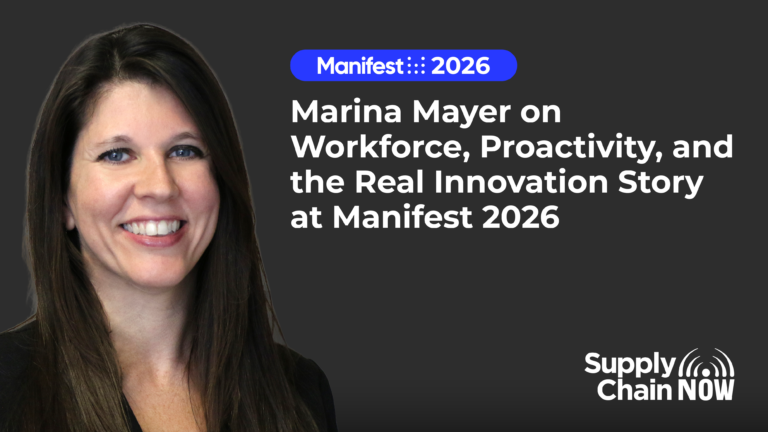
Culture Over Clicks: Marina Mayer on Workforce, Proactivity, and the Real Innovation Story at Manifest 2026
At Manifest 2026, Scott Luton caught up with Marina Mayer, Editor-in-Chief of Food Logistics and Supply & Demand Chain Executive, and Co-Founder and Content Director of the Women in Supply Chain Forum, for a conversation that cut through the tech buzz and landed squarely on what matters most: people.
Marina leads two influential digital publications covering the full spectrum of supply chain — from temperature-controlled cold chain logistics to e-commerce and retail — along with four major industry awards programs and the rapidly growing Women in Supply Chain Forum, now entering its fifth year.
But amid all the innovation on display in Las Vegas, her message was refreshingly grounded.
Disruption Is the Baseline. Proactivity Is the Shift
When asked about dominant themes shaping the industry, Marina didn’t hesitate.
One common theme linking 2025 and 2026 is that “disruptions obviously still exist,” she said. From tariffs to trade wars to Mother Nature, the hits keep coming.
What’s different in 2026 isn’t the disruption itself; it’s the response.
Instead of dwelling on what’s gone wrong, companies are getting proactive. Leaders are “acting on it and being proactive about getting in front of it,” she noted. Since COVID, organizations have learned that volatility isn’t an outlier event. It’s the operating environment.
That mindset shift is critical. As Scott observed, companies are now “baking in what we have learned,” including the expectation of a landscape where chaos and turmoil are ever-present. Even when policy shifts happen overnight, organizations are better positioned to manage, adapt, and innovate through them.
AI — But Make It Human
Of course, AI dominated conversations at Manifest. But Marina sees a noticeable evolution.
“Everybody talks about AI,” she said, “but I think the AI at this show is different.”
The focus is no longer on plugging AI in simply because it’s trendy. Instead, companies are asking: how can AI make the workforce stronger?
On the show floor and in sessions, Marina kept hearing about AI supporting customer service and delivering better data visibility; tools that empower operators, planners, and leaders to execute better. Not flashy tech for the sake of headlines, but practical tools that enhance decision-making.
That shift matters.
The industry’s workforce, often underappreciated, is what makes global supply chain function every single day. The best AI strategies are those that amplify human capability, not attempt to sideline it.
Supplier Selection and Trust in a Crowded Market
When discussing top challenges, Marina highlighted something deceptively simple: supplier selection.
She’s hearing more about it now than ever before.
But this isn’t just about sourcing materials or services or the like. It’s about selecting the right partners: technology providers, logistics fleets, warehouse operators, cold storage facilities, etc – – and ensuring that they are organizations that you can trust with your product and your people.
In a market flooded with AI-labeled platforms and new solution providers, getting the basics right and optimizing the selection process is more important than ever. As Scott noted, the explosion of options means leaders must return to disciplined evaluation: choosing partners aligned with culture, capability, and long-term strategy.
Fixing long-term strategy without addressing near-term operational gaps rarely works. Companies must tighten what’s close before reaching for what’s far.
Real Innovation Starts with Workforce and Culture
Perhaps the most powerful takeaway from Marina’s perspective is where she sees true innovation happening. It’s not just in robotics or AI agents.
“I think the real innovation comes from how they are training and working with their people,” she said.
Upskilling matters. Culture matters. Recruiting the next generation into supply chain careers matters. Companies acquiring others or “cleaning up a mess” must rebuild culture, not just processes.
“You can’t replace tribal knowledge with technology,” Marina emphasized.
That tribal knowledge, the lived experience of operators, planners, and frontline workers, is irreplaceable. Technology can enhance it, but it cannot replicate it.
In a world chasing automation, the companies that win will be those investing just as aggressively in culture and people.
The Super Bowl of Supply Chain
Asked about the best thing she’s seen at Manifest, Marina didn’t point to a booth or a demo.
She pointed to connection.
Competitors hugging on the show floor. Industry peers celebrating each other’s wins. “This show brings out a different culture than any show that I go to,” she said.
As one speaker put it, Manifest is the Super Bowl of supply chain.
In an industry defined by friction and disruption, that sense of community may be one of its greatest competitive advantages.
Technology may accelerate performance, but culture sustains it.
Where to Learn More
Connect with Marina Mayer on LinkedIn here. Visit Food Logistics at: https://www.foodlogistics.com/. And check out Supply & Demand Chain Executive here: https://www.sdcexec.com/. Lastly, learn more about the Women in Supply Chain Forum 2026 here: https://www.womeninsupplychainforum.com/
More Blogs
From Integration to Impact: Lessons in Modern Supply Chain Leadership