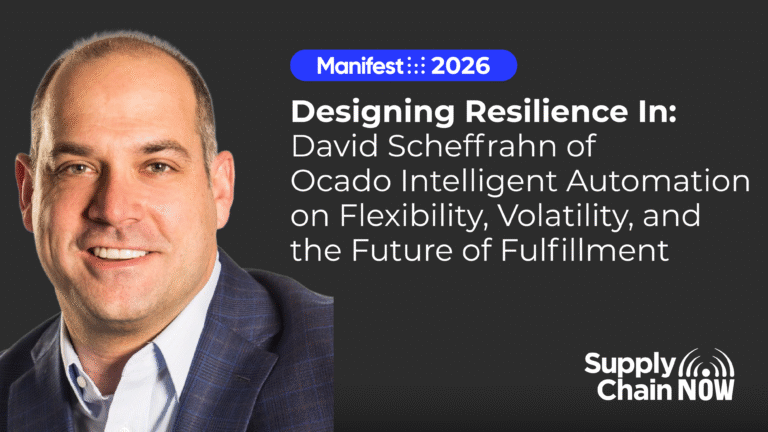
Designing Resilience In: David Scheffrahn of Ocado Intelligent Automation on Flexibility, Volatility, and the Future of Fulfillment
From Grocery Innovator to Global Tech Enabler
At Manifest 2026, Scott Luton spent time with David Scheffrahn, Vice President of Sales with Ocado Intelligent Automation, to explore how fulfillment technology is evolving in an era defined by volatility.
While Ocado is widely known in the UK and Europe for its e-commerce grocery leadership, Scheffrahn explained that the company’s North American focus is different. Over 25 years of building its own advanced grocery e-commerce and fulfillment operations, Ocado developed a powerful technology stack to drive efficiency. “What we’ve done in the last five years,” he shared, “has taken the tech stack that we built for our own use, and now we’re offering it to other companies to buy and use for their operations.”
Today, Ocado supports 3PLs and global brands with end-to-end automation solutions that enable companies to maintain greater control over their omnichannel fulfillment, especially those looking for alternatives to marketplace giants.
Volatility Hasn’t Gone Away
When asked about dominant supply chain themes heading into 2026, Scheffrahn was direct: “Volatility has not gone away.”
He described 2025 as “a massive shock in the system,” with tariffs and shifting trade policies forcing customers to pause projects and reassess strategy. “Almost every single one of our customers last spring said, ‘We need to put a pause on everything we’re doing and figure out how this new tariff supply chain is going to affect us.’”
The difference in 2026? Companies are no longer reacting. In fact, they are designing for disruption. “Customers’ boards are requiring resilience to be something that they plan into projects, not just a talking point,” Scheffrahn explained.
Flexibility Is the New Superpower
One of the clearest patterns emerging from Ocado’s customer base is a renewed focus on flexibility; both operational and financial.
Scheffrahn pointed to Ocado’s autonomous mobile robot (AMR) solution, known as “Chuck AMR,” as a prime example. The system can be deployed quickly, scaled up during peak periods, and scaled down just as efficiently when volumes soften.
“The ability to scale up has always been in their mind,” he noted. “The ability to scale them down quickly… it’s a real awareness of like, wow, this is a superpower.”
Today’s leaders want solutions that can flex with market realities.
Capital, Confidence, and Optionality
Another key theme Scheffrahn is tracking in early 2026 is how companies are funding automation. Customers are increasingly asking about supplier stability and financial backing, which some would say is a reflection of tighter capital markets and heightened risk awareness.
Interestingly, Ocado is also seeing more organizations shift toward capital purchases rather than purely operational expense models. That shift signals a desire for greater financial control while still maintaining agility.
“Operational flexibility and financial flexibility,” Scheffrahn summarized. That dual focus is driving demand for optionality: how solutions are deployed, how they’re paid for, and how they evolve over time.
Collaboration Is Maturing
Beyond individual technologies, Scheffrahn sees a broader shift underway across the industry. As automation platforms mature, collaboration between providers is increasing.
“A lot of the technologies that have been introduced for the last five years are now maturing,” he observed. “There’s a lot of collaboration between the technology companies that just maybe wasn’t there three, four years ago.”
In a world of compounding uncertainty, that collaborative innovation may prove just as important as any individual system.
Resilience, Built In
For Ocado Intelligent Automation, the path forward is clear: provide scalable, configurable solutions that allow companies to adapt, whether they are expanding aggressively or managing risk.
Volatility may be permanent. But for leaders willing to design resilience in from the start, it can also become a competitive advantage.
Where to Learn More
Connect David Scheffrahn on LinkedIn here, as well as Ocado Intelligent Automation here. If you happen to be in the Dallas/Fort Worth area, David invites you to visit the company’s North American Solutions Hub, which is about five minutes north of DFW Airport. Join the team for a cup of coffee and a hands-on glimpse as to what Ocado Intelligent Automation is doing in industry. You can also learn more the company website: https://ocadointelligentautomation.com/
More Blogs

5 Questions I Would Like to be Asked About the Logistics Behind Traveling