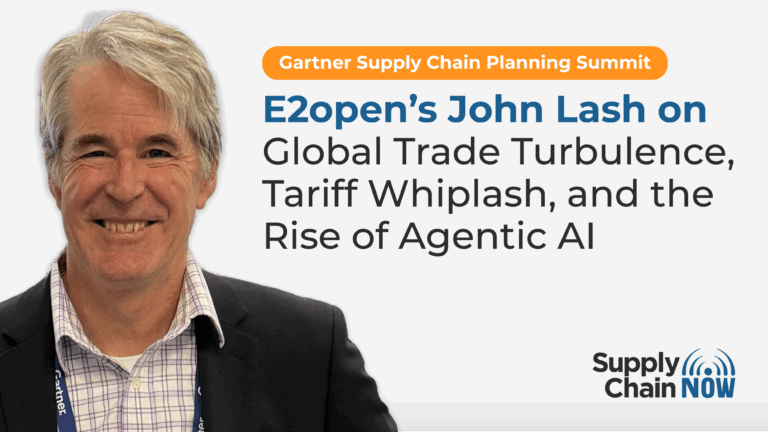

E2open’s John Lash on Global Trade Turbulence, Tariff Whiplash, and the Rise of Agentic AI
At the 2025 Gartner Supply Chain Planning Summit in Denver, Scott Luton met with John Lash, who leads strategy and vision at e2open, a WiseTech Global Group company. E2open is a global platform powering the entire lifecycle of making, moving, and selling goods, with capabilities spanning planning, logistics, global trade, supply management, and procurement. The platform is designed not just for enterprise visibility but for true end-to-end coordination across extended supply chain ecosystems.
Lash emphasized that disruptions rarely originate within a company’s four walls. “Your sub-tiers are where most of the risk lives,” he explained. “That’s where your day-to-day operations—and your long-term strategy—are truly shaped.” It’s a lesson sharply reinforced during the pandemic, which reminded leaders worldwide that no one does supply chain alone.
Old Challenges Intensified by New Realities
When Luton asked about the biggest challenges facing planning teams today, Lash pointed immediately to constraints—supply constraints, manufacturing constraints, and now, the added layer of global trade volatility.
Trade policies that once shifted every few years now change weekly, daily, or even hourly. Lash offered a striking example: Brazilian coffee duties jumped from 10% to 50% this summer—before returning to 0%. “How do you plan through that?” he asked. “How does a CEO make decisions with uncertainty spelled with a capital U?”
It’s not just cost volatility. Tariff changes can cause spikes and dips in demand, disrupting both sides of the planning equation. And as Lash underscored, spreadsheets simply can’t keep up. The pace of global trade and geopolitical change has outstripped manual processes entirely.
The Good News: Unified Platforms and Agentic AI
The conversation shifted to the innovations e2open is most excited about—and agentic AI topped the list.
Agentic AI changes the way planners work by enabling goal-oriented queries, where a human or machine asks for an outcome, and the system orchestrates the end-to-end actions required to achieve it. This shifts planning from siloed tasks to holistic decision flows.
Instead of a planner handing work to logistics, who hands work to trade compliance, who hands work to procurement, agentic AI can help one person execute the entire problem from start to finish.
Lash sees this not only as a solution to talent gaps but a breakthrough in workflow orchestration:
“It transforms not just the processes, but the organization itself.”
He views this moment as one of the most transformative of his career. “I wish I were 20 years younger to ride this wave,” he admitted, “because what’s happening now is extraordinary.”
Why This Moment Matters
Despite joking about the “good old days” of relatively stable supply chains, Lash believes today is just as exciting—if not more. Companies that embrace modern planning technology, real-time trade intelligence, and agentic AI will outperform peers. In fact, Lash warned that the competitive stakes ahead could be stark: from market leaders to bankruptcy filings.
“Supply chain is the heart of every business,” he said. “Organizations that do this well will have the edge.”
Connect With e2open
Lash encourages leaders to visit e2open.com or connect with the team via LinkedIn to explore how these innovations are being put into action across global supply chains. Connect or follow John Lash on LinkedIn here.
We also invite you to check out the full audio version of this interview with Scott W. Luton and John Lash: click here.
More Blogs
Key Demand Sensing and Forecasting Use Cases Across Industries