[00:00:00] John Cusick: agents are only based on the context they’re given. we’re entering an age of like context engineering in the sense that we need to be able to give our agents the ability to understand what we want them to do and give them the context to do it.
need to be able to still have a clean chart of accounts, right, from accounting perspective, consistency in your entities, your customer records, things like that, clear source of truth for your data. and I think that that’s where the work of us coming in and doing it needs to happen.
[00:00:45] Scott W. Luton: Hey, good morning, good afternoon, good evening, wherever you may be. Scott Luton and the Wiley Johnes here on Supply Chain Now. Hey, Wiley, how you doing?
[00:00:55] Wiley Jones: I am doing super well. Good morning, Scott
[00:00:57] Scott W. Luton: Good morning, good morning, good morning. We got [00:01:00] East Coast to West Coast here today. I know it’s earlier in the day for you, but it’s great to have you back, and it’s even better to continue this popular series here on Supply Chain Now, Enterprise Unleashed, powered by Wiley and all of our friends at Doss.
I tell you what, folks, as we’ve heard from you, we’ve heard your feedback, what you agree with, what you disagree with, what you love, and what you don’t love so much. But me and Wiley are tackling the tough topics, and we’re leaning into conversations with leaders that have a proven track record for truly unleashing the power of the enterprise, especially in new and innovative ways.
And Wiley, we got another one, another great conversation here today with a, a fellow mover and shaker just like Wiley, a guest who’s been helping all sorts of companies drive transformational change, especially when it comes to replacing the finance stack that’s slowing down the organization. Wiley, you’re always ready, but did you eat a second extra bowl of Wheaties for today’s [00:02:00] conversation?
[00:02:00] Wiley Jones: It was, um, it was some oatmeal and blueberries, but I’m … My, my brain is as supercharged as it can be coming off of having a cold, so I’m maybe a little bit slow to hit the buzzer, but we’ll, we’ll be there
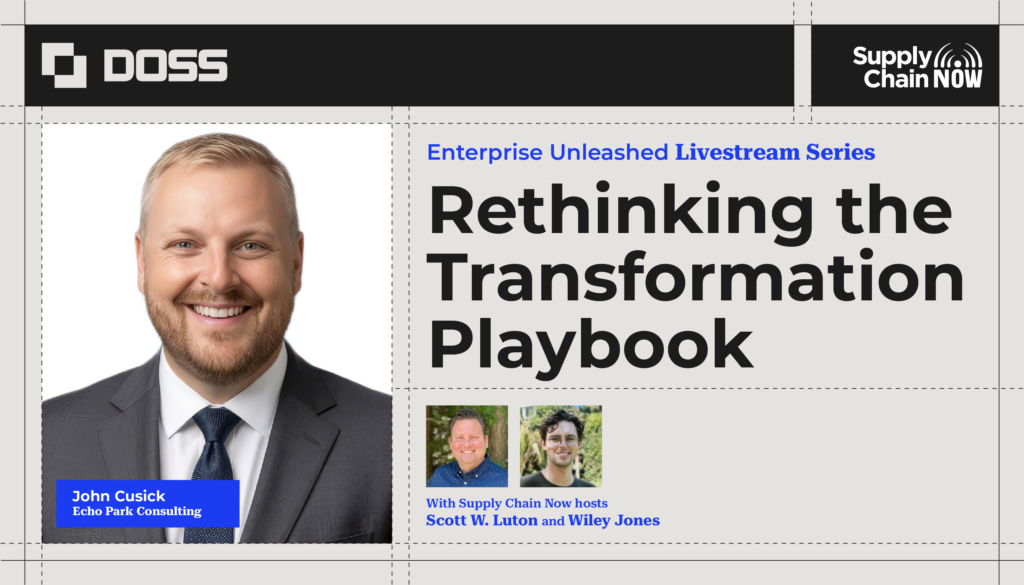
[00:02:13] Scott W. Luton: Well, Wiley, your definition of slow is probably everyone else’s like, uh, most productive day ever. So those blueberries will keep it, keep that brain power functioning. But, uh, folks, uh, let me introduce a wonderful guest joining Wiley here. Uh, Wiley and I here today on Enterprise Unleashed. John Cusick serves as president of Echo Park Consulting, a consulting firm that helps companies grow their business by implementing AI-native solutions.
John’s been in the technology transformation space for years. You’re gonna see some of his passion here today, along with proven best practices and ideas that are not theoretical. They’re not, “I think they are.” They’re real, and they come from his hands-on, in-the-trenches experience of driving big change. So I wanna join in our guest here today, [00:03:00] John Cusick, president with Echo Park Consulting Hey, hey, John. How you doing, my friend?
[00:03:05] John Cusick: I’m doing well. How you doing, Scott?
[00:03:07] Scott W. Luton: Wonderful. Great to see you. before we get to our fun warm-up question, did you have a healthy breakfast like Wiley did, or are you getting a, a McMuffin like I might have gotten this morning?
[00:03:17] John Cusick: I skipped it this morning. Um, I’m probably gonna grab a, uh, one after for sure. Uh, but I did get some water, uh, which is always good. Keep the, get the wheels moving,
[00:03:25] Scott W. Luton: we all got to focus on hydration strategy these days. Well, let me ask you this. Folks, we’re in football season, Wiley and John, if you haven’t noticed, and we’re what? Three or four weeks into the NFL season, and I th- I’m convinced that fuel is like 25% of the US economy. Uh- You’re right … and I want to ask you, John, because you’re a big time, you might be the biggest Packers fan west of the Mississippi, right?
Ca- y- ’cause you call Denver home. At least. At least. Maybe, maybe, maybe nation. But, um, you’ve had a string of two Hall of Fame quarterbacks in Brett [00:04:00] Favre and, uh, Aaron Rodgers. And now you’ve got Jordan Love, who’s, who’s doing good things. Which one of those three have been your favorite quarterback to watch play?
[00:04:11] John Cusick: By far it was Brett Favre. By far. Well,
[00:04:13] Scott W. Luton: Okay, and why is that?
[00:04:15] John Cusick: mean, the, the thing is the guy was so unique. He threw the ball so hard, so, so hard. Uh, some of those receivers didn’t really have a chance, I don’t think. But I think the thing that is so interesting about him is that he was just passionate. He’s
of a kind. One of a kind. And some folks don’t know the Falcons, uh, drafted him originally, and I think there was a little trade there if I don’t, if I can’t, uh, don’t remember.
[00:04:39] Scott W. Luton: All right. So Wiley, react to John’s, uh, uh, quarterback commentary about the Green Bay Packers
[00:04:47] Wiley Jones: Well, I’m a Bears fan, so I don’t have much to say. No, actually, um, I did have a lot of fun watching Brett Favre growing up because only ever been to one Monday Night Football game
[00:04:58] Scott W. Luton: Ja
[00:04:59] Wiley Jones: in, in person. [00:05:00] uh, I grew up in, Champaign, Illinois, which is down, you know, probably about three, two and a half, three hours south of Chicago. when they were renovating Soldier Field back in, I think it was the early 2000s, Favre, came down, played at the University of Illinois football stadium. and they blew the Bears out like probably 50 something to 10, I think. it was one of the worst. I think actually it might be the highest scoring blowout in Monday Night Football history still. and you know, I was like, I don’t know, like 10 years old or something watching, wa-watching Brett Favre absolutely dominate my team and that has stuck with me for a long time.
[00:05:39] Scott W. Luton: that healthy rivalry between the Bears and Packers is very unique,
So John, as I was sharing in your introduction, you know, uh, change and transformation and certainly innovative technology is not, not new ’cause you’ve spent years at the intersection of business processes, enterprise systems, and of course, implementation. So I want to [00:06:00] ask you, based on all of your, your journey and your experiences and expertise, why do some transformation initiatives really create meaningful business value while others flop and disappoint?
[00:06:11] John Cusick: let’s be real. I mean, the differentiator is not usually the technology itself always. Now, the flexibility of the technology, I think, is a huge differentiator. implementations to really do well, they need to be solving for a real business problem, right? So valuing things that, um, are more important, like system changes that you’re applying based on something that is your business has outgrown your system and they need those changes now in your new system.
I think a lot of the, a lot of time we end up with, um, lot of implementations that are sitting there with a disappointing result because they’re trying to recreate what they have already,
Right
That’s a common problem. And that transformation that they need to do, yes, requires technology, requires technology, but it also [00:07:00] has, requires you to look at the processes that you have in place and where you want to be in the next couple years
[00:07:06] Scott W. Luton: Wiley, that sounds pretty savvy, uh, and a pretty good response in like to cover all that ground in like a minute and a half. How do you react to that in terms of folks that get it right and a lot of folks don’t, don’t get it right, Wiley?
[00:07:17] Wiley Jones: I think what John is describing is a thing that we’ve seen a lot, but, you know, it, it spans supply chain, finance operations organizations, even sales and product development organizations, people will say, “We’re doing X today. need a new system to do X better. Let’s make sure we meet all the requirements of X.”
And I’m like, “Whoa, whoa, whoa. We need to do something a little bit different, it sounds like. You wanna make changes. Where are you going? What do you care about? What are the problems you’re trying to solve, not today, but for tomorrow?” you know, I think getting people to recognize that the, the transformation, you’re not trying to transform into a cir- you know, in a circle and end up at the same place. You’re trying to transform to a new place. that [00:08:00] capability map and that curve for where we are today, where we’re trying to go, here’s what we do today, X. Here’s what the software and systems do out of the box. That’s Y. We need to get to Z. That is a combination of these two things, and maybe something that we can pull from best practices from other people and other people who have figured out how to do this effectively. having those conversations early and gaining organizational clarity and decision-making through the implementation, really the magic. And as John was describing, software makes up probably about 15 to 20% of that realistically.
[00:08:33] John Cusick: Agree
[00:08:33] Scott W. Luton: this isn’t what exactly what either one of y’all said explicitly, but your, both of your responses reminded me of, um, Charles Kettering’s quote, and I, I might botch it, but, “A problem well stated is a problem half solved,” or something like that. in my experience, so often we think the problem is ABC, and it actually, and start solving for ABC, but it actually is XYZ, right?
A good bit [00:09:00] away.
John, I wanna keep driving, ’cause, you know, one thing that, uh, we’ve returned to show in and show out on Enterprise Unleashed is let’s start with that business problem and rather, rather than starting with AI or starting with the technology or starting with a solution, right?
So John, where do you see organizations getting that sequence w- wrong time and time again, and what should they be doing instead?
[00:09:24] John Cusick: Yeah, I think today specifically, and it’s probably, you know, was okay maybe decades ago, but is not okay today, is that, you know, they come in with a system that they want to implement, right? With limited information. You know, like, I want this one system to do my thing because I hear that that’s good. so they’re focusing more on the what to diminish the why. Like, why do I want that system, know, like at EPC for instance, we act more of an advisor to help clients actually figure out and diagnose the problem first. You know, like what are the– what’s your close speed? What’s, what automation maybe [00:10:00] you need or inventory visibility you need, to recommend those systems. I think the thing is, is that we a lot of times start with the system as the starting point, and we
have to convince the idea that actually it might be multiple systems. And today, because of the best-of-breed kind of solutions that are out there and the build, the ability for na- you know, native integrations we’ll talk about later, it really gives us a lot more opportunity put things together with less risk.
I think one of the roles that leaders have is to make sure we get the sequence, sequence right amongst many, many other things. Wiley, what’d you hear there from John?
[00:10:38] Wiley Jones: ultimately the responsibility to get the business case right is up to the leaders. y- leaders will
[00:10:45] John Cusick: We were then
[00:10:46] Wiley Jones: from a number of directions. Sometimes, you know, the street will post something back in an earnings call back to, you know, if a big public company and say, “Where’s the AI?
Where’s your systems? What are you doing?”
[00:10:58] John Cusick: what?
[00:10:58] Wiley Jones: into
[00:10:58] John Cusick: Yeah[00:11:00]
[00:11:00] Wiley Jones: and says, “Hey, why aren’t we using, you know, insert new vendor, insert new technology? What are we doing?” And then there’s a big, you know, center of excellence and a transformation committee and a steer co, and the whole thing trickles down.
And then, you know, the people who actually are doing the work, they’re saying, “This doesn’t make my life better. This doesn’t change anything about the way that we work.” I think in that, uh, filtering down of, you know, of the objective, the business objective, what the leadership team really has to focus on is how do we win as a company? And, you know, maybe what that looks like is revenue, risk, profit, productivity, you know, whatever the, key performance indicator that identifies what winning looks like, then design towards that outcome and say, “What tools do we need in order to get there?” And the tools being exactly what John’s describing is, hey, we need to be able to have a system that helps us have inventory visibility across seven different sales channels, where we have different mechanisms of fulfilling inventory there, and some of it’s made to order, some of it’s made to stock.
Here’s the [00:12:00] supply chain differences for those. Here’s the tool we need for this and this and this and this. But the whole goal is we need to hold less cash in our balance sheet stuck in inventory. I think leadership organizations can get so caught in the filtering down of requirements that they miss we need to win as a company.
What does winning look like?
[00:12:17] Scott W. Luton: Yep. John, Wiley makes it seem so easy. When he did– He just walked through that. Am I, am I right, John?
[00:12:24] John Cusick: You are so right. You’re so right.
[00:12:27] Scott W. Luton: Oh my gosh.
So John, from your deep experience on the front lines, two-part question here, what are the biggest reasons these projects become so complicated, right? And then secondly, which parts of the traditional implementation model are most ripe for reinvention?
[00:12:44] John Cusick: Oof. Yeah, I mean, two, two of, two of the big reasons, one will be probably not surprising. That’s data. All right? think data in general, because of the amount of, I’ll just say the sea of data that we are [00:13:00] collecting now that we weren’t maybe 10 years ago or even 5 years ago at this point, we are at a point now where we need to be able to collect that data, get an understanding of it, and adapt it for new systems and new s- your new, new tech stack. And so for an implementation team, that takes a lot of time. a lot of effort that is put into taking data, moving it to this one spot, seeing, making sense of it, and moving forward so that the business can move, move faster. The second one is probably a little less, obvious, but one I think that a lot of people kn- feel but don’t really say out loud, and that is the loss of context.
[00:13:42] Wiley Jones: Mm-hmm.
[00:13:44] John Cusick: especially today, and y- you see this with Doss and a couple of these others where you’re working with a lot of different streams of data from different places, right? There’s lots of moving parts. Projects require that you break those processes up when implementing [00:14:00] so that you can get the work done, pull the right data in from, say, Shopify and then another one in from Walmart, okay? By breaking that, you kind of lose the context of the, of the bigger picture. And both for the clients and for the consultants, that can be really hard because you’re answering questions or you’re asking questions, making decisions based on what is in front of you and not the whole bigger picture. So that’s where it leads to where I think where we are ripe for reinvention in the implementation process, which is that AI gives us a lot of opportunities, right, to do some of that data migration processes, make sense, make sense of it, be able to like set it up so that we can make those adjustments. Not only that, but also for just the implementation process as a whole, like recording and adjusting requirements, RAID log items, tasks, things like that, so that we’re keeping the little things that people say in context all the time.
[00:15:00] We know that if we impact thing A, it will impact thing C over here. and if we do that, we’ll have a much better experience across the board ’cause we don’t cause one problem in one area by fixing it in another.
And I think that’s where a lot of these go wrong, and we have a lot of issues in implementation. Doesn’t matter what the system is, truly.
[00:15:21] Scott W. Luton: that’s good stuff. And we, we could devote the rest of the conversation around your last response, and I bet it res- resonates with a lot of folks out there. Wiley, uh, at the beginning of r- his response, he started with data and how we got a sea of data. And unfortunately, so many teams are on the SS Minnow, uh, as we’re trying to navigate our way through all this data.
But what’d you hear John say there?
[00:15:44] Wiley Jones: very interesting to me personally because I, I experienced this when I was operating and building and basically running parts of a supply chain, was that information model of what the [00:16:00] company does is just as complex as, if not more, than the actual physical model of what the company does.
So like, let’s say we have this information supply chain that mirrors the physical supply chain or value chain of the company. as the physical value chain grows in complexity, as the company gets bigger, they multi-source from different vendors, they bring some manufacturing in-house, they outsource manufacturing in other areas, they have multiple new entities, they buy new companies, they sell in new channels, they add new products. that information model of how that works also grows in complexity. And it is even harder to wrap your head around because it’s not something you can paint out into a map and say, “Well, we’re, you know, we have these documents that describe how we actually work with vendor A and vendor B.” It actually will live inside of a server in code that people will have to go in and read and untangle and make sense of.
in the process of doing so, it’s actually throwing out logs and [00:17:00] pieces of data across the entire, you know, uh, across the entire tech stack. And human beings have to then go in and unpack all of that, almost reduce that complexity down to what does our business do? How does that map into our information model that we store in order to make sense of the fact that system A says this order was fulfilled, system B says this order was not fulfilled, system C has no idea this order exists. How do I make sense of that? That’s right. that Cambrian explosion I think is something that AI is ripe to be able to help physical operations companies solve. And it’s what John, John is describing is it looks a little bit like data mining, a little bit of process mining, a little bit of, contextualization, and then ultimately allowing us to take this elephant and break it down into pieces that you can eat in bite-sized chunks.
And, you know, how do you, how do you eat the, you know, supply chain information model elephant? Well, you break it down into parts. And I think this is where John is, uh, very s- you know, hitting the, the nail [00:18:00] on the head there is that that’s the only way for these companies to be able to deliver these large scale transformation projects that touch the physical value chain.
[00:18:07] Scott W. Luton: you know, one of the points, uh, both are speaking to, and, and Wiley, you definitely shared on the beginning of your response is, you know, man, who raises their hand and says, “Sure, I’d love to have 2X complexity on my Wednesday than I had on Tuesday.” No one, right? And, unfortunately, all too often with some, not all, but some of the implementations, some of the change management projects or initiatives out there, we’re cr- we’re not thinking about the, the complex.
We’re thinking about the future state and how everything’s gonna be so great, but we’re not always thinking about the complexity we’re creating for our workforce to get to that point, at least in my experience. John, would you agree with that?
[00:18:46] John Cusick: Yeah. No, I, and I think that that’s the, the challenge is that we’re kind of going, we’re going in, we’re putting our foot into the middle of the, of the, uh, circle, and we’re putting it out all the time, right? So we have to be able to keep that context the whole time [00:19:00] and understanding, because you, if you make too many changes here on one side of the coin, you’re gonna create an issue on the other.
And, and it kind of goes to the, you know, what Wiley said about like, you know, system C not even knowing the order is there. That’s, that’s real life
[00:19:15] Scott W. Luton: Right
[00:19:15] John Cusick: well, like in the sense that like context is not always necessarily like everyone knows everything about what we just, what we just built. Chances are there’s parts that of the sys- of the stack that don’t, and we have to be able to understand why that is, and keep that context.
[00:19:30] Scott W. Luton: you know, I, I stole something last year. Uh, one of our guests said, “Hey.” Reminded earlier this year on this Enterprise Unleashed series, said, “Hey, there’s two rules not to be broken with any technology implementation. Don’t stop, uh, the products from being shipped out, and don’t stop the products from being shipped out.”
And that applies here to this conversation as well, I’m sure.
all right. So I wanna talk about the best of breed, um, and where we are here today.
But, you know, Wiley, starting with your, you know, what we talk, what I’ve talked about a lot, you know, you’ve [00:20:00] challenged tons and tons of conventional thinking around, uh, technology in general, but also enterprise software, including the idea that one massive platform doesn’t need to do everything and be the end-all be-all, right?
So I wanna ask you, Wiley, what does a modern best of breed strategy look like?
[00:20:20] Wiley Jones: it mirrors the strategy that the business is using in order to win, and that can vary wildly by company. And as you said, a company that is really focused on super high throughput orders of relatively commoditized products, let’s say they work with contract manufacturers, they’re more of a, it’s more of a brand business as opposed to a deep technical manufacturing business, strategy looks very different in the way that they set up their supply chain, the way that they set up their operations looks very different.
Therefore, you need different tools and systems to be able to support the thing that they care about. They care, let’s [00:21:00] say, about omni-channel order management, being able to say, “We have coverage over seven GOs around the world. The way that we have coverage allows us to reduce the price per, you know, unit shipped footprint and the way that we fulfill for them.” That is a very different problem that, let’s say maybe like GE has when they’re saying, “Hey, we have a shortage of turbine blades right now. We don’t care about, um, order management. We have two major customers. That’s all we care about for our turbine blades or something.” And so the, the way that we think about building enterprise applications is in service of the strategy, instead of saying, “Take your strategy and fit it into the way that the system and this monolith functions.” And of breed allows you to elegantly balance and blend those trade-offs where you can raise your hand and admit and say, “We do not have the best, you know, best in class system for a manufacturing execution system. Not our problem to solve. However, a bunch of really smart people over there [00:22:00] have built an amazing one, and we can partner with them and find the boundary conditions between what we do well and what they do well and put something together that’s better for everyone.” And I think that the technical decisions that were made in ’70s, ’80s, ’90s were the best that they could accomplish at the time, given the limits of the technology. not the case anymore, and so we shouldn’t have to live with those architectural, a forever way of doing this work.
[00:22:26] Scott W. Luton: makes a ton of sense to me. And, you know, it’s really cool to see the art of the possible continue to evolve based on some of the things you mentioned there, Wiley. And John, I know, I’ve done my homework on you before you joined. I was talking to some of your colleagues and some of your customers, and this is one thing, one area you are very passionate when it comes to best of breed.
So John, what are your thoughts here?
[00:22:47] John Cusick: Yeah. I mean, it’s in the name, best of breed. I mean, everyone, if they had the option, regardless of the industry you’re in, would want to have the best that they could [00:23:00] have to run their business. Everyone wants that. challenge has been is that, uh, there’s also been a lot of technological changes over, over time that have made it so it’s harder in some cases to be able to do that.
You know, things like having, um, some tougher integrations, right, between different systems, people building, building tools that are not keeping your business in mind. And so I think there’s a lot of opportunities now today, and legacy ERPs in general have grown to a point where they try to gobble up a lot of that, you know, proc- a lot of the processes your
[00:23:35] Scott W. Luton: Right?
[00:23:35] John Cusick: run, but they don’t do them well, unfortunately.
Some they do well, and I, you know, I’m not gonna sit here and say, “Yeah, you’re their master of none.” but I think the biggest thing that I, that I’ve seen in the trend is that there is much easier paths to being able to connect best of breed solutions because native integrations are a dime a dozen now. Being able to connect across, you know, um, a lot of [00:24:00] your different tools in a way that makes it so that it works for your business without having to do a lot of stitching. And that’s where it has been usually the, you know, the point as to why you would go with a solution that maybe is not best of breed and it just covers a lot of your bases, is because you’re like, “I don’t wanna stitch together five different systems.” And that’s a fair thing, but today it’s just easier. AI has made it also easier. you know, I’ve definitely shifted over my career ’cause I’ve been in both, um, both of the, both sides of the story here. but I will say that today’s world is, is definitely a best of breed world in my mind.
[00:24:38] Scott W. Luton: to kind of put it in maybe universal terms, you know, if you take your truck down to the 15-minute oil and lube express folks that specialize in oil changes, and you say, “Hey, not only oil change, but I want you to do some body, body repair. I want you re- do an engine change.” They can probably do it, I imagine, ’cause they’re talented people.
But specialization is so [00:25:00] important and, uh, especially as it applies to technology. And if you can, in this world, have your cake and be able to eat it too, why not, right?
but I want to move on to a big topic here today: agentic implementation. This is fascinating. Fascinating. And John, you know, we’re hearing more and more about AI agents really doing all kinds of stuff, but certainly changing business processes, right?
[00:25:25] John Cusick: Yep
[00:25:26] Scott W. Luton: But two-part question. I, I’m not– I must be the king of two-part questions, hey, John. My apologies, but it’s a lot, so much stuff.
How can agents change implementation process itself is one A. And then what work that traditionally required armies and armies of consultants and humans, you know, months of configuration, mapping, testing, integration can increasingly be handled by agents?
John, I’m really curious here
[00:25:51] John Cusick: It has changed a ton as to how we should be looking at implementation. Because what are the things that make implementation hard? Data, [00:26:00] usually, like I mentioned before, loss of context, but then also time. And I think the biggest thing is that we end up with a really, really tough problem that we need to solve, but we don’t have the hours in the day to actually solve it. And I think that what’s changing here and what is changing with agents in the picture is the ability to take some of that manual effort that takes time and not, not, actual, like, brainpower in a lot of ways. Data mapping, chart of accounts, like configuration, integration builds, test case execution. You think about the amount of time a test case and, like, having that, uh, put in places. putting that into a structured way, rules-based agent to do saves hours and hours and hours and can accelerate it. That’s one. thing to your second question, which is that there’s lots of [00:27:00] things that are increasingly being handled by agents. One of the things that I think is really important for everyone to understand is that I see it as more of a framing of compression and not elimination.
[00:27:13] Wiley Jones: Mm-hmm.
[00:27:14] John Cusick: Agents are allowing you to handle that first pass mapping, config, all that thing, the, the amount of hours spent.
[00:27:21] Scott W. Luton: Right
[00:27:22] John Cusick: But it is still very, very important have human validation, handling the exceptions that come in, making those, making those judgment calls on the process design. So I think the biggest thing to k- take out of this, and one that I, you know, I’m seeing firsthand, is that yes, it can do a lot of things, but just like in any other industry, the human in the loop still needs to be there and doing some of the things like cleaning, mapping, stuff that is going to require a lot of hours. Cut out 90% of the hours to then feed the 10 so that you’re doing that accurately.
[00:27:57] Scott W. Luton: appreciate that. You know, a lot of these topics, [00:28:00] uh, it’s tough to tackle any of these in, you know, three, four minutes’ time. Uh, and, and so I’ll use this moment, folks, Wiley and John welcome conversations after today. They’re, they’re happy to compare notes. Uh, I’ve seen Wiley in action, and now I’ve seen John in action.
So reach out to them. We’ll make sure we, we add their contact information here momentarily. Uh, all right. So Wiley, we were talking about agentic implementation. John shared some key thoughts there. Uh, what comes to your mind?
[00:28:28] Wiley Jones: you know I love a good analogy. There’s kind of two versions of this analogy, which is a bit of the gardening and farming one. I think a lot of people will describe, you know, as, as John was saying, the human in the loop. I think of it a lot less like this loop and a lot more like you’re trying to grow something, you plant these seeds and you nurture them. and I actually even think– I’m thinking back also to, might have been a second or third grade science fair experiment where I learned how to grow crystals. And you kind
[00:28:59] John Cusick: Hmm
[00:28:59] Wiley Jones: [00:29:00] this structure, and once you create the structure and then you feed the crystal, then the crystal will grow and expand on its own. But it follows the structure that you give it to start with. It’s very much like planting a seed and saying, you know, “Hey, I want corn to grow.” It’s very much exactly how these implementations work, which is we know exactly where to start. We have this seed and kernel of an idea of a business process we want to support in order to go towards this outcome, and I’m shaping and sculpting this thing as we go. I’m not letting it grow wild. I’m pruning and taking the stuff that’s like, “Oh, maybe we don’t want to have that go over here. Maybe let’s pull the weeds from that part of the system.” And ends up looking like this explosion of context where you’re able to take all of the things that the business does and distill them down to these core truths and say, “You’re fundamentally a company that sells products to customers, and this is the way you do it, and here’s how your products function in general. Here’s what you care about as a company. Let’s take [00:30:00] those core ideas and make it so that we can service them better, and the processes that support those that are limiting that, uh, work that you’re doing today, things that you don’t have that could enhance that, and making it so that you’re really trying to create this flourishing ecosystem of technology instead of thinking about it as you know, I must follow this hundred and fifty step business process that I, that I have to work through.”
[00:30:21] Scott W. Luton: Mm.
[00:30:22] Wiley Jones: really about trying to, you know, have agents do as much of the growing on their own, and you’re just the farmer or the gardener planting the seeds and maintaining the ecosystem.
[00:30:32] Scott W. Luton: that crystal example, that unlocked a memory of mine from, like, uh, grade school. I remember, uh, failing miserably at growing those same crystals you talk about. So
[00:30:42] Wiley Jones: what I’m talking about. You get the string and they… Yeah.
[00:30:45] Scott W. Luton: yes, I’ll have to get some best practices from you after today’s, uh, conversation. as we stick with agentic implementation for a second. Earlier in the conversation, we were talking about the importance of process first, technology second, right? And I think we all know that, including the folks that [00:31:00] are tuned in.
But does it become even more important in an agentic implementation model, John?
[00:31:05] John Cusick: Yes, 100%. I think a lot more important because, will, you know, happily automate a bad process, right?
[00:31:15] Scott W. Luton: Right
[00:31:16] John Cusick: It’s, we’re giving them the context. We’re giving them the direction. So I think, um, speed without that right process is really, is really the problem here. And so I think thinking about that process from the get-go, what do is, what do I want in the end here?
What matters the most? It has to be before your technology. there’s nothing else I can say to that other than it’s very clear.
[00:31:42] Scott W. Luton: Yep. Period. Point blank.
all right. So John, EPC, your organization’s Doss’ first implementation partner, uh, and y’all have hit the ground running, it seems. I want– I’m curious, how has y’all’s collaboration to this point illustrated some of the ways that industry, like we’ve been talking [00:32:00] about, industry’s got to rethink the ERP implementation playbook?
What’s come to mind, John?
[00:32:05] John Cusick: Yeah. I mean, everyone talks about how probably everyone on the, on the, watching this today has probably heard this is like, you know, they hear, “My business is unique,” right? For some, that’s truly not the case. Others it is. you look at, like, the AI boom over the last few years, it’s created, like, new businesses, uh, changed a lot of how businesses operate today and how they should be run. the same goes for how you implement ERP today. we’re seeing a, you know, a product like Doss that has flexibility. I wanna be very clear on that. The flexibility to grow with the business and tell it what to do. which is interesting because a lot of other tools out there will be very determined to tell you how to run your business. And some of that is, some of that is needed. Some of that is definitely needed, and there’s definitely people that need that. But I think the, the thing that we’ve learned the most from working with Doss is that that flexibility with the types of companies they work [00:33:00] with really, really important because it allows for them to make adjustments as time goes on. we wanna be future-proofing, right? Like, that’s the goal every time anyone… Which has been the gripe with legacy ERP implementations in the past is that, like, you know, you, by the time you’ve implemented a year later, chances are your business has changed. and you wanna be able to future-proof that.
So I think that’s important. but I think, you know, to kind of tie the bow on it is that the implementation itself requires almost more understanding of the business than it does the technology that is put in place to run it, right? I think that’s where, um, working with Doss has been really great for us because we understand that you have to.
There’s no if, ands, or buts. You have to understand their business to implement Doss. And that is a good thing, not a bad thing.
[00:33:52] Scott W. Luton: Right.
[00:33:53] John Cusick: thing,
[00:33:54] Scott W. Luton: Well, I’m with you. And, you know, Wiley, I, I’ve read some of the reviews. [00:34:00] Um, it seems like a lot of your customers tout how Doss is become so ingrained in the organization, they know the business intimately, and that’s kind of what John is, is really is calling out how critical that is.
And, you know, one last thing before I get Wiley to respond to what John said. You know, John, a lot of folks will say future-proofing, and they’ll be talking about it as if it’s, like, just something to write about. When you say it, it really has got some ax- uh, some added operational oomph behind it, uh, ’cause I know that, that, that’s core to some of the work that you and, and Doss is doing to help organizations not just, um, not just plan, but execute on all this growth and success and new complexity goes with it.
Uh, but Wiley, that’s got to make your, y- your ears gotta be ringing, uh, ba- and you gotta be delighted with what John just shared about what he’s learned thus far the, with the collaboration.
[00:34:55] Wiley Jones: really cool to hear outside of the [00:35:00] organization and from the partners we work with, like, like John and team. I think what’s interesting with the way he framed this, and it’s something I have never said this way, but it’s, it’s true, is have to deeply understand our customers’ businesses in order to actually help them. And that is not actually true for a lot of the people in our ecosystem. I think that, you know, again, if I’m being less generous or less diplomatic, I’m sure there’s a lot of listeners on here who have been a part of some sort of enterprise applications implementation. Consultants come in, present a hundred-page, you know, or a hundred-slide deck and, you know, say, “Awesome.
Great. Our work’s done here.” and the organization really isn’t better for it. The systems that then come online don’t actually drive value. the only way around this that we have observed is that you have to deeply understand their business. There is no shortcut to deep understanding. And deep understanding is painful and difficult to accomplish, but [00:36:00] when you do it, you actually build value. And we think that that’s a feature and not a bug. And some people look at that and say, “Oh, that’s– that– It’s very time intensive. It’s very difficult. How are you gonna go do that? How do you make it sustainable and scalable?” And our answer to that is, well, we’re actually driving value on the other side of it. in order to
[00:36:20] John Cusick: Sådan.
[00:36:21] Wiley Jones: we think this is a hard requirement
[00:36:23] Scott W. Luton: Well said. And I can’t wait to see what else comes out of the EPC and the Doss, uh, collaboration in the months to come. We’ll have to have John back. And Wiley, we won’t talk too much about Green- the Green Bay Packers because of your Bears allegiance. But, uh, we’ll, we’ll check out the big things y’all are doing winning Super Bowls in, uh, the Global Business League.
all right, so let’s do this. Wiley, I want to go back for a second to agentic implementation.
It’s fascinating what’s going on, but I want, I want to zero in on one thing in particular, because I think we’ve talked about how the traditional implemen- implementation model is being rethought and re- rein- invented and, and, um, reconfigured and all that [00:37:00] stuff. The human role in implementations, how does that change, Wiley?
[00:37:05] Wiley Jones: I think that this is the coolest thing that’s happening in the world if you zoom out and look at it for what it is, which is that humans are able to operate complex systems now just by having mastery over the concepts, not necessarily the, the, um, the syntax or the language underneath. I understand how my supply chain works, I understand how our business needs to function better, I can actually construct and build systems around that without having to know how the underlying databases work, without having to know how the applications actually work, without actually having to be the one to open the box and assemble all the circuits and wires. And this is true universally across every, every industry, not just for physical supply chain. especially cool for the physical supply chain world and for enterprise applications in our category because they have had [00:38:00] such a hard time getting these systems to model the complexity of what they do.
[00:38:05] John Cusick: Hmm.
[00:38:06] Wiley Jones: And
[00:38:06] John Cusick: Yeah
[00:38:06] Wiley Jones: a result, are, what John was saying, the flexibility. Flexibility means you must understand how all this stuff comes together. You gotta, you know, learn a 50 bajillion different systems in order to actually put them together properly. That’s not true anymore. And leaders are going to be able to challenge the way that they have done processes in the, you know, historically, and just by understanding the, the higher order concepts, they can drive their implementations towards that outcome. It means that organizations that perform these value-added services, they’re gonna have to go up a level in the stack. They’re not gonna be billing time and materials on, “Hey, I went and did,” as John said, “this data mapping, that data mapping, that data mapping. It’s gonna take me nine months. I need you to pay me 100K.” instead it’s going to be, “How do we work with you to chart a course from where you are to where you need to be? And along the way, yeah, we’ll [00:39:00] do some of that work that we were talking about on data mapping. But really the end goal is you need to be able to close your books four days after first of month.
You need to be able to look at contribution margin across all your products, even when new product’s introduced. You need to be able to do it within 30 days of the release. Okay, let’s build systems that can enable that.” That’s where consulting organizations have to get to, and I think some of them are gonna be very afraid that they’re gonna be on the hook for the business outcome and not just a hundred-page slide deck.
[00:39:29] Scott W. Luton: Hmm.
[00:39:29] John Cusick: Yeah.
[00:39:30] Scott W. Luton: John, Wiley just called that one of the coolest things happening in the world in terms of the human role. Uh, your thoughts
[00:39:38] John Cusick: Yeah, no, I mean, this is not even just unique to… Which is why I, I agree with Wylie. It’s, it’s more for the world and not just for, for how we see it in implementation land. But, you know, in general, in general, the human impact that we have is now changing because we’re using our [00:40:00] time differently.
we’re moving from being an executor of configuration tasks to designers and validators. That’s gonna be a challenge for a lot of, for a lot of industries, a lot of companies, um, to do. But it also is somewhat of a relief for some, think, in the sense that they can actually do their job.
You look at like finance and accounting teams that we’re, that we’re helping today, you know, they’re, they’re always in, they’re always in reactive mode because they’re having to spend a lot of time in the configuration doing not necessarily for implementations, but just running their business in general. so I think it’s, uh, it’s larger than, than just implementations, but definitely implementations is a good microcosm of how, of how that actually operates,
[00:40:42] Scott W. Luton: Well,
[00:40:42] John Cusick: the real world. Yeah.
[00:40:43] Scott W. Luton: I like it, John. And then Wiley, I, I guess based on John’s response, I’ll, I’ll have to agree with it. It’s one of the coolest things happening in the world today. Um, and I think in a, in a greater sense, how technology is certainly empowering the workforce and, and is taking, giving so much time back [00:41:00] and, and reducing so much friction.
And in some cases, friction that’s lasted, you know, been around the workspace for decades. It’s attacking that, uh, and, and it, it really is one of the coolest things going on, not just in global supply chain, but global business. I wanna go back to a big topic, John and Wiley. You know, so Wiley, really have enjoyed the conversations we’ve had.
I think we published a summary of the, the first half of the year, and I– John’s gonna have about seven moments of brilliance in the next summary article based on this conversation. But, you know, we’ve had some big themes, right? Leadership and culture and change management, of course. Those are to be expected.
And then data, and of course, that’s, that is to be expected as well. We’ve touched on that a couple times already. John, you know, best of breed environments, whether we agree or disagree that that is in, you know, in the art of the possible here, inevitably mean data’s moving across multiple platforms, right?
And agents increase the speed of all those interactions. So John, how do companies espa- uh, establish lots of [00:42:00] things here? The data quality, context, governance, and most importantly, trust that’s necessary for agents to make good decisions across some of these really big and small ecosystems
[00:42:13] John Cusick: Yeah. This is probably the biggest topic we’ve talked about today that has the most impact in my mind. and the reason is because, you know, a lot of people are fearful of the idea of like, what are, what are agents gonna do and like having… What’s the auditability? You know, you look in the finance and accounting world, like what’s the, what’s the auditability of what changes an agent is doing in your system? but I go back to the point I said before, which is that, you know, agents are only based on the context they’re given. if you engineer the context, you know, I had one of my team members mention this to me a couple months ago, is like, you know, we’re, we’re entering an age of like context engineering in the sense that we need to be able to give our agents the ability to understand what we want them to do and give them the context to do it.
You know, so what that means is [00:43:00] in, in, in reality here is that need to be able to still have a clean chart of accounts, right, from accounting perspective, consistency in your entities, your customer records, things like that, clear source of truth for your data. and I think that that’s where the work of us coming in and doing it needs to happen. Now, now shameless plug here, I think, you know, EchoPark for us, like we, that’s what we do a lot of times. We’re helping, you know, companies work through and figure out what is this, what is the thing that we need to make sure we can maintain over time that is not going to spend, uh, that we’re not gonna spend a lot of time on, on a day-to-day basis? ‘Cause the whole idea is that really usually for us to spend to save time and effort. and managing that across the whole tech stack is hard to do. But if you work together with us, for instance, in the beginning and help support you in building those right agents, building the right tools to be able to do that, that maintenance, actually starts to reduce over time. [00:44:00] I think it’s a, it’s a larger problem than what I’m stating here, I think in general, because there’s lots of possibilities as to what, uh, what agents can do because we’re not just tying to one system. but I think having someone to work alongside you that has a better understanding of it is, is a better idea.
[00:44:19] Scott W. Luton: It sounds good to me, and I bet there’s no shortage of work, uh, based on what you’re, how you’re helping organizations. All right, for the sake of time, uh, I want to move forward and in a couple of ways, namely to have both of y’all break out your crystal ball devices, what- however you read the future, because yeah, you remind me of Carnac when he did that, John.
And if, if no one out there, if you’re too young to know Johnny Carson and Carnac, look it up. It’s pretty good stuff. Um, so we fast-forward, let’s call it, let’s call it five years from now, right? If you want to go shorter, that’s fine. But, you know, if agentic implementation, AI-native platforms, best-of-breed architectures, all of that continues [00:45:00] advancing, what part of today’s enterprise technology and implementation playbook will look completely outdated with like no doubts?
And how would you challenge business leaders today to prepare for that ultimate scenario five years from now? So, John, I’m gonna pose this, this tough question to you first
[00:45:21] John Cusick: years is a long time, I will say that, Scott, especially now knowing where we got, where we’re at in the AI age. But,
I think the thing that’s gonna change the most is the, is the status quo having long implementations, like long, linear, large, months-long implementations.
I think that will reduce just from a, from a how it impacts the enterprise. That’s, that’s what I see. I think the assumption that ERP selection is a decades-long, uh, decision is also going to be, will go to the wayside. Solutions are just getting better, quicker, faster, um, and I [00:46:00] think that change will make it so that people think about it kind of w- the way that Wiley and I have talked about today, you know, process first.
Like, what am I trying to solve for? The technology needs to be flexible enough for me to be able to do that, make that change. I think what we do now is we build that best-of-breed muscle in the sense that we are giving the opportunity to lots of different solutions that are out there do some of the work that we want it to do based on the, on the challenges we have today and we expect to have in the ne- in the near future. and kind of go away from the one big platform because I think we’re at a point now we don’t, we don’t expect that that is going to be sustainable over time. Connecting those systems is important. Having a system that can do that, you know, like Doss, for instance, is, is important. But I think to la- the last point I would say is that companies that wait for the agentic implementation to be proven will be relearning today’s playbook on someone else’s timeline
and what I mean by that is, is [00:47:00] that we have a very clear picture of what we think we can do to be able to implement better. We should be able to do that over time and do it better, less time, less effort, but also smarter. And if we do that, we don’t need to be scared of implementations anymore. That’s how I see it. Now, that’s a bold statement probably, uh, but reality is, is, uh, um, I think that’s where we’re, we’re headed.
[00:47:27] Scott W. Luton: But, you know, some of the greatest news you’re sharing there, and, and this has come up in some earlier epis- uh, earlier episodes, or at least themes of it, is, you know, implementation, the word alone, uh, for so long conjured up so much painful reaction, right? Just saying the word. But it’s getting better.
It’s getting better. And it’s got to because just like we’re seeing consumers demand certain expectations that are getting tough, getting more stringent and challenging in, in say, the retail space, because we’re all consumers, right? Why not the [00:48:00] same demands should we, we should see when it comes to how technology evolves for, for business and supply chain?
Wiley, John nailed it, I think, with his five-year look ahead. Uh, your quick thoughts before I get your patent key takeaway
[00:48:14] Wiley Jones: I try to look at consumer behavior as a leading indicator for what’s happening in the enterprise and broadly in corporations. It’s interesting, you know, I think a lot of times people talk about how military technology is 10 years ahead or something, right?
They’ll have alien lasers, space guns, and stuff. Um, it’s interesting because consumer technology is pretty much always five years ahead or so of what’s happening in businesses. And you can just look at w- how well, what is, what are consumers learning today about how they should behave how technology impacts their life, and what is that gonna do to the way that they expect to do their work? And if you look specifically at the way that these AI companies, [00:49:00] let’s think about a couple of the big ones, have taught consumers that you can shout questions into the void and get coherent, great answers back. and they’re also now teaching them that these things can do real work for you. It can real, do real tasks for you.
It can you find recipes. It can– It’s not just now I am asking some pithy question. It’s actually, I can give it all my medical data, and it helps me diagnose a problem. If using these things to solve real problems, people are going to bend their expectations in the enterprise to say, “Why can’t I have all of my enterprise context in a place?”
And we drive the organization through this new way of working where we push towards outcomes, but we’re not traversing, you know, order screens and detail screens and looking at a, an approval queue and having to go line by line by line and check everything off. I think consumers over the next five years, their expectations of how they do their job will look a lot more conversational, [00:50:00] and we are starting to see that everywhere. And it’s, I think it’s only going to dramatically heighten as younger generations that are currently growing up in this era enter the workforce. And if you were to show them a, no knocks to IBM, but if you were to show them an AS/400, they’d, you know, say, “What is this? What is this monolith of…” Or, “What is this relic of, uh, you know, ancient alien technology?” And it turns out that that still powers a lot of the global supply chain. And so, you know, I think expectations are going to change a lot, and the way we work will, will change a lot because of, uh, because of what consumer organizations are teaching people right now on how they should interact with the world around them through technology.
[00:50:42] Scott W. Luton: Yep. I like it. Uh, and gosh, your point about, um, the different generations coming into the workforce, not just now, but, you know, five years from now, they’re gonna expect a, a much different working environment, including expecting more, as you said, at conversational [00:51:00] technology and, and how work gets done.
[00:51:02] Wiley Jones: the PC revolution really started around ’81, ’82, you know? if I think back on this and talking to folks who, who were in supply chain around that timeframe, when do you think people really started feeling like they could run their business on their PCs? Probably not until the ’90s.
[00:51:18] John Cusick: Oh,
[00:51:19] Wiley Jones: probably took about a decade.
[00:51:21] Scott W. Luton: Yeah
[00:51:21] Wiley Jones: we’re probably about five, 10 years away from people really feeling like they can run their product, their businesses through these AI tools, but it’s gonna happen
[00:51:29] Scott W. Luton: I do have faith in that. Uh, it’s amazing where we are today and where we’re headed, uh, here in the golden age of supply chain tech, golden age of business tech, and it, it requires forward thinkers like both of y’all that aren’t just thinking and not just do- uh, saying, but you’re doing and you’re innovating.
So, um, we gotta have a fast and furious finish. Uh, otherwise, I’m gonna be tempted to add those couple hours we needed John and Wiley on some of those earlier topics. Um, John, appreciate what you and the Echo Park consulting team are [00:52:00] doing. I look forward to learning more about, uh, you and, and Doss’ collaboration.
Uh, but how can folks, you know, you, you shared some of the things you’re doing.
[00:52:07] John Cusick: Ja.
[00:52:07] Scott W. Luton: How can folks, uh, book some time with you and, and, uh, figure out how to work with you?
[00:52:11] John Cusick: Yeah. I mean, you can go right to echoparkconsulting.com. Uh, we have a place where you can, you can actually schedule right directly with us, um, on, on the website. You can also go to our LinkedIn page, um, Echo Park, and, uh, you can always find me too. I have my booking link right on my, page, so feel
[00:52:30] Scott W. Luton: Okay.
[00:52:30] John Cusick: to reach out.
[00:52:31] Scott W. Luton: Man, you’re fearless. You’re not scared, like you were saying earlier. you can visit the URL at echoparkconsulting.com. And it looks like we are also dropping, uh, John’s direct LinkedIn. And as he mentioned, you can book a, uh, book a meeting with him from the convenience of his LinkedIn page.
Good stuff. John Cusick with Echo Park Consulting. But John, stick around for a second because I’m about to ask Wiley [00:53:00] the toughest question that we’ve asked all day because you’ve, we’ve, we’ve covered a lot of ground, and John, you’ve shared a lot. But Wiley, if folks forget all of our conversation today except for one, what is your patented key takeaway here today, Wiley?
[00:53:15] Wiley Jones: Focus on business outcome, design process around outcome, where you need to go, what you’re trying to accomplish. Technology and tools fit into that and service where you’re going, what you’re doing, not the other way around
[00:53:29] Scott W. Luton: Okay. I like it. I like a good practical key takeaway, not theoretical. One we’ve proved out in the last hour and we’ve certainly proved out as an org, as a industry for, gosh, years and years now, right? What’s old is new again in some of these timeless challenges. We get so excited about the outcome, sometimes we, we jump right over defining what it is, the problem that we’re trying to solve.
Good stuff there, Wiley. Um, okay. And Wiley, how can folks connect with you and the Doss team?
[00:53:58] Wiley Jones: Just go to [00:54:00] doss.com, D-O-S-S.com. us an email, send me an email, connect with you on LinkedIn. All that sounds great
[00:54:06] Scott W. Luton: Outstanding. And then before we wrap here today, I’m gonna take that one step further because folks, Doss is the aid of na– uh, AI native operations cloud for the physical economy, connecting the flow of goods and dollars and data. In fact, I was reading the other day that one CFO and head of e-commerce at an organization that’s been rapidly growing left and right said, quote, “Doss has been crucial in helping us manage our growth without compromising on efficiency or accuracy,” end quote.
How about that? Don’t take that word. Go, go learn. Go kick the tires hard, right? You can go over to doss.com, D-O-S-S.com, and take a demo. And, uh, once you do, report back, let us know what you think. Um, all right. So folks, we gotta stop the conversation, gotta leave it there, but we welcome Wiley and John back soon.
I wanna thank, uh, John [00:55:00] Cusick again with Echo Park Consulting. Thanks for being here, John
[00:55:03] John Cusick: Yeah. Thank you. Appreciate it
[00:55:05] Scott W. Luton: Good luck to your Packers against our Atlanta Falcons Thursday night, but take it easy, would you?
[00:55:10] John Cusick: Yeah, it won’t be that, uh…
[00:55:12] Wiley Jones: Oof
[00:55:12] John Cusick: I, I would not be surprised if we were talking next week and the Packers would’ve lost. So
[00:55:16] Wiley Jones: Yeah.
[00:55:17] Scott W. Luton: let’s put a, a Coca-Cola and a bag of peanuts on it and let’s see who wins. Uh, all right. Uh, and Wiley Johnes, of course, with the Doss team on the move. Wiley, these have been great conversations, Enterprise Unleashed. Folks, you can go check out the Doss page, by the way, at SupplyChainNow and review all the past conversations with dynamos like John.
Uh, but Wiley, thanks for being here once again, my friend
[00:55:39] Wiley Jones: Thanks, John and Scott. Always a pleasure.
[00:55:42] Scott W. Luton: Uh, big thanks, Amanda and Joshua today behind the scenes helping make production happen. I appreciate both of y’all. Thanks to our global audience for tuning in. Keep the feedback coming.
Feedback is a blessing. Uh, I’ve got to be… Folks got to tell me that sometimes, time and time again, but it is a blessing. And most importantly, folks, Wiley and [00:56:00] John, as promised, delivered some actionable perspective, some been, actionable been-there-done-that perspective here today, right? especially relevant given this transformational age where we’re moving faster and faster.
I challenge you, your homework is take one thing you heard, you heard here from John or Wiley, share it with your team. Do something with it. Deeds, not words. That’s how we’re gonna keep transforming global industry and leave no one behind. And with that said, on beh- on behalf of the whole Supply Chain Now team, Scott Luton, uh, challenging you to do good, give forward, be the change that’s needed, and we’ll see you next time right back here on Supply Chain Now.
Thanks, everybody