
Share:

“If you’ve got the systems and analytics to identify what’s coming back and feed that into the forward supply chain, you can start factoring that in when you’re determining your actual demand and upstream ordering.”

– Curtis Greve, Vice President of Liquidation and Remarketing for Inmar


The surging growth of ecommerce has provided a clear reason to focus attention on the post-purchase consumer returns pipeline. This new source of returns has dramatically expanded the scope and the requirements facing retailers and manufacturers. They can no longer start handling returns from the time they arrive at the return center – the effort begins when the consumer decides they want to return an item. Keeping up with the credit and customer service implications of this change is a significant challenge.

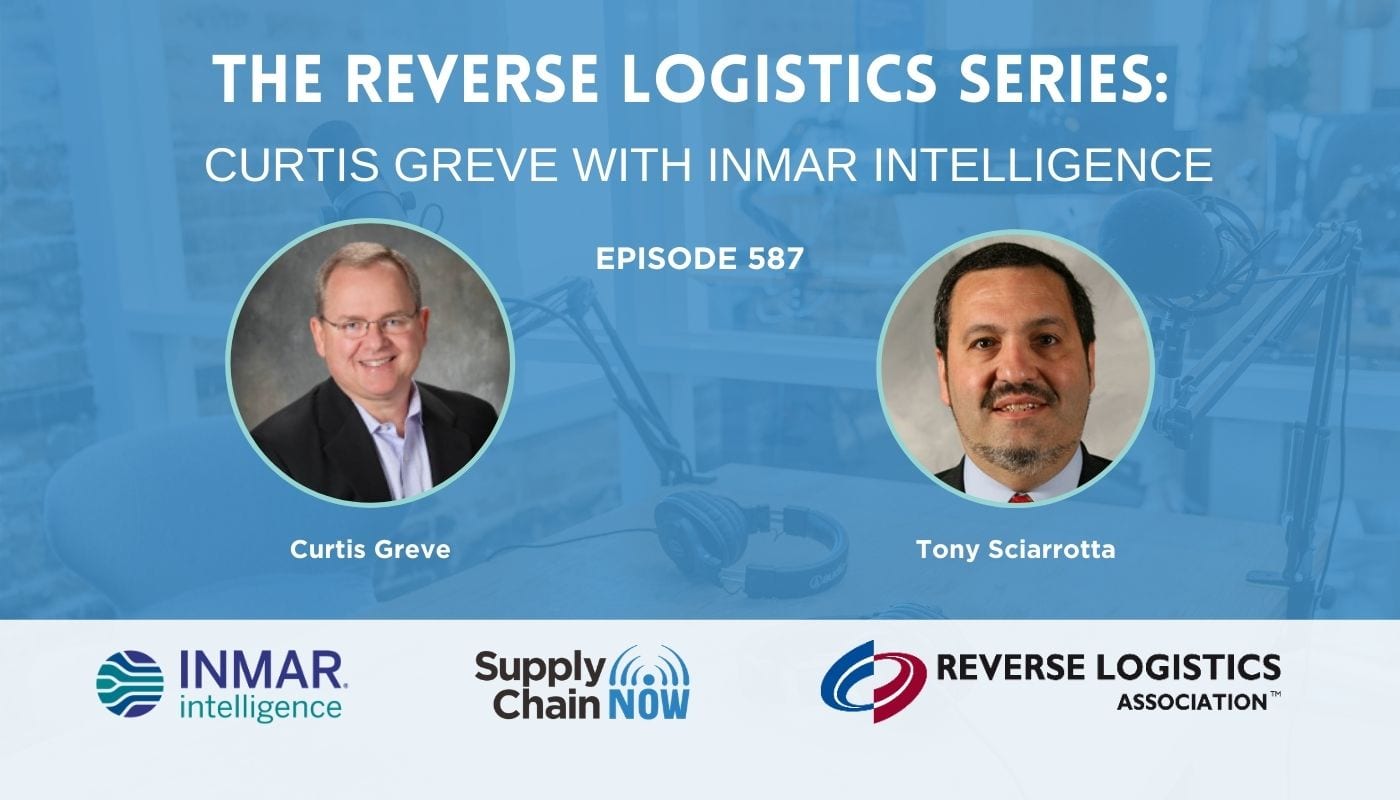
On this episode of Supply Chain Now, Curtis Greve, Vice President of Liquidation and Remarketing for Inmar- the largest reverse logistics provider in the US, and Tony Sciarrotta, Executive Director of the Reverse Logistics Association, provide their insights as part of the Reverse Logistics Series.

Curtis and Tony join Supply Chain Now Co-hosts Greg White and Scott Luton to discuss:

· The importance of approaching returns and reverse logistics through an expansive ‘ecosystem’ approach

· How the market value of goods affects the returns process, whether they can flow through traditional reverse logistics or need alternate handling to protect brand value in the eyes of the consumer

· Ways in which retailers can improve the customer experience starting at the moment of purchase to streamline and even minimize the need for returns

More Podcast Episodes
market demands
play-button-podcast
podcast-blue-microphone
Podcast
September 26, 2025

The Buzz: A New Era of Geopolitical Challenges

In today’s episode of Supply Chain Now, we dig into the imperative nature of supply chain transformation in the current global landscape, characterized by incessant change and complexity. Welcome to The Buzz, powered by EasyPost! Today, hosts Scott Luton and Jake Barr welcome special guests Pierre Abou Hamad, Managing Partner USA with Citwell, Inc., and Koray Kose, Founder and Chief Analyst with Kose Advisory. The conversation includes: The multifaceted challenges faced by supply chain leaders, particularly in the context of heightened geopolitical tensions and evolving market demands Critical insights from industry leaders, who stress the necessity of embracing innovation and adaptability as key strategies for navigating these turbulent times The importance of effective communication and the cultivation of a resilient organizational culture that fosters continuous improvement. Tariff impact on coffee prices Join us as we embark on this exploration, and reflect on the profound implications of these discussions for the future of supply chain management.   This episode is hosted by Scott Luton and Jake Barr, and produced by Trisha Cordes, Joshua Miranda, and Amanda Luton.   Additional Links & Resources Check out all the great resources and information mentioned during the show: With That Said EasyPost Supply Chain Dive…
knowledge
play-button-podcast
podcast-blue-microphone
Podcast
February 23, 2026

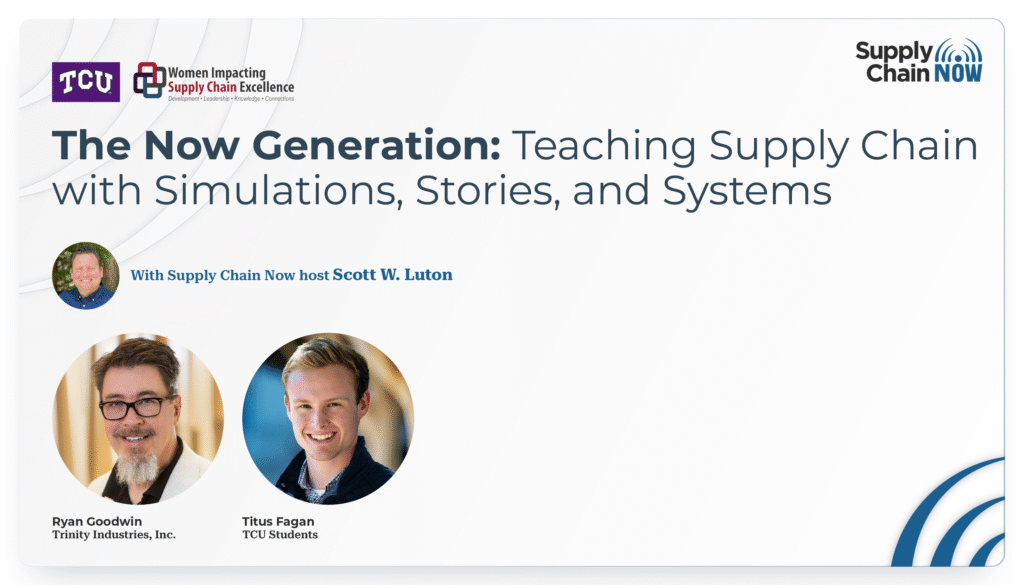
The Now Generation: Teaching Supply Chain with Simulations, Stories, and Systems

As supply chain technology accelerates, the ability to translate operational knowledge into scalable systems is becoming a defining advantage for both companies and early-career talent. In this episode of Supply Chain Now’s Now Generation series, Scott W. Luton sits down with Ryan Goodwin, Sr. Director of Supply Chain Technology & Innovation at Trinity Industries and an adjunct professor at Texas Christian University, alongside Titus Fagan, TCU Student Body Vice President and a third-year accounting major with a minor in energy business. Ryan shares how his team is integrating planning, MRP, and financial data into platforms that enable faster automation and application-building, often with the help of AI and “vibe coding,” where non-traditional builders can create real tools without a formal software background. Titus brings the student lens, explaining why practitioner-led teaching changes the classroom experience, how simulation-based learning builds cross-functional thinking, and why early responsibility and collaboration are top priorities when evaluating future employers. Together, they explore how AI can lower barriers to entry, accelerate skill development, and reduce manual work while also raising bigger questions about infrastructure, power demand, and the bottlenecks that can slow even the most innovative systems. From freight reporting automation to energy transmission constraints, this…

Supply Chain Now – Episode-587

Share: