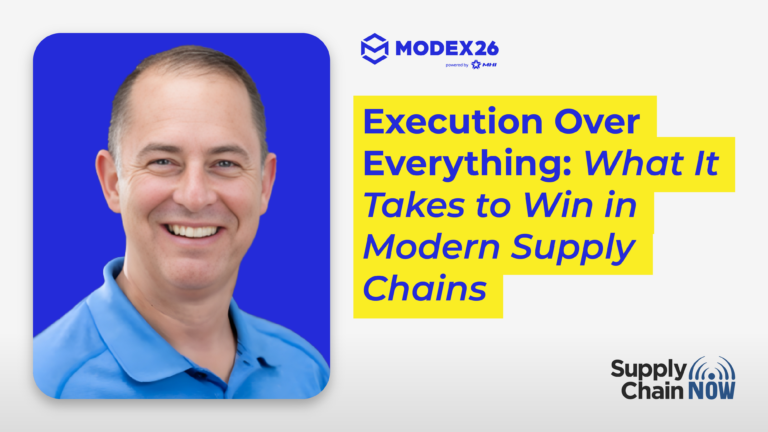
Execution Over Everything: What It Takes to Win in Modern Supply Chains
At MODEX 2026 in Atlanta, Scott Luton sat down with Tevon Taylor, Senior Vice President of Contract Logistics at Pegasus Logistics Group, for a candid conversation about what’s really driving success (and failure) in today’s supply chains.
From tariffs and AI to warehouse inefficiencies and leadership mindset, Taylor’s perspective cuts through the noise with a simple truth: technology matters, but execution matters more.
Disruption Is the New Normal
If there’s one constant in 2026, it’s disruption. Tariffs, geopolitical uncertainty, and shifting trade lanes are no longer occasional challenges. They’re baked into the system.
“You can’t stick to the old methods of running your supply chain. You must constantly find new ways to gain resilience,” Taylor explains.
That resilience starts with flexibility. Companies that rely on rigid, linear networks are increasingly vulnerable. Instead, supply chain leaders must rethink how they design and operate their networks.
Taylor emphasizes the need for multi-threaded strategies: nearshoring, domestic sourcing, and diversified transportation routes. In short, supply chains must evolve from static systems into adaptable ecosystems.
AI Is More of a Requirement Than a Buzzword
While some technologies come and go as industry cliches or flavor of the month, Taylor is clear that artificial intelligence is different.
“I don’t think AI is a buzzword. I think if you don’t adapt… it’s going to hurt your business,” he says.
At Pegasus, the impact is already tangible. Tasks that once required dozens of employees (such as manually tracking shipments across partner networks) are now being automated with AI-driven tools. What used to take days, like reviewing and redlining contracts, can now be completed in minutes.
But Taylor is quick to point out that automation isn’t about eliminating people; but rather, it’s about elevating them. The time saved allows teams to focus on higher-value activities like customer service and problem-solving.
The Hidden Costs Lurking in Your Warehouse
One of the most overlooked areas in supply chain operations is hidden cost, particularly within warehouse environments. According to Taylor, the real issue isn’t billing discrepancies or invoice errors. It’s inefficiency.
“If you have inventory accuracy that’s poor, along with excess touches, damages, bad forecasting… those are the hidden costs,” he explains.
These inefficiencies compound quickly, driving up operational expenses and eroding service levels. Taylor also highlights workforce composition as a key factor. Warehouses overly reliant on temporary labor often struggle with quality and consistency.
“You shouldn’t have more than 30% temps in a warehouse… otherwise you don’t really have your own warehouse,” he notes.
The solution lies in building a stable, engaged workforce and fostering a culture of continuous improvement, where employees are encouraged and rewarded for identifying better ways to work.
Rethinking 3PL Partnerships
When it comes to selecting third-party logistics providers, Taylor sees a recurring mistake: focusing too heavily on price. Organizations often default to large, recognizable providers or choose the lowest bid based on transactional pricing. But that approach can backfire.
“3PLs are not interchangeable… they all have their strengths and weaknesses,” Taylor explains.
He advocates for a more collaborative model, including gain-share and pain-share agreements that align incentives between provider and customer. This ensures both parties are invested in long-term success, not just short-term cost savings.
Perhaps most importantly, Taylor stresses realism. Warehouse transitions are complex, and any promise of a “seamless” implementation should be viewed with skepticism.
The Growing Divide: Adopters vs Laggards
Looking ahead, Taylor predicts a continued growing divide between organizations that lean into the Golden Age of Supply Chain Technology and those that resist it.
“The gap between companies that embrace technology and those that don’t is going to widen very quickly,” he says.
Interestingly, he doesn’t believe large enterprises will automatically win. Smaller, more agile companies often have greater incentive – – and fewer barriers – – to adopt tools like AI and automation. The real differentiator will be speed: the ability to make decisions faster, adapt to disruptions, and recover quickly.
Leadership Matters: Embrace Failure, Enable Growth
Technology alone won’t close the gap. Leadership plays a critical role in shaping how organizations respond to change. Taylor highlights a key trait of successful leaders: a willingness to accept failure as part of innovation.
“Failure is okay. Fail fast… let people take chances,” he says.
This mindset encourages experimentation and continuous learning, which are both essential in a rapidly evolving environment. Leaders who create space for calculated risk-taking are far more likely to unlock new opportunities.
Final Takeaway: Technology Is the Tool & Execution Is the Differentiator
MODEX 2026 showcased an incredible array of technologies, from robotics to AI-driven analytics. But for Taylor, the takeaway is straightforward:
“Technology is not the answer. Execution is.”
The organizations that succeed won’t be the ones with the flashiest tools. They’ll be the ones that implement the right tools effectively, align them with real-world operations, and empower their people to deliver results. In today’s supply chain, there are few constants.
But Taylor names one: “Some things just don’t change. Execution isn’t just important. It’s still everything.”
Where to Learn More
Connect with Tevon Taylor on LinkedIn. You can also learn more about Pegasus Logistics Group by visiting their website: https://www.pegasuslogistics.com/. Finally, find Tevon Taylor regularly on Supply Chain Now, as he co-hosts a variety of shows, including this recent livestream focused on “Uncertain Times, Skittish Consumers, and the Impact on Shipping Costs”.
More Blogs
The Sustainability Voice Missing From Most Boardrooms