[00:00:00] Madeline Creasman: So we have an earlier access to information. And information, it could be storytelling, it could be, other geographical locations throughout the world and their circumstances. So that allows us to have more empathy, more perspective when we’re going into the workforce. That is very plausibly the reason, the catalyst for us being disruptors when we go into the supply chain world.
[00:00:32] Scott W. Luton: Hey, good morning, good afternoon, good evening, wherever you may be. Scott Luton and special co-host, guest co-host, esteemed co-host, Liz Raman, with you here on Supply Chain Now. Welcome to today’s show. Hey, Liz, how are you doing today?
[00:00:48] Liz Raman: I’m doing great, Scott. Thanks for having us
[00:00:50] Scott W. Luton: You bet. I was trying to get all those superlatives in.
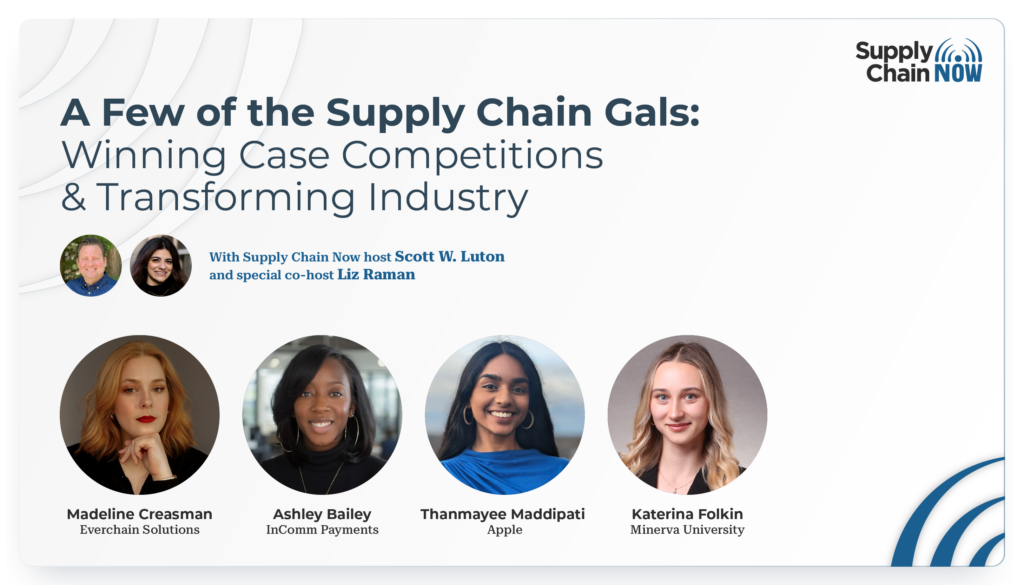
[00:00:53] Scott W. Luton: Uh, you know, it’s great to have you back. We had a great sit-down about a year or so ago. That was a lot of fun, and you’ve brought a ton of very talented friends here today. Special show we got teed up as we welcome in an incredible panel of talented, talented business leaders. In fact, we’re featuring the winning team that took home the first place ribbon in the 2026 case competition that was hosted by Liz and Supply Chain Gals.
[00:01:18] Scott W. Luton: But beyond learning more about that topic and that story, we’re gonna be exploring how some say that senior supply chain leaders, well, they regularly underestimate the next generation coming into industry or already here. We’re gonna be sharing some practical advice as to how organizations and leaders can better engage and support early career talent.
[00:01:38] Scott W. Luton: All of this and much, much more. And Liz, as I mentioned, great to have you back. Most folks will know that you’re the founder and CEO of Supply Chain Gals. More on that in a moment. But are you ready for today’s conversation, Liz?
[00:01:50] Liz Raman: Absolutely. I’m excited for it
[00:01:53] Scott W. Luton: We are too. So folks, stick around for a great conversation. It’s gonna be offering up tons of actual insights by the truckload.
[00:02:00] Scott W. Luton: Okay, so what I’m gonna do, we’ve got a big panel tonight. We can, we can solve the world’s ills tonight with this panel, I can, I can promise you. So I’m gonna introduce them all, and then we’re gonna get to know them. So I wanna start with, uh, Madeline Creasman, founder and CEO with EverChain Solutions.
[00:02:16] Scott W. Luton: Madeline, how
[00:02:16] Scott W. Luton: you doing?
[00:02:18] Madeline Creasman: I’m doing well, Scott. How are you?
[00:02:20] Scott W. Luton: Wonderful. Great to see you. Uh, then Ashley Bailey, inventory analyst with Income Payments here in Atlanta. Ashley, how you doing?
[00:02:28] Ashley Bailey: I’m doing fantastic. How are you doing today, Scott?
[00:02:30] Scott W. Luton: Uh, and then Thanmayee, Muddy Patty, Global Supply Manager with Apple over there in San Francisco. Thanmayee, how you doing?
[00:02:41] Thanmayee Maddipati: I’m doing well. Really excited to be here. Thank You
[00:02:44] Scott W. Luton: You bet. Uh, and then Katerina Folkin, uh, an operations and economics student at Minerva University there in San Francisco who’s just about to graduate. Katerina, how you doing?
[00:02:54] Katerina Folkin: Doing great. Very excited
[00:02:56] Scott W. Luton: We are too. All right, so Liz, we’re gonna get to a fun warm-up question in a second, but we got together before this show happened and, and you’re like, “Hey, I’ve got this incredible panel of leaders and we gotta get them on a show.” Liz, you’ve assembled this bit of, this bit of the A-team I hear, and I’m gonna look forward to diving into the story, but your quick comments about these four, uh, individuals here.
[00:03:17] Liz Raman: Yeah, this is a great team, really diverse backgrounds, um, all stages of careers here and really impressive. I’m excited for you all to learn from them.
[00:03:27] Scott W. Luton: and champions, and champions. So, and we even have a two-time champion. More on that in just a second. But what I want to do, I want to, before we get into the case competition and some, uh, some advice and some, um, expertise from this panel, I want to start with a fun warm-up question. And let’s do this. I’m gonna start with you, Madeline.
[00:03:47] Scott W. Luton: Uh, and I wanna, I wanna talk, you know, we’re, we’re approaching summer 2026 here in Atlanta, as Ashley well knows, and as Madeline, you’re not too far away from us. We got 127-degree temperatures right around the corner. Uh, hopefully we got some vacations and some feats and some, uh, outdoor festivals with AC or whatever, uh, whatever, we get our summertime cool down from.
[00:04:15] Scott W. Luton: So Madeline, I want to ask you, what is one thing you’re looking forward to here in the summer of
[00:04:19] Scott W. Luton: 2026?
[00:04:21] Madeline Creasman: Well, Scott, definitely escaping the heat. I’m gonna be traveling quite a bit. I think a couple of the cities I’m looking at are New York and Seattle. Um, but definitely trying to escape the heat as much as possible.
[00:04:31] Scott W. Luton: Same, same. Uh, I, I’m thankful for air conditioning. Whenever we hit early May, um, and Ashley, I’m coming to you next ’cause we’re, we’re almost in the same zip code, I think. Um, we are thankful for our air conditioning in Atlanta and certainly in Savannah. But Ashley, what are you looking forward to, uh, coming up here in summer of 2026?
[00:04:51] Ashley Bailey: Well, I’m actually a Georgia peach and I’m used to this heat, so it doesn’t bother me too bad actually. Um, so I’ll just be hanging out with my kids. Uh, my son is actually an artist and he, um, he actually, he’ll be doing a summer program as dad for the summer. So I’m excited to just kinda let him immerse into that.
[00:05:08] Ashley Bailey: And yeah, I’m just, I’m a total mom, so I’m all about the kids. So whatever they’re doing, that’s what I’m excited about for the summer.
[00:05:14] Scott W. Luton: I love it, Ashley. Love– Sounds like a great plan. And please, I- I’ve, I’ve lived here for over 20 years, and then I grew up in the South Carolina heat. You gotta give me your tips. You, uh, I, I gotta become a fellow Georgia Peach
[00:05:27] Scott W. Luton: Thanmayee, let’s ask you. Got a big summer of 2026 coming up. What’s one thing you’re looking forward to?
[00:05:33] Thanmayee Maddipati: Well, one of them, thanks for this opportunity ’cause I love– I forgot how funny Ashley is so organically, so that was lovely. Um, but second, um, I, it’s actually my first year living in California where, one, I’m blessed with sub 127 degree weather and also, um, the amount of nature. So I’m now a proud owner of the National Park Pass, so I’m super excited to take advantage of that at the California National Parks and all the national parks on the West Coast this summer
[00:05:57] Scott W. Luton: That is outstanding. Please send us pictures. I’m, I’m jealous already. Um, all right. So Katerina, same question, and you’re not too far away from Dunmy. Uh, what’s your big plans here this coming summer?
[00:06:11] Katerina Folkin: Yes. I wish it was like Thanmayeeee’s because I would love to see all the parks. Um, but after I graduate, I head back home and then going on a well-deserved Europe trip. So hoping to hit London, Portugal, and a couple other cities. So very excited.
[00:06:24] Scott W. Luton: All right. That sounds outstanding as well. Uh, all right, so Liz, you’re gonna be the cleanup hitter with this response. What’s your big plans for the summer of 2026?
[00:06:33] Liz Raman: It’s my first Seattle summer, but I am also a Georgia peach, so I’m trying to find some swimming pools and, and I’m a little jealous of the heat you guys are experiencing.
[00:06:46] Scott W. Luton: We will pack it up, send it your way, no tariffs. Uh, I’m telling you what. Uh, but we’ll see. You know what? I c- I can’t complain. It really is, we’ve had a great long, mild spring, and, uh, we can’t complain. Uh, well, I hope you all have a wonderful summer because you’ve had a wonderful start to your year already, and I look forward to learning, uh, from each of y’all here.
[00:07:08] Scott W. Luton: So let’s do this. Let’s level set, now that we’ve kind of learned a little bit more about you personally, let’s learn about, a little bit more about you professionally, and let’s level set on how you found your way into global supply chain and a little bit about your current role. And Madeline, we’re gonna start with you again.
[00:07:24] Scott W. Luton: Tell us more
[00:07:25] Madeline Creasman: Sure. So my
[00:07:26] Madeline Creasman: background’s actually in agriculture. I went to University of Florida, got a degree in ag comm and education, and it was the peak of COVID when I graduated. So some of the jobs that were avail- available to me, uh, were, you know, Amazon operations. So moved to Memphis, dove headfirst into Amazon operations and loved all things supply chain.
[00:07:47] Madeline Creasman: And now fast-forward about five years later, and I’ve actually started my own supply chain consulting firm with a focus on sustainability. So it’s kind of an intersection of my background in agriculture and my love of supply chain.
[00:07:59] Scott W. Luton: Madeline, love it. And go Gators as well, right? You got to be careful in Georgia. Man, I got, I got to look over my shoulder when I say that. Um, Madeline, that’s outstanding, and I love that, um, you’re a fellow entrepreneur. We’ll have to, uh, uh, compare notes on that later. Um, all right. So Ashley, same question.
[00:08:16] Scott W. Luton: Uh, how’d you find your way into industry and your current role?
[00:08:19] Ashley Bailey: So yeah, I actually don’t think there was like a single moment where I feel like I found, uh, my way into supply chain because I think once you understand what operations is, you realize that almost everything is supply chain. Um, I actually started in healthcare operations, um, specifically working like with appeals and dispute resolutions for providers.
[00:08:38] Ashley Bailey: that’s where I learned a lot about like process improvement, issue resolution, and then like what happens when systems actually break down. then I actually started my own beard care product business, um, where that’s kind of where, where I really got like my first hands-on exposure to kind of like, um, supply chain, because there I was sourcing products, managing inventory, coordinating packaging, and also selling at trade shows.
[00:09:01] Ashley Bailey: So I was getting everything, um, from top to bottom firsthand, like right then and there, without even really recognizing that that was supply chain. I think the moment that it actually like all came together for me though, is when I started being an FBM, fulfillment by merchant, uh, seller on Amazon.
[00:09:19] Ashley Bailey: And that was something that really is just so high volume that I was able to really see how every operational decision basically connects back to the customer experience and supply chain. Um, I think that being a part of space like Supply Chain Gals, this group, has been so wonderful to help me connect to those experience more and realize like what it is to be a part of supply chain and the different areas that I wanted to explore, which has kind of brought me a little bit more into data analytics, ’cause Liz did a great class on last, um, data analytics for Supply Chain Gals that kind of sparked my interest a little bit more, um, into AI and machine learning.
[00:09:54] Ashley Bailey: So now I’m actually currently getting my master’s in computer science, um, with a focus on AI and machine learning. And right now I work for, um, Incom Payments as an inventory analyst, and I’m just learning every day and building on those experiences that I have taken in.
[00:10:09] Scott W. Luton: Ashley, you’re right. It’s not a single moment. That’s, that’s thousands of moments you were describing. I love that, Ashley. all right, so this is, this is fascinating, these journeys just from what Ashley and Madeline have shared. Thanmayee, tell us about how you found your way into supply chain and a little more about your current role
[00:10:25] Thanmayee Maddipati: Yeah. How, so how supply chain found me, honestly, was when I joined my undergraduate at Indiana University. Um, I was in the Kelley School of Business, and like most undergraduate students, I had no idea, like, which business pillar would be for me. Um, so luckily, the first event on this self-discovery journey kind of became my last because I got to attend a faculty panel hosted by the supply chain professors of the school.
[00:10:47] Thanmayee Maddipati: And there was a professor there that I still remember to this day was doing their research on humanitarian logistics, and he proposed this question of like, here’s what supply chain professionals answer. And it was, how do we get resources to communities in need as effectively and efficiently as possible?
[00:11:00] Thanmayee Maddipati: And something of that ethos clicked immediately of like, I want to spend my time and invest my career answering that same question for people again and again. So, um, as I studied supply chain, I later on added sustainable business, um, and in the future aim to intersect and find harmonies of the two, similar to the work that Madeline is already doing and started, um, so early in her career, which has been great to hear about.
[00:11:24] Thanmayee Maddipati: And, uh, I locked in procurement as the part of the pillar to learn how to build relationships and kind of be at the focus of decision-making, which landed me, uh, a role, right after grad, uh, po- graduating at General Mills in procurement, and then now has found me, um, at Apple here in San Francisco, as well.
[00:11:42] Scott W. Luton: Outstanding. And, you know, you, you brought up humanitarian logistics earlier. I want to give a, a shout-out to, to a nonprofit that’s hopefully on everybody’s radar. Um, ALAN is its acronym, but it’s American Logistics Aid Network, and they do incredible work getting aid to communities in need, especially after disasters.
[00:12:00] Scott W. Luton: So, uh, a lot of good stuff there, uh, Thanmayee. Um, all right, so Katerina, uh, tell us same thing, how you found your way in the industry and a little bit more about your, uh, current role. you’re a graduating student, but you’ve also had some other cool roles, huh? Tell us more
[00:12:15] Katerina Folkin: Yeah, absolutely. I definitely started where Thanmayeeee started, where I came into university knowing that I want to do business, but not exactly what track to take. And once I had a conversation with a student and realized, let me jump into operations and see what that looks like. And so since then, I’ve been studying operations and economics at Minerva University, and I will be graduating in a week, which is very exciting.
[00:12:38] Katerina Folkin: But I think alongside that, my interest in supply chain also really took off during my time at Tesla, where I was in supply chain recruiting and helped launch their first supply chain rotational program. So I was actually taking business systems classes at the same time, and so I’d be learning new terminology in my classes, and next day I was scanning through resumes with that exact terminology that I just learned, and it was such like a full circle moment applying my classes.
[00:13:03] Katerina Folkin: And that really just taught me how much I love, you know, solving complex problems within supply chain and operations. And I’ll actually be going into the finance space in a few months, and I’ll be doing product development at JPMorgan.
[00:13:15] Scott W. Luton: Outstanding. Well, congratulations. Uh, now Liz, I’m coming to you next. Comment first, before we talk about Supply Chain Gals, make sure everybody understands what this powerful organization does. We just heard four different versions of how I think Thanmayee put it, industry found all four of these, these, uh, these leaders.
[00:13:35] Scott W. Luton: Your comments here, Liz
[00:13:36] Liz Raman: Yeah, I think it’s a true testament to your opportunities in supply chain, whether you study supply chain and that’s how you break into it, or you decide to come in later on in your career. There’s so many different ways that you can go with it. And we always say at Supply Chain Gals, if you’re part of an organization that delivers a product or a service, you’re part of the supply chain
[00:13:59] Scott W. Luton: I love that. And as, uh, I think Ashley put it, everything is supply chain, I think is what Ashley said. And I’m, I’m so wholeheartedly… You know, folks, folks don’t understand, um, out there that maybe haven’t s- you know, spent minute in this industry, even if you’re in the information business, you still have a very vibrant supply chain behind that or anything other that might be im- intangible to folks.
[00:14:21] Scott W. Luton: Um, so Liz, Supply Chain Gals clearly is a, is a strong common thread amongst others between the five of y’all. Tell us more about Supply Chain Gals.
[00:14:30] Liz Raman: Yeah. Um, Supply Chain Gals was truly started by the community for the community. I started sharing my personal career story through content creation, and people started reaching out to me saying they had never seen someone who looked like themself in supply chain until they found me. So I said, “That’s a huge problem.
[00:14:50] Liz Raman: There’s so many of us out here doing amazing, interesting work.” And so that’s why Supply Chain Gals was started, and the community has continued to ask us for more programming, more virtual events, career workshops, opportunities to network, and we’ve responded to all of those requests. So Supply Chain Gals is an official, uh, 501(3) nonprofit organization with over 30,000 followers, 120-plus active members, a case competition, a Visionary 50 Award for the top leaders in supply chain, and so much more is coming.
[00:15:28] Liz Raman: Um, it’s Supply Chain Gals is the place where you come to learn, and we’re just getting started.
[00:15:34] Scott W. Luton: Just getting started. And that’s a lot. That, that
[00:15:36] Scott W. Luton: starts, that’s a big start, Nutliz. Um, all right, so let’s, let’s do this. This next segment, we’re gonna, uh, be talking with this winning team about the case competition. And if you would, level set first. I think this is the second annual case competition at Supply Chain Gals.
[00:15:53] Scott W. Luton: Tell us about it at a high level and a little bit about how it is structured.
[00:15:56] Liz Raman: Yeah, definitely. This year’s case competition was centered around a fictional beauty brand called Lumiere Beauty. The goal was to mirror the kind of strategic exercise you find in a corporate environment, not just a textbook case. So we had 75 participants across 5 countries, 19 US states, all given the same case, all required to develop their recommendations in a team independently.
[00:16:25] Liz Raman: We had people asking to join the wait list of the case competition after it sold out weeks after we started, so there was a ton of excitement around this. The format was really tight by design. Each team had five minutes to present an executive summary followed by Q&A, because it’s one thing to build a deck, but it’s another thing to be able to defend your thinking under pressure in a room with executives.
[00:16:53] Liz Raman: And so our executive judges were very impressive, very diverse. We had Kenta Gates, the VP of Supply Chain at Glossier, Pradeep Raman, the VP of Customer Success at Microsoft, Augustine, the VP of Logistics at Mitsubishi Power, Jill Dao, the Senior Director of Global Procurement at Pepsi, Lisa Woodis Backlund, the SVP at Partstown, Erin Donnelly from The Home Depot, and Cherry Heinisch, the CEO of Supply Chain Revolution, come and give feedback for the teams, um, because getting that real feedback from executives on the way you think is something that’s so rare to find earlier on in your career.
[00:17:36] Liz Raman: So it was really exciting to have this opportunity for the supply chain gals.
[00:17:40] Scott W. Luton: Well, two quick comments. What an incredible judges panel, uh, from across industry. I recognize some of those names, including Supply Chain Queen. Uh, I loved her, her most recently awards that she rolled out. That was awesome. Um, and then secondly, the demand. Uh, you had to, had to roll out a waiting list because folks wanted to be like this group here and, and compete.
[00:18:01] Scott W. Luton: I love that. And I know we’re at the end, folks. Um, if you’re a potential sponsor out there or a potential competitor, we’re gonna make sure we, close the loop and make sure we y’all know how to, participate, be a part, and support, and engage the effort here. Um, okay. So, and as Liz said, just getting started.
[00:18:18] Scott W. Luton: This is only year two of the CASE Competition. So back to the panel. Um, and Katerina, I’m gonna start with you here. I got a two-part question I want to g- get each of y’all to respond to and kind of speak to. Number one, speak to a critical moment in the CASE Competition when you’re like, “Oh my gosh, the competition’s on, the stakes are real.
[00:18:38] Scott W. Luton: You got a bunch of teams, all want first place.” And then secondly, how did your team decide and prioritize what mattered most as you built the, the
[00:18:46] Scott W. Luton: solution?
[00:18:48] Katerina Folkin: Great question. I think one moment for me
[00:18:51] Katerina Folkin: was usually the day before the competition. We had done all our research, came together and realized there is so much content we have, so many parts to the solution. How do we present such a complex answer in under five minutes? Uh, so really usually that day is where we would choose what content we prioritize, what should stay in our pitch versus what parts can we just put on the slides or take out.
[00:19:13] Katerina Folkin: And I think in a real meeting, you may only have a few minutes to present to your boss or to the team. And so I think it came down to what were our values? What did we think was the most important part of the case competition prioritizing to kind of answer the questions that were given. And I think we did a really great job as a team highlighting our differences and moving forward towards that same goal together.
[00:19:36] Scott W. Luton: Hmm. Under five minutes. Oh my gosh, I can barely say my name, uh, in, in three minutes. Uh, all right. So following up to Katerina, uh, Thanae, speak more to those two questions there
[00:19:48] Thanmayee Maddipati: Yeah. So I honestly thought the stakes were high the whole time, and I know there might be some eye rolls about a cop-out answer, but I say that to say something that I didn’t even anticipate taking away was, um, how our team navigated that so intuitively was, I was really surprised and very proud of the way we celebrated our strengths in the way that we, um…
[00:20:10] Thanmayee Maddipati: Something I see in my workforce is supply chain. Everything is urgent right now, obviously, with everything going on, just like kind of this competition, this quick turnaround of deliverables needed, and a lot of work can be dumped and then divvied out by a task. But what our team did so well is intuitively know like what are our strengths and apply them.
[00:20:25] Thanmayee Maddipati: So for example, like Madeline was kind of like anchor leg in this Olympic race, like knew how to tie everything together, clean everything up, make sure it, it like all was consistent and synergistic with our solution. Ashley really was good at like double-clicking into the math, making sure like, yes, we have a great tool and we are great presenters, but like are we really having data-driven decision-making?
[00:20:44] Thanmayee Maddipati: Of course. And then Katerina was a great scriptwriter as well, like she talked about and brought such good energy, um, and perspective as like also being a student as well. So, um, that was something I didn’t even expect and now apply a lot in my teams in my career. Um, and so I’m grateful for that.
[00:20:58] Scott W. Luton: Outsta- all right, so Liz, really quick before I go on to Ashley and Madeline, comment on especially Thanmayee’s, uh, kind of how she bro- broke out the roles and functions and the strengths. Your thoughts, Liz
[00:21:09] Liz Raman: Yeah, I think that’s a really smart way to break it up and let everyone play into their strengths. And I really liked her point around how everyone does have something great to offer to the team. I think a lot of people make the mistake, um, in their careers in general of saying they can only learn from people who are further on in their
[00:21:30] Liz Raman: career or more senior or more executive.
[00:21:33] Liz Raman: Um, but even students have a great new perspective they’re bringing to the industry that we should learn from
[00:21:39] Scott W. Luton: Yes, Liz. As, um, as a wonderful person I sat down at MODEX this year, RD Deshmukh, uh, former Amazon executive, now at ID Logistics, he encouraged folks to have a day one mentality. And that’s such a, a great piece of advice kinda you’re speaking to. Um, all right, so Ashley, same two questions. What was that moment, if there was one, there might have been hundreds to your earlier response, and then secondly, how did your team kind of decide what mattered the
[00:22:05] Scott W. Luton: most?
[00:22:06] Ashley Bailey: Well, I’m gonna be honest. When you are the returning champion, the stakes are already high from the beginning. Um , the stakes were real the entire time though, I will tell y’all that. Just, just kidding. Just a little humble brag there . Um, but honestly, once that twist was introduced halfway through the competition, man, things stopped feeling theoretical and they started feeling more like a real disruption s- scenario for us.
[00:22:32] Ashley Bailey: Um, we had already built one solution through the first part of the case, and then suddenly we had to reassess our priorities and solve for multiple connected problems with that twist at once. I think what strengthened our approach was realizing that we couldn’t just treat those issues separately, um, especially because we had supply disruption, impacts to inventory, um, retail relationships were threatened, and demand was, was threatened all at the same time.
[00:22:59] Ashley Bailey: So we had to look at all of those issues, and I think it was better that we looked at them as one connected operational system. Um, that way everything just really became clear to us. I think a big part of that though came from, um, like Liz was talking about, Kenta Gates actually came in and spoke to us before, VP of supply chain operations at Glossier.
[00:23:17] Ashley Bailey: Shout out to her again. Um, she gave a great, um, speech to us before, and she really brought home the idea that make sure that you’re solving for the who and let the facts and the data support the story that you’re trying to tell in this competition. I think that really shaped how we approached the case, um, and it forced us to really think beyond just numbers and recommendations.
[00:23:39] Ashley Bailey: I think every operational decision impacts real customers, retail partners, internal teams, and the overall brand experience. So we made sure to solve for all of those issues
[00:23:51] Scott W. Luton: I believe you, Ashley. Uh, you present a very compelling case, no pun intended. And it sounds like Lumiere Beauty, if I have that, that fictional company right, that the case was built around, had lots of challenges, lots of real world challenges at that. Um, all right, so Madeline, uh, same two questions. Was there a specific moment where the stake where it was like, “Okay, we got to get this done.
[00:24:12] Scott W. Luton: We got to get the blue ribbon”? Um, and then secondly, like your fellow team members have, shed a light on how you made decisions and how you prioritized. Your thoughts, Madeline
[00:24:23] Madeline Creasman: Sure. I mean, as they’re talking, I’m reliving every, every moment of it. We– From the beginning, we cared so much about the work we were doing, so the stakes felt high the whole time because we cared about the work we were putting out. But I would say the moment for me that stuck out the most was after the, the first part, so I believe the, the semifinals.
[00:24:43] Madeline Creasman: Uh, so we did our questions and we got our feedback from the judges, which was amazing that we got feedback from judges. And, you know, we took that and we pivoted and we threw it into the finals. And I think the largest feedback we got was being able to hold water when it came to questioning. And when we came into the finals, um, we made it a, a little dramatic but fun.
[00:25:06] Madeline Creasman: So we, formatted the presentation like a war room. So our intro line was, “Welcome to the war room.” And it felt like that. You know, the disruptions that we had, they were very, they were very realistic. Um, and in real situations like that, you have to be reactive. Uh, you have to, you know, have that, uh, urgency.
[00:25:25] Madeline Creasman: Um, but yes, I mean, working with these women, we all took it very seriously the entire time and it was very refreshing.
[00:25:33] Scott W. Luton: Sounds like it. And, you know, Madeline, of course, of your, uh, colleagues called you kind of like the, uh, the anchor, the cleanup hitter maybe. Um, and, you know, feedback is a blessing. It doesn’t always feel like that, but it really is. a great friend once shared that with me, and I’ve, subscribed to that notion ever since.
[00:25:50] Scott W. Luton: Um, Liz, we just heard four, different views, but also, again, about common threads amongst the four. And c- and you could tell the passion that these four panelists brought to this case competition, brought to the experience, brought to the solution. I mean, are you ready to launch another one next week, Liz?
[00:26:10] Liz Raman: I, I should. I mean, every year
[00:26:14] Liz Raman: these case competitions get more intense. People are so passionate about it, um, and they really put their heart and soul into these presentations, um, so that they can win the, the annual Supply Chain Gals membership for the following year. So this team did a, did a really great job, and some of the crisis they were speaking to included a supply disruption from an earthquake, a brand that went viral at the beauty company, um, a Sephora on-time fulfillment penalty that was reaching almost $2 million.
[00:26:53] Liz Raman: So they had a lot of challenges to pick from, and most teams picked a lane, and this team really built a system for their answer, and they structured their response really well into a three-phase plan with financial outcomes. They quantified everything. They didn’t just say, “We should air freight some SKUs.”
[00:27:15] Liz Raman: They showed exactly which SKUs they were thinking about, why, what it would cost. Um, and in the Q&A, they didn’t get rattled when the judges gave feedback or asked really tough questions. They pushed back and they had numbers and, uh, thought really, thought through their answers very well. So, um, this is exactly the kind of thinking that gets you hired, gets you promoted at the top levels in your career, and it’s the kind of thinking that Supply Chain Gals is helping people to develop
[00:27:47] Scott W. Luton: I love it. And I love that line you
[00:27:49] Scott W. Luton: shared, Liz. Uh, and this isn’t– Hey, we’re not throwing stones at any team, but, you know, in any, in any competition, there are the differences that make up the folks that finish first and, and folks that do well but don’t quite finish first. And, and you mentioned a lot of folks picked a lane, and this team built a system.
[00:28:07] Scott W. Luton: Liz, I love that. That’s a great T-shirtism. Um, all right, so let’s do this. Let’s talk about, let’s kind of get past the case competition. Well, really quick, Liz, if folks want to, since we’re still at the case competition, if they want to get on the waiting list for next year, or if they maybe want to judge or volunteer to judge, or if they want to sponsor, because you need spon- you know, any nonprofit needs sponsors to, to do this kind of work, they reach out to you, Liz, is that right?
[00:28:32] Liz Raman: Yes. Yeah, please reach out to me directly if you want to sponsor, get involved, and give back. Um, if you want to participate, it will open up, uh, a month before we launch the case.
[00:28:44] Liz Raman: So it’s usually around February or March you’ll start seeing the event come out on, um, our social media channels
[00:28:53] Scott W. Luton: Outstanding. and folks, if you want to be a part of what you saw Ashley and, uh, Thanmayee and Katerina and Madeline speak to, and the passion and the experience, uh, folks, we need sponsors to make this happen. So please reach out to Liz and the S- Supply Chain Gals team to make it to, uh, to do just that.
[00:29:12] Scott W. Luton: Um, all right, so let’s, let’s move a little bit broader out beyond the case competition. I wanna get all of y’all’s thoughts on, on a couple related topics. And Ashley, I’m gonna start with you here. You know, what do, in your view, what do s- senior supply chain leaders that many would say consistently underestimate, you know, the next generation or what we call the now generation, either coming into the field or maybe they’re n- they’re new, right?
[00:29:37] Scott W. Luton: They’ve just graduated or, or they’re, maybe they’re in their first year, first couple years. Um, what do they, what do you think are the, is the biggest misstep? What’s the biggest misconception or the, or the, the underestimation of the next generation, Ashley?
[00:29:54] Ashley Bailey: So honestly,
[00:29:55] Ashley Bailey: I… think that sometimes senior leaders underestimate how much real-world transferable experience the next generation actually can bring into supply chain. Like earlier when you asked your first question, like how did we get into supply chain? We all come from so many different backgrounds, and I didn’t even realize I was in supply chain.
[00:30:12] Ashley Bailey: So it’s like that, first of all, a lot of us, we have experience, we just don’t even realize that it’s transferable. Um, so I think senior leaders making sure that they’re not underestimating that, um, because a lot of us have come through different areas like e-commerce, startups, myself, healthcare operations, and we already naturally think cross-functionally.
[00:30:32] Ashley Bailey: We don’t see supply chain as just like one department. We see the
[00:30:35] Ashley Bailey: full ecosystem behind products, information, how the experiences move,
[00:30:40] Ashley Bailey: Um, so I think that the next generation
[00:30:43] Ashley Bailey: can, can really give us a lot more than senior, um, leaders are really maybe necessarily
[00:30:49] Ashley Bailey: realizing.
[00:30:50] Ashley Bailey: Um, I think also the next generation has a healthy level of
[00:30:53] Ashley Bailey: curiosity when they look at the field. Um,
[00:30:56] Ashley Bailey: they ask questions. They challenge outdated processes. We don’t like to keep doing what, you
[00:31:01] Ashley Bailey: know, what the system did for 20 years before that you thought worked. We like to
[00:31:05] Ashley Bailey: challenge those things, give new ways to do things, um, look for, for ways for data and technology, and now automation to improve how the operations are working overall.
[00:31:15] Ashley Bailey: I think that curiosity is what’s gonna push the next generation forward, um, and helps us not only maintain, but keep growing and evolving our systems so that they can improve.
[00:31:27] Scott W. Luton: Ashley, completely agree. And it’s also, uh, to take your point a step further, it’s what’s gonna change industry. And at, at a time we gotta change industry, right? We got some old and new challenges, uh, and that natural curiosity, I mean, there are so many different points there, but that natural curiosity is so critically important, as well as, uh, uh, not settling with outdated and old-fashioned and, and, “Hey, we’ve, we’ve always done it this way,” type of thinking.
[00:31:51] Scott W. Luton: Love it, Ashley. Um, all right. So, Thanmayee, same question. We’re gonna get to your advice, the whole panel’s advice, uh, with the next question about kind of what to do and how to engage, but just let, let’s kind of define the problem a bit. You know, what do… What’s, what’s the recurring, um, misconceptions about the next generation of supply chain leaders make?
[00:32:12] Thanmayee Maddipati: I think both of you said it very well, and something I will say is we are always told, you know, the supply chain’s being disrupted. And I think younger generation like myself, I’ve noticed, is like we are also not afraid to disrupt the business processes in which the company wants to build its
[00:32:29] Thanmayee Maddipati: supply chain too.
[00:32:29] Thanmayee Maddipati: Um, so I think it’s like, it’s a two-way street in that relationship with supply chain, um, with the disruption. And ways I’ve seen it,
[00:32:37] Thanmayee Maddipati: um, in the misconcep- where I think, and maybe it can maybe just be maybe not underestimation or even more so, like please start to expect, or what I’ve noticed as a theme is even sitting in procurement where you have a lot of executive decision-making power, because climate education is being more advertised
[00:32:55] Thanmayee Maddipati: and built in curriculums in supply chain schools,
[00:32:58] Thanmayee Maddipati: um, that builds a train of thought of, yes, we can have a 30,
[00:33:01] Thanmayee Maddipati: 60, 90 solution to the firefighting issues we face everyday and we are hired to solve.
[00:33:07] Thanmayee Maddipati: But I think even with our case, we saw like our team did really well of adding on, uh, looking around
[00:33:12] Thanmayee Maddipati: every corner of like what is also the long-term solution that we are building
[00:33:17] Thanmayee Maddipati: with the
[00:33:17] Thanmayee Maddipati: 30, 60, 90 day. So I think what people or senior leaders
[00:33:21] Thanmayee Maddipati: can start to expect is no more just a band-aid,
[00:33:24] Thanmayee Maddipati: but our solutions, we might take time to really disrupt the process because the supply chain is being disrupted too
[00:33:31] Scott W. Luton: Liz, really quick, before I move on to Madeline and, and Katerina, you gotta respond to what we heard there from Ashley and Thanmayee
[00:33:38] Liz Raman: Yeah, I think they both really elaborated on things that we, we really need coming in the age of AI, um, being ready for disruption, being ready for change. So much is going to change in this industry, and we definitely need voices like these leading organizations as they head into this uncertain future.
[00:33:59] Liz Raman: So I think it’s really exciting to hear
[00:34:02] Scott W. Luton: It is an exciting time. And this, this, this conversation here will make you wanna, what makes me wanna kinda run through the wall behind me. Uh, it’s really good stuff. And we’re only halfway. Let’s get the other, um… And then we’re talking about how the supp- supply chain leaders out there can oftentimes m- uh, underestimate what the next generation is capable of.
[00:34:23] Scott W. Luton: And, and Madeline, let’s go to you, your thoughts
[00:34:25] Madeline Creasman: Yes. So what Tamaye said about us being disruptors, I could, I could give you
[00:34:30] Madeline Creasman: my opinion on what could be the catalyst for that. So we have an earlier,
[00:34:34] Madeline Creasman: uh, access to information. And information, it could be,
[00:34:37] Madeline Creasman: storytelling,
[00:34:38] Madeline Creasman: it could be, um, you know, other
[00:34:39] Madeline Creasman: geographical locations throughout the world and their circumstances.
[00:34:42] Madeline Creasman: So that allows
[00:34:43] Madeline Creasman: us to have more empathy, more perspective when we’re going into the
[00:34:46] Madeline Creasman: workforce. And so that
[00:34:49] Madeline Creasman: is
[00:34:50] Madeline Creasman: very, like, plausibly the reason, the
[00:34:52] Madeline Creasman: catalyst for us being disruptors when we go into the supply
[00:34:55] Madeline Creasman: chain world.
[00:34:56] Madeline Creasman: We have the big picture. Uh, We lead
[00:34:58] Madeline Creasman: with empathy. We lead with, you know, what are the
[00:35:01] Madeline Creasman: actual outcomes of
[00:35:02] Madeline Creasman: this decision? And I’m definitely seeing more of a focus on sustainability and ethics because of this, because of the access to information. But then we also, you know, compound that with the new age of AI that we’re going into. we’ve got a lot of fast-moving parts here, uh, for young leaders.
[00:35:19] Madeline Creasman: We’re very resilient
[00:35:21] Scott W. Luton: Yes. And it’s tough to keep up with because, I mean, you, uh, you, you talked about the compounding factors, plus you got the velocity of global business right here, and tomorrow’s gonna be faster, the next day it’ll be faster. But y- you mentioned in front of your response, empathy. there’s so much tremendous power around that uniquely human, uh, trait.
[00:35:43] Scott W. Luton: Uh, and I love that that came up here. Uh, Katerina, same question. How do folks underestimate the next generation, uh, folks out there leading supply chains? Your thoughts
[00:35:53] Katerina Folkin: Yeah, absolutely. I think Madeline just had a great response overall and inspired me when she was
[00:35:58] Katerina Folkin: talking about perspective.
[00:36:00] Katerina Folkin: Uh, speaking from my
[00:36:01] Katerina Folkin: own POV, I’m about to graduate in a week. I have seen so much. Personally, I’ve also gotten the opportunity to live and work in six countries over the past years as part of my program, And this taught me so much about how to be perceptive, how to adapt and be open-minded and curious, and I think those are all traits that You can bring into the
[00:36:19] Katerina Folkin: workforce, especially within supply chain. And as you guys mentioned about AI, it’s becoming a big part of our
[00:36:25] Katerina Folkin: day-to-day. So how do we make sure we adapt alongside
[00:36:28] Katerina Folkin: AI to improve our workflows or rather than have AI replace our jobs? So I think there’s a lot of excitement around this term. But there’s also a big future ahead in how we navigate this change and how we become adaptable to everything that’s happening.
[00:36:44] Scott W. Luton: Liz, two thoughts there. Um, number one, Dr. Stephanie Thomas from the University of Arkansas mentioned, uh, at MODEX, again, a little sit down, that she sees students, members of the next generation, you know, picking up AI-driven tools faster than many instructors and employers. That’s exciting.
[00:37:01] Scott W. Luton: Something Cat- Katerina and others just mentioned. And then secondly, uh, Katerina mentioned she lived in six different countries, lived and worked in six different countries. You know, supply chain’s a pretty unique industry in that it’s really, it’s the world’s greatest team sport, right? And, and being able to work through different customs and traditions and cultures and, and be able to, to, to
[00:37:22] Scott W. Luton: really, um, recognize that and lean
[00:37:24] Scott W. Luton: into and celebrate it, I mean, I think that also gives the folks that can do that, whether the next generation or others, a leg up in, uh, being more successful.
[00:37:34] Scott W. Luton: But Liz, comment there, um, give us your views in terms of this underestimation of the next generation that, that a lot of folks see, and why communities and initiatives like Supply Chain Gals is sorely needed to address these gaps
[00:37:48] Liz Raman: Yeah, I think sometimes the next generation gets a bad reputation, um, but hearing among this group and even some students I’ve spoken with, Supply Chain Gals members, you’ll notice that they’re very curious, they’re very ambitious, and they’re excited to be here and to learn. Um, so I think only good things are coming from this generation of leaders coming up. Um, Supply Chain Gals is so needed because I think a lot of the times leaders have to focus on their low performing talent and how to coach them, how to improve, that they miss these high potential leaders that need a space to learn and to cultivate their curiosity so they continue to be high performing in the organization.
[00:38:40] Liz Raman: So Supply Chain Gals is one of the very few spaces that I know of that gives people this opportunity and this community to come together. I think it’s a great opportunity for leaders in the
[00:38:54] Liz Raman: industry to recruit this
[00:38:56] Liz Raman: talent, or if these voices sound like someone on your team, to send them our way so that your high potential people and your teams can join Supply Chain Gals.
[00:39:07] Liz Raman: We have corporate memberships built exactly for that, and it’s one of the most tangible ways that you can show your team that you’re serious about their development, that you value their contributions by putting them inside of this community of professionals who are actively helping each other level up in their careers.
[00:39:25] Liz Raman: If you’re a senior leader that wants to give back, build your presence as a thought leader in supply chain, this is a talent pool that will follow you in your career. These are the people who are going to be running the supply chain in the next five and 10 years. So the community is here and it’s ready for you to become a part of it.
[00:39:46] Liz Raman: We’d love to have you
[00:39:48] Scott W. Luton: Outstanding. And hey, I’m a member, Liz. I’m, I
[00:39:50] Liz Raman: Yeah.
[00:39:50] Scott W. Luton: need to get one of these, I need to get one of those cool backgrounds like all y’all
[00:39:54] Scott W. Luton: have, but I am a
[00:39:55] Scott W. Luton: member. Uh, and kidding aside, that is,
[00:39:57] Scott W. Luton: um, th- there’s so much in, in the why here, why to get involved, why, whether you’re,
[00:40:03] Scott W. Luton: um, you know, wanna be involved in the case competition, wanna get into the,
[00:40:06] Scott W. Luton: you know, networking with the community, or if you wanna be a company or a supply chain leader
[00:40:10] Scott W. Luton: or business leader that wants to support, you know, these eureka moments, these connections, and, and these, uh, this, these professional journeys,
[00:40:17] Scott W. Luton: there’s room for all of y’all.
[00:40:18] Scott W. Luton: So reach out to Liz and Supply Chain Gals. Um, all right, so let’s do
[00:40:22] Scott W. Luton: this. Uh, I think Liz said earlier, one of y’all said, I think it was Liz said
[00:40:26] Scott W. Luton: earlier, that it’s not just
[00:40:29] Scott W. Luton: the
[00:40:30] Scott W. Luton: 30-year industry veterans that can give advice and expertise and, and
[00:40:34] Scott W. Luton: give, um, you know, guidance. Anyone in any of their journey, and all of y’all are gonna give us valuable guidance now and expertise now because we’ve got a bunch of leaders either listening or they’re,
[00:40:46] Scott W. Luton: they’re, they’re tuned into YouTube or, you know, watching the conversation.
[00:40:50] Scott W. Luton: I wanna get all of y’all to give advice to them, especially folks that, that
[00:40:54] Scott W. Luton: genuinely want to engage and support early career talent. So, Thanmayee, what would be your advice to those folks that really mean well, they’ve just been taking the wrong approaches or what have you? What should they do?
[00:41:08] Thanmayee Maddipati: I think to put short and sweet, like what do we crave right now? And I am coining this off of, uh, me being in my mid-20s, something I heard in
[00:41:15] Thanmayee Maddipati: social media all the time of like third social spaces, but like where
[00:41:19] Thanmayee Maddipati: are the third spaces for supply
[00:41:21] Thanmayee Maddipati: chain? And I know Liz just talked about Supply Chain Gals, and I want to give a lot of
[00:41:25] Thanmayee Maddipati: recognition.
[00:41:25] Thanmayee Maddipati: It’s my first time doing the case competition. I’m so glad I did, and I feel like it scratched our brains the right way
[00:41:30] Thanmayee Maddipati: because like I mentioned
[00:41:31] Thanmayee Maddipati: throughout my, uh, other answers here
[00:41:33] Thanmayee Maddipati: of you can quickly get into the
[00:41:35] Thanmayee Maddipati: same ethos or synergy within the company you’re in. Um, but something that was so refreshing was the diversity and thought that
[00:41:42] Thanmayee Maddipati: this third space provided
[00:41:43] Thanmayee Maddipati: us.
[00:41:44] Thanmayee Maddipati: Um, so continuing how to have these, you know, civil discourses of supply chain in various platforms outside of the industry or company you work in, um, will, would be just so lovely to see and something I hope to continue on after this ca- this competition.
[00:42:01] Scott W. Luton: Love that, uh, Thandi. It’s so true. It’s so true. I think, I think even outside walk of life, I think certain sectors just cluster together, right? And th- they stay in this one pond. And, and it’s, and you know, it’s not a bad thing, but it really is limiting, right? Uh, and it, and, and we wonder why we have, you know, talent engagement and, and recruiting and, and development challenges.
[00:42:25] Scott W. Luton: Well, this is one big reason. That’s great advice. Uh, all right, so Madlyn, same question. Those leaders that really wanna make a difference and engage and support the early career talent, your thoughts?
[00:42:35] Madeline Creasman: Yes. I would say the best way to support us. and this would be in my opinion, my experience, would
[00:42:40] Madeline Creasman: be, be flexible, welcome new perspectives. Let us rub off on you a
[00:42:43] Madeline Creasman: little bit. you know, be, be open, uh, to the new
[00:42:46] Madeline Creasman: perspective and you know… I mean, we’re, we’re contrasting and we have, you know, four or five different generations in the workplace, so there’s gonna be some major players at play there.
[00:42:57] Madeline Creasman: Uh, so definitely let us rub off on you a bit
[00:42:59] Scott W. Luton: I like it. I like it. What a challenge. Uh, good stuff, Madeline. Um, all right, so Katerina, you’re next. You, what would be your advice to supply chain leaders out there?
[00:43:08] Katerina Folkin: Yeah, I would say that a lot of us, we’re very curious, very excited, and we want to bring true value to the team and not just be an observer. Uh, we wanna take ownership or ask questions, solve problems early on. And I think what’s really interesting to me is understanding why we operate in a certain way or why senior leaders are making certain decisions.
[00:43:28] Katerina Folkin: And the best mentors I’ve had were able to take, you know, my day-to-day task and explain the bigger operational picture behind it, which made my work feel a lot more engaging and a lot more valuable because I knew how I was contributing and why, you know, we were doing things the way we did them.
[00:43:45] Scott W. Luton: Katerina, I love it. And I love the first part of your response. Don’t want to just sit there and be an observer. To all the observers out there, no offense, takes all kinds. But, Uh, all right, so Ashley, your thoughts, what would be your
[00:43:59] Scott W. Luton: advice
[00:44:00] Ashley Bailey: Um, so I actually completely agree. I’m gonna piggyback off of what
[00:44:03] Ashley Bailey: Katerina
[00:44:03] Ashley Bailey: said And also Liz said earlier, and Femi. Every– all of us actually have been
[00:44:07] Ashley Bailey: saying kind of the same thing, keeping the same thread.
[00:44:10] Ashley Bailey: Um, just making sure that they don’t
[00:44:13] Ashley Bailey: underestimate how
[00:44:14] Ashley Bailey: impactful access and visibility can be for people
[00:44:18] Ashley Bailey: coming into the system.
[00:44:19] Ashley Bailey: Um, programs like Supply Chain Gals, they’re really important. You know, that third space like Femi
[00:44:24] Ashley Bailey: was talking about, is because they give people the chance to really apply what they’re learning in a way that really feels
[00:44:30] Ashley Bailey: real. Um, like I said, humble brag, this is my
[00:44:32] Ashley Bailey: second year competing and winning in Supply Chain Gals, and I can genuinely
[00:44:37] Ashley Bailey: say that I’ve grown leaps and bounds significantly, um, in between the last competition and this
[00:44:43] Ashley Bailey: first one. And it’s not just even, I would say, even just
[00:44:46] Ashley Bailey: technically, but how I think through how
[00:44:48] Ashley Bailey: problems, um, should be handled. I’m able to communicate more confidently
[00:44:52] Ashley Bailey: under pressure, and I really just approach, um, operational decision-making more confidently now that I’ve done
[00:44:59] Ashley Bailey: this. I think that those spaces like this
[00:45:01] Ashley Bailey: are the reason why we have to make sure that we’re still advocating
[00:45:05] Ashley Bailey: for those spaces and making sure that we’re presenting them to early professionals.
[00:45:08] Ashley Bailey: Um, and also to piggyback off what Katerina said, um, because yeah, we don’t want just jobs. We wanna understand. We want context. We wanna understand how you’re making that decision. We wanna understand how you’re thinking during the disruption and how the operations are affected during that time. Um, I think the more opportunities that leaders create for people
[00:45:28] Ashley Bailey: to contribute and really ask questions, the stronger the future pipeline can be
[00:45:32] Scott W. Luton: Well said. Well said. Um, all right. So Liz, um, I can’t wait to get your take here, but one quick comment that, that really all four individuals
[00:45:44] Scott W. Luton: touched on at some point during their response. Folks, um, this isn’t, I mean, we all wanna help, um, you know, folks that are maybe looking
[00:45:52] Scott W. Luton: for their next opportunity.
[00:45:54] Scott W. Luton: You know, there’s groups for that, and then there’s plenty of g- uh, I bet there’s some members, you know, in Supply Chain Gals that are
[00:45:58] Scott W. Luton: doing that
[00:45:59] Scott W. Luton: However, what I’m
[00:46:00] Scott W. Luton: hearing in this all four
[00:46:01] Scott W. Luton: responses is, is how this experience and their involvement
[00:46:05] Scott W. Luton: with Supply
[00:46:05] Scott W. Luton: Chain Gals is
[00:46:06] Scott W. Luton: enhancing their professional development in their current role, which of
[00:46:11] Scott W. Luton: course benefits their teams, their
[00:46:14] Scott W. Luton: current teams, current employers, and
[00:46:16] Scott W. Luton: of course their own professional
[00:46:17] Scott W. Luton: development
[00:46:17] Scott W. Luton: journey. That’s some powerful stuff.
[00:46:20] Scott W. Luton: But Liz, um, beyond your comments on anything you heard here from this panel,
[00:46:24] Scott W. Luton: uh, your advice to supply chain leaders out there
[00:46:28] Liz Raman: I would say don’t underestimate your impact. Your
[00:46:31] Liz Raman: presence is impactful in the spaces that you’re in, whether you’re showing up at our networking night
[00:46:38] Liz Raman: just to have conversation casually with folks,
[00:46:41] Liz Raman: or just like you, Scott, having the space for us to amplify our mission. It’s so impactful, and we’re so thankful we’re here, um, to help shed light on Supply Chain Gals.
[00:46:52] Liz Raman: So really appreciate the opportunity to share about the case competition experience and hope to see others sharing out, uh, their experiences at Supply Chain Gals because it only helps the network grow stronger, and we’re all only as strong as our network. So excited to keep bringing opportunities for people to learn and so thankful for everyone who helps us amplify our
[00:47:19] Liz Raman: mission and, and our journey in that way
[00:47:22] Scott W. Luton: Well said, Liz. And hopefully we can find some new supporters to help, uh, uh, incredible folks like the folks on this, uh, podcast here and all the folks at Supply Chain Gals, uh, amplify and further that mission and reach more folks. Uh, you know, I can’t remember who
[00:47:38] Scott W. Luton: said it, but someone said it earlier,
[00:47:40] Scott W. Luton: um, about it, it, it really doesn’t matter how things used
[00:47:44] Scott W. Luton: to be. And I don’t… I mean that in all, with all due respect.
[00:47:47] Scott W. Luton: I was sitting down with a, a, longtime friend, Brian Devine, that’s been in the workforce side of
[00:47:51] Scott W. Luton: industry for a long time, and he was talking about some of the
[00:47:54] Scott W. Luton: challenges with decision-makers out there that
[00:47:57] Scott W. Luton: when change is being pushed for in terms of how hiring
[00:48:00] Scott W. Luton: takes place, one of
[00:48:02] Scott W. Luton: the instant reactions is like,
[00:48:03] Scott W. Luton: “Well, back when I was doing this, XYZ
[00:48:06] Scott W. Luton: happened.” And we all like telling that
[00:48:09] Scott W. Luton: story, but really, it doesn’t matter. It doesn’t matter. It’s where we are now and where we wanna go. And I, I really appreciate what all five of y’all are
[00:48:17] Scott W. Luton: doing to, um, to, to drive that change, right? We respect traditions, and we respect experience out there, but hey, uh, you, we gotta respect folks that come from all levels of experience and places and walks of life.
[00:48:32] Scott W. Luton: So, a great conversation here today. I wanna go back around the panel. I wish we had three more hours ’cause we’re only getting a tip of the iceberg with all five of y’all. I know that. But I wanna make sure folks know how to connect with each of y’all. So, you know, they may reach out, they may wanna learn more about something you shared here, connect with you, network with you, you name it.
[00:48:50] Scott W. Luton: Have you come in and speak? Who knows? So let’s make sure, uh, starting with Madeline Krispin, uh, with, uh, Everchain Solutions. Uh, Madeline, how can folks connect with you, my friend?
[00:49:03] Madeline Creasman: So LinkedIn for sure. I have my personal account on there under Madeline Creasman. And then for Everchange Solutions, if you want to check out the work we do, I am very active on LinkedIn, very much a LinkedIn warrior, so feel free to
[00:49:13] Madeline Creasman: reach out. I’d love to chat
[00:49:15] Scott W. Luton: Outstanding. A LinkedIn warrior. I’m gonna steal that term from you. I love that. Um, all right. Ashley Bailey, inventory analyst with InComm Payments, fellow Atlantan, uh, fellow, uh, Hawks fan. We had a rough, rough end of season. Hey, next year will be better. But, but Ashley, loved your perspective, uh, today. How can folks connect with you?
[00:49:36] Ashley Bailey: I too am a LinkedIn warrior. We’re on the same– We’re part of the same tribe, Madeline and I. And, um, w- I’m
[00:49:42] Ashley Bailey: on LinkedIn as well. You can find me
[00:49:44] Scott W. Luton: A fellow LinkedIn warrior,
[00:49:45] Scott W. Luton: and we should make it, put it out there again, uh, I think the only two-time champion, uh, in the Supply Chain Gals case competition.
[00:49:55] Scott W. Luton: Good stuff. Uh, all right. Uh, Thanmayi Mudipati, Global Supply Manager with Apple. Uh, tell us, how can folks track you down?
[00:50:05] Thanmayee Maddipati: I think I have one more piggyback for this interview is also you can find me on LinkedIn, Bunmi Ladipate, you got my personal LinkedIn
[00:50:12] Thanmayee Maddipati: Happy to connect there
[00:50:14] Scott W. Luton: Outstanding. I tell you, I wish I had, uh, invented LinkedIn way back when, huh? I tell you. Uh, all right. Uh, Katerina Folkin, uh, a student, an operations and economics student at Minerva University, just about to graduate. about the time we publish the podcast, you will have been a graduate, undoubtedly.
[00:50:33] Scott W. Luton: Katerina, how can
[00:50:34] Scott W. Luton: folks connect with you?
[00:50:35] Katerina Folkin: You know, I wish I could be more creative, but also joining the LinkedIn warriors. You can find me on there, Katerina Folkin. I’m always available
[00:50:43] Scott W. Luton: Outstanding. Uh, all right. So Liz, Liz Raman,
[00:50:48] Scott W. Luton: founder and CEO
[00:50:49] Scott W. Luton: of Supply Chain Gals. Uh, always enjoy
[00:50:52] Scott W. Luton: our conversations.
[00:50:53] Scott W. Luton: Again, folks, you should go check out, we, we profiled Liz about a year or so ago. We’ll see if we can include that in the show notes. Great conversation there. But Liz, how can folks track you and Supply Chain Gals.
[00:51:05] Scott W. Luton: down?
[00:51:06] Liz Raman: Yeah. You can also find me on LinkedIn, um, and Instagram at itslizraman, and would love for
[00:51:13] Liz Raman: you all to also connect with Supply Chain
[00:51:15] Liz Raman: Gals. We’re on Instagram, ‘
[00:51:17] Liz Raman: LinkedIn, and
[00:51:18] Liz Raman: if you head to supplychaingals.com, like Scott, you can also become a member of this amazing community
[00:51:25] Scott W. Luton: Outstanding. And one quick follow-up question, Liz. We heard, you know, I- I’ve, I’ve taken a lot of chicken scratch notes ’cause it’s late in my time and my brain is working on fumes, but I’m
[00:51:38] Scott W. Luton: glad I captured. Man, we got, we had some
[00:51:40] Scott W. Luton: really good stuff come out of this incredible panel. So this is a very unfair question I’m gonna ask you, Liz, but I’m gonna ask you
[00:51:46] Scott W. Luton: anyway. If folks forget everything else from this whole conversation here today, what would you suggest they, they take with them? What’s one of your favorite key takeaways here?
[00:51:56] Liz Raman: I think it’s incredible how this group spent their weekends, their evenings preparing for a case competition for a fictional brand and really just take so much pride in the opportunity to
[00:52:07] Liz Raman: learn. So I think the main takeaway is, um, be really
[00:52:12] Liz Raman: conscientious of how you spend your time. And it’s so important, and make sure that you’re carving out some time in your busy lives to learn something new
[00:52:23] Scott W. Luton: I’m with you. Very well said. Very poetic. Good stuff there, Liz Raman. Um, I wish we had a couple extra hours. We’re gonna have to have him back. Uh, we’ll have to
[00:52:31] Scott W. Luton: cover the third case competition live. We’ll see how
[00:52:35] Scott W. Luton: that works. Pay-per-view. Um, I wanna thank the winning team, uh,
[00:52:40] Scott W. Luton: Madeline Creasman.
[00:52:41] Scott W. Luton: Thank you for being here, Madeline
[00:52:43] Madeline Creasman: Thank you, Scott and Liz
[00:52:45] Scott W. Luton: That’s right.
[00:52:45] Scott W. Luton: Uh, Ashley
[00:52:46] Scott W. Luton: Bailey, thanks so much for being here, Ashley. Uh, Thanmayi Mudipati, thanks so
[00:52:55] Scott W. Luton: much
[00:52:55] Thanmayee Maddipati: Thank you. Appreciate it
[00:52:58] Scott W. Luton: Katerina
[00:52:58] Scott W. Luton: Folkan,
[00:52:59] Scott W. Luton: thanks for being here
[00:53:00] Katerina Folkin: Thank you for having us.
[00:53:01] Scott W. Luton: You bet. And of course, the common thread
[00:53:04] Scott W. Luton: here, Liz Raman, great to see you again. Uh, really appreciate what you and Supply Chain Gals
[00:53:09] Scott W. Luton: do. Let’s do it again soon
[00:53:12] Liz Raman: Thank you
[00:53:12] Liz Raman: so much. Yeah, great to see you too
[00:53:16] Scott W. Luton: And to our Supply Chain Now global fam, I tell you what, what a great conversation. I really hope you enjoy the conversation as
[00:53:22] Scott W. Luton: much as I have. But you know the homework I’ve got to assign you because there’s so much actual perspective in what we heard
[00:53:28] Scott W. Luton: here from all
[00:53:29] Scott W. Luton: five of our esteemed guests. You gotta take at least one thing, one thing from all the good stuff that Liz and friends shared here today and do something with it, please.
[00:53:39] Scott W. Luton: Deeds not words, that’s how we’re gonna continue transforming global supply chain and leave no one behind. And with all that said, Scott Luton here challenging all of
[00:53:47] Scott W. Luton: our fam members, do good, give forward, be the change that’s needed. And we’ll see you next time right
[00:53:52] Scott W. Luton: back here on Supply Chain Now. Thanks everybody