[00:00:00] Dan Wrightsman: When you’re in with your infantry platoon or, and things, you know, you’re kinda, forced to be loud and kinda have to, people’s attention, or you’re just giving commands, have to do that. But for recruiting, it was really about
[00:00:09] Dan Wrightsman: getting out of my shell and being able to go up to somebody and say, “Hey, I’d like to talk to you about your future and what you got, your plans, and how maybe we can connect the Army.”
[00:00:33] Lloyd Knight: Welcome to the Tango Tango podcast. I’m your host, retired First Sergeant Lloyd Knight. And thank you to Supply Chain Now for being such a great, partner to w- work with and my producers, my friend,Scott Luton over there. Uh, happy, anniversary. Scott’s also an Air Force veteran, although people are watching this are like, “Oh, it’s past the, the birthday of the Air Force,” but we’re taping this on September 18th, the Air Force’s 79th birthday.
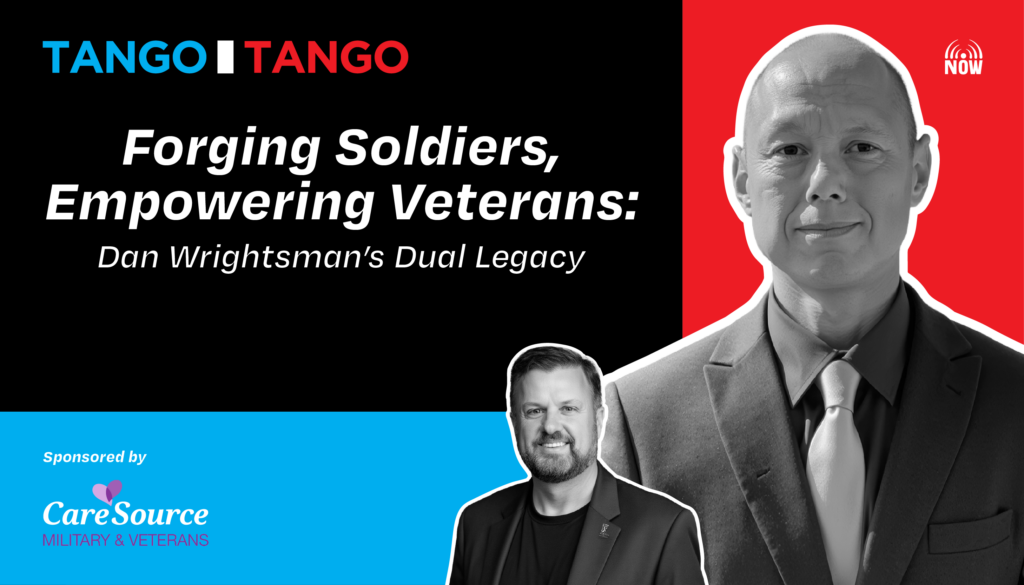
[00:01:02] Lloyd Knight: And also, thank you to CareSource Military and Veteran, a, our sponsors for this season, and, and that’s who I choose to, cover me for TRICARE. And today I have a great friend, a, fellow, Bush Institute Veteran Leadership, Program, a, classmate, and a director of, a operations, deputy director of operations for the South Carolina Georgia, Department of Veteran Affairs, Dan Wrightsman.
[00:01:31] Lloyd Knight: So welcome to the Tango Tango podcast, Dan.
[00:01:33] Dan Wrightsman: Thanks, Lloyd. Appreciate you having me here
[00:01:35] Lloyd Knight: so Dan’s a retired sergeant major, 30 years in, in the Army, and probably the quietest, sergeant major I’ve ever met. But, but Dan’s also a, a very intelligent guy. Dan’s great at, uh, listening.
[00:01:50] Lloyd Knight: so you are my EF Hutton, uh, Dan.
[00:01:53] Dan Wrightsman: Thanks. I appreciate that. That’s a pretty
[00:01:55] Dan Wrightsman: good compare– group to be compared to,
[00:01:57] Dan Wrightsman: so
[00:01:58] Lloyd Knight: Dan’s an army brat, but Dan’s, got a little bit, uh, yeah, a different, yeah, army brat story. So born in, South Korea and kind of walk us, through the story of how you became an army brat there, Dan.
[00:02:10] Dan Wrightsman: Yeah. So, my dad is originally from Nebraska, and he was in the Army. he met my mom when he was stationed in Korea. my mom’s Korean, but we’re not blood related. So my mom and dad, dated, got married, decided that they wanted to adopt some kids. so they adopted my sister, a year before me.
[00:02:30] Dan Wrightsman: again, we’re not related by blood, but, they adopted her, in 1971, and they “Hey, we’re doing such a great job. We enjoyed this so much. Let’s, adopt a boy.” so 1972, when my dad s- they were still stationed in Korea, adopted me. and so grew up in the Army from ’72 to about 1981 when my dad retired from the Army, but we stayed in Korea and still had that, Army lifestyle going there.
[00:02:55] Dan Wrightsman: So the being a student at the Department of Defense, Education School, Seoul American Elementary School, Seoul American High School, had the, experience of friends PCSing in, PCSing out, growing up, moving around. Even though we’re still in Korea, we definitely moved from place to place, in different neighborhoods, until we ended up in Texas, for a couple years when my dad went to seminary. and then we ended up in California, where I graduated high school,
[00:03:24] Dan Wrightsman: and joined the Army
[00:03:24] Dan Wrightsman: afterwards.
[00:03:26] Lloyd Knight: what part of California did you graduate high school?
[00:03:28] Dan Wrightsman: so a little town called Saratoga, California, just right on the outside of San Jose. High School. been so long ago, it was almost 36 years ago now. But, out of Saratoga, California, joined as an infantryman, spent 30 years there, just retired 2021 and, have enjoyed
[00:03:43] Dan Wrightsman: a, a great Army career
[00:03:45] Lloyd Knight: I was a product of the Department of Defense schools as well, and I, I’m just a couple, three years, older than you, and my dad retired, about the, same time as, as your dad, and, you know, I ended up in Fort Knox, Kentucky. So what did high school look like for you?
[00:04:02] Lloyd Knight: It, it must have been, kind of a culture shock ’cause you’d been around, you know, uh, military kids the whole time and now you transfer to a, a place that I, I guess I, I’m assuming that everybody had probably been, majority of the kids had been living in that town probably their whole high s- school careers.
[00:04:19] Dan Wrightsman: Yeah. So I was, uh, I mean, total transparency, I was not a great student. so when I was going to the military schools, in Korea, grades weren’t the best. And the, the best thing, I’m not knocking Texas education or California education, but the best thing is I went from a, a barely passing student in the military schools to a AB student in Texas and California.
[00:04:42] Dan Wrightsman: the difference in going to a Department of Defense, school to a, civilian school, a public school a complete culture shock to me.
[00:04:51] Dan Wrightsman: There were things that, I had grown up just thinking things were normal as far as, seeing certain things, that when I got to Texas, and even California that were not. and so a lot of it was just being more, kind of more, accepting of certain things, especially different type of relationships. And also how people dressed, and how people talked to teachers and, and different things, and how they of associated and, and kind of, their groups that they associated with. So that was, a big difference, for me going from, Department of Defense school to
[00:05:23] Dan Wrightsman: a, public school.
[00:05:24] Lloyd Knight: we have another
[00:05:25] Lloyd Knight: thing in common. I, I was not a good student so yeah, and I, I didn’t get As and Bs my last year of school. My late wife really kind of helped me through some of the, subjects I wasn’t doing very well in. so definitely have that in common.
[00:05:39] Dan Wrightsman: think what President Bush said at, a graduation that, you know, you too can be a C student and a president of the United States. I definitely, felt pretty good when I heard him say that. I was like, “Yeah, I don’t feel too bad now about, having the best grades,” so
[00:05:52] Lloyd Knight: Yeah. Well, that was a shtick ’cause he was a Rhodes scholar.
[00:05:55] Dan Wrightsman: Yeah.
[00:05:56] Lloyd Knight: So, what, what were your interests in, in, in that f- you know, your last couple years of, of high school? What’d you like to do?
[00:06:03] Dan Wrightsman: So I definitely, started playing, football when I got to Texas. first time playing tackle football. grew up in military school, we had flag football, so I played that, but tackle football was definitely, something I wanted to do and it was, uh,
[00:06:15] Dan Wrightsman: good experience, but a different experience. putting pads on and getting hit and doing two-a-days in this Texas heat was definitely different. got to California, the cost of living was just so much more expensive and we were, turned 16 and, had to go to work, in order to just, you know, be able to have some things afterwards and, and do things.
[00:06:34] Dan Wrightsman: So it was going to work, my last couple years in, school was my biggest thing. were, you know, hanging out with friends. I think typical high school stuff, hanging out with friends, going out and doing, you know, just different things I teenage kids do as far as like, bowling, movies, going to parties, different things. and then, joining the Army was something I knew I was gonna do, So I was trying to get ready for that.
[00:06:59] Lloyd Knight: Okay. So you you had the goal to join the Army after high school, for a while. It wasn’t a, it wasn’t on a whim?
[00:07:06] Dan Wrightsman: Yeah, I always knew I was gonna join the Army even when I was a, a kid. My dad always said that, yeah, you’ve– ever since you were– since I was a little kid, I was gonna join the Army, which, I knew I was gonna do. took me a little bit longer. Just something happened where, I didn’t join right after high school.
[00:07:22] Dan Wrightsman: It was about maybe seven, eight months later. but I joined the Army f- when I was about 19, and just knew I was gonna do that. That was– I looked at my dad and said, “Hey, my dad.” took care of my dad, my– and seeing other people growing up in there and seeing other people serve,
[00:07:39] Dan Wrightsman: I just knew the Army was something that I wanted to do.
[00:07:42] Lloyd Knight: All right, so you joined the Army infantry, so you had to port a, uh, Benning. hopefully it wasn’t, you didn’t go, you didn’t have a summer slot, so
[00:07:51] Dan Wrightsman: I’m glad I didn’t have the summer slide because Fort Benning, as you know, down in Georgia, Georgia heat’s no joke. so I went in November, as soon as I got there, had a long, layover, before at the reception battalion before I went to one station unit training. I got there, and a couple of days later, we had Thanksgiving dinner, which was great. got a good Thanksgiving, then we had a great PT session afterwards to work off all the, Thanksgiving, that we ate. and then we had Christmas exodus about, I think, maybe four weeks later, five weeks later.
[00:08:22] Dan Wrightsman: So I got a chance to, leave and, basic training for Christmas. I didn’t go home just because the cost of flying from Georgia to California, where my parents were, was pretty expensive. So what I did do was catch a bus, back to Fort Worth, Texas, and visited and stayed with some friends there, for the Christmas break. and then came back. It was right after New Year’s, January, so things are still pretty nice and cold in, Georgia, which I appreciated ’cause all the, all the bugs and vegetation died down. so it made basic
[00:08:51] Dan Wrightsman: training, a little bit better
[00:08:53] Lloyd Knight: So did you go to jump school right away?
[00:08:55] Dan Wrightsman: No, so I graduated.
[00:08:56] Dan Wrightsman: I never went to airborne
[00:08:58] Dan Wrightsman: school.
[00:08:58] Dan Wrightsman:
[00:08:58] Dan Wrightsman: I
[00:08:58] Dan Wrightsman: did go to ranger school
[00:09:00] Dan Wrightsman: so after we graduated one station training, I was part of a cohort unit and, so there was about 130 of that all went to infantry training together. And then we, went to Schofield Barracks in Hawaii.
[00:09:12] Dan Wrightsman: So spent the first three years, in Hawaii as light fighting– light fighter infantry, and had a great time. learned a lot of great things, a lot of, good leaders that I had there. the first battalion commander I had, Lieutenant Colonel McKnight, later went on to, ranger regiment
[00:09:28] Dan Wrightsman: in, uh, three seven five in Somalia.
[00:09:30] Dan Wrightsman: us a lot of great things. Had a lot of my squad leaders, and team leaders were from, ranger regiment down at the time. So really took a lot of time to invest in us and make sure
[00:09:40] Dan Wrightsman: that we were getting trained the right way
[00:09:42] Lloyd Knight: I had the opportunity to meet Randy McKnight a couple times, uh, here in, in Atlanta. Him and his wife, one of the things that just amazed me, they visit the fallen every year from Somalia, the graves. they do a road trip. an incredible leader. Wow, that you got to serve early on in your career with him
[00:10:01] Dan Wrightsman: Yeah. Had I known at the time, what he was teaching us and how he was teaching us, I probably would’ve appreciated more. But, you know, you’re a private and you just have a battalion commander kind of telling you, “Hey, this is what’s this, and do this.” like, “Okay, got it.”
[00:10:14] Dan Wrightsman: But always saw him at PT sessions. We always saw him during training sessions. He was a leader that you think of when they say, “Hey, the leader leads by example and the audio has to match the visual.” He was that kind of a leader. He would not ask you to do something that he wouldn’t do, and definitely held himself and the officers
[00:10:33] Dan Wrightsman: in the unit to a higher standard than everybody else.
[00:10:35] Lloyd Knight: Yeah. Outstanding. So you spent three years in Hawaii, which is absolutely amazing.
[00:10:40] Lloyd Knight: So what was your next assignment?
[00:10:42] Dan Wrightsman: from there I PCS’d, to Fort Lewis, Washington. spent, two years there. first got there, we’d just gotten, notified that we were going to GITMO, uh, Guantanamo Bay, to pull security on the Cuban and Haitian migrants that were trying to get into Florida. Uh, they were getting picked up by the Coast Guard and Navy, and brought there until they could figure out what they were gonna do with them. So I got there in January of ’95 to Fort Lewis, put my rucksack and everything together, and then got on a plane a couple weeks later, with my unit and went down to Cuba, Guantanamo Bay, and spent, six months there,
[00:11:20] Dan Wrightsman: It was where the family camp was at by the airfield. We spent six months there guarding the, family camp, so we weren’t over by Camp X-Ray. but six, first six months there, then we redeployed, to Fort Lewis, did the recon, went to Triab, joined the recon platoon, and then went to Panama for jungle operation training, which was a good time, good training.
[00:11:41] Dan Wrightsman: and then PCS to Korea after that.
[00:11:44] Lloyd Knight: what was it like, you know, being Korean American and growing up in Korea, what was it like to return?
[00:11:50] Dan Wrightsman: so I was on the DMZ. I was at Camp Greaves, and was able to go down to, Yongsan, Seoul, where I grew up at, for a living. Went, walked by the school, high school I went to, elementary school I went to, where I used to hang out as a kid and, and do things. it was different, especially being Korean, and not speaking Korean, was a little, different.
[00:12:11] Dan Wrightsman: being an adult, when you’re a kid is one thing, but as adult, made it a little interactions with Korean people a little different. but it was good to go back it was different to see how much Korea had changed too. when I was there, the, was more of a traditional Korean environment. but when I got back in ’98, I think it was ’98, they were more westernized. There was a lot more, Western influence.
[00:12:34] Dan Wrightsman: American fast food restaurants had kind of started springing up more. you could see the shift and change from where it was back in 1986 when I left to 10 years later, especially after the Olympics, that
[00:12:46] Dan Wrightsman: Korea just started com- become more westernized.
[00:12:48] Lloyd Knight: Yeah, I definitely see that now when I, the couple times I’ve returned, recently. So you, you do remote in Korea, and then what’s next?
[00:12:56] Dan Wrightsman: So I was in Korea and then went back to Hawaii afterwards, which is lucky. So I got to go back to Hawaii, spent three years there, and had, a-again, good experience with the, the unit there. one of the, the probably the best sergeant major I had, Sergeant Major Harrell.
[00:13:13] Dan Wrightsman: So he brought a lot of experience with him, especially, combat experience. had a great, company first sergeant, sergeant, squad leader, had a great team. I really enjoyed the second time around in, Hawaii as well, especially ’cause already been there, so I knew all the training areas, knew the places to go to, to have, enjoy and have fun.
[00:13:34] Dan Wrightsman: And I had a good that I was with, had good people there who cared about each other. and we definitely made sure that, you know, if somebody needed something, we took care of it. If somebody needed help, we helped them. and it was just a good,
[00:13:49] Dan Wrightsman: a good team to be a part of.
[00:13:51] Lloyd Knight: Wow. So, uh, you’re, you’re moving a lot. I, I mean, the way I see it, you’re in your first third of your career, and, you know, you have two assignments to Hawaii, you’re in Korea, uh,
[00:14:06] Lloyd Knight: uh, Cuba, and, and then Washington. So that’s quite a lot, especially for, for somebody young. But now you’re, you’re starting to mature a little bit. I imagine you’re, you’re climbing, uh, the ranks. Uh, so what was next for you?
[00:14:17] Dan Wrightsman: so I volunteered for recruiting duty, out in Sacramento, California. So I came to Fort Jackson for recruiting school, where I met my wife. so it’s been, uh, 23 years that we’ve been married, uh, and 25 years together. at the recruiting school, got stationed in Sacramento, California, and was out there, recruiting was hard. it’s challenging, especially with the Air Force. everybody seemed to wanna join the Air Force and kind of gravitated towards, uh, right next door to us, Air Force recruiting office.
[00:14:48] Dan Wrightsman: So it was, a great place to recruit, but we had to convince people to join the Army instead of the Air Force.
[00:14:55] Dan Wrightsman: so that was, that was the challenge for us
[00:14:57] Lloyd Knight: An army recruiter told me one time how he was successful was the office opened an hour prior to the Air Force office, and it, it closed two hours after the Air Force office.
[00:15:08] Dan Wrightsman: exactly. Yeah,
[00:15:10] Dan Wrightsman: Yeah.
[00:15:11] Lloyd Knight: that must have been challenging for you. I mean, you’re, you’re typically kind of a, a, a quiet, uh, person. what kind of growth did becoming a recruiter facilitated you?
[00:15:20] Dan Wrightsman: For me, it really was, more outgoing. When, you know, when you’re in with your infantry platoon or, and things, you know, you’re kinda, forced to be loud and kinda have to, to just people’s attention, or you’re just giving commands, you have to do that. But for recruiting, it was really about talking to people, and just going up to them and saying, “Hey, wanna talk to you about your future.
[00:15:41] Dan Wrightsman: Wanna talk to you about what you got going on, and have you ever considered the Army?” So it really was getting out of my shell and being able to go up to somebody and say, “Hey, I’d like to talk to you about your future and what you got, your plans, and how maybe we can connect the Army.” f-first person that I enlisted, the very first person I enlisted in the Army, was the very first person I talked to.
[00:16:03] Dan Wrightsman: Army assigned you a, mentor as a recruiter, so I went out with my mentor. we went to a place, he said, “All right,” so he just told me, “Hey, all you gotta do is go talk to somebody.” So, I went and talked to him and said, “Hey man, I just wanna sit and talk with you about, see what you got going on, and maybe you ever thought about the Army.” And he said he had thought about the Army. and he tried to join the Air Force, but the timing wasn’t right. But we ended up talking, had a, set an appointment with him, and he said, “Yeah, I’m ready to join the Army.” talked to him, his wife. He had a kid. and so they were all on board. and so was able to get him into the Army, I think, within the first two, three weeks of me being on recruiting duty, was a good thing.
[00:16:43] Dan Wrightsman: Everybody was happy with that. And so from there, that kinda just reinforced in my head that’s what success looks like on recruiting, is being able to go up and talk to people and say, “Hey, you know, whatever your future that you wanna have, whatever things you’d like to do, I’d like to show you how the Army can help you get there.”
[00:17:01] Dan Wrightsman: there was one young lady I talked to that I was actually kinda challenged with. she said she wanted to be a Disney princess that goes out in the parades out in Disneyland. she said she went there as a kid and saw that, and just thought that was the greatest thing ever, that she could be, one of the Disney princesses in the parade. And I could not connect the Army to that. I was like, “Well, I’m not sure how could do that.” But, I did have a good conversation with her because she’s great, a great person. but just I
[00:17:30] Dan Wrightsman: couldn’t connect the Army to
[00:17:31] Dan Wrightsman: that for her, so
[00:17:33] Lloyd Knight: how many years did you spend as a recruiter?
[00:17:35] Dan Wrightsman: spent three years,
[00:17:36] Dan Wrightsman: as a recruiter, so
[00:17:37] Dan Wrightsman: do you have a n- a total number that you recruited during that three years?
[00:17:40] Dan Wrightsman: I was actually I wouldn’t say I was a really great recruiter, but thir- uh, what, 30 months, I think, straight of recruiting two people, a month. So I think total was 36 people is what I ended up with for the entire,
[00:17:56] Dan Wrightsman: time. So,
[00:17:56] Dan Wrightsman: two people
[00:17:57] Dan Wrightsman: per month
[00:17:58] Lloyd Knight: So did you go back to infantry after you were done with, uh, that or how’d that look?
[00:18:02] Dan Wrightsman: so, I was on recruiting when 9/11 happened.
[00:18:04] Lloyd Knight: it didn’t speed anything up, like they still kept us our entire time, but, that was a, unique time on recruiting because a lot of people wanted to join. we got phone calls from people who said that, “Hey, I’m ready to go.”
[00:18:15] Dan Wrightsman: you know, some of the phone calls were guys who just got released from prison or had some other things that were going on. So there was a, big surge in people who wanted to join, but we had to kind of filter out to make sure– we still had standards that we had to follow, to make sure that we were recruiting the right, the right qualified people. after that, we went back to, the infantry. I PCS’d up to, Fort Wainwright, Alaska, where I was part of the 172nd and when I got there, we were, middle of January, it was freezing cold. There was ice, snow, everything on the road.
[00:18:51] Dan Wrightsman: we had to winterize our car, with battery blankets, oil adhers, and different things. but got to Alaska, we transformed from a light brigade to the Stryker Brigade, and so we did some training with our Strykers. did that for about a year, I think, and then we deployed to, Iraq, with, my first deployment, 2005, 2006, taking
[00:19:13] Dan Wrightsman: Strykers to Iraq
[00:19:15] Lloyd Knight: Yeah, Fort Wainwright was the coldest mission that I ever went on. We left Charleston and, and it was– I’m gonna, I’m gonna show my age. In 1989, it was Operation Brim Frost, and we left Charleston, it was 80 degrees, and we, we landed at Fort Wainwright, and it was minus 50. And it created some unique havoc with the aircraft.
[00:19:37] Lloyd Knight: Not so much on that stop, but the very next stop after the aircraft thawed out, and we had leaks everywhere. So you, you go to, um, you go to Iraq. Where’d you go in Iraq for your first deployment?
[00:19:49] Dan Wrightsman: Yeah. So our brigade was assigned to Mosul, and then, and then my company, we got, attached to, a cav squadron, so went out to Rawah. And we spent the first few months out there in Rawah attached to, I think it was 414 cav squadron. so we were an infantry, company attached to a cav squadron.
[00:20:10] Dan Wrightsman: spent three months, three months there, maybe a little bit more. And then we ended up going back to our brigade– excuse me, back to our battalion, over in Mosul. and we thought we were gonna head back, that June.
[00:20:23] Dan Wrightsman: lucky for us, we got extended, to go down and clear Baghdad. so the summer of 2006 is when we were supposed to head back, but then because we got extended, we didn’t actually leave until think December
[00:20:36] Dan Wrightsman: of 2006
[00:20:37] Lloyd Knight: And what rank were you at this time, Dan?
[00:20:40] Dan Wrightsman: that time I was a sergeant first class, E7
[00:20:43] Lloyd Knight: Okay.
[00:20:44] Lloyd Knight: So E7 sergeant first class. So your, your first time in combat, you’re leading troops in combat. what kind of learning curve did you have there? Were, were, did you have leaders that were, a set of leaders that were collaborating and, and, and helping with that?
[00:21:01] Lloyd Knight: Or did you have to just figure it out on the go?
[00:21:04] Dan Wrightsman: again, it was– I was very lucky I had good leaders. so Colonel Webster was our battalion commander, and then, our company commanders. We kind of went through a f-a few company commanders, just, just with the, with the turnover of, of, of commands. But I had three very good company commanders. had good first sergeant and good to, to me, really the best things I had good platoon sergeants, to my left and right.
[00:21:27] Dan Wrightsman: still friends with, one of them today, really good friends. he’s down here in South Carolina. we talk and text all the time. so having that group of people who had deployed and kind of just told me to lean on our training because the training is really what got us through and those repetitions of things that we did for, vehicle recovery, battle drills, casualty evacuation and different things is really what got us through that.
[00:21:52] Dan Wrightsman: And then extension, especially because it was a very no notice extension, we already had– our brigade had, I think, 300 people on our ADCON already back in Alaska. And then they said, “Hey, you’re gonna stay for another six months to, go clear Baghdad as part of the surge or pre-surge,” I should say. what got us, all of us through that was our group of people, our platoons, our teams, our platoon sergeants. And you know, it was a very emotional time for everybody, but that’s what got us through was, was, was just that great
[00:22:26] Dan Wrightsman: group of people that we had as part of our company
[00:22:28] Lloyd Knight: Yeah, I can’t imagine.
[00:22:30] Lloyd Knight: E- emotional for you and emotional for the families. So, so you get through that first deployment, return to Alaska, and then I imagine y- you, you didn’t spend too much, longer up there before your next assignment?
[00:22:42] Dan Wrightsman: I already had my next assignment going t- back to Fort Lewis. I was going to, Brigade, 2 ID, which was a brand new brigade. It was a, uh, another Stryker brigade, and we were standing that brigade up. it was really interesting to me though because all the battalion designations that we had in Alaska being redesignated down there.
[00:23:00] Dan Wrightsman: So the brigade I went to, I almost went back to the exact same battalion, 2-1, but then I ended up getting transferred over to, 4th Battalion, 23rd Infantry. we received our Strykers, did our training, and then, deployed to Afghanistan,
[00:23:14] Dan Wrightsman: 2009
[00:23:15] Lloyd Knight: So I, I imagine you were a, um, you were much more prepared, for that second deployment. But can you talk a little bit, for our viewers and listeners what the, you know, some of the stark differences be- were between, combat deployments to Iraq and Afghanistan?
[00:23:31] Dan Wrightsman: Yeah. So, an easy way to say it is, Iraq is more westernized and has city and power and a lot of things that you’re kind of used to, that you can find. reliable power sources. they’re a little bit more educated, so they read, so it’s easier sometimes to talk with them. You go to Afghanistan, it’s like going to the land that time forgot. it really is. There’s villages that have the same, mud huts that have been there for probably 100 years that generations of families have lived in. people there r- are not as educated, and so they don’t have a very strong, influence on other than what they hear other people tell them. and so they don’t know what’s really going on other than what’s inside their, their little community. and they’re very tribal. So there’s villages that we would go to that wouldn’t talk to the village that was maybe a mile down the, the road from them, because 150 years ago they killed their goat, and so they won’t talk to them or do anything to support them. it’s a very, very different, different way you have to interact with them as well, especially with all the tribals between north and southern Afghanistan, and just the way that the people are
[00:24:51] Lloyd Knight: so, uh, was that a, was that a six-month appointment, nine months?
[00:24:55] Dan Wrightsman: Oh, that was a 12-month appointment
[00:24:58] Lloyd Knight: Another 12 mile, another wow.
[00:25:00] Lloyd Knight: So the, uh, um, God bless your wife.
[00:25:03] Dan Wrightsman: Yeah.
[00:25:04] Dan Wrightsman: Yeah
[00:25:06] Lloyd Knight: So this is, this is starting to wrap up the second third of your career. And it sounds like you were gone for, most of that early part of your marriage for sure
[00:25:14] Dan Wrightsman: Yeah, probably the first six, seven years, with deployments and training and different things,
[00:25:20] Dan Wrightsman: didn’t spend a lot of
[00:25:21] Dan Wrightsman: time with, family
[00:25:22] Lloyd Knight: Yeah. And we have that in common too, but one thing was different for me being a crew member, I, I wouldn’t spend six, nine, 12 months a- away. I would, I would spend two weeks away and come home for three or four days, then go for a week and home for a day or two, go for a week or two. So, so, so a little bit different, but still the family’s are the sacrifice for that, for sure.
[00:25:45] Lloyd Knight: So, um, you come back to, Fort, Lewis. When did Ranger School happen, Dan?
[00:25:51] Dan Wrightsman: So Ranger School happened bef-
[00:25:52] Dan Wrightsman: when I got back to Fort Lewis the second time.
[00:25:55] Lloyd Knight: had tried to go to Ranger School before, but not a very good swimmer, so couldn’t pass pre-Ranger to go. and then, when I got to Fort Lewis, I think, what was it, October 2000… Oh my gosh, ’10, no, shit, eight. So yeah, 2008.
[00:26:09] Dan Wrightsman: I don’t remember the class number. 2008, went to Ranger School, was able to pass the swim test. and so passed Ranger School, graduated. I not go to Airborne School because we were deploying, the next five, six months. and I was also becoming a first sergeant, so I wanted to back, spend some time with the family, before we deployed, especially ’cause it was around Thanksgiving, Christmas time. and then get ready to take
[00:26:35] Dan Wrightsman: over the company, before we deployed
[00:26:37] Lloyd Knight: did the skills you learned in Ranger school, better prepare you, for this next assignment that you did in Afghanistan?
[00:26:44] Dan Wrightsman: It did. it prepared me and it also confirmed what I thought was right. So when I was, in Iraq and all the training I had done before, different, training things it that what I was doing was the right thing and things I was learning and things I had learned and things, was not wrong.
[00:27:04] Dan Wrightsman: And so especially with the planning and, CASEVAC different things, all those things were the right things. And so that, that reinforced what I had already learned. working– The g-good thing about Ranger School is you get to work and meet so many different people. I met people from Ranger Regiment.
[00:27:20] Dan Wrightsman: And so being able to work with all those different and see how they did things and how they approached it, I was able to take some things back and say, “Okay, this makes sense. This makes sense. I like this. I can do this.” especially as a first sergeant and working with, the platoon sergeant, making sure that we were ready to deploy. Ranger school helped reinforce what I had learned, and then it also taught me new things that I could bring to the unit,
[00:27:44] Dan Wrightsman: as we deployed to Afghanistan.
[00:27:46] Lloyd Knight: All right. We’re gonna fast-forward just a, a, a little bit ’cause I, I really wanna dig into,
[00:27:47] Lloyd Knight: um, the Georgia Department of the, uh, Veteran Af-Affairs.
[00:27:51] Lloyd Knight: But how many total, assignments did you have, in Afghanistan and Iraq?
[00:27:59] Dan Wrightsman: So I had one deployment to
[00:28:02] Dan Wrightsman: Iraq and then two to Afghanistan
[00:28:05] Lloyd Knight: Okay.
[00:28:05] Lloyd Knight: To, to the Afghanistan. So what was, what was next up after Fort Lewis?
[00:28:09] Dan Wrightsman: So at Fort Lewis, went to Fort Hood, was assigned to a battlefield surveillance brigade, we were deploying back to Afghanistan. So I had about a month, nine month break, 10 month break, and then went right back to Afghanistan, back to RC South, down to Spin Boldak. So spent, about 11, 11, 12 months there on that th- third deployment, or excuse me,
[00:28:32] Dan Wrightsman: second deployment to Afghanistan, third deployment total.
[00:28:35] Lloyd Knight: And what had changed between those two deployments to Afghanistan?
[00:28:39] Dan Wrightsman: Actually, not much. RC, South, uh, I was in a different part. I was down by Spin Boldak, but Kandahar Airfield, KAF, was still KAF. the people were still the same. not a whole lot of changes. It was, I mean, it was only about 10 months, before
[00:28:54] Dan Wrightsman: I had come back, so
[00:28:55] Dan Wrightsman: not a whole lot changed
[00:28:57] Lloyd Knight: What was your first, assignment as a sergeant major?
[00:29:00] Dan Wrightsman: My first assignment was at 166 as Operations Sergeant Major to 166 Armored Battalion at Fort Carson,
[00:29:07] Dan Wrightsman: Colorado
[00:29:07] Lloyd Knight: how many total assignments did you have?
[00:29:09] Dan Wrightsman: I
[00:29:10] Dan Wrightsman: think seven or eight, I
[00:29:12] Dan Wrightsman: think,
[00:29:14] Lloyd Knight: All right.
[00:29:14] Dan Wrightsman: count
[00:29:14] Lloyd Knight: you went to some great places.
[00:29:17] Lloyd Knight: I mean, Fort– and, and Fort Carson is, like, the number one, you know, requested area in the entire Army. Even Fort Wainwright is, it’s cold. You know, uh, winter sucks, but it’s a, it’s a, it’s a great location. you know, like you probably could’ve done without Afghanistan and Iraq for sure, but, Did you finish your career at Fort Carson?
[00:29:36] Dan Wrightsman: No.
[00:29:37] Dan Wrightsman: I can’t remember who I was talking to before I retired, but they were like, “Man, you’ve had all the great spots. You
[00:29:42] Dan Wrightsman: had Carson, Fort Lewis, Hawaii.
[00:29:44] Dan Wrightsman: I spent about a year at Fort Carson, and then came down, uh, selected for, battalion command sergeant major here at Fort Jackson, South Carolina.
[00:29:52] Dan Wrightsman: but my wife being from South Carolina, had been trying to get us to get stationed there. So part of the command, selection process is that you get to, you look at what’s available, and then you can rack and stack and kind of rank order where you’d like to go to.
[00:30:06] Dan Wrightsman: So as a compromise for my wife because I was gone for so much time when we first met and married said, “Okay, I will put everything in Fort Jackson first, but I don’t think I’m gonna get
[00:30:17] Dan Wrightsman: it because I was never a drill sergeant.”
[00:30:19] Dan Wrightsman: so 2016, I got here to Fort Jackson, and was– did my battalion command time, and then was able to stay here as a brigade officer major for, about few months, maybe four or five months before, I was able to move up to the G3 sergeant major
[00:30:37] Dan Wrightsman: position here at, Fort Jackson
[00:30:40] Lloyd Knight: Yeah,
[00:30:40] Lloyd Knight: you, you had an, uh, uh, a very interesting career. The fact that you were a recruiter for a while, and then in basic training, for a while, and then the infantry assignments, in between. yeah, pretty wild. So you retired what year?
[00:30:54] Dan Wrightsman: retired in 2021,
[00:30:56] Lloyd Knight: so 30 years, 30 years in the Army, you go all the way to sergeant major. I’ve always said the, the hardest, ranks when you go to leave the military, like, right, you’re, you’re tran- You have to transform yourself. The, the hardest ranks are, are E9 and, and, and, full bird colonel.
[00:31:17] Lloyd Knight: It can be, it can be a, a big challenge, to fit in an organization. How hard was that for you?
[00:31:25] Dan Wrightsman: As a sergeant major, I think for me was, wasn’t quite as bad. I mean, there was… Going to Sergeant Major Academy, teaches you the, what you need to know academically and kind of technically, and it really is designed to prepare you that, you know, you, you can go into your next position as a sergeant major with all the, the institutional knowledge that you need. I think I was… it was the expectations of what sergeant majors do. Because they don’t know if you’ve been– When you show up with a sergeant major rank, they don’t know if you’ve been a sergeant major for a day or for 10 years. so that transition to being a sergeant major, I think the expectations is what kind of caught me off guard a little bit because as you’re not showing up as a first sergeant or a platoon sergeant, you’re showing up as a sergeant major, so
[00:32:08] Dan Wrightsman: people are gonna ask you and expect you to know things.
[00:32:11] Dan Wrightsman: Ja may- not know those things, but you should be able to know where to go. And that’s what the Sergeant Major Academy helps prepare you for. so it was a little, different as far as being what’s expected, where people would just come ask me. It’s like, “Hey, what is about this? What about that?
[00:32:27] Dan Wrightsman: So trying to navigate that and kind of figure out how that works. and then on the operations side, as the operations sergeant major, all the day-to-day responsibilities of making sure that the battalion was functioning properly, meeting all the, suspenses for assignments and tasks. it was definitely an eye-opener for me and definitely taught me how important it is to have systems and processes, and checks in place to make sure that everything’s being done correctly. and having contingency plans because something is gonna fail, something is not gonna work. going to the range Monday morning at 6:00 is probably not a good idea because something is not gonna be there ready for you. so it was, it was a good experience. and I had, again, I think the one common thing I’ve noticed, throughout my career is I’ve always had great teammates. I can’t, I can’t think of a time where I did not have a good team to help everything. We all helped each other out. We all supported each other. so that made
[00:33:25] Dan Wrightsman: everything a lot easier.
[00:33:27] Lloyd Knight: so now it’s time to retire. after doing this for 30 years, what did that transition
[00:33:32] Lloyd Knight: look like?
[00:33:34] Dan Wrightsman: I think that’s something I’m still going through. it was lot of stress, at the beginning. It was, say, I’ve done this for 30 years and I don’t know what I’m doing next. going to the transition brief, I think it’s a, you know…
[00:33:47] Dan Wrightsman: the transition briefs are, are good. They do help, you know, prepare you, as much as they can, but you don’t know what you’re going through until you hit those points. a lot of the things that were said during the transition briefs didn’t make sense until I actually got to that point. So when it came time to build a resume, or it came time to look at, finances and look at, know, your, your separation process, make sense until I hit those, those milestones or those, those gateways. I had two kids that were in high school. and one was getting ready to go to college, so I was thinking of a job. I was like, “I gotta make sure I have a job afterwards.” so trying to make sure that skills, as an infantryman, there’s not a whole lot of skills that are readily transferable to the civilian sector. So that part was like, “Okay, so what do I do next? How do I an infantry background skill set and translate that to the civilian side?” and there really wasn’t a lot of information that I could find that could help me do that. So, there was a lot of just uncertainty of what the next step was gonna be after I left the Army.
[00:34:54] Dan Wrightsman: I was fortunate enough that, I was able to find… when I was still on transition leave, I was able to get a job at, one of the schools here for a little bit. That kind of the, the… Wasn’t the right fit for me, so it was just something I took, I think, to, to ease some pressure off of me, take some stress off, but that really wasn’t what I was looking for. so I was only there for about maybe a month, before I left. and then I took a contracting job for a little bit. but that really wasn’t what I wanted to do either. but I was lucky enough that the job I have now was, I had applied for and, and I was lucky enough to get an interview, and get selected for this position.
[00:35:33] Dan Wrightsman: So that took some pressure off. But then navigating work and conduct of work and how you do things outside the Army i- is definitely and something I’m still trying to learn. I’ve gotten better. I would not say that … You know, I’m not the same person I am now that I’m retired. I think I’ve, learned a few things and, and figured a few things out.
[00:35:54] Dan Wrightsman: but it’s still a, a, a learning process for me, on how to do things outside of the
[00:36:00] Dan Wrightsman: Army or after the Army, I should say.
[00:36:02] Lloyd Knight: Yeah, it’s a,
[00:36:03] Lloyd Knight: it’s a, it’s a learning curve for sure. I mean, we, we have so many advantages. Our military experience and all the leadership and, and, and, all the training we get, is, really serves us well. But it’s, it’s definitely a learning curve. I mean, I’ve, I’ve been retired for almost 20 years and, I’m still learning, For our listeners and viewers out there, they’re, they’re, they’re very familiar with the, you know, the federal government, you know, the, the VA and the federal government.
[00:36:31] Lloyd Knight: But the, the state agencies are, are very, very important. And you know, we have the Georgia Department of Veteran Services, here, which i- which is good. horribly underfunded, especially compared to s- our, our neighbors up north. to the, the state’s credit up north, wow, you, you’re, you’re a lot better funded.
[00:36:52] Lloyd Knight: the facilities you have are, are, are pretty amazing. You, you have a, a bigger staff. And so can you talk a little bit about the, the, the mission of your organization?
[00:37:02] Dan Wrightsman: Yeah. So for South Carolina Department of Veterans Affairs, still young state agency, so it wasn’t till about maybe six years ago, a little bit over six years ago, that at the time, I think Governor Haley said, “Hey, I need to have a full cabinet position for the Department of Veterans Affairs.”
[00:37:21] Dan Wrightsman: And then under, Governor McMaster, that became a reality. so we have been very fortunate that because we are such a young agency and we had great secretaries, first secretary, Secretary Grimsley, to our current secretary, McCaffrey, we’ve been very fortunate to have their support, the General Assembly support, and, the veteran community support for the work that we’re doing. And so our work, what we really wanna do as a state agency, is we wanna make sure that we advocate for, the benefits that veterans are entitled to and have earned, and also make sure that we can get them all the services that they need to help them become thriving members in their community.
[00:38:02] Dan Wrightsman: we look at really three things. We look at entrepreneurship, workforce development, and education. we think that if we can retell the story of the value that veterans bring to South Carolina, using those three pillars, then we think we can get it right. as a state agency, we are trying to build pathways for transitioning service members and their family members to find education, and from education to workforce and/or from work education to, entrepreneurship.
[00:38:30] Dan Wrightsman: We understand education is a gateway to a lot of different opportunities. for the veterans who wanna start their own business, we wanna make sure that we connect them to the right agencies and advocate for legislation here in South Carolina that can support their desire to start their own business. for workforce development, wanna make sure that they have all the tools they need to translate their military skills into civilian skills. That way, when HR people read it, they understand what it means, so that when they say, “Hey, I was a sergeant major,” that that means, “Hey, I was a senior, manager at this level.” So it’s something that, we have to make sure that they’re prepared, when they leave the military to find employment, find education, or find, ways to get
[00:39:11] Dan Wrightsman: into their own business, so.
[00:39:13] Lloyd Knight: So, so Dan and I became friends at the, uh, Bush Institute. He, uh, was attracted to him, uh, really quite early in, in, in the class and admired him, from probably the very first cohort. And then, the very last cohort, he briefed his personal leadership project, which is, which is very special, something that Georgia tried to do, a handful of years and, and it lost momentum, after or during COVID.
[00:39:41] Lloyd Knight: But can you talk a little bit about your, project and, we had a great conversation before we went live here on, on, on some of the successes that you’re having with it.
[00:39:51] Dan Wrightsman: So for Veterans Treatment Courts South Carolina, I became familiar with that, from a grant that, we received from the Bureau of Justice of Assistance to, implement and enhance veteran treatment courts in South Carolina. So had no idea what they were, so I started reading about them, started learning about them, and started becoming more interested in what they were– the work they were doing, especially as I got to get out and, and meet some of the, the people who are already doing work with veteran treatment courts here. The numbers of p-people who participate are small. I mean, I think thirty, forty, a year graduate. so it’s, it’s not a very large population. But the impact it has on those veterans is more than you can measure with the people that go through. keeping veterans with their families, keeping veterans’ benefits safe, giving them treatment for their substance abuse or their mental health that they have– issues that they have, helping them get well, is really what the, the power of the veterans treatment courts. and veterans treatment courts are diversionary programs. And so a participant who has commits a crime, non-violent crime, and pleads guilty into the program, goes through a twelve to fifteen-month, treatment court program where they receive, mental health counseling, substance abuse counseling, and attends court sessions, and meets with mentors, and counselors to really address the root cause of why they’re maybe committing some crimes.
[00:41:18] Dan Wrightsman: seeing that impact of, a person who starts from day one and goes through the program at the end when they graduate is like a night and day difference. they come in frustrated, angry, upset, not being able to take care of themselves, but through the great work of the veteran treatment court staffs here, they get better. at the end of it, when they get done, they are able to take care of their families, they’re able to take care of themselves. They find good jobs, they’re able to support, themselves, and they find their community again as well. They connect with the people who are going through the program.
[00:41:51] Dan Wrightsman: They meet with other veterans, in the community, and they find their people again. and that kinda keeps them straight and narrow afterwards, and gives them the support they need to continue
[00:42:01] Dan Wrightsman: to get
[00:42:02] Dan Wrightsman: better
[00:42:03] Lloyd Knight: Yeah, Dan, it’s absolutely amazing. the state of South Carolina is blessed to, to have you, involved and as a, uh, director of– a deputy director of operations. I see the, the good you’re doing, and keep it up. We’re gonna be together in Tampa next week for the Military Influencers Conference.
[00:42:23] Lloyd Knight: So, so looking forward to seeing you, my friend, and, and hanging out with you. You get to meet a, uh, your South Carolina bride here in a, uh, a couple of days. So looking forward to, to meeting her as well. So, so with that, I’m gonna give you, closing, uh, comments
[00:42:40] Dan Wrightsman: Well, hey, Lloyd, I appreciate this opportunity to be on your podcast. And, you know, when we first met back at the, the Bush, Leadership Program, you were somebody I just noticed right away that was a good person, and very open to other people and hearing what other people say. and as I’ve gotten to know you over the last year and a half, I definitely appreciate all the work that you do to support the veterans, especially with employment. it can’t be said enough the, the great things that you’ve done, especially from your position with to, to make sure that
[00:43:08] Dan Wrightsman: veterans are taken care of on the employment side
[00:43:11] Lloyd Knight: Oh, thank you, my friend. Yeah, and, and likewise. And I’m gonna close it like I always close it. Be like my friend Dan. Be safe, be kind, and be remarkable
[00:43:22]