Intro/Outro (00:00):
Welcome to the Tango Tango Podcast, real, raw, and unfiltered conversations with veterans and those who support them. Tune in, be inspired, and walk away stronger.
Lloyd Knight (00:14):
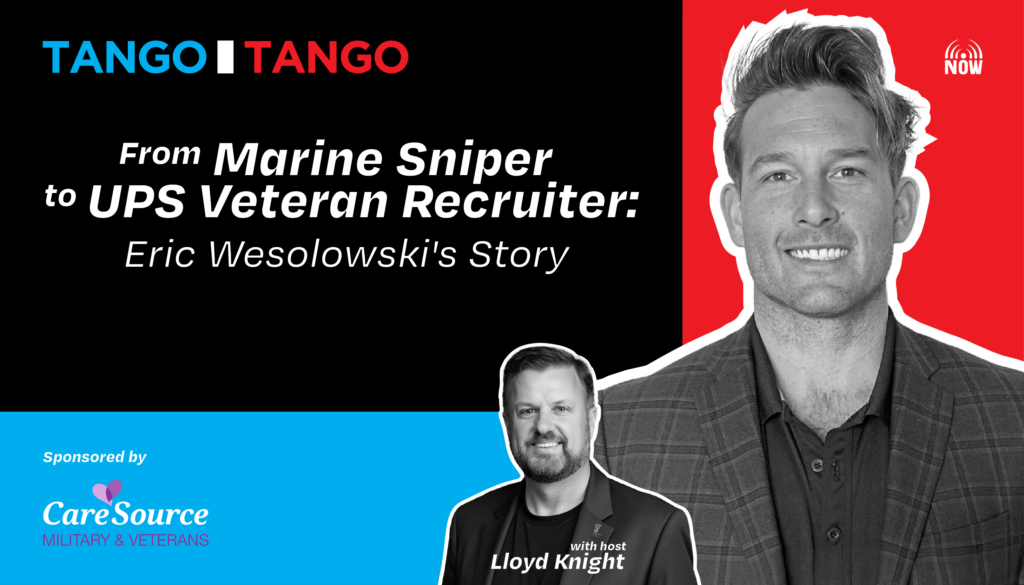
Welcome to the Tango Tango Podcast. I’m your host, Lloyd Knight, and I just want to thank the folks at Supply Chain Now for making this happen and our sponsors for this year, CareSource, Military and Veteran. If you live in the Tampa and Atlanta communities, you should definitely check them out. They’re a great alternative to TRICARE. So I have a good friend and one of my employees at UPS and a Marine Corps veteran, and for the folks who listen to this podcast know how I love Marines. Eric Weselowski, welcome to Tango Tango, Eric.
Eric Wesolowski (00:49):
Yeah, thanks for having me, Lloyd, as always.
Lloyd Knight (00:51):
If I remember right, you are originally from Oklahoma?
Eric Wesolowski (00:55):
Yes, sir. I was born in California, actually. My father at the time got transferred out to Oklahoma when I was about five years old. So I grew up in small town, Midwest, pretty close actually to a base that you probably know, Advanced Air Force Base out there, one of the training flight schools for the Air Force. So yeah, I spent my early years growing there in Oklahoma there in Enid.
Lloyd Knight (01:20):
Enid, Oklahoma in the middle of a nowhere, a lot of land. So I’m assuming you became a Marine. So your childhood was a lot of outside, rough and tumble, cops and robbers, soldier man and all that.
Eric Wesolowski (01:35):
My whole childhood was playing guns with all the neighbors. I think I was the only one who would round all the neighbors up to get organized to go play guns together. And you can ask my parents to this day, always was a fan of going into Army surplus stores, buying all the old Vietnam gear at the time. And I still to this day, actually, I got it while I was in the Marine Corps. My parents at that time, I was like, “I want a wetsuit. I want to be the military and wear a wetsuit.” I never got one, never got one from Costco growing up, but I finally had the opportunity when I was a Marine to get my own issued wetsuit there.
Lloyd Knight (02:13):
That’s very cool. So did you join the Marines right after you graduated high school?
Eric Wesolowski (02:19):
I didn’t. I took a little time and I appreciate my father for this. My father wanted me to go to school. He wanted me to test out college, and I ended up getting my associate’s degree before I went in. And it was something I always wanted to do, especially from a young childhood. I had a grandfather that served in the Air Force during World War II at the time. He was a firefighter, I believe, for inside the World War II there, but that was a big sticking point. And then growing up, always having this real close-knit of wanting to join the military at a young age. And then I got my associate’s degree, and at that point in time, it was time to move forward and I wanted to join. So I joined, I think I was about 22, 23, retaking the ASVAB at that age.
(03:07):
It was a challenge for myself.
Lloyd Knight (03:09):
You were probably an old man when you went to basic training
Eric Wesolowski (03:11):
In 23. I was an old man. I do remember an older gentleman. He was probably about 27, 28, but I was thinking to myself, I am surrounded by all these young kids here.
Lloyd Knight (03:24):
I imagine that maturity. And now that we have age, we don’t look at 23 being the curb, but you’re much more mature at 23 than you were 18. I imagine that served you well at the beginning.
Eric Wesolowski (03:38):
Yeah, it did. I mean, I’m really good of noticing my environment. So checking into bootcamp, that was really the first time I was away at that age for such a long period of time. And it was a new environment. There was yelling all over the place. It was just this new environment that I was in. And so I think one thing that really helped me out was just sitting there and observing what was going on and be able to adjust from my surroundings there.
Lloyd Knight (04:09):
So in basic training, were you an East Coast Marine or a West Coast Marine?
Eric Wesolowski (04:13):
I was West Coast. I was out there at San Diego, the Depot out in San Diego. So the worst part about that is every day while you’re running and you’re PTing, you’ve got the San Diego airport right there and you see all the planes taking off and touching down every day, and you’re just wishing that you were on a plane.
Lloyd Knight (04:36):
I bet. So how physically demanding and how mentally demanding was bootcamp in the Marines?
Eric Wesolowski (04:43):
I will say this, it was very physically and I would say more mentally demanding. And I say that with you understand what you need to have going into the military. You understand you need to run three miles in this time, this, this. But the mental part I think was really just an eye-opening of experience like, “Man, I can do a lot more than I put my brain to. I can do a lot more.” And I say that in regards to you’re not feeling good and they push you and they push you and you push you and you get this new baseline of what you can really do. And so that was a really big eye-opener. I would say the mental piece exceeded the physical piece by far.
Lloyd Knight (05:25):
Yeah, great. So this podcast, just to set the stage, we’re going to learn a little bit more about Eric and his Marine Corps journey. And then we’re going to talk a lot about the transition. We’ll talk a little bit about Eric’s transition and Eric being a veteran recruiter for UPS and has a lot of experience recruiting and myself running the recruiting department and being a veteran affairs manager. Eric and I have a lot of experience with this. So we’re going to really use this Tango Tango podcast episode to give people some advice and how they can be a better candidate because Eric and I spend a lot of time each and every day doing that. But getting back to your Marine Corps journey, Eric, what was your MOS in the Marines?
Eric Wesolowski (06:14):
Yeah, so I started out fully infantry. My whole career has been infantry here. So started out, I was a little bit older, and so they put me in charge. I was a team leader, pretty new into the Fleet Marine Force. Yeah, pretty new. My first experience, I checked into my unit after going through our MOS training, which was 0311, a rifleman, the basic rifleman. Went all the way through in that first two, three months of checking in, I ended up meeting up our unit up in Bridgeport, California. And then for those of you that ever been to Bridgeport, we know that that’s our Marine Corps mountain warfare training and it gets cold. You learn a lot about yourself, a lot of mental toughness again. So I ended up meeting my unit up in Bridgeport, California and had a good time, had a really good learning experience, got my first chance to really experience Marine Corps as a Marine fleet force at that time.
(07:11):
Was at Bridgeport learning how to build a shelter. I think one of the days they gave us, it was a little bit of a survival day. And so they gave us one MRE for four people, and then you had the opportunity to pick one item out of your pack and you went and slept out for 48 hours and just took what you had and built what you were able to and just survived in that situation. So that was really, really awesome opportunity. And then fast-forward, went on a few deployments inside the Marine Fleet Force. I was with 1.5, 3.5. And then at that 3.5 period, one of my really good friends at the time, we were both motivated. We both loved what we were doing, but we wanted a little bit more. And so we seen that they were holding a sniper screener and we both kind of acknowledged let’s do it together.
(08:04):
And so I was in Okinawa, Japan at the time, and they were holding a screener that was about a week long out in Japan. And so we decided we were going to do it. So we packed all of our gear, met the whole sniper platoon. The next morning at 04:00, they did a gear inspection. And then from that point on, they put us through a bunch of different screening things to see if we were going to stick around a platoon. And that’s one thing that I love inside the sniper platoon at the time is in the Fleet Marine Force, the best of the, I wouldn’t say the best of the best, but the highly motivated are the ones who go to the sniper platoons because if you are not footing out or if you are not giving the effort, if you don’t know your job, your skillset, then you could find yourself getting kind of pushed out of the platoon.
(08:51):
So it was a very competitive nature. So anyways, went through, passed the screener, spent some time learning a lot of different skillsets with that. I would say the biggest skillset that I’ve learned, honestly, with being in a sniper platoon was two big things was our fires portion of being a Marine, being able to call close air support, indirect fire assets and all that good stuff. So I had the opportunity to go through joint fires observers course over at Coronado, California. It was about a two-week-long course where we got a chance to understand all that stuff. And then we just got a lot of different hands-on of everything that was fires related. And then I was a little bit older inside the sniper platoon, and I was able to brief very well. And so I did well in the sniper platoon. I ended up becoming one of the sniper team leaders.
(09:41):
And so at that point, that was a lot of different briefs that I would give to our commands over understanding our capabilities of our sniper team, what they were qualified with, how we were going to conduct the mission, whatever COA we wanted to go with, whatever mission that was. And yeah, that was pretty much it. Spent two years inside that platoon learning different assets like that. And then I had the opportunity, I was coming up on a marine combat duty for instructor. And so ended up going to go be a combat instructor over at School of Infantry on the West Coast. And they were looking at my resume. I had a lot of different fires backgrounds, some concealment and camouflage with being in the sniper platoon. And so they compared ours to our class. It was about a class of 60. And I ended up getting pulled over to go be a squad instructor for squad leaders course, which was for those of you that don’t know, the Marine squad leaders, they’re in charge of about a 13 to 18-man team with attachments there.
(10:44):
And they conduct operations, they conduct different types of missions. And so what I was there for was teaching them, one, some leadership capabilities, two, mission planning and different things of that. And I ended up teaching our patrolling phase. I ended up teaching our demolitions phase, so they learned to create improvised demolitions. And then lastly, our fires package. So all call for fire and closed air support. I was able to teach to them. And that’s really where I ended my active duty career as an instructor. And at that point in time, I was going through whether I wanted to stay in, I wanted to get out, and I decided to get out. And that was about 2021 is when I ended up getting out of active duty force there.
Lloyd Knight (11:32):
And we always joke around, Eric and I have a joke that because of his hair, he more looks like a retired Air Force veteran versus a current Marine reservist. But Eric is still in the Marines as a reservist out in San Diego. So tell us a little bit about what today in the Marines looks like for you.
Eric Wesolowski (11:50):
Today in the Marines has changed a lot. So yeah, I asked out of active duty in 2021, and I always knew I wanted to stick. I wanted to stick around. I’ve always had this very deep passion for the Marine Corps, even though it’s had its ups and downs, but a very close part of my heart there. So I transitioned out. I’ve stayed in the Marine Reserves out in California there. And since 2021 till now, I’ve been in the reserve component. And it’s just really interesting to see all the new gear the Marine Corps has, the way that they’re restructuring their capabilities to stay relevant with today’s battlefield. And then all the different technology that we have. It’s understanding it. And I think one thing that I always love to give to my guys whenever we see each other once a month or different training evolutions is a lot of this technology, yeah, it’s amazing.
(12:50):
The capabilities are very amazing what it can do, but it always comes back to the basics of understanding camouflage and concealment and discipline. Those are the things that are really going to set you apart on the battlefield today, especially with all the drone warfare and all that good stuff.
Lloyd Knight (13:09):
Yeah, fast-forward several years, and Eric ends up on my team. It’s a little bit of a interesting story, but we don’t really have time to get into it. But about two and a half years ago, I think it was, I was really blessed. I had an opportunity to bring Eric on largely as a contractor. And then he did such a great job that we ended up adding him in a full-time position. And Eric and I always joke around. I think of the ideas and then he executes my ideas and it frees me up to shake hands and kiss babies. But we’re a great team. We both have our strengths that compliment each other. So Eric is just give him some props. He is not only good at the recruiting portion of it, but he cares. If you ever touch base on LinkedIn with Eric, you’re going to get some great response.
(14:05):
He’s going to have patience and he’s going to walk you through it in order for you to be a better candidate hopefully at UPS, but not UPS, somewhere else. This is very different from every episode we’ve ever done of Tango Tango halfway through our second season. We really focus in the past on just the people, but we’re going to do things a little different. We’re going to start talking about the transition experience and about what transitioning service members, even some veterans and military spouses, we’re going to give them some advice and talk about some of the mistakes that we see. But let’s talk a little bit about the transition itself. And I’m going to give some of my thoughts and have some of your thoughts. So this first question is for both of us, what is really tough about the transition? For me, it was very different.
(14:57):
I’ve been at UPS almost 20 years now. I retired in 2007. In 2007, there simply wasn’t the amount of resources out there to help transitioning service members as there is now. And for me, it was GI Jobs Magazine was the only one.
(15:14):
And so I would read that cover to cover. And I’ve actually been at a couple of the magazines afterwards. They featured me, but it was a great resource. And then I remember that first resume I wrote, I went to Walmart and bought, I’m showing my age, I bought some software to write a resume. And at the time, I thought I had an amazing resume. I wrote a nine-page resume and I was really, really proud of it. And I went into the Airman Family and Support Center, so they’re the office that handles transition in the Air Force. And I gave it to one of their transition specialists and he was like shirt. As everybody knows, I’m a first sergeant, was a First Sergeant. He was like, “Throw this thing away.” This is not opening any doors for you. And he helped me create a competitive resume.
(16:04):
I don’t think it really impacted me at the time. The next thing is I didn’t know anybody. I didn’t have a network, and I was just applying off the website, which it ended up working well for me, but it doesn’t work well for everybody. I mean, we’re going to talk about networking here and the importance of networking. But when you made that transition from the active duty of Marines to the Marine Reserves and you had to go find a job, what were some of your struggles and the headwinds that you saw?
Eric Wesolowski (16:36):
Yeah, so I was in 2021, so we had all the resources, really. Everything that you see out there now was pretty much what was out there. I would say the only thing that I just wasn’t educated on what was out there for me. And I don’t know, that comes down. You made a really good point in one of your LinkedIn posts here in this week was it comes down to the individual of seeking that knowledge as well. And so I didn’t seek it at the time. It was busy with my transition, which we can all see that gets pretty busy. Family, all these other things. I didn’t take my transition. I was in my, if you want to look at Windows, I would say really 30 days out before I was even really worrying about what was next, and that’s not the answer. And so I transitioned out.
(17:26):
I ended up taking the first job that I could get. It was with a mortgage company working remote. And at that point in time, that was me. I just seen what I needed or seeing what was out there. I took the first thing and really just took that. And so that was my transition. It was unplanned. There was nothing backing behind it. Didn’t use any of the resources. I didn’t say I would’ve used them. I just wasn’t educated on that. Even in 2021, I didn’t know that some of these things were out there. And so yeah, fast-forward, that was my transition. And then I ended up getting laid off by that company at the time. And we’re about to jump into the power of networking and telling your story. But at the time I was teaching yoga just part-time. It was a hobby of mine.
(18:14):
It was something that helped me through my transition. And I was teaching yoga. And one of my students, him and his wife would take my class regularly. He was a Marine veteran back in the ’80s, and he was the director of talent for a huge company, a very huge company. And he gave me, we sat there, he took my class, we just got a chance to talk. I told him my story, and we had a cup of coffee later that week, maybe it was later that week or the next week. Had a cup of coffee and had a chance to tell my story a little bit more. And I’ll say this, he gave me a chance inside of the recruiting world for a very entry level job. And I thank him, even to this day, I’ve reached out to him and told him, “Hey, I’m doing veteran recruiting for UPS now, and I got to thank you for giving me that opportunity as an employer, giving me that entry level opportunity, and then me being able to take that and run with it to where I am now.” And so yeah, that was my transition with giving the importance of networking and telling your story.
(19:19):
But yeah.
Lloyd Knight (19:20):
What year was that, Eric?
Eric Wesolowski (19:21):
That was 2022. So I spent about a year with that company, and it was at the time where rates were going up, so they were making the virtual layoffs at the time. And another key talking point for those that are out there is ensure that your resume is always up to date. Always keep that resume up to date. You never know what’s going to happen. I didn’t know that that was going to happen, and I had to start all over again. I had to start back all over again with building a resume. I didn’t keep it up to date for that. So yeah, that was 2022 timeframe.
Lloyd Knight (19:54):
Great advice, Eric. I’ve been at UPS again for almost 20 years and I update my resume about every three months. So again, you never know what’s going to happen. Wow, what a lightning rod career path you’ve had. So from starting off in a very junior beginner recruiter position to really the chief recruiter at not only a Fortune 500 company, a Fortune 40 company, and one of the largest veteran employers in the world. Yeah, tremendous story. You deserve it. But we talked about networking. You mentioned having coffee, and that’s some of the advice I give you. We’re going to start talking about networking. Eric and I are going to talk a lot about LinkedIn because we both love LinkedIn and see the power of LinkedIn. But if you have an opportunity to meet somebody for coffee, well, that’s very powerful. In my coaching business, I teach a 50 cup of coffee concept and it’s not new.
(20:54):
I would love to say that it was my idea, but I’m sure I stole it from somewhere. But if you have a goal you’re trying to do, if you start asking people for coffee, meet up for coffee, and that coffee, they’re going to provide you mentorship, they’re going to connect you with other people and grow your network, you’re likely you’re not going to make it to 50 cups of coffee before you get to what you’re trying to do. So it’s really, really, really important. And don’t hesitate to ask if you’re a service member, if you’re a veteran, if you’re a military spouse. Generally, people want to help with veterans. Really, it’s something I’ve seen. So the worst they can do is say no. As we say in the military, they can’t take away your birthday. And I even tell UPSers that. If you want some mentorship, ask for it.
(21:41):
Even internally, I tell my team, “Just put it on my calendar and we’ll make it happen.” So networking is very important. I love the fact that you had a cup of coffee that paid out for you. One of my employees, Jordan Kellett, and I’ll have to send us the Jordan Kellett, one of my former employees, Coast Guard veteran, hired him right out of the Coast Guard in a very junior position as well. Did really well at UPS advancing. We started the very first veteran business resource group together. Jordan went back home to Charleston, South Carolina and did the Ashley Cooper Bridge run. And as he’s waiting in line to start the run, he starts talking to the guy next to him. And the guy’s just fascinated that Jordan works on global freight forwarding for UPS. So this guy starts peppering him with questions, peppering him with questions, and he makes Jordan put his phone number in the phone.
(22:33):
And he’s like, “Call me when you get back to Atlanta.” So Jordan comes back to Atlanta, he’s not going to call him, actually is sick one of the first days he’s back. His wife makes him call. He calls this guy. Next thing that Jordan knows, three weeks later, this company buys his house in Atlanta. They hire him, they move him to Charleston. And here it is, I think almost a decade later, Jordan’s still working at this rubber derivatives company, doing very well from just a conversation with a guy
Intro/Outro (23:07):
Standing
Lloyd Knight (23:08):
Next to him. So a piece of advice is every opportunity is a networking opportunity. You don’t have to be at a networking event. I spend a lot of time in coffee shops just because of the nature of what Eric and I do and what I do with Atlanta. And these coffee shops, I see amazing networking that happens all the time. A lot of time it’s just standing in line waiting for that coffee. Have a good elevator pitch, ready to go, and you never know what it’s going to lead into. So what are your thoughts on that, Eric?
Eric Wesolowski (23:39):
Yeah, no, absolutely. And I see with the power of networking, that’s where it kind of got me for today. And then with everything that’s out there, I get a lot of different messages via LinkedIn. And inside those, I hardly ever really see like, “Hey, I’d love to put some time on your calendar just to have a cup of coffee and speak.” A lot of it is candidates reaching out and giving some of that. So my advice for that is look on LinkedIn. That platform is such an amazing platform out there. It is so powerful. Look on LinkedIn, do a search of some of the company, your top five companies inside of those searches. Look to see who’s working from there. When you tie that in, it’s going to tie it into veterans that work there as well because you’re a veteran. And then go from there.
(24:27):
Start to chat or the different roles. Maybe somebody’s filling a role that you would love to see yourself in the future and send them a message and see if they’re open for a cup of coffee and say, “Hey, I’m 120 days out from my transition. I would love for you to maybe give me some more guidance maybe next month or every quarter, maybe we could do a quarterly call where I could just touch base with you.” And you do that with a few different companies and you get different perspectives on different people who are working at different companies and different industries and things of that nature. And you get to start to see what the power is out there as well. There’s a guy that actually takes our, I got to give him kudos. One of the guys that comes and joins our monthly LinkedIn recruiting group on LinkedIn there.
(25:16):
He’s a year out and he is just building his network right now. I’m sure you know who I’m talking about out of Fort Hood there, Lloyd. He’s building his network out right now a year out.
Lloyd Knight (25:28):
And he came through Atlanta and we actually met and had coffee. He brought his wife to Atlanta summit. So that’s paying dividends. Eric and I know who this guy is, right? Yeah. And then we –
Eric Wesolowski (25:43):
I know him by name.
Intro/Outro (25:44):
Yeah.
Lloyd Knight (25:46):
So yeah, that’s fabulous advice. Piece of advice I can offer is don’t only connect with recruiters on LinkedIn. Connect with people from veterans and non-veterans all across the company. Generally recruiters, you’re going to find very few recruiters that are as responsive as Eric and I. On LinkedIn, I give recruiters a hard time because they’re unresponsive and they’ll ghost you, but it’s just because they’re so busy. So what you want is you want to make connections within an organization, within a company that are going to personally connect you with the recruiters.
Intro/Outro (26:23):
Because
Lloyd Knight (26:24):
Recruiters like when they get referrals, so definitely connect with everybody. So Eric mentioned some of the great best practices. Eric, let’s talk a little bit about things you shouldn’t do, like pet peeves. One of my pet peeves is when I have a candidate that contacts me and goes, “What do you have open?” Or, “What do you have in Dallas, Texas?” And I’m like, “Holy cow, we’re a company. We have 480,000 employees in 160 countries and territories around the world. Our website changes, our career website changes every day. Don’t ask that. That should never be your first statement to a recruiter.
Eric Wesolowski (27:13):
Yep, absolutely. And I’ll tailor off of that too, is if you’re reaching out to somebody and you know already what the context is, do you have an actionable step inside of there? Because I do get a lot of messages throughout my inbox of just like that, asking me where the position is, if you have any openings here. I would say have an actionable step that what I can take as a recruiter and put that into action, whether it’s of adding a meeting on your calendar, whether it’s looking up a requisition that you applied to, or whether it’s finding you of somebody who’s there at our company that could be a good resource for you or something of that nature. My biggest thing is have an action inside of there for me whenever you send that over or a recruiter whenever you send that over, have an actionable step inside of there.
Lloyd Knight (28:03):
Absolutely. An actionable step is phenomenal advice. And don’t be too informal. I get some informality that actually shocks me. When you’re talking to a recruiter, it’s like you’re in an interview. Don’t be informal. I get messages like somebody’s text messaging me. I have to look up what these things are because I’m 57. I don’t know what these abbreviations are. It is just being too informal. And then take your time and compose a very professional message. I think I get one out of every 20 messages I get, they spell my name wrong. There’s five letters in my name. Yeah, take your time and make sure that you’re putting a well-thought out composed professional message that has some formality to it. And like Eric said, have an ask. What else, Eric? LinkedIn.
Eric Wesolowski (29:00):
Yeah, LinkedIn-wise, let’s see. We kind of talked about messaging for there. You hit on the note of don’t ask for locations and things of that nature. We live in a world where everything is at your fingertips. I can pull up our jobs career site and type in remote work if I wanted to do that, and it’s going to give me a key search from that. So just use those things, use the information that’s out there for you. LinkedIn-wise, I really think that’s it. I mean, on LinkedIn, this powerful, powerful site to use. Just make sure that everything’s cleaned up. We live in a world with AI. Everything’s out there that’s built into the platform to where you can really redo your LinkedIn as an extension of your resume. And with that being said, when you do that is use the tools that are out there to recreate that, and then use that as your first kind of.
(29:56):
I know recruiters, hiring managers, they all definitely Definitely look at LinkedIn here. So I would say use that platform as your extension of your resume there. You got anything
Lloyd Knight (30:07):
With that point? Yeah, great point, Eric. So your resume, everybody should know this, is going to be a max of two pages. Your LinkedIn profile should be page three, four, five, six, and seven. Any recruiter or hiring manager worth a darn will look at your LinkedIn profile. So I could tell if I look at somebody’s profile, if they have the minimum, I’m like, are they lazy? This is really important. One of the great resources for you, LinkedIn offers military veterans service members one year, and it’s only one year now, of LinkedIn Premium, which has all the AI resources and job seeker resources. So when it’s time for that job search, use that one-year premium. So let’s go over to, now it’s time to apply for a job, Eric, and this is where you and I really get into it. So hopefully you’ve used your network, you get somebody to refer you, and you’re sitting down with the application.
(31:07):
You’ve got a great resume. There’s all kinds of resources you can get a great resume from. HireHeroes USA is one of them. You can put them in Google to get a free resume. But let’s talk about the application process. Those questions they ask when you’re starting to fill out your application, are those questions important, Eric?
Eric Wesolowski (31:29):
Yeah, absolutely. And one thing that I get to see on my side with being a recruiter, being able to see all of our applications come through, I can generate data based off of the knockout questions. And that’s something I like to key into just to make sure that us as a company are having the right questions there to ask. But I would say a lot of time I see the bulk of people not even being able to enter the door because I think maybe it’s they’re just going fast through the application process. They’re not actually seeing what’s being asked. The questions, these knockout questions, they’re on our applications as the very base defense, not defense, the very base mechanism for us to get you through. Once you meet these very basic qualifications for the knockout questions, whether it be, do these shift hours work for you based off of reading the job description?
(32:24):
You go through and you hit yes or you hit no. That’s going to give us a recruiter instead of going through 5,000 resumes, now we’re ciphering them down from those knockout questions to we’re going down to 2,500 resumes. And then after that, once those recruiters go through those resumes, that’s the second one. We start to go into screening calls for those who we think are the most qualified for that. And then from there, we’d knock it down to 500 resumes from there or so. And that’s just given the nature of the life cycle. But yeah, knockout questions are very, very important. I think that some people just go through it way too quick, so it’s important to slow down when you’re going through your applications and really read some of those questions. I’ll tell you on my side, I see a lot of data that doesn’t make sense with the knockout questions for us.
(33:16):
Yeah.
Lloyd Knight (33:16):
Yeah, absolutely. And again, people get in a hurry. Sometimes they’re so used to filling out non-military forms with questions. So they’ll go down and hit on the right side of the screen, put yes all the way down. And the first three or four questions could be like, are you qualified for the job? Do you meet the minimum? And then are you legally allowed to work in the United States? And it could be a no on the right side. And so now you just answer the question wrong. Pay close attention to those. Read each question twice and answer it, and that is going to get you by that next phase. So let’s talk a little bit about the importance of tailoring your resume. Again, most companies are going to get dozens, hundreds, and even thousands of applications for a job. So when you get that many applications and resumes, you’re never going to be able to interview a thousand people.
(34:13):
It’s just not going to happen. When I was a director for UPS and I would get a job requisition approved and we would go put the advertisement out for two, three, four weeks, I would get 500 people apply. And my recruiter would give me maybe about 20 to 25 of applications. I didn’t have time to interview 25 people, so I’m looking at the resume. So they’re looking at the resume, I’m looking at the resume. This is scientifically proven through data. The first look at a resume is less than two and a half seconds. They’re just making sure the format’s good. Maybe they’re looking at the education that you have the minimum
Intro/Outro (34:54):
Education.
Lloyd Knight (34:55):
And then from there, second level, a review will be a little bit longer, third level, fourth level. So by the time it reaches the hiring manager, they’re making sure that you’ve tailored your resume. And so how you tailor your resume, and this is a big mistake that many veterans make, they get one resume and they shoot it out for every job. If you do that, your odds of getting to an interview are dwindling. So you need to tailor your resume and you tailor your resume to showcase that you have the required and desired. So first of all, let me tell you the difference. If it says required, it’s mandatory. You absolutely have to have it. And if it says desired, that means they’d like for you to have its. But I can tell you, you’re never going to get a candidate, usually not going to get a candidate with 100% of the desired.
(35:50):
So desired
Intro/Outro (35:51):
Is
Lloyd Knight (35:51):
Great. So it’s required and desired. And then here we go. Skills, knowledge, education, and experience. So you need to go through and tailor your resume, the job summary, your skill sets, and then your body of your resume. So what are your thoughts on that, Eric?
Eric Wesolowski (36:10):
Yeah, no, absolutely. I would say just to not say the same points there. You made a good point. Your resume shouldn’t be that nine-pager that you showed up with back in the day there. It’s got to be at maximum, two pages at maximum with that. Showcasing your education, staying away from the military jargon. I think we’re doing a good job with it right now. I don’t see it as much as I used to when we first started in this role in 2023. I don’t see as much as we used to, but staying away from the military jargon with fire team leader or squad leader or platoon sergeant or whatever. Start to use technology at your hands and siphon what is a platoon sergeant? Is that an operation supervisor? So start to using some of those keywords and aligning that to the roles that you’re looking for for that.
(37:04):
I think that we live in a world where we can really find out compared to what we’re used to with everything that’s out there for what are we capable for right now and what are we seeking for? And so that’s pretty much it for the resume. I would say keep a format. Hire Heroes USA does a phenomenal job, a phenomenal job of their turnaround time. And then also the resume products that they build. They do an amazing job for everybody who we send through and the product that we see. It’s a great job for that.
Lloyd Knight (37:37):
Yeah, great advice. So Eric, and I just got you up to the interview phase, so we’re going to do part two probably next season and walk you through interview and all the way up into how to get promoted in a position. So hope you enjoyed that. Let’s go back to you, Eric, before we close it out. So what do you like to do for fun?
Eric Wesolowski (37:59):
I’m pretty active guy here. I’ve got the Marine Corps engraved into me, so I’m usually PTing early mornings.
Lloyd Knight (38:09):
And he means this. So Eric came to Atlanta a couple months ago, actually stayed in my guest bedroom office, which I’m in right now. And he was up and out at the door at 4:30 in the morning going to Lifetime Fentanyl.
Eric Wesolowski (38:26):
Don’t let this hair fool you. I still have my discipline in there.
Lloyd Knight (38:32):
I always like, was Eric Early, was he a Marine or is he a fraud with that air? And then he came and spent the week with me. I’m like, oh no, he’s Marine all the way.
Eric Wesolowski (38:45):
Yeah, I’m just a very active guy. I love to do that. I love spending time with my kiddos. I’ve got two sons and one young daughter as well, so I love to spend time doing things with them out here in Austin, Texas where I currently reside.
Lloyd Knight (38:59):
So are your boys like you Eric? Or are they like you as a
Eric Wesolowski (39:04):
Kid? They are. Yeah. They’re very much like me. Things have changed a little bit. As a kid, I grew up, and I’m sure you too, I grew up outside all the time, and now we’ve got different things out there. But they’re still very much just like me. If I could show a picture, they look identical to me as well. So they’re amazing kids.
Lloyd Knight (39:26):
Yeah, they do, except for the supermodel haircut.
Eric Wesolowski (39:29):
Yeah.
Lloyd Knight (39:33):
Well, Eric, I appreciate you coming on. Eric and I have done a other podcast together on The Landing Zone, which is our UPS podcast. And it’s always fun to do the podcast with you. And we’re going to do this each and every season as long as we’re finding sponsors and as long as UPS keeps us, which I think they will. I think they appreciate what we’re doing. Any closing comments, Eric?
Eric Wesolowski (39:59):
Closing comments? I would just say if you’re in transition right now, whether you’re a year out, like one of the individuals that come to our LinkedIn group or you’re 30 days out like I was, take some time, turn off the distractions and get a plan together on what that looks like, whatever timeline you’re in. But use the resources that are out there. I didn’t use the resources that I had. Use the resources, put a plan into place, and take action into those steps, whether it’s reaching out and building your network or setting up coffee meetings or whatever it might be, but just take action in regards to that. And overall, that’s just my overall plan with that, whatever timeframe you are in with your transition.
Lloyd Knight (40:42):
Awesome. Well, thank you, Eric. And I’m going to close my podcast like I always close it, but I’m going to add, be like Eric, have great hair, and then be safe, be kind, and be remarkable.
Intro/Outro (40:53):
The Tango Tango Podcast is produced in partnership with supply chain now. Join the Tango Tango community for more inspiring stories. Follow us on Facebook, X, and LinkedIn. Subscribe to the Tango Tango YouTube channel and follow and listen to Tango Tango wherever you get your podcasts.