Scott Luton (00:02):
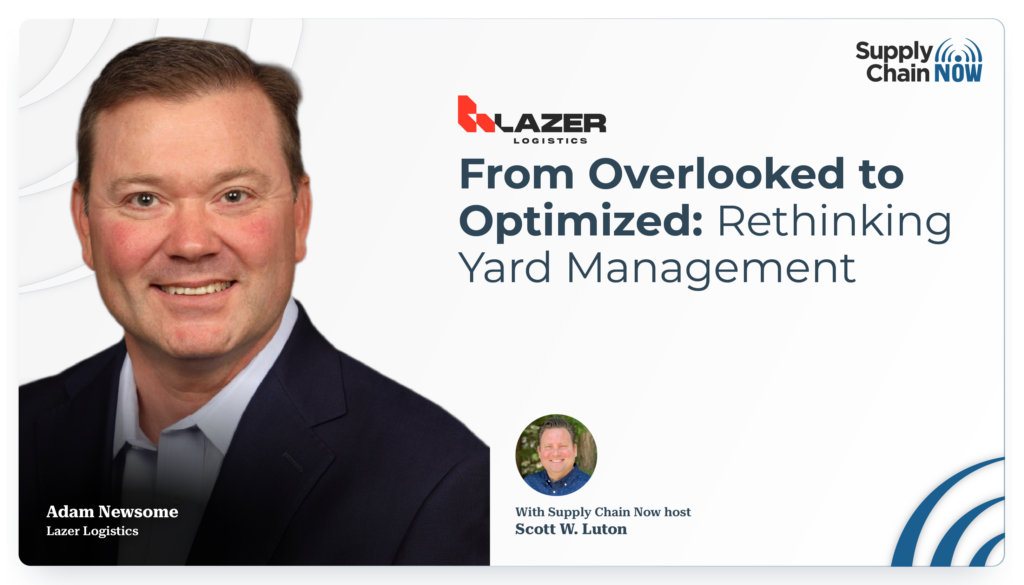
Welcome to Supply Chain Now, the number one voice of supply chain. Join us as we share critical news, key insights, and real supply chain leadership from across the globe. One conversation at a time. Hey, good morning, good afternoon, good evening, wherever you might be. Scott Lewton here with you on Supply Chain now. Welcome to today’s show. Folks, when we talk about supply chain technology, we spend a lot of time talking about what’s happening inside the warehouse or manufacturing plant or elsewhere across the supply chain ecosystem. What is often not talked about is what goes on in the yard, one of those critical components of facilities and supply chain footprints that doesn’t always get the attention it deserves. Yet, when trailers are sitting, check-ins are getting delayed, assets can’t be found or moves are being wasted, those issues can add up in a hurry. But today we’re going to be talking with one innovative leader that is helping organizations everywhere connect and optimize their yard operations.
(00:58):
There is so much of a tremendous opportunity in this facet of global supply chain, so get ready for a unique yet fascinating conversation full of actionable takeaways. So with all that said, I want to bring in our special guest here today. Adam Newsom serves as a CEO of Laser Logistics. Now, after 30 years of relentless improvement and growth and innovation, get this, Laser Logistics has grown into the largest provider of outsourced yard logistics. They can now be found in over 800 locations in the US and Canada, where they work with a wide array of organizations, including 54 companies in the Fortune 500. So let’s learn more and welcome in Adam Newsom with Laser Logistics. Adam, how you doing my friend?
Adam Newsome (01:42):
I’m doing great, Scott. Thanks for having me today.
Scott Luton (01:44):
You bet. Well, you know what? We could have completely had a two hour pre-show session talking about your love for the Tennessee volunteers and my love for all things Clemson, but we didn’t do that. However, I’m going to give us a second opportunity to that. With my fun warmup question, I like to get to know folks before we start talking supply chain. And I’ll tell you what, your passion for the Vols is in your bones, isn’t it Adam? Is that right?
Adam Newsome (02:08):
It’s deep.
Scott Luton (02:10):
So I want to ask you two things. So number one, give me one of your favorite all time moments as a Vols fan. And then number two, you got to tell us, and for all of our SEN global fan out there that might travel into Knoxville for a game where they just got to go get a bite to eat. But first, give us your favorite moment, one of them.
Adam Newsome (02:29):
Well, obviously not having had but just one national title in my career or lifetime, it’s obviously got to be when we won the national championship against Florida State. But I would actually say that the year before was really great. Seeing Peyton win the SEC championship leading the band there in Atlanta was really another great moment as well. So I have to go back a little bit for the great moments, but hey, that’s what’s great about sports. Hopefully we’ll have more in the future.
Scott Luton (02:54):
That’s right. That’s an iconic moment in Manning’s journey is when he’s directing that band. And now, gosh, you turn on a channel anywhere and you see Peyton Manning, he’s like omnipresent. Good for him. Let me ask you though, food and tailgating and sports, especially maybe in the South, it’s like hand in hand. If folks venture up to Knoxville for a weekend experience for a game or otherwise, where do they got to go get something good to eat?
Adam Newsome (03:20):
Got to go to Balter Brew Works. It’s a great food, great atmosphere, good bar, a great location, not too far from the stadium. So you got to go to Balter Brew Works.
Scott Luton (03:31):
Okay. Sounds like a good place to go. We’re going to meet up there and we’re going to do a supply chain now on the road and maybe with a football in the background. How’s that sound, Adam?
Adam Newsome (03:39):
That sounds like a great weekend.
Scott Luton (03:41):
All right. Now I think we avoided what we warned each other not to do, which is talk for a couple hours about sports because we got a lot to get into about supply chain and in particular, a lot of innovation that you and the laser logistics team is driving across industry. So I want to start, Adam, with the bigger picture. We have poured as an industry, I like to refer to this modern era as the golden age of supply chain tech, at least for now it is. Who knows? Five years from now it might even be more golden, but we’ve poured enormous amounts of technology into all sorts of aspects of global supply chain, warehouses, transportation networks, manufacturing facilities, and a whole bunch more. The yard traditionally hasn’t ever received the same amount of attention. So I want to ask you, Adam, why has the yard and yard operations remained such an overlooked part of supply chain?
Adam Newsome (04:33):
Well, I think for any of our businesses that we work with, you start with the P&L and what do you spend most money on? And so the first place you’re going to look is your warehouse operations and your transportation. And that’s pretty obvious for the spend, but what you’re not going to look at necessarily is the yard operations, that in between kind of connective tissue between those two big spins and how that yard enables both of those spins as well. So I think it’s a hard time because again, you look at an org chart and you’ll sit there and say, okay, I’ve got my vice president of transportation, my vice president of warehousing and a lot of times, and so they’re competing obviously within their silos for those dollars. And that makes a lot of sense, don’t get me wrong as well. But I think when you really start looking at the supply chain as a whole, and again, a lot of businesses are doing this, you say, “Hey, this connective tissue between the yard, transportation and warehouse is pretty important.
(05:24):
And so maybe we need to spend some time on it because it’s one of those things that you never hear about it till it goes wrong. So that’s why it’s really important that you try to get your message out there and why it’s important. And you talk to leaders within these organizations and you do shows like we’re doing right now, Scott, and this is a great thing that you do for the industry to get those thoughts out there and maybe people that look at it a little bit differently.
Scott Luton (05:46):
Adam, man, you’re right out of the gates with sharing supply chain truth. And one of the things I heard there as you applied it to the yard is you never hear about it until something goes wrong. And I’ve heard the same folks talk about that when it comes to supply chain performance. You want to keep your supply chain out of the headlines because a lot of times they can be the headlines for the wrong reason. And one quick follow-up before I get into one of y’all’s mantras is just because it’s invisible doesn’t mean there’s not tons and tons of opportunities that can roll right up into powerful supply chain performance, right? Y’all are living
Adam Newsome (06:22):
Proof.
(06:23):
Absolutely. And don’t get me wrong. I mean, we used to joke about it, especially in the early years, my dad and I, the best days were when the phone didn’t ring because it was either going to ring for a problem or opportunity. Now when it rang for opportunity, we were all for that. But again, so sometimes again, we want to be invisible because again, we shouldn’t be a big production for these operations. We should be enabling these operations as well. And that’s okay if we don’t get a lot of the limelight. I’m fine with that. Again, we just want to do a great job and deliver value for our customers.
Scott Luton (06:52):
Love that, Adam. Okay. So I want to talk about, it seems like a regular idea, maybe a mantra that you and the laser logistics team regularly share with others. And that’s a visibility step one. The next evolution is action. So Adam, I like to talk about this a lot. And sometimes when I say this, I’ve had some folks take exception because visibility is not enough. I know we’re still looking for it in so many different ways, but for me, we got to have that visibility, but it’s got to power decision making and solutions and it’s got to guide us into what steps we should be taking both kind of reactively, but even more importantly, proactively. So tell us about in your view, the importance of action, not just visibility.
Adam Newsome (07:38):
Well, I think you hit the nail on the head. I mean, again, I can show you a lot of cool things and videos of stuff, automated trucks. I can show you EVs and everything else like that, but so what? I need to put that on TikTok videos the way I look at it as well. If it’s not driving value for the customer to their profit and loss statement, what’s the point? If it’s not making me better, what’s the point of it as well? So technology for technology’s sake, you hear a lot of people talking about, again, and don’t get me wrong, that’s really cool stuff, but you’ve absolutely got to take those benefits that it give you and you got to get it somewhere where it shows up in real value as well. And obviously one of the key places there could be around safety.
(08:16):
For example, you want to show it up in your safety numbers. Are you trending better? Are you getting down there? When you have an accident, can you really get to the root cause of it as well? You want to talk about the productivity numbers, but what’s really driving it underneath it and what action can you take about it there that you can then have increased visibility to the action you took and see if it’s driving the KPI that you’re looking to do there, which should be an operational metric, which eventually leads to a financial metric if you’re doing your job right as well. So absolutely you hit the nail on the head is that you can have all the cool toys in the world, but it’s about what it means to the bottom line.
Scott Luton (08:51):
That’s right. And I like your mention there right near the end of your response of some of the most important operational metrics don’t just stay as a scoreboard item, but they evolve into financial metrics and data points that helps guides where we take organizations. And also you mentioned safety. One of my favorite things, and I think it’s still sticking, check me on this Adam, but the pandemic changed so much, but some of the silver lining there, other than consumers figuring out what supply chain is more and more, but it taught organizations why we’ve got to protect safety as a north star and take care of our team members. And I think that’s still sticking and I hope it sticks for a long time, but I’m so glad you mentioned that because yard operations probably present all sorts of safety mishap opportunities, so to speak, Adam, right?
Adam Newsome (09:40):
Oh, absolutely. And I mean, again, it’s a core value for us. We keep each other safe and that can’t be just words. And it also can’t be just, “Hey, look at our TR hour.” Yeah, that’s a super important metric, don’t get me wrong. But what about how you’re feeling safe as far as being able to talk to your manager, being able to bring up issues, concerns, things like that? So you have to have a culture of safety. I know a lot of companies talk about that as well, but again, it does show up in the metrics over time as well, but it’s how much are you spending on training? You got to get into those lead indicators as well. And as far as some of the hazards that we see on the yard, our number one accident that we have, unfortunately in frequency, is slip, trips, and falls.
(10:18):
That’s biggest thing because we’re getting up and down off the cabs sometimes six, seven, 10 times an hour as well. So there’s a lot of three points of contact that we have to reinforce over and over and over again. So yeah, and these can lead to some really terrible access. The other thing is that sometimes people look at our little trucks, which look kind of funny like a half truck and they’ve got this hydraulic fifth wheel in the back of it and they’ll think it’s kind of a toy. It is not a toy. It is a commercial vehicle that can move trailers with over 45,000 pounds on it, just like an over the road carrier. So when you’re moving that, maybe you’re only going 10, 15 miles per hour, but that is still a dangerous, dangerous activity and it can never be taken lightly as well.
(10:59):
And again, that’s something we have to train, train, and then you train some more on it as well.
Scott Luton (11:05):
Adam, I love that. All of this adds more sense of urgency around bringing our yard operations into the 21st century and beyond. So I really appreciate that. All right, so we’re hearing more and more about the connected yard. I want to ask you, Adam, I’m not a quarter zip technologist over in Silicon Valley somewhere, so we got to take the technology jargon out of this part of our conversation. What does a truly connected yard look like in practice and how does it operate differently from the traditional yard?
Adam Newsome (11:38):
Well, let’s just make it real simple and I’m the same way as well, so I’m glad I’m found a fellow southern guy that speaks my language there. So I mean in its simplest form, look, my dad used to always say it, and he helped co-found a business with me 30 years ago, anybody can go buy a truck and hire a driver. It’s how you manage the process. So in its simplest terms, that’s really what we’re talking about there as well. Because at the end of the day, I always give this example as well. So say I’m a customer and I’ve got an order for Walmart and I’m waiting on a specific item and I’ve got a five o’clock cutoff, I’ve got to get this truck out the door, got to close this door and stuff. And I may be looking for that product and it may be on a trailer sitting on the other side of the yard there, but if you don’t know it’s there and you don’t know how to call it and get it cross docked across the warehouses, well, it might as well be a thousand miles away.
(12:31):
So that’s kind of a connected yard is that you got good visibility matched up with good processes that allow you to get the product where it needs to go as quickly as possible. Because if we’ve learned anything, you mentioned COVID earlier, is that we live in a world now where we order something in the morning, we expect it there that afternoon as well. And that requires an awesome supply chain. And again, a lot of times I know we get the criticism, but the US has an amazing supply chain that there’s a lot to be proud of within it as well. But the yard right there could be the problem that you run into. It’s just that I didn’t know the product was over there, so I shorted my customer Walmart and there’s going to be fines, penalties, repercussions for that as well. And then somebody says, “Well, you know it was just about 500 yards away from you over there.
(13:14):
You could have walked over there and got the product as well.” So in its simplest terms, that’s what we’re talking about.
Scott Luton (13:19):
Adam, I keep coming back to this, but I think it’s really important given what I was talking about on the front end, how as an industry where we’ve put all of our investments and priorities and innovations, but the thing of it is we could have a world-class warehouse operation, but if we’re ignoring opportunities when it comes to yard operations, oh my gosh, we’re losing those valuable minutes or much worse, huh?
Adam Newsome (13:44):
Oh, absolutely. I mean, one of the key metrics, and again, you talk about yards, there’s still a lot of yards out there that run on pen and paper. You’ll have a WMS, you know where everything is inside the warehouse, and then you’re using pen and paper outside. Now, one of our goals is obviously to bring YMSs, yard management systems to there that can be integrated, standalone. We don’t care. We’re just trying to get you off a pen and paper there as well. So again, when you talk about the dollars that are being spent there as well, it’s little things like that because let’s talk about the cycle times and the wait times at the docks. We always talk about this way. You may have a hundred people in the warehouse and certainly there are things that are going on to automate inside the warehouses, but you still got a lot of activity happening there as well.
(14:28):
We may only have for that hundred people out there, one truck that’s moving the trailers. So that one truck, its ability to quickly, efficiently, effectively move and put the trailers to the door can hold up that whole 100 person workforce as well. Because if they don’t have a trailer to work on, that’s unproductive time sitting there on the dock. And more importantly, that means that there are inventory and freight that is not going out the door, which translates to sales and also to consumer satisfaction.
Scott Luton (14:55):
So Adam, I want to get back to the non-technology technology talk for a second, right? And I think I’ve got this right. So correct me if I’m wrong, Adam, I was perusing some of the blog articles y’all put out and it seems like Laser Logistics is tracking some 3000 connected spotter trucks that are generating more than 300 million data points per day while the organization handles roughly 30 million trailer moves annually. So if I’ve got all those numbers right, and those are some big numbers, how are you and the team able to turn all of that data and growing data, as you are growing left and right, into operational intelligence people and organizations can actually use?
Adam Newsome (15:35):
Well, I think the biggest thing right now is AI is helping us in amazing, amazing way. Accords, we’re clawed, we use most call for our workshops, and underneath that, that allows us to handle data in ways we’ve never been able to handle it. We spent years investing in getting the visibility, as you were talking about at the beginning question there as well. So we want to get the telematics off the truck. What’s the truck doing? Is it idling? Is it sitting there as well? We want to get weather, so we have investments in weather. We want to get the safety cameras. We have cameras in every truck, which is very unusual for a yard management, that way we can look for access. We’re not looking to be big brother, but we are looking to say, “Hey, are you sitting there drinking Coca-Cola? Are you on your phone?
(16:17):
Do you have your seatbelt on?” And we have the AI technology. But here’s the thing, you got to tie all that together, and that’s enormous amounts of data, as you said as well. So AI is just a godsend for us to be able to take all of that massive amounts of data and boil it down and just make sense of it and tell me what’s the next right thing to do? What do I need to do next? And that’s what we’re really trying to do because again, I can’t do a thousand things, but I can do one thing next and then I can do a next thing after that.
Scott Luton (16:43):
There’s two things that your response made me think of. Number one, you said it, ever since big data became a thing, and I’m not a data historian, but I’ll call that 20, 25 years ago, we’ve certainly learned since then it’s not who accumulates the most data, it’s who wins, but rather it’s who finds all those signals in the tidal wave and tidal wave of data and then connects them so that the whole organization, not just one silo like you touched on earlier, can powerfully align, make decisions and seize the opportunity. So connecting, especially when you’re talking about 300 million data points per year, those that can connect those signals amongst all of that is who I would say would win. And then second thing, I love how you talked about doing the most important thing next, especially for humans, right? I think it was Lou Holtz, taking it back to football.
(17:32):
I think it was Lou Holtz that wrote a book about his time at Notre Dame. And one of the great takeaways from that book was a simple tactic that he would use with all of his, especially with the freshmen that came to the program, they’re getting overwhelmed with college experience, practice, football grades, all of that. And he would tell them, “Hey, keep it simple. When you wake up in the morning, you ask yourself, what’s the most important thing I need to be doing right this minute?” And then knock that out. And then you ask yourself, “Okay, what’s next?” And that really sounds really simplistic, but I’m going to tell you, not telling myself, Adam, but there’s been some days in my journey where 3000 things are going on and I’ve recentered myself like what you’re describing, okay, what’s the most important thing right this moment?
(18:16):
React to the late great Lou Holtz there.
Adam Newsome (18:18):
Well, I think he nailed it. I mean, I think definitely that is the way I try to live my life because I can get overwhelmed. There’s no question about it. And you’re looking at your desk, you got this thing you need to do, this thing you need to do. And if you really just take a moment, as you said, just kind of say, what is the next right thing to do right now? And then just go do it. Don’t sit there and debate a bunch. Go do that. And then you look up and you say, okay, what’s the next right thing? Well, at the end of the day, you look up, most of your desk is probably pretty well cleared off as well. Now, it may have seemed daunting as all get out early in the morning, but I think Lou Holtz nailed it there as well.
(18:53):
And I think just look where your feet are at, just look down different ways of saying it, but it’s so true as well. And I think that’s something that business leaders, we struggle, but AI allows you now to do things and again, that you just couldn’t do. It would take teams of analysts to take all that data you were talking about to sort it, and we spent a lot of years compiling it. And I wanted to touch on your history there as well. So around 2017 was when we really started saying, how can we continue to differentiate with our customers? How can we have that connected yard? How can we help them understand the value that we provide between their transportation and their warehouse there? So for us, we started developing a group we called Premier Solutions Analysts, which are basically data people, and we started collecting that data as well.
(19:40):
And again, that was great and everything, but they spent so much time that we rarely spent the time telling the customer about this is what it tells you you need to do as well. So just going back to that, and now we can cut through all that noise and do the next right thing, and that’s what we’re looking for out of
Scott Luton (19:56):
- Yeah, I love it. And I bet Lou Holtz didn’t know that he was an AI expert with that great book, that advice. But to your point, that is exactly what technology is enabling us to do, especially when we focus and we know what we’re trying to do with said technology rather than just procure it and throw it over the fence is what I like to talk about. And to your point, doing it manually, it’s just not an option these days, especially at scale that we’re talking about in this conversation here. So now we’re going to take a hard turn that maybe some folks watching or listening, they’re like, wait a second. I want to talk about Uncle Phil. Now, this is when y’all hit my radar. I know y’all are everywhere these days, but y’all had a great article that came out not too long ago about Uncle Phil.
(20:37):
And from what I gathered, Adam, is you took basically decades of operating knowledge from your COO and you used it to build an AI coaching capability for site managers. So I want to ask you, where did that idea come from and how do you capture something that is as difficult to quantify as the judgment and intuition of a longtime logistics pro?
Adam Newsome (20:58):
Well, I think the first thing is I got to give credit where credit is due. My CIO early in the year, as we’ve seen just the advancements with AI, came up with the idea that we could start to give these agents personality. And so that was the first thing that it got. And so there was no better place to go than our COO who happens to be my uncle, Uncle Phil. So there’s the connection. So still have very much a family run business mindset at Laser. I mentioned my dad who unfortunately passed a couple years ago, but my uncle’s our COO, my sister is still involved in the business and the Premier Solutions Group as well. So the whole idea kind of came together through that combination of the CIO saying, “Hey, we can take this data. We can give the manager insights into the data, but we can give it a little bit of a personality.” And a lot of things, it’s really simple.
(21:49):
They did hours of interviews with Phil just posing business questions to him as well. And so a lot of times it’s just like it’ll respond to a question that you say, “Hey, my yard is behind on moves by about 20. What do I do?” Well, the first thing Phil’s going to say is slow down, notify the customer, be honest with your customer and be safe. Don’t sacrifice safety to try to catch up. Start identifying what your options are. And it’s just simple kind of things like that, but it’s amazing how it can do it. But let me tell you what that gives us, Scott, and we were talking about scale earlier as well, but there’s only one Phil Newsom, and again, there’s other good operation. We have a lot of, we have great, literally thousands of years of experience within our organization as well. So don’t get me wrong, we just use him as the cool name, uncle Phil and things like that.
(22:38):
But what it allows us to do is it allows us to have a unified training platform because there’s only one Phil. And as we bring on new managers, we grow, people retire, which is a wonderful thing. If they have had a great career and they go off into greener pastures and more fun, we have to replace those people. And so you want those core lessons, like we said, slow down, be safe, clear communication to come through with data to back it up as well for those managers as well. So again, pretty simple in concept, but it’s amazing that it can actually do this stuff as well. And so of course we have a lot of fun with that internally. And again, what you’re trying to do is you’re trying to change the mindset of a lot of our managers because people are still afraid of AI.
(23:19):
And Lord knows the politicians and the leaders of these companies aren’t helping us, Andy, with some of their comments around governance and stuff. And maybe they should have thought that a few years ago, but that’s a whole other story as well. But we have a lot of our people, they’re blue collar. They’re greatest people in the world, love those people. And so those blue collar people are like, “AI, I don’t want to use it.” But they might talk to Uncle Phil. Uncle Phil sounds a whole lot less threatening than maybe something else. So again, that’s how it kind of came to be. And again, we look to continue to invest in it, make it smarter. Th’s other thing. You have to keep investing into these tools and have to find ways that it connects better with your people.
Scott Luton (23:54):
So I got a follow-up related to Uncle Phil in just a second, but something you said, a couple things you’ve said a couple of times now made me think of what I believe is a core operating philosophy and mantra for the US Navy SEALs. So bear with me and I’m sure we’ll have some fact checkers out there, but I’m pretty sure slow is smooth and smooth is fast. And so when I hear you say slow down, that doesn’t mean performance and process. What it means is finding ways with technology and better process for that kind of game to slow down, kind of like what as rookies get into the football or baseball, eventually the game will slow down for those that develop. And so when I hear you say about slow down, I’m hearing you say the game is slowing down for the leaders and the teams that lean into a better way of running really any facility or running a better yard.
(24:46):
Am I picking up what you’re putting down?
Adam Newsome (24:48):
Oh, you absolutely are as well. And again, a lot of times you can make a tough situation. It doesn’t have to be a tough situation. You can make anything worse sometimes by trying to go too fast, skip a step, do this, do that. Well, now you got a real problem on your hands. You thought you had a problem, now you don’t. So a lot of times it’s exactly right and I love that. That is such a great saying, slow is smooth and smooth is fast. I mean, again, and it’s very true. And you mentioned, of course, one of our great loves football, but you’re exactly right. You see a freshman quarter out, they start seeing ghosts and everything around, and then a year or two later you see that same quarterback and they look unflappable. They know just to sidestep a little bit here, make that throw and just totally different there as well.
(25:32):
And that’s very true for any of us and anything we do in life a lot of times is that we get overwhelmed and we trying to make it better, but we actually make it worse.
Scott Luton (25:41):
You’re right. You’re right. And as we add technology in a focused manner and as we make continuous improvement initiatives and gains, and of course the more experience that we gather, we’re able to develop from that freshman quarterback throwing pick sixes into that Peyton Mannon that’s winning big things by the time he’s a junior or senior. I want to ask you about this. We talk about this often. Going back to Uncle Phil, what have you learned since rolling this out? What have you learned about the difference between giving someone an AI tool and giving AI the operational context required to provide useful advice? That context is so important.
Adam Newsome (26:21):
Well, it’s huge. I mean, at the end of the day, because again, data is just data. And for me, and I’m not saying I know everything about the AI, but again, it’s just going to do what it’s told to do and what it’s limited to do. It’s limited by it has to have the data, that’s where all those investments that we made over the years to get those data points, it has to happen. But then it has to have the context. You got to teach it what to do as well. So there’s no question that you have to have both as well. And especially if you’re going to offer a scaled tool to your managers as well, they’ve got to have trust that, okay, first of all, it can add one plus one. It knows it’s two, and it can do to that thousands of times as well.
(27:00):
But when I’m asking it a question like, “Hey, I’ve got to change this oil filter, what do I do?” You need to have confidence it’s going to take, well, first of all, you go to your fleet management software, you open it up, here’s how you set it up, here’s the PO, and have confidence that it’s going to be there. So again, it takes time. Trust is built over time. And again, that’s something that you have to do. So what I’d say for AI is that you got to encourage everybody to take the time, explain it, give time people to reject it. We’ve got over 300 and almost 350 managers out there using Uncle Phil and stuff. I won’t lie to you. We rolled it out. Some use it every day. They’re great. I get a report on who’s the usage of it. Some are still fighting it a little bit as well, but you give them time and then you say, “What would make you want to use this more?
(27:44):
What do you need?” Then you work with the solution itself, say, “How can I better meet that for these managers as well?” So again, it’s a great thing. You want to have it out there. But again, our goal is a year from now and two years from now is that there’s full absolute adoption. Best practices are not the outlier. They are the standard that you have. So those are the things that we’re looking to do as well. But it’s a great journey to be on and allows you to do things you never could do. And here’s what I’d also say is that it’s all around the edges. If you think about supply chain, go back to that, it’s doing all the little things right that really adds up to a big win. I mentioned that example I give a lot of times about I’ve got 50 cases of product over here in the corner of there.
(28:26):
Being able to execute on that every day consistently and not miss it right there, that’s what wins today. That’s what gets you, for our customers, a supplier of the year award that they may get from one of the big retailers or so forth. So again, I just think it’s about the little details and that’s what we’re trying to accomplish at scale.
Scott Luton (28:43):
Adam, I like it. And going back to that context, I mean, with Uncle Phil, your Uncle Phil’s industry knowledge from all those years, you sat down, asked him hours and hours of questions, man, capturing all of that versus an industry agnostic LLM or just a general, there’s such a big difference in that operational context and the value of those two approaches. So fascinating stuff. And I bet Uncle Phil is continuing to evolve. I think that’s what you mentioned, right?
Adam Newsome (29:15):
Oh, absolutely. I mean, again, you keep doing updates, you keep training it, keep doing the interviews, but I look at it this way, having Phil sit down for an hour and address some operational things and educate it as well, that how could he do that with 300 and something people as effective as he can be right now? So the investment actually is a scaled investment.
Scott Luton (29:34):
All right. So speaking of scale, thank you for giving me a great segue, Adam. I want to talk about, it’s one thing that one manager and perhaps her team could run an exceptional yard. We see pockets or islands of excellence all the time, but the bigger challenge, much bigger challenge is delivering that same level of world-class execution, world-class excellence across hundreds of locations, different customers, different shifts, different product You name it. So I want to ask you, Adam, how do you see technology and standardized processes and institutional knowledge helping you and the team scale operational excellence, but without losing the human expertise that has made all of this possible in the first place?
Adam Newsome (30:17):
Well, don’t get me wrong. Now, I love AI and I love the technology and stuff, but we’re still humans. We still need to connect with one another as well. So one of the things for our company that we really pride ourselves on is our hands-on training as well. So we certainly pride that we give a very good classroom work, but it’s not so much the classroom work that does it. I mean, we could sit here and take a test online and I could halfway be paying attention and still manage to get through it and I ain’t going to retain anything. It’s kind of like the way I went through college. But as far as for being a manager, where you learn is on the job and that’s really where it matters. And you need to have hands-on training there as well. So we’re real proud of the support given.
(30:55):
We also try to connect with people. You mentioned that we’re in 800 sites throughout 44 states plus Canada. I mean, it blows my mind, moving over 30 million trailers a year as well. So how do you chop the business up to make people feel connected more there? So we do manager summits every year and we do three of them because if we did one big one, we’d probably shut down the country, as many trailers we do. But also we want to make sure that we have time to spend with our managers. So we have a west coast, south and a north. So you still got to have the human element. And this is a great time. This last year we did Vegas, we did New Orleans, Atlantic City, and it’s amazing. Nobody got arrested, not even me. So we’re real proud of that too. You got to count your blessings, but it’s a great time to get together and to get them into then smaller work groups with the functional leaders so the new managers can hear from the older managers how you do all this.
(31:47):
How do I use this uncle Phil? What does this mean? And stuff like that. So you still have to have a human element as well to do this on a scale process. And you got to work so hard on the culture because again, there’s nothing more lonely than being out there at 2:00 AM in the morning, it’s snowing, the truck just froze up, it’s jelling, whatever the case may be, and you feel like you’re the only person in the world there. You need to have somebody in your organization that can be there and not just be there to be a shoulder to crown, but it can tell you what to do next, help you, support you and things like that. So you got to have the culture to back up anything to scale
Scott Luton (32:21):
It. I’m with you. Again, in this incredible technology age, it’s still the human factor, the beautiful human factor that powers our industry forward every single day. And just like the yard is often invisible or forgotten about in so many different ways, all too often we forget about all the incredible humans that do just that from our professional truck drivers to those driving forklifts, picking and packing. I mean, you name it, all the different roles, our maintenance pros, and I love how you baked in that big part of your culture in not just celebrating the human component, but investing in them and making sure they got what they need. I’m glad no one got arrested, Adam, but I’m
Adam Newsome (33:02):
Very glad. It was a win. We budgeted for two to three, but anyway.
Scott Luton (33:07):
Okay. North, south and the wild, wild west out there. All right, so let’s look ahead for a second. So if you and I, after we took in a great Volz game and went and got dinner and a cold beverage at Buckner, what was the name of the.
Adam Newsome (33:23):
Walter Brew Works.
Scott Luton (33:24):
Walter Brew Works. So after we did all that, and then we made it a work trip by going into a world-class yard operations, say five years from now. So you’ve done a pretty good job, it seems like, based on y’all’s growth and success of predicting the future. In that world-class yard operations five years from now, what’s going to look remarkably different from today and what is going to look surprisingly similar, Adam?
Adam Newsome (33:50):
I think it’s an interesting question because you frame it as a world-class operation and not trying to reframe the question completely, but let’s talk about maybe what the medium looks like. Where is the standard at right now? I mentioned earlier that you got pen and paper to control your inventory as well. I think in five years you’ll see that most everything’s off pen and paper, that there’ll be some sort of yard management system digitized that will be there. I do think that. I think for your world class, to get back to your question, because I didn’t want to short you there as well, you’re going to see continued automation and let’s talk about where it’s going to be. It’s going to be around the edges. You’ve probably talked on your show, I’m sure, about gate technology. I mean, getting in and out for the trucking companies.
(34:31):
How can we use computer vision? We have made a pretty large investment in computer vision that is meant to not only give us visibility on the yard to help with that accuracy, but also at the gates as well. And you’ll be hearing more from us as we’re rolling this out and there’s other people out there doing some of these things as well. But again, it’s all about how you get it adopted and you work it into your process. So I think you’ll see around the edges, things like that. I think you’ll see that there could be even more automation as far as trucks. But the problem with automated trucks right now, and again, it’s going to get there as well. It’s only solving part of the problem. It’s moving the truck. It’s the truck and the driver that you got to start solving for as well.
(35:11):
So I think as we see things continue on with robotics and some other things out there, you may see some interesting use cases developed. Don’t know if it’ll be really wholesale, it won’t be the medium as well, but I think that’s what you’ll be looking at seeing world class. You’ll see some people out there as well. But for me, let’s go back to that question scale. What I’m interested in is not the science project that I can put on TikTok or whatever the kids use these days as well. What can we bring to the market that drives efficiency? And it’s not only efficiency, but you’ve got to remember, as you said, the supply chain has to be resilient. We all want it to be as lean as possible and as quick as possible as well. But when there are problems like a COVID or whatever the case may be, we can’t even probably fathom today as well, the supply chain is what’s got to be resilient as well.
(35:56):
So you have to have a reliable partner. So again, that’s great. You can do something with this cool technology, but what does it mean in the middle of winter in Buffalo, New York when all hell breaks loose and what are you going to do to make sure my product keeps moving as well? And that’s what we’re trying to build at Laser, and that’s what we’ve built for 30 years and that’s what we’re going to continue building. Technology is an enabler of that. But again, it has to come with all these other things and it has to come with some outstanding people. And that’s something I’m proud of to have been associated with. So we’ve got 6,500 employees right now and continuing to grow and they’re the greatest blessing I could imagine having the opportunity to lead them.
Scott Luton (36:35):
Now that’s quite a vision on a couple different levels there, Adam. I’m impressed. I mean, not that I expect anything less, but I like how you broke it down into the world class and then the prevalent, the 80% I’ll call it. And of course you touched on technology, you touched on people. And one thing I’m hoping, and I’m curious to see if you see this, we’ve come a long way, it seems, with folks investing in their yard operations, and I’m hoping that five years from now we’ll be even further well down the road. Is that what you’re thinking?
Adam Newsome (37:05):
I think so, because again, I think at some point, again, you can’t work in silos. We mentioned a little bit earlier, and I’m certainly not saying that every company is like that, but we all have that. We have silos and we work hard to break them down. So the more you can see the full vision of the supply chain and what that means, I mean, when we talk about autonomous over the road trucks as well, okay, well, what does that mean at the connection points? What happens when it gets to the yard? What do you need to do? There are activities that need to be handled. What is the yard’s role in that? So if you’re just solving the problem for the over the road, well, what happens when it gets there to the destination? Again, cool video. Love it and God bless it. It’s awesome, but I’m more interested if it brings that freight and it just stops right there at the gate, well, I’m still cutting the order to Walmart.
(37:52):
So again, those are the things that for me, it’s all about the practical application that we’re trying to drive there. Now listen, all those tech people that are listening way smarter than me, keep doing what you’re doing. I need it. I need it bad. And hopefully you can dumb it down, as you said earlier, Scott, to where I can practically use it. Because what we want to use is that institutional knowledge, that uncle feel that we’ve got out there and say, how can we then take that, apply it to the process, solve the problem in a more effective way? That’s really what we’re trying to do.
Scott Luton (38:20):
I like it. I like it, Adam. All right, so as we start to wrap, I got two final questions for you. The first one is what’s next for the laser logistics team? And then secondly, we’re going to make sure folks want to connect with you. So I mean y’all have come so far really fast. What’s next?
Adam Newsome (38:36):
Well, certainly again, we’re going to continue to grow in our core areas. I think you’re going to continue to see us invest in the technology as well. Again, this next year we’ll do about over 800 million in revenue or this year we’ll cross over 800 million revenue. Never thought we’d be that big. Again, you’re talking about one truck starting back in 96. So this has been just the greatest journey you could be on. I’m so blessed for that as well. So we’re certainly going to try to race to a billion, get there as fast as we can, but we want to get there the right way. We want to make sure that’s a sound, safe business that’s delivering on the promise of service and safety that we have to our customers. So we’re certainly targeting that, but you have a lot of milestones along the way there, but we don’t have any really plans to deviate from our core services anytime in the near future as well.
(39:20):
Certainly everything’s always subject to change, right opportunity to right situation. But as we sit here today, no, it’s doing more what we do, do it with excellence and just keep getting better every day, a little bit. You don’t have to get perfect because you’ll never make it as well. So I think that’s where we’re heading there as well. And as a longtime Tennessee fan, I’ve had to say that a lot, we’re just getting better every day. Just getting a little better every day.
Scott Luton (39:43):
We can all relate to that, whether you’re a Tennessee fan or Clemson fan or gosh, Atlanta Braves fan, although we’ll see what we’re doing this year. We’re recording this in mid-September and the Braves are, I think, five games up with I think 12 games ago. So we’ll see how that goes. But Adam, I really love the story. It’s an impressive story on a variety of different levels for sure. And I love how you’re changing the game for this. To continue our theme, you and your team are changing the game for this often overlooked aspect, which is critical
Adam Newsome (40:15):
For
Scott Luton (40:16):
Every supply chain operation. So how can folks connect with Adam Newsom and the laser logistics team on the move?
Adam Newsome (40:22):
Yeah, I think the biggest thing is always go to our website, www.lazerlogistics.com. You certainly can find us on social media and certainly LinkedIn. Now that’s lazer with a Z, L-A-Z-E-R, logistics. Again, remember, Tennessee grad, so I couldn’t figure out the S or the Z. Got a little confusing back in 96, so we went with the Z. So do please remember that as well. But yeah, I mean, and the other thing, find a carrier pigeon, find something. We’d love to talk to you if you’ve got yard management and get to know you.
Scott Luton (40:52):
Love that. Laserlogistics.com, and as Adam says, that is laser with a Z, so go check that out. Or Z for our friends around the world, for sure. All right. So Adam, really enjoyed our conversation here today. Adam Newsome, CEO of Laser Logistics. Adam, looking forward to reconnecting soon and talking football, supply chain, and much more.
Adam Newsome (41:14):
Absolutely. Scott, I appreciate it. Appreciate what you do for our industry. Thank you.
Scott Luton (41:17):
Appreciate that. Folks, make sure you connect with Adam and the team over at Laser Logistics. It’s fascinating to see what they’re doing. And you got homework. We’ve got such a great episode. And Frank, a real conversation here with a leader that’s really, him and the team are changing a big part of our industry. You got to take one thing you heard here from Adam in our conversation and share it with the team. Do something with it. Deeds not words. That’s how we’re going to keep transforming global supply chain and leave no one behind. And with that said, on behalf of the whole supply chain now team, Scott Lewton challenging you do good forward, be the change that’s needed. We’ll see you next time right back here on Supply Chain Now. Thanks everybody. Join the Supply Chain Now community for more supply chain perspectives, news, and innovation.
(42:01):
Check out supplychainnow.com. Subscribe to Supply Chain Now on YouTube and follow and listen to Supply Chain Now wherever you get your podcasts.