Intro/Outro (00:02):
Welcome to Supply Chain Now, the number one voice of supply chain. Join us as we share critical news, key insights, and real supply chain leadership from across the globe. One conversation at a time.
Scott Luton (00:14):
Hey, good morning, good afternoon, good evening, wherever you may be. Scott Luton and Supply Chain Hall of Famer, Jake Barr with you here on Supply Chain Now, welcome to today’s live stream. Hey, Jake, good to see you again. How you doing today?
Jake Barr (00:26):
I’m ready for football this weekend. Come on.
Scott Luton (00:29):
It’s going to be here soon. Did you see the bills thrown, I don’t know, a thousand points last night?
Jake Barr (00:33):
Can they borrow a quarterback for the Falcons?
Scott Luton (00:36):
We need one in Atlanta, folks. Oh my gosh. But before football gets here, we’re going to be diving in first into the world, the wide world of supply chain planning. And in particular, we’re going to be dispelling several common myths out there when it comes to especially AI in supply chain. And then secondly, we’re going to be sharing a conversation had recently with one of the top reporters that covers the supply chain industry. So folks, stay tuned for a great live stream here today, and we can’t wait to hear from you on these topics. But Jake, really quick, want to say hello to a few folks. Hey, Trip, great to see you here today. I appreciate all the great leadership content you’re putting out there. Let us know where you are tuned in from. We’d love to hear from you. Tian, good evening from Vietnam.
(01:16):
Great to have you back with us. I know you’ve been on a couple different shows. I look forward to your perspective here today. And hey, Trip doesn’t waste any time from Pittsburgh, home of the Steelers. Jake, home of the Steelers. We’ll see if they’re going to go two and 0 this weekend. But hey, really quick, number one, I want to thank all of our professional truck drivers out there as we continue to celebrate National Truck Driver Appreciation Week. Can’t do anything without them. Number two, hey, we welcome your take on our conversations here today, so drop it in the chat. We want to hear from you, just like Natalie Christian from Charlotte. Great to see you. It’s been a while, Natalie. Hope you’re doing well up there in the Queen City. And then lastly, if you enjoyed today’s show, share it with your network. They’ll be smarter and they’ll be happy that you did.
(01:56):
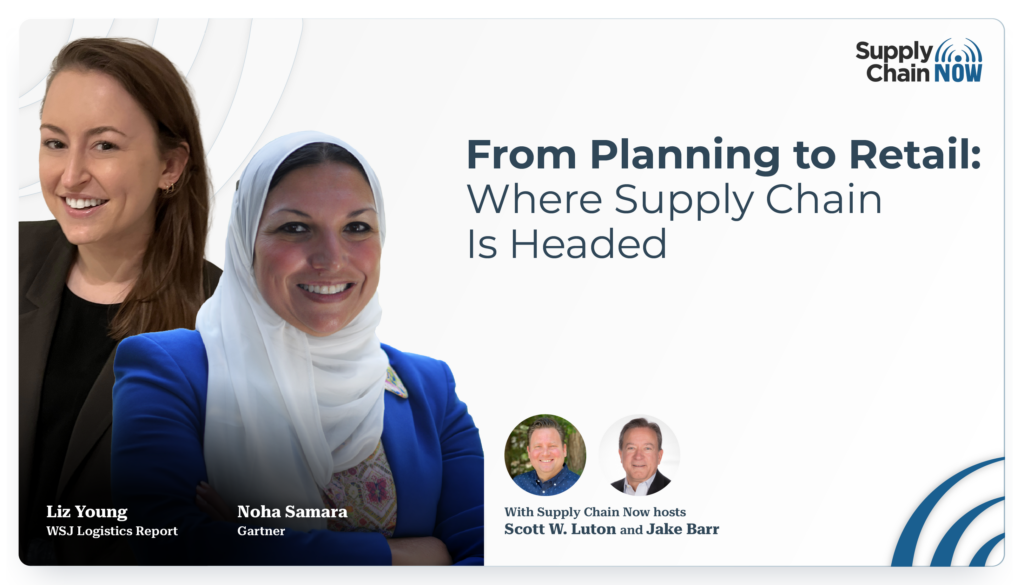
So with all that said, Jake, I want to introduce our guest here on Supply Chain Now, a seasoned supply chain professional with a couple of decades of diverse experience with global companies in sectors such as fast moving consumer goods, electronics, beauty and luxury cosmetics. And she now serves as vice president and customer fulfillment with Gartner, including this role where she chairs the Gartner Supply Chain Planning Summit, one of the more popular annual events, which we’re going to talk about here in a second. I want to welcome in Noha Samara. Hey, Noha, how you doing today?
Noha Samara (02:34):
Hi, Scott. Hi, Jake.
Scott Luton (02:36):
It is great to have you back on supply chain now. How are you doing?
Noha Samara (02:39):
I’m good. I’m good. It’s Friday night here in Dubai. The weather is getting better, so I’m really looking forward to the winter month.
Scott Luton (02:47):
Oh, man. We’re looking forward to some cooler temperatures here as well, Jake and Amy. I’m going to just jump right in, Noha and Jake. We got a lot to cover. And Noha, what I want to do is let’s level set on your role because your role is different than the last time you’re with us about, I don’t know, eight months, a year ago. You’re doing bigger and better things now. Noha, tell us more what you do with Gartner.
Noha Samara (03:10):
Right, so I’m Karen Key VP at Gartner and I’m leading myself and the team are leading the research agenda, helping our CSEOs, heads of planning, heads of logistics tackle their most critical priorities. And I’m obviously still sharing the planning summit.
Scott Luton (03:29):
Noah, that’s outstanding. And Jake, we’ve talked about this quite a bit. We’re going to be back at the planning summit here in just a couple months, which we’re going to touch on, but this is one of these very focused events that keeps getting bigger and bigger and bigger. Jake?
Jake Barr (03:42):
Well, the event’s getting bigger for obvious reasons, and that’s kind of the purpose of today’s chat because Noha’s going to talk to us about the myths on AI, but the use of AI is completely transforming the way we think about planning as a whole.
Scott Luton (03:56):
That’s right. So Noha, before we get into the myths, I want to go ahead and share. I want to put this on people’s radar. They got to come join me and you and Jake in Denver. Of course, there’s a sister event in London, but the one we’ll be at is the one in Denver, November 2nd through the 3rd. That’s just, gosh, that’s less than two months away. So folks, as the graphic says, the time to act is now. So come join us. We’re going to drop a link in the chat as well. All right, so Noha, I want to do some myth busting with you. Want to learn from you here today. I’m going to walk through four prevalent myths related to AI in supply chain planning. And bear with me. The word myth trips me up every single time. So Noha, I look forward to learning about the four.
(04:40):
Where do we start on the first one, my friend?
Noha Samara (04:42):
Let’s start with the first one. When people think that AI productivity is simply about making the same job faster or the same exact tasks faster, which is actually a very wrong belief because the whole intent of AI is to help us redesign the jobs we have, to help us do much, much more than what we are doing today. So I don’t think that any organization implementing AI and still keeping the same workflows that they have, the same job scopes that they have, the same decision maps that they have is actually going to benefit by any means from AI. To really get the right level of AI productivity, we need to think differently about the core of or the benefits of AI. It’s really about thinking of how the jobs are going to evolve, how the processes could change and how the decisions could be elevated for planners.
(05:39):
All
Scott Luton (05:39):
Right, so Jake, I was going to bring you in after the second myth, but I’m going to go ahead and bring you in now because she’s making some good points. It’s not only about accelerating existing work, is it?
Jake Barr (05:47):
It’s not. It’s about recreating the work because fundamentally that’s about unlocking the silos and the boundaries that someone perhaps forced upon how you think about the way in which a role executes. And the world of planning in and of itself for years has had to deal with, unfortunately, somebody put it in a sandbox. It’s like you’ve been knocking on the door on walls of the adjacent walls for years waiting for somebody to answer so you could adjust how you’ve been thinking about making decisions. What AI and Noah is referring to is it allows you to rewrite how you think about the work as a whole, who does it, when you do it, how you do it, where it’s done from. All those things are back on the
Scott Luton (06:33):
Tape. It’s interesting. I think all industry has been using the word re-imagine almost to cliche levels these days, but what y’all both are very tangibly describing is how we’re truly re-imagining how work gets done, how we find success and how we move our supply chains forward. So that’s just the first myth, Noha. So what is the second myth we want to completely eviscerate here today?
Noha Samara (06:59):
The second myth is thinking that AI adoption alone is what’s going to guarantee the value realization from AI. And this is again a big misbelief, I would say that, because beyond AI adoption, we need to ensure that the planners trust AI. So it’s not really about using or logging into a tool to generate some word, but it’s really about trusting that that output could be taken and could really be used for making decisions. Today, most of the organizations focus on that adoption piece, the KPIs around adoption, and they sometimes overlook the part on the AI trust. And obviously planners today, we have to be realistic also about the expectations from our planning teams. Many planners today, they have a lot of anxiety around AI and they think that AI is not to be trusted, a tool that’s going to take their jobs away. And they don’t see the real value behind really utilizing AI to the fullest.
(08:05):
So the AI adoption, I think before thinking of AI adoption, we need to think of AI trust. How can we ensure and empower our teams to use AI trust it and trust the outcomes out of it? We need to build a positive AI sentiment first before thinking around who’s using what and who’s using what in which processes. I think this is a very important piece around gaining AI trust. Also working on reducing the planner’s anxiety about AI by offering them a clear understanding of how their jobs are evolving, how the humans and AI should collaborate together. So it’s not about enforcing the adoption as is, but it’s really about creating a human AI augmented framework where planners could understand where they add value, where AI could add value, and helping them in the areas where AI is going to create fully the outcomes, they can trust and rely on these AI automated decisions.
Scott Luton (09:15):
Noah, I love number two here. And Jake, two of the things I love in particular about much of what Noha shared is number one, we can’t jump over the trust piece to solve the adoption challenge that is so prevalent. That’s a big one. And then secondly, I loved how I think all of us as humans are anxious living in this technology age, especially within our job and our roles and stuff like that. And to Noha’s point, I think this is a really important thing that gets lost in a lot of leaders out there. We’ve got to use technology and deploy it in a manner that really addresses some of that natural anxiety that anyone out there has. But Jake, what’d you hear there from Noha?
Jake Barr (09:54):
She’s a guru. She understands the nuance of it. Fundamentally, planners gain trust when they understand the insights that are derived from what AI does for them. So fundamentally, we have to think about it in almost a pyramid shape. And you’d think that previously, prior to AI, the planner’s role, 90% of the effort was at the bottom of the pyramid trying to sift through all of the data sources and elements that were required to get to the top of the pyramid, which is the insight that was derived that I could then use to go apply that logic to either an intervention or restructure or plan or whatever. So this trust comes from the ability of leveraging the AI to go and do all that prep and heavy lifting work so that I get to the insight that is logical and falls in line and it’s understandable.
(10:52):
So there’s a need for it to understand the path of how it got to the conclusion. And so the ability to interact and query with it to track your assumptions and how it’s going through the decision-making process is critical. And from that, the trust jumps out of the box because once I see it’s actually doing what I need it to do to derive, important word, derive a path for how to plan, then my trust goes off the charts.
Scott Luton (11:21):
Well said. And a little vocabulary lesson two from the John Wayne of Global Supply Chain. All right, so Noha, two down. We got two more myths to go. Before I prompt you for number three though, I want to say hello to Jerry Halls tuned in Happy Friday from Ireland. Great to see you, Jerry. Give us your take on these topics we’re talking about here today. All of y’all out there, we’re welcome to hear whether you agree, you disagree, you name it. All right, so number three, the third myth that we want to bust through here today, Noha, tell us more.
Noha Samara (11:49):
Number three is the fact that AI equals workforce reduction, and this is a big expectation from organizations once they implement AI. However, the reality today is not telling us that these are two things that are equal to each other. The reality is the fact that these time savings and the efficiency gains that should come out of using AI are actually often modest and heavily debated in many of the organizations that implement AI and can sometimes be negative. We know for a fact that only 18% of the organizations report that they are having a positive ROI out of AI. And most of this ROI is not coming honestly from workforce reduction. The real productivity, if you think of it, out of AI, is coming from deliberately redeploying the time saved by AI into higher value work and better decisions to be made by the planners. It’s really important as leaders that when we are thinking of AI and AI productivity to be clear on what are these value adding activities that we want to shift our planners to, instead of thinking of how much headcount can I reduce, I should be thinking of how many more scenarios can I evaluate?
(13:10):
How many faster root cause analysis I can do? How big is the inventory optimization opportunities that I can identify? Rather than just merely thinking of I’m implementing AI, I’m reducing this X headcount. Because I can tell you productivity gains, biggest productivity gains don’t come from the headcount reduction necessarily. It comes from doing more value added activities.
Scott Luton (13:36):
I though the second one was my favorite, but that third one has got me. And one of my favorite stories, Jake, that kind of somewhat illustrates, there’s so many that illustrates that third myth that Noha just busted up the smithereens is, I think it was Ford. They brought in a lot of technology and they let a lot of their savvy, most experienced team members go. And then they went a little bit further and they figured out they made a problem and they brought a lot of those folks back. And that’s just one little wrinkle on what Noha’s talking about, but your thoughts and what we heard there from Noha, Jake.
Jake Barr (14:09):
I’ve got firsthand experience. I mean, I’ve got clients that have literally taken all of the gains that they accrued. And oh, by the way, they were tangible gains in terms of simplification of the work, the recreation of the process, and freed up organizational capacity. Now in this case, I had one who churns through all of their brand portfolios. So think of it as the number of product introductions they bring to market generally replace about a third to 40% of all of the items they have available for sale every year. But they didn’t have the bandwidth to actually spend the time to properly plan out the material flow, the production schedules of the items that they had not yet introduced. So they’ve taken 100% of all the gain and it’s been a tangible, large scale productivity improvement. And they’ve redeployed it on bringing to market the new items faster, more effectively and at better margin levels because they’re being able to do the diagnosis and spend the time getting them right as opposed to just flowing them out in the market and trying to catch up to them.
Scott Luton (15:22):
Good stuff, Jake. Before we hit number four, I’m going to bring in this comment here, and this is tuned in from New Jersey. His name is Ya’ir, but he says, “My Starbucks name is Jake.” So I like that. He’s speaking to your third myth that you’re busting Noha. And Ya’ir says, “I was always pitching to the core I was working with. Do more with the same because it also helps you fight the planner’s turnover.” Excellent comment there. And turnover is still something one of the workforce challenges we’re certainly all fighting through global supply chain, really any industry. And then Natalie shares a year plus ago in conversations around robotics on the shop floor, we talked about how to change worker knowledge to work with robotics rather than doing the job that robotics is doing. Same conversation in the thought and work with AI. It’s a great point, Natalie, great point.
(16:11):
And it’s really opening tons of opportunities for the human workforce.
Jake Barr (16:14):
Scott, the alluding piece as well to what Noah brought up is, wait a minute. Noah, last time I checked, but all the statistics say we don’t have enough talent. There are gaps. There aren’t enough people for all of the jobs. So we’re talking about taking the people that actually improving their work-life balance and being able to keep the good people that we have as opposed to burning them out and throwing them out.
Scott Luton (16:40):
Excellent point. Excellent point. All right. So Noha, I tell you what, I wish we had a couple hours because there’s so many different side topics and sidebars related to each of these myths. But for the sake of time, let’s get into the fourth myth that you want to just blow away here today. Tell us more.
Noha Samara (16:57):
So the fourth myth is scaling the number or increasing the number of use cases of AI would automatically increase the productivity gain. And again, that’s a big misbelief because productivity only scales when you focus on the high impact initiatives. Regardless of their number, you really need to be choiceful on what are those specific use cases or high impact initiatives you want to deploy AI in because not all the operational areas benefit equally from AI deployments. We know that, and according to a recent research we ran, was the fact that high performing organizations, they focus on scaling fewer AI use cases that drive typically most of the value. So it’s really about being choiceful, being targeting the high impact ones rather than trying to implement AI everywhere. On average, we see that high performing organizations are actively pursuing around 3.2 AI use cases at a time.
(17:58):
And that limited number would indicate that they have a strategic focus on how are they going to implement and scale AI within a specific use case rather than trying to spread it all over and just get marginal benefits from the AI implementation. I think it’s good to start thinking of the different AI initiatives or AI use cases as products. So think of these products, think of it from a cross-functional perspective and start thinking, is this product worth that I invest in? Is it worth the investment? Is it worth the implementation? What would be the tight success matrix that I would measure that product on? We also see that high performing organizations typically, while focusing on a fewer number of use cases, they build a kind of sequencing in terms of what use cases they implement after the other in a way that helps them reuse the data and the platforms as they are implementing more and more AI initiatives in a way that they are building that capability that they are helping with the change readiness across the organization rather than trying to implement everywhere.
Scott Luton (19:17):
Some organizations are trying to do just that, implement any and everywhere. And you mentioned it, that change readiness, right? I’ll tell you. Jake, that fourth one was big. What’d you hear there from Noha?
Jake Barr (19:28):
It’s big. No, it’s called being strategically choiceful about the outcomes you’re trying to drive. Not I’ve got a bunch of fires. Let’s throw AI at each of the fires. No, she’s talking about stepping back and saying, “Hey, choicefully, if we’re going to do something, we’re doing it with a purpose so that it will lead to a next layer that we can drop on top of it.” I’ve got a perfect example of it in a client that I was working on. They started off, they were trying to say, “Hey, we’re just going to take in transportation updates that we get on our finished product movements and we want to be able to determine whether it’s going to have a consequence to our ability to fulfillment.” And so we talked to them and stepping back and said, “Well, you get transportation updates on everything, materials and packaging and stuff you’re sending and bringing back from kitting centers and from your CMOs.
(20:27):
Let’s make sure we design for using all updates.” Now our first lead-in was on the finished product side for fulfillment, but it allowed us to quickly reapply to all of the physical flow.
Scott Luton (20:41):
Good stuff. And you know what folks, if we had. Jake’s got lots of stories. He only shares some of them behind the scenes and shares some of them in front of the scenes, but to make sure you connect with Noha and Jake for all the different ways that organizations –
Jake Barr (20:55):
We’ll have hours in Denver. Come and see us.
Scott Luton (20:57):
We are going to have the hours in Denver. And hey, that’s a great segue, Jake. Thank you very much because I want to get to, from Noha’s point of view, the two to three top reasons that Noha, that you would suggest that supply chain pros, there’s no option. They got to be with the three of us and I don’t know, 500, 800 of our best friends in Denver for the Gartner Supply Chain Planning Summit, November 2nd through the 3rd. And Noha, again, you’re the chair of this outstanding event, I think for the second year in a row. Why do folks got to be here?
Noha Samara (21:28):
Look, Scott, the Supply Chain Planning Summit is actually the go-to event for heads of supply chain planning and their teams. If you think of it two days full of insights, ideas, and sharing experiences. In these two days, attendees are hearing from the Gartner experts about the latest advancements. They are getting actionable advice on how they tackle their priorities, but they’re also connecting with peers that are facing the exact same challenges that they are facing every day. They are able also to visit vendors and get demos across all the different tools that are available. I don’t think there is an event that is specialized in planning as much as this event, getting everybody under the same roof for two very condensed days.
Scott Luton (22:15):
I agree with you, Noha. A lot of events out there may touch on planning. They got planning modules or breakout sessions or keynote sessions, but this event is gavel to gavel. It features, I’ll call it the largest gathering of leaders and organizations that are truly innovating and changing how planning is done across global supply chain. Jake, would you agree?
Jake Barr (22:36):
I definitely do, because I’m a planning geek. So if you’re a planning geek, this is where you want to be. It’s geeked in heaven. You get to talk DEFCON four level planning problems. I don’t care if it’s material, capacity, production, distribution. And the great thing that Noah was referring to is you get to look through it through the lens of other people’s eyes, which I find refreshing because many times the solve to my problem is something someone else has already learned their way through and I don’t have to repeat.
Scott Luton (23:10):
That’s right. That is being our advice there from the both of y’all. Folks, we got a link right there. Thank you, Tricia, for sharing a direct link. You can learn more about the summit. Come join us there in Denver. I look forward to me and Jake. We’re going to be interviewing some of the movers and shakers out there, so look forward to that. Hey, one last question before we let Noah get to enjoying her weekend and all kinds of. And hopefully not any working at least for not a little bit more this week, get into the weekend. Enjoy some of that stuff. Noah, how can folks track you down, my friend?
Noha Samara (23:42):
I’m available on LinkedIn and I’m happy to connect. And for those who are going to be there in London in two weeks from now or in Denver, early November, please stop by and say hello. It’s always great to connect with great minds.
Scott Luton (23:55):
Outstanding. And Noha, right before we let you go, I want to share a couple quick comments. Jerry says, “Hey, as a 35 plus year supply chain management veteran, I find AI to be one of the most exciting innovations to date. Keywords mentioned by Noha and Jake are validate and trust and then build confidence in this supporting advancement. Well said, Jerry. And then Jayote, AI gives us the efficiency and speed, but domain expertise and context are what keep the outputs accurate and reliable. Excellent discussion.” And then Mohammed says, “Great to have Noha back. I’m with you. T squared. Good nourishment. Noha, you brought us nourished. If T squared is giving us praise, we’re hitting the mark.” So Noha, Samara, thank you so much for being here. Thanks for what you do, and I can’t wait to see you in Denver, Noha.
Noha Samara (24:42):
Thank you so much, Scott. Thank you, Jake.
Scott Luton (24:44):
We’ll see you soon. Jake, that was good stuff.
Jake Barr (24:46):
Insights by the truckload, I’m telling you.
Scott Luton (24:49):
No doubt. Let’s see here. I meant to share this link as well. Folks, go follow or connect with Noha right there on LinkedIn. We’re going to make it really easy. Natalie shares, “Noha, it’s a pleasure to hear your thoughts on key topics. I became a fan on your last visit on supply chain now. Man, Natalie, me too. Me and you both, my friend. All right, I’m going to get back to some of these other comments in just a second. But Jake, we’ve got the second segment. Noha hit it out of the park, as you can see with some of these comments here, and we’ve got a second segment that is going to deliver as well. Are you ready to dive in?
Jake Barr (25:25):
Let’s roll, man. This is two for one, I’m telling
Scott Luton (25:29):
You. All right. And you know we’re nerds if we’re enjoying supply chain planning discussions on Friday, Jake. You know we’re nerds like you described it, right?
Jake Barr (25:37):
Guilty.
Scott Luton (25:37):
That’s right. All right, so folks, I’m looking forward to sharing a terrific conversation I had with one of the best reporters that covers global supply chain. Liz Young is a reporter with the Wall Street Journal’s Logistics Report and the Dow Jones Risk Journal. Now, as I’ve said, I don’t know, a thousand times, I’m a big fan of the logistics report. It’s weekday required reading. First thing in the morning, you can sign up for an email and it’s good stuff. So let’s see what Liz had to say on a variety of topics recently. Liz, great to see you. How you doing?
Liz Young (26:08):
Thanks so much for having me, Scott.
Scott Luton (26:10):
So just so you know, I’m chair of the Metro Atlanta Liz Young Fan Club. Do you know that Liz?
Liz Young (26:16):
Thank you very much. I appreciate that.
Scott Luton (26:18):
So kidding aside, I really appreciate the spotlight you put on industry and your reporting. We’re going to walk through a couple of examples here today, but first, little fun warmup question. So I understand, Liz, that you’re a graduate of the Ohio State University. Is that right? That’s
Liz Young (26:34):
Right. Don’t forget the the.
Scott Luton (26:36):
Can’t forget the V. I think we’re talking pre-show. I was last in Columbus with ASCM’s change event last year, which is going to be at Long Beach this year. I think you’re going to be there, right, Liz?
Liz Young (26:46):
That’s right. I will.
Scott Luton (26:47):
But the fun warmup question is this one. If folks go to Columbus, let’s say they have the bad experience of having their team scheduled to play the tough Buckeyes, but the highlight of their visit may be food, restaurants, tailgating. What’s one place you’d say they got to go for folks that spend a weekend in Columbus?
Liz Young (27:06):
One of my favorite spots is Mikey’s Late Night Slice, which is a pizza place, and they have this great sauce. It’s called Unicorn Sauce that is delicious. You can get it spicy as well. You dip the pizza in it. And keep in mind, I say this living in New York, Mikey’s is really good pizza, so I recommend. All
Scott Luton (27:23):
Right, so Liz, you’re making me starving for pizza now. Thank you very much. What was the full name? It was Mikey’s. Late
Liz Young (27:29):
Night Slice. Mikey’s Late Night Slice.
Scott Luton (27:32):
Mikey’s Late Night Slice. And you living in New York City, that is high praise from someone that has
Liz Young (27:37):
Access to delicious
Scott Luton (27:38):
Pizza? I think so. Okay.
Liz Young (27:39):
I think so.
Scott Luton (27:40):
All right. So now that everybody’s starving, I want to get into some great topics with Liz Young, the Liz Young maybe. All right, so Liz, I want to get into some of your recent reporting. And one of your recent articles, which really has gotten a lot of feedback, has been looking at retailers reducing product variety as they of course wrestle with tariffs and higher supply chain costs. I want to ask you, what’s been a couple of key points that you really want to communicate to your readers out here via this article?
Liz Young (28:12):
I think it’s been really interesting to see how companies have responded to the tariffs, and they’ve done this in all manner of different ways. But one of the things we’ve seen is that companies, and this includes big companies like Under Armour, Helen of Troy, which makes Oxo Kitchenware and Hydro Flask water bottles. These are companies that, even with their size and scale, are taking action to help reduce the impact of tariffs. The other thing is they’re taking these steps partly too to reduce supply chain complexity. So what they’re doing in this case is they’re selling a more limited selection of merchandise, and the idea here is that they’re able to then really focus on the best selling items. And if you think about it, I mean, it makes sense. You don’t want to clutter your shelves with a bunch of extra variety if consumers aren’t really interested in it.
(29:00):
The tariff benefit here is that say you’re making a sneaker in five different materials. If you make it in three instead, you might only have three tariff codes to deal with instead of the full five. So it allows you to reduce some of the complexity, if not outright costs, you can at least maybe get a little bit of a better grip on what you have to handle and tackle and source, et cetera.
Scott Luton (29:24):
Right. I like it, especially your second point about reducing complexity. We got so much complexity. It goes with the territory I know, but here in 2026 has introduced new layers of complexity. And just one quick example, because as we both know, a lot of folks know out there, SKU rationalizations is nothing new. It comes and goes all the time. And one of the more, not famous maybe, but for me, a landmark move five or six years ago, the Coca-Cola company eliminated almost half of its product lines. But the good news, Liz, is I can still find my caffeine-free diet cherry Coke. When I visit freestyle machines mainly, what’s one of your favorite beverages?
Liz Young (30:05):
Oh, I’m a pure, just Coca-Cola the way it is. I know how much sugar is in it, so I try to drink more of the Coke Zero, but it’s
Scott Luton (30:14):
So
Liz Young (30:14):
Good.
Scott Luton (30:15):
Struggle’s real. I’m with you. I’m with you. All right. So Liz, I really appreciate that. I want to talk about a different wrinkle when it comes to tariffs, right? Because oftentimes conversations when the tariffs come up, it’s about prices and landing costs and of course complexity. But from your perspective, how are tariffs actually changing the way that retailers design and operate their supply chains?
Liz Young (30:41):
So I think one of the notes, and I’m preaching to the choir here, but one of the things I would say is that tariffs are just one of the latest and greatest in a series of a years long constant supply chain disruption era. So retailers are grappling with all of this, and this includes going from the pandemic and from over ordering during the pandemic and having too much inventory. And now you’ve got wars in Ukraine and in Iran and you’ve got all of these energy prices in flux. So with all of this, including the tariffs, the word that I hear more and more is flexibility. I hear about agility. I hear about trying to keep your supply chain resilient in the face of all of these disruptions, whatever the disruptions may be. And they may be even a tornado. They can be something much more veinal than having to deal with all of these different geopolitical risks.
(31:36):
And so retailers are trying to get smart about where they produce items. They’re trying to create flexibility so that if one site goes down again, say due to a storm even, they have another place they can source from. And they’re just trying to create more visibility into their supply chains and try to get a little smarter about when something happens, what can we do right away? Sometimes in the case of tariffs, that was trying to get smart about when they officially quote import the goods. So using different warehousing mechanisms that allow you to not have officially imported the goods yet or delaying shipments or front loading merchandise, whatever they can do to try to manage that tariff risk and that tariff burden, we’re seeing them do. So again, it’s all about trying to create this resilient supply chain to create redundancies and just also overall to have a better picture of what even is your supply chain, which is not easy for a lot of companies.
Scott Luton (32:35):
That’s right. Lots of different definitions. You shared a lot in that one response, Liz, is a required listening here in supply chain now. You touched on getting more visibility through second, third, fourth tier. It’s always been a challenge, right? You mentioned some of the bonded warehouses, free trade zones, those have really surged in popularity over the last couple years. You mentioned sourcing diversification, which is not new, but it continues.
(33:04):
We’re seeing it in different creative, more creative ways. And you touched on two last things amongst other things. Inventory’s cool again, inventory strategy is changing for a lot of front loading. And then there’s probably all, you used several words agility and I would add optionality, supply chain optionality. How can we bake in an easier ability, I hate to use the word pivot, but to flex, to make alternative choices when it comes to product mixes or transportation modes, you name it. Liz, you nailed it I think with your response. That supply chain optionality or supply chain agility is what so many leaders are after, huh?
Liz Young (33:41):
Yeah, absolutely. Yep. I hear about it all the time.
Scott Luton (33:44):
All right, so a little follow-up question there. As you’re seeing companies make some of these changes, structural sourcing, inventory, assortment, network decisions, many of which may well remain in place even if the current challenging tariff environment eventually changes. We don’t know what with this next administration in a couple years, who knows what may change. What do you think sticks? What has the best chances of sticking long after this challenging trade chapter?
Liz Young (34:16):
It’s kind of the old maxim of the only constant is change. So from where I sit talking to companies, that’s the biggest thing they’re planning for to stick around and their anticipation is tariffs might used in different ways. They’re planning accordingly for that. There might be different disruptions that happen as extreme weather becomes more common. So they know all of this and they’re anticipating all of this, but at the same time, at the end of the day, what they’re really trying to plan for is back to what we were just talking about, they’re trying to plan for the unexpected. And that’s what I expect to stick around, funny enough, is that if you plan for the unexpected, maybe you’ll be a little bit more prepared for it, but there’s nothing that they see with a crystal ball, at least that they’re sharing with me to put out publicly that will fix all of their problems long
Scott Luton (35:05):
Term. One of the things I think about regularly is has our industry, global supply chain, has an industry gotten stronger or better or has it fueled innovation to go through all these trade wars? You could make a case for that, but if we had our choices, I don’t think anyone would opt to drive innovation and development that way. But nevertheless, so moving downstream a little bit, I want to ask you a question or two about the consumer. For years, the last mile arms race has been all about being faster and of course cheap or free delivery. I want to ask you, in all of your reporting with your finger on the pulse, are consumers still demanding speed above everything else or are retailers starting to maybe rethink the economics of the last mile?
Liz Young (35:50):
It’s both and. So we’re seeing, again, consumers too, like flexibility. So just making things even harder for retailers. We’re seeing that there are some consumers who, let’s say I want a t-shirt delivered to me today, you want the same t-shirt to be available in the store near you tomorrow. And there’s a third consumer who’s decided, “Well, I want it, but I don’t really want to pay for that fast shipping, so I’m going to just wait and have it come next week.” And so retailers are having to get really, really smart about where they place their inventory and how they try to forecast their sales so that they have the right products in the right place at the right time. Because there are some consumers who are more than happy to wait if it means free shipping. There’s some consumers who expect it’s got to be really fast and it’s got to be free.
(36:35):
And there’s some consumers who say, “It’s just got to be fast and I don’t care if I have to pay for it.” And so retailers are trying to get smarter about meeting all of the needs of those different groups because exactly to your point, retailers are really, these are heavy shipping costs. These are costs that have only gone up. Retailers aren’t really excited about having to pay for that free shipping, but it is something that a lot of consumers now see as a given. So retailers trying to control some of the costs. In some cases, some companies will offer you free shipping, but it’s got to be the three to five business days. It’s not going to be tomorrow.
Scott Luton (37:09):
One other wrinkle to this, as my dear friend Lori Boyer has shared with me, some data out there suggests that as long as we can answer the customer’s question, where’s my stuff? As long as they know where it is, they’ll be, generally speaking, more patient when it comes to the speed of that delivery. Do you see some of that out there as well, Liz?
Liz Young (37:28):
I think that’s definitely true. I think that we’ve all gotten so spoiled and we have gotten used to being able to look on Amazon, Walmart, Uber Eats, whatever it might be, and see often exactly with a GPS estimate at least where a package is. So I think that expectation is there and I do think people, especially after the pandemic, I think consumers have a little bit more understanding of some of the complexity that happens here and they think, well, I realize it’s going to take a few days, but at least I can see that it’s making its way from California to New York. I can see it’s going in the right direction.
Scott Luton (38:03):
That’s right. Well said. And consumers out there, if you don’t have that, come on, we got to practice some empathy. All right, so Liz, you’ve been covering trucking quite a bit, which of course is the backbone of global supply chain, at least here in the States, I’ll call it. And one of your recent articles from a week or two ago focused on the trucking crackdown that continues here in the US. And I think one little nugget that I read in this is the current administration, I think they’ve shut down 300 driver training schools mainly due to training deficiencies and other reasons. But I’m really curious, what are you seeing in the trucking market right now that retail and supply chain leaders got to be paying more attention to?
Liz Young (38:42):
Yeah, it’s been a weird few years for trucking. A lot of truck drivers entered the market during the pandemic and that created an oversupply environment when demand fell back versus pandemic highs. And we’re in this moment now where trucking is a pretty traditional supply demand business, but this is a really weird cycle for the business where what we’re seeing is supply contract even as demand remains relatively flat. I mean, demand’s not in terrible position, but it’s certainly not popping off the charts great either. And so what we’re seeing happen right now is that that supply contraction, which is in part due to the Trump administration’s crackdown on certain classifications of immigrant drivers as well as certain driver schools, et cetera, that all of this together is contributing to spot rates going way up. Costs are going way up. So retail and supply chain leaders right now need to be aware that the costs are dramatically up.
(39:39):
I think I was looking yesterday and I saw, I think it was the truckstop.com latest report said spot rates were up, I think it was something like 38% last week compared to a year earlier. So we’re really seeing a lot of that pricing momentum return in carrier’s favor after several years where it was really a shipper’s ball game.
Scott Luton (39:57):
So Liz, good stuff there. And thank you for adding more resources. We love putting resources in front of folks. Liz, I meant to ask you about drones. We’re talking trucking, we’re talking last mile. There’s so much Wall Street Journal was reporting on all sorts of drone developments, including I think DoorDash is not only increasing their drone fleet, but they’re going to be manufacturing their own drones. I think I saw that in Wall Street Journal. A thought or two around the ever evolving drone landscape, Liz.
Liz Young (40:25):
Drones are a really interesting delivery method in my opinion. I think right now they’re still very novelty, but also I say that as someone who lives in New York and I don’t expect that I will probably ever have drone delivery in New York. So I try to keep aware of that because it is becoming more and more popular, especially in states like Texas where you have a little bit more land, you have people with houses and yards, et cetera. So with that in mind, I think this year the drone industry players who I talk to, whether they be a retailer, whether they be a smaller drone operator, they are very insistent that we are kind of at the cusp of this becoming much more mainstream. And I think we’re seeing that in some of the numbers in terms of Walmart’s rolling this out to hundreds of its stores.
(41:10):
Amazon just said it’s going to have this in 500 cities in town soon. Again, we’re seeing, like you said, DoorDash, Uber Eats, some of these more traditional same-day delivery providers getting into the race themselves. And so I think we are at a moment where we might see a lot more of this, and then what remains to be seen is how consumers respond to that. Companies say that the customers who use drone delivery really like it and return to use it again often, but I think we’ll see. I mean, as this becomes more popular, your neighbors are going to hear this too, and maybe they don’t like the drones flying overhead, maybe they don’t like the buzzing. So we’ll really see. I think that this year will be, and maybe over the next few years, will be kind of a critical period to see how realistic this is.
Scott Luton (41:55):
Yeah, I think that’s good perspective. And who knows, maybe if we can get some of Mikey’s late night slices down here in Georgia via drone delivery. We’ll see how it unfolds, Liz. There
Liz Young (42:05):
You go.
Scott Luton (42:05):
All right. So Liz, I really appreciate you’ve got your finger on the pulse like you do, you’ve got the benefit of talking with executives and companies across the industry, especially the innovators every single day. I want to ask you, what’s one change happening, especially when it comes to retail supply chains right now that maybe we’re underestimating, including one maybe that’s going to really grow with impact over the next couple years?
Liz Young (42:29):
Yeah, I think to me, one of the most interesting changes that’s happening is that we are seeing the spending power starting to shift. We’ve got millennials, but then we’ve also got Gen Z, Gen Alpha coming up and they’re spending more, gaining more spending power throughout the US. And especially with Gen Z and Gen Alpha, you’re going to have this moment where a lot of these consumers grew up, at least in the era of Amazon Prime. So they have different expectations around social media, around delivery, around what it costs to get things delivered same day. I think that’s going to be a really interesting shift that retail leaders need to be prepared for and aware of. As a millennial, I remember very vividly, I mean, it wasn’t that long ago that you would order something online and the expectation was it would come in seven to nine business days.
(43:13):
So I remember that. I mean, I’ve gotten spoiled too. I get plenty of things same day and next day now. So it’s not like I’m like, oh wow, I thought it would come in seven days. But at the same time, there is that kind of baked in like, okay, I remember that it used to not be so fast. So kind of like you were saying before, that empathy of maybe it’ll take a little while. And I wonder personally, and as I talk with supply chain leaders, what that will mean in terms of how expectations change as younger consumers are the ones placing more and more of these orders.
Scott Luton (43:45):
Yeah. Liz, that’s a terrific observation. One other little wrinkle when it comes to the different generations out there that I’ve seen in my household in the last day or two. So my oldest is a senior in high school, her name’s Brantley, and she was applying to colleges here recently on her phone. And I talked with them and say, “Okay, what are you doing on your phone?” And Amanda, who’s handling production for us here today, said, “Yeah, there are studies out there that shows it’s like big screen, small screen. Generations have big differences in what they would like to do on small screens versus if I’m doing anything, applications, taxes, making airline reservations,
Liz Young (44:25):
I’ve
Scott Luton (44:25):
Got to do that on my laptop or my desktop, not on my phone as much.” Liz,
Liz Young (44:30):
React
Scott Luton (44:30):
To that.
Liz Young (44:31):
No, absolutely. I feel exactly the same way. And it’s kind of a funny curve in fact, because I find that my mom, she’ll order things off of her iPad, which I think of as kind of a small screen. And then exactly to your point, I’m like, “I have to be on my laptop to do many different things.” Even last night I was doing my fantasy football draft. I had to be on my laptop for that. I need to be able to see all of the information at once.
Scott Luton (44:55):
Liz, I’m with you. Gosh, I’m not going to ask you who you drafted first, right? I’m not going to do that, but best of luck and we’ll get an update next time you’re with us.
Liz Young (45:03):
Thank you.
Scott Luton (45:03):
All right, so I want to turn things around a bit because you are asking questions, the tough questions of everybody every single day. But one question I’ve got for you, what do you think is the big retail supply chain question that the industry, all of us, just haven’t landed on a good answer just yet?
Liz Young (45:21):
Yeah, I think there are two things that I’m constantly wondering about. One is what’s the fastest delivery that people really want? We saw during the pandemic that some of those ultra fast delivery models, 10 minutes or less, I think it was go puff and gorillas, that didn’t really pan out to be as popular as maybe was expected. Now we just saw recently Amazon’s rolled out the option for 30-minute delivery, at least in some markets across the US. And so I’m really interested in seeing how popular that is. Again, maybe this is about that flexibility where there’s some things people are willing to pay for to get in 30 minutes and other things they’re not as interested in. So I’m curious about the dynamics of the super fast delivery. And then the second thing that I wonder a lot about is returns. We all, during the pandemic especially, got used to ordering a lot of different things online.
(46:10):
And I think retailers in a lot of cases accidentally trained us that if I like this dress, but it comes in three different colors, and I’m also not really sure about my size, if I go to the store, they might not have it in all of those sizes in all of those colors. So I might go online and order all of my options and then I’m deciding, okay, well, this is the one I’m going to keep. I’m going to send back the rest. And that behavior is not ideal for retailers for a lot of different reasons. It costs them a lot when I do something like that. And so I’m wondering where we see returns go from here. Is there a way to stop that behavior? Is that even a good thing to stop that behavior if we like the product variety? This is kind of bringing us full circle back to the skew point.
(46:56):
If you like having different colored options, but you can’t fit them all on store shelves, something’s got to give. So I’m really curious what’s going to happen in that space too, as far as kind of controlling, I guess, and figuring out that returns behavior and how to not lose money on every single return.
Scott Luton (47:16):
Liz, well said. And I am so glad, I love both of your points, but I was so glad you included returns there because I completely agree with you. I think industry, we’re trying to find that balance. We’ve got this growing tidal wave of returns, and unfortunately, despite all the gains we’ve made, a lot of it goes to the landfill, right? And we’re also seeing the immense rise of organized return fraud, not friendly fraud as some folks call it, but organized crime. And so thankfully all that is driving a lot of innovation in the returns part of global business. But man, we got a lot of heavy lifting to go. Liz, good stuff. Really enjoyed. I wish we had a couple more hours with you here today, but I want to make sure. As I mentioned, I read your reporting all the time, many of your colleagues.
(48:01):
One of the top places I go and I look at, it’s required reading in our household, and that’s the logistics report that’s put out by the Wall Street Journal. Don’t necessarily start my day with it because I think this comes at 7:00 AM. Sometimes unfortunately my days start earlier, but I get an email with the logistics report every day, I think at 7:00 AM. And I also get the weekend edition of the journal, which is outstanding. So beyond the logistics report, which I think folks can find you regularly, how else can folks connect with you and your reporting list?
Liz Young (48:30):
Yeah, absolutely. So they can, again, like you said, subscribe to the WSJ Logistics Report newsletter, which comes out every weekday. And you can follow me on LinkedIn, just my name. Might have to also search WSJ Logistics Report because my name is Liz Young, and so there’s a lot of Liz Youngs on LinkedIn, but you’ll find me on there. And the other place you can check out is we have some other related publications. As we talked about at the beginning of the episode, I’m part of a publication called the Dow Jones Risk Journal, which you can see right behind me, which covers supply chain risk, trade risk, geopolitics, all of that. And they have a LinkedIn page as well that you can follow along to see what we’re putting
Scott Luton (49:10):
Out. Liz, I love it. Information is certainly power and trusted information is even better. And you are one of the trusted reporters in Voices Industry, and I’m going to check out. So Dow Jones Risk Journal sounds like yet another great resource that we got to add to our radar, huh?
Liz Young (49:26):
Yep, please do.
Scott Luton (49:27):
Outstanding. Well, folks, we’ve been talking with Liz Young, who again is a reporter with the Wall Street Journal and Dow Jones Risk Journal. Liz, thanks so much for shining a spotlight on our global industry and for spending time with us here today on Supply Chain Now. Thanks, Liz.
Liz Young (49:45):
Thank you so much for having me, and thank you for everything you do to be a source of reliable information and just fun information in the industry. I
Scott Luton (49:54):
Appreciate that, Liz. We’re going to have you back and we’re going to get some fantasy football tips from you. How’s that, Liz? All right.
Liz Young (49:59):
Okay. I’ll try my best on that one.
Scott Luton (50:01):
We’ll see you soon, Liz.
Liz Young (50:03):
Thank you.
Scott Luton (50:04):
All right, Jake. Well, hey, 50% of that was really good. Liz was awesome. Who the other guy was?
Jake Barr (50:11):
Insights by the truckload. You have to know how to unlock them, Scott.
Scott Luton (50:15):
That’s right. Well, hey, so Liz, we covered a lot of ground there with the Liz Young, and I tell you, it’s tough to keep up with Liz. She’s knocking out stories almost every single day, and also you got to check her out on social where I think she’s walking through the streets of New York while giving updates on topics and stuff. It’s really cool stuff. But Jake, what stood out to you the most? What are your key takeaways from that segment with Liz?
Jake Barr (50:38):
Well, there are a couple things, but I want to give her koodies because she really, truly deserves them. There’s one thing to report on the space. There’s another thing to actually be the domain deep. So I give Liz credit. She literally rolled up her sleeves and she went to school on understanding supply chain at its deepest, most fundamental level. And that’s why I think her reporting is so insightful. There are a couple things that honestly stood out, and I want to echo a couple of her points. One, the trade-off that folks are doing on their portfolios, think of them as how many items I make available for my customers or consumers to actually buy and find for me. That is a fundamental reaction to saying, “Hey, I’ve got to control the chaos.” So I’m trying to put some boundaries on how many options I have to look at and problems I have to solve, how many materials I have to source, how many, I’ll call it packaging suppliers I’m going to need, how many places I’ve got to get it put.
(51:43):
So that is a true reaction to that. So that’s like putting guardrails on just keeping in control of the choices. She also spoke to a very important element. Even if you do that, the optionality of how you or I go shop for that is added yet again another dimension of complexity. So hey, you want it right now within 30 minutes. I actually want to go to a bricks and mortar store for it and my neighbor actually doesn’t care and it’s going to be perfectly fine if it meanders its way into the house X week. All of those are valid and they all are part of the demand flow. So the optionality has mushroomed and then therefore the need to back into it on what are my processes capable of delivering? Where do I put that safety stock? Because that safety stock is precious. You spoke in that piece around, wait a minute, folks are playing what I call the roulette game of extra safety stock right now.
(52:44):
Okay. Well, hey, if I keep all of what I used to sell, my safety stock and my cash utilization without the window, so if I can control, give you fewer options during this period and then reinvest the money that I might’ve saved onto other items into that optionality of where I keep it, I’m able to hedge my bets. So she nailed it on the trends that are coming through. I think her piece around as you got into the automation, the piece of how will the drone piece develop? They’re taking off, Scott. The investment in the technology, in the AI, the collapsing of the cost of the units is making it the break points of what used to be the only things I could use it on as an option has dramatically shifted. And oh, by the way, we keep going with $6 plus diesel, that goes even further down the curve.
Scott Luton (53:40):
That’s a great call out, Jake. And some of the experts out there, I’m not going to remember the analyst name with Gas Buddy. I was tracking him earlier this week and Amanda and/or Trisha, if you can find his name. Patrick Dahan, I want to say, but I might have that wrong. Anyway, I think he’s projected over 650 by the end of the weekend. So we’ll see if we can find a better path in the weeks ahead, but that’s a great call out, Jake. And one last thing, I know we’re running long folks. We’re about to wrap here. Thanks for all the great comments I’m going to hit on a couple days before we leave. But one of the things I found interesting with the drones is some of the big companies that focus on anything but manufacturing drones, not only are they building out their fleet, but they’re building the drones themselves.
(54:21):
That somewhat surprises me. How about you, Jake?
Jake Barr (54:24):
I describe it as they’re looking and saying, “How can I de-bottleneck my supply chain?” So this is the old age old battle of do I source it all from outside or do I vertically integrate certain elements? And if you think about it, we’re talking about what is DoorDash’s business? It’s delivering crap. So it’s not stuff that I made, but it’s stuff I deliver, right?
Liz Young (54:49):
Sure.
Jake Barr (54:49):
So this is a case of them going cost trade-off analysis, and as I go higher on the cost per unit, I have to stay relevant because as much as you want that food, I don’t think you want that food if I add a $20 delivery charge on top of it.
Scott Luton (55:04):
Hey, it’s high enough already. Oh my gosh. And for that matter, just eating out thanks to all sorts of inflation and many other things. So we’ll see what lies ahead. But Jake, excellent. I really appreciate your key takeaways from the segment with Liz. Folks, I’d encourage you, I urge you, go connect with, follow Liz on LinkedIn. You’ll see not only her pieces at the Wall Street Journal Logistics report and the risk resource that we shared, but also she drops a lot of knowledge, as I said, just on various topics day in and day out. So go check that out, make sure you follow her. Good stuff. Okay. Hey Trip, great to see you again. We’d love to know if your Steelers are going to make the playoffs. All right, so Jake’s saying no. We’ll see
Jake Barr (55:53):
If that – Eagles and Ravens out of the division.
Scott Luton (55:55):
And Natalie, for some reason, I’m not able to pop these comments up. Th means it’s time to go, but Natalie says, “Great conversation today. Thank you, Liz, for the insights.” I agree with you, Natalie. I though Liz really brought it here today. And Trisha is dropping. It is Patrick Dahan, and you can go learn more. He’s with Gas Buddy. There we go. Thank you. Patrick@dahan.com. Learn more. He’s been interviewing everywhere these days because he knows these fuel markets, so go check that out. We’re dropping Jake’s LinkedIn profile as well. Make sure you follow what Jake does, whether you like it or not, as he travels around the world, helping supply chains everywhere. One last thing, folks, we encourage you, two last things rather, come join me and Jake in Denver at the Gartner Supply Chain Planning Summit. That’s coming up soon, November 2nd and 3rd.
(56:43):
We’re dropping the link. A couple links to that is in the chat, so go check that out. And then finally, hey, don’t miss live events like this. Sign up for our almost weekly newsletter with that said. We’re dropping a link to that right in the chat. It comes out, as I’m suggesting, almost every single weekend and it’s chocked full of resources and perspective and tools, and of course our upcoming live events. All right, Jake, we got to leave it there, my friend. I hope the Falcons can find a way back this Sunday. I hope they can find a quarterback and give the Carolina Panthers a ball game. We’ll see. And how about Kentucky going up over to, are they going traveling to A&M for that game?
Jake Barr (57:21):
They’re at A&M.
Scott Luton (57:22):
Okay.
Jake Barr (57:22):
Two touchdown underdog. That’ll probably be about the right.
Scott Luton (57:26):
Okay. Well, good luck. Good luck to everybody’s football teams, pro, college, you name it. Hey, those two universes are getting closer and closer, huh? But good luck to all the football fans out there. And hey, whatever you do, reflect on what we heard here today from Noha and from Liz and from Jake and your homework. If you choose to accept it, take one thing and do something with it, right? Deeds, not words. That’s how we’re going to continue transforming global supply chain one day at a time. And with all that said, hey, on behalf of the whole Supply Chain Now team, Scott Lewton challenge you. Do good. Get forward. Be the change that’s needed. And we’ll see you next time right back here on Supply Chain Now. Thanks everybody.
Intro/Outro (58:04):
Join the Supply Chain Now community for more supply chain perspectives, news, and innovation. Check out supplychainnow.com. Subscribe to Supply Chain Now on YouTube, and follow and listen to Supply Chain Now wherever you get your podcasts.