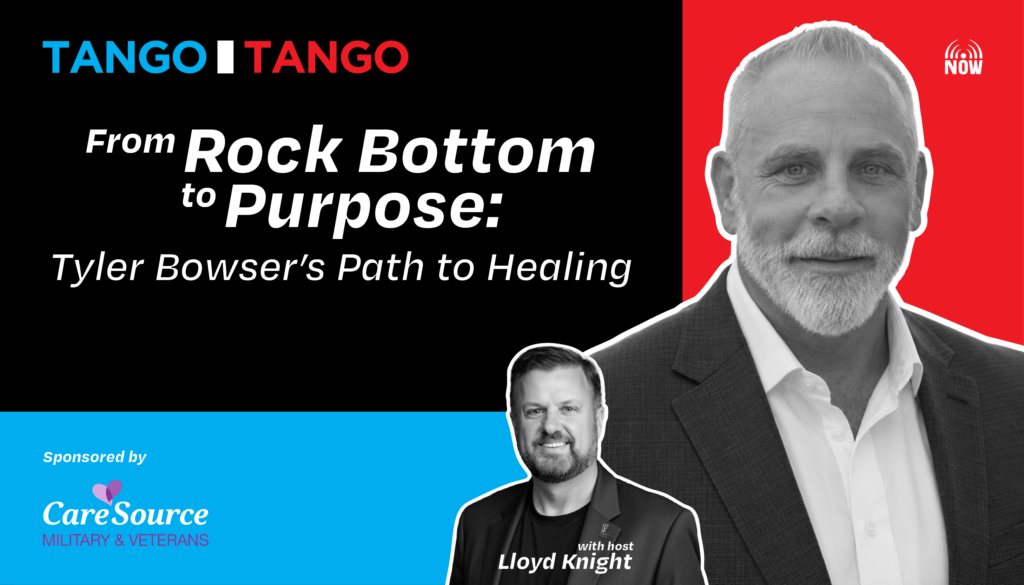
[00:00:00] Tyler Bowser: I knew that there were gonna be seven families that were gonna be, gonna be visited by seven different service members telling them that their loved one is no longer with us. And I was like, “I can’t do this anymore. It’s time for me. I’m not healing. I’m just sitting over here hiding.” And that’s what I was. I wasn’t healing, I was just hiding. the second deployment and going through that many fallen comrade ceremonies, I said, “Enough is enough. I’m gonna go back to the States.”
[00:00:42] Lloyd Knight: Welcome to Tango Tango Podcast. I’m your host, retired First Sergeant Lloyd Knights. And as always, thank you to our sponsors, CareSource Military and Veteran. It’s who I use for my TRICARE option. And I’m really pumped. I’m always pumped when I do this podcast, but man, we have a special story for you today.
[00:01:02] Lloyd Knight: Uh, not only I’m wearing my Air Force shirt in honor of my good friend Tyler, but Tyler’s story is, wow, it, it’s tragedy, it’s success, it’s failure, but most of all, it’s somebody picking up themselves by their bootstraps, uh, grit, determination, and a, uh, and also a story of, uh, faith. So welcome to the Tango Tango Podcast, Tyler.
[00:01:28] Tyler Bowser: Yeah, glad to be here with you, Lloyd
[00:01:30] Lloyd Knight: Tyler, uh, where are you originally from?
[00:01:32] Tyler Bowser: I grew up out in, uh, San Diego. I was born at, um, a Naval Air Station Jacksonville, and then grew up down in Southern California in San Diego
[00:01:43] Lloyd Knight: childhood look like growing up?
[00:01:44] Tyler Bowser: Man, uh, it was great. It was, it was a great time to live where I lived. I lived in a little town called Encinitas. It was right on the coast. spent countless hours at the beach body boarding and swimming, and then eventually surfing. just had a great childhood growing up. Uh, it kind of morphed, uh, as I started to get older as, uh, kind of laying the, the groundwork for, uh, some of the tragedy that happened in my life, uh, that was, uh, fully self-inflicted, but had a great childhood growing up.
[00:02:16] Tyler Bowser: loved being outside with my friends and, um, then we started to … As I started to get older, in, in about, uh, seventh or eighth grade, started to experiment with alcohol and drugs, and that led me down a, uh, a long, dark path
[00:02:32] Lloyd Knight: I, I, I, you know, we’ve known, Tyler and I have known each other for, for a very long time, and we’re gonna tell the story how we met ’cause it’s hilarious. Uh, but a, um,
[00:02:42] Tyler Bowser: Ja, ja
[00:02:43] Lloyd Knight: I never knew that, that your substance abuse issues started that early. So, uh, yeah,
[00:02:49] Tyler Bowser: did. That’s right. That’s right
[00:02:51] Lloyd Knight: high school. Uh, so y- uh, your, your dad was in the Navy, Tyler?
[00:02:55] Tyler Bowser: That’s right. He was a naval aviator. He flew A-7s back in the day off of the John F. Kennedy
[00:03:00] Lloyd Knight: A-7 Corsairs. So the, uh– So, uh,
[00:03:04] Tyler Bowser: right. That’s right
[00:03:05] Lloyd Knight: was in the Army, and I, I chose the Air Force. Your dad was in the Navy. You, you chose the Air Force. Why the Air Force?
[00:03:12] Tyler Bowser: Well, uh, my, my grandfather was in the Army Air Corps, uh, and then my brother was in the Air Force at the same time that I was getting ready to enlist. And, um, before I enlisted, I was working for a call center down in Tampa that handled all the, believe it or not, all of the phone calls from the Atlanta post offices went down to a call center in Tampa.
[00:03:34] Tyler Bowser: And, um, it was, uh, about 120 to 150 seat call center. And there was, uh, some build-out that was going on, and one of the guys that was laying out the computers and building out the, the IT infrastructure and stuff, sitting and talking with him one day and I said, “How’d you gain all this, these skills to do all of this?”
[00:03:54] Tyler Bowser: And he’s like, “Oh, I was in the Air Force for, for four years, got out and landed this great job.” And pretty much after we had that conversation, I was like, yeah, it’s time for me to do something different in my life and, um, it’s, it’s time to, uh, make a commitment. And I went down to the recruiter’s office, and luckily I had a good ASVAB score, so I was able to get the job that I wanted.
[00:04:18] Tyler Bowser: it sounded super exotic. It was satellite and wideband communications. And, um, you know, I, I’d been, uh, accused of being a space cadet before, so working in space sounded like a good place for me to be
[00:04:31] Lloyd Knight: what was your first duty station, Tyler?
[00:04:33] Tyler Bowser: First duty station, first and only real duty station was Eglin Air Force Base down in the Panhandle. And, um, what an awesome place to be as a young enlisted guy. You know, uh, get to take advantage of, Destin and Pensacola Beach and all the beautiful beaches and the piers to go fishing in. it was awesome.
[00:04:53] Tyler Bowser: And then on top of that, I had, uh, the shop that I was in. It was great. Everybody wanted you to be the best. they had your back. They weren’t out trying to backstab you to try and get a promotion, to try and get, you know, an award, uh, faster than you. They literally were, were grabbing you and saying, “Let’s go out on the pad.
[00:05:14] Tyler Bowser: Let’s do some work on the equipment. Make sure that we’re ready for the next, uh, drill that we do.” And, um, they just– I love the Air Force because that was, uh, that was the commitment that fellow airmen had to each other, and, um, I just kind of found my groove there
[00:05:31] Lloyd Knight: lucky were you that you got Eglin Air Force Base as your one and only
[00:05:35] Tyler Bowser: Oh yeah.
[00:05:36] Lloyd Knight: what, like
[00:05:36] Tyler Bowser: Yeah
[00:05:37] Lloyd Knight: one of the top three, you know, most requested bases for, for the Air Force in the U- US.
[00:05:44] Tyler Bowser: Yeah, I was blessed for sure
[00:05:46] Lloyd Knight: you, uh, did you have any deployments during your… Well, you, you spent four years in the Air Force, didn’t you?
[00:05:50] Tyler Bowser: I did. That’s right, four years, uh, from ’96 to 2000.
[00:05:55] Lloyd Knight: But
[00:05:56] Tyler Bowser: I had a deployment in ’98. We went over to Kuwait and we were there for, uh, six months. So we were supporting Operation Southern Watch. and that was a great experience. It was obviously super hot there. I, I remember, um, we landed on an old C-141, into, um, Kuwait International Airport.
[00:06:17] Tyler Bowser: And we did the typical, like, combat, uh, landing where you do this big corkscrew all the way down to the– till you land. And they ended up, like, overdriving, uh, one of the engines, and the engine caught on fire. And so as we’re landing, the crew chief comes on, and he’s like, “Listen, folks, uh, one of the engines is on fire on right side of the aircraft.
[00:06:37] Tyler Bowser: So everybody do not grab anything when we, when we park. You’re gonna get ep- you’re just gonna grab your shelf and get off the plane to the left.” So we got out there and they quickly extinguished the engine. It was no big deal. Nobody got hurt. Um, but it was so hot. The tarmac was so hot. I thought it was the heat from the engine on the other side of the plane.
[00:06:59] Tyler Bowser: And I had said something to the, one of the MPs that was standing there. He’s like, “No, man, that’s the tarmac. It’s that hot all the time here.” And it was 3:00 in the morning. So very hot experience. very kind of, uh, um, Groundhog Day kind of experience. So every day was very much the same. You’d see the same people at the same time in the same place doing the same stuff.
[00:07:23] Tyler Bowser: And, uh, it was a great, it was a great experience though as a young airman to be out there doing the mission, uh, working on a bunch of equipment in extreme heat and, It was, uh, a good deployment
[00:07:33] Lloyd Knight: you and I have some things we share in common. I- one of the things we share is our love of the Air Force, ’cause I, every, you know, when I hear you talk about the Air Force, I, I, I hear it in your voice that you loved it. I, I retired at the earliest opportunity available, 20 years, but was still in love with it.
[00:07:49] Lloyd Knight: And, uh, y- you absolutely… You only spent four years and, and, and you were in love with it. Wh- why did you get out?
[00:07:58] Tyler Bowser: Yeah, that’s a great question. Um, I definitely would’ve stayed in, uh, but I was getting ready to get married and my wife at the time did not wanna be a military wife. She just wanted to have a regular lifestyle. So it was four and out, and that was kind of the decision that was made for me, which I, I wish it, you know
[00:08:18] Tyler Bowser: We, we always look back in life and say, “Well, what, what would it have, have been like?” I don’t regret not being able to, to be in the Air Force, but I do miss the opportunity that I could have had staying in the Air Force. I look a lot, uh, at a lot of my friends that got out as E8s and E9s and, um, they had just incredible careers doing incredible work.
[00:08:41] Tyler Bowser: Uh, so I feel a little bit like I missed out on that. Um, but it is what it is and, uh, I just carried on
[00:08:49] Lloyd Knight: so you got out and, and initially you had some, some great success with your, your transition. So the, uh, so we’ll, we’ll talk about the initial success before the, the bottom drops out. So, so what, what did you do as soon as you got out?
[00:09:03] Tyler Bowser: I had a couple job offers, uh, from the get-go. I was in a high-tech, high-demand job, satellite and wideband communications, so basically RF communications. It could be applied in cellphones, it could be a, a cellphone towers, it could be applied in RF, point-to-point systems. So I had this really, really great skill set and I had two job offers.
[00:09:25] Tyler Bowser: One was with, uh, MCI WorldCom working on fiber optic, uh, rings around the Florida area. And then, uh, the second job was, with a company called Fusion Wireless, which was a brand new startup company, and this was right at the end of the dotcom era when it started to implode. And the job was a really cool, neat, high-speed job, but, um, they were n- uh, number one, they didn’t have a successful business model.
[00:09:55] Tyler Bowser: They were trying to take Wi-Fi to the last mile. They didn’t have a successful business plan to get that done, and they were burning through a lot of money. So, uh, I had this great job, had, like, a bonus. I was expecting to get stock, you know, awards when the company went public and all that kind of stuff.
[00:10:13] Tyler Bowser: And, um, unfortunately within the first 90 days I saw the writing on the wall and, uh, within I think four months I had lost that job. And I was, I was real fortunate there was a competitor out there that was doing the same thing. but when I got down there I knew it was even more dire because, uh, I was working with the sales folks on installations and basically, uh, they were losing like fif- let’s call it $1,500 to $2,000 on every job.
[00:10:44] Tyler Bowser: And then, uh, the director of sales said, “Well, we’ll make it up in volume.” And I looked at him and I said, “Well, won’t you just be losing it more in volume if we get more volume?” And sure enough within two months, uh, we were standing around in a big kumbaya circle and, uh, the CEO looked at us and he said, Two out of three of you will not be with us tomorrow.
[00:11:07] Tyler Bowser: We’re gonna be shutting our doors and, uh, shutting the business down.” And so that was my second kind of, defeat and I, I really didn’t know what I was gonna do at that point. Um, but I knew that I was in a bad situation with a lot of other folks. That was, uh, really I remember going to the unemployment office filing for unemployment and the lady saying, “It’s only gonna get worse from here.”
[00:11:31] Tyler Bowser: So that wasn’t good. But I did end up getting a third job, working in logistics for a window film manufacturer, uh, LLumar window tint, and, um, that was right before September 11th
[00:11:45] Lloyd Knight: you end up deploying downrange, taking a contract job?
[00:11:49] Tyler Bowser: I did. So fa- fast-forward, uh, quite a few years, that was back in the early 2000s. And then in 2009, I went downrange, uh, as a contractor and, uh, worked first at Bagram Air, Air Base, for about 15 months, and then came home for a little bit, and then went back, uh, for another 15 months down at FOB Farah in the south, uh, west province of, uh, Afghanistan
[00:12:14] Lloyd Knight: and how was that?
[00:12:15] Lloyd Knight: Okay. So, so I was married, uh, to basically we were, we were high school sweethearts. Um, and, um, we had some big tragedies in our life. Um, the first time that my wife was pregnant, it was, uh, the day that we told her parents she was pregnant, she ended up having an ec- ectopic pregnancy and ended up almost dying on the operating table.
[00:12:39] Tyler Bowser: And, uh, it was a huge blow for us. It was our first child. Uh, we lost the child. My ex-wife lost her fallopian tube, and she b- almost lost her life. It was a big traumatic thing that happened in our marriage. And, um, we slowly recovered over some time, to, uh, kind of even think about having children again.
[00:13:03] Tyler Bowser: And, uh, two years later, we were blessed with knowing that, um, my wife was pregnant again. And we waited kind of for a while to make sure everything was settled in and everything was going well before we told anybody. And everything was fantastic. And on, February 2nd of 2006, my daughter, Taylor Kate, uh, was born, and she had all of her, uh, 10 toes, 10 fingers, came out.
[00:13:27] Tyler Bowser: You know, everything was normal, and, um, life was good. Life was good for my wife and I. We had started our family. And about five weeks after my daughter was born, my, my wife had noticed that she wasn’t making certain milestones that children are supposed to meet. And so one of those is being able to put them on their stomach, and they can lift their head up and tilt it from side to side.
[00:13:50] Tyler Bowser: She, she just couldn’t do that. You put her on her stomach, she just laid there with her head flat against the ground. So, uh, we took her to the pediatrician and, and he said, “Oh, it’s probably no big deal, um, but I’ll refer you out to some nerve specialists to see what’s going on if she has any, any nerve problems.”
[00:14:07] Tyler Bowser: And so we go out to these specialists, and, uh, we had three appointments in one day. the first two basically said, “Hey, she’s growing at her own pace. She’s doing fine. There’s nothing that we can see that’s wrong with her. just continue to monitor and, and, uh, keep cruising.” And then the third, uh, gave us an opinion of, uh, this could be a very serious disease.
[00:14:30] Tyler Bowser: And he just held her up in her, um, diaper, and he looked at her. And because these children all have very similar, challenges, one of them is like a bell-shaped body, real thin rib cages with an extended abdomen. And then especially when they cry, their, their tongue will quiver.
[00:14:49] Tyler Bowser: So those are two tell-telltale signs that they have this disease. They said, um, “W- We’ll have to take a blood test, and, and this test takes about two weeks.” So sure enough, two weeks later, he called up and says, uh, “You need to come in with the whole family.” And so we got there to the doctor’s office, and he pulled me aside before everybody else, and he said, “I’m so sorry, Mr.
[00:15:11] Tyler Bowser: Bowser, but Your daughter’s not gonna live past 18 months old. She has spinal muscular atrophy. And, uh, then we told the whole family, and we were just– It was a death sentence. we looked at our daughter. She looked perfectly fine and normal to us, but she had this disease that wasn’t allowing her body to create muscle from proteins. So, it was a very long, hard sixteen and a half months. And that’s how long she lived to be. it, uh, was a challenge for our marriage, and we ended up, uh, getting divorced over all the stress that it caused us. it used to be extremely difficult for me to even talk about this, but I’ve been able to have the opportunity, like in front of Vetlanta and in front of countless other audiences, to share my daughter’s story, to give honor and glory to her for her little life and, and what she has meant to me and what, she has meant really for me in my life.
[00:16:09] Tyler Bowser: it’s still painful, and it still brings tears to my eyes, but it’s softer, if that makes any sense.
[00:16:16] Lloyd Knight: similar to how you love the Air Force, when you, when you talk about your little girl, I can, I can hear the love in your voice.
[00:16:22] Lloyd Knight: we’ve known each other a long time.
[00:16:24] Tyler Bowser: Yeah
[00:16:24] Lloyd Knight: I’ve seen the healing happen and, but, but I, I know it’s still painful.
[00:16:29] Tyler Bowser: it is. And I, I think back on her birthdays, like this year she would’ve been 20 years old, and, what she would’ve been. But listen, you know, I love Jesus and I love God, and, uh, I know that she sleeps on the lap of Jesus every night, and that when I get there, and hopefully it’s not too soon, but when I get there, that she’ll be there in her full glory and her full body without pain, suffering, or tears.
[00:16:53] Tyler Bowser: So,
[00:16:54] Lloyd Knight: yours was a journey. So the, uh, this, this healing, the, uh, didn’t happen overnight and I mean, you had, you definitely had struggles. So, so you div- you divorce. Can you talk about some of the struggles you had before the deployments?
[00:17:09] Tyler Bowser: Yeah, absolutely. So, uh We got divorced. I was working, um, in the tech industry selling software and hardware to large enterprise companies and, uh, actually had, uh, a lot of accounts up here in, in Atlanta. And I was down in, in Florida, and I was just wasting my life away. God was so good to me, Lloyd. He, he continued to send business my way that I was not worthy of having, but the business continued to come my way.
[00:17:40] Tyler Bowser: And I would wake up in the morning right at about 8:50, call my partner at work, kind of get an idea, idea of what the, what was going on for the day, and then by noon, I was over at the bar, man. I was having brunch, or I was at a bar down on the beach, drinking beers, trying to commiserate my misery and, I was not in a good place.
[00:18:03] Tyler Bowser: And on top of that, Lloyd, I was also dealing with undiagnosed bipolar disorder, which as I look back in my marriage, my first marriage, it wreaked havoc, across the marriage. Um, I would go into these, uh, manic phases where I’d be just kind of out of control, doing whatever I wanted, and then I’d go into a depressive phase for six or seven months where I’d be absolutely depressed.
[00:18:29] Tyler Bowser: And that’s where I was at this point. I was, uh, absolutely, completely depressed. And my buddy Chris, uh, he was my Air Force-issued brother, he was down range in Afghanistan, and he gave me a call, and we were talking, and he’s like, “Man, it doesn’t sound like you’re really enjoying life there too much.” He goes, “Why don’t you think about not doing life right now and come out here to Afghanistan and join the mission again and wrap yourself around, you know, doing what you used to love to do in the Air Force?”
[00:19:01] Tyler Bowser: And so that’s what I did. And in, uh, 2009, I landed. It was in January at Bagram Air Base. It was freezing cold out. C-17 touched down. We started the taxi, and the, the sun was just coming up, and there was snow all across the Hindu Kush Mountains, like kind of wrap over the western and northern edge of, of Bagram.
[00:19:24] Tyler Bowser: And then they were all purple, and it was just a very surreal feeling, you know, to be there in a war zone. I did my first 15 months, and I remember probably within three or four days of being there at about 2:00 in the morning, there was a message over the loudspeaker that said, “Attention on base.
[00:19:43] Tyler Bowser: Attention on base. All personnel are requested to, um, go to Disney Drive for a fallen comrade ceremony.” And I didn’t know, know what that was, but I got up, and we went out there. And, uh, every time that there would be somebody passing a body of one of our beloved service members passing through Bagram to make their way back to Dover- Uh, they would be put into a pinewood box, draped in our beautiful flag, and placed into the back of a Humvee, and then taken down and given their last respects by everybody on the base that can come out and pay their respects.
[00:20:21] Tyler Bowser: And, um, and, and all in all, I went to over 40 of those, Lloyd, and it tore me up. The last one that I went to was seven, seven Humvees, seven pinewood boxes, and seven flags, and I knew that there were gonna be seven families that were gonna be, gonna be visited by seven different service members telling them that their loved one is no longer with us. And I was like, “I can’t do this anymore. It’s time for me. I’m not healing. I’m just sitting over here hiding.” And that’s what I was. I wasn’t healing, I was just hiding. And so, uh, I finally, a-a-after the second deployment and going through that many fallen comrade ceremonies, I said, “Enough is enough. I’m gonna go back to the States.”
[00:21:05] Tyler Bowser: And so, um, I’d been dating this girl when I, when I was in Fallujah my last deployment. I was, uh, dating this girl back here in, in, uh, Flowery Branch, Georgia, and I was sending her money back home every month expecting for us to have this great, you know, family. You know, I was gonna marry her and we were just gonna be one big happy family.
[00:21:28] Tyler Bowser: And the day that, uh, I was putting my battle rattle on, getting ready to gear up and go back home, she sent me a email and said, “Don’t move to Georgia. It’s just not gonna work out. Move to Texas where your family’s at.” And, uh, I was devastated. So being an alcoholic and bipolar, uh, being in a place where there’s no alcohol, I, I could only do one thing that would be manic enough, Lloyd, so I went out and bought a Jeep down at the, at the local, uh, AFES store.
[00:21:57] Tyler Bowser: They had, um, car, new cars dealt there. So I went and bought a Jeep. I was feeling pretty good about myself at that point, knowing I was gonna have a new toy when I got home. and then landed in Houston where my mom and my brother live and, um, thought that I was gonna get a job in the oil and gas industry pr-pretty quickly, but that’s not the way that things kind of turned out.
[00:22:17] Tyler Bowser: Yep, as the, the downturn, the gas prices dropped, That’s right. and so I ended up just going on, uh, about a three or four month vacation and, um, I went through six figures in cash in that timeframe and, uh, had nothing to show for any of my hard work in Afghanistan except for my Jeep. So I finally did end up landing a job in the oil and gas industry, stayed there for about two and a half years.
[00:22:48] Tyler Bowser: And again, the fluctuations in the price of oil and gas, uh, gas was at, uh, like 80, 90 bucks, uh, a barrel when I first started working there, and then it got down to about 60 bucks a barrel. And Shell, who was our largest, uh, contract, uh, they were gonna close one of their fields, and the field that they were gonna close was the one that generated probably 70% of the revenue for our company.
[00:23:12] Tyler Bowser: So I ended up getting, uh, laid off from there and, uh, doing what anybody that would do that was fueling their life with lots of alcohol and then unbridled manic episode. I just went on, uh, an epic journey, got in my car, had, uh, a little bit of pocket money, pretty much gave away all the, the stuff that I had accumulated and, um, just went on a raging drinking binge throughout the South.
[00:23:40] Tyler Bowser: And then I went to jail in Mississippi, Florida, Georgia. And I think, I think that covers it, but it was twice in Florida. So in, in about a five or six month span, I had been in jail four times, all for stupid stuff, all for things like, you know, drinking in public, public intoxication, disorderly conduct, stuff like that. Well, my life was absolutely out of control, man. And, um, everybody in my, my family, I had destroyed those relationships except for my dad. My dad was my one rock where he wouldn’t send me any money, but at least I could call him and talk to him. And then, uh, I found myself back here in Atlanta and thought that I could get a job, uh, ’cause I had worked in the IT industry here.
[00:24:30] Tyler Bowser: I thought it’d be no problem to be able to get a job, but I couldn’t find a job. Ended up getting a job at Starbucks. And, um, I was working at Starbucks. I had a car that I hadn’t paid for in like five or six months. And I remember one day this guy comes into the store and he says, “Uh, we’re here to get the car.”
[00:24:48] Tyler Bowser: And I said, “Uh, is there a car stuck outside? I, I don’t know what you’re talking about.” He said, “No, we’re here to repo your car.” That was all I had, Lloyd. I had a job. I had my car. I was living in my car. I had a, gym membership, so I’d go take a shower every day before I go to work, or every day I’d, I’d do something, go work out, take a shower.
[00:25:09] Tyler Bowser: Nobody knew that I was homeless at that point, but now without a car, I was a- absolutely, truly homeless. So I heard about the VACRC down at Fort McPherson, and I made my way down there, and said probably the most humiliating, humbling words that have ever come out of my mouth. Said, “I’m Tyler Bowser, I’m an Air Force veteran, and I’m homeless, and I have no, no place to go and no place to live.”
[00:25:34] Tyler Bowser: They said, “All right. Well, we’ll take care of you. We, we’ve got a couple places we can put you.” So they immediately put me into the, Gateway Center, which is downtown, and it serves a purpose, uh, don’t get me wrong, but it’s the old Atlanta City Jail. it was brutal. And so that’s where, uh, that’s where I was at my lowest of lows, Lloyd
[00:25:54] Lloyd Knight: talk a little bit about the, your lowest of lows. I, I know you go get to a, a park and you’re drinking and a can you, and a, uh, I think that was your, the lowest of lows was your first step to, um, life again
[00:26:09] Tyler Bowser: That’s right. You know, um, like I said before, Lloyd, I love Jesus and I love God. I’ve known Jesus since I was a little kid, but I didn’t think I was close to Him anymore, and I felt Him just tug at my heart and say, “I’ve given you all the tools that you need right now to recover your life. Go after, you know, go after it.”
[00:26:33] Tyler Bowser: And it was this, this final day. It was July 10th of 2016, which, 10 years ago. sitting there downtown near Georgia State, drinking a beer out of a paper bag, sitting on a wall, just bums to my right, bums to my left, and there I was, a bum. And, um, I remember this so vividly. There was this woman and this family, and the woman was pushing a stroller down the sidewalk, and I looked up and made eye contact with her, and she pushed that stroller away from me as far as she could.
[00:27:06] Tyler Bowser: And I was like, “Lord, I can’t go any lower. I just can’t do it.” And so I felt this gentle tug at my heart and said, “I need to get back down to the VA. Uh, there’s something better for me. God’s got something better for me.” And then the next day, I went down to v- to the VA. I threw those beers away that day, and, um, they said, “We can put you into a place called the Veterans Empowerment Organization.”
[00:27:30] Tyler Bowser: And that’s where I ended up eventually meeting you. But I was there for three months, going to AA meetings seven days a week, going to a meeting, uh, way up in Sandy Springs to try and get out of the, the rut of being on that campus every single day, but would go to a meeting up in, um, in Sandy Springs and started my recovery.
[00:27:53] Tyler Bowser: grabbed a, a mentor of mine, and he kind of walked me through these steps to recover my life. And I remember about three or four or five months into it, uh, I was sitting out on the basketball court, and I just had an overwhelming sense of peace. I still didn’t have anything, Lloyd. I had a– When I, when I left that car, they allowed me to get some stuff out of it, and I grabbed some clothes and some flip-flops, and that’s all I really had left of me. And I still didn’t have anything in my life, but I was at peace, and it was a, an unbelievable feeling. I just felt the Lord doing some work in my life, and I knew that if I just continued to respond, that things would continue to get better, and they did. So fast-forward a month or two, the executive director had come down to the basketball court one day and, uh, asked me to come upstairs and share my story with the board of directors to let them know, like, where I came from and how things are going at, uh, Veterans Empowerment Organization and, um, what they’re doing right, what they’re doing wrong.
[00:28:59] Tyler Bowser: And so I went up there, gave them a pretty glowing, recommendation about the program, shared what was going on with me, and then the next day, Franz came up to me and he said, “Dude, if I buy you some suits, will you go out with United Way and help us raise money for the VEO?” And I said, “Absolutely.” He goes, “We’ll give you a little stipend, and we’ll move you into staff housing.”
[00:29:20] Tyler Bowser: And I was like, “Man, this is great.” Going from nothing to having a, a little, a little bit of pocket money every week, and I get to move up into, uh, staff housing. This is awesome. So that’s what I did and, and, uh, God just continued to pour blessings into my life, Lloyd. Uh, and right around there is probably when I met you.
[00:29:40] Lloyd Knight: uh, I, I, I remember it so vividly. So I’d say, uh, Vetlanta had been around for about three years. So we, we, uh, y- we hit the scene pretty hard. I, started getting some attention. John Phillips and I started getting some attention to the Veterans Empowerment Organization, really trying to plug them in.
[00:30:00] Lloyd Knight: on the veteran side of the house, they were supporting veterans, but their money was, and, and attention was coming from non-veteran side of the house. So we, we plugged in and, and were trying to get them, uh, engaged. And it was a Christmas celebration downtown. Uh, so the, uh, you, you showed up and you spoke, and then we hopped in the elevator and, and the ride down and, and, uh, you know, I, I worked for UPS, was working UPS at the time, and I had– we had crappy BlackBerrys.
[00:30:33] Lloyd Knight: You know, with a little trackpad. And we get on the elevator and it– You know, I’ve, I, I’ve got this, unique sense of humor and, you know, I’m gonna bust your chops whether you’re a, a CEO or you’re a homeless guy living in the Veterans Empowerment Organization. So I look, I look over at Tyler, we, we take eye contact.
[00:30:53] Lloyd Knight: I look down and he’s got this, this big, huge phone, this like super nice phone. And I was like, “Damn, bro. Like, I got a BlackBerry, you’re homeless and, and you got a, you got a super nice phone.” Like, like, what gives? And, I think maybe the fact that I, I, I treated you like a human and, and no differently, you know.
[00:31:15] Lloyd Knight: I didn’t have any, uh… I had empathy for you, but I, I, you know, the, I, I treated you normal. I, I think maybe that’s one of the reasons we bonded
[00:31:23] Tyler Bowser: I think so too. I appreciate it. I always saw you as a first sergeant
[00:31:27] Lloyd Knight: became friends from that, that point on. So, um, things start getting better for you, Tyler. Well, were you diagnosed with bipolar during that time?
[00:31:39] Lloyd Knight: Uh, yeah, and, and, and started treatment or how did that go?
[00:31:42] Tyler Bowser: So in the recovery process with the VA, and that’s one, one, uh, important component that I didn’t share is, um, probably 90% of my initial recovery was done through the VA s- through, uh, peer support, working with a psychiatrist, working with a s- a psychologist, a therapist, a, peer support specialist.
[00:32:03] Tyler Bowser: So that was three months of really intense, uh, going through all, unpacking all this stuff. And through that process, they discovered that I was bipolar and I, and I’d looked back and kind of done a, um, a self-inventory of my life and saw these big manic episodes and these depressive episodes and it, and it made sense.
[00:32:24] Tyler Bowser: So I finally got put on some medication to kind of stabilize, stabilize the, the chemistry in my brain.
[00:32:31] Lloyd Knight: so now you’re living in staff housing. You’re, you- you’ve got a, a, um, a little bit of money coming in, but, how were you eventually able to move out of that, the homeless shelter?
[00:32:43] Tyler Bowser: we were just very, very fortunate that we got put into some positions that we did, uh, with some billionaire donors here in the Atlanta area. W- the first of them being the Rollins Foundation. So Gary, uh, W. Rollins and Kathleen Rollins, they are, uh, one half of the Orkin family. they supported us, uh, enormously.
[00:33:05] Lloyd Knight: And then, we happened to have an in with the Blank Foundation. They came down and then, and just embraced us with the Falcons and with the United and with all the things that come along with being a, a recipient of Arthur Blank’s energy and time. know, the Veterans Empowerment Organization is, is still downtown. Um, it is not your typical homeless shelter. It looks like, uh, uh, nice apartments and, uh, and now they have, uh, it’s much nicer now than when, when Tyler was working there. It’s– They were– got an influx of money, and it’s a, it’s a beautiful campus.
[00:33:44] Lloyd Knight: Uh, went through some great supports from the, from the, the Rollins and from Arthur Blank, who’s the– one of the founders of the Home Depot and owns the Falcons and the Atlanta United PGA Stores of America and, and wonderful, uh, for the veteran community. but going back on the question, it was like, so you, you made the transition out of the homeless side and the housing.
[00:34:08] Lloyd Knight: You’re now living in staff housing. You got a little bit of income coming in. But what finally pushed you over the top where you
[00:34:15] Tyler Bowser: Right
[00:34:15] Lloyd Knight: to move out of the Veterans Empowerment Organization?
[00:34:18] Tyler Bowser: Yeah. So I was taken from, uh, uh… Finally they said, “Listen, do you want a, a real salary paid job? You’re, you’re doing well. You’re accelerating through all this stuff and you’ve helped us raise some money. Would you want to do this full time and, and, um, really kind of be on our staff?” And I was like, “Absolutely.”
[00:34:38] Tyler Bowser: So I got a regular salary position there and so going from zero to 100 is pretty awesome. That’s what it felt like at least, you know. I don’t remember what my first wages were there. It’s not important. But, it was enough money for me to finally, after a year of being there on the, on the campus, I found an amazing, um, apartment that this lady was, uh, subleasing to me.
[00:35:03] Tyler Bowser: So I went from being homeless in downtown to living in a five-star community in a beautiful, uh, townhouse and it was just, you know, another, another thing for me where I, where I just give all glory to God on that because I certainly didn’t deserve it and there’s no way that a normal person would’ve been able to get those kinds of accommodations in their life just by happenstance.
[00:35:28] Tyler Bowser: It was amazing.
[00:35:28] Lloyd Knight: one of the, one of the things that has been incredible for your healing a- and i- is keeping you focused i- is, is relationships. And, and one of the things you’ve always said is, you
[00:35:42] Tyler Bowser: That’s right
[00:35:43] Lloyd Knight: has put the, uh, people in my life. I take care of those relationships now.” And they, uh, certainly you came into that lane and, and, and they, uh, were important, uh, to our growth.
[00:35:55] Lloyd Knight: And, so I love you for that. I, I, I mean, we’ve, you’ve, you got some new friends, but, but God put a, a, a new family in your life
[00:36:03] Lloyd Knight: again, I, I, I see the love whenever you talk about your, your, your wife and, and, and your children. Can you talk about that journey?
[00:36:12] Tyler Bowser: Yeah, that’s, that’s a, a great segue there. So transitioning out from being a, a single recovered homeless guy and then still being in recovery. And they say that you should wait at least a year before you actually go out and date somebody after you started to recover your life. And so I waited a year, and as soon as the year was up, man, I was chomping at the bit, man.
[00:36:36] Tyler Bowser: I, I hopped online and, went, not on Plenty of Fish. I can’t remember what it was, but, uh, the first date that I went on was with my wife. I think we started talking in like August, and then we had our first date in September. It was actually, uh, September 17th. It was, uh, Wesley, my son, it was, it’s his birthday.
[00:36:57] Tyler Bowser: It’s, uh, the day that we first had our, our first date. And, um, we just fell in love with each other. We, we wanted everything that each other wanted. We wanted a loving, secure, fun house of, of family. We wanted our family to be, to know that these kids are loved all the time, to know that they, they have a safe, secure place that when they come home at the end of the day, that they’re gonna be loved by both parents.
[00:37:27] Tyler Bowser: And, my wife and I just, we get along really, really well. We have so many similar interests. it just was like a fairytale romance. And, we dated for a year, and then, uh, we were married, uh, February 22nd of 2019
[00:37:44] Lloyd Knight: the, uh, Suzanne and I, you know, the, uh,
[00:37:47] Tyler Bowser: You were there?
[00:37:48] Lloyd Knight: uh, with, with… Hey, you know who else was there? Scott Luton. So Supply Chain Now Radio. So
[00:37:55] Tyler Bowser: Luton, that’s right.
[00:37:56] Lloyd Knight: Chain Now.
[00:37:57] Lloyd Knight: I was so happy for you, my friend. And, um, I, I saw how far you had come and, uh, and, um, how, um, God had a, a, a, a, a new purpose for your life.
[00:38:13] Lloyd Knight: And then, but I also saw the grit and the determination and, and for, for you, uh, to get where you’re at. hey, life is life, r- like, and one of the things I want to ask you, you just don’t hit a switch and all your problems go away, and you’re not faced with struggles. And,
[00:38:32] Tyler Bowser: That’s right
[00:38:33] Lloyd Knight: you get punched in the face.
[00:38:35] Lloyd Knight: So, so when, when now when life happens and you get punched in the face and, and I know it’s happened to you, h- how do you handle that now with, the journeys you’ve been through and some of your new tools and resources, uh, versus how you handled it in the past with, with alcohol?
[00:38:52] Tyler Bowser: Yeah, luckily my struggles are, um, are not that big anymore because I’m not creating self-imposed, you know, I’m not digging a hole for myself when I go out or I’m not, destroying relationships anymore. So just the, the growth of, of what has happened in our family and has, has allowed me to, shrug off big challenges.
[00:39:17] Tyler Bowser: You know, the, the biggest challenges I have are at work. I don’t have those struggles at home. I don’t have them in my faith system. I don’t have them, uh, with my friends. I, I really, the biggest struggles I have are at work, and my wife is just a great supporter. She understands where I’m coming from, the struggles of dealing with, uh, with the types of veterans that I work with.
[00:39:39] Tyler Bowser: now everything that I do, really I, I think it’s been clear by now in this podcast that I give all glory to God, and the big things that I can’t take care of, Lloyd, I just pray on those and, and allow the Lord to come up with whatever answer, uh, because nine times out of 10, Lloyd, uh, maybe 10 out of 10, his answers are way better than what I’ve got, and I know that he has good things.
[00:40:04] Tyler Bowser: He has not taken me from, uh, the utter ruins of my life and brought me out of the pit to bring me to a place where I’m gonna fail now. So I don’t feel those e- extreme challenges in my life anymore
[00:40:17] Lloyd Knight: Yeah. Uh, give him your struggles. Uh, you know, talk, talk to him. Amen one of the things that I, I love doing is Tyler and I do buddy checks, wingman checks with each other. So the, uh, sometimes it’s as simple as me calling him or him calling me, and it’s a thirty-second conversation, “Hey, are you all right?”
[00:40:39] Lloyd Knight: And then, uh, sometimes it’s a– we have, we have time to talk. Yeah, but we’re, we’re both very busy serving veterans.
[00:40:46] Tyler Bowser: That’s Uh, I, I do appreciate that. I, I only do that with a handful of people and, and, and, and you are one of them. I, I thank God has put you and me, uh, in each other lives for, for a purpose, and, uh, and, and I, I love that.
[00:41:00] Lloyd Knight: But let’s talk about what you’re doing now. I mean, I he- um, y-y-you now are, uh, working for a unique organization. thank you for, for coming on, uh, ’cause I know you’re busy with this golf tournament you’re, you’re doing.
[00:41:15] Lloyd Knight: But he’s not only working in a veteran organization, he’s leading a veteran organization. Uh, th- and th- that journey, watching you g-get into that, it’s been pretty glorious, but I know how hard it is to lead a veteran organization.
[00:41:31] Tyler Bowser: after I left VEO, I kind of went, um, went into a little bit of consulting role. I helped a, um, operation rally point out on the east side in Monroe. I helped them really lay down, uh, some formalities around their organization processes and procedures and board of directors and all that kind of good stuff, and then did some development work for them.
[00:41:53] Tyler Bowser: And then, uh, one of my buddies that you know is Dan Valentine, he started, uh, this organization that I work for now called Connecting Georgia Veterans. And, uh, it really is a very simple organization. We’re here to help struggling veterans get connected to different resources and benefits that they need and have earned.
[00:42:11] Tyler Bowser: And we do that by a huge, uh, collaborative space called the Vector Center, uh, down at Chattahoochee Tech. And we have nine different service providers that are there, where a veteran can come down to the Vector Center and see myself. They can, um, go see the Georgia Department of Veteran Services. They can see Emory Health Care, the Marietta Vet Center, and the list goes on and on of the different partners that are available for them to see in a single day.
[00:42:40] Tyler Bowser: And so I went down and saw Dan, and, uh, Dan said, “Well, there’s this opportunity to, uh… This is, uh, funded through a grant, and we have two positions. One is my position, and then the other one is the manager’s position to manage this program.” And, uh, I said, “Yeah, that’d be great. I’d love to come on board.”
[00:42:59] Tyler Bowser: So, uh, my first year I m- just managed the clients. and then Dan was getting ready to retire, and they– he turned the reins over to me, and now I’m the program director for Connecting Georgia Veterans. And, uh, we’re a small staff. It’s just myself and then one other guy that works part-time. And we are up underneath a larger nonprofit called the Cobb Collaborative, that they were tasked, tasked with creating this, um, unique organization through this grant that we had received.
[00:43:30] Tyler Bowser: Uh, it’s actually from COVID funding. So, leading the organization has been fantastic. I’ve been able to institute all my own policies and procedures in the way that I want it streamlined so that no veteran gets left behind because they can’t prove immediately that they’re a veteran through a piece of paper.
[00:43:52] Tyler Bowser: So we take them through a series of questions to where I can vet them out and know and sniff them out if they’re not a real veteran or not. But a veteran that is going through crisis and that is homeless, they may not have that access to that paperwork, and it takes some time. We help them get their DD 214, but it can take some time.
[00:44:11] Tyler Bowser: And so I really got to structure this organization the way that I thought it would be most impactful to the veterans that we were gonna serve and the most efficient way for us to get things done, take away all the red tape, streamline the processes And make sure that veterans that need the help get the help when they need it.
[00:44:30] Lloyd Knight: that’s amazing. I, I see the good work you’re, uh, you’re doing. Uh, we don’t get to hang out, uh, that much anymore ’cause I’m so busy with UPS and Atlanta, and you’re, you’re running this thing. But, Man, I’m, I’m just really impressed. And a- as we go to, uh, close it out, uh, Tyler, what advice can you give to a, a veteran that, that is st- having struggles like you were struggling?
[00:44:56] Tyler Bowser: Yeah, it’s, uh, old saying by Winston Churchill is never, never, never give up. He didn’t say never give up. He didn’t say never, never give up. He said it three times. And that’s emphasis for us to never give up. We’ve got to push through. and then if, if you don’t know God and you’re struggling, I highly suggest that you find him now.
[00:45:17] Tyler Bowser: Uh, it wasn’t easy, but it was simple. My recovery was simple, and it was, uh, doing the things that, that I knew that had been placed before me to go out and attack them and get after life.
[00:45:29] Lloyd Knight: Well, well, Tyler,
[00:45:30] Tyler Bowser: give up
[00:45:30] Lloyd Knight: didn’t give up. I mean, you could be a statistic, uh, and, and you’re not. So the, uh… So, so that’s admirable. Uh, thank you for the friendship. So the, uh, y-you’re near and dear to my heart. a role model now, which is in-incredible, right? And, uh, the, uh… So it’s, it’s very cool. Thank you for coming on the podcast.
[00:45:52] Lloyd Knight: And as I go to close out, I’m gonna close it out like I always close it out, and that’s be like Tyler. Be safe, be kind, because he’s one of the kindest people I know now, and, and be remarkable like Tyler. Thank you, everybody
[00:46:07] Tyler Bowser: Thanks, Lloyd. Be well, man.