The Geopolitics of Junk
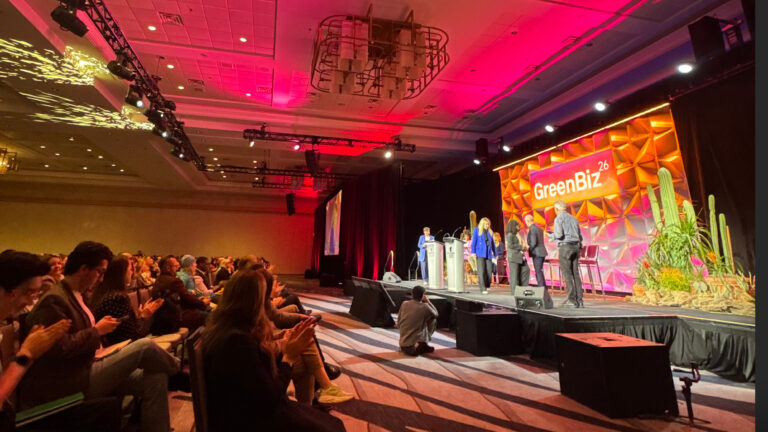
written by Deborah Dull, on site at GreenBiz 2026
I spent today in a room full of people who think about waste for a living. And the word that kept coming up had nothing to do with recycling. It was sovereignty.
Here is the situation. The United States imports 95% of its critical mineral supply. Lithium, cobalt, rare earth elements, the stuff inside every battery, every semiconductor, every electric motor. We do not make it, we do not mine much of it, and we do not control the supply chain that delivers it. That is not an energy policy problem. That is a national security problem.
Now here is the part that should make you put down your coffee. A ton of smartphones contains dramatically more gold than a ton of mined ore. We are talking about concentrations that make urban mining look like a gold rush compared to digging in the ground. And yet the recovery rate for those materials, once a phone leaves its first owner, drops to around 13%. We are losing roughly 80% of the value sitting in devices right now, in drawers, in closets, in landfills.
E-waste is also the fastest growing waste stream in the world, at 2% per year. We are not catching up. We are falling further behind every single year we delay building the systems to recover these materials.
What I kept hearing today, from people running battery recycling operations, from state economic development officers, from supply chain professionals, is a reframe that matters. Urban mining is not a recycling program. It is a domestic supply chain strategy. The materials are already refined. They are already concentrated. They already exist inside products we made and sold. The only part missing is the infrastructure to get them back and the policy environment that makes it worth doing.
There are some promising signals. The federal government put $100 million toward critical mineral recovery through Project Vault. A critical mineral ministerial just launched. States like New Mexico are directing sovereign wealth fund capital toward exactly this kind of industry. The appetite is real.
But appetite without direction goes to the people who already have the relationships. That is not cynicism, that is just how procurement works. The question for everyone working in this space right now is whether we can get specific enough, fast enough, to shape where that money actually goes.
The materials are not buried in a mountain somewhere waiting on a 20-year permitting process. They are in your junk drawer. They are in the back of your office supply closet. They are in the decommissioned equipment sitting in a warehouse three miles from here.
We just need to stop treating them like trash and start treating them like inventory.
More Blogs

Freight Audit & Payment: The Anchor for Supply Chains in Turbulent Times