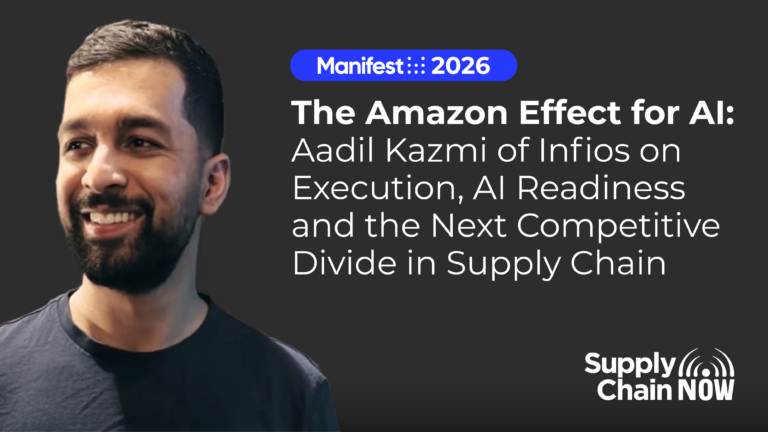
The Amazon Effect for AI: Aadil Kazmi of Infios on Execution, AI Readiness and the Next Competitive Divide in Supply Chain
Execution Is Everything
At Manifest 2026, Scott Luton spoke with Aadil Kazmi, Head of AI at Infios, to discuss the next chapter of intelligent supply chain execution.
Infios provides an integrated suite of supply chain execution software: order management, warehouse management, and transportation management – all running on a single data model.
“When a supply chain runs on a single data model, you can make better decisions,” Kazmi explained. Fragmented systems require expensive data lakes and normalization efforts before even basic BI is possible. An integrated ecosystem simplifies intelligence from the start.
For Kazmi, AI is not about flashy demos. But rather, it is about execution. The most advanced technologies mean little if companies cannot execute faster, smarter, and more resiliently in the real world.
Disruption Isn’t Going Away
Reflecting on 2025, Kazmi did not sugarcoat reality. Ports closed. Trade wars escalated. Wildfires disrupted domestic production. Shipping lanes tightened.
“We don’t believe that supply chain disruptions are going away anytime soon,” he said. Volatility is becoming the baseline, not the exception.
But what is changing in 2026 is mindset. Kazmi describes what he calls the “Amazon effect for AI.” Just as Amazon forced retailers to rethink last-mile execution a decade ago, early AI adopters are now setting a new performance bar.
“If all of your competitors are executing with AI agents, faster and cheaper, at a certain point you need to start thinking about what that means for your business,” he noted.
AI Readiness: The New Competitive Divide
Kazmi identifies three primary concerns keeping supply chain leaders up at night.
First: How do we become AI-ready? Enterprise AI deployment is not a plug-and-play process. It requires data preparedness, governance, and alignment.
Second: How do we avoid ‘AI washing’ and instead focus on ROI-driven use cases? Kazmi emphasizes surgical precision: identifying workflows that generate measurable impact, whether in dollars saved, hours reduced, or risk mitigated.
Third: How do we manage change? Businesses are moving from human-to-human workflows, to human-to-software SaaS models, and now to human–software–agent environments. Teams must adapt to hybrid collaboration with AI systems.
The Generative AI Unlock
Kazmi urges leaders to approach AI from first principles.
“AI is not new. Machine learning is not new,” he explained. The breakthrough of generative AI lies in its ability to understand unstructured data.
Historically, systems could only ingest structured data: numbers, tables, limited OCR. They could not comprehend human conversations or contextual workflows.
Generative AI changed that. It unlocked the ability to process conversations, emails, voice calls, and other unstructured inputs that drive real-world supply chain activity.
Kazmi recommends a practical lens: identify workflows heavily reliant on unstructured data – think dispatcher-driver calls, rate negotiations, internal coordination – and target those for AI augmentation.
Use Case First, Technology Second
At Infios, AI deployment begins with use cases. Kazmi and his team partner with customers to identify opportunities, offer frameworks, build buy-in, and co-develop AI agents across order management, warehousing, and transportation.
The goal is not wholesale automation overnight, but incremental, ROI-driven transformation that frees human time for uniquely human decision-making.
As the industry converges around intelligent agents, Kazmi remains optimistic. “The innovation is through the roof,” he said of what he saw at Manifest 2026. The opportunity ahead is not just about surviving disruption; it is about redefining execution in a world where AI continues to play a bigger (and more critical) role.
Where to Learn More
Connect with Aadil Kazmi here on LinkedIn. We also invite you to follow Infios on LinkedIn here; and you can learn more via the company website: https://www.infios.com/en
More Blogs
Blame Follows the Messenger