
Share:

The Geopolitics of Junk

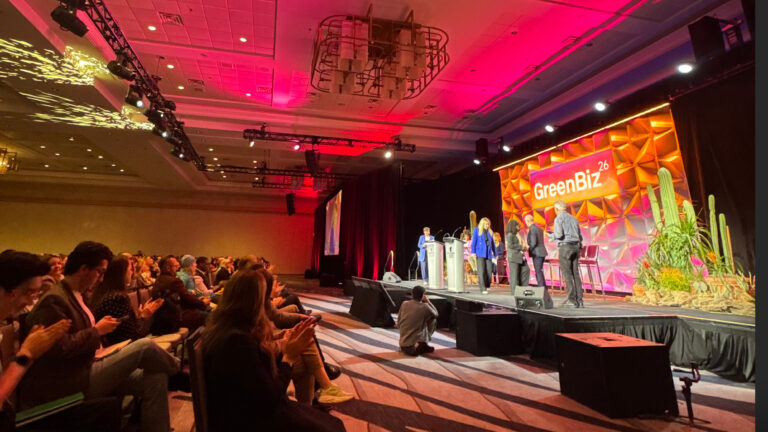
written by Deborah Dull, on site at GreenBiz 2026


I spent today in a room full of people who think about waste for a living. And the word that kept coming up had nothing to do with recycling. It was sovereignty.

Here is the situation. The United States imports 95% of its critical mineral supply. Lithium, cobalt, rare earth elements, the stuff inside every battery, every semiconductor, every electric motor. We do not make it, we do not mine much of it, and we do not control the supply chain that delivers it. That is not an energy policy problem. That is a national security problem.

Now here is the part that should make you put down your coffee. A ton of smartphones contains dramatically more gold than a ton of mined ore. We are talking about concentrations that make urban mining look like a gold rush compared to digging in the ground. And yet the recovery rate for those materials, once a phone leaves its first owner, drops to around 13%. We are losing roughly 80% of the value sitting in devices right now, in drawers, in closets, in landfills.

E-waste is also the fastest growing waste stream in the world, at 2% per year. We are not catching up. We are falling further behind every single year we delay building the systems to recover these materials.

What I kept hearing today, from people running battery recycling operations, from state economic development officers, from supply chain professionals, is a reframe that matters. Urban mining is not a recycling program. It is a domestic supply chain strategy. The materials are already refined. They are already concentrated. They already exist inside products we made and sold. The only part missing is the infrastructure to get them back and the policy environment that makes it worth doing.

There are some promising signals. The federal government put $100 million toward critical mineral recovery through Project Vault. A critical mineral ministerial just launched. States like New Mexico are directing sovereign wealth fund capital toward exactly this kind of industry. The appetite is real.

But appetite without direction goes to the people who already have the relationships. That is not cynicism, that is just how procurement works. The question for everyone working in this space right now is whether we can get specific enough, fast enough, to shape where that money actually goes.

The materials are not buried in a mountain somewhere waiting on a 20-year permitting process. They are in your junk drawer. They are in the back of your office supply closet. They are in the decommissioned equipment sitting in a warehouse three miles from here.

We just need to stop treating them like trash and start treating them like inventory.

More Blogs
logistics
Blogs
October 23, 2025

Taming Inbound Logistics: A Playbook for Multisupplier Sourcing
Special Guest Blog Post from Emo Trans The unpredictable economic landscape has produced unprecedented challenges within inbound logistics. Company leaders must navigate global disruptions and shifting consumer demands as they reshape their supply chains. Amidst the adversity, multisupplier sourcing has become a strategic advantage instead of a contingency plan. Follow this approach to equip business leaders with actionable insights. What Is Multisupplier Sourcing? Multisupplier sourcing involves purchasing products or services from two or more suppliers. This strategy differs from organizations using just one supplier. Diversifying the base requires establishing and managing relationships with multiple vendors. A robust network lets you be more agile as the market changes. Multisupplier sourcing has gained traction in the last five years. A 2022 McKinsey survey said 81% of companies implemented dual-sourcing strategies — an increase of 26 percentage points since 2020. Sixty-nine percent of respondents said this approach will continue to be relevant through the decade. The survey noted changes in inventory, sourcing and regionalization to boost resilience. Why Businesses Use Multisupplier Sourcing Increasingly complex supply chains have made businesses reevaluate traditional sourcing models. Multisupplier sourcing has emerged as a popular strategy to improve operational efficiency and resilience. Here are three key benefits that…
supply chain planning
Blogs
January 13, 2026

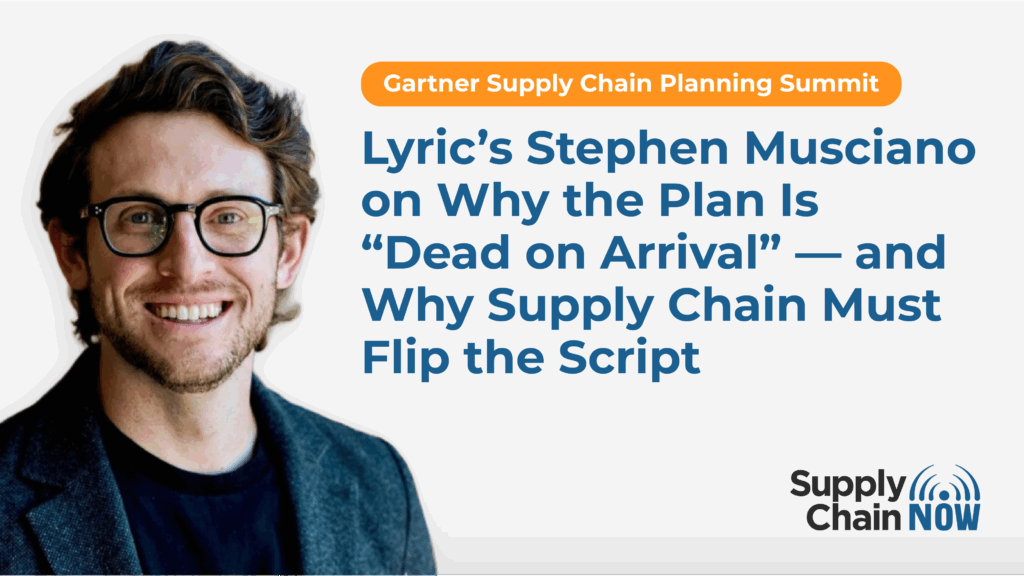
Lyric’s Stephen Musciano on Why the Plan Is “Dead on Arrival” — and Why Supply Chain Must Flip the Script

At the Gartner Supply Chain Planning Summit in December 2025, Scott Luton sat down with Stephen Musciano, a former practitioner turned technology leader who now helps transform supply chain organizations through Lyric—a fast-growing, math-first, AI-native platform redefining what supply chain technology can be. Musciano, who began his supply chain career at companies such as New Balance and Under Armour, brings both real-world execution experience and deep technical vision to his work. That mix is central to what makes Lyric—and its philosophy—stand apart.   Lyric: A Platform, Not a Point Solution Musciano described Lyric as fundamentally different from traditional vendors. Rather than offering a single application or fixed module suite, Lyric provides a true supply chain platform in Lyric Studio—one built from composable, no-code building blocks that allow companies to create exactly what they need. “Think Legos,” Musciano explained. “We’re not selling you a car or a house. We give you the blocks so you can build what your supply chain truly needs. We might even give you a starter kit but the configuration and molding it to fit your business and your problem is where the magic happens.” Lyric Studio is intentionally designed centered on non-technical practitioners—people like “Maria,” Lyric’s…