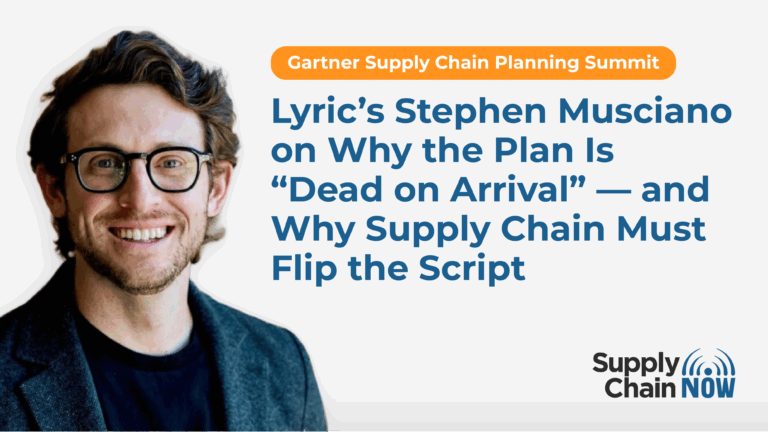

Lyric’s Stephen Musciano on Why the Plan Is “Dead on Arrival” — and Why Supply Chain Must Flip the Script
At the Gartner Supply Chain Planning Summit in December 2025, Scott Luton sat down with Stephen Musciano, a former practitioner turned technology leader who now helps transform supply chain organizations through Lyric—a fast-growing, math-first, AI-native platform redefining what supply chain technology can be.
Musciano, who began his supply chain career at companies such as New Balance and Under Armour, brings both real-world execution experience and deep technical vision to his work. That mix is central to what makes Lyric—and its philosophy—stand apart.
Lyric: A Platform, Not a Point Solution
Musciano described Lyric as fundamentally different from traditional vendors. Rather than offering a single application or fixed module suite, Lyric provides a true supply chain platform in Lyric Studio—one built from composable, no-code building blocks that allow companies to create exactly what they need.
“Think Legos,” Musciano explained. “We’re not selling you a car or a house. We give you the blocks so you can build what your supply chain truly needs. We might even give you a starter kit but the configuration and molding it to fit your business and your problem is where the magic happens.”
Lyric Studio is intentionally designed centered on non-technical practitioners—people like “Maria,” Lyric’s hero persona—who excel in supply chain but don’t code in Python or SQL. Whether it’s demand planning, network design, or tactical scheduling, Lyric Studio allows teams to build and orchestrate solutions without needing engineering resources.
The Challenge No One Talks About: The Plan Is Always Wrong
When discussing planning challenges—old and new—Musciano highlighted a painful truth practitioners know well: “The plan is dead on arrival.”
No matter how hard teams work, no matter how sophisticated the tools, the plan is always wrong the moment it’s created. For 30 years, the industry has tried to solve this problem, and yet manual intervention, rework, and human energy remain the norm.
The reason? Traditional planning tools and approaches haven’t adapted fast enough to match the speed, complexity, and volatility of modern supply chains.
“We have to flip the script,” Musciano said. “Technology everywhere else is shifting dramatically. Supply chain planning technology will too. The question is whether that future is Lyric Studio—our job is to make sure it is.”
A Math-First Future, Built Natively for AI
Lyric’s answer to the planning gap lies in being math-first, not human-first or process-first. The company has built a library of optimization, simulation, prediction engines as well as an environment to create your own living prediction engines that are powerful as ingredients to other solutions or even as solutions in and of themselves. This science can be stitched together for virtually any use case.
This architecture makes Lyric Studio fundamentally different from legacy tools that attempt to bolt on AI.
“If you were built in the ’80s, ’90s, or early 2000s, you’re retrofitting,” Musciano said. “We’re AI-native. Modern tech built to scale for the future enterprise.”
Lyric’s math-driven core allows users to orchestrate complex science—even if they could never solve the equations themselves.
Connecting With Lyric
Musciano encouraged leaders to connect with the Lyric team to learn more or follow the company’s highly active LinkedIn page, which features daily content, white papers, videos, and monthly live webinars led by Lyric product leaders.
We invite you to check out the full-audio version of this interview with Scott W. Luton and Stephen Musciano: click here.
More Blogs

Critical Mass: Inside the Coalition Building America’s Circular Supply Chain