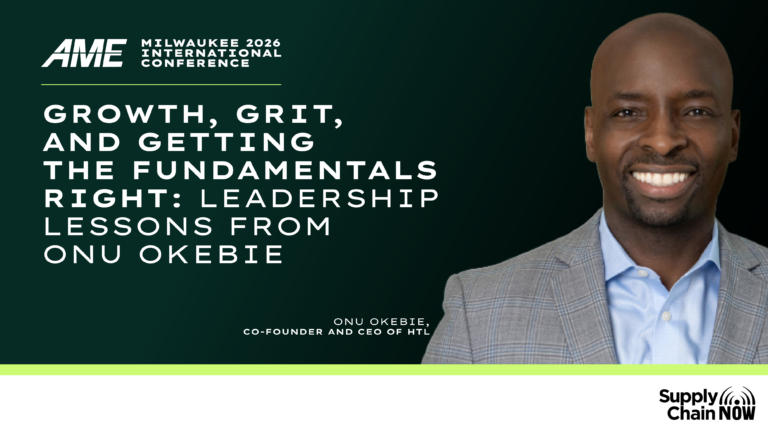
Growth, Grit, and Getting the Fundamentals Right: Leadership Lessons from Onu Okebie
Growth is exciting. New customers, acquisitions, expanding operations, and fresh opportunities can create tremendous momentum for a business. But growth also has a way of revealing weaknesses that were much easier to overlook when an organization was smaller.
That’s one of the lessons HTL co-founder & CEO Onu Okebie has learned while building the organization, which is a growing transportation and logistics business.
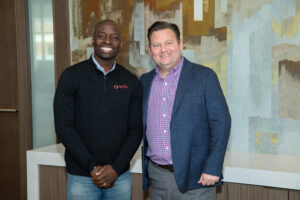
At the Association for Manufacturing Excellence (AME) International Conference 2026 in Milwaukee, Supply Chain Now Founder and CEO Scott Luton reconnected with Okebie to discuss leadership, operational excellence, the freight market, and the importance of preparing for an increasingly unpredictable future.
Okebie previously joined Luton and AME CEO Kimberlee Humphrey on Supply Chain Now, where they explored his entrepreneurial journey and HTL’s growth. This latest conversation picked up where they left off, with several important developments underway.
Growth Has a Way of Exposing Weaknesses
One of Okebie’s biggest priorities has been strengthening HTL’s organizational foundation for its next stage of growth. That includes bringing aboard Jeff Thomas as Chief Operating Officer to develop the people, processes, and operational discipline needed to support a larger business.
For Okebie, scaling successfully requires more than expanding revenue or completing acquisitions. It demands clarity, accountability, and consistent execution.
“One of the biggest lessons I’ve learned is that growth exposes weak spots in the business,” Okebie explained.
Acquisitions introduce additional complexity, particularly when different teams, systems, and operating practices must work together. Okebie believes operational excellence begins when everyone understands what great performance looks like and who owns the outcome.
His philosophy is refreshingly straightforward: execute the fundamentals correctly, consistently, and with a clear understanding of how those activities deliver value to customers.
Keeping the Entrepreneurial Spirit Alive
As companies grow, preserving the entrepreneurial mindset that helped build the business becomes increasingly challenging. More employees, more processes, and additional management layers can unintentionally slow decision-making. Okebie believes the solution begins with hiring people who naturally think like builders. But hiring is only the beginning. Leaders must also establish clear expectations and empower employees to make decisions within defined boundaries.
“As the company grows, you can’t have every decision coming back to the CEO,” he observed.
That means encouraging employees to question existing processes, identify unnecessary obstacles, and suggest ways to improve the customer experience. It also requires leaders to provide the resources, coaching, and clarity their teams need to succeed. Accountability, in Okebie’s view, is a two-way street.
Perhaps most importantly, organizations must create environments where employees feel comfortable raising problems before they become major disruptions.
“We celebrate the red,” Okebie explained, reinforcing the importance of recognizing problems, taking ownership, and preventing them from recurring.
That’s a powerful cultural principle. When employees are encouraged to surface challenges rather than hide them, continuous improvement becomes a natural part of everyday operations.

A Freight Market Facing New Pressures
The conversation also turned to the transportation market, where Okebie sees an interesting combination of tightening capacity and continued economic uncertainty. He noted that recent freight market tightening has been driven primarily by supply-side conditions rather than a significant increase in freight demand. Higher diesel prices have added further pressure to transportation costs.
Looking toward 2027, Okebie believes manufacturers should carefully consider what happens if freight demand strengthens while available capacity remains constrained. That combination could create additional challenges around transportation costs, service reliability, and overall supply chain performance. He encouraged manufacturers to develop strong relationships with experienced transportation partners capable of helping them navigate changing market conditions.
The larger lesson is that transportation deserves a meaningful place in strategic supply chain planning, particularly when market conditions can shift quickly.
Connecting Manufacturing and Supply Chain Excellence
Another significant development is HTL’s involvement in helping establish AME’s new Supply Chain Center of Excellence.
Okebie was originally attracted to AME because of its commitment to continuous improvement and its emphasis on practitioners learning from one another. Those principles closely align with the culture he’s working to build at HTL. He also sees an opportunity to expand the operational excellence conversation beyond the manufacturing facility.
Transportation disruptions can affect production schedules, inventory availability, working capital, customer satisfaction, you name it. Consequently, improvements within individual facilities can only accomplish so much when challenges persist across the broader supply chain. The new Center of Excellence aims to encourage collaboration and practical learning across procurement, manufacturing, transportation, and final delivery.
For Okebie, the partnership represents an opportunity to contribute HTL’s experience while learning from other industry leaders. That mutual exchange of knowledge is central to what makes AME valuable.
Putting People First in Milwaukee
AME’s 2026 conference theme, People First, Progress Together, resonated strongly with Okebie’s leadership philosophy. He believes employees closest to the work often have the clearest understanding of operational challenges, including missing information, unnecessary delays, and inefficient workarounds.
His advice to conference attendees was practical and actionable. First, ask employees what makes it unnecessarily difficult to serve customers effectively. Identify one recurring problem, assign ownership, and follow through until it’s resolved. Second, examine a process that crosses departmental or organizational boundaries. Following that process from beginning to end can reveal gaps in accountability, communication, and execution.
“You don’t have to change everything at once. Solve something meaningful, measure whether it improved, and build from there.”
It’s a sensible approach that emphasizes meaningful progress over ambitious initiatives that never gain traction.
Preparing for the Unexpected in 2027
As the conversation concluded, Okebie challenged supply chain leaders to reconsider a potentially dangerous assumption: that today’s operating conditions will remain available tomorrow. Transportation capacity, supplier availability, lead times, and even access to critical technology systems can change unexpectedly.
He recalled how his father regularly challenged him to anticipate different scenarios by asking, “What if this or that happened? What would you do?”
That simple question offers an important leadership lesson. Organizations that think several steps ahead are better positioned to respond when conditions change.
Ultimately, Okebie’s perspective reinforces a central theme from AME Milwaukee 2026. Sustainable growth depends on strong fundamentals, empowered employees, clear accountability, and the willingness to challenge assumptions before circumstances force difficult decisions.
As manufacturers and supply chain leaders prepare for 2027, those principles offer a valuable starting point for building more resilient, adaptable, and successful organizations.
Where to Learn More
We invite you to connect with Onu Okebie via LinkedIn. You can also learn more about HTL at the company website: https://gohtl.com/
More Blogs
The Geopolitics of Junk