

More
agentic AI
January 19, 2026
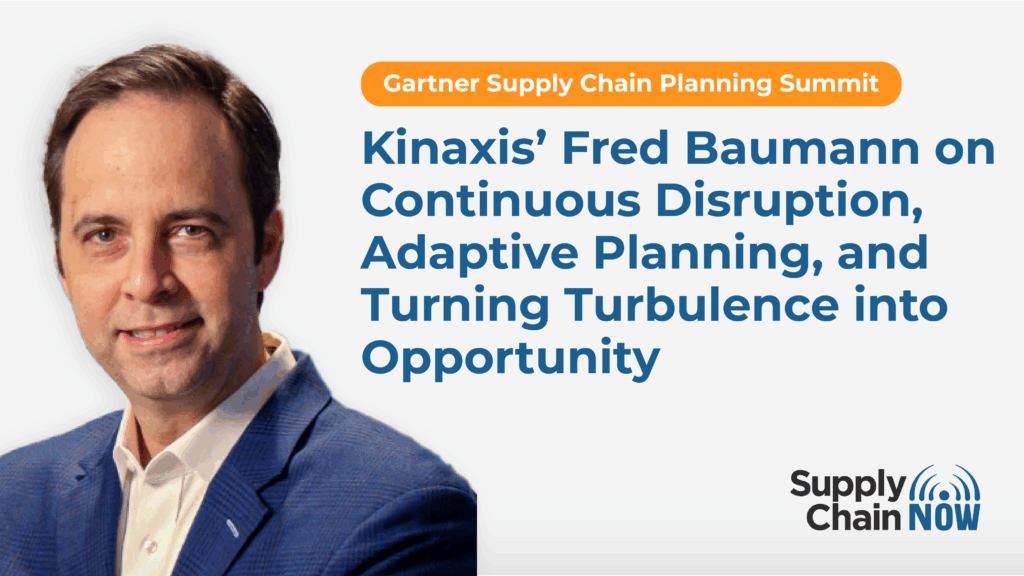
Kinaxis’ Fred Baumann on Continuous Disruption, Adaptive Planning, and Turning Turbulence into Opportunity
At the 2025 Gartner Supply Chain Planning Summit in Denver, Scott Luton sat down with Fred Baumann, Senior Industry Principal at Kinaxis, one of the world’s most recognized leaders in supply chain planning and orchestration. Kinaxis has spent over four decades shaping the planning landscape and has been named to the Gartner Leaders Quadrant an extraordinary 11 consecutive times—a testament to its execution strength and long-term vision. Baumann’s role at Kinaxis centers on helping chief supply chain officers and senior leaders shape their strategic transformation roadmaps, quantify value, and build the business cases necessary to achieve breakthrough outcomes. From Episodic Disruptions to Continuous Turbulence When asked about old and new challenges facing supply chain planning teams, Baumann observed a major shift: disruption is no longer episodic—it’s continuous. Historically, companies faced major disruptions every few years. Today, volatility and constraint-related challenges—whether driven by tariffs, sourcing changes, geopolitical shifts, or supply shortages—are unfolding weekly or even daily. This environment demands a new way of working. The speed of global business is accelerating, and uncertainty is at historic highs. As Baumann noted, organizations must now adjust their supply chains “much faster than they had to even last year.” The shift isn’t only…
AI
September 25, 2025
The 3 Critical Questions Enterprise Shippers Ask Me About AI
Special Guest Blog Post written by Matt McKinney, Co-Founder and CEO of Loop I spend most of my time with supply chain and innovation leaders at major enterprises who are sitting on significant AI budgets but struggling to show measurable business impact in an increasingly complex and volatile supply chain environment. These conversations have evolved dramatically. A year ago, executives were asking basic questions about AI feasibility. Today, the questions have shifted to strategic implementation at enterprise scale. Based on hundreds of these discussions, three questions consistently emerge that separate companies making transformational progress from those stuck in pilot purgatory. How do we move from AI experiments to enterprise-scale impact? Most organizations have yet to see organization-wide, bottom-line impact from AI use. This is the strategic challenge keeping C-suite leaders awake at night. The problem isn’t the technology. It’s the application of the technology. Too many enterprises are trying to treat AI like a magic wand they can bolt onto existing systems. But garbage in, garbage out. If your underlying data is fragmented and inconsistent, AI won’t solve your problems; in fact they’ll get worse. At its core, anything automated is powered by…