

More
agentic AI
January 19, 2026
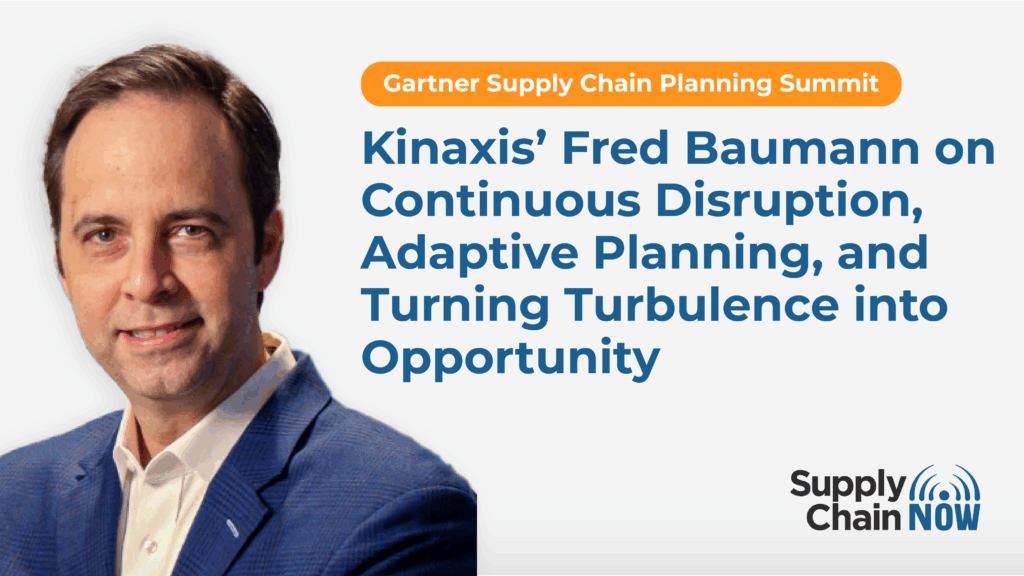
Kinaxis’ Fred Baumann on Continuous Disruption, Adaptive Planning, and Turning Turbulence into Opportunity
At the 2025 Gartner Supply Chain Planning Summit in Denver, Scott Luton sat down with Fred Baumann, Senior Industry Principal at Kinaxis, one of the world’s most recognized leaders in supply chain planning and orchestration. Kinaxis has spent over four decades shaping the planning landscape and has been named to the Gartner Leaders Quadrant an extraordinary 11 consecutive times—a testament to its execution strength and long-term vision. Baumann’s role at Kinaxis centers on helping chief supply chain officers and senior leaders shape their strategic transformation roadmaps, quantify value, and build the business cases necessary to achieve breakthrough outcomes. From Episodic Disruptions to Continuous Turbulence When asked about old and new challenges facing supply chain planning teams, Baumann observed a major shift: disruption is no longer episodic—it’s continuous. Historically, companies faced major disruptions every few years. Today, volatility and constraint-related challenges—whether driven by tariffs, sourcing changes, geopolitical shifts, or supply shortages—are unfolding weekly or even daily. This environment demands a new way of working. The speed of global business is accelerating, and uncertainty is at historic highs. As Baumann noted, organizations must now adjust their supply chains “much faster than they had to even last year.” The shift isn’t only…

Africa
March 24, 2025
Supply Chain Trends, Challenges, and Opportunities in Africa
The top supply chain trends in Africa right now include ecommerce, sustainability, technology and skills development. The e-commerce boom that was fuelled by Covid-19 is showing no signs of slowing. It is predicted that in 2025, e-commerce transactions in South Africa will grow 150% to R225 billion. While African consumers are clearly sold on the speed and convenience of online shopping, they are also increasingly recognising that there is an environmental price to be paid, and they are demanding greener e-commerce supply chains. African businesses also recognise that to compete on the global stage, and for Africa to rise as the supply chain powerhouse that many predict it can be, they must align with global environmental standards. Integrating sustainability into supply chain and logistics is therefore a growing imperative in Africa. African companies are investing in technologies like electric vehicles, renewable energy sources and advanced data analytics to measure, manage and minimise their environmental impact. They are optimising transportation routes to have fewer vehicles on the road and to cut CO2 emissions. They are adopting circular supply chain models, to get more use out of products and move beyond the traditional “take-make-waste” approach. Takealot, which is South Africa’s largest online…