
More

supply chain
January 15, 2026
5 Supply Chain Predictions on our 2026 Bingo Card
Special Guest Blog Post written by Philip Vervloesem If your supply chain planning still runs on a monthly cycle, 2026 will be uncomfortable. We are operating in a polycrisis where change is constant, and responses need to be fast enough to keep up. From customer conversations, industry research, and leadership discussions at the Gartner supply chain conferences, a clear pattern has emerged: the organizations pulling ahead are not planning more often. They are embedding agility, intelligence, and speed into the way they make decisions. Here are five predictions shaping supply chain excellence in 2026 – our “bingo card” for what’s now table stakes. 1. Continuous, always-on planning is a must Monthly or quarterly cycles are no longer enough. The organizations that outperform treat planning as a continuous capability embedded in daily operations, and make it part of their governance and operational excellence. Imagine this: a sudden surge in demand hits or a supplier flags a delay. Instead of waiting for the next planning cycle, teams immediately evaluate options, share insights across functions, and adjust course. Planning stops being a calendar exercise and starts shaping real-time decisions. “By shifting from process-centric to decision-centric planning, we now run hundreds…
foundational industries investment
February 23, 2026
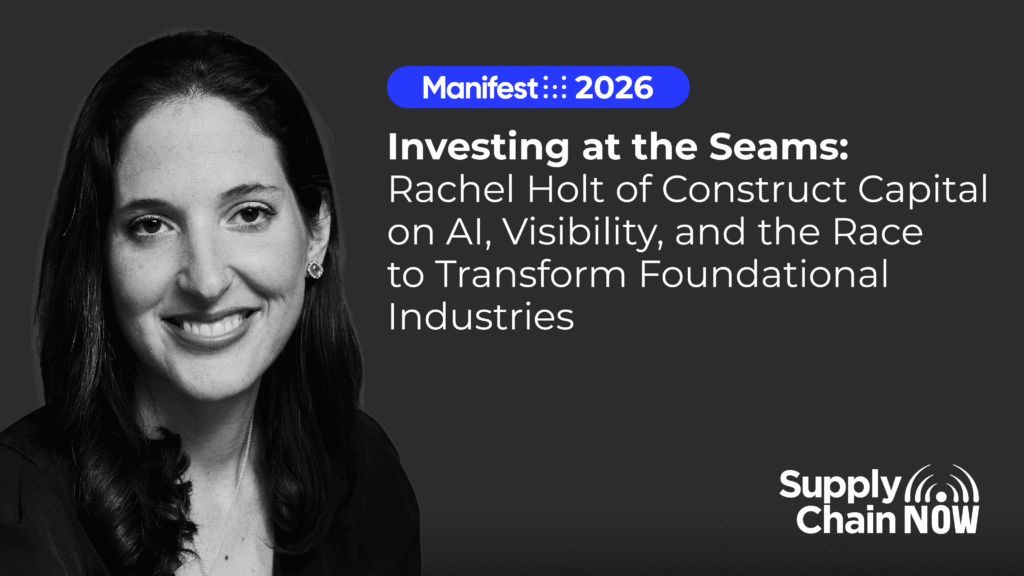
Investing at the Seams: Rachel Holt of Construct Capital on AI, Visibility, and the Race to Transform Foundational Industries
From Uber to Foundational Industries At Manifest 2026, Scott Luton sat down with Rachel Holt, Co-Founder and Managing Partner of Construct Capital, to explore how venture capital is fueling the next era of supply chain innovation. Construct Capital, now six years old, was founded in early 2020 with a bold thesis: transform foundational industries that represent nearly half of GDP: supply chain, logistics, manufacturing, mobility, infrastructure, and defense. When the fund launched, Holt recalls many skeptics asking whether supply chain and logistics were truly venture-scale opportunities. It echoed what she heard when she joined Uber in 2011, when transportation was considered slow moving and heavily regulated. Yet Uber went on to redefine personal logistics. Her final years at Uber brought a pivotal lesson. While the rides business operated with second-by-second visibility, the company’s e-bike and scooter supply chain operated in near darkness. Products shipped from China would disappear for weeks at sea, briefly reappear at ports, then stall again in customs. “We had no visibility, we had no ability to reroute,” Holt shared, as this Eureka moment would go on to help shape her investment focus. The Visibility Gap at the Seams Supply chain, Holt emphasized, is not monolithic.…