

More
execution
May 1, 2026
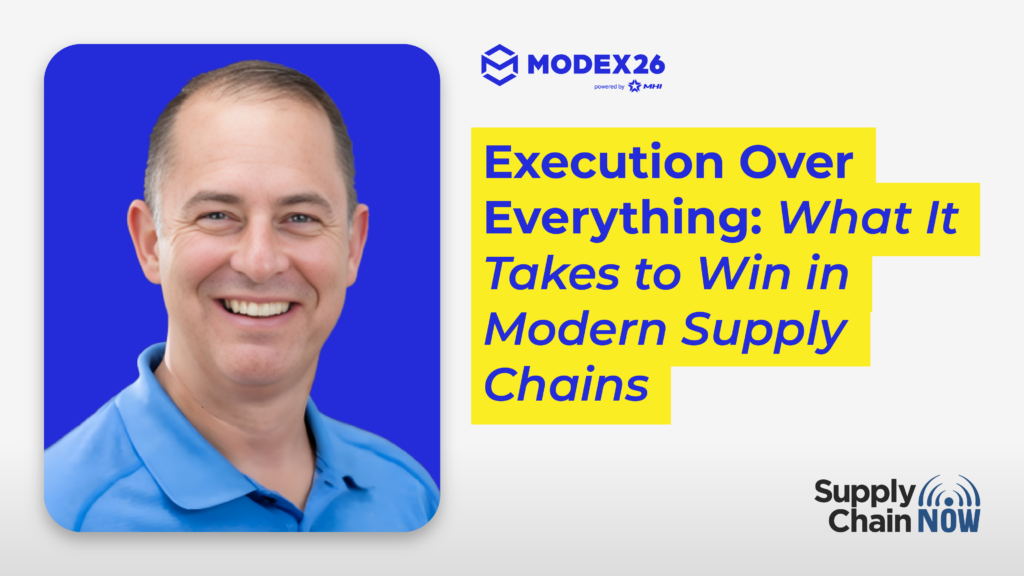
Execution Over Everything: What It Takes to Win in Modern Supply Chains
At MODEX 2026 in Atlanta, Scott Luton sat down with Tevon Taylor, Senior Vice President of Contract Logistics at Pegasus Logistics Group, for a candid conversation about what’s really driving success (and failure) in today’s supply chains. From tariffs and AI to warehouse inefficiencies and leadership mindset, Taylor’s perspective cuts through the noise with a simple truth: technology matters, but execution matters more. Disruption Is the New Normal If there’s one constant in 2026, it’s disruption. Tariffs, geopolitical uncertainty, and shifting trade lanes are no longer occasional challenges. They’re baked into the system. “You can’t stick to the old methods of running your supply chain. You must constantly find new ways to gain resilience,” Taylor explains. That resilience starts with flexibility. Companies that rely on rigid, linear networks are increasingly vulnerable. Instead, supply chain leaders must rethink how they design and operate their networks. Taylor emphasizes the need for multi-threaded strategies: nearshoring, domestic sourcing, and diversified transportation routes. In short, supply chains must evolve from static systems into adaptable ecosystems. AI Is More of a Requirement Than a Buzzword While some technologies come and go as industry cliches or flavor of the month, Taylor is clear that artificial…
freight network
February 12, 2026
How Freight Visibility is Reshaping Supply Chain Resilience
Special Guest Blog Post from Amazon Freight For supply chains across the globe, goods in motion are promises in motion. When a palletised shipment is delayed or goes dark, the impact is felt not just in transport teams, but in customer service, inventory planning, and broader network performance. In a conversation, economist Dr. Rebecca Harding and Chris Roe, Managing Director of Amazon Freight, explored how technology and collaboration are changing the way freight networks operate. While their primary focus was freight, their insights map directly onto the resilience challenges supply chain leaders face every day. Old pressures, new data In a study supported by Amazon Freight, every shipper surveyed agreed that technology is crucial to the freight industry’s resilience. While this isn’t a surprise, it’s an important reminder of the role that technology plays. Roe shared a key example where Amazon Freight connected a customer’s system to its own system. Visibility on the end-to-end movement went from essentially zero to a high level of coverage. Instead of discovering problems only when a shipment failed to arrive, the customer could now see disruptions as they emerged and act earlier. For supply chain teams, that move from partial, delayed information…