

More

supply chain planning
December 15, 2025
Uncovering Hidden Costs in Supply Chain Planning: Tom Moore of ProvisionAI on What Companies Miss
In today’s increasingly complex global supply chain landscape, Tom Moore keeps his message refreshingly straightforward: ProvisionAI helps large companies discover hidden costs and eliminate them. Organizations such as Procter & Gamble, Nestlé, and Unilever have leveraged the company’s technology to uncover and eliminate inefficiencies—particularly in transportation and warehousing—that traditional systems fail to detect. The outcome is significant and often delivers immediate savings. But Moore believes many of these problems stem from misunderstandings about the very technologies companies rely on. Misnamed Systems & Misaligned Expectations Before the interview officially began, Moore reflected on the surprisingly inaccurate names assigned to modern supply chain technologies. ERP systems rarely plan resources across the enterprise, despite what their name suggests. Warehouse Management Systems, while certainly used in warehouses, don’t actually “manage” much at all. People behind keyboards still make most of the critical decisions. This disconnect in terminology shapes faulty expectations. Many organizations believe their planning systems will truly plan the supply chain, yet most tools merely react to demand signals. If ABC Company orders ten cases, the system automatically replenishes—without considering warehouse capacity, transportation availability, downstream implications, or cost-to-serve. Moore characterizes this as both an old problem and a new one, and it…
supply chain planning
January 13, 2026
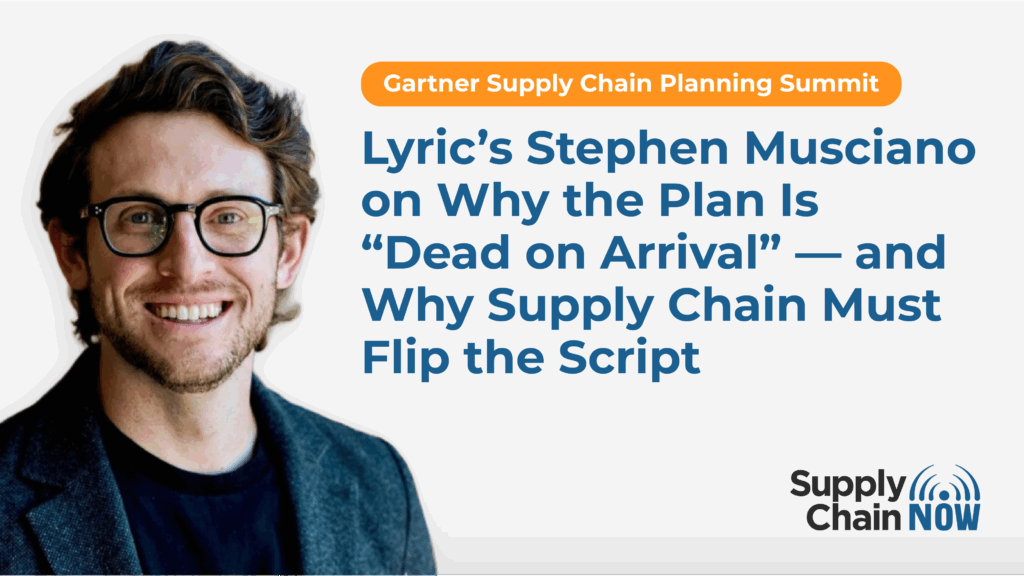
Lyric’s Stephen Musciano on Why the Plan Is “Dead on Arrival” — and Why Supply Chain Must Flip the Script
At the Gartner Supply Chain Planning Summit in December 2025, Scott Luton sat down with Stephen Musciano, a former practitioner turned technology leader who now helps transform supply chain organizations through Lyric—a fast-growing, math-first, AI-native platform redefining what supply chain technology can be. Musciano, who began his supply chain career at companies such as New Balance and Under Armour, brings both real-world execution experience and deep technical vision to his work. That mix is central to what makes Lyric—and its philosophy—stand apart. Lyric: A Platform, Not a Point Solution Musciano described Lyric as fundamentally different from traditional vendors. Rather than offering a single application or fixed module suite, Lyric provides a true supply chain platform in Lyric Studio—one built from composable, no-code building blocks that allow companies to create exactly what they need. “Think Legos,” Musciano explained. “We’re not selling you a car or a house. We give you the blocks so you can build what your supply chain truly needs. We might even give you a starter kit but the configuration and molding it to fit your business and your problem is where the magic happens.” Lyric Studio is intentionally designed centered on non-technical practitioners—people like “Maria,” Lyric’s…