

More

supply chain podcast
April 8, 2025
Meet the Supply Chain Now Host: Jake Barr
Supply Chain Now is the voice of the supply chain industry, and our hosts are experts in the field. Podcast listeners and webinar viewers tune in to hear the sage advice of host Jake Barr, heralded as an architect of global supply chain strategy and creator of “profit powerhouses.” Earning His Spot on Stage Barr today is the CEO of BlueWorld Supply Chain Consulting, which provides support to such Fortune 500 companies as Cargill, Caterpillar, 3M, PepsiCo, and Pfizer and helps them bring products to market. “We place a premium on accelerating speed to market by leveraging supply chain transformation,” he says. “The result is better operating margin performance and the opportunity to drive faster growth in revenue.” During his more than 33 years with Procter & Gamble, Barr served as the global director of supply network operations and led the end-to-end planning transformation project, which created control towers that now manage the daily business globally and earned him recognition as the architect for the company’s demand-driven supply chain strategy. He served on the MIT Center for Transportation & Logistics advisory council for its Supply Chain 2020 Project, was named to the League of Leaders for retail and consumer goods…
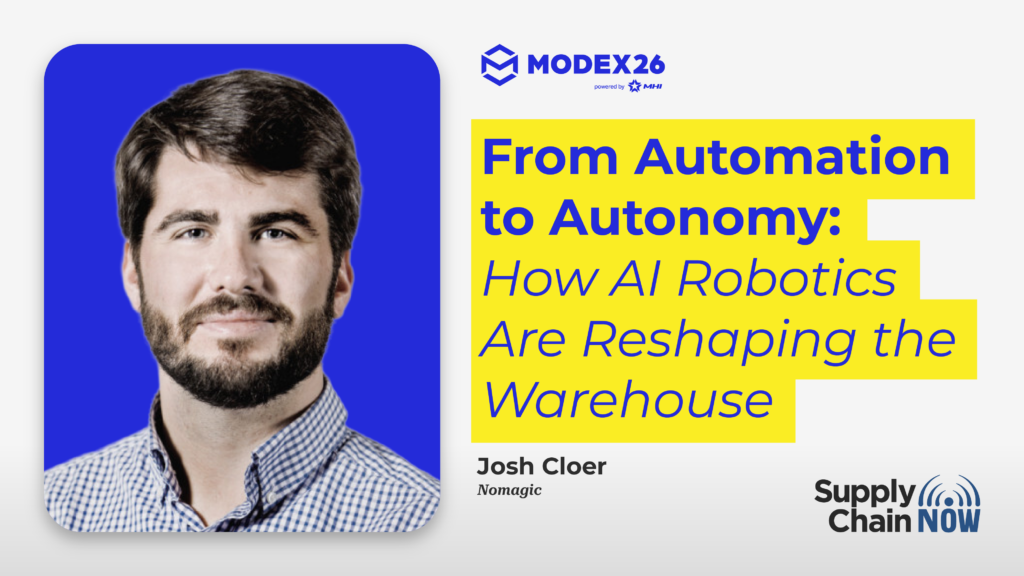
MODEX 2026
May 27, 2026
From Automation to Autonomy: How AI Robotics Are Reshaping the Warehouse
At MODEX 2026 in Atlanta, Scott Luton sat down with Josh Cloer, General Manager, North America for Nomagic, to discuss the next phase of warehouse robotics and the growing role of AI-driven automation inside modern fulfillment operations. While transportation costs and economic uncertainty continue to pressure supply chains globally, Cloer sees a major opportunity emerging inside the four walls of the warehouse. The Next Wave of Warehouse Investment According to Cloer, many organizations spent the last decade investing heavily in core warehouse infrastructure: automated storage systems, shuttles, and tote-moving technologies. Now, the focus is shifting toward connecting and expanding those systems. “What they’re moving forward with now is doing the rest of their warehouse,” Cloer explains. That includes: automated forklifts, robotic picking systems, mobile robots and AI-driven item handling. At the same time, smaller operators that may not have justified large-scale automation investments in the past are increasingly turning to more flexible robotic solutions. This evolution reflects a broader industry trend: warehouse automation is no longer reserved only for massive enterprises. More scalable and adaptable technologies are opening the door for a wider range of operators. A Different Approach to Robotics One of the most interesting parts of…