

More
AI in supply chain
March 2, 2026
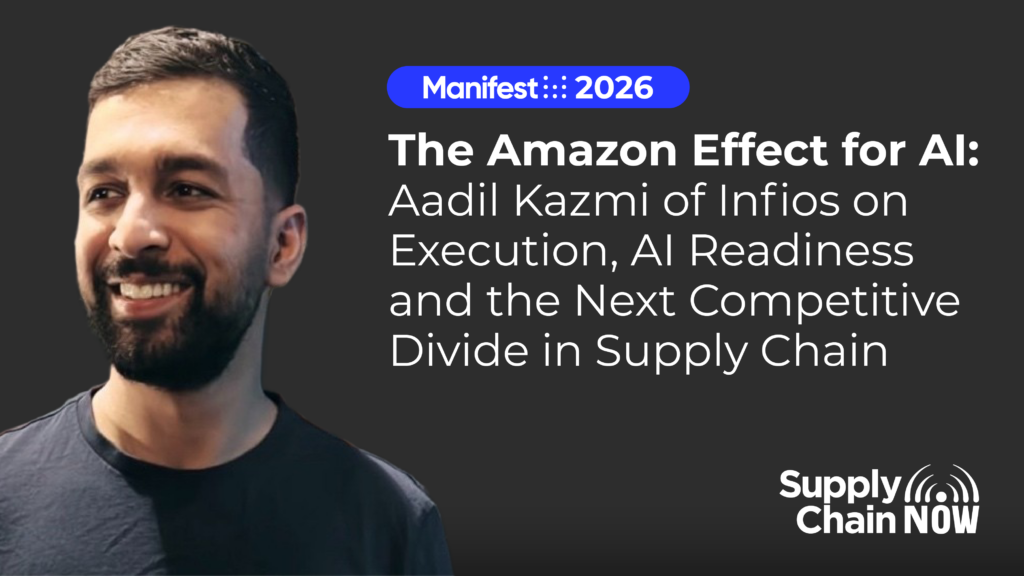
The Amazon Effect for AI: Aadil Kazmi of Infios on Execution, AI Readiness and the Next Competitive Divide in Supply Chain
Execution Is Everything At Manifest 2026, Scott Luton spoke with Aadil Kazmi, Head of AI at Infios, to discuss the next chapter of intelligent supply chain execution. Infios provides an integrated suite of supply chain execution software: order management, warehouse management, and transportation management – all running on a single data model. “When a supply chain runs on a single data model, you can make better decisions,” Kazmi explained. Fragmented systems require expensive data lakes and normalization efforts before even basic BI is possible. An integrated ecosystem simplifies intelligence from the start. For Kazmi, AI is not about flashy demos. But rather, it is about execution. The most advanced technologies mean little if companies cannot execute faster, smarter, and more resiliently in the real world. Disruption Isn’t Going Away Reflecting on 2025, Kazmi did not sugarcoat reality. Ports closed. Trade wars escalated. Wildfires disrupted domestic production. Shipping lanes tightened. “We don’t believe that supply chain disruptions are going away anytime soon,” he said. Volatility is becoming the baseline, not the exception. But what is changing in 2026 is mindset. Kazmi describes what he calls the “Amazon effect for AI.” Just as Amazon forced retailers to rethink last-mile execution a…
inventory control
July 16, 2026
The Sales You’re Losing to an Inventory Record
Inventory audits may be one of retail’s most overlooked revenue opportunities. Every large retailer has invested in software that predicts demand, triggers replenishment, and manages shelf space with precision. Almost none of that software questions whether the inventory number it’s reading is actually correct. A recent study in the Journal of Business Logistics suggests that blind spot is expensive, and that fixing it is one of the more overlooked levers a retailer has for growing sales. The researchers, working with a major UK grocery chain, examined roughly 24,000 products across 11 stores to understand why inventory records drift from what’s physically on the shelf, a problem known in the industry as inventory record inaccuracy. They then ran a field experiment to measure what happens to sales when a store corrects those records through a full audit. The results reframe a task most retailers treat as a nuisance into something closer to a growth strategy. Start with why the records go wrong in the first place. The study found that products carrying more inventory and products replenished more often were significantly more prone to inaccuracy. That makes intuitive sense: every case broken down, every unit moved from backroom to shelf, is…