

More
execution
May 1, 2026
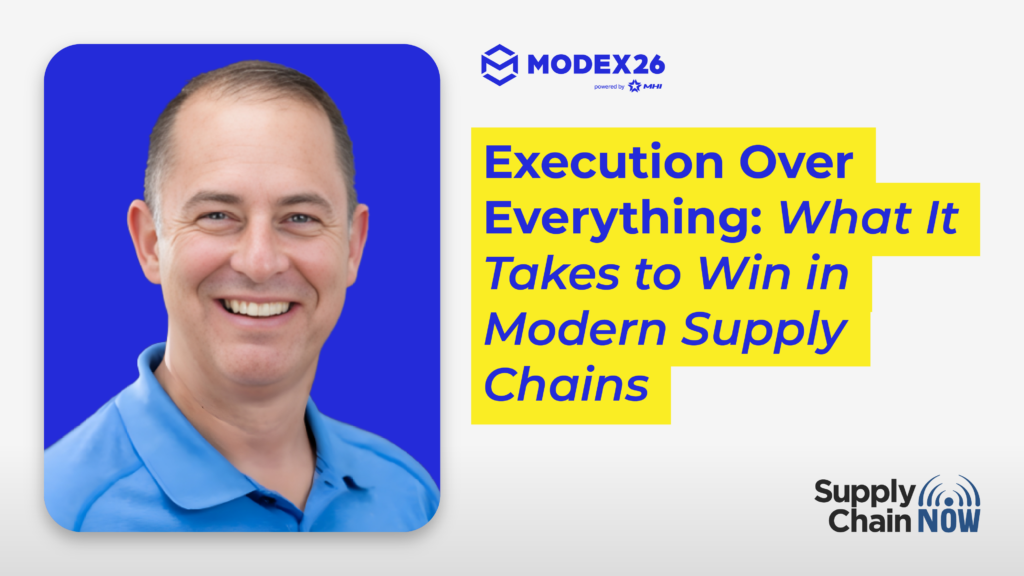
Execution Over Everything: What It Takes to Win in Modern Supply Chains
At MODEX 2026 in Atlanta, Scott Luton sat down with Tevon Taylor, Senior Vice President of Contract Logistics at Pegasus Logistics Group, for a candid conversation about what’s really driving success (and failure) in today’s supply chains. From tariffs and AI to warehouse inefficiencies and leadership mindset, Taylor’s perspective cuts through the noise with a simple truth: technology matters, but execution matters more. Disruption Is the New Normal If there’s one constant in 2026, it’s disruption. Tariffs, geopolitical uncertainty, and shifting trade lanes are no longer occasional challenges. They’re baked into the system. “You can’t stick to the old methods of running your supply chain. You must constantly find new ways to gain resilience,” Taylor explains. That resilience starts with flexibility. Companies that rely on rigid, linear networks are increasingly vulnerable. Instead, supply chain leaders must rethink how they design and operate their networks. Taylor emphasizes the need for multi-threaded strategies: nearshoring, domestic sourcing, and diversified transportation routes. In short, supply chains must evolve from static systems into adaptable ecosystems. AI Is More of a Requirement Than a Buzzword While some technologies come and go as industry cliches or flavor of the month, Taylor is clear that artificial…

reverse logistics
January 28, 2026
Why Can’t America Train Workers for a Trillion-Dollar Industry?
Inside the reverse logistics education gap and the economic blind spot keeping it invisible Special Guest Blog Post written by Deborah Dull Tony Sciarrotta has been asking the same question at industry conferences for years. As the Senior Director of Circularity and Reverse Logistics at the National Retail Federation, he knows what answer he’s going to get. But he keeps asking anyway. “Anybody in here go to school for returns management, reverse logistics, circularity? Any degrees in those fields the room?” It’s rare that anyone raises their hand. “That’s what’s wrong with our industry,” Sciarrotta told me at NRF Rev this January, the first conference under NRF’s new reverse logistics banner. “We still need to fix it.” The Numbers That Should Make Headlines Here’s what makes reverse logistics so fascinating: the scale is staggering, but the infrastructure to support it needs to be stronger. According to the National Retail Federation, American retailers processed approximately $890 billion in returns in 2024 which is roughly 17% of all retail sales – and it’s higher for ecommerce. But that number almost certainly understates reality. “We have a fragmented industry,” Sciarrotta explained. “Where are all those returns going? It has to be…