

More
agentic AI
January 19, 2026
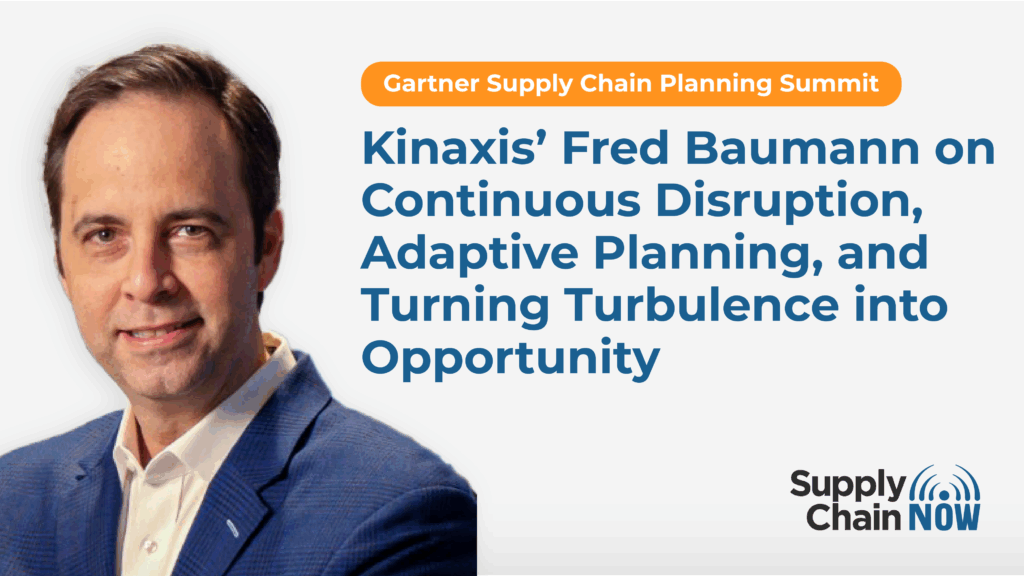
Kinaxis’ Fred Baumann on Continuous Disruption, Adaptive Planning, and Turning Turbulence into Opportunity
At the 2025 Gartner Supply Chain Planning Summit in Denver, Scott Luton sat down with Fred Baumann, Senior Industry Principal at Kinaxis, one of the world’s most recognized leaders in supply chain planning and orchestration. Kinaxis has spent over four decades shaping the planning landscape and has been named to the Gartner Leaders Quadrant an extraordinary 11 consecutive times—a testament to its execution strength and long-term vision. Baumann’s role at Kinaxis centers on helping chief supply chain officers and senior leaders shape their strategic transformation roadmaps, quantify value, and build the business cases necessary to achieve breakthrough outcomes. From Episodic Disruptions to Continuous Turbulence When asked about old and new challenges facing supply chain planning teams, Baumann observed a major shift: disruption is no longer episodic—it’s continuous. Historically, companies faced major disruptions every few years. Today, volatility and constraint-related challenges—whether driven by tariffs, sourcing changes, geopolitical shifts, or supply shortages—are unfolding weekly or even daily. This environment demands a new way of working. The speed of global business is accelerating, and uncertainty is at historic highs. As Baumann noted, organizations must now adjust their supply chains “much faster than they had to even last year.” The shift isn’t only…
warranty management optimization
June 2, 2026
Your Supply Chain Isn’t Broken. Your Data Is.
written by Chris Cunnane with InterSystems Supply chain leaders are under constant pressure to move faster, reduce costs, improve resilience, and respond to disruptions in real time. Yet despite billions invested in technology, many organizations still struggle with stockouts, delayed shipments, excess inventory, and unreliable forecasts. The problem may not be the supply chain itself. It may be the data behind it. Most organizations today operate with more supply chain data than ever before. ERP systems, warehouse management platforms, transportation tools, supplier portals, IoT devices, and analytics dashboards generate a nonstop flow of information. On paper, this should create unprecedented visibility. But visibility is not the same as confidence. When inventory data is delayed, supplier updates are inconsistent, and demand signals are fragmented across systems, organizations are forced to make critical decisions using incomplete or unreliable information. The result is a distorted picture of reality, and costly mistakes follow. Companies expedite shipments they didn’t need. They over-order inventory “just in case.” They miss shortages that were hiding in plain sight. And they spend valuable time reconciling conflicting reports instead of solving problems. The Real Problem: Fragmented Data The challenge isn’t a lack of data. It’s that the data…