[00:00:00] Onu Okebie: If you really distill it down as entrepreneurs, it’s like what is it? It’s you look at an opportunity and you see there’s a problem that needs to be solved and you solve the problem. In order for you to solve that problem, there’s going to be a level of risk that you’re going to have to take. You could win, you could lose and it’s all about creating value. So if you think about, especially in transportation and logistics, that’s what we’re doing every day.
[00:00:27] Voice Over: Welcome to Supply Chain Now, the number one voice of supply chain. Join us as we share critical news, key insights, and real supply chain leadership from across the globe. One conversation at a time.
[00:00:39] Scott W. Luton: Hey, good morning, good afternoon, good evening, wherever you may be. Scott W. Luton and special guest co-host, Kim Humphrey with you here on Supply Chain Now. Welcome to today’s show. Kim, how you doing today, my friend?
[00:00:51] Kim Humphrey: I’m doing great. How are you, Scott?
[00:00:53] Scott W. Luton: I’m doing outstanding in part because we have another outstanding show here today. Folks, we’re going to be talking about the wide world of freight and what’s going on in the current market out there. But we’ll also be talking with this intriguing industry leader about the role of an entrepreneurial culture across today’s business climate and where human judgment still fits into an ever more technological supply chain world. All this and much, much more. Stay tuned for a fascinating discussion. So Kim, you always bring some of the best guests when you join me here on Supply Chain Now and this is another big show, huh?
[00:01:29] Kim Humphrey: It sure is. I’m really excited about today’s show.
[00:01:32] Scott W. Luton: Me and you both. And I already found out in the green room that you’re a fellow bird nerd. I never knew that, Kim. So we’re learning all kinds of stuff here today,
[00:01:42] Kim Humphrey: Huh? I love all animals. It doesn’t matter. Well, there is one. I don’t like snakes, but I like all animals except for snakes. Sorry, Scott.
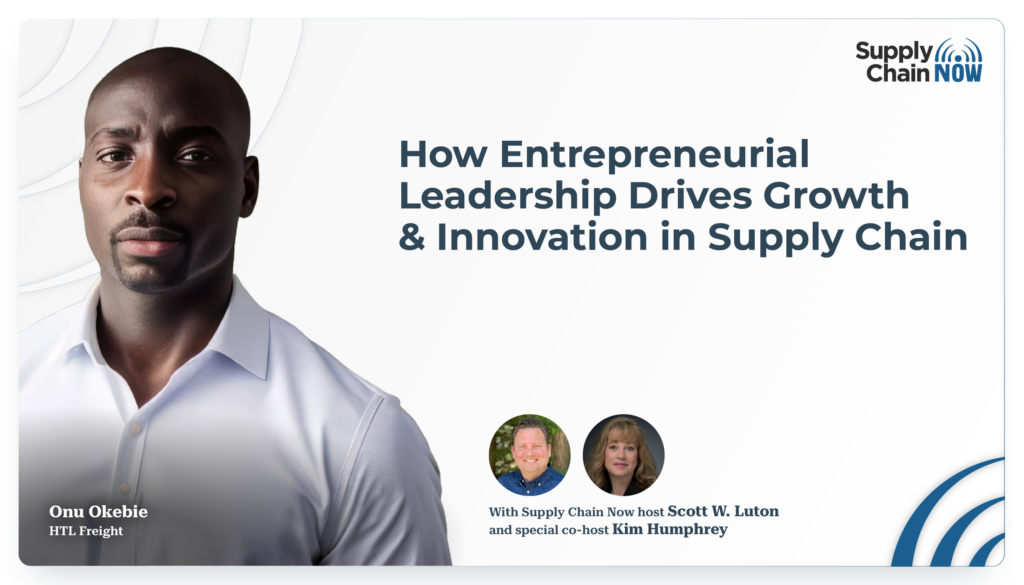
[00:01:50] Scott W. Luton: Hey, I bet a lot of folks out there can relate to you there, Kim Humphrey. But folks, great conversation that’s going to offer up tons of actionable insights by the truckload right here today. Our guest today is a graduate times two from Georgia Tech where he played football as I’ve learned in the green room. He currently leads HTL where they have been on quite a growth journey, an impressive journey, having acquired a variety of businesses in the last few years in addition to their organic growth. So prior to his current role, our guest has owned and operated an asset-based trucking company that moved freight throughout the country. And he served as managing partner at an investment firm that he co-founded, which focused on transacting in the lower middle market with the aim of acquiring non-asset logistics companies. I’d say he’s been pretty successful. So I want to welcome in Onu Okebie, CEO at HTL.
[00:02:44] Scott W. Luton: Onu, how you doing?
[00:02:45] Onu Okebie: Hey, Scott, I’m fantastic. How about yourself?
[00:02:48] Scott W. Luton: I’m doing better now. I’ll tell you, but I think you’re, based on what I’ve heard, you’re 10 feet tall, bulletproof, and you wear a cake. Is that right?
[00:02:56] Onu Okebie: That is true. That is true. That is true. That is true. I’m not a superhero, but I play one on TV. How about that?
[00:03:01] Scott W. Luton: I like it. And you definitely play one out in global business. And Kim, we’ve been talking about this interview for quite some time, so I really appreciate, as always, your collaboration and making it happen, Kim.
[00:03:11] Kim Humphrey: I’m real excited about today. Thank you, Onu, for joining us.
[00:03:15] Scott W. Luton: Let’s start where we always start because life’s too short not to have fun and I like my fun warmup questions and we learned something about Onu, a couple things in the pre-show, including one regular practice of his. And we all find our own ways of managing the work-life balance. It’s so difficult at times. And Onu, we learned that you’ve got a regular morning and maybe afternoon practice that helps you find those moments of Zen. Tell us about it.
[00:03:44] Onu Okebie: Yeah, I have this thing on my wrist. It’s a whoop. So I’m a big proponent of tracking my steps. So my goal every day is to hit 10,000 steps. So for me, the new thing is first thing in the morning, this is before the family gets up. I’m out walking the neighborhood. Again, this is a point in time in a day where there’s no noise, no notifications on my phone, no emails. You can just walk in, listen to the birds chirp. And it’s been very, very zen-like for me. I certainly encourage everybody to take that on first thing in the morning walks.
[00:04:15] Scott W. Luton: Onu, you had me at birds. All kidding aside, ever since the pandemic, I’ve really doubled down. And to your point, I’ll tell you, it’s the simple things in life. During the school year, when I take my kids to school and you step out and it’s still kind of dark, but the birds are already kind of up and at them and you hear them and all around you, all the different trees, all the different calls, there’s something very therapeutic about that, Onu. So I like it. I like it. All right. So Kim, I got a different question for you. So I’m a big fan of your weekly from the CEO messages that you and the AME team send out to your community almost every Friday morning, if I’m not mistaken. And I want to ask you, you’ve been at this, I think for several years, but you get responses, all kinds of responses.
[00:05:02] Scott W. Luton: What’s one of your favorite responses you gotten to your from the CEO message?
[00:05:06] Kim Humphrey: Yeah. Well, thanks, Scott. So I’ve been writing those messages every week for six years. It started as I was just going to write one letter and people expected it the next week and the next week. And at one point I said, “I’m going to stop and I’m not going to do this anymore.” And I got such feedback saying, “No, no, you have to keep going.” But I’ll tell you, the one I got the most response from was based on Supply Chain Now, Romney Goldbratt. When he shared with us the Winnie the Pooh, what his favorite book was, Winnie the Pooh. And so I wrote a letter around Winnie the Pooh and leadership and I got more comments from people on that one than just about anything I’ve written in six years.
[00:05:42] Scott W. Luton: Well, I can’t believe it. It’s been six years. Gosh, time flies, as they say, when you’re having fun, but it really resonates. It’s very genuine. It’s very eclectic on a variety of topics. And that last one about Winnie the Pooh and I’m trying to pull up the quote really quick that Romy shared with us, but it was nothing’ impossible. That was one of the key messages, which is why he loves Winnie the Pooh. So folks, if you’re not subscribed to From the CEO, you are missing out. Okay. Onu and Kim, we got a lot to get to here today. Onu, you’ve had a fascinating journey and I feel like you’re just getting started on so many levels, which makes it even more impressive. But let’s level set on your professional background a bit. Share a few highlights of your professional journey, especially a position or two prior to your current role that really shaped your worldview.
[00:06:32] Onu Okebie: Thanks, Scott. I mean, I would argue every single role that I’ve had in my professional career has had an incredible impact on where I’m at today. I mean, we talked about Georgia Tech by way of formal education. I’m a finance and accounting guy, so I’m a CPA by trade. So after graduating from Georgia Tech, I spent a couple of years at the Home Depot working in accounting. And for me, I come from a family entrepreneur, so all I’ve known in my life was finance and accounting and entrepreneurship. So I stumbled into transportation and logistics because a friend of mine, his uncle was a truck driver and he just got laid off from his job and I saw it as a business opportunity. I had some money saved up and I always wanted to get into entrepreneurship. So I saw it as a business opportunity to purchase a truck and have him be my first driver.
[00:07:25] Onu Okebie: So that experience specifically really, for me, it was bias to action. If you have a thought, if you have an idea, just spring into action because you never know what’s going to happen. And secondarily, it really taught me about risk and not over indexing on the perceived risk of certain behaviors. For me was if I didn’t take that risk of starting my own trucking business, I probably would not be where I’m at today. So fast forward, we did well. We had about five trucks, ended up selling that business and then went back into corporate America. I was working for a company called Vanguard Truck Centers. I was back in finance and accounting and this company got purchased by a private equity firm that I’m sure everybody from your audience would’ve heard about before and that experience really taught me a lot about structured finance and that was where I got enamored about mergers and acquisitions.
[00:08:21] Onu Okebie: And that led me to my next journey, which was going back to school and going to go receive my MBA. So I enrolled at Goizueta Business School with the primary focus of just learning how to do M&A. Fast forward after graduation, I partnered with a business school classmate and we set out to go buy non-asset logistics businesses in the United States and the rest has been history.
[00:08:42] Scott W. Luton: Okay. Onu, just in that response, I think Kim and I have got about a thousand questions and we can make a whole series from your last response. But Kim, my pen gave up as I’m taking notes his last response. Number one, I’m really glad that there are smart people that understand finance and accounting out there like Onu because that was not one of my gifts. The family of entrepreneurs and how that stuck with him and how that, once he found his opportunity, he acted on the legacy that his family has provided him. That bias for action he talks about, I’m telling you, you can see folks that have a strong bias for action that don’t want to talk about stuff, they want to do stuff. And then after he had that early career success, I’ll call it, he goes back, gets his MBA. What I heard there at least, he takes a career experience, professional experience that he was part of as inspiration to find new success, applying new skills industry, which is a big part of the HTL story, which we’ll touch on in just a second.
[00:09:44] Scott W. Luton: That’s just some of what I took away. What’d you hear there, Kim?
[00:09:47] Kim Humphrey: I just think it’s an amazing story, Onu, just the entrepreneurial spirit that you have and just where you started and how it came from your family and you’re so driven to do it. And Onu and I got a chance to meet not too long ago, less than a year ago and I’ve just watched and just so respect what you’ve done with your career.
[00:10:04] Scott W. Luton: Well, you know what? And this might be the recurring theme. I get a feeling that Onu’s just getting started. I think he finished the first two chapters you got 37 more to go. So Onu, one of the biggest chapters you’re writing and have been writing for several years now is the story of HTL. So let’s level set on that. What does your company do? Yeah.
[00:10:25] Onu Okebie: I mean, so HTL, I mean, obviously I did the first acquisition of a company called Heritage Trucking back in 2021 and we’ve since rebranded it to HTL. But the platform business, we’ve been around since for over three decades. I mean, throughout that time, we’ve always had a real passion for solving supply chain challenges for North American manufacturers and distributors. Like I said, we started off as a pure brokerage, but through organic growth and mergers and acquisitions, we’ve transformed the company to be more of a comprehensive logistics provider offering not only just brokerage services, but also transportation management. And just for folks that don’t know what brokerage is, our brokerage division is called ACF rate and that provides transactional capacity to manufacturers that need it. So for instance, you have shipper A, you need shipment to move from point A to point B. We help secure capacity on their behalf to help them facilitate that particular transaction.
[00:11:24] Onu Okebie: And our managed transportation management business is called HTL Command and this is more of a strategic engagement. And what we do is we implement systems that provide end-to-end transportation support anywhere from procurement to routing to shipment execution, freight bill audit and pay and continuously looking for ways to reduce waste within their transportation function. And I mean, I think we can all agree with this that transportation is a critical part of supply chain. And in fact, it’s really top three, top five cost line item on any shipper’s P&L. And the alarming part about that is it’s also the most mismanaged part of the value chain. So it’s just what it is. And with our resources, our experience with five acquisitions, we have over 140 years of combined operating experience. But with that experience and our network, we’ve demonstrated the ability to manage transportation cheaper, better, faster, and more efficient than manufacturers or distributors could do themselves.
[00:12:25] Onu Okebie: So that’s the meat and potatoes of what we do here.
[00:12:28] Scott W. Luton: Cheaper, better, faster, and more efficient. It’s like the $8 million man. Is that what that series was back in the day? Inflation might be $25 million man. I don’t know. All right. So HTL clearly is evolving. HTL and Onu is kind of like, you can almost see it’s a manifestation of who you are as you’ve evolved through your career, your early career so far. HTL is evolving. That’s exciting. Five deals, five acquisitions folks. We’re going to circle back to that. Kim, what’d you hear there? Transportation does offer up tons and tons of opportunities. It’s the backbone of global supply chain, but lots of opportunities there. Kim, what’d you hear from Onu and HTL?
[00:13:08] Kim Humphrey: Yeah, I just love the fact that you’re sharing that the outside experts can provide a lot of information to industry that we don’t have in-house and how you guys are able to do that for us.
[00:13:19] Onu Okebie: My perspective is you should outsource anything but genius. And manufacturers and distributors, they’re not transportation folks or manufacturers and distributors. So that’s something that they just can’t do in an efficient manner. So it’s always best to outsource that function.
[00:13:35] Scott W. Luton: Onu and Kim, I talk about this regularly, but back when I used to ship stuff back in the caveman days, it’s been a long time. I’d ship stuff to construction materials to construction sites, bus depots, retail centers, church constructions, and much, much more. And our stuff would get lost all the time. And I think now, and plus I wasn’t strong at the pricing gain back then, way back then, feels like 40 years ago. But now I’ll just marvel at one of the things you mentioned, Onu, all the technology at our fingertips and how we can really do business like it’s 2026 versus like it’s 1986. So I can see you helping a bunch of companies there. All right, let’s get back to one of, I think, one of the most intriguing parts of your story because it’s a series of acquisitions. I think you started with a relatively small acquisition and have since, I think as you mentioned, completed five deals plus grown organically.
[00:14:37] Scott W. Luton: When you look back, I think the first deal was completed in 2021. Does that sound about right, Onu?
[00:14:42] Onu Okebie: Yeah, that’s correct.
[00:14:43] Scott W. Luton: Okay. A lot of things have happened in those five years. When you think about a big lesson you learned from that first deal and then you think about where you are today, what is one of those lessons that was valid then and even more valid perhaps today? Your thoughts?
[00:15:02] Onu Okebie: Yeah. Scott, 2021 just seems like 30, 40 years ago. It seems like so long ago, right? So that’s a great question. And I mean, I would say in the five acquisitions we’ve done, I mean, we haven’t always gotten it perfect, but we’ve learned along the way and we’ve gotten better. So every deal we’ve done has been better than the last deal. But if I were to go back to 2021 and think about some lessons learned throughout that process and bringing it back to how that still anchors us today, big thing, I mean, especially in our business, we’re a people business. So if I can think back then, the biggest lesson would be people actually welcome change because if you think about it, when an acquisition happens, it’s a change of ownership. So you’ve been operating in the business for five years, six years, seven years in a particular structure and then a new owner comes in and there’s typically new ideas, new technology, new processes, et cetera, et cetera.
[00:16:01] Onu Okebie: And oftentimes you think there’s going to be a lot of friction because there’s going to be some change. It might be good change, but there’s going to be some friction. But one thing that I’ve learned is people welcome change when they understand why the change is happening. Oftentimes, I mean, I’m guilty of this as a leader, you have an idea, you go to a business conference or you watch your video and you’re like, “Ah, I want to do this.” And you go and implement that change within your business and you get resistance because folks don’t understand what you’re trying to accomplish. Things weren’t broken before, why do we need to do this now? But the one thing that I’ve learned, especially during that first 12 months was, here’s what we’re going to be doing different. Here’s why we’re doing it differently and here’s how it’s going to impact you.
[00:16:45] Onu Okebie: Once everybody understands those different talking points, change is very, very easy to actually implement. I mean, you have a whole industry on change management and that’s all it is. It’s here’s the change, here’s what we’re doing, and here’s how it’s going to impact you. And I would say that was a key learning for me and my business partner and also something that anchors us to today.
[00:17:07] Scott W. Luton: I like that answer. I love that answer. Kim, a couple things there. When it comes to perfection, he mentioned earlier, every big move, every small move, typically it’s going to be perfect, especially the bigger ones. But there’s a phrase out there and I can’t think of the exact quote to save my life, but it’s something like perfection is the enemy of progress. Because if we wait for the perfect plan, the perfect execution, every single thing we need, usually we’re going to be waiting for a long time and maybe never seize the moment, Carpe Diem. Y’all like my Latin there? I threw that at you. And then secondly, the change piece. And Kim, this is where I know you and the AME organization helped tons of companies out there and professionals manage change, digest change, drive change, especially continuous improvement. And I bet what he mentioned there about helping the workforce, helping the team better what the change is going to be, as he said, why we’re doing the change and basically the WIIFM, what’s in it for me and what’s in it for you.
[00:18:08] Scott W. Luton: I think when you boil it down, those are three key components to successful change management. But Kim, what’d you hear there?
[00:18:15] Kim Humphrey: Yeah, I agree. Onu, when you talked about making sure there’s clarity of mission, that people understand why this change is occurring and we talk about that in continuous improvement. It’s those small incremental changes and it’s okay if you fail, but just keep moving, make those small changes and keep moving and keep communicating as you go.
[00:18:32] Scott W. Luton: That’s right. Communicate, communicate, communicate. And when you’re not sure if you did enough, communicate a little bit more. But what you just shared there, Kim and Onu also reminds me, how do you move mountains? Well, through millions of small nudges and that helps breaking it up into his bites of elephant certainly helps folks find, I think, the rigor to get through the next day, the next week, the next milestone, you name it. And that leads me, Onu, to my question I want to pose to you about culture and trust and execution because I’ve been doing my homework and these are leadership priorities that you talk a lot around and act on quite a bit. So when you think about HTL and other organizations that continue to grow and preserving that entrepreneurial culture that is so, as you’ve spoken to, it’s so palpable, it’s like rocket fuel, right?
[00:19:26] Scott W. Luton: But balancing that with the need to build systems and discipline and frameworks and whatnot, how do you maintain that balance Onu?
[00:19:35] Onu Okebie: Obviously you need both, right? Typically, the entrepreneurial culture will get you to a certain point and then in order for you to get to that next level, you do need to start building systems and having discipline in order for you to scale. And my vision and hope for my company is we’re able to keep that same fifty fifty ratio of entrepreneurial mentality across the organization, just not for me and my business partner, but also having that entrepreneurial culture for all of our employees here as well. Because if you really distill it down as entrepreneurs, it’s like, what is it? It’s you look at an opportunity and you see there’s a problem that needs to be solved and you solve the problem. In order for you to solve that problem, there’s going to be a level of risk that you’re going to have to take. You could win, you could lose and it’s all about creating value.
[00:20:28] Onu Okebie: So if you think about, especially in transportation and logistics, that’s what we’re doing every day. I mean, we have account managers that are working with shippers and it’s all about, here’s a problem that’s going to happen, here’s how we’re going to solve it, here are some different options that we can take. Again, it’s risk, but we’re always creating value. I mean, I think inherent to our business model, you have to be entrepreneurial for you to make it at HTL, number one. Number two, in order for us to scale, I mean, we’ve grown 15X over the last five years since 2021. I mean, that’s a lot of growth over a short period of time. You need systems in order for you to support that growth. If you grow 15X without those systems, it’s a house of cards, you’re just going to crumble. So again, it’s for us, we have to find that balance where our employees are entrepreneurial, they have that mindset of entrepreneurship, but also working within guardrails and systems that allow us to operate at a very high level every day consistently for our customers.
[00:21:29] Scott W. Luton: That’s right. And that consistency and that scalability that implementing systems really provides is irreplaceable really. I was talking earlier today, Kim and Onu, with an organization that provides technology for cargo security. And what we focused on is this fascinating story of one of their customers. He was a director of transportation that happened to using the technology and the real-time technology to find a stolen big load of copper, $240,000 load of copper that was being stolen. And he actually, him and his wife intervened and stopped working with the authorities, they stopped the bad guy. And one of his comments was, kind of goes to your point, Onu, is, hey, it’s a great story and it’s kind of dangerous. He wasn’t recommended that folks do the same thing, give the information to the authorities, but that’s not scalable. You got to have systems and processes that don’t force your team members to put on a cape and save the day.
[00:22:34] Scott W. Luton: So Kim, going back to building the system, that balance between entrepreneurial culture and entrepreneurial thinking, but the systems, processes, and discipline that organizations need to scale, it’s a tough balance to manage, huh?
[00:22:49] Kim Humphrey: Yeah, it sure is. Onu, you talked about the effect of communication in the beginning and that’s really what this all really has to have to have all … You can have great systems, but if you’re not communicating that, you have to have great problem solving skills across the organization, but again, you have to communicate that across there. So I really like what you said.
[00:23:08] Scott W. Luton: Onu, I love what you’re sharing. I tell you, tons of passion in Onu as he shares his perspective. I love it. It’s contagious. It really is. So Kim and Onu, I want to talk about a couple of topics. We’ll talk about up next the freight market. I’ll tell you what, if you think of this timeframe we’re talking about in the last five, six years, the freight market has experienced everything from a pandemic that was on nobody’s bingo card 10 years ago, nobody’s to record breaking freight recessions. I think we’re seeing signs that what some have called the longest and deepest freight recession that we’re starting to come out of that. There’s different takes there. But I want to ask you, Onu, a few of your observations as it relates to the current freight market and what do you see maybe just around the corner?
[00:23:55] Onu Okebie: That’s a very good question and it’s always evolving, right? I always think about this, like how do we even get to this point? And the way I think about it was this was all a multi-layer problem going back all the way to through 2020 with COVID. The way I look at it is we had misalignment of just immigration policy with the last two administrations. We had COVID that happened, the entire supply chain was choked up and all of a sudden everything opened back up. So there was just this glut of demand that came through the marketplace. With that, we had an increase in pricing from a spot market perspective, which brought in a lot of new entrants. And when I talk about new entrants, I’m talking about both legal and also non-domiciled CDL drivers come into the marketplace. And then again, this is all economics.
[00:24:44] Onu Okebie: You have supply demand. When demand goes up, supply always try to find a way to meet and get some sort of equilibrium when demand goes down, then supply, now you’re competing on price. Who’s going to take that shipment? Who’s going to take that one? So what ended up happening was, and what caused the freight recession was that. It was just had an oversupply of capacity in the marketplace. And it’s been the longest recession we’ve seen, as you said, Scott, and the reason why that is, and we thought a lot of carriers would exit the market faster than they did. You had carriers that were heavily levered from a debt perspective and banks didn’t want to call those notes, so they stayed in the market longer. So all of that being said in 2026, I wouldn’t even call this a recovery because a recovery is typically driven by demand and we haven’t seen an increase in demand.
[00:25:36] Onu Okebie: This is all supply driven and you have the non-domiciled carrier issue, you have the English proficiency issue as well that all past March 2026, which is going to take out over 200,000 carriers out of the marketplace. I mean, that’s a lot of capacity leaving our industry and we’ve been talking about a driver shortage for years. I mean, for longer as I’ve been in the industry, it’s always been we don’t have enough drivers, we don’t have enough drivers. We have an aging driver pool. I give all of that context because this is a multi-layered issue that we have right now and as those drivers are leaving the marketplace, pricing is currently going up. And the way I see it is like right now it’s anybody’s guess to where this is going to line. The one thing I will say is the new floor for transportation costs is higher than it was last year or two years ago, but where the market is going to actually end up from a spot market perspective, that’s anybody’s guess.
[00:26:35] Scott W. Luton: Just the world of freight is like another one of the world’s largest economies where the butterfly effect is alive and well. And speaking of one of the topics you mentioned, I’m hoping that we could have a better solution to the English proficiency challenge and lose a bunch of important talent. I’m hoping that there’s going to be a better solution coming down the pike. And also he mentions economics, Kim. I was hoping to get through this conversation. Economics, accounting, finance, not my strongest groups folks. All right, but Kim, what’d you hear there from Onu?
[00:27:07] Kim Humphrey: I still go back to continuous improvement and you’re talking about all these challenges and these opportunities, but also just looking at things from a continuous improvement lens and how you’re trying to address what you know is coming down the pike. We’ve seen it and you know it’s coming even more. So I love earlier you talked about problem solving and change management. I think this is just opportunities for us all.
[00:27:27] Scott W. Luton: I love that mindset because it is opportunities and that’s really where it’s a perfect tee up for this next question I want to pose to you, Onu, because through all the different new seasons and chapters of global business, they’ve all looked a little different, but there’s been some real strong common themes. And one of the things that has always existed since the beginning of time is you’ve got the trailblazers when it comes to folks embracing new ways of doing business in light of all the challenges you’ve shared. And then you got some laggards that find a way to cling to how business has been done. The cost of being a laggard continues to rise in light of just some things you mentioned and much, much more. So when it comes to leading into AI and automation and other modern technologies and logistics, it’s amazing where we are right now in the golden age of supply chain tech.
[00:28:17] Scott W. Luton: But again, it’s about a balance. Where do you see that balance in terms of, especially in the world of logistics and freight where we’re going to lean into modern technology, but we’re also going to lean into precious human judgment. And so where do you see that balance and where do you see that precious human judgment still today to be irreplaceable? Your thoughts, Onu.
[00:28:40] Onu Okebie: Yeah, AI is just similar to blockchain back in 2020, 2021, it’s a new buzzword. But I will say this AI is here to stay and I’m a 100% believer in it. As far as our industry goes, we’ve had providers that have come and gone in relation to trying to digitalize or automate the industry to a certain extent. But I mean, I sell that to say there’s a high dependence on human judgment because if something is going wrong, I mean you just talked about the other podcast that you did in relation to a stolen load of copper, like you needed somebody to act. It does nobody any good for an AI to say, “Hey, your copper is being stolen. Now what? Somebody needs to act.” I don’t believe there’s going to be a world where a human intervention or human interaction would be necessary in our industry just because it’s so complex and you’re always going to have a certain level of judgment that’s going to be needed, whether it’s on a transactional level on a shipment or just making decisions from a supply chain perspective.
[00:29:48] Onu Okebie: But I do think AI is going to help us be a lot more productive. It’s giving your people the ability to harness AI and increase their output, take out some of the manual work that they are spending hours and hours working throughout the day. Another thing that we’re going to see in our space, the biggest expense for most logistics providers is payroll. And as your revenue goes up your percentage as the percentage of revenue, it’s typically like this, but what I believe is going to happen is your payroll as percentage of revenue is going to start going down. So that means you’re going to be able to grow your business, get more market share with the same amount of headcount that you currently have by just giving them the power of technology and AI just to help them be more productive. And I also believe in our space this AI is really going to democratize access to best in class technology literally just three, four, five years ago, because AI has grown so fast in such a short period of time.
[00:30:51] Onu Okebie: But just five, six years ago, it’s only the big mega logistics firms like the C.H. Robinsons. Those are the ones that have the capital to invest in a team of engineers. They have the capital to invest in best in class technology, et cetera, et cetera. But now with AI, the small to midsize providers can now build their own technology. I’ve always been a proponent of, let’s not build, let’s just go find best in class vendors out there to help support our tech stack. But some of the things that I’ve seen over the last month in relation to what we can do in-house here with the tools that we have at our disposal, it is mind-blowing. So in six months, I’ll be very curious to see where we are from an AI perspective, but AI is definitely going to be a huge, huge value driver for our business moving forward.
[00:31:43] Onu Okebie: And I believe for the rest of the industry as well.
[00:31:45] Scott W. Luton: Your crystal ball is working really well. I love your practical optimism around the continued role and value that the human mind plays in global supply chain. And you listed a lot of different reasons. I would add to your list creativity. If we know anything about global supply chain, and I use that very holistically, right? Manufacturing, transportation, warehousing, all of that in my mind is part of global supply chain. Problem solving is at the core of what we do hour by hour in the world of global supply chain. And hey, it’s amazing. I’m not taking anything away. Technology is amazing. And to use that solar and copper example, maybe there’s a day when robots go flying or chasing after that drive, but there is still a wonderful role, especially as you put it, for how we take AI and we use it to empower and support the human minds out there.
[00:32:38] Scott W. Luton: Kim,
[00:32:38] Kim Humphrey: What’d
[00:32:38] Scott W. Luton: You hear there?
[00:32:40] Kim Humphrey: Yeah, I thought you said it best when you really said AI allows the humans to focus on what’s really important. AI gives you the data, but you still need that human judgment. So I loved how you framed that.
[00:32:51] Onu Okebie: And I would also add, and I mean, this is like a personal story and I’m sure you guys deal with this exact same thing, but it’s like when I’m on the phone with a bank and it’s an automated person on the other line, I’m like, representative, representative. I want to talk to a human. That’s our industry. When things go wrong, people want to talk to people.
[00:33:10] Scott W. Luton: It’s very true. And I swear you were looking over my shoulder about two weeks ago when I could not. I was like in a death loop, death cycle with this automated agent on the phone. But you’re right, when things go wrong, you really want to talk through it with people. Empathy is part of that. Chatbots and AI has continued to come a long way, but there’s something so powerful and unique about human empathy.
[00:33:35] Onu Okebie: Absolutely.
[00:33:36] Scott W. Luton: Okay. So you finished your last perspective a minute ago, your last full response around kind of the next six months. It’s going to be interesting to see where a lot of these things land that we’ve brought up here today. I want to follow up on that comment and talk about say five years from now and get your thoughts in terms of what is something that’s going to be fundamentally different about freight and logistics that most leaders aren’t preparing for today. And I’m going to beat you to the punch with one thing because I’ve been talking a lot about quantum computing and I feel that is not only are we not preparing for the quantum era and the harvest now decrypt later, decipher later, whatever that acronym is, theme that’s going to be prevalent in the quantum era, but I think most, we’re not even talking enough about it.
[00:34:22] Scott W. Luton: But in your view, Onu, especially freight and logistics, what’s that one thing?
[00:34:27] Onu Okebie: That’s a very good question. And you talked about my crystal ball being alive and well and working. It’s looking a little bit fuzzy because of how fast AI has grown over the last 30 days. I remember when ChatGPT first came out and it was strictly just a search engine, you’re asking me questions. Now you can build apps on whether it’s ChatGPT or Claude in a matter of a year. So in five years, I can’t even imagine where we’re going to be because I could not imagine that we were going to be here right now. But the one thing that I would say is I would recommend that leaders lean into it headfirst and adopt AI because it’s here to stay number one. And number two, a thought exercise that I’ve been going through is if we were starting a company today, how would we build it understanding the tools that we currently have at our disposal?
[00:35:19] Onu Okebie: Because the one thing that I do know is in five years we’re going to be leaps and bounds ahead of where we currently are. How do we create an organization that is leaning into AI? We’ve talked about AI led is like, this is where we’re going. So for us is really recreating and just letting our imagination run because it’s some of the things I’ve seen be built with AI. It just has been phenomenal. So for us, let’s open our minds and see where we can take this company by leveraging AI and all of the tools that come with it.
[00:35:54] Scott W. Luton: Onu, I like it. I like it. And Kim, two things there. Number one, if you’ve heard Onu has reinforced one big thing almost throughout the whole show here today. Folks, AI is not a flavor of the month. It’s here to stay as he says. I completely wholeheartedly believe that. And then number two, just kind of a gee whiz and I am no futurist. I’m not sure what a futurist is, but I’m not one. Five years from now, commercial drone transport. I think it’s going to be really exciting to see where that space is just a year from now, but certainly five years from now. So we’ll see. Kim, your thoughts on what he shared or your own fear prediction?
[00:36:34] Kim Humphrey: Yeah. Oh, I could never predict, but it is fun to watch. I am a big fan of change and I love seeing what AI is doing in industry right now and even in personal lives. And when you talk to the founder of AME, one thing he really instilled in me is you’ve got to be agile and embrace everything that’s coming down the pike. And I really do believe AI is going to provide so many opportunities for us.
[00:36:57] Scott W. Luton: I believe that too. It reminds me here recently we spoke with a big time investor and advisor in industry and one of the things he mentioned that was in the New York Times was that AI has helped one gentleman create the largest or maybe the only, but certainly the largest one person company. We’re talking about a multi-billion dollar company in revenue and what it is, not all it is, but what it is, it’s like a marketplace for GLP-1. So anytime you think about, and I got to dive in more and get all the facts, but anytime you think about losing jobs and what machines are doing, folks, we’re going to keep it real. With every technology revolution, you’re going to have jobs that are lost. That’s just how it’s gone since the beginning of humanity. But the opportunities that it presents, if you’re willing to learn something new and apply it are going to be endless, truly endless.
[00:37:51] Scott W. Luton: So Onu, let’s make sure folks can connect with you whether they want to talk shop, talk freight, talk industry, talk leadership or entrepreneurship or the investment cycles you’ve gone through, but you’ve got tons and tons to offer. How could folks track you and HTL down?
[00:38:06] Onu Okebie: Yeah, so you can reach me on LinkedIn. I believe I’m the only Onu Okebie on LinkedIn. So just type in my name in and I’ll come up and you can visit our website at gohtl.com. And you can also reach me at my email, onu@gohtl.com.
[00:38:22] Scott W. Luton: Outstanding. So folks go venture that. I love their website. They really tell various aspects of their story including, and you’ll have to go find out why it’s a team and not a family. So go visit gohtl.com and learn more and make sure you connect with Onu on LinkedIn as well. All right. So Kim, let’s get your patented key takeaway first. Let’s get this billion dollar question out of the way. What’s one of your favorite things that Onu share with us here today? I
[00:38:49] Kim Humphrey: Think just the whole concept of embracing change and how AI is here to stay and it’s going to be a lot of fun. And I keep saying opportunities, but it really is going to be the opportunity of the future. But I also, you really stress, don’t forget the human side. So I think the takeaways are technology’s great, don’t forget the people.
[00:39:06] Scott W. Luton: That’s right. That’s right. And maybe I might would add one more thing because I think this Onu may not have named it outright, but it certainly is a big part of his story. Origin story and modern story is mindset. It’s all about the mindset. Do you view it as an opportunity or do you view it? Yeah, I’m going to do the Winnie the Pooh reference since you started on the front end. Or do you view it like Eeyore, right? If you view things like Eeyore, those opportunities aren’t going to find you as often as if you’ve taken a more positive mindset and view disruption as the opportunities that it is. Kim, let’s make sure folks know how to connect. I think Onu is one of the outstanding board members at AME along with one of our favorites, Billy Ray. I tell you what, Billy could power.
[00:39:49] Scott W. Luton: We need to hook him up to the power grid. He could power communities around the globe.
[00:39:54] Kim Humphrey: He is hooked up to the power grid. No doubt. Don’t underestimate him.
[00:39:57] Scott W. Luton: I’ll tell you what, but let’s make sure folks know how to connect with you and AME. And Kim, what’s the best way to do that?
[00:40:03] Kim Humphrey: Yeah, I’m on LinkedIn as well, Kim Humphrey and also ame.org, our website. And I did want to just put a plug in. We are going to be launching a new center of excellence around supply chain on our AME website and our partner, Onu and HTL will be providing the content. So this is a great partnership with the two organizations.
[00:40:22] Scott W. Luton: Outstanding. That is great to hear.
[00:40:25] Kim Humphrey: So
[00:40:25] Scott W. Luton: We’re going to get a lot more Onu on demand and live coming up soon with the Supply Chain Center of Excellence. That is outstanding. Plus we’d be remiss if we didn’t mention the international conference coming up in Milwaukee in October. Tell us about that really quick.
[00:40:40] Kim Humphrey: Yep. We are going to be there October 26th through 29th and it’s going to be around people first progress together right around what we’ve been talking about today. And I love our tagline, yes and approach to excellence, operational excellence.
[00:40:54] Scott W. Luton: That is outstanding. So folks, you can learn more about all of that from the great event in Milwaukee, from the CEO, that blog that we mentioned earlier to the new Supply Chain Center of Excellence and a lot more at ame.org and make sure you find Onu and Kim on LinkedIn. What an outstanding conversation. It’s been a whirlwind just like global businesses here lately. I want to thank our wonderful guest, Onu Okebie, CEO at HTL. Onu, thank you so much for being here.
[00:41:26] Onu Okebie: Of course. Scott, thanks for having me.
[00:41:29] Scott W. Luton: And next time you roll into Atlanta, because I know Charlotte is home based for you, next time you roll in, we’re going to continue our conversation over some really good grub. How’s that sound?
[00:41:38] Onu Okebie: That sounds fantastic.
[00:41:40] Scott W. Luton: Awesome. And of course, big thanks to my esteemed co-host, the one and only Kim Humphrey. Always a pleasure. Kim, I love your mindset. We were just talking about mindsets. I love how you encourage folks to embrace all the opportunities out there. And of course, you and AME are equipping organizations and people to take advantage of all the opportunities that change and technology and process improvement, continuous improvement offers. So really appreciate you being here today.
[00:42:08] Kim Humphrey: Thank you, Scott.
[00:42:09] Scott W. Luton: All right folks, to our beloved Supply Chain Now Global FAM. I hope you enjoyed this conversation as much as I have. I found it to be very energizing between what Onu has done thus far and what he’s about to do and of course what Kim continues to do. There’s a lot of actionable perspective here today and you know your homework. You got to take one thing from all the good stuff that Onu and Kim shared and do something with it, deeds not words. And with that in mind, Scott W. Luton here on behalf of the whole Supply Chain Now Fam, do good, give forward, be the change that’s needed and we’ll see you next time right back here on Supply Chain Now. Thanks everybody.
[00:42:46] Voice Over: Join the Supply Chain Now community for more supply chain perspectives, news and innovation. Check out supplychainnow.com. Subscribe to Supply Chain Now on YouTube and follow and listen to Supply Chain Now wherever you get your podcasts.