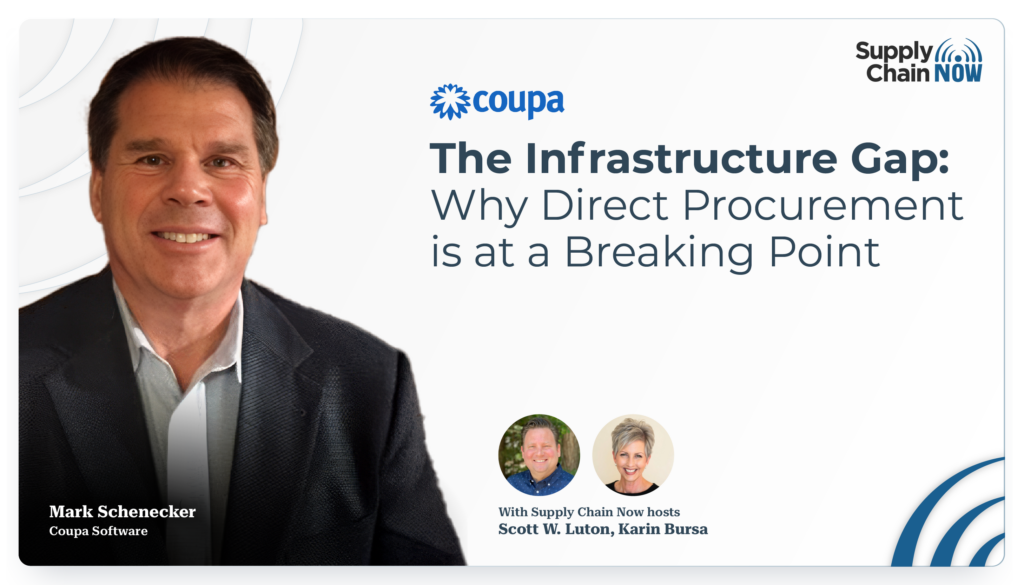
[00:00:00] Mark Schenecker: organizations now are actively piloting or scaling AI, and the intent is right, but here’s the problem. They’re layering intelligence onto fragmented data or disconnected workflows and architectures that were built really for a much simpler world, right?
[00:00:15] Mark Schenecker: One with a lot less volatility. What you get, is not transformation with this type of implementation of AI. It’s the same problem, you’re just processing it faster. more sophisticated analytics produces more sophisticated noise.
[00:00:29]
[00:00:42] Scott W. Luton: Hey, hey. Good morning, good afternoon, good evening, wherever you may be. Scott Luton and the one and only Karin Bursa with you here on Supply Chain Now. Karin, how you doing today?
[00:00:52] Karin Bursa: I’m doing great, Scott. I’d like to add my welcome to all the supply chain movers and shakers out there It is a great time to be in supply chain, and I think we’re gonna have a really interesting conversation today
[00:01:04] Scott W. Luton: We are. We are. And there you go. You nailed it. I knew that mantra was coming, but it’s all true. It is a, it’s a great time to be in our industry, and it’s a great time to be here today on Supply Chain Now because as Karin mentions, we got a great show coming up today. Hey, did you know that according to some studies, 72% of companies react, uh, expect rather procurement to become a strategic competitive advantage within three years?
[00:01:28] Scott W. Luton: Yet most organizations aren’t seeing that gap close between ambition and capability and ultimately value. Today we’re gonna be speaking with an industry leader about how we can close that powerful gap. Uh, and we’re gonna be talking about one proven approach in particular that relies on automotive visibility, continuous intelligence, and cross-functional influence.
[00:01:51] Scott W. Luton: Uh, all that and much, much more, so stay tuned for an informative and actionable conversation. So Karin, um, giving your not only your passion and excitement for what’s going on in global supply chain, but given your track record of making stuff happen, moving mountains in global supply chain for years, especially from a technology standpoint, I’m really looking forward to your, to your insights here today.
[00:02:13] Scott W. Luton: Should be a great show, huh?
[00:02:14] Karin Bursa: It really should be. It’s an important conversation, and it’s something that sometimes gets thought of as a back office component, but it’s a big contributor to your overall profitability, um, and how you serve your customers. So looking forward to, to, uh, what our speaker has to share.
[00:02:31] Scott W. Luton: That’s right. We gotta take a 2026 approach to the procurement expertise and function, not a 1986 approach, folks.
[00:02:38] Scott W. Luton: So Karin, it’s time to get to work. I’m gonna introduce a great featured guest we’ve got here today. Our guest is known for turning complexity into actionable results. He has shown an innate ability to blend technical expertise with deep industry insight to deliver measurable value across supply chain planning, sourcing, procurement, and even supplier collaboration and much more.
[00:03:03] Scott W. Luton: He’s a frequent speaker, a patent holder, a published author, and he’s almost as passionate as Karin about solutions that meet the demands of today’s dynamic supply chains. I wanna welcome in Mark Schenecker, Vice President, Industrial Manufacturing with Coupa Software Hey, hey, Mark. How you doing today?
[00:03:21] Mark Schenecker: Hey, Scott. I’m doing good. Thank you. Hey, Karin
[00:03:24] Scott W. Luton: it, uh, it’s terrific to see you. And Karin, we had a great pre-show session where we learned a lot about Mark earlier, didn’t we?
[00:03:32] Karin Bursa: We certainly did
[00:03:33] Scott W. Luton: you now call St. Petersburg, Florida home, Mark. And when you, when you’re not doing big things in global supply chain, you c- we can expect you to be, uh, on your schooner or your boat, uh, chasing after fish across the Gulf and up the Intracoastal Waterway. Tell us more about that, Mark.
[00:03:52] Mark Schenecker: Oh yeah. I love, I love spending time on the water. I’m on the Intercoastal and, uh, really fishing has kind of become one of my passions. I just love the sport. I’ll be out there this weekend again
[00:04:03] Scott W. Luton: Okay. And your fish of choice, if that’s a thing, I don’t know if it is a thing, I’m not really a fisherman, but red snapper is, is what you like to get. If you catch anything else, uh, it’s red snapper. Is that right, Mark?
[00:04:14] Mark Schenecker: Yeah, that’s definitely a favorite. You know, I, I like the, the play on the line I like it for dinner too. So hopefully I can catch a big enough one,
[00:04:22] Scott W. Luton: the family feasts for days maybe with a big enough one. And, uh, uh, Karin, when we talk about Florida, that’s kind of your old stomping grounds. You still have a bunch of family down there. Did you like to grow up fishing as well?
[00:04:33] Karin Bursa: Love it. Love it. Love to go fishing, uh, scuba diving, you know, playing in the water, the beach, um, Intercoastal. Any- anywhere I could get my feet wet was great
[00:04:42] Scott W. Luton: Okay. Okay. Well maybe, maybe you’ll have to share some of your, tips and tricks with Mark, uh, since he’s, uh, called Florida home for a few months now. But Mark, we expect some whoppers, uh, you know, 50 pound red snappers you’re catching this weekend. You’ll have to report back.
[00:04:58] Karin Bursa: I, I think one of the things he mentioned that is a real treat is just seeing dolphin all the time, um, even up and down the Intercoastal. And it’s just fun to watch them play in the water. Um, and usually they’re headed for some fish, so you may wanna follow where they’re going
[00:05:15] Mark Schenecker: Oh, that’s a great… Yeah, that’s a great idea.
[00:05:17] Scott W. Luton: There you go. There you go. We’re just now getting started, and we’re getting some good stuff from Karin. Um, let’s do this. We got a big show teed up, and it’s gonna be driven by a report we’re gonna share in just a second. But Mark, before we talk about that, I wanna talk about your long background of driving change across industry. Tell us more about
[00:05:38] Mark Schenecker: well, I’ve spent about, uh, the better part of three decades working on supply chain design and solutions. I was in supply chain at SCP for 15 years, and as part of that, I helped pioneer the direct spend collaboration solutions at Ariba. Um, I was also a founding member of e2open, uh, back when supply chain collaboration was just becoming, you know, kind of a solution category.
[00:05:58] Mark Schenecker: Uh, today at Coupa, I lead the industrial manufacturing market. So in my world, um, I work with companies that actually make things and the procurement teams that, you know, keep the factories running. That’s what I work on today
[00:06:12] Scott W. Luton: I love that. Um, it’s important to keep those factories running. Manufacturing, of course, such a core component of a global economy and, of course, a global supply chain. Uh, and Karin, he mentioned quite a few impressive stops, uh, in his journey, uh, including what he’s, of course, he’s doing today at Cooper.
[00:06:28] Scott W. Luton: What’d you hear there, Karin?
[00:06:29] Karin Bursa: Yeah, absolutely. Um, I, I think Mark, you’ve probably looked at this problem or opportunity from lots of different angles, um, in your experience, both from an Ariba perspective, which was one of the early innovators in this procurement space, um, all the way through to the work with, e2open, who did a lot with supplier collaboration and had some very interesting and innovative solutions, and Coupa now, who is a leader in the procure-to-pay process, has been long established and doing some interesting things in other areas of supply chain as well
[00:07:04] Scott W. Luton: Well said, Karin. We’ve enjoyed our con- uh, variety of conversations over the years that really illustrates, uh, that innovation and how they’re ch- helping to change the game. Um, let’s do this. So Mark and Karin, as we were talking about in the pre-show, we wanna kind of put this on folks’ radar. A lot of today’s conversation and expertise and insights we’re gonna hear from Mark are driven through a report that Coupa has invested in called the State of Direct Procurement 2026.
[00:07:28] Scott W. Luton: One of the most important things about that, I think, is it features insights from 133 senior direct procurement leaders, right? So this is really gonna help you between Mark’s expertise and that report, and of course, uh, Karin’s, um, perspective as well, to put your finger on the pulse of not only what is going on today, the steps we gotta take, now to start to bridge that gap more effectively.
[00:07:51] Scott W. Luton: Because as we were talking pre-show, Mark and Karin, the cost of being a laggard is going up by the hour. We’ll help you figure out how not to be a laggard. Um, all right, so let’s do this. Mark, I think it’s really important to get your take on, uh, the evolution that we’ve seen that continues to take place in the procurement space.
[00:08:12] Scott W. Luton: Would you speak to that a little bit, Mark?
[00:08:13] Mark Schenecker: Oh yeah, absolutely. I think, uh, what’s really interesting is the evolution or the pace of change right now is phenomenal. it’s faster than I’ve ever seen in my career, and I’m a computer scientist by, by degree and mathematician. I think, you know, first we have to talk about generative AI.
[00:08:28] Mark Schenecker: But really what’s happened is this leap from generative AI to agentic AI. So, and, and of course that’s simply just, you know, autonomous digital work. Uh, these aren’t tools that wait for a human to push a button. They’re autonomous agents capable of triage, you know, classifying, automatically classifying incoming documents, autonomous risk analysis.
[00:08:48] Mark Schenecker: You know, where we run this continuous now in the background, we don’t actually just run a report and say, “Hey, can I bring this supplier on board?” We watch them all the time. predictive sourcing, you know, detecting, you know, shifts in demand and, and alternate suppliers. So I think that, you know, what’s happened in AI is just permeating the solution.
[00:09:06] Mark Schenecker: And what’s more interesting is that when it is in your workflow and you don’t know it, and it’s working for you, that’s when it’s the most effective. I think second, uh, thing that’s really, really changed or evolution is the rise of the digital front door. So instead of forcing users to navigate, you know, through a catalog, what you’re really doing is saying, “Hey, just talk to me,” right?
[00:09:26] Mark Schenecker: So the employee can just simply type, “I need to onboard a software vendor for a new marketing project.” And the intake and orchestration, you know, it just automatically triggers the forms, the security reviews, the legal checkpoints, you know, all of the rules and regulations to make sure we keep this right and tight in our organization, and it balances that strict corporate compliance with really a seamless, easy consumer-grade experience.
[00:09:51] Mark Schenecker: So, user says, “I need this,” and the system says, “These are– This is what we’re gonna do, and this is the process we’re gonna go through.” And then finally, the biggest change I’ve seen, because I, I was a buyer for a period of time, and everything that I did was around can you drive the cost down? And the way that we drove down cost with the CFO is we aggregated our spend.
[00:10:13] Mark Schenecker: So I would give all of my spend to a single supplier, and I was judged by, you know, how I could negotiate that aggregated or the, you know, the larger spend at a lower cost, So my bonus was based entirely on how much money I could, I could save. But with global volatility, I hate to say it, you know, we’d have an event every, couple of quarters.
[00:10:34] Mark Schenecker: Now it seems like every week, you know, we have a new event, right? That’s happening. And it, and it’s, it’s not something we can plan for. So with volatility, inflation, shifting trade regulations, e-everything has changed on the scoreboard. Now we need to build for resiliency, not for cost, in order to keep the supply chains running.
[00:10:54] Scott W. Luton: All right. So Karin, we got a lot to dissect just in that last response in terms of how he’s speaking to the evolution. And did you hear that he’s also a computer scientist and a mathematician, so I’m out of my league. Uh, he talked about, of course, that, uh, moving from GenAI to, of course, all the different ways and, and windows of opportunity that agentic AI offers.
[00:11:14] Scott W. Luton: He talked about, uh, predictive sourcing, the rise of that digital front door, of course, orchestration. But, um, he also talked about, and this is one of my favorite parts, that consumer– How’d he put it? Uh, cons- um, consumer qual-
[00:11:29] Karin Bursa: grade experience.
[00:11:30] PPoint: experience.
[00:11:31] Scott W. Luton: And to be able to afford that to our team members, I think is a game-changer.
[00:11:36] Scott W. Luton: But what’d you hear there from, from Mark, Karin?
[00:11:38] Karin Bursa: Well, I, I’m gonna comment on that last, um, your last comment, uh, first, because I think, um, what I took away from consumer grade was simplicity. Is it, is it simple, easy to engage with? Is it intuitive? These are characteristics that we typically align with consumer interaction because we know we’re gonna do it with, you know, hopefully thousands and thousands of consumers.
[00:12:02] Karin Bursa: So I love that they’ve got that eye and that capability, in what they’re delivering to the market. But Mark, I’ve got to tell you, I like this concept of the digital front door. I like, um, the way that sounds. It’s very engaging, but also that standard process, that quick response, the fact that agentic AI is behind the scenes kind of moving that workflow through its paces and giving me quick responses.
[00:12:29] Karin Bursa: Because historically, some of the challenges in procurement were time lags, right? I send you a question or leave you a message or send you a form, and it may take some time to get a response. But with agentic working and moving things through, it makes everybody more efficient in the process and helps to make sure we’ve got contract compliance in place as well.
[00:12:54] Karin Bursa: So very important for both buyer and seller
[00:12:57] Scott W. Luton: Uh, yeah, we can eliminate some of those faxes and those carrier pigeon r- back and forth, uh, that I remember from some of my days in manufacturing. But, good stuff, uh, Karin, good stuff. Um, so I, I wanna do this, Mark, as we get deeper and deeper into, the topic at hand. And again, folks, go get your copy of the report that really is fueling today’s conversation.
[00:13:18] Scott W. Luton: Again, the State of Direct Procurement 2026, uh, insights from 133 leaders out there. Go check it out and, uh, let us know what you think. Um, okay, so we’re getting into this, what we’re calling a $16 million foundation. So Mark, first thing I’d love for you to speak to is why are supply chain disruptions no longer just statistics, but they are instead the literal cost of operating on fragmented infrastructure?
[00:13:44] Scott W. Luton: Tell us more, Mark
[00:13:46] Mark Schenecker: So then, um, you know, that $16 million number, it just makes the study impossible to ignore, It isn’t theoretical at, uh, risk, right? It’s the actual recorded losses from the report, you know, from just the data. So expedited freight, production shutdowns, uh, you know, missed commitments, you know, margins that walked out the door ’cause I couldn’t get my, my discounts.
[00:14:07] Mark Schenecker: this is an average for every organization every year. here’s why it matters. Uh, those losses aren’t happening because supply chains are inherently broken. They’re happening because the infrastructure underneath procurement was never designed to see disruption coming. It was… You know, so look what a leader can do versus a laggard in the study.
[00:14:27] Mark Schenecker: 60% of leaders can detect supplier reliability issues as well as price risk, early in the process. Only 26% of laggards can do that. That, that’s a 34-point gap, and it’s an amazing way to run. So by the time, a laggard or an average organization knows there’s a problem, the leader has already responded to it.
[00:14:50] Mark Schenecker: That window between detection, impact, response, uh, that’s where the margin lives or dies.
[00:14:57] Mark Schenecker: So when the data is fragmented across spreadsheets, ERP, or somebody’s, you know, email inbox, you don’t get that window. The cost lands, it impacts your organization before you ever saw it coming. So when the report talks about 16 million, what we’re really measuring is the price companies pay every year because they don’t have the right data foundation
[00:15:17] Scott W. Luton: All right. So Karin, one key thought I’d like to make that, that, that, uh, Mark is illustrating with the data points is that, you know, 60% of leaders detect supplier reliability and price risk early. Only 26% of laggards do that. And that’s just on, on those couple of areas. Think of all the other areas where leaders are doing one thing and prioritizing another thing and making it happen with real return, and laggards, hey, uh, I’m not throwing stones, but we’re sitting on how business has always been done despite the massive landscape shifts that have been taking place over months and years and certainly decades.
[00:15:52] Scott W. Luton: Karin, what’d you hear there from Mark?
[00:15:54] Karin Bursa: Yeah, a couple of things. You know I’m a big fan of facts not feelings, right? We can’t, we can’t make good logical decisions just based on feelings. So this research, um, is substantial. So, uh, Mark said 133 different companies sharing their insights. So that 34 point gap between what leaders are seeing and laggards are seeing is substantial.
[00:16:18] Karin Bursa: Um, and, you know, rolling into this $16 million figure that, that he shared. Um, so I, I think that means there’s money on the table for all of us, and we need to take a harder look at where we can boost data quality and maybe evaluate our workflows because many companies have built their current procurement workflows off of very antiquated business processes.
[00:16:44] Karin Bursa: And, uh, there’s a huge opportunity now in 2026 to change that and accelerate, streamline, and harvest data and insight where we couldn’t do it before
[00:16:54] Scott W. Luton: That’s right. Do better, lead better, make better decisions, make better returns. All of that stuff is part of the art of the possible.
[00:17:02] Scott W. Luton: So as a follow-up, Mark, uh, I wanna talk about one of the investment traps out there that’s catching organizations left and right, day in and day out. And what I’m talking about is tell us what happens when we deploy AI and we– a- and advance analytics, let’s not sleep on those, on top of really messy data, broken workflows, old, stagnant, static processes.
[00:17:27] Scott W. Luton: Mark, what happens?
[00:17:29] Mark Schenecker: Well, I, you know, uh, Scott, I think this is one that should be keeping the CFO up at night. I mean, half of organizations now are actively piloting or scaling AI, you know, and the intent is right, but here’s the problem. They’re layering intelligence onto fragmented data or disconnected workflows and architectures that were built really for a much simpler world, right?
[00:17:52] Mark Schenecker: One with a lot less volatility. What you get, you know, is not transformation with this type of implementation of AI. It’s the same problem, you’re just processing it faster. And the report, I think, had the perfect line for this, and I got to make sure I say this right. See, more sophisticated analytics produces more sophisticated noise.
[00:18:12] Mark Schenecker: and here’s the part that confuses me. the majority of organizations, for example, will share, they still share demand forecasts via email, spreadsheets, phone calls. Flat out, it makes it impossible to run predictive models on information that lives in these point solutions or like in a buyer sent folder.
[00:18:31] Mark Schenecker: You can’t build agentic AI on data that no two people in the company agree on, You’ve got to get your processes to work. So when AI adoption stalls, and I’m seeing it stall a lot, because of data, it’s not because AI doesn’t work. The technology does work.
[00:18:48] Mark Schenecker: but it’s simply because the foundation for it simply doesn’t exist yet. So in this report, it shows that procurement leaders that figure this out early, they invested in connecting existing infrastructure, cleansing their data, and then adding AI capabilities on top of that. So that sequence, which basically is foundation first, you know, intelligence second, that’s how I think separating organizations that really are getting results and pulling ahead from companies that are just frankly spending money
[00:19:19] Scott W. Luton: Yep. Uh, all right. So Karin, uh, I, I wanna go back to that line he um, spiked the football in a bit. More sophisticated analytics produces more sophisticated noise. And, uh, transformation isn’t always a good thing because if we’re transforming, uh, bad components of our operation and organizations, uh, it’s j- it’s gonna multiply and give us more of the bad thing and, and, and certainly more friction and heartburn.
[00:19:45] Scott W. Luton: But what’d you hear there, Karin, from Mark?
[00:19:48] Karin Bursa: Uh, lots of good stuff. I, I think number one, lots of companies are piloting different aspects of artificial intelligence, and I just want to be sure that when you do that, you’re not necessarily thinking of that as a long-term sustainable solution. Uh, so speeding up a process today may not result in a sustainable advantage for your company.
[00:20:10] Karin Bursa: I think if you step back and look at your foundation, look at the data, um, it’s not uncommon that, uh, an enterprise has multiple systems, multiple data sets that need to be accessed and inquired upon, uh, to really look at the procurement process. So, um, looking at your data foundation is really important, um, because otherwise you’re, you know, you’re, you’re basically bridging gaps, but you’re not necessarily moving into transformation.
[00:20:40] Karin Bursa: You’re not necessarily taking advantage of new workflows, uh, that are gonna change the way you interact with your suppliers, and you manage your process and, and gain visibility, new insights, and new opportunities to drive costs in alignment with, uh, with your corporate goals
[00:20:59] Scott W. Luton: You know, Karin, kind of to your, of your last points there, and certainly something Mark had called out that resonates with me during when I was in manufacturing, is spreadsheet-driven or email-driven forecasts. Uh, you know, no matter how often Mark called out, you, you can’t go tracking something down in your, in your sent folder. It is so inefficient. And of course, for me, that was years ago when I was actively shipping stuff, making stuff, you know, um, working in manufacturing. There is such a better way here in 2026 to do, um, do better by your customer, do better by your supplier, and certainly do better by your team member that’s working so hard to make things happen.
[00:21:36] Scott W. Luton: So let’s get more into the good news, Mark and Karin, ’cause there is certainly a better way, and I look forward to Mark’s take and, and what we’ve learned from these 133 leaders from the report. We’re gonna be offering up, uh, or learning from Mark on this proven three pillar framework that is separating the leaders from all the rest, and it’s really gonna focus on three things: infrastructure, intelligence, and influence.
[00:21:59] Scott W. Luton: So Mark, on that first pillar, uh, when it comes to infrastructure, tell us more
[00:22:06] Mark Schenecker: Yeah. I mean, I think this, you know, kind of segues from what we’ve been talking about. I mean, it’s the basis, the foundation, it’s the floor, right? You know, can, can you really see across spend, suppliers, and risk before the consequences hit? Um, so leaders have solved this problem. That’s what we found in the study, and they’ve moved on.
[00:22:23] Mark Schenecker: So 60% can detect supplier reliability as, as we discussed, and laggards are at 26%. they’re half as efficient. The point isn’t that visibility is hard, it’s that it is a prerequisite, right? So on top of that, once you have the visibility, then you need process discipline. do your workflows run on system logic, or is it really the superhuman efforts of individuals and individual, you know, judgment?
[00:22:51] Mark Schenecker: So, for example, 30% of leaders in the study are, are doing touchless, invoicing, But laggards only 11%. So the takeaway isn’t that process discipline, uh, it’s not an efficiency play, It’s a risk reduction play. So workflows that depend on individual judgment behave differently under pressure.
[00:23:12] Mark Schenecker: So as we see volatility, you’re gonna see really severe reactions when they’re, uh, versus normal conditions. So leaders remove that variability. They basically say, “Let’s put in structured processes, you know, take out the basically superhuman efforts of some incredible employees and get back into a system,”
[00:23:31] Mark Schenecker: And then the third aspect of that pillar, it’s got to be integration, right? And we got to put all the pieces together, and that’s where I think it gets really interesting. So the report wasn’t looking at, you know, what you’re using for integration tools. It’s just showing that leaders, that they’re citing their legacy systems and integration complexity as bigger barriers than the laggards,
[00:23:54] Mark Schenecker: So what does that tell you? That tells you that the leaders looked at, the problems of the data first, right? I know that sounds backwards that they’d say that integration is a barrier, but it’s because they realize that’s the first problem I have to solve. They don’t have a clean data set, so they’re not gonna get clean results.
[00:24:12] Mark Schenecker: You’re gonna get hallucinations. AI’s gonna give you an answer. Uh, it still does.but it’s only based on the data it has. So leaders, they cross that threshold. they give it clean data. They’re working on the harder problem first, which is really the foundation, the infrastructure, and the data
[00:24:28] Scott W. Luton: Karin, we’re talking about this three-pillar framework, and the first pillar was infrastructure that Mark was speaking to. What did you hear there?
[00:24:35] Karin Bursa: Yeah. Um, first of all, I think it’s important just to reiterate that when procurement breaks, margin, service, production, customer commitment, all of those are gonna feel the impact of, of gaps or leaky procurement processes, if you will. Um, and then Mark shared some really compelling numbers there. Um, Mark, I think you said 60% of, um, of leaders can detect supplier reliability or pricing risk.
[00:25:07] Karin Bursa: That’s huge, right? That, that’s, that’s compelling to me, um, especially in today’s global market where we’ve got increased volatility, but also as a result of COVID, many companies are looking at dual sourcing or multi-sourcing and making those trade-offs, and having a foundation that allows me to do that, again, facts not feelings, to do that in a good, standard, methodical way, I think is critically important
[00:25:36] Scott W. Luton: Yep. And you know, uh, also he mentioned the, the touchless invoice processing, right? 30% of leaders are doing that, and their teams are very grateful. Probably the whole ecosystem’s very grateful. And only 11% of the laggards are doing that. So that, that’s, uh, there’s a lot of friction between those two numbers and consternation for our team members.
[00:25:54] Scott W. Luton: Um, okay, so that, the first pillar was infrastructure. The second pillar we’re gonna be talking about is, uh, uh, intelligence and decision quality. Tell us more, Mark
[00:26:05] Mark Schenecker: So this is, uh, this is where visibility, so once you have that visibility, translates into action, So two dimensions really matter here. So now that I have the data, I, I really need decision quality and I need sourcing agi-agility. These are the two kind of aspects. So the report surfaced a really interesting statistics, and one I think I’m a little bit surprised.
[00:26:25] Mark Schenecker: 17% of laggards, Karin just touched on it, still negotiate single source, primarily just on unit price. And I just get the best price, you know, I aggregate my spend, I drive the best possible contract, I meet my metric of basically saving from the previous, you know, contract. When you look at the leaders, only 3% do that anymore.
[00:26:47] Mark Schenecker: That’s it. Only three. Leaders have moved on to a much more comprehensive evaluation, so they’re looking at cost, risk, quality, lead time, tariffs, um, production capacity, and they weight, they weight all that together, right? Now you can give different weights to different variables, but they look at everything.
[00:27:05] Mark Schenecker: Because the hidden cost of a price-only sourcing strategy, the effect of that, it shows up later, and what that means is that you’re gonna end up with expedited freight, part shortages mean production delays or outages, you know, in the worst, worst case, and a lot of times frequent order changes.
[00:27:22] Mark Schenecker: So the data backed it up and this was I think, a-amazing at this, like only 3% of leaders actually negotiate just on cost. Um, instead, 60% of the laggards have, frequent PO changes, and what that’s really saying is, “I have no backup, so I keep changing the PO to make it fit as best I can for my master production schedule.”
[00:27:45] Mark Schenecker: Versus leaders have already shrunk that down to 40%. So PO churn is not an operations problem, it’s a decision quality problem, and it, it compounds across, thousands of transactions and procurement operations per year
[00:28:01] Scott W. Luton: All right. So that’s a compelling second pillar of this framework. And I got to go back to one of the first things he mentioned, uh, that single source, 17% of laggards, only 3% of leaders. Uh, in my, just my take in today’s world, gosh, if we’re only starting and stopping and looking at cost and all the different challenges out there, uh, we are really doing a disservice to our, our ecosystems.
[00:28:23] Scott W. Luton: But Karin, what’d you hear there from Mark in this second pillar?
[00:28:25] Karin Bursa: Yeah. When I heard the 17% based on unit cost, so that’s not total cost, that’s unit cost. Total cost could be exponentially higher. Um, so I, I think that’s a really important point that, that makes that 17% even more concerning, quite honestly. Um, so, you know, one thing that I believe firmly is visibility tells you what’s happening, but intelligence is gonna help you decide what to do next, where to make changes, where to engage with your suppliers, and even make some recommendations on the next logical steps that, that should be taken.
[00:29:03] Karin Bursa: So we’re not talking about passive reporting anymore. We’re talking about active decision support, right? And again, we’re into this mode where we want to leverage technology and AI enablement to accelerate the response, to mitigate any impact of disruptions, um, and make sure that we’re able to deliver on our commitments to our customers by keeping manufacturing, you know, running smoothly and efficiently and protecting margin.
[00:29:34] Karin Bursa: Um, so these gaps are, are significant, Mark, in, in your research here between the leaders and the laggards. I think you’re giving us a lot to consider, and it shows that incrementally we are leaving money on the table, um, and we’re making our business process harder than it needs to be
[00:29:55] Scott W. Luton: Y- y- you know, the good news though, it– the, the gaps are significant, but you know the good news? Is there’s something we can do today start bridging them more effectively, right?
[00:30:04] Scott W. Luton: okay. Good things come in three. We’ve shared the first two.
[00:30:08] Scott W. Luton: We’re getting to the third pillar. We’re talking about this influence deficit, Mark. Tell us more
[00:30:12] Mark Schenecker: So the first one, I mean, you know, getting the right data, having the intelligence, you know, leaders can respond quickly to market conditions, you know, almost twice as, as fast as laggards. But the third one kind of goes a little bit sideways, and I think it’s gonna make some people uncomfortable.
[00:30:26] Mark Schenecker: that is really where do you report, right? Where does the procurement, sourcing and procurement processes live inside of an organization? what we found, right, because we asked the question, you know, where are you in the organization? And only 2% of senior procurement leaders report to the CEO.
[00:30:44] Mark Schenecker: Okay? I know when COVID hit, what I found was the CPO was at the table, and now it’s shrunk back down to saying, you know, you really are not at the seat with them. So suppliers, materials, risk decisions, they feed into every part of your strategic discussions at the top. But the, uh, procurement’s influence is not keeping pace with its impact.
[00:31:07] Mark Schenecker: That’s kind of the dichotomy. We don’t know why that’s happening, but what it– but it actually surfaced up in the report. So where leaders sit organizationally is really interesting. 37% of them report to the chief supply chain officer, and I think that’s fabulous. But laggards are more likely to just be under the CFO.
[00:31:27] Mark Schenecker: Nothing, nothing wrong with the CFO, but remember, that’s all about financial discipline, right? It’s about cost, uh, typically, right, in that area, versus a supply chain, it’s about continuity, it’s about getting product shipped, it’s about cost as well as all the other variables to ship product. So when you treat procurement as a financial control function to say, “I’m just trying to control my cogs,” um, it tends to stay transactional,
[00:31:54] Mark Schenecker: But when you wire it into the supply chain or operations, then it starts to become, strategic. And that, that is what we saw. But the deeper point is this: influence in the organization, because that’s really what it comes down to, it’s not really earned via the reporting lines.
[00:32:10] Mark Schenecker: It’s earned through outcomes. And so the cost of not having that is measurable. So laggards, got to make sure I get the stat- statistics right, experience revenue loss from fulfillment failure. In other words, they couldn’t get the parts on time. Almost half of the laggards saw that.
[00:32:27] Mark Schenecker: That only happened 20% of the time for leaders. So what’s really happening is when it’s treated strategically, not as a cost control, we’re getting the parts we need to keep the factories running, to keep our master production schedule on time. So the gap is the price of operating, you know, without a seat at the table of, of basically being part of the strategic discussion versus just transactional cost control
[00:32:52] Scott W. Luton: That’s a big gap. Uh, it can be corrected. But two quick things, Karin, before I get your take. Number one, uh, at the beginning of Mark’s response, he talked about, uh, this might be a bit uncomfortable. If we’re not getting a little bit uncomfortable at least, uh, we’re probably not having some of the conversations we need to have, uh, especially in 2026.
[00:33:10] Scott W. Luton: And then secondly, on a lighter note, hey, CFOs out there, we love you. We love you. Nothing against you. Just want to make sure we, we establish that. Uh, all right. So Karin, what’d you hear there from Mark?
[00:33:21] Karin Bursa: First of all, I want the CFO to be the supply chain cheerleader in the business. So making customers happy and doing it profitably, that’s what we’re in business for. So, uh, nothing against CFOs here. Um, but I do think procurement has been this stepchild, the procurement organization or process has been a bit of a stepchild in the organization, and it does move around.
[00:33:45] Karin Bursa: It’s, it’s in accounting and finance sometimes. It’s in its own little silo. We want it integrated, the Karin Bursa recommendation as a part of our supply chain. So reporting into that chief supply chain officer is gonna make sure we are aligned with serving our customers and serving our customers well and meeting our strategic goals for the business.
[00:34:08] Karin Bursa: So, you know, the, the impact of direct material decisions is the intersection of supply, finance, operations, engineering, customer, customer satisfaction. Um, so it is really vital to the process, and I think having it personally tightly integrated with the rest of the supply chain operations is, is really important
[00:34:33] Scott W. Luton: Karin, I, I’m with you. Out of all the events and all the, gosh, thousands of conversations I’ve had just this year, uh, from the Gartners to the Manifest to, MODEX and more, you know, reinventing the operating model was a big major theme in light of technology and, and challenges out there, the ever-changing landscape.
[00:34:50] Scott W. Luton: Well, folks, part of that is reexamining the reporting structure, which Mark and Karin is talking to. So, uh, what a thought-provoking and hopefully conversation and action-provoking, three-pillar framework, Mark. Uh, so we’ll see where we can keep driving the conversation. Folks, check out the report.
[00:35:06] Scott W. Luton: But we got more. We got more good stuff to come. So beyond the framework Mark, you just walked us through, right, all three pillars, there’s a- another barrier that we’ve got to speak to because it impacts so many companies out there. And, you know, we talk about silo busting. I feel like I’ve been talking about that for years.
[00:35:22] Scott W. Luton: And Karin know, we have been, and as Karin knows, uh, I like to observe that in this era of go- of the golden age of supply chain tech, I don’t know if we’re eliminating more silos or building more digital silos. I don’t know. But the one silo that we would argue maybe nobody has solved yet is that silo between direct and indirect procurement.
[00:35:45] Scott W. Luton: So Mark, speak to that silo a bit. I feel like we’re back on your ranch, Mark, with these silos
[00:35:51] Mark Schenecker: Yeah. Um, so I, yeah, I don’t keep silage. I, I use fresh, um, I’ve done– You know how we’re… Yeah, I, I raise my own, um, alfalfa. Anyway, so this was one I think maybe not as big a surprise, but it was kind of one of my favorite findings in the whole report because it’s a place where literally, I mean, people are not solving this problem.
[00:36:12] Mark Schenecker: And so when it came back and it said thirty-seven percent of leaders and forty percent of laggards, or, roughly a huge, uh, audience, they operate with completely separate direct and indirect procurement functions. And I think it kind of follows on to the organizational structure, which is, sometimes we, we stick indirect over here, and we stick to, the direct materials over there.
[00:36:33] Mark Schenecker: But in the end, category strategy, sourcing, optimization, contracts and everything that we do in kind of foundational elements is really, um, the same, right? So it’s not a leaders versus laggards story. I mean, it’s an industry-wide gap that we see And then I think the cost of not addressing this is actually pretty real.
[00:36:54] Mark Schenecker: So as long as the two functions are silos, no one in the business can really see total spend, total supplier exposure, you know, total risk. that also plays into the ESG part. you can’t model, for example, a tariff impact across both. You can only do it separately, right? So now you have two different ways to say, “Okay, what’s gonna happen with the new tariff that we just happened?”
[00:37:15] Mark Schenecker: You can’t negotiate across both. and you certainly can’t apply AI across both because you’ve got them in two completely different systems. You have to then get that foundation right, you know, get that integration because the data won’t speak for itself. So I think the organizations that close this gap, they get a tremendous process efficiency, but then there’s also now the tooling that comes on top.
[00:37:38] Mark Schenecker: So once we get this data foundation that says, “Hey, look at all your spend,” and I’m talking about indirect spend, MRO spend, services spend, direct spend. When you look at everywhere that you spend money and you analyze it, you have an opportunity to get a complete picture of who you actually buy from, uh, from who and at what risk, and the agentic AI functionality really gets a lot more powerful
[00:38:04] Scott W. Luton: Karin, that last point he made that whoever has a complete picture, right? That he’s referencing, that has massive competitive advantage. But what’d you hear there from Mark, Karin?
[00:38:13] Karin Bursa: Yeah,I think that, um, in our minds we oversimplify direct and indirect procurement. In reality, for most companies, they have suppliers that they work with, and they may work with them in a variety of different capacities, and some of those suppliers may even be customers. And so there are, you know, buy and sell transactions in many directions.
[00:38:35] Karin Bursa: So one thing Mark mentioned is that visibility of total spend with a supplier. and it could be with a region of a supplier, or it could be on a global basis. So the ability to bring that direct and indirect together, is really valuable because we do wanna look at total spend. We wanna look at total margin.
[00:38:53] Karin Bursa: These things, quite honestly, are negotiation points for us as we go forward and select and partner with suppliers in the future as well. Having good, clear visibility of the total engagement, both in what we buy and maybe what we sell to those suppliers, is really important.
[00:39:12] Scott W. Luton: Well said, Karin. Well said. Um, okay, we’re gonna talk about the so what factor, but first, Mark and Karin, I wanna let people in our little inside joke a second ago, ’cause folks, one of the things we learned about Mark is he spent years on a ranch in Colorado before he moved to Florida. So that’s where the, the hay remarks and the silo remarks came from, folks.
[00:39:34] Scott W. Luton: Just wanna bring y’all with us, uh, as always. Um, okay, Mark, the so what factor. in all the different events I’ve been to, all the different supply chain conversations and keynotes and presentations, you always got, uh, folks in the back, arms crossed. They like to use the word humph at things, you know, uh,
[00:39:51] Scott W. Luton: and then at the end of everything, “Oh, well, so what?” Well, I think the so what factor here in your response is really important because I think it speaks to the sense of urgency, the, uh, the art of the possible here today in 2026, and of course, all the results that comes with it you’ve been speaking to.
[00:40:07] Scott W. Luton: So I think it’s important for us to kind of bring it home with a few examples of organizations that have taken this framework and are getting considerable outcomes, increasing competitive advantage, and certainly being more leader than laggard. Talk, to us, Mark
[00:40:22] Mark Schenecker: I think I just want to reference the report and then talk about a, a few customers. Um, I, you know, I think this so what really it comes down to the math, in the report. it just puts that out on the table. You know, so disruptions happen to everyone. The same disruption affects virtually, the same two companies, right?
[00:40:41] Mark Schenecker: in this case, 47% of laggards experience revenue loss because they can’t get their parts, Only 20% of leaders suffer from that. 40% of laggards have missed or delayed product launches, so you can’t even run your new product introduction, your NPI process. That’s only happened for 23% of the leaders.
[00:41:00] Mark Schenecker: So this is really the interesting part of looking at the math and saying these are, are really huge economic impacts, to a company. So we all have the same environment, the same disruptions, but the P&L is completely, you know, the outcome is completely different from leaders versus laggards.
[00:41:19] Mark Schenecker: You know, that’s the macro story. I’ll use, um, a, a few examples. In, in Albemarle, the intelligence program that they built is on top of the integrated Coupa data. The pattern is the same. They invested in the foundation, the data itself, and they then layered, you know, AI on top of that clean integrated data not on top of fragmented silos.
[00:41:41] Mark Schenecker: So the results they have are incredibly precise, right? They’re part of the leaders that basically do not suffer from, shortages of product, uh, fulfillment Glencore. Now in their case, they’re running different modules of Coupa, But it’s really one operating system. It’s not four separate modules.
[00:41:58] Mark Schenecker: And I think that kind of comes, part of that is, you know, the suite story that Coupa will, talk about. but it unlocks the ability to model scenarios, you know, when you have these modules together continuously, rather than as, you know, every single time I source, the market shifts.
[00:42:15] Mark Schenecker: So for Glencore in a commodity-exposed industry, they’re in mining, that’s the difference between protecting margin and chasing it, and then, you know, to kind of go back to this reporting structure and, I love this because the CPO at ADM is, uh, Archer-Daniels-Midland is turned into a friend, not just an associate.
[00:42:33] Mark Schenecker: And he now sits at the, in the S&OP process. So in the sales and operations process or strategic planning that says, “What are we gonna sell? Okay, based on what we sell, here’s the supply that we’ll need to fulfill those orders.” He’s there at the table. and so he’s basically bringing procurement intelligence and feeding it to the executive team.
[00:42:54] Mark Schenecker: He has a seat there. So the shift in procurement went from reporting on what happened, “Oh, I didn’t get the parts, so we missed our production plan,” to shaping, what’s going to happen next and building that into their plan. So the common thread across,a few customers is that they didn’t get there by buying more software,
[00:43:13] Mark Schenecker: They got there by deciding at the executive level that procurement is core infrastructure, right? And then building it that way and operating it that way
[00:43:24] Scott W. Luton: All right. We can’t just throw more dollars at technology, throw it over the fence and say, “Okay, done. Check the box. Move on.” Uh, it’s kind of one of your last points there. Uh, but two things that really amongst other, the examples Mark shared, Karin, we all know the value of clean integrated data. It can move mountains when we have both of those items together.
[00:43:43] Scott W. Luton: And then secondly, that continuous scenario modeling, one-off, not starting over again, but continuous scenario modeling at scale, uh, massive value there. But what’d you hear, Karin?
[00:43:56] Karin Bursa: Yeah. first of all, loved the customer examples. those are very helpful, Mark, and I think that they are very compelling examples of how we move from this transactional cost center mentality to a strategic lever for the business, right? How do we activate our digital front door, as you said, and really make it part of that S&OP process where it’s integrated into our overall goals and objectives for the business.
[00:44:25] Karin Bursa: It’s not just being pressured on unit cost. Um, so I think that’s very important to the overall value proposition, and those examples give some good tangible thoughts and ideas on where we can start.
[00:44:40] Scott W. Luton: Yep, that’s right. And folks, if you want more, uh, details on those examples and what it may mean for your business, your organization, your ecosystem, your team, I know Mark and the Coupa team would welcome those conversations. Is that right, Mark?
[00:44:54] Mark Schenecker: Yes. Yes, uh, certainly. I think it also– But it depends on where you are, The kind of conversation to have, right? So there’s– I think there’s kind of three different paths. You know, if you’re early in your journey and you want to know, where you actually stand, the easiest place is to start with a maturity assessment.
[00:45:11] Mark Schenecker: It basically is the procurement maturity model. really received incredible, uh, focus from the industry as a whole. can map your organization against that framework that these hundred and thirty-three companies were measured against.
[00:45:25] Mark Schenecker: And you can see exactly where you are and where your gaps are. So if you’re early, that’s an easy way to self-start and say, “Hey, we’re really good here” or, “You know what? We are nowhere near, the leaders.” Um, if you’re already on, if you’ve already started, your digital transformation roadmap, uh, but you want to pressure test it, you know, whether you’re building foundation, or you’re,deploying intelligence, or whether your direct and indirect strategies are aligned, whether you’re investing in the right pillar, that’s a conversation.
[00:45:54] Mark Schenecker: that’s definitely one you want to tailor it. You know, reach out We can talk with you personally. if you want to see what’s next,you know, connect with me on LinkedIn, I’d be glad to talk to you about it. We just finished our conference, uh, it’s called Coupa Inspire, and, a lot of what we showcase there is, uh, directly ad-addresses what we discussed today, and it’s pretty, pretty amazing.
[00:46:15] Mark Schenecker: So it’s autonomous procurement, agentic AI, intake and orchestration. Of course, we acquired a company, as well as platform, you know, and platform integration. So the on-demand content is released. Um, it’s extensive. It can get kind of deep, but it’s worth a look. So the bottom line, um, and this kind of echoes, I think, the report itself, is that organizations are, are closing the gap.
[00:46:38] Mark Schenecker: They aren’t spending more money. They’re just building differently, and they’re looking at the problem differently. And we’d love to help you build the right foundation, uh, in the right sequence. So please reach out or, uh, through coupa.com or, um, connect with me directly on LinkedIn.
[00:46:54] Scott W. Luton: Mark, uh, it sounds like it’s really easy no matter where you are in the journey to connect and get value. Even if you don’t start working with Coupa right away, I think, uh, you’ll find them to be, and Mark and the team to be an excellent resource to bounce some thoughts off of. And of course, as he shared, there are no, shortage of companies that are getting, uh, partnering with Coupa and getting great, great value on such a challenging time to find, uh, success across global business.
[00:47:21] Scott W. Luton: Uh, which only adds to Karin, only adds to the, um, the why that we’ve got to do business different. Get your quick comment on that, Karin course, we’ve got your big patented takeaway coming soon, but not yet. React to the urgent need to do business different, Karin
[00:47:39] Karin Bursa: Yeah. Um, it is urgent, because the gap is getting bigger, and Mark has already shared, or this research has shared some pretty significant gaps. So those who are leveraging technology to accomplish some really tangible goals, are not taking small steps, but giant leaps forward and creating a competitive advantage in the way they manage their businesses.
[00:48:02] Karin Bursa: So that, that’s my big takeaway from that last point that Mark was sharing with us. And I have scribbled several different things I wanna put into a final thought, so
[00:48:12] Scott W. Luton: Good. I’ll circle back on that because I saw you fast and furious. I knew you were taking 17 pages of notes too like I have today.
[00:48:19] Scott W. Luton: Let’s see here. Let’s start with the report that we have been referencing
[00:48:24] Scott W. Luton: regularly,Check it out, the State of Direct Procurement 2026. As we’ve mentioned a couple of times, this resource sheds light on how leaders pull ahead while others stall or even regress in some cases, right?
[00:48:36] Scott W. Luton: And it also features those insights, uh, those actual insights from 133 senior direct procurement leaders. And then secondly, uh, we got even more. This resource entitled The Direct Spend Procurement Maturity Model, I think Mark was referencing this earlier.
[00:48:51] Scott W. Luton: This offers up a roadmap for evolving from reactive operations that just react to market conditions and geopolitical and tariffs and trade and all the headaches out there, evolving from reactive operations to intelligent connected supply networks. So make sure you go check that out, that roadmap will be very useful today and into the future.
[00:49:14] Scott W. Luton: Okay, Karin, you got the toughest question of the day because Mark has shared a, um, a container load of perspective here today. So what is your patented key takeaway here today, Karin?
[00:49:26] Karin Bursa: Yeah. So I guess to start with, um, Scott, you made the comment about the art of the possible, and I’m gonna add the art and science of the possible, um, because technology, artificial intelligence does play a part in here in really taking that data and transforming it into insights and actions for our business.
[00:49:47] Karin Bursa: So, um, I want you to think about both the art and the science of the possible, uh, to help you run your business in a more strategic manner every day, so that those tactical activities happen and they feed our, our, um, our strategic goals for the business. So that’s the first thing. The second thing is download this report.
[00:50:07] Karin Bursa: It is packed full of some really good insights, and it’s gonna help you ask some questions internally about your business on where you sit today, um, and where your opportunities might be. So the fact that they’ve also got this maturity model, that can help you identify where you are, grab that too, because that’ll be helpful for your business to take a look at where you are so then you can understand what’s possible and put the pragmatic steps, uh, in place to do that.
[00:50:38] Karin Bursa: The third thing is this concept of the digital front door. I love it. I love having one digital front door, one process that can serve my suppliers and all of my procurement professionals and do it in a consistent, efficient manner. So think about, do you have a digital front door for your business? And then finally, let’s unleash our inner leaders.
[00:51:04] Karin Bursa: These leaders are killing it based on this research, and chances are that investments in this area are gonna pay for themselves. Um, and you’re gonna see better margins across your business, better service for your customers as a result
[00:51:21] Scott W. Luton: Hmm. Karin, I tell you, I knew you were up to the task, uh, but those are three exceptional takeaways from what Mark shared here today. Mark, did she do you justice? I think she did, huh?
[00:51:32] Mark Schenecker: Yeah,
[00:51:32] Mark Schenecker: fabulous. You guys, you guys are the greatest.
[00:51:36] Scott W. Luton: Well, really, um, you have brought some quality perspective, uh, rooted in data and rooted in industry and rooted in those organizations that are, that are doing what we’re talking about, right? And there’s such a great opportunity, if you feel like you’re a laggard and you’ve got some catching up to do, hey, there’s no time like right now here today, because as Karin mentioned, I’m gonna steal this from her, the art and science of the possible.
[00:52:00] Scott W. Luton: I love that. I love that. Um, all right. SoMark Schenecker, vice president industrial manufacturing at Coupa Software. Thank you so much for being here with us today, Mark
[00:52:11] Mark Schenecker: Thank you. I
[00:52:13] Scott W. Luton: forward… You bet.
[00:52:14] Scott W. Luton: Look forward to having you back. Good luck this weekend as you chase down, uh, those famous Florida, uh, red snappers. Uh, and Karin Bursa, always a pleasure. I tell you what, I learned from both of y’all here today. Thanks for being here.
[00:52:28] Karin Bursa: Oh, thank you. I really enjoyed the conversation. I think this is an important topic
[00:52:32] Scott W. Luton: It is. It’s a critical topic. Uh, and unfortunately, we still see a lot of folks sleeping on the opportunity of the incredible role that modern-day procurement, uh, can play in your supply chain and your business, um, uh, enterprise and ecosystems.
[00:52:46] Scott W. Luton: Mark and Karin both really laid out some actionable expertise here today driven by research, driven by data, driven by what’s going on in reality, not what we wanna think, but reality what’s going on out there in our industry.
[00:52:58] Scott W. Luton: You gotta take one thing you heard here from today from Mark and Karin and do something with it. Deeds not words. And with that said, on behalf of the whole Supply Chain Now team, Scott Luton challenging you, do good, get forward, be the change that’s needed, and we’ll see you next time right back here on Supply Chain Now.
[00:53:13] Scott W. Luton: Thanks everybody.