[00:00:00] Jason Murray: what we’ve worked really hard with at Shipium is to stay ahead of that curve, right? And I, I have no doubt that there will be people that will come and compete with us. but I think the, the question you got to ask yourself is, are these guys leaning in and, and really AI native, or are they not?
[00:00:15] Jason Murray: we are. And I think if they’re not, I think they’re gonna be in big trouble. I think
[00:00:32] Scott W. Luton: Hey, good morning, good afternoon, good evening, wherever you may be. Scott Luton and the one and only Marty Parker with you here on Supply Chain Now. Welcome to today’s show. Hey, Marty, how you doing today?
[00:00:43] Marty Parker: I’m excited. I’m excited to learn, excited to see some great innovation
[00:00:48] Scott W. Luton: Me, I am too. You stay in that constant state of supply chain excitement. Is that a fair statement, Marty?
[00:00:54] Marty Parker: Hey, I’m always learning, my friend, and I’m getting ready to learn again today
[00:00:57] Scott W. Luton: We are. We got folks. I’m really looking forward to today’s show. We’re gonna be diving into the world of shipping. In particular, we’re gonna be discussing the freight audit industry. You know, unfortunately, there’s a ton of, “But we’ve always done it this way,” type of old-fashioned thinking out in the market.
[00:01:12] Scott W. Luton: However, as is usually the case, there’s a big opportunity to lean in to the golden age of supply chain tech and carve out a much better path moving forward. Today, we’re gonna be walking through all of that and more with one heck of a power panel that are challenging industry leaders to take a much different approach to shipping and really overall supply chain performance.
[00:01:32] Scott W. Luton: Our guests are gonna be ring, uh, bringing perspective and expertise that might just change the way you see the supply chain world today and down the road. So stay tuned for a fascinating discussion. Now, Marty, uh, always a pleasure when you join us on the show. Given your decades of practitioner and operator experience, I look forward to your take on the conversation today.
[00:01:52] Scott W. Luton: Are you ready to go, my friend?
[00:01:55] Marty Parker: I am ready. Let’s do this thing.
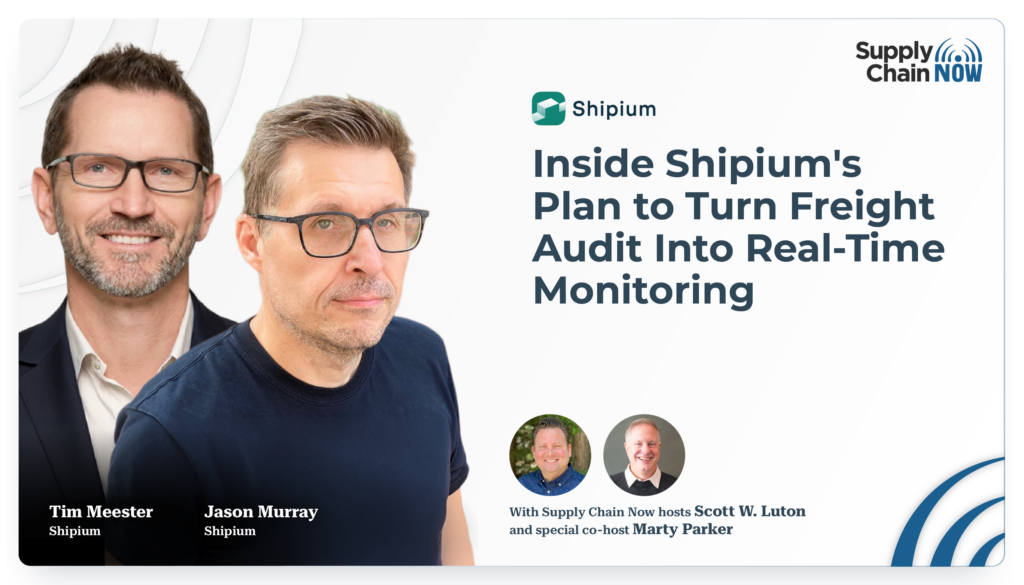
[00:01:57] Scott W. Luton: So folks, stick around for a great conversation that’s gonna offer up tons of actionable insights, ’cause if they’re not actionable, just how good are they, right? Wanna welcome in, uh, our wonderful guests joining us here today, starting with Jason Murray, who spent over 19 years in varying leadership positions with Amazon, all before co-founding Shipium, where he serves as CEO today.
[00:02:19] Scott W. Luton: Now joining Jason, his colleague Tim Meester, is a sustainability-minded procurement and supply chain executive that served in leadership roles with companies such as Best Buy and Kohler, and now he serves as vice president for operations and intelligence with Shipium. Folks, you’re gonna love Jason and Tim’s perspective here today. Let’s welcome them both in. Jason, how you doing today, my friend?
[00:02:42] Jason Murray: I am wonderful. Great to be here
[00:02:44] Scott W. Luton: Hey, we are glad you’re here as well. And Tim, great to finally rub elbows officially and get you on the record here at Supply Chain Now. How you doing?
[00:02:53] Tim Meester: Great. It’s about time. I’ve been liking your stuff for like 10 years on LinkedIn, I think. So it’s great to finally be here
[00:02:59] Scott W. Luton: Oh, we’re gonna keep it real here today, folks. But Marty, our audience, our SC&Global fam is in for a treat with Jason and Tim here today, right?
[00:03:08] Marty Parker: Yeah, 100%. We are gonna, um, learn a new way of thinking about, um, saving money and increasing our margins
[00:03:17] Scott W. Luton: That’s right. No fluff zone here today. No fluff zone. But before we get into all the business, y’all know how I like to start, right? With a nice, fun warm-up question. And we’ve got, we got two characters that y’all have a lot of common threads and kindred spirits amongst you. Jason, uh, you’re much like me.
[00:03:34] Scott W. Luton: You may not be a bird nerd like I am, but I love getting outdoors, I love nature, uh, and you live up in a beautiful part of the world, uh, in the Seattle area, where you’re a big rabid Seattle sports fan. So I got a two-pronged question for you. Uh, number one, where’s one of your favorite go-tos in terms of getting out and taking in the sights and the nature sounds? And secondly, what’s your prediction for Seahawks football in the 2027 year?
[00:04:00] Jason Murray: Uh, one, if I can get up to Mount Rainier, I just, uh, I, I love it up there. I told my wife, you know, probably just one, when I, when I do pass, I want my ashes sprinkled on that thing. So I l- I love it. I absolutely d- I think it’s the most beautiful place on the planet. Um, so Seahawks, I think my head says, man, the Rams look tough this year.
[00:04:23] Jason Murray: They got Miles Garrett now. Um, seems like everything’s lining up, but my heart says we’re gonna get a repeat. It’s time to go back-to-back. So I’m, I’m going all in on that. That’s my prediction
[00:04:35] Scott W. Luton: Uh, Jason, I love that, and what an impressive year last year was. What
[00:04:40] Scott W. Luton: a resilient and dynamic Seahawks team. Um, all right, really quick, Marty. Uh, uh, on the Seahawks prediction, uh, your– does your sports analysis and supercomputer, does it, does it, uh, back up Jason’s prediction?
[00:04:55] Marty Parker: sadly, I don’t think with my brain, I think with my heart, and I’m a, I’m a perpetual Falcons fan. My son-in-law works at the Falcons. I think this is the year. I s- I, I make that prediction every single year, and let’s just say I’ve, I’ve not, uh, won a lot. But, uh, th- this next year is the year. new coach, got a new, um, approach, and I, I think it’s gonna make a difference
[00:05:21] Scott W. Luton: Love it.
[00:05:21] Jason Murray: you got your heart broken by the, uh, by the Patriots just like us back in 2014, but we had our revenge last year, so anything’s possible, Marty
[00:05:30] Scott W. Luton: You
[00:05:30] Scott W. Luton: did.
[00:05:30] Marty Parker: I may need to go take a pill right now. That, that was
[00:05:33] Marty Parker: hard.
[00:05:34] Scott W. Luton: Jason, Jason went there. He went
[00:05:36] Jason Murray: Yeah, I, I, I went through it. It’s all part of it.
[00:05:39] Jason Murray: Yeah.
[00:05:40] Scott W. Luton: Um, all right, so as I mentioned a minute ago, uh, Tim, you and, you and Jason have some things in common. You also are a big outdoors, um, uh, passionista, getting outside and taking in a breath, uh, breath of fresh air there in Wisconsin. And you, but you are a big original football fan, which is soccer, some of the states call it.
[00:06:00] Scott W. Luton: Of course, we got the World Cup going on right now. Uh, Tim, two questions for you. Where’s your go-to for getting outdoors? And, uh, and we’re recording this, this podcast in late June. Who is gonna win the World Cup, Tim?
[00:06:14] Tim Meester: first of all, I’m a fellow bird nerd too. So getting outdoors, we’ve got woods right behind our house. If I’m having a stressful day because of Jason or somebody else I work with, then I walk back out to the woods. Um, but, uh, and I just saw my first western tanager out in Portland, uh, when we were out at Multnomah Falls out there.
[00:06:33] Tim Meester: Um, so it honestly, anywhere there are birds, there are great state parks and hiking areas in Wisconsin, and it’s fantastic. Um, I’d, I’d say for the World Cup, uh, the USA looks really strong, and I know it, it seems weird to say that, but it would great, be great to see the men catch up with the USA women’s team and actually win this.
[00:06:53] Tim Meester: So, um, I don’t know. Other- otherwise, I’m a huge Netherlands fan, uh,
[00:06:57] Tim Meester: too. So, you know, the, the, orange or the red, white and blue.
[00:07:02] Scott W. Luton: I like it, Tim. And it’s good to have a couple of horses in the race. Uh, all right. So Marty, uh, I tell you, you know, Tim’s in Wisconsin, Jason’s in Seattle, great places in the world, of course. We’re here in the Atlanta area, and the World Cup has just taken over, and it’s been so cool to see the passion and the camaraderie and the kindred and the, you know, competitive spirits too, but it’s really brought so many countries together.
[00:07:24] Scott W. Luton: Your quick thoughts there, Marty.
[00:07:26] Marty Parker: Yeah. Very proud of my son-in-law. He, he got tickets and he gave two of the tickets, uh, for last night’s match with Haiti to a naturalized citizen and, uh, a friend of his, uh, daughter. And, uh, those were Haiti’s first two goals in the World Cup. And to see on social media them just going crazy, uh, at the beginning and the middle of the game.
[00:07:48] Marty Parker: They didn’t win, but, um, I don’t know. It, it, it, to me it was the story of sports where you give up your tickets to someone else that really, um, you know, cared a lot about it
[00:08:02] Jason Murray:
[00:08:02] Scott W. Luton: Marty, well said. Love that. Um, gosh, I’d, I’d love to talk more about that, but we got a great story to get into here today. Talking about one of my favorite topics. No, not birds, but thank you, Tim. Supply chain, and better yet, how we can, we can take, you know, move industry to a much better, more innovative approach when it comes to certainly shipping, a better managing our supply chain performance, and we’re gonna get into that now.
[00:08:22] Scott W. Luton: But Jason, first, you know, I, I shared just a nugget or two. Didn’t do you justice ’cause you’ve done a lot in your career. But if you would, for our audience, we’re gonna level set a little bit on your journey as well as your current role as CEO there at Shipium.
[00:08:36] Jason Murray: Yeah. So, uh, you know, twenty years at Amazon. I’m a technologist by trade. My career was really defined by kind of the combination of logistics and technology and applying that, both data and technology to the space. Uh, I ran the supply chain optimization tech group from twenty ten to twenty sixteen. And, um, the things I’m most…
[00:08:58] Jason Murray: You know, that was kind of right when Prime was starting to take off. And, uh, the thing that I’m the most proud of is the– are kind of what we did with machine learning and data science and that kind of first version of AI and how we applied it to that space. Uh, and then you fast-forward to Shipium, we’re really trying to democratize or bring that technology to the rest of the market.
[00:09:16] Jason Murray: And, um, you know, I– what I like to say is, you know, we, we obviously started with something that looked a lot like what we were trying to do at Amazon, but we’re also now going through this AI revolution, this generative AI revolution. And so I have the exciting prospect of actually figuring out how do we apply generative gen– now generative AI to the space, right?
[00:09:34] Jason Murray: And I would say it’s even more exciting. So
[00:09:36] Jason Murray: I, I feel very blessed that I’ve been a-able to kind of do this in, in two different locations with a similar, similar effect. And it’s– I’m excited to talk about that today
[00:09:45] Scott W. Luton: Hey, we are too, and the industry’s better off for it. Uh, so
[00:09:49] Scott W. Luton: I’m excited about what y’all are doing. I love the democratization that we’re seeing in so many different lay- uh, levels and layers. Um, and we’re gonna talk more about all that. Tim, really quick, on a level set too, on your journey as well as your role here at Shipium
[00:10:04] Tim Meester: Yeah. So I’ve got 30 years in supply chain, uh, mostly in retail, you know, Best Buy, Toys “R” Us when they were, you know, thriving, uh, some in manufacturing with Kohler and so forth. And my roles have been across logistics, supplier management, overarching supply chain transformation. Uh, spent a lot of time in procurement, which most people don’t, um, desire to end up in procurement. But, uh, o-once I got there, I loved it, right? And so was able to do that with Best Buy and got deep, deep exposure to the parcel space in retail as things were shifting to ship from store and, um, getting more complex and speed and, and, uh, so it’s, it’s just been a fascinating set of puzzles that, you know, for 15 or 20 years people have not been able to solve.
[00:10:53] Tim Meester: And
[00:10:54] Tim Meester: now we’ve got some amazing tools and capabilities that you can see solutions like now, whi-which is really exciting.
[00:11:02] Scott W. Luton: It really is. And, and, uh, Marty, between Jason and Tim’s perspective, you just heard in the, you know, a, a minute or two of their responses, uh, and, and Jason pointed out that intersection of technology and logistics. Uh, I think the impression I get with Jason and Tim is they’re not asking, um, uh, “Hey, how have we always done it?”
[00:11:23] Scott W. Luton: They’re asking, “Why are we, have we always done it this way?” And offering a better way. But Marty, what’d you hear?
[00:11:28] Marty Parker: Yeah. So, uh, you know, I speak with folks in the C-suite a lot, and, um, for a while they were talking about, uh, AI and tariffs, and now they’re talking about AI and what a great opportunity for, uh, essentially low-hanging fruit. They know there’s an efficiency there. Uh, it’s, it’s a safe way to do it within their existing systems. Uh, and they’re all under pressure, if you read The Wall Street Journal every day, to do something with it. And, and now they can. You know, there, there’s technology like Shipium available that they can apply. So having the kind of backgrounds that Jason and Tim do, it just gives strength and credence to the ability to make that application
[00:12:09] Scott W. Luton: I like it. Strength and credence. That’s a great phrase, Marty. You make me sound smarter when I hang out with you. Um, all right. So Jason and Tim, let’s dive in deep. And, and w- and Tim, we’re gonna focus on a lot of your perspective on the front end, and then we’re gonna circle around to, uh, Jason’s, uh, perspective and then the vision he sees for Shipium kind of on the second half. So Tim, starting with you, you know, there’s a entire industry built out there, uh, focused on auditing freight and parcel bills. And, and the crazy thing is it keeps growing year after year, yet operators keep losing money to billing errors. What the heck is actually going on here, Tim?
[00:12:46] Tim Meester: Yeah. I’ve, uh, as an operator, I’ve always believed that, uh, auditing is a non-value add function, right? It, it, it’s necessary, but reconciling bills, chasing after the money you’re owed, it, it’s, uh, I’ve always called it reconciliation hell. Like, you’re just stuck in this, and it’s not adding value to your business. And surprisingly, yeah, it, the industry is growing. So the freight audit industry, um, has grown at a 14.2% CAGR over the last five years. And still, we have 2 to 6% billing errors on all invoices in the parcel space in particular. So it’s not improving. Um, auditors are growing and making a lot of money out of it.
[00:13:28] Tim Meester: And yes, contracts are getting more complex, the pricing mechanisms are getting more difficult, and those errors are just perpetuating. But the industry’s growing, and it’s not being solved. So, you know, our, our team talks about it like, uh, what we’re building is like the GLP-1 for the audit industry, right?
[00:13:46] Tim Meester: Like f- finally we have, uh, a diet pill that can help solve this issue. And, uh, we can apply the technology that is available today to it. And, uh, hopefully we can make audit a non-issue, uh,
[00:14:02] Tim Meester: just by our monitoring capabilities and the corrective actions that we can turn into agentic corrective actions in the future.
[00:14:09] Tim Meester: So
[00:14:09] Scott W. Luton: Tim, I love it. We’re gonna come back to that diet, the, the GLP-1 analogy. But, uh, really quick, Marty, when he was talking about the multiplication of errors, reminds me of the Tribbles. Remember the Tribbles episode from Star Trek, right? Just kept multiplying and getting bigger and bigger, right? Marty, uh, what’d you hear there from Tim?
[00:14:28] Marty Parker: No. Um, I teach this. So, uh, companies that I go into to help are in firefighting mode, and Edwards Deming said, “You never made a company better by putting out a fire.” You’ve got to go back, uh, to the root cause. Uh, and in my manufacturing world, you’ll go in with inspectors and auditors, and that tells you automatically they’re not a high-quality company, because high-quality companies do it, uh, before it ever gets to that point. And so, uh, you know, I think the diet analogy i- is perfect. You know, if you’re eating wrong and you’re not working out and you’re not doing the preventive maintenance kinds of things, you know, things aren’t gonna go well. And then after the fact, you’re desperate to do something about it. Let, let’s be proactive with these things
[00:15:14] Scott W. Luton: I’m with you. I’m with you. So I’m gonna, and, and Jason, I’m gonna circle back to you in just a second. I wanna stick with this diet industry theme ’cause I think it’s a, it’s an intriguing one. And so Tim, you’ve just like in a moment ago, and I know, uh, as I’ve been watching it out, um, sharing your perspective across industry, you’ve likened all of this to the diet industry. And of course, in this industry, it’s been a category that continues to thrive precisely kind of to Marty’s point, because it never gets solved, right? It never,
[00:15:43] Scott W. Luton: we never resolve the underlying problem. So a few more thoughts there, Tim
[00:15:48] Tim Meester: Yeah, you know, and I think– and not to knock other auditors, because there are great auditors out there doing their job the way they’ve prescribed their job to happen, right? And you’ve got a lot of freight audit and payment companies that, um, will, you know, do a surface level review of the billing and detect issues and go chase them and get the money back, and then collect their percent of that money. Uh, but the root cause is never addressed, right? And so that issue isn’t detected in the carrier’s pricing system. It perpetuates, and they catch it again, and they get the money back. They collect their percent again. So they, they continue to, to do that, uh, off a gain share model. You do have other auditors that do try to fix the root cause, and, um, they’re great at it, at fixing that root cause.
[00:16:39] Tim Meester: They’re also incredibly expensive because it’s labor intensive. And, you know, the– one of the issues it’s, is it’s after the fact. The invoice comes in, um, you re-engineer the costs, you try to find where that’s at, you reconcile with the carrier, and then you talk with the shipper who endured that, and it’s a month after the issue happened, right? So that has happened for four or five weeks since then, and now, now we understand it. So there, there are just better ways to use live data and do validation and things to detect it through the execution process and take corrective actions early, uh, and automate conversations with the carrier. So it’s sent immediately to them that there’s an issue.
[00:17:22] Tim Meester: So that, that’s, that’s how we’re focused on the vision of this.
[00:17:26] Scott W. Luton: Tim, I like it. And, and it kind of goes to your vision, uh, Jason, uh, when it comes to the diet industry analogy. Um, uh, and, and also, uh, the, the real time, you know, ’cause, you know, when you’re sneaking in, uh, completely regular potato chips, right? It doesn’t catch up to you later. I, I need like a buzzer that goes off as I, as I, eat more than one portion or something. But Jason, speak to this analogy that I think will resonate with folks out there
[00:17:55] Jason Murray: Yeah, I think, um, you know, we, we’ve kind of cleverly called the product Always On Audit, right? And I, I think the, the thing to note here is just that it, it– we’re, we’re gonna build this in an AI-native fashion. And I, you know, I alluded to the fact that we’re, we’re getting into AI, and we’ve, we’ve made it, you know, we’ve made changes to some of our other products.
[00:18:15] Jason Murray: But I think it– the, the auditing thing was so interesting because anytime you have an introduction of new technology, the, the real benefit of that new technology doesn’t happen until the processes themselves start to get transformed around the new technology, right? I, I personally love the story about how when, you know, cameras came out to make movies, film, uh, filming video equipment came out to make movies, what they did at first is they just filmed plays, right?
[00:18:41] Jason Murray: And then it took them another ten years before they realized that you can film scenes and clip them together, and that happens over multiple days, and you have multiple sets, and, and you end up with a much better kind of finished product than you did of just filming a play, right? Um, but I, I think audit is interesting because if you think about what was audit before, it was a human-driven process, right?
[00:19:01] Jason Murray: And they, they maybe had tools that they used, but it was ultimately, if I had a, a million transactions to get through, I needed enough people to work through those transactions and some level of productivity. And I think why AI is so interesting is ’cause we’re basically pushing forward an entirely autonomous product, right?
[00:19:19] Jason Murray: And by doing so, you kind of introduce, you know, you start to think, well, like, what can you do? If someone can look at this all the time, what could happen, right? And I, I think honestly, we’re still figuring out where, where all the benefits live, like any time you’re in this kind of unpredictable experimental phase.
[00:19:35] Jason Murray: But it means that why not look at every transaction five times a day, right?
[00:19:40] Jason Murray: We, we don’t– We’re not limited by humans. It doesn’t matter. Let’s keep looking and looking and looking, right? And also then I can take action immediately, right?
[00:19:47] Jason Murray: And, and take action before the invoice even arrives, as opposed to, as opposed to waiting until that’s done, right?
[00:19:54] Jason Murray: And so I think the, you know, the important takeaway from all this is just that we’re, we’re trying to kind of upend how we think about this. And I actually have been starting to talk about this more as a monitoring system as opposed to an auditing system, right? And, and it’s, it’s a– it’s kind of a reframing around the point that you should expect it to just work, and we’re really just looking for mistakes as opposed to expecting that there’s gonna be mistakes and working back from that, right?
[00:20:18] Jason Murray: So, um, it’s really gonna be– it’s really interesting, but it’s, it’s been the first thing that we found within our space that just is so applicable to this can– this is gonna be a, uh, a total rethink of this process given this new technology that’s available to us with this generative AI.
[00:20:34] Scott W. Luton: Outstanding. We’re gonna touch on the always-on thing, um, uh, in the second half of the conversation too. So good stuff there, Jason.
[00:20:40] Scott W. Luton: Marty, whether it’s a diet analogy or I love Jason’s, um, you know, early film industry analogy too. You know, you, you’ve been in the industry for quite some time as an operator and a practitioner.
[00:20:50] Scott W. Luton: All that squares with you?
[00:20:51] Marty Parker: Yeah. Think of the lag times involved. Think about I’m a COO trying to make, uh, decisions on bad data that gets to me late that I can’t trust, and then I make a decision and make an implementation, and then there’s another lag time on that. So at the end of the day, I’m months into making, uh, ch- changes in decisions. And, um, you know, let’s be honest, this is a commodity, and I want it, uh, to deliver to my product, uh, to the customer as fast as possible at the lowest cost possible as an optimization. Now, suddenly, as a COO, I can focus on innovations. I can focus on improvements to customers. I can focus on new products. I can focus on better pr- packaging. I can focus on the things that customers really care about. A- and I think folks worry about the elimination of tasks and jobs, but this is one that’s thankless that nobody wants to do.
[00:21:45] Marty Parker: You know, let’s be proactive on it so that we can focus on the things that matter in our business
[00:21:51] Scott W. Luton: Well said, Marnie. Okay. All right, so Tim, I got some questions for you. This next section, I’m gonna stick with you for a minute. And don’t judge my lack of mathematical prowess, okay, Tim? Don’t do it. Um, my middle name is
[00:22:05] Scott W. Luton: not math, I can promise you. But I want to ask you, Tim, I’ve seen you frame this as a margin tax, you know, not leakage or loss spend.
[00:22:12] Scott W. Luton: Why does the, the word, the M word margin really matter here, Tim?
[00:22:17] Tim Meester: Yeah, I mean, the leakage and loss spend are– those are weak terms, right? Um, the margin tax. So I don’t know if you watch Monty Python at all, if you’ve seen the knight get his arm chopped off and it’s merely a flesh wound. Like, it’s the same kind of thing with
[00:22:33] Tim Meester: leakage and, and, uh, loss spend. Like, like let’s call it what it is.
[00:22:38] Tim Meester: You, you, you miss a dollar in your, um, billing, in the billing errors. You do not recover that dollar, it goes directly to your bottom line, right? And your entire company is working to preserve that bottom line. So, like, let’s not gloss over, you know, contract leakage and things. It is that, but it, it’s critically important.
[00:23:01] Tim Meester: And I think people underestimate the value of a dollar on the bottom line and what that means. Um, but it’s, uh, like I just, I just don’t like the weak terms. Uh,
[00:23:11] Scott W. Luton: Right. I can tell. You, you keep it real, and I appreciate that. We need more folks to keep it real in the industry and in our world. So, so you mentioned that bottom line, right? Uh, I think I was reading either a blog or maybe another podcast you’re on where you made the point that a dollar lost on the bottom line can take roughly 19 to 20 new revenue dollars to earn back. That’s a serious bur- sh- uh, expound on that, Tim
[00:23:36] Tim Meester: Yeah. So I mean, I, I really grew up in retail, so th-that, those figures are specific to retail, and I, I just, on the top of my head, I don’t have the manufacturing, uh, information. But, um, typical retail operating margin is around four and a half to five and a half percent. Um, some lower, some higher, but generally the retail industry, at least recently, has been around that 5% mark. That means, um, the operating expense taken to, um, in every $100, you know, you get $5 of margin, $95 spent trying to, you know, drive revenue to get that margin. Um, so every dollar, um, that you can just add directly to that bottom line, directly to your margin, alleviates the need for $19 to be spent. Um, and it’s, uh, y- you know, people in organizations, I mean, I led procurement for years, and, and savings isn’t a sexy thing to go after, right?
[00:24:32] Tim Meester: People are like, “Oh, you know, uh, we’re– I’m not driving profitability. I’m not driving growth.” But the impact of, of that and reframing the perspective about bottom line versus top line and what it takes, um, helped people to understand just the critical importance of, you know, managing your business effectively, having the appropriate controls in place so you don’t lose money, and then, you know, negotiating effectively and getting the right suppliers and carriers and so forth in the mix to optimize that.
[00:25:03] Scott W. Luton: Hmm. All right. So Marty, I saw you nodding your head as we were, um… I mean, c- that’s, that is, that’s a interesting perspective a- as Tim kind of framed it up. Your thoughts, Marty?
[00:25:14] Marty Parker: No, I teach my students the same thing. I think it’s relevant with manufacturing, uh, where I was, ’cause manufacturers run under tremendous, uh, margin pressure as well, and, uh, with fierce competition. And if they do, uh, begin to beat that net income, they start reinvesting it because they’ve got competitors coming after them.
[00:25:34] Marty Parker: So, uh, a-a-absolutely true. And with my students, I’m like, “Hey, um, save the company money. You’re gonna affect that margin, uh, in a substantial way.” And, uh, I-I think it’s absolutely right. And e-every study I’ve seen on it is in that range.
[00:25:50] Scott W. Luton: Uh, and Jason, just really quick check in with you. Uh, we, we got to protect the bottom line because of these immense repercussions that Tim and, and Marty are speaking to. I know it, it may sound obvious for a lot of folks out there, but when we, when we, when we get it down to the dollars, the specific dollars and cents proven by research out there, it sure is costly.
[00:26:09] Scott W. Luton: Your quick thoughts here, Jason
[00:26:11] Jason Murray: Yeah, I mean, I, I think people totally underestimate the, the, the, you know, the work about being cost-efficient. You have to– I think people tend to kind of go rail to rail on either side of this. And it’s important to, while you grow, make sure you maintain that, that same margin discipline, right? And if there’s one thing Amazon I felt, you know, was beaten into me over the years is that grow, but also do it efficiently, right?
[00:26:38] Jason Murray: And that’s, that’s very important to run a company effectively because of what these guys are talking about.
[00:26:43] Scott W. Luton: Yep. Good stuff, Jason. All right, so Tim, where the heck does the money actually leak? You know, invoice errors, unclaimed refunds, surcharges, misapplied rates, all that and, and others. Give us the real world keep it real picture there, Tim
[00:27:00] Tim Meester: Well, you just gave the answer.
[00:27:01] Scott W. Luton: Oh, all, all of them? All of… You
[00:27:03] Tim Meester: All of the above.
[00:27:04] Scott W. Luton: you mean I was onto something there, Tim?
[00:27:07] Tim Meester: I, I, I think at the, um, at the highest level, uh, so we operate in the parcel industry primarily. Um, and it’s an incredibly complex industry, and especially with the, the national carriers. The pricing mechanisms, the levers, the, you know, how things get applied differently, how a fuel surcharge gets applied to different elements within the package details or the delivery, um, is, you know, I consider it a labyrinth, right?
[00:27:34] Tim Meester: It, it’s, it’s almost impossible to navigate and know, you know, how not, not to go around the wrong corner, how to figure that out. Um, so I just, I just think the, the level of complexity has, um, with that level of complexity growth, there’s a growth in the opportunity for issues. And, uh, carriers, frankly, are their own worst enemy. They make it complex, and then their own pricing teams can’t figure it out when they’re doing the billing. Uh, I’ve seen that multiple times, where you have to clarify to them, um, “You made this change. Here’s how it actually affects the pricing. Here’s how the contract shows up. Um, you need to correct your pricing system to bill this correctly.”
[00:28:15] Tim Meester: Um, uh, and I’m not saying they’re doing anything wrong. It’s just, it’s a, it’s– Well, I mean, they are doing something wrong, but it’s just a complex space, uh, and they, they become their own worst enemy. I, I think the primary drivers are, you know, where we see the rate increases coming most frequently. And it’s typically in parcel.
[00:28:32] Tim Meester: It’s the packages that they don’t want, the delivery areas that they don’t want. So delivery area surcharges, um, weights and dimensions, and the pressure around size and weight in the shipment, where they put dim divisors on it and so forth. Um, residential versus commercial, uh, deliveries, and understanding what that address is.
[00:28:52] Tim Meester: Was it a residence? Was it commercial? Like, what’s the difference? How– What does a dorm count as, uh, you know, at a college? It actually counts as a commercial address
[00:29:02] Tim Meester: because of the, the density of the deliveries going into it. So, um, th-those things, the interpretation of them between the carrier and the shipper, um, and how the contract is written is, is important so that the understanding is aligned. And then, like, within our platform, doing rate shopping and carrier selection, we, we codify all of that within there and verify. So, um, within milliseconds, we can, um, make the right carrier selection and ensure that the rating’s accurate. Um, so it’s, yeah, it’s, uh, it-it’s a little bit all over. So there are billing errors.
[00:29:40] Tim Meester: There are also undetected, um, errors, right? And there are eligible recovery dollars sitting out there. And, and one fact that I saw that I could not get validated was
[00:29:53] Tim Meester: that the nat-national carriers have $2 billion worth of unclaimed, um, returns So it’s, uh, not returns in packages, but, but returns on invoice issues. So I don’t know if that’s true, but I could see it. Like I could see people not going after it
[00:30:10] Jason Murray: one thing to add too, though, is, uh, we do a lot of what you find in audit is, is things that the shipper themselves has, you know, brought in incorrect data, right? So you might have incorrect item dimensions or something else, right? And so it, it’s not all about, it’s not all about reconciling between kind of what you think you should have paid and what you actually paid.
[00:30:34] Jason Murray: It’s sometimes, “Oh, I actually should have… You know, they were correct, but I need to fix this upstream decision or this upstream data point because that will ultimately gonna lead to a different decision that I wasn’t making,” right? So it’s a, it’s an important distinction because it, it is– it’s one of the, the fundamental things, and I, I think Marty talked about, uh, delay, right?
[00:30:54] Jason Murray: And you can see how a whole season could go by if you’ve got this long delay where I’m shipping this, this, this item in a wrong, like, in the wrong package. And then by the time I figured out that I had the wrong dimension on this item,
[00:31:07] Jason Murray: like, the season’s over. It’s too late, right? So, you know, the being able to do that in real time is so important
[00:31:12] Scott W. Luton: That, that delay you speak of makes the labyrinth, Marty, even more complex, right? Uh, Marty, w- I think Tim and Jason both are keeping it real. Uh, I, I love some of the examples, you know, what does it look like on the distribution floor a month in or, or during a, uh, an early morning finance close. I think they’re keeping it real like that, but what’d you hear there, Marty?
[00:31:36] Marty Parker: Well, one, I’m suffering a bit from PTSD ’cause I’ve, I’ve lived all of the stuff we’re describing. Uh, I’m just thinking back to RFPs that took months to put together, were wrong because, uh, we didn’t have good visibility. And then we implemented the, the, with the particular, uh, provider, and it didn’t match up because, I don’t know, six months had gone by.
[00:32:03] Marty Parker: We, we’re– our business was running differently, and then we… It was like a cat chasing its tail.
[00:32:08] Marty Parker: Um, and no one could figure it out. I mean, I’d have teams working on the things that they mentioned, working with the vendor. The vendor couldn’t figure it out. We couldn’t figure it out. Imagine a world where, you know, you’re doing that real time and you’re fixing those problems real time instead of months and months later. Uh, everything from RFPs to, um, you know, real-world decision-making gets faster and easier
[00:32:35] Scott W. Luton: Hmm. The de- deadly delay, right? The deadly delay. And I tell you what, I’m gonna sign up for Shipim and see if I can’t claim a stake of that $2 billion that’s out there, Tim. And, and disclaimer, we’re not sure. We’re still figuring out, making sure what, if that’s quantified or not, but still. Um, all right. So, Jason and Tim and Marty, I wanna shift gears a bit here. And Jason, I, I, I wanna kind of lead with your perspective through this next section. Uh, you know, traditional audit is fundamentally, as we’ve established, after the fact, right? You catch error, um, uh, an error months later, and then you gotta go chase after a refund. And that’s if you’re aware, that’s if you catch it in the first place. So you touched on earlier something that, um, that your team is launching, but let’s talk about the concept first. Always on that real-time audit change, y- or real, real-time audit. What does that change from how it, you know, this industry’s always been done?
[00:33:26] Jason Murray: Yeah, I mean, I, I kind of went into it a little bit before, but, um, I think the, you know, the exciting thing is there’s actually lots of data points happening along the whole cycle, right? We’re– When we go to plan a shipment, we’re actually, we’re actually calculating out what we think this is gonna cost. Um, we have feedback on did they measure and weigh this item from the conveyor?
[00:33:49] Jason Murray: Uh, once we will manifest or send it to the carrier, we get feedback on what they think it should cost. We have the ability to call out to another system and say, you know, “What, what is the– what’s the current state of your contract?” Like, we can do kind of audit in place. And then we finally kind of get the invoice at the end and, and then tie it all out, right?
[00:34:08] Jason Murray: But the, the point there is that there are multiple touch points along this, this process. And as I was talking about a minute ago, um, traditionally you just kind of like let it ride, let the, let the invoice get mailed in, and then you, you check and see what worked or didn’t work right after the fact. But, um, we’re now entering a world with kind of AI where we can, as these things are coming in, we’re constantly comparing and updating, and then also have the ability then to, like, try to take action as soon as possible.
[00:34:38] Jason Murray: So I alluded to, I alluded to that a minute ago. You know, if I’m identifying that there’s something– there seems to be something wrong with a certain item, I should be telling the ERP, like you have a– you, you– something’s wrong with this data source, right? And that, that could be as early as right, right before that item ships.
[00:34:54] Jason Murray: I mean, you know, theoretically, you kind of run a Toyota production sys– Toyota production system type play and, and pull the damn thing off the line and say like, “Well, let me get this right before we actually do it,” right? But, but I mean, at the very least, you’re constantly monitoring all the signals, you’re constantly updating data sources, you’re constantly talking to the carrier about what their perspective is, right?
[00:35:15] Jason Murray: And it’s just kind of to eliminate that in real time. And I, I think this is just emblematic of a situation where an existing old, old process needs to be totally rethought for this technology that we have entering into the picture. Um, and, and that’s what I’m honestly the most excited about.
[00:35:30] Scott W. Luton: Me too. Uh, and Marty, I always use the word paradigm wrong, but I think, uh, Jason and Tim are u- are making a case that we gotta change the paradigm when it comes to, uh, freight audit and beyond. Your thoughts, Marty?
[00:35:43] Marty Parker: No, TPS is perfect because i- in manufacturing, when you go in and you see inspectors and auditors, you automatically know it’s a poor quality, uh, system. You know, they’re, they’re not proactive. They’re doing reactive maintenance. They’re doing reactive, uh, inspection and quality control and audits and, and even the best audit can’t get every data point.
[00:36:05] Marty Parker: So if you, if you can take, uh… And then a second point I would think would be all the different disparate systems that you just described, all the acronyms, right? TMS and WMS and ERP and CRM, and it, it just goes on and on and on. Uh, if now through APIs and AI, you can do a coordination there and reconcile, um, you, you can stop it before it ever starts and you can fix it, like you said, in a really short period of time. And, you know, it propagates, right? I- if, if there’s like five a day and maybe you’re starting a new product and suddenly it’s selling 10 times as much, now you got 250 a day, uh, you know, 50 a day or 250 a day or whatever. Um, so you, you– those problems just explode in, i- in growing companies that are selling more and, and growing their customer base
[00:36:59] Scott W. Luton: Massive opportunity. All right, so I’m gonna pose one more ques- uh, question to Jason, and then I’m gonna circle back to Tim and get your, uh, some of your thoughts here on this change, on this transformation, on this transition, uh, ’cause there’s lots of good news. Uh, I think you mentioned it earlier, Jason, you know, Shipium is launching always-on audit in, I think, Q3 of 2026.
[00:37:21] Scott W. Luton: That is really cool. It’s gonna be able to serve this massive opportunity and, and, and break the da- the, the diet cycles that we were referencing earlier. Um, but Jason, and maybe circling back ’cause you’ve touched on some of this stuff, but I like sharpening the, the point on the pencil here. In the plainest terms possible, Jason, how would– is this going to be different from all the audit tools and the third-party services that so many operators out there are already paying for?
[00:37:48] Jason Murray: Yeah, I mean, I, I think there’s a couple points, right? And I think I’ll, uh, just start with the, the kind of AI first approach, and I, I’ve, I’ve covered that a couple times, right? But by virtue of the fact that we are going for a fully autonomous system, right? Meaning that this is going to be running by agents, you know, meaning AI agents, not humans.
[00:38:09] Jason Murray: And there, there will obviously be exception workflows and everything else as we continue to feed data into this and train these models up, right? But not too long, these are gonna be running autonomously, and that opens all the doors for the stuff we’re talking about. We can be constantly monitoring, constantly looking, constantly taking action twenty-four hours a day.
[00:38:28] Jason Murray: Whereas if you think about a traditional audit firm, they’re limited by humans. Humans have to sleep, humans have to do all these things. And, and, uh, these are systems that are gonna be able to watch all the time and make sure that you’re staying up to– of speed. Um, I think the second piece, though, kind of comes back to the fact that we are positioning Shipium as an end-to-end platform from the delivery promise you tell the customer all the way to what you pay the vendor, right?
[00:38:53] Jason Murray: To pay the carrier. And you think about a shipment through that entire life cycle, which is promise, routing, uh, rating, you know, manifesting, invoicing, billing, payment, et cetera. You know, those different stages, tying those all together. Um, and because we’re involved in all those decision points, we understand a lot more about what the intent of a retailer was in the first place.
[00:39:14] Jason Murray: So we understand when were they trying to get it to the customer? How much did they expect to pay? What was the margin through the whole cycle, right? And so we are– feel we’re very uniquely positioned to have data sets that, uh, that we have a data set that is not going to be available to someone who is entirely looking at invoices, right?
[00:39:34] Jason Murray: We’ve got all of this intent data that goes through the entire life cycle of that shipment. Um, and then thirdly, I think it just kind of leans into, you know, what’s possible, right? I think, I think that b-by going autonomous, I’m– we’re mostly talking about replacing something. But ex– technology doesn’t get exciting until you start building on top of it, right?
[00:39:53] Jason Murray: And the ability to take actions, whether that’s claims, whether that’s fixing an upstream system that I alluded to, that’s where, you know, the good stuff happens, right? Where
[00:40:03] Jason Murray: you’re now, you’re now doing things that weren’t possible, right? And so, um, we fully expect to match what’s there, and that’s fine. Um, we’re gonna be able to do it at a lower marginal cost because we’re doing it with, with a hyper-efficient system compared to what was happening before.
[00:40:19] Jason Murray: But really, the, the, the bang comes when we start adding the stuff on top that we’re really excited about
[00:40:25] Scott W. Luton: All right, so hold that thought on your second point on data, because I’m gonna circle back to you, Jason, on that. But Tim, uh, two-part question here. Number one, in your supply chain labyrinth, is David Bowie in that supply chain labyrinth, Tim? Like, like the famed 1980s movie. Do you see that? Uh, and sec- secondly, we’re… Sorry, folks, I had
[00:40:47] Scott W. Luton: to. I don’t think we’ve ever had the word labyrinth in one of our pod- 1,600
[00:40:53] Tim Meester: it’s fair. I brought up the flesh wound from
[00:40:55] Tim Meester: Monty Python,
[00:40:56] Scott W. Luton: That’s right. That’s, that got me thinking.
[00:40:57] Scott W. Luton: Um, but
[00:40:58] Scott W. Luton: Tim, more s- more seriously, uh, I wanna circle back and get your take. You know, I was asking Jason the, the, the, in the plainest of terms, you know, why it’s different than what’s already out there, and I wanna get you to weigh in too, Tim
[00:41:11] Tim Meester: Yeah. I, I think the biggest thing for me is, is the immediacy of everything, um, and that Actions can be prompted that day. Uh, and, and, you know, k-kind of back to Jason’s earlier point, it’s not always a carrier’s issue when there’s a billing problem or something that went wrong. So we, we just last week had a prospect talk to us about, um, the fact that they had made a change in how they were routing shipments and which carrier they were going to within their existing platform. And, um, that choice that they made and how they pulled that lever within the system generated delivery area surcharges because it was going to a more remote location with a carrier that had a six dollar fee on every single package for delivery area surcharge. Um, like that added up very quickly. Um, the auditor looked at it.
[00:42:05] Tim Meester: It was audited correctly because that’s how they shipped it. They got charged the correct amount, so it didn’t go through, or I mean, so it went through. In the reporting five weeks later, like they see the delivery area surcharges spiked incredibly. And it’s five weeks later. The, the carrier didn’t do anything wrong.
[00:42:25] Tim Meester: They, um, there were no dollars to recover in that situation. They just spent tens of thousands of dollars too much because of a decision they made, right? So i-if we’re detecting those things, if we can, um, uh, pin within our platform what’s appropriate, um, we can detect that very quickly. “Hey, today we’ve seen a spike in this, you know, what did you do?” or or if they’re operating on our platform now, we can program the platform to say, uh, “You’ve made the wrong selection in this case.” And actually our platform would resolve that beforehand anyway. But, you know, th-those are, those are the interesting, um, things within the audit space. The other thing that gets really powerful, I’ll just give you a second example. Being in the procurement world, Marty brought it up earlier, it takes months to get data together and, and by the time you get it together, your data’s stale and you’re like working from a different playbook than your suppliers. Um, in our case, we, we’ve got simulation capabilities that can operate on live data. Uh, today we can execute a three-stage RFP within a week or two.
[00:43:32] Tim Meester: Um, the carriers can’t turn around that fast, but, you know, we, we can, we can identify the opportunities and, and drive the scenarios and simulations and things over a couple weeks. And, uh, the, the fun thing about that is we just did that with, uh, a company a couple months ago, and they had assumptions going into their RFP.
[00:43:52] Tim Meester: We leveraged the data, and we were guided by the data, and it told a completely different story than what they were going in with,
[00:43:59] Tim Meester: right? So if you’re guided by data, like they changed in round two, they changed their direction, which carriers they were considering, um, how these carriers supported their ultimate objectives as a company. Uh, just the power of being guided by real live data Being able to simulate it, being able to then plug that into the platform to execute and monitor from that point forward is, is just powerful. I’ve never seen anything like it in my 30 years in supply chain. It’s fun stuff
[00:44:27] Scott W. Luton: that’s a big statement, big statement there. Marty, really quick comment. If we can’t see it, we certainly can’t manage it, we can’t take advantage of it, we can’t correct it. And there’s so much data, of course, in a, in a modern day, uh, supply chain. Your quick thoughts, Marty.
[00:44:40] Marty Parker: No, I was, when, when both Jason and Tim were talking, I was thinking about what the C-suite cares about, which is adding value. And, um, value is what a customer will pay you for. A customer is not gonna pay you for a bunch of errors and mistakes. And, uh, you know, whether you’re B2C or B2B, um, you look kind of like the Keystone Cops.
[00:45:03] Marty Parker: You look like you don’t know what you’re doing when you’re having all of these issues and, and problems. And I, I, I’ve been recommended to, um, potential customers by vendors as an example. That’s not gonna happen if a vendor sees that you can’t keep track of your information, your data, your processes. And so having someone that helps you do that in a proactive way adds value.
[00:45:28] Marty Parker: And then secondly, you know, with the bot comment, uh, that, that Jason talked about, that is coming. You know, and there’s sort of this, uh, Skynet Terminator fear that people have and, um, they’re gonna lose jobs. But I’m a, I’m a big believer that, um, people are gonna pivot into the things that matter.
[00:45:46] Marty Parker: Fixing mistakes that are easily fixed doesn’t add value, right?
[00:45:51] Marty Parker: S- so
[00:45:53] Jason Murray: underestimate humans’ ability to create new problems.
[00:45:55] Marty Parker: Well, that’s a good point,
[00:45:57] Jason Murray: some new stuff. Yeah, yeah
[00:45:58] Marty Parker: that you’ll be able to write some more code and get some more bots to fix
[00:46:02] Marty Parker: some more issues.
[00:46:03] Scott W. Luton: That’s right.
[00:46:04] Jason Murray: It’s
[00:46:04] Jason Murray: always, always there.
[00:46:06] Scott W. Luton: so Marnik, good stuff there. Good stuff. Um, so Jason, I, I want to circle back to data because, you know, none of this works on bad data, or certainly is a heck of a lot more challenging. Jason, talk about why the data layer has to come first and where the new, um, Compass offering from the Shipium team, where this fits into the equation
[00:46:28] Jason Murray: Yeah. I mean, I, I think in general, I think the first thing to level set on is just how you think about data. I think there’s kind of this tendency to believe that I just want to get more and more and more and more data, right? And you’ll hear like Facebook has all this data and, um, I, I– Facebook does have a lot of data.
[00:46:43] Jason Murray: It’s, it’s in– it’s incredible. But the, the bigger point there is that they– the, the valuable part of what they have is actually the factory that they’ve built around this, right? And that’s, that’s basically how do you take all of this data in? How do you then, uh, normalize it into something that can be processed?
[00:47:00] Jason Murray: And then how do you kind of build the models that can create, um, relationships between all these things and trends and insights and everything else that goes along with it, right? And, and I think, I think people skip that step, um, and they just think, “If I can get data, I’ll be fine.” But it’s, it’s very hard.
[00:47:16] Jason Murray: It’s actually tricky to, to, to actually, you know, get– draw insights from that in such a way that it’s useful to you, right? And, and so I think, um, we’ve spent the, we spent the first couple of years of this platform, uh, you know, as we built it out and we built kind of our, our rating engine and, and kind of how we ingest contracts into the system and how we normalize all of that, um, how we take when we’re communicating with a customer, how we’re taking intent like, like what are– when do you want this delivered by?
[00:47:45] Jason Murray: What other restrictions do you have on this package? What’s in the package? What, what regulations need to be… All that stuff, um that we figured out over the first couple years as we were building this execution platform, that gave us kind of the foundation that we’re working from to now build out the ability to take in this invoice data and kind of add that, add that to this, this mix and, and create the auditing product.
[00:48:09] Jason Murray: But the other part of, of kind of what this product is, what this platform is, is kind of off-gassing, right? In terms of all the data that we’re collecting and building and manufacturing and, and building up, is that it also gives us all of this information about, uh, strategic, basically strategic intent, right?
[00:48:27] Jason Murray: And, uh, the Compass, the Compass launch, what really what we’re trying to do is the fact that we do have all this data, can we start to draw insights from a combination of your data set plus all of the other customers we work with in terms of benchmarking and understanding what they do to start drawing conclusions about how should you appro-approach your larger structural decisions, right?
[00:48:48] Jason Murray: And I often, I, I kind of, one thing that I find useful in supply chain is kind of thinking about the timeline of the transaction. The original Shipium platform was really all keyed in on millisecond micro-decisions that have to be made right now, right? Like, like, I need to ship this now. What carrier do I use?
[00:49:06] Jason Murray: I need to give the customer a delivery promise. What do I give them, right? And, and these, these decisions tend to be a little more once a quarter, once a year, once a, you know, they’re the aggregation of, of, um, roll-up of this stuff. They– And therefore, there can be a lot more work that goes into actually sorting through them, right?
[00:49:24] Jason Murray: And so that’s where the Compass offering is trying to do things like, “Let me help you prepare an RFP.” We know lots and lots about all these carriers on our platform. We have, we have a lot of information about what types of stuff you ship. We have the ability to simulate in our digital twin exactly what happe- what would have happened if you would have used some of these other different carrier mixes.
[00:49:45] Jason Murray: And now we have AI to both distill your, distill what you’re trying to do, distill what we get out of these simulations, and come back with a result that, that is gonna be, frankly, you know, way more detailed than, than would have– you would have been able to get in a year, you know, 10 years ago, right? And so I think that’s, it-it’s all kind of like from the same thread, but this is what we’re kind of pulling towards with our, with our Compass offering.
[00:50:10] Scott W. Luton: I like it. I like it. All right,
[00:50:12] Scott W. Luton: I’m gonna circle back. Uh, Martin, I’m gonna get one more question in. I’m gonna get your, your take here. Uh, you know, we wanna make it as tangible as possible. And really, Jason and Tim, I really, I really, uh, like how frank and direct you’ve been, uh, with the vision, uh, why it matters, w- how it’s different. Uh, but I’m gonna circle back. I love good use cases and, and, uh, uh, um, operator examples. Jason, when it comes to, uh, your favorite use case or two where continuous audit and machine learning, they surface money that traditional audit misses, what comes to mind, Jason?
[00:50:47] Jason Murray: I really love, um, I really love the root cause stuff, right? And, and I, I, I’ve said this a couple times, and it seems like it should be a fairly simple thing, but the, the simple act of just fixing a root, uh, like a item property data immediately as this comes through the system is so intriguing to me because I, I– we have seen so many retailers that struggle with this, right?
[00:51:11] Jason Murray: And I, and I think it’s, it’s a culmination of detecting it early. That’s where kind of the, the machine learning comes in and, and, and pulling this together. But then also these new agen- these new agent workforces that we’re starting to deploy, the ability of them to go off and with some level of intelligence, go try and address that root cause, right?
[00:51:32] Jason Murray: And so I’m really excited by these types of things. I think the other parts, the, the other kind of secondary pieces of that go– taking on the agent thread is more, um, even the, the automation of the claims process, which is gonna kind of be a next layer to our Auror offering, where you’re, you’re going out and saying, you know, “Why does a human need to go con-contact all these carriers?
[00:51:53] Jason Murray: If there’s a problem, I should be able to, to have a system go, go, uh, effectively send the email or talk to the host system or whatever else needs to happen.” And so that’s, that like, to me, that pulls it all together. The actual, like, taking action and addressing root cause in an automated way is really fresh and new and, and really exciting.
[00:52:11] Scott W. Luton: I like it, Jason and Tim. Uh, we’ve, we’ve ta- y- y- you are helping folks get over and overcome that deadly delay we’re talking about. You’re helping folks break out of, one of y’all called it reconciliation hell. I’m not sure if that was you, Tim, or you, Jason. That really paints quite a, Yeah.
[00:52:26] Scott W. Luton: that paints quite a visual.
[00:52:27] Scott W. Luton: But Tim, what are some of your, what’s, uh, one or two of your favorite operator examples? I know you’ve shared a couple, but what else comes to mind?
[00:52:34] Tim Meester: Yeah, I think, um, I also love the root causes, but the thing I love even more is epiphanies, right? And I, I talked about being guided by data. So we were helping a customer recently, um, just evaluate. They were shifting from a two-day promise to their customers to a one-day promise to their customers, and they’re using a reputable carrier.
[00:52:55] Tim Meester: And so we weren’t questioning the carrier they were using. We just evaluated the different service levels and, and prices and rate cards for that carrier, and we ran their network through our simulation and used our machine learning modeling about time and transit and, and what’s possible. And the, uh, simulation came back with a recommendation to bump up the service level to the next tier of service level. like, that made no sense to me. I’m like, “That doesn’t make any sense.” And, and you save two and a half million dollars by doing so. And I’m like, “Well, that can’t be,” right? Um, turns out certain cells in the rate card were priced differently for the premium service tier, so th-they could shift essentially 40% of their business roughly to a premium service and save millions of dollars. Um, it was an epiphany thing, right? And so I, I think those are just fascinating when you just, uh, try to set your– I mean, we’re, we’re ex– my team’s experts in the industry, so when we’re working on the Compass stuff, like we know what to look for, we know what questions to ask, we know how to run the simulations. But then when we start it, we just have to step back and say, “Okay, what’s it telling us? And what’s weird? And let’s drill into that.” You know, where the anomalies are at. The anomalies, um, oftentimes are the, the success points. Like, like, like you can, you can find things in that. So like, like we’re, we’re just like every week we’re just like, “Oh my gosh, look what I found,” right?
[00:54:25] Scott W. Luton: Oh, love it. Eureka moments.
[00:54:28] Scott W. Luton: Eureka moments. Those epiphanies. Uh, Marty, really quick, between Jason and Tim, some of their favorite use cases and, and elements at play here. What’d you hear, Marty?
[00:54:37] Marty Parker: So Scott, you and I have talked a lot, a, a lot about this. I, I go into companies that are still in sticky notes and spreadsheets, and, uh, I, I’ll talk about just simulations, which is 10-year-old technology, and they just have no idea what I’m even talking about. The idea of being able to do simulations real time and optimizations real time and get that savings now, I think is profound.
[00:55:02] Marty Parker: And I used to sit in meetings and we’d have a one-hour meeting trying to make a decision, and at the end I would say, “We just spent $19,112 in this meeting not making a decision.” And so, um, y- there, again, back to lag time, if I run a simulation, I implement it six months later, um, I’ve lost six months of savings.
[00:55:24] Marty Parker: And so I, I, I think the sort of the net present value opportunity, um, the getting it out of people’s heads, that’s another thing that’s implied here. Uh, I, I love humans. Uh, they’re my, they’re my favorite, but if I’m in a business and it’s all in a single person or a group of people’s heads and they leave, I’m in a, in a lot of trouble.
[00:55:45] Marty Parker: And that is, and p- and stuff in people’s heads is not an optimization
[00:55:49] Scott W. Luton: Hmm. Decisions have repercussions. Not making decisions have repercussions, to your point, Marty. I love that board meeting example, $19,000 for an hour of not making a decision. Um, all right. We’re coming down the home stretch. And Jason, I feel like, uh, your crystal ball is working so well, not just with what y’all
[00:56:10] Scott W. Luton: are building at Shipium, but what, with, with what I’m gonna be asking you. Uh, and you know, I know we don’t wanna badmouth the competition at all. That’s not anyone’s style here. But when, when we want to appreciate the holistic competitive differentiation, you know, what ha- is something we haven’t touched on that you believe genuinely sets Shipium’s approach apart, especially for that enterprise operator out there?
[00:56:34] Jason Murray: Well, I mean, I think we are right now in a moment in time that probably hasn’t happened since the railroads, to be honest with you. And I, I don’t say that lightly. I, I, I didn’t believe this with VR glasses. I didn’t believe this with crypto. I didn’t even really believe this with clouds or phones, right? I mean, it was– those were great technologies, and they moved.
[00:56:53] Jason Murray: But I– This AI thing is, is, is real. I think everyone knows it’s real. Um, and it’s going to fundamentally change every industry. And I think if you think about what it’s really, really good at, it is these, like, data-heavy human labor wa– back, you know, back office type tasks, right? That, that it’s, it’s, it’s just seems to be just perfectly suited for, right?
[00:57:18] Jason Murray: And, and I think, I think what we’ve worked really hard with at Shipium is to stay ahead of that curve, right? And I, I have no doubt that there will be people that will come and compete with us. Um, but I think the, the, uh, the question you got to ask yourself is, are these, are these guys leaning in and, and really AI native, or are they not?
[00:57:37] Jason Murray: And we, we are. And I think if they’re not, I think they’re gonna be in big trouble. I think this is, this is universally true across every company in the world and, and this is a particularly sensitive space. And
[00:57:48] Jason Murray: so, um, I think that’s at a high level what we’re bringing to the table
[00:57:52] Scott W. Luton: I like it, Jason. I like it. Um, all right. So Marty, in a second, I got two more questions for Jason,
[00:57:57] Scott W. Luton: and
[00:57:57] Scott W. Luton: then you’re gonna give us your Patney key takeaway, and then I’m gonna make sure folks know how to connect with Tim and Jason when they’re not outdoors, uh, you know, uh, hopefully getting in fresh air after all the, the mountains they’ve been moving, uh, at the office. Um, but first, Jason, as we come down home stretch, where does this entire category go over the next 24 months, and what should operators be getting ready for right now, Jason?
[00:58:25] Jason Murray: Uh, I mean, I think you’re gonna see massive disruption over the next two years, and I think, um, I, I don’t think we’re gonna be the only one by any means that, that are approaching it this way, but you’re gonna start to see real cost pressure on these processes for what we do now, right? And then that– what, what is considered audit and now is going to get– continue to get compressed, and then you’re going to see if you can’t do these new things that start emerging, that’s gonna become a real problem, right?
[00:58:57] Jason Murray: So if you’re stuck in the past, you’re gonna have a hard time competing on price, and you’re gonna have a hard time competing on features, right? And I, I think, I think we’re gonna see that really in, in– start to take effect, right? There, there always are laggards. People in this space are not traditionally, uh, super fast bleeding edge movers, right?
[00:59:16] Jason Murray: But the fringes start to eat away. I’ve seen this, I’ve seen this play before, right? And it starts to, it starts to affect everything as, as the, the cost pressure comes in. Um, I think in terms of getting ready, I mean, it’s just– it’s pretty, pretty canned advice, right? But it’s, it’s like we have to– you have to start culturally moving your organization towards a data-first organization.
[00:59:37] Jason Murray: Um, and that’s, that’s probably small steps in terms of, you know, shifting your workforce more towards technologists, right? Uh, and, and data-first people, right? And, and thinking about culturally what needs to change in your organization to approach it that way. Obviously, we’re– there are vendors like us that are trying to help with that process.
[00:59:57] Jason Murray: But, um, I, I, I think you have to, like, at least be moving in that direction, um, or your industry itself is going to start compressing around the fringes, right?
[01:00:07] Jason Murray: Um, I, I, I tend to agree with Marty that this is all very positive in the end, right? I, I, I don’t mean to sound like a– This, this is not me sounding like a doom and gloomer.
[01:00:16] Jason Murray: I think more companies are gonna have the ability to service much larger surface areas as a result of this, and the net need is going– the, the demand is going to increase overall, but it’s just not gonna look like it did today. So
[01:00:28] Jason Murray: it’s, it’s time to change.
[01:00:29] Scott W. Luton: Yes. Uh, we’ve seen this play before, as you said. I think we captured it on the film somewhere, uh,
[01:00:35] Scott W. Luton: going back to your film analogy. Uh, Tim, uh, really quick before I give Jason’s the final question here. Does your crystal ball see the same that Jason sees, Tim?
[01:00:47] Tim Meester: Yeah, I think, um, yeah, definitely. Uh, I think w-what really resonates for me and something like, uh, I’m, I’m not just kissing up. Like, one thing I admire about Jason is he, he challenged our organization to leverage AI tools internally as well, right? Like, like we, we are not gonna win if we’re not l-leveraging Claude to help refine our processes and rethink, you know, what we do. Um, we’ve, we’ve got non-engineers within our company that are developing almost entirely new operating systems for their job, um, wh-where it can be predictive and tell them where risks are at and tell them how to do their job most effectively to get things out of it. And it’s just, uh, I’m amazed, right?
[01:01:33] Tim Meester: Like I, I– every day I’m like, “Oh my gosh, I didn’t know you could do that,” right? And, uh, I, I, I’ll tell you, I was slow to get into it just because I, uh, didn’t know what to expect. And once I got in, it’s, um, it’s amazing. So I, I, I think– And, and our, our clients are kind of in the same kind of mindset, right?
[01:01:53] Tim Meester: They’re a little bit hesitant. They know they need to do it. They don’t know how to do it. Um, so when they look at our build in the open model for how we’re, um, elevating our sophistication and how we’re, um, you know, exposing what we’re trying and what we’re doing, um, they love that. And so th-they wanna tag along.
[01:02:14] Tim Meester: They want us to help guide their, their AI strategy. And, and th-that’s really fun because then, like, my team and the Compass team can harvest use cases from them and use that to, you know, fuel the platform even more. And
[01:02:27] Tim Meester: yes, so I, I would love to say, yeah, I see that’s where we’re going, but every day I’m surprised and just amazed.
[01:02:33] Tim Meester: So like, I, I trust Jason to, um– what his view is of the market because he’s talking with a lot of really, really, uh, insightful people.
[01:02:41] Tim Meester: It’s
[01:02:41] Scott W. Luton: Love it. It is. It’s, it’s like every hour a new, new
[01:02:46] Scott W. Luton: maybe new disruptions on one hand, but new unlocks on the other hand. So it’s
[01:02:50] Scott W. Luton: really fascinating. Um, okay, really quick, Jason, big, big billion-dollar question here. What’s next for Shipium? And easier question, folks that want to learn more about anything we’ve touched on here today.
[01:03:02] Scott W. Luton: Of course, you are coming back this fall. We’re gonna have a live webinar with, uh, the Shipium team, which we’re excited about. But, um, what’s next and where, where can folks find more information, Jason?
[01:03:12] Jason Murray: Yeah. I mean, I think we’re really going hard into, um, you know, audit and compass, so, so kind of this, the deeper analytics and simulations and audit like we talked about today. We’re really excited about those launching through this year and in, in terms of the initial launch plus the, the kind of inevitable add-ons, like whether that be claims and everything else that, that goes along with it.
[01:03:32] Jason Murray: But, um, I think next year is gonna be largely defined by kind of really starting to tackle the agentic shopping space, which we also think is going to be one of those, those big changing events, right? And so we’re gonna do a lot of work next year on, on how does our system interact with, with shopping systems as they start to switch to people shopping on LLMs, and what does that mean in terms of our delivery promise product and our post-order product and what we’re kind of showing.
[01:03:59] Jason Murray: And so I’m excited about, um, I’m excited about what that’s gonna do overall to, to kind of how people think about the experience. And, and I would say like, uh, if you push me on details, I won’t be able to give it to you yet because we’re still trying to figure it out. But the, but the, the, the, the– We’re heading in that direction next year is the plan.
[01:04:17] Scott W. Luton: Outstanding. And
[01:04:18] Scott W. Luton: folks, you can learn more as that unfolds,
[01:04:21] Jason Murray: shipium.com. Head there if you want to, want to, um, talk to us, and we will be at Parcel Forum here in a couple months also, if you want to, you want to meet up in person. But, um, always excited to have conversations on this. We’re all passionate about the space and, and what can come from it, so
[01:04:36] Scott W. Luton: Same. And if you stop by and talk to the team at Parcel Forum, folks, make sure you eat your Wheaties that morning, ’cause they’re gonna, they’re gonna, they don’t– they, they keep it real, and they’re gonna go deep. They’re changing, they’re changing a big part of our industry for sure. Exciting times. All right, so Marty Parker, before we know– we make sure folks know how to connect with Tim and Jason individually, so to speak. I’m gonna go ahead and get your patented multi-billion dollar key takeaway. Um, and this is the toughest question of the whole hour because Tim and Jason both have brought it. So Marty, what stands, uh, stands out the most to you?
[01:05:11] Marty Parker: So everyone in the C-suite is talking about using AI to make processes better. And I’m sorry, but playing with Copilot and automating a few tasks doesn’t affect the bottom line yet, and they’re under shareholder pressure to do that. They know that freight is a mystery box that has lots of problems because they’re paying auditors to come in and audit it and find all these problems.
[01:05:39] Marty Parker: Why not partner with somebody like Shipium that can go in, um, do that in a proactive way, do that with state-of-the-art technology, and allow you to work on parts of the business that add value?
[01:05:51] Scott W. Luton: Outstanding,
[01:05:53] Tim Meester: I like that guy.
[01:05:54] Scott W. Luton: I do
[01:05:55] Jason Murray: I lo- I love this
[01:05:56] Scott W. Luton: too.
[01:05:57] Jason Murray: guy.
[01:05:58] Scott W. Luton: I’ll
[01:05:58] Scott W. Luton: tell you
[01:05:58] Jason Murray: my new favorite guy.
[01:05:59] Scott W. Luton: Marty always wins them over. Marty always wins them over. I’m, I’m stuck, uh, I’m
[01:06:04] Jason Murray: Bad cop, good cop. Yeah.
[01:06:08] Scott W. Luton: Marty, well said. Well said, my friend. Well said. Um, okay, so let’s make sure, folks, so Jason Murray, I know you’ve mentioned shipium.com and of course Parcelform. Uh, you welcome all the conversations. Uh, how else can folks connect with you, Jason?
[01:06:23] Jason Murray: I think the easiest way is, uh, LinkedIn. Uh, you know, keep up to date on that, and then obviously Jason and shipium.com is fine also
[01:06:31] Scott W. Luton: Outstanding. And Tim Meester, uh, again, I really have enjoyed your perspective. Uh, I’ve been tracking you for quite some time. Uh, y- when you talk about this is like the biggest thing you’ve seen, like 40 years of industry leadership, I know that, um, you don’t say those things lightly. So it’s great to have you here on Supply Chain Now, and how can folks connect with you, Tim?
[01:06:52] Tim Meester: also on LinkedIn and email is tim.m@shipium.com because I think we’ve got three or four Tims.
[01:06:58] Scott W. Luton: Okay. Hey, that’s a good problem to have, my, is my hunch. Um, all right. Uh, Marty Parker, what an outstanding episode here today. Always a pleasure to knock these out with you. I wanna thank our, our esteemed guests here today, Jason Murray, Co-Founder and CEO at Shipium. Uh, Jason, thanks for joining us.
[01:07:18] Jason Murray: Thank you
[01:07:19] Scott W. Luton: And Tim Meester, Vice President, uh, Operations and Intelligence with Shipium.
[01:07:25] Scott W. Luton: Uh, Tim, thanks so much for being here, my friend.
[01:07:27] Tim Meester: Yeah, it was a pleasure, you guys. Thank you
[01:07:29] Scott W. Luton: Folks, go to shipium.com and learn more, uh, the innovation today and what they’ve got up their sleeves. Uh, Marty Parker, I tell you, I’m ready, I’m, I’m ready for the second hour. Are you ready to go, Marty?
[01:07:42] Marty Parker: Let’s do it right now.
[01:07:43] Scott W. Luton: Right now. Folks, you have to come back for that second hour.
[01:07:46] Scott W. Luton: I’ve got to chew on everything we’ve uncovered in this, uh, hour spent with Jason, Tim, and Marty. But Marty Parker, always a pleasure to have you join us here on Supply Chain Now. Folks, to the SCN global fam out there, hope you enjoyed the conversation. we covered a lot of ground, right? But you know your homework.
[01:08:03] Scott W. Luton: You gotta take one thing, one thing that Jason or Tim or Marty shared and do something with it, right? Deeds not words. That’s the name of the game. That’s how we’re gonna continue to transform global business, certainly global supply chain, and leave no one behind. With all this said, Scott Luton challenging you on behalf of our team here, do good, give forward, be the change that’s needed.
[01:08:23] Scott W. Luton: And we’ll see you next time right back here on Supply Chain Now. Thanks, everybody.