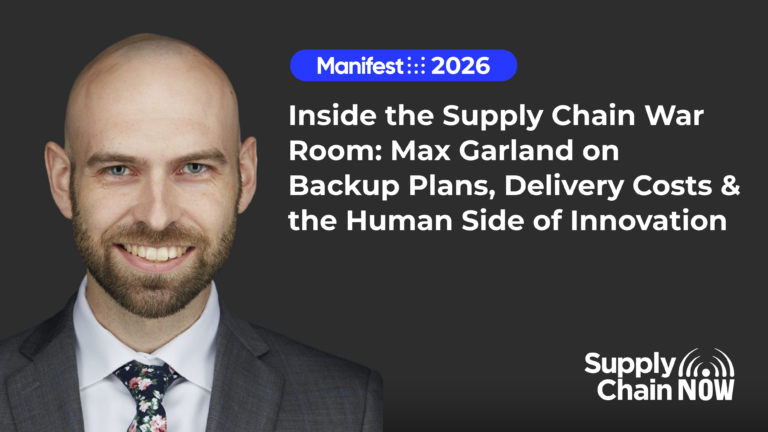
Inside the Supply Chain War Room: Max Garland on Backup Plans, Delivery Costs & the Human Side of Innovation
At Manifest 2026, Scott Luton shared a cup of coffee with Max Garland, Senior Reporter at Supply Chain Dive, an Informa TechTarget publication, for a boots-on-the-ground perspective from one of the industry’s most plugged-in observers.
Garland covers freight, logistics, retail fulfillment, and parcel delivery: the parts of the supply chain where strategy meets reality. And after a bruising 2025, he sees an industry that’s not just reacting anymore. It’s recalibrating.
From Plan B to Plan D
If 2025 had a theme, Garland says it was contingency planning.
“Last year was when a lot of companies were putting together those Plan B’s, Plan C’s, and Plan D’s,” he explained, pointing to tariff upheaval and shifting trade policy that forced leaders into constant reaction mode.
Companies prioritized flexibility: diversifying sourcing, adjusting procurement strategies, and preparing for fires wherever they might spark. In 2026, that flexibility remains. But the tone has shifted.
Now companies are “firming up their plans, fine-tuning, making sure those back-up plans are cost-effective as well.” It’s no longer just about avoiding disruption; it’s about operating efficiently within it.
In other words, supply chain leaders aren’t just jumping over candlesticks anymore (like Jack from the old nursery rhyme). They’re strengthening their footing and ability to make leaps and bounds, depending on the size of the flame.
Battle-Tested Leaders, Smarter Partnerships
Garland believes today’s supply chain professionals are better equipped than ever.
“These are battle-worn professionals,” he said. Leaders who have navigated multiple trade regimes, pandemic shocks, and policy pivots now have scars – – and experience.
They also appear more open.
Big companies are increasingly willing to partner with startups and new solution providers, something less common a decade or two ago. Whether accelerated by trade wars, pandemic pressure, or competitive intensity, the willingness to seek outside help has grown.
That openness is unlocking new innovation pathways across supply chain ecosystem everywhere.
Delivery Costs: The Pressure Point
If Garland had to put one challenge at the top of his short list, it would be delivery costs. Although his reporting focus may create just a tad bit of bias there.
Nevertheless, as companies try to offset tariff impacts and upstream volatility, they’re scrutinizing every line item cost. And last mile delivery is a big one.
Fuel prices fluctuate. Rural delivery expands. Same-day delivery expectations, amongst others, grow.
“You want good value and good pricing,” Garland said, “but you don’t want that at the expense of service.”
Consumer expectations aren’t retreating. Amazon’s massive same-day growth underscores that demand remains strong, especially in essentials like grocery and healthcare items.
The real question isn’t whether same-day matters. It’s where it makes sense.
Innovation: From Packaging to Partnerships
So how are companies responding? Garland points to both operational creativity and relationship management.
On the operational side:
- Rightsizing packaging
- Consolidating orders
- Encouraging customers to bundle shipments
- Using robotics to reduce fulfillment costs
These are practical, margin-protecting moves. But innovation isn’t just technological.
“Anything’s negotiable with these carriers,” Garland noted. Relationships still matter.
Carriers want the right volume mix. Shippers want cost control without sacrificing service. Transparent conversations about distribution center routing, lane optimization, and volume allocation can unlock savings without destabilizing service levels.
It’s not vendor versus shipper. It’s partnership.
Transparency as a Competitive Edge
One of the most promising trends Garland sees at Manifest 2026 is improved transparency between shippers and carriers.
New platforms are enabling better visibility, trust, and volume alignment. When both sides see the same data and understand mutual constraints, friction decreases. And in a margin-sensitive environment, friction is expensive.
The goal isn’t squeezing carriers for every penny; but rather, it’s aligning incentives so both parties win.
The War Room Effect
Perhaps the most powerful insight from Garland’s time at Manifest wasn’t about robots or drones, though he admits those are pretty cool and are hard to ignore.
It was the war room energy. In sessions, leaders walked through real-time decision frameworks:
- Do we move sourcing?
- Do we wait out this tariff?
- Do we shift suppliers or hold steady?
“You get to feel like you’re in the war room almost,” Garland said.
It’s that mix of tech demos alongside tactical strategy & frank discussions that makes Manifest unique.
You see the robots. You hear the negotiations. You feel the pressure. And you leave with perspective.
Tech Forward. Human Centered.
Garland’s view is balanced. Robotics, drones, and automation are clearly reshaping supply chains. But human relationships: between carriers and shippers, startups and enterprises, sourcing teams and partners – – they remain foundational.
The future may be more automated. But it’s still negotiated, strategized, and executed by people.
And according to one of the industry’s sharpest observers, that blend of tech and trust may be the defining story of 2026.
Where to Learn More
Connect with Max Garland here on LinkedIn. We invite you to check out Supply Chain Dive here, as well as the full family of Informa TechTarget publications here.
More Blogs
Your Supply Chain Isn’t Broken. Your Data Is.