Intro/Outro (00:02):
Welcome to Logistics With Purpose, presented by Vector Global Logistics in partnership with Supply Chain Now. We spotlight and celebrate organizations who are dedicated to creating a positive impact. Join us for this behind the scenes glimpse of the origin stories, change making progress and future plans of organizations who are actively making a difference. Our goal isn’t just to entertain you, but to inspire you to go out and change the world. And now here’s today’s episode of Logistics with Purpose.
Enrique Alvarez (00:35):
Good day. My name’s Enrique Alvarez and welcome everyone to another very exciting episode of Logistics With Purpose. We have amazing guests here today. I’m the co-founder and managing director at Vector Global Logistics and I really, really happy to be here with you, Christie, as always. How are you doing?
Kristi Porter (00:52):
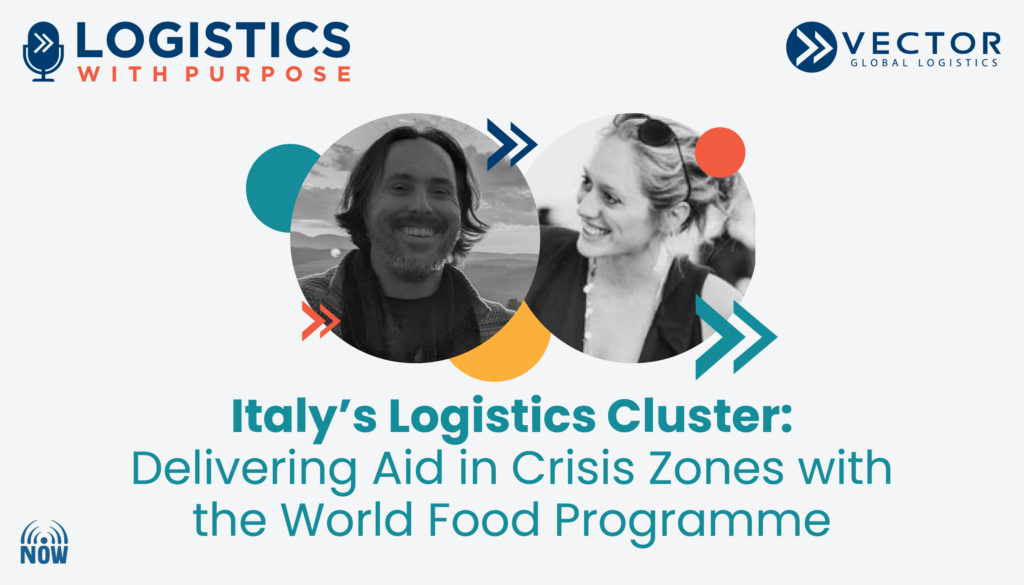
I’m good. We have been looking forward to this interview for a while. I feel like it’s also special when we get to actually meet our guests in person. The amazing thing about talking to people all over the world is talking to people all over the world, but when you actually get to meet them, it’s a totally different experience. So Noemi and I got to hang out a few months ago and I’m looking forward to learning more about Kelly and hearing his expertise as well, but we are delighted to introduce the World Food Program, one of the most respected NGOs in the world. I’m Christie Porter, Chief Impact Officer at Vector and delighted to bring this conversation for you today. So without further ado, let me introduce Noemi Penzieti. I hope I did not butcher that and Kelly Bradley. Thank you, Kelly, for having an easier name on me.
(01:37):
They are both from the logistics cluster, which is the platform led by the World Food Program that helps deliver lifesaving aid in some of the world’s most complex environments. So they’re both here from Rome. We’re grateful for their time, for their ability to join us. We’ve had to reschedule a couple of times because logistics and the world at large, and so here we are and we’re looking forward to a great conversation. So Noemi is the project and communications officer. She brings a very strong background in humanitarian advocacy, UN operations and global communications. And alongside her today is Kelly Bradley, the team lead for technical operations support, which with an extensive frontline experience responding to crises around the world, of which we have no shortage and look forward to hearing more and more about their expertise. So today we’re going to talk about both their strategic and field experiences and what humanitarian logistics looks like today.
(02:30):
It is an ever-evolving issue. So we’re delighted to have this conversation.
Enrique Alvarez (02:34):
Absolutely. And I’m very excited about having them as well. It’s always interesting to hear from the people that are really going into all those different parts of the world. They’re definitely making a possible impact. And of course, I would love to hear them tell us a little more about this story. So Noemi and Kelly, welcome. Welcome to the show. How are you doing today?
Noemi Pazienti (02:52):
Thank you very much, Enrique and Chris. It’s very nice to be here and thank you for hosting us in your podcast today. We’re very good considering the situation around the world. We’re busy, but we’re good. It is,
Enrique Alvarez (03:09):
Challenge. And we’ve have had a couple of challenging few years, I would say, around the world when it comes to natural disasters and human and other crises that we’re facing. But it’s always good to have companies and organizations like Years. Kelly, how are you doing today?
Kelly Bradley (03:24):
Good. And as you said, it has been a chaotic few years and it even has been a chaotic few months. I think we’re all just here in Rome happy to just be in town and looking forward to summer. So thanks for having us here.
Enrique Alvarez (03:35):
Thank you for joining.
Kristi Porter (03:36):
Absolutely. Well, let’s start a little bit, I guess first some background on the logistics cluster. So in case anyone has not heard of it yet, it was born in 2005 as the humanitarian reform process led by the United Nations Interagency Standing Committee and the World Food Program was designated as lead agency. Huge honor. And just even being appointed by the UN to lead this response already says a lot about you and your capability. So we talked about the last couple of years, which have been, I feel like since the pandemic, weve certainly seen a different just climate in the world, but the last two decades since 25 now entering the 26th year of the logistics cluster, you’re operating in places like Gaza, Lebanon, Crane, Burkina Fasa. Is there one moment or story or maybe even a statistic that really captures the power and capabilities of the cluster model?
(04:34):
Naomi, I’ll start with you and then Kelly, I’d love to hear your thoughts.
Noemi Pazienti (04:36):
Thank you, Christina. As you mentioned, the cluster was first activated in 2005. So 20 years ago we actually marked our anniversary and first activation for the Pakistan airquake last year. So now we’re over 20 years. And since then we’ve grown into this very diverse humanitarian logistics community of partners. So through the cluster, we really bring together a broad range of partners, including private sector, academia, international and national NGOs, donors, and they all bring to the cluster this very diverse expertise and operational capacity that’s really helping us in this very difficult context that you were just mentioning before. As you mentioned today, we’re working very challenging contexts where no single organization can deliver alone. This is why the logistic cluster and this coordination mechanism is very relevant in this specific context, including as you mentioned, Gaza, Sudan. We’re active in Lebanon in Ukraine and in total around another 14 logistics operation we’re currently activated.
(05:48):
But what still impressed me is really the power of this partnership. I think this is our strength and today we have reached over 1,000 partners that we are supporting across 53 countries. We provide them with logistic support, operational support. And my colleague, Kelly, can also give you more details about how we operate together in this context in specific crisis, including shared transport and storage, but also we provide support in terms of emergency preparedness activities. So we work together with local and national actors. In fact, now we have more than 47% of our partners who are actually national and local counterparts. And also we provide trainings and capacity building across these countries and environmental sustainability guidance that we also keep in mind during the emergency response, having in mind the future of our planet as well. So I think these numbers has really relevant I think and really struck me because it really gives you an idea of what we’ve been building together over these 20 years and the power of the community that we’re building to overcome all the logistic barriers in these emergency responses together.
Enrique Alvarez (07:07):
Wow. There’s a lot of moving parts, as you mentioned, and we’ll dive right into them and we’ll get a little more specific into the operations. I’m sure our audience being primarily supply chain driven, I would really like to better understand how you guys do what you do because it’s not only the partners, but it’s quite amazing that you reach so our places in such an efficient way. But before that, Kelly, maybe you can tell us a little more what is the actual mandate of this logistics cluster and how does that kind of differ from say any other logistics company around the world, like a freight rewarding company or something? What are the single organizational logistics fundamentals from what you do and including the role of the World Food Program?
Kelly Bradley (07:49):
Yeah, I think it’s important to use the word mandate there because we offer essentially what are considered mandated services, but we also have other categories under the mandate as well too. As Christie had pointed out, the interagency standing committee went back over 20 years now. We sort of established certain parameters of what we do. I guess the three top level would be considered coordination services, information management services, and when and where required is a service provider of last resort. I should say that I’m the most conversant in that third category because that’s my technical area of support, whereas some other units might be doing some other things. What this essentially comes down to is that when there’s an emergency of sufficient size, the logistics cluster is activated and there’s a whole series of steps that you have to go through to get there. I’m not going to explain all of them here, but when we are in fact activated and operating at the behest of national authorities and host governments, we are essentially meant to fill gaps through a variety of mechanisms.
(08:44):
So that means that if we understand that there is a precient gap, transportation and storage, customs and importation to provide that as a service to the community in one format or another. Again, this can get a little bit sort of technical and complicated, and so I don’t want to weigh it down, but for example, if we go into a situation and we realize there’s an existing commercial sector, it’s not our job to replace the commercial sector. We don’t want to put locals out of business. In fact, we may even be hiring them to help us support in one way or another, but what we’re really doing here is trying to find out where we can plug in and help in that way. If there is a problem with customs and importation, we can help organize that through meetings. We can actually share guidance documents. If there is a gap in storage in a remote location, we can establish that storage.
(09:26):
It goes much further beyond that. And unfortunately, I think Noemi has more information than I do on those points, so I would hand over to her.
Enrique Alvarez (09:32):
No, thank you. Thank you so much. I had a question for you, Kelly, before we move on to Noemi. And of course, Naomi, if you can tell us a little bit more about this mandate. So you mentioned it gets activated. Is it all reporting up to the UN council? I mean, who activates a new, I guess, project for you and your team?
Kelly Bradley (09:49):
Hyper-specific question and I don’t want to bore your audience to death, but in a situation in which there is an emergency, there is something in a country, a prior existing infrastructure of UN agencies that can make a determination that said, “Hey, we are now an uncharted territory or now we are in a period of unprecedented need.” They collectively have to choose to request the activation. WFP as lead agency has to basically say, “Hey, we’re here and we can do this thing.” And ultimately there has to be a letter that’s issued to a much higher authority in Geneva. Again, there’s plenty of information online if you-
Enrique Alvarez (10:22):
Very, very political, right? I mean, you have to follow the right … Well, it’s delicate, right? I mean, you want to do everything with the right kind of processes to make sure that you are very political and to make sure that you do actually end up helping people as opposed to pissing them off like something- Yeah,
Kelly Bradley (10:38):
Absolutely. We are a neutral organization. We are not meant to make anyone angry. But also when we’re activated, we actually have certain obligations as well too. And we can talk about that a little bit later on, but we have to report, we have to provide services in a certain way. We’re not allowed to say no and that’s sort of the power and the strength of where we are.
Enrique Alvarez (10:56):
Thank you. Noemi, do you want to add something to that regarding the very general for as we get into the details on the operations, how does the cluster repair from a single organization’s logistics operate?
Noemi Pazienti (11:08):
I think as Kelly was mentioning, our mandate is very simple and difficult to explain at the same time because basically what we are doing is really to ensure that logistic does not become a barrier to monetarian assistance. We keep basically monitor and assistant moving by coordinating the services that Kelly was mentioning that the common storage for humanitarian cargo, the transport, the interagency transports, this is what make the difference. Numonetarian coordination mechanism, we’re not a single monetarian organization delivering aid, meaning that when the cluster is activated, we’re really a platform that enables the other humanitarian actors involved in the response to actually make sure that the response is actually implemented now in a more efficient, timely and costly manner. And as you mentioned in terms of accountability, as Christie was mentioning also before we have the Workforce program is the United Nation Lead Agency, meaning that really has the role to making the system accountable and providing logistic support as last resort.
(12:18):
So the goal is not to replace, as Kelly was mentioning, not the existing logistics providers or compete with the commercial sector, but provide alternative emergency solution where no other organization are able or willing to provide it in a specific context.
Kristi Porter (12:35):
Fabulous. Well, when I hear activated, I think more of the bad signal. So now I know it’s a letter that
Enrique Alvarez (12:40):
Gets to- Red phone.
Kristi Porter (12:41):
The red flag.
Enrique Alvarez (12:42):
Signal or red phone straight to Kelly. Yeah.
Kristi Porter (12:45):
So it’s a very official letter. Yes. Amazing. Well, let’s look at a couple of your projects and initiatives more closely. I’d love to start with Burkina Faso, which doesn’t get a lot of, at least here in the US, a lot of airtime on the news, but there’s always something going on there as well. And then for that initiative, you started leaning on the private sector to deliver support when the humanitarian aid didn’t have the means to reach such remote areas on its own. Definitely I feel like those kinds of partnerships, I’m hearing more and more at humanitarian aid in conversations and conferences wanting to hear more of those happening, wanting to see more of that as a future of humanitarian logistics, but clearly you’re again leading the way on this. So can you tell us a little bit more about how that came together and what the private sector brought to the table?
Noemi Pazienti (13:34):
As we were mentioning, I mean, as logistic cluster, we’re really a diverse group of partners. So the private sector is very important, is key for our work. The partnership that we have initiated with different companies over the year, what we’re trying to do as logistic cluster is really work with the private sector to bridge a gap between those who have resources and those who lack the most. We have initiated a different partnership, one in 2005 with the logistics emergency team through the World Economic Forum and the logistics emergency team members are four global logistics leader. Some of them are very well known. So it’s agility, UPS, Mars, and DP Award. And in 2021, we also initiated another partnership with the Airbus Foundation. And through this partnership, we are really making sure that partners during the emergency response can really access the asset and the expertise that the private sector can bring to the humanitarian responses.
(14:33):
So what we are doing, we’re basically, as I was saying at the beginning, bridging a gap and making sure that the humanitarian community can easily communicate and talk and access to these resources that the private sector have. And as you mentioned, Christie, there’s some concrete example we can bring in terms of the impact and the support that the private sector is bringing to the table to the monitor and response through this partnership. For example, in the first quarter of 2026, we had also another example is the mods and big flows, both the logistics emergency teams stepping in order to provide safe storage for partners during the response and also the Airbus Foundation in Modzambique provided supported with 65 rotation of helicopter. So basically thanks to that, they had really help loading over 39 kilo for Monetarian aid and supporting in terms of reach and impact 5,000 families.
(15:34):
So these really supported remote areas that were also not accessible. For example, in the case of Bufkina Faso for over six months, really reopening schools, the canteen of the schools and also health centers in this remote areas. So together, for example, in Burkina Faso, we managed throughout 23 organization and 80% of them were national and local, so very close to the communities we have reached. This is really, I think for us, the power that you were mentioning before of this public private sector collaboration in monetary and logistics, because as I was saying, we really make sure that these assets are really available for the entire humanitarian community.
Kristi Porter (16:16):
And then Kelly, from your perspective and for our commercial supply chain professionals listening in, what does a meaningful partnership with the humanitarian sector look like in action? How do you always ensure that everybody is getting exactly what they need and want? Sometimes companies want to offer something that may actually not be a need at the time. And so that’s also a bit of a delicate dance. And what do those strongest partnerships look like and how should partnerships approach it?
Kelly Bradley (16:43):
I think you actually said it perfectly well. It’s identifying what is required. So Lumi mentioned we have the LET, but there are actually other commercial entities that we have varying degrees of relationships with. Some are squarely focused on supporting logistics cluster and logistics cluster partners. Others are actually for WFP writ large that we can tap into. The important part is that when we call forward these services, we have to have a clear idea of what we’re going to do, what we need and then how that agency can support us in one format or another, whether it be air delivery or establishing a storage location, you are very correct when you said that somebody might want to offer something. They have unused storage space on the back of an aircraft going somewhere. They might have storage locations and we say, okay, but this isn’t a part of the country that there’s already commercial operations that we don’t necessarily want to take away that business from other people.
(17:34):
Are you willing to operate in a location that might be potentially insecure or that is completely unprofitable or something? And essentially how we have come to this relationship with these partners is they are very good at understanding that relationship. They’re very good at extending themselves where they can and when they can’t provide it, they simply say no. But what they’re not doing is they’re not just trying to force what’s available rather. They’re actually very good at adapting to us and it took a lot of back and forth between us, but it’s actually been phenomenal.
Enrique Alvarez (18:01):
I mean, it’s amazing and it sounds very straightforward when it comes to the way you’re explaining it, but it’s hard. It’s hard to do this at our world stage and of course striking these partnerships and really reacting in time, it’s kind of what’s really needed. And so you guys do a very, very good job on that. But Kelly, I kind of heard you say trust, communication being open, really listening. I mean, it’s building this trustworthy relationships with people. Is it a big, important part of your job building this relationships?
Kelly Bradley (18:35):
I mean, if I’m honest, an important part of my job is ensuring the machinery moves smoothly. That being said, yeah, we have a lot of overlap with these commercial entities all the time and very frequently, I mean, they’re companies that we traditionally have regular contractual relationships with, but under certain situations they’re willing to offer free services. Again, it just depends on the nature of the emergency and the relationship with that partner. We have to be able to live up to what we have said we’re going to do. We cannot have junk showing up at a warehouse or things being packaged poorly, but at the same time, we rely on them to say, “Hey, this is not a perfect scenario. There is going to be chaos. Things are not going to make sense and so we need you to be adaptable to us.” And honestly, working with ground operators, people who run the facilities, people who maybe regional managers, those are the ones that really get it and those are the ones that I have been able to develop the best relationship with, but we have communication at every stage of management in this organization.
Enrique Alvarez (19:29):
Makes sense. You both were on the ground during the Lebanon activation in October 2024. I’ll start with you, Kelly, this time, but you were leading the operations, you were setting up a new warehouse capacity in Beirut and you were coordinating interagency convoys into active conflict areas for most of us that really don’t have a clue of what all that really, really means when it comes to the experience that it entails. Could you try to take us inside those first weeks inside of Beirut and what you were doing where you were seeing how do you feel and live through those initial steps in such a horrible crisis?
Kelly Bradley (20:07):
Well, one, I don’t know if we can talk about how we feel and live. I mean, it is actually a problem for the people who are living there now. I think it’s safe to say that we’re committing ourselves to support them first before we concern about, I guess, our feeling on this. But I would say this, Lebanon is a good example and it’s sort of the new normal that we’re encountering. It’s a country with very high capacity in many ways. There was already a prior existing commercial infrastructure that was very robust. There was also a very good national coordination mechanism between the municipalities and the federal government. They actually had a lot of disaster response capacity on their own. So when we show up for what we typically do in almost every situation is that we launch a survey, we talk to the community, we figure out what is happening.
(20:50):
Is there a problem? Do you need us to support in one way, do you’re not able to solve yourself? So in this specific instance, a lot of partners, a lot of humanitarian organizations were already there way in advance. Now they already had pipelines established for procurement, but the problem was is that they could no longer reach some of the inaccessible locations predominantly in the south, south of the Latonia River, but not exclusively. In addition to that, they had had very streamlined sort of operations where they could just procure something and go right to the point of distribution. They didn’t really have a holding mechanism or decoupling mechanism in between. So suddenly there’s an emergency, their pipeline breaks, they have no place to put anything. The way that I generally refer to us to people who are not really familiar is that we’re the equivalent of, I guess, a humanitarian DHL.
(21:33):
In so far as stuff comes to us, we convey a parcel for somebody else and then we ultimately return it back to the owner. We could be doing advanced things like kidding and palletization, but we don’t always. And sometimes we don’t always have the most information. We just know, “Oh, there’s an emergency. Here’s my stuff. Take it. ” And so we have to make a calculated decision of how we’re going to do it, how we’re going to get it to where it needs to be. In the case of Lebanon, so WFP, it’s actually not a nonprofit. It’s an intergovernmental organization by definition because it’s an organ of the United Nations. We have really good standing. We have the ability to communicate with both sides to the party of the conflict. We can deal with national authorities and local authorities incredibly well and we are neutral and we’re trusted because of that.
(22:14):
So in this specific scenario, one, we were able to identify a commercial warehouse relatively modest capacity. It was up to 2000 pilot positions that we could immediately say, “Hey, humanitarian community, if you have no place to put your stuff, just bring it into our possession and we’ll hold onto it for the time being.” That was actually through the commercial partnerships and it was phenomenal. We had it in four days. All we had to do was pick up the phone and call and say, “Who’s willing to donate this to us?” And sure enough, we had it in our possession. But the big thing and the huge value added that the logistics cluster could do is that we could use our sort of United Nation status and our neutrality to negotiate what’s called a deconflicted convoy to the south, meaning that we can radio head to everyone and say, our vehicles are going in this direction on this day.
(22:56):
We’re going to be there. Just be aware that we would like to have safe passage. And believe it or not, I mean, it takes some back and forth and they have to coordinate amongst each other, but they will actually tell us exactly, “Here’s the route that you’re going to take and here’s the timeframe in which you can offload safely.” And that gives us, I guess, a leg up, an advantage in a way that other parties that cannot … Even large traditional organizations that would normally operate there didn’t necessarily have that sort of access. And so that’s the good stuff. Great. We awesome. We get these vehicles, we load them, we put WFP and UN logos on the outside so everyone’s aware of what’s going on, but that’s sort of where the complexity comes in. We had extremely tight windows. Oftentimes we had two hours or less to offload what would be up to 20 vehicles.
(23:38):
Usually the delivery locations were heavily impacted. Sometimes there was rubble, sometimes there was bombs falling around. So we would have to literally scope them with satellite imagery. We’d have to find somebody locally and have them walk around with a phone and say, “What is clearing? Where can we put the trucks?” We had to run with our own MHE, the handling equipment. So we actually had to have forklifts in tow behind us that could actually offload the vehicles in real time as we went. And we had very, very tight deadlines. We were able to move safely, but there would be eventually some point that they would say, “After 2:00 PM, there’s no guaranteed safety. And so if you’re not done, you have to just drop and get out of there as fast as possible.” Luckily in that time we didn’t really have any major incidents and luckily we were actually able to hit most of our targets.
(24:20):
It’s not a good expression, not targets. We were able to administer our time windows in the way that was appropriate, but it was also extremely complex. Little things like partners delivering pallets. Well, is the pallet properly braced? Is it wrapped? If it falls apart when it’s in transit, it’s slumping in the truck. Suddenly it has to be offloaded by hand. Guess what? You just added 15 minutes to the offloading process. So really having to educate them on how to deliver things to the warehouse, really educating the warehouse to say this has to be triple-wrapped. It cannot go beyond certain dimensions. Having to prep the forklift drivers once we got there, thinking out how the game plan is going to work. It ended up being a significant amount of work for ultimately, I’m not going to say it was a small amount of output. It was still very large, but just the amount of attention to detail you had to pay versus if you just paid a company and said, “Hey, drop it off at my warehouse,” nobody would think twice about it.
(25:08):
So it was kind of going through every step of the process.
Enrique Alvarez (25:11):
No, I mean, it sounds dangerous too. So on top of everything that you’re describing and how logistically is working, so I wanted to just get your reaction on it, Noemi, and you were there as well. There is a big component that you probably are being too humble to mention, but people are risking their lives to help each other. It sounds like you’re going to rubble and bombs are falling. And why? What drives you guys to be so amazing and why are you doing what you’re doing? And I’m guessing what else can you share from that kind of Lebanon experience with our audience, Noemi?
Noemi Pazienti (25:45):
I think we’re just professionals. For us, it’s really when I think about ourself as professionals of the United sectors, we don’t really feel special. I think people who we are serving and other organization are also responding to this crisis are special because I think you need a lot of strength when you find yourself in this difficult situation. As you mentioned, and also Kellino was kind of explaining all the technical aspects behind the response. So we really need to make sure that we follow standards, we’re professional, we reduce the risk, we use the resources properly in order to really make the response not efficient for the people we serve. So I think one additional aspects that I can bring to the Lebanon response with Kelly and other colleagues who have been deployed for the activation of the cluster back was October 2024. It’s really also the importance nine hour mandate to make sure that when there are these onset emergencies and there is a lot of chaos around, as Kelly was mentioning, there were already many organization working in country with a lot of experience about the country and the resources that were available was really important and critical to bring all these people around the table and make sure that we were not duplicating efforts.
(27:07):
We are not coming into the country to increase the confusion and the cost, but you really need to make sure that you start mapping as Kelly was mentioning, what are the routes, where we can go, who is already there, who’s doing what, what are the resources available and starting the plan from there. So this is really how we started the setup and all the operational information management at the beginning is really key in our mandate and all the coordination meetings that are also very important not to start mapping out who is part of the response, who has the capacity and how we can also mutualize not these resources in terms of efficiency. So I think it went very fast. I think the first weeks are very fast during the response.
Enrique Alvarez (27:55):
So what you mentioned and what you both described, it’s like a setup where you need to coordinate with a lot of different partners and a lot of different organizations that may or may not have been there already before you. Is everyone, I’m guessing, under the same mentality, same mindset, everyone’s really trying to openly talk to each other, collaborate. I mean, it must be a very, very good team effort and all the organizations and partners and people trying to do this must be very well aligned in trying to achieve and accomplish the goal, right? Does it feel that way? Does it feel like we’re all in this together, everyone’s so open, everyone’s helpful, everyone’s trying to proactively support each other?
Noemi Pazienti (28:32):
I think this is a very key aspect, especially for the response in Lebanon where actually a logistics working group was already in place and this for us really makes the difference when we are activated. As you mentioned, if there is already at country level, there’s a working group in place or a coordination mechanism, national level already in place, it’s very helpful. We really saw the difference because you already have many information available that you don’t have if there was not a national coordination mechanism in place. So it’s very important enough for the scale up of the response at the beginning to make sure that you, as you mentioned, now you kind of capitalize what is already in country and the actual coordination mechanism. So Lebanon for this was a very great example of how the setup was faster compared to other responses because of the logistic working group.
Kristi Porter (29:26):
Fantastic. The collaboration I feel like is another topic that has come up a lot in conversations and of course that is a prime example. We’ve talked about some difficult areas including logistics cluster has also worked in Gaza, Egypt, Cyprus, Jordan. We just talked about Lebanon and Burkina Faso. So in areas where there may be an ongoing disaster or still very soon aftermath, could be war, could be rebel bombs, everything that we just discussed, do you have to redefine in what success may look like? Do you have often plans … Going in that have to be pivoted and adjusted and they don’t look exactly like they did before. And so success looks different. Will you tell us either one of you about your perspective on just the goals and how to define success or how you take that approach?
Kelly Bradley (30:14):
Yeah, I can. The success specifically I think has to be measured as a yardstick against what the goal is. And I think this is going to come up probably over and over again in the conversation, the conversations we’re going to have that every context is very different and sometimes you think you go in with a plan and then something else is just going to be completely changed along the way. The example that I sort of was going to give was that of Palestine. And if I were to measure success there, I would say, okay, it’s fundamentally what is the most amount of goods that get into the hands of people who needs it? And I think that commercially and even the NGO sector between donors, sometimes we become obsessed with KPIs or metrics. We like this information on our supply chain. If you look at a situation like Palestine, there was essentially a de facto communications collapse that early stage once the conflict really ramped up anyways, we basically had no idea what was going on.
(31:07):
We couldn’t really get proper demand signals. And mind you, the logistics cluster, we don’t run our own cargo. We are supporting the community, so we just know talking to everyone else that they didn’t know necessarily what was going on. And even at that point, the only point of border crossing was into Rafa on the Gaza side was actually coming from Egypt and it was the only one that was open for the humanitarian corridor. And I think I remember us calculating just based on reviewing the way bills that it took an estimated 21 days for things to get from Alarish in Egypt to the Rafa border crossing. 21 days, that is 40 kilometers or 25 miles for our US audience. And that’s because there was such a huge backlog of trucks that nobody … It was impossible to actually everything get in. There was scanning, there was crossloading, there was actually the inavailability of trucks inside of Palestine to move them onwards.
(31:54):
In addition to that, the partners, they didn’t know. What would leave first wouldn’t necessarily arrive first, it could arrive third. As things were being crossloaded, the chassis didn’t match. You’d go from a large truck to a medium size one, and so cargo was getting intermixed. Our partners just literally couldn’t necessarily anticipate what was going on. So in that specific scenario, that was the first time we actually rolled out a QR code labeling thing where partners could actually pre-register their cargo with us and then we could just put a label and put it right on the side of the pallet. And then once we crossed over and I was with the initial team and there was a few of us went and identified the storage locations inside of the Gaza Strip and we actually hired people to pretty much man the border. And then we also were working with local companies internally so that when those trucks would show up, even without internet whatsoever, you could visually see this belongs to that partner.
(32:41):
With the phone, you could actually scan it and we could get a little bit more information. We would have phone numbers, we would have emails and that we could actually contact that individual and say, “What do you want us to do with this? Do you want to leave it here and you come get it? We can deliver it to your location. We can put it in storage.” And that was really extremely complex in the early days. We were having to do everything with pen and paper plus a QR code, but everything fundamentally returned to an offline process in a way that we didn’t think that we would ever have to do again and yet here we are in 2025, 2026 still doing that.
Enrique Alvarez (33:10):
That’s incredible.
Kristi Porter (33:11):
Yeah, really. Thank you for explaining that process. These are long days. They’re difficult days. I’m curious also what helps you get through just especially when you’re on the ground. And I would assume to a certain extent even just working remotely from your offices and things, but in those situations, what are some of the things that get you through personally, just those difficult situations?
Noemi Pazienti (33:32):
I think for me in my case is to see that the impact that we can make if we move forward. We know it’s difficult when you choose this job is always, as we say, not the initial setup, the initial onset emergency, it’s really working around the clock, but you know that the final objective is really to help the monetary and community, to enable the monitoring community to save lives at the end, to really bring cargo where it’s needed. So I think this is really what keep the motivation high in terms of extra working hour and you really don’t feel them. I mean, you feel them, but it’s not your priority to feel them. So I think this, at least for me on a more professional level, it’s something that I see also working with many different teams, especially the teams based in the country where the sudden onset emergency is happening, really the one affected to really help them and make sure that even when we work remotely from HQ at the beginning before the deployment, we can really ease a bit their workload.
(34:39):
I think we all make sure that we do our best from our different capacities and technical expertise to ensure that the process goes smoothly as much as we can.
Kristi Porter (34:54):
Yeah. And what about you, Kelly?
Kelly Bradley (34:55):
I once heard someone say in an emergency like that when you show up, that may very well be the worst day of that person’s life. And so I just like to think that always remind myself that there’s someone, another human at the end of that supply chain and no matter how stressed out you are or how inconvenient you are, I can still get on a plane and go home at some point. I can still see my family. I can still return to a normal life when this might just be the future for whomever it is that we’re attempting to serve. So those long days, I mean, yeah, you just think to yourself, you probably should keep going. Now, I’m going to caveat this by saying that nobody is a superhero and that people do get burnt out and people need to know when it’s time to pack it in.
(35:36):
But when you’re there, you can put on a professional face and just hope that you can do the best.
Enrique Alvarez (35:40):
Thank you. Thank you both for what you do. I just want to be very straightforward and clear and open about this. You’re amazing and maybe you don’t feel like superheroes and that’s probably the superhero posture to have. But no, I’m pretty sure that all over the world, you and your teams and all the other organizations and people that are truly going into those conflict areas and those natural disasters early on and trying to help, they’re pretty inspiring. So thank you so much for what you do. I’m sure our audience is delighted with this conversation and I just want to make sure that you know that you are an inspiration for most of us. 20 years is what you said for the logistics cluster and you’ve gone in through all this complex and critical regions and I’m sure you’ve seen very, very unique environments. You have experienced very, very unique things in each one of these different regions of the world.
(36:33):
What is the one thing or the lesson that you have learned the hard way? One thing that is common in all these different circumstances that you have learned kind of the hard way.
Kelly Bradley (36:43):
Well, I think the commonality is that there is no commonality. If I can just reply to that, is that there’s no such thing as a- That’s a
Enrique Alvarez (36:50):
Good way of going around the question a little bit.
Kelly Bradley (36:53):
No, I think it’s actually a direct response. There is no such thing as a single one size fits all solution. And if you approach the problem on autopilot, you’re bound to fail.
Enrique Alvarez (37:02):
So what have you learned the hard way after all these different unique situations? What is one of the things you’re like, “Yeah, this is something I
Kelly Bradley (37:09):
… ” Details matter, which I was going to say, I drive my team saying that in that when you walk into a situation, you have to really approach it with eyes open. The examples I always give is that you can have something like Ukraine where it’s like basically right on the EU’s doorstep. It’s a high commercial infrastructure inside of the country. So just going and finding someone to provide a service for you, it’s actually quite easy. But being in the EU, you also run into complexities. High regulatory environments, partners were trying to transit in pharmaceuticals into Ukraine or ballistics rated dual use items or something and that is highly restricted inside of EU territory. So you can get a warehouse, but the warehouse can’t necessarily do the thing that you want to do for cross-border activities. Contrast that with, say, the Ebola response when you show up and we’re expected to essentially clear cut parts of the jungle and build warehouse infrastructure out of mobile tents because there is literally nothing.
(38:00):
And then you’re also confronted with these really complicated medical equipment and devices that you don’t normally deal with like Tyvek and Taichem or these reagent chemicals and things that humanitarians typically don’t do. If you don’t ask the right questions, if you don’t pay attention and you just assume that you know what’s going on, you’re going to have that problem. I sometimes joke about it saying it’s second mission syndrome because you go through one emergency and you figure things out and then you say, “Ah, got it. Next time I go to an emergency, we’ll just do it the same way.” And then you just get knocked on your butt because everything is completely new.
Enrique Alvarez (38:32):
Wow. Well, those are incredibly practical things and I appreciate that you actually brought them up and for everyone listening and just to summarize them, I heard you say details matter, pay attention, pay attention and do not assume anything. This is very critical for logistics and I’m sure it is even more so for the type of logistics that you guys perform. Noemi, anything that you have learned the hard way?
Noemi Pazienti (38:54):
I think many things because as Kelly was mentioning, when you’re exposed to so many different contexts with different stories, different peoples, different team members, I think it’s true. I mean, adaptability, flexibility, it’s really something you have to learn and you learn it at the beginning and down the hard way. It’s really like you arrive to a second or third deployment thinking that now you’re kind of used to what to expect and no absolutely not. This is something you have to every time learn again from scratch with the people around you with the context surrounding you and really make sure that you get the right needs and the right response for whatever is happening.
Kristi Porter (39:41):
I also want to talk about … No, I mean, I can’t let us go without talking about the time we spent together in Rome. I loved my afternoon with you. Well, it started as morning coffee, then it turned into lunch and then a little later after lunch. And so we had a great time chatting and getting to know each other. And so I appreciate all the time you spent with me. And of course, we talked a lot about marketing and communications, both having a background in that. I loved some of the practical takeaways that you talked about when we were together and I’d love for our audience to hear those. The difficulty I think of situations like these is you have such a breadth of stakeholders. As we discussed, you have reporting mechanisms, you have people who may be paying or donating services, you have your logistics partners, your humanitarian partners.
(40:25):
There’s a lot of people who have a lot at stake and a lot of people who want to know what’s going on. So I’d love for you to share a little bit more about that, what you do for your different audiences and how you approach them.
Noemi Pazienti (40:37):
Thank you, Christie. It was also my pleasure to meet you, by the way, Rome. It was very fun and nice to have you here and have the chance to meet you in person. No, absolutely. I think I want to start here now with also what we discuss in terms of a bit of misconception when we talk about our sector. I think this is very important now when you manage communication with donors, with our partners, it’s very important to make our message clear to really make sure that the audience is, because it can be very technical as we know. So make sure that it’s actually we ensure that we elaborate all the data, all the complexities, all the technical aspect in an easy wording, an easy narrative that can be accessible to all our audience. Because at the end, what we want is really to communicate the impact that we have.
(41:29):
Because I think Enrique, you also mentioned at the beginning, something related more about accountability, what you guys are doing in terms of transparency reporting. I think this is a very important aspect of our work. And so of course it needs to be reflected also in our communication in different channels now from social media to official communication to operational information sharing. So of course we have a very different range of products that we have to produce both in countries and at global level. So we really need to, as we discuss in Rome, not to match the audience in order to really make sure that the message arrive very, very clear. For what concern of monetary and logistics, what I can say is that on misconception that we have been working around it and try to really to clarify is that logistics is not just about transport, trucks or storage warehouses is really the backbone of every emergencies.
(42:30):
So basically with the logistic assistance can flows also across border, without it, lifesaving assistance might not reach people in need. So this is a very important message and a critical message for people to understand that logistic is really behind every emergency response. It might sound a bit technical, but this is actually really what’s keep the aid moving. So I think at the end of the day is really to make the different audience, as you mentioned, Christie, with different products. And I think in Rome, we had more time to also go into the different products for the website, information you can make and social media, the new also type of formats that now with social media we can also use in terms of live interviews now with your podcast is also a way not to go a bit inside these very technical aspects of humanitarian response.
(43:24):
So I think there are very different possibilities, but I think one of the important thing is also to focus on the complementarity. I think Enrique, you were asking us now what’s the difference between the cluster and one single organization delivering aid. I think it’s very important also in terms of communication to highlight the differences complementarity. Everyone is working this very complex and interconnected monetary environment. So I think for each organization and for us as well, it’s important to be clear on what’s our added value for partners, for donors, for the different audience. So what make us basically unique where the expertise and how we can work with others to avoid duplication of efforts in audience, make the system more efficient.
Enrique Alvarez (44:17):
Absolutely. Well, we talked a lot about the logistics cluster. We talked about some of the different activations and projects that you have worked on, but I’m pretty sure our audience would love to get to know you guys a little bit better and a little bit more personally. So before we go, Naomi, I would love to talk a little bit more with you about your personal life and then of course Christie will do the same with Kelly. You started with internships at the International Criminal Corps in Lehag and the UN Sub-Saharan African office in New York. Then you went on to work for the United Nations in Haiti as a strategic and analyst and gender affairs officer, then UNICEF in Niger, Saved the Children in Italy. And now of course you’re the logistics cluster in Rome. Where does this passion for humanitarian work come from? Tell us a little bit more about you.
Noemi Pazienti (45:03):
Wow, thanks for reminding me of this experience.
Enrique Alvarez (45:06):
Well, I’m sure a lot of people out there listening to this and wanting to learn how can they do something similar if they need to?
Noemi Pazienti (45:15):
Absolutely. And I’m always willing to support young people who wants to enter in the sector because I know that at the beginning it seems very far away, very complex and very difficult. I always want to keep my door open to everyone, as you mentioned, is interested into this sector. I think for me it was always the curiosity to see how lives work around the world now in different countries, maybe because I’m half French and half Italian, so I was always a bit in the middle. So I was always curious to learn even more about other countries and other people. So I think that the traveling side is also part of our work. And I think when you start traveling, you also start understanding that there are issues everywhere that you can maybe really support communities wherever you go with different projects, it doesn’t have to be at … I mean, you can choose at which level can be at community level.
(46:14):
You can have a lot of impact in whatever organization you work with. I had the opportunity to work with many different organizations from international NGOs, with the United Nations system, also with the private sector. And I think that it’s very important to also understand different approaches and make sure not that you learn a bit from every organization and you can bring around that value. What I was mentioning also before the complementarity, the adaptability. I think it’s very important in our work.
Enrique Alvarez (46:47):
Thank you. I just had two questions for you that kind of follow up. The first one is, do you have any particular story that you remember when you were younger that kind of helped you shape this mindset of exploring the world and then helping each other and going around? Is there something that kind of drove you to do what you ended up doing? Is there someone that maybe a mentor or a teacher that kind of helped you shape the person that you are now?
Noemi Pazienti (47:11):
Oof, many people. No, let me start. No, I think personally, yes, as I was mentioning, I think my French grandmother was always kind of my mentor when it was too hot in Italy and I wanted to escape. I think France was my first destination. So I think that’s something that I will always remember. But in terms of, I mean, more professionally speaking, I think my first deployment was in Laos with an NGO and I think really there I understood that that was the type of work I wanted to do. So really working with the community at the time was a food security project for women in remote areas in Laos. And I learned a lot from the organization, from the communities, from the team. And I think for me that was the, I think not for the experience that made it exactly.
Enrique Alvarez (48:01):
Thank you so much for sharing this personal stories. For people that want to do something similar, is there one piece of advice so you can give them one call of action? What should they be thinking of? What should they be trying? What should they do?
Noemi Pazienti (48:16):
From my side, I would say the curiosity is very important. I think if you have the curiosity to really understand what you’re reading, what’s happening, to reach out, to connect with people to the organization or working in a specific context or response. I think this is always helping you understanding what’s the right path for you, what’s the right organization because we also have very different mandates. So also understand now where you can bring your added value as a professional.
Kristi Porter (48:46):
Curiosity can take you a long way. Kelly, what about you? We’ve talked about you’ve been on the ground and helping in situations from Ebola response to Liberia, Ukraine, Gaza, it’s Turkey, earthquake, and you’re currently leading all the systems behind those complex operations. So I guess first question is, how did you find your way into this work?
Kelly Bradley (49:05):
Actually, the first job I ever had outside of the week and a half, I worked in a bagel store and could not stand getting up at 4:00 AM to go open the shop. I actually was unloading shelves in a distribution center in my hometown. And by the time I was 18, I was driving a forklift and offloading trucks. And I kind of maintained that job even through university. I thought I had a very different vision because I mean, nobody knows about this type of thing where I’m from. I’m from a little tiny corner of the United States. I actually had a degree in anthropology and conflict studies. And when I graduated university, I was working for a domestic violence center that was funded by the state of California that did some community disaster relief efforts and they did homeless support. And I think that’s when it just kind of clicked where I said, wait a minute, I have all these practical skills that it can be applied in a way that’s relatively meaningful.
(49:52):
And so I started interning and volunteering. And I went back to school and I got a master’s degree in humanitarian operations managements and I just kind of have continued to advance from there. Now when I think about it, I’ve been doing humanitarian logistics for 18 years and of those 18 years, 13 of which are involved in the rapid emergency sides, which it’s been a wild ride and I wouldn’t trade it for anything, but it’s definitely has taken me more than I think 50 or 60 countries by this point I’ve had to work in in one part or another. Things are slowing down now, but before it was like you didn’t know what country you were going to go to sleep in that day if you were on the roster because something would happen and then you would just get the call and you’d be out the door.
Kristi Porter (50:31):
Which brings me to my second question. That’s an excellent lead in for it. What have you learned in the works that you’ve done?
Kelly Bradley (50:37):
What I think is just perspective and perseverance. And you have to realize sometimes when you’re walking into these situations, you are just a little tiny part of a huge thing that’s happening around you. Sometimes it’s just a gigantic disaster of global proportions that you won’t even really realize until years later looking back. So one, just know that you’re there to help, but you’re not going to fix everything and also you may not be helping at all. You might actually be part of the problem. So try to find out where you can plug in. And then secondly, I think it’s what I was getting at before is that sometimes you may feel completely overwhelmed, but just imagine how that other person feels. So you can continue for as long as you can and then you can pack it up and go home. And that’s a super advantage that we have that a lot of other people don’t.
(51:21):
So do what you can when you can where you can do it.
Kristi Porter (51:24):
Love that. Thank you. I love it.
Enrique Alvarez (51:25):
Yeah, thank you both. As we wrap up, I would like to ask you, what does the phrase logistics with purpose mean to you? And I’ll start with you, Kelly, and then to you, Naomi, logistics with purpose.
Kelly Bradley (51:36):
Ultimately, it’s that knowing that what I am doing is going to have at least a net outcome that is positive and trying to maximize what I’m doing with logistics as a tool. I mean, I’m a logistician. I love supply chain and logistics. In fact, I’m a huge nerd. People who know me know that sometimes I talk too much about it. In fact, I think I have more photos of warehouses than I do my own family and that’s all good. That’s fine. But as long as you can take that and then turn it into an actionable tool that actually is making at least the world a slightly better place than how it was when you first got there, that’s the best that I can hope for.
Noemi Pazienti (52:12):
For me logistic with purpose, it’s really … And thanks to Kelly because I’ve learned a lot about logistics from Kelly. So thanks for being nerd. But for me, it’s where the real magic begins because what I’ve experienced is really that’s what we are discussing. When there is a purpose in logistics, you’re basically moving goods, delivering humanitarian aids, you really ensure that our systems, services, communities are connected together. So I would say it’s really the magic happening.
Enrique Alvarez (52:43):
Thank you both again. I know I’ve said this before and I’ll say it again. What you do is really changing the lives of a lot of people. So you’re putting it in your terms, Kelly, I think the net positive impact is very, very … I mean, the net impact in what you guys are doing is very positive and we appreciate you taking the time for this interview. So thank you both for what you’re doing. And of course, thank you to all your team and the whole organizations that are doing this.
Kristi Porter (53:11):
And to kind of peek behind the curtain at what you do, I think you’ve shed a lot of light on a lot of different things. You’ve given us some insight into your processes and I know you’ve helped our audience understand both who are working in humanitarian aid and who are maybe not at all. There’s a lot we see on TV and in news that we just don’t understand what’s happening behind the scenes. And so as we wrap up, how can our listeners connect with you and of course learn more about the logistics cluster? I know you do trainings and working groups and all kinds of amazing things. So how can people get in touch with you and get involved in those?
Noemi Pazienti (53:44):
Thank Christie. So I would encourage listeners who are interested in knowing more about the logistic cluster to, first of all, they can reach out to us. So we have a logistic cluster inbox. So it’s global.labcluster@wp.org. So we can always reply to them if they have follow-up questions or specific. We’re just discussing about curiosity. So for anything, we can just reply to them. And of course, we have a logistic cluster website. Listeners can of course go and visit our website. All our operation and activities are there with all the technical and operational pages there and they can also subscribe. We have a monthly newsletter so that they will find the link on the webpage so in that way they can remain also up-to-date with all our monthly updates. And finally, of course, social media. We’re on X, Instagram, LinkedIn, and Facebook. So we always encourage people to follow us there because we always share stories, interviews, and content from our operation and the impact we were discussing before.
(54:48):
So all the information is out there, but we remain available for any questions.
Kristi Porter (54:54):
True communications professional. Yes.
Enrique Alvarez (54:56):
We’ll put all those links to the interview probably when we upload it. And thank you so much. Naomi, thank you so much. Again, Kelly, thank you so much for giving us a little time. And of course, thank you to our audience. If you like episodes like this, if you like engaging conversations like the one that we just had, don’t forget to subscribe and thank you once again for listening to Logistics With Purpose.