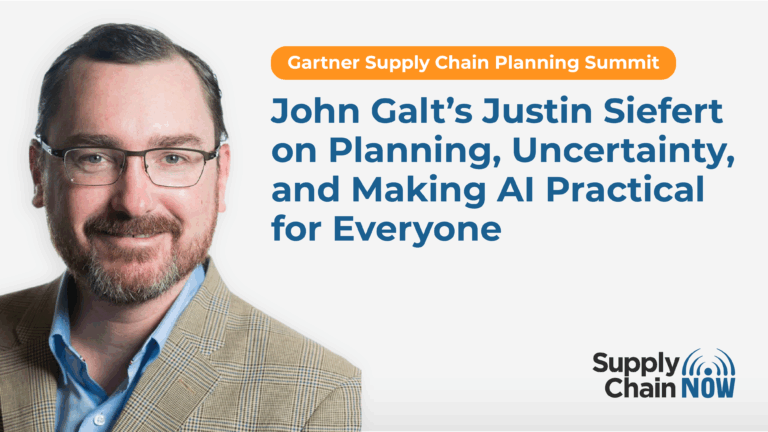

John Galt’s Justin Siefert on Planning, Uncertainty, and Making AI Practical for Everyone
At the 2025 Gartner Supply Chain Planning Summit in Denver, Scott Luton caught up with Justin Siefert, a familiar face in the supply chain community and a leader at John Galt Solutions, a global provider of end-to-end supply chain planning software. From demand and supply planning to inventory and S&OP, John Galt supports organizations across industries with the holistic capabilities needed to thrive in an increasingly unpredictable landscape.
A Company Investing in the Next Generation
Before diving into industry trends, Siefert shared an update on one of the programs that sets John Galt apart: its supply chain scholarship program, which awards $10,000 to students pursuing supply chain degrees. This year’s cycle brought in a record number of nominations, with new winners set to be announced in January. It’s an initiative Siefert is proud of—and one that reflects John Galt’s belief in cultivating tomorrow’s leaders.
Old Problems, New Pressures: Planning in a World of Uncertainty
When asked about the biggest challenges facing planners today, Siefert didn’t hesitate: uncertainty.
While the forms of disruption change—pandemics, geopolitical shifts, demand shocks, evolving portfolios—the underlying challenge remains the same. Planners must anticipate what’s next and respond quickly, often in real time.
“No day is like the day before,” Siefert noted, emphasizing that the past several years have only amplified long-standing volatility. Companies expect immediate answers: What should we produce? What will demand look like? How fast will customer needs shift? What will my product portfolio require?
There’s no room for slow analysis or spreadsheet-driven planning anymore. As Siefert put it, “If you don’t have that answer now, somebody else will—and they’ll beat you to it.”
The Real Breakthrough: Making AI Accessible
While the industry is buzzing with AI, GenAI, and agentic AI announcements, Siefert believes the more important story is practicality—how companies can make these innovations usable, intuitive, and impactful for every employee, not just technical specialists.
That’s where he sees John Galt standing out.
Siefert explained that John Galt is focused on democratizing access to advanced planning capabilities. Their goal is to ensure any planner—regardless of technical background—can leverage AI-powered insights quickly and confidently. That means tools that are simple to use, easy to interpret, explainable, and built for speed.
Two themes stood out in Siefert’s vision:
Simplicity. Turn ultra-complex challenges into clear, actionable guidance.
Velocity. Support decision-makers who are operating in a business environment that only continues to accelerate.
“Everybody needs access to it,” Siefert said. “You shouldn’t need a data science degree to get value from AI.”
Connect With John Galt
For those interested in John Galt’s scholarship program, planning innovations, or broader supply chain advancements, Siefert encourages leaders to visit JohnGalt.com or email connect@johngalt.com. Follow Justin Siefert on LinkedIn here.
We also invite you to listen to the full audio of this interview with Scott W. Luton and Justin Siefert: click here.
More Blogs

Can the Warranty Claims Process be Improved?