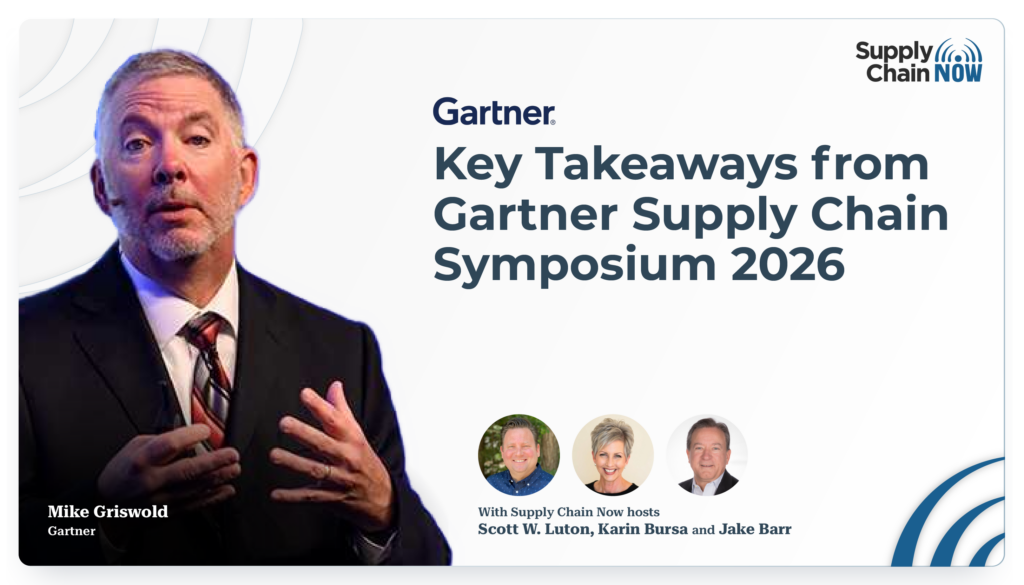
[00:00:00] Mike Griswold: whenever we don’t tackle things cross-functionally, we run into problems, right? We end up doing a really, really good job of creating highly efficient functional silos.
[00:00:10] Mike Griswold: And if you’re not careful, AI will do that even better and faster for you, right? So you really have to be careful around, you know, what problem we’re trying to solve.
[00:00:33] Scott W. Luton: Hey, good morning, good afternoon, good evening, wherever you may be. Scott W. Luton, Karin Bursa, and Jake Barr with you here on Supply Chain Now. Welcome to today’s special live stream. Hey, Karin, how you doing today?
[00:00:45] Karin Bursa: I’m doing great, Scott. It’s good to be with you.
[00:00:47] Scott W. Luton: Great to have you here with us today. And Jake Barr, the John Wayne Global Supply Chain. How you doing?
[00:00:53] Jake Barr: I’m doing well. I’m looking forward to grilling Mike. Let’s go.
[00:00:58] Scott W. Luton: Well, you’re letting the cat out of the bag, folks. Today we’re featuring a true power panel to dive into the key takeaways for one of the best supply chain leadership events of the year, Gartner Supply Chain Symposium. Now, all of us were there in Orlando, as well as our guest, on site talking with the movers and shakers that make global supply chain happen.
[00:01:17] Scott W. Luton: So stay tuned for in the know perspective and market intel that’s gonna make you smarter and more informed going into your next business conversation. So just like Jake mentioned, we’ve got a special guest joining me and Karin here today. So folks, for almost eight years, that’s crazy, for almost eight years, our guest has joined me for a monthly podcast entitled Supply Chain Today and Tomorrow with Mike Griswold of Gartner.
[00:01:42] Scott W. Luton: And I think I’ve earned four degrees and two certifications over that time because many, many of you already know Mike serves as Vice President Analyst with Gartner, and he’s one of the smartest folks in just about any room. So I wanna welcome in the one and only Mike Griswold. Hey, hey, Mike Griswold, how you doing?
[00:01:59] Mike Griswold: Hey. I’m well, thanks. Definitely not the smartest person in this room, but it’s great to be here. It is great to.
[00:02:05] Scott W. Luton: great to have you. Uh, Karin and Jake, uh, I tell you, I know, Karin, I know you and Mike go way back. Uh, it’s always a, a treasure to have him on live, huh?
[00:02:14] Karin Bursa: It is, it is. And Mike, it was so good to see you in person at the event this year. So enjoyed, uh, lunch and just catching up.
[00:02:21] Mike Griswold: Yeah, it was great to connect. Uh, we don’t get out, uh, I don’t get out much. So yeah, it was, it was great to get out and, and see people, so.
[00:02:30] Scott W. Luton: And Jake, uh, I’m sure you found a moment or two. You’re like the mayor of these symposiums. I, I’m sure you got some, uh, some private time with Mike down in Orlando, huh?
[00:02:39] Jake Barr: Actually, I was quite dismayed. Mike was, uh, incognito for much of it, so I, I had my court of folks.
[00:02:48] Jake Barr: around me. It’s actually you, Scott, that I was constantly looking for, and you were somewhere between Epcot and, you know, Disney World, where, wherever.
[00:02:57] Scott W. Luton: Well, I’m gonna dispel those rumors. I’m gonna dispel those rumors right here, Jake, Karin, and Mike, because let me tell you, we worked hard. We worked hard interviewing dozens of folks, or I got a couple snapshots here, dozens of leaders at Gartner Supply Chain Symposium in Orlando. We spoke with leaders from Project 44, Schneider Electric, uh, Estée Lauder, GAINS, FourFlow, Cleo, Everstream, uh, Analytics, Manhattan, and here’s one of my faves here.
[00:03:25] Scott W. Luton: This is Peter Larrison with Amazon, who’s a key leader making the charge with Amazon Supply Chain Services. So get ready as we release all of these interviews in the, in the next few weeks. So, so Jake, see, I was working, my friend.
[00:03:40] Jake Barr: Uh, work. Well, well, that’s a literal word, right?
[00:03:45] Scott W. Luton: Alright. So in the meantime, uh, get ready folks, uh, as we’re gonna be diving into some key takeaways from this incredible panel from Symposium, three of the smartest folks I know in Mike, Karin, and Jake. But I wanna set the table first. There was a very well-received opening day keynote from Lindsay Azim, uh, which included this nugget.
[00:04:05] Scott W. Luton: Check this out, folks. 60% of supply chain disruptions will be resolved without human intervention by 2031. That’s intriguing to ponder. And then check out these two other nuggets, uh, that, uh, were released during the week of, uh, Symposium in Orlando. Uh, the top one, Gartner survey shows AI is not driving supply chain operating model transformation.
[00:04:29] Scott W. Luton: And then the next one there, Gartner predicts supply chain organizations pausing entry-level hiring for AI will face higher costs by 2030. So as now the table is set, we proved that I worked a ton, and we, we shared some key takeaways already. But Mike, you were there, boots on the ground, talking with hundreds, if not thousands of people.
[00:04:54] Scott W. Luton: Um, what were some of your key takeaways?
[00:04:55] Mike Griswold: Well, i-i-it’s interesting, Scott. We’re, we’re, uh, doing the event now at, uh, Barcelona, and, uh, Alan, uh, O’Keefe just did the keynote on Monday and scored a 4.61 out of five. And the only reason I share that is what we put together from a keynote perspective this year, I think resonated really well, both in Orlando and in Barcelona.
[00:05:22] Mike Griswold: And I think it resonated because we had that mix of, you know, people always want to hear about AI. Karin and Jake, I’m sure will, will talk about that. I think the keynote did a great job of putting AI in perspective, both from what it can do and what it cannot do. A couple of observations from me, one on the AI side and one on the, on the people side.
[00:05:46] Mike Griswold: The first is we had a stat that said something like a third of AI projects are over budget. And then we had a stat which I think goes to your first point that you just showed, about twenty percent of people say their AI initiatives are not focused cross-functionally. So one of the takeaways is people need to figure out exactly what problem or problems is AI gonna solve for them, and then how do they figure out where the value is gonna come from, right?
[00:06:15] Mike Griswold: That will keep the AI initiatives from, from necessarily, or at least maybe hopefully not go over budget. I think the other element, Jake and Karin can appreciate this given their longevity in the supply chain, is whenever we don’t tackle things cross-functionally, we run into problems, right? We end up doing a really, really good job of creating highly efficient functional silos.
[00:06:39] Mike Griswold: And if you’re not careful, AI will do that even better and faster for you, right? So you really have to be careful around, you know, what problem we’re trying to solve. The other element I wanna raise though, and I know th-this will definitely resonate with Jake and Karin given all the people they talk to, is we had… the team that I look after at Gartner covers supply chain t-uh, talent and org design, and we’ve done a lot of work around, um, CSCO effectiveness. And I know Jake and Karin talk to tons and tons of CSCOs. My other observation from the event is, to put it bluntly, the lack of respect CSCOs have within their peer group, CSCOs are often seen as, like, the execution arm of the organization. They get, within their peer group, a lot of credit for being able to execute. CSCOs don’t get nearly enough credit for being strategic thinkers, partly because CSCOs don’t do a great job of telling their story. We have a, an interaction we call a strategy session, and we, we’ve built over three years, we do tons and tons of strategy sessions around this idea of storytelling. And we had a session from one, a person on my team around how do you use data to tell your story. And my message to CSCOs is you need to figure out how to sell yourself better through being able to tell stories that highlight the value that you provide as a supply chain leader, and you need to figure out how do you better connect with, like, the cool kids at the table, right?
[00:08:26] Mike Griswold: Like it or not, the CF- the CFO is the most often collaborated person within the C-suite.
[00:08:34] Mike Griswold: I’m not here to offend any CFOs, but they don’t have the personality of a CSCO, right? And the second most important person, or the second most collaborated person is HR. So, we have, on the one hand, we have this AI conundrum that CSCOs need to work with, and on the other hand, we have an image problem, quite frankly, as, as CSCOs.
[00:08:54] Mike Griswold: And we spent a lot of time at the event trying to convey that message and give CSCOs just some ways to think about how do they better tell their story. So tho- those are my two big takeaways.
[00:09:09] Scott W. Luton: I like it. And really quick public service announcement. We’ve enjoyed interviewing numerous tons, hundreds of CSCOs over the years. If any chief supply chain officer wants to practice their storytelling, give us a shout. We’d love to, uh, love to feature you. Um, okay, so Karin, that’s a lot of, lot of fodder out there and, and we heard you get a kick out of a couple of Mike’s points.
[00:09:31] Scott W. Luton: What were some of your key.
[00:09:32] Karin Bursa: Yeah. So first, I totally agree with Mike. We can do a better job of telling our stories and talking about how supply chain enables strategic initiatives for the business. Uh, but my big takeaway this year, um, and, and Jake, I know you and I discussed this last year. Last year I saw a lot of deer in the headlights.
[00:09:53] Karin Bursa: It was shock and awe and fear all coming together last year. This year, for me, the big headline was not simply AI is coming, it is that supply chain is moving from this idea of how do I automate as an efficiency lever to how do I reach autonomy as a new operating model? This is a shift, and it’s a much bigger conversation for our chief supply chain officers.
[00:10:23] Karin Bursa: It really drives four big, uh, big things. One, how decisions are made, and expect to hear more of this going forward. Uh, two, how is the work designed, right? This is a huge opportunity to rethink workflows, not just automate your current workflows. and as an extension of that, it’s how the ecosystems operate.
[00:10:47] Karin Bursa: Are there ways that we can further accelerate decision velocity because we can connect electronically and elevate information for better decision-making? And then fourth and final is, is this leader factor, this, uh, opportunity for our supply chain leaders to balance initiatives around growth, cost, risk, and talent.
[00:11:12] Karin Bursa: I think that all of that comes together to say that the shift is not just a technology shift. We s- need to start thinking of it as an operating model shift. And that started with Lindsay’s opening, uh, keynote, I think set the table for that conversation throughout the conference.
[00:11:29] Scott W. Luton: Well said, Karin. Um, and I, I particularly like how your, your comment there about this is a terrific opportunity to change how work is designed. And if organizations and leaders aren’t focusing on that, they’re m- they’re missing a, um, a really important, uh, opportunity. Uh, Jake, we’ve heard from Mike, we’ve heard from Karin, we’ve got a couple comments I’ll share in a minute.
[00:11:50] Scott W. Luton: What were some of your key takeaways?
[00:11:51] Jake Barr: Well, first my head’s exploding because I, I wanted to jump in on like every single thing that Mike and.
[00:11:57] Jake Barr: Karin.
[00:11:58] Jake Barr: have just thrown out. But I’m gonna back up and play back at the truck again and play devil’s advocate on something. Look, I, I thought the opening keynote was perhaps the most on-point summarization in a very pragmatic sense that it has been for the last several years, okay?
[00:12:18] Jake Barr: And I, I’ve been around for like thirty-five of them, okay? but I want to give kind of a nuance on what Mike mentioned around the sixty percent piece, right? Around all the disruptions, right? Being managed without human intervention. I’m gonna call bullshit. And, and it’s not an incorrect statement.
[00:12:39] Jake Barr: It’s actually a very valid statement. Sixty percent will. Now, the choice, and much to Karin’s comment, is how you approach that. Because you can actually tactically approach that where you’re using AI as just another bolt-on, for a little bit of process simplification, execution elimination, much like I saw a whole host of folks attempting to do while I was at the event.
[00:13:13] Jake Barr: Or conversely, you can step back and say, “Wait, this is the way that I actually attack all those losses between, between these processes that I’ve had at the seams forever,” right? And it just drains money. And I have the ability to step back and re-engineer how I’m going to do the work, who I’m gonna do it with, where I’m gonna do it, all those things, right?
[00:13:37] Jake Barr: Tech doesn’t lead. Tech is in support of a business outcome that I’m trying to engineer. Okay? So that, that to me was extremely valuable. The other thing, as Karin said, look, look, let’s be blunt. A year ago, there were so many people walking around in a complete daze, right? That were lost, okay? Going, “Holy shit, what do I do?”
[00:13:59] Jake Barr: Now, I also want to give credit where it’s due on the opportunity to have the keynote piece say, “Hey, wait, let’s ground ourselves.” Never ever forget that the job, his or her job as a chief supply chain officer is actually two things, not one, two. The first, and very importantly, as Mike was alluding to, “Hey, I am the answer machine.
[00:14:24] Jake Barr: I’m the one that actually keeps the cash register running day in, day out.” ‘Cause 80% of the money of the entire corporation, big or small company, doesn’t matter, it’s all the same, okay? Hey, I manage the inventory flow, the production, the distribution, making sure sales occur, all those things. So that’s job one, operational excellence, right?
[00:14:46] Jake Barr: the second piece that was alluded to that I was really pleased by was, wait a minute, my job is also to concurrently, while I’m at executing with excellence, is to actually figure out what the hell we need to do to blow up the current operating model to remain relevant and competitive for the next four, five, 10 years.
[00:15:08] Jake Barr: And that requires disruption, right? So the use of AI in two buckets. One, help me squeeze out more operational efficiencies. Second, and very important, how am I gonna game change the way that we’re running the operation to drive that disruptive capability? And so I was like wanting to get up and chant and scream in the audience when we were going through these two buckets, but so I’m going, “Hallelujah.”
[00:15:40] Jake Barr: People are actually grounding themselves in pragmatic reality of, I need some lighthouse cases where I learn my way through, because guess what? AI, to Mike’s point, is going to run decisions to you faster than you’ve ever had the ability to blink your eyes, and you’re gonna be deer in headlights again of going, what do I do with it now that I know?”
[00:16:03] Jake Barr: It used to take me two days. I know in two minutes now where the disruption is. Okay, well, can I or can I not make a decision on it? So both of those. I also love the piece Karin was offering up around how to think about the element of the design, right? I’m sorry. For the near term future, big, small, in between corporations, I got clients on the entire spectrum.
[00:16:31] Jake Barr: Even the most advanced are not eliminating the folks. They’re enabling the folks they have to actually, guess what? Take on more work with the same number of bodies.
[00:16:45] Scott W. Luton: So, uh, Jake, that’s good stuff. And Mike, I would just, for whatever it’s worth, um, I would’ve paid a sweetener on our registrations to see Jake take the stage and bang on drums or what- whatever he was suggesting there. So next year, maybe.
[00:16:59] Karin Bursa: I think I saw him banging on the table in the bar one night, so that.
[00:17:04] Jake Barr: Oh, I did. I did.
[00:17:06] Jake Barr: multiple.
[00:17:07] Scott W. Luton: So now that we’ve got terrific takeaways and insights from our, uh, panel here today, we’re gonna talk about some priorities building on that, that they’re, they see supply chain leaders taking in the next, uh, through the end of this year and into next year. But first, you know, we all think we’re kind of raving about, uh, the opening day keynote by Lindsay Azim.
[00:17:29] Scott W. Luton: And, you know, Mike, you and I chatted with Lindsay on a great episode that we released just about two weeks ago. And so folks, if you couldn’t make it down to Gartner, we really, Mike and I focused our conversation around some of the big takeaways that Lindsay hoped that the audience, took away from her keynote.
[00:17:46] Scott W. Luton: So folks, go check that out. We’re dropping a link. And Mike, really quick, your comment on that conversation we had with Lindsay, that was good stuff, huh?
[00:17:53] Mike Griswold: Yeah, it was really good. I think it gave people, uh, what Jake and Karin just both said very well, which is, here’s where we see AI and its impacts going, and here are some things you can actually do today.” I think, um, what j- what Jake was alluding to, and he said it very well, is in the past, if I, if I’m honest here, I mean, in the past, our keynotes at times have been a lot of maybe theoretical and a lot of, you know, m- maybe not as aspirational for everyone as they could’ve been.
[00:18:32] Mike Griswold: And I think this year we took a step back and, and really said, “Hey, look, w- we need to kind of come clean on our perspectives around AI, and we have to give people some things that they can actually start thinking about doing.” And I think Lindsay and Alan both did a, did a, a really good job of that.
[00:18:49] Scott W. Luton: In light of all the takeaways that all three of y’all have shared, and as we look at the second half of the year, cause 2027 will be here soon, what do you see supply chain leaders prioritizing in light of some of these topics?
[00:18:59] Mike Griswold: I think we’re going to see what Karin and Jake alluded to, which is the prioritization around workflow design. As Jake was, was providing his perspectives and as Karin was providing hers, I was, I was listening to that thinking about, what actually are people gonna start working on? And I think it has to be the, the key workflows.
[00:19:24] Mike Griswold: If we think about the supply chain plan, source, make, deliver customer service right at a super high level, which of those workflows do organizations feel are the ripest for a redesign and a review? Uh, I think Jake made the comment, which I agree with completely, which is technology is not the solution.
[00:19:47] Mike Griswold: More often than not, it’s the enabler. And unfortunately, we’ve seen, I can now say I, I am old enough to say that I saw this with RFID. We saw this with blockchain, right? I, I had an old boss of mine who said, you know, “We can’t have technology running around an organization looking for a problem to solve.
[00:20:09] Mike Griswold: We need a problem defined, and then let’s find the right technology.” And I think the focus, you know, and, and I love Karin’s description. Last year, there were a lot of deer in the headlights, and I think that was because people were unsure what to even ask. It’s like, I don’t wanna ask this question ‘cause I’m gonna feel like I’m the stupidest person in the room when everyone else has that same exact question.
[00:20:32] Mike Griswold: I think what was different this year is that people knew a whole lot more, and they knew what to ask, and they knew what to look for, whether that was in the solution showcase, looking for technology providers, whether it was their peers, right? Whether it was talking to Jake and Karin, they knew what to ask.
[00:20:49] Mike Griswold: So I think it’s, it’s going to come down to, I think the prioritization on the key workflows and then figuring out what role does technology, ’cause the oth- the other thing is, when you talk to companies, and I, and I, I feel confident saying Jake and Karin would agree with this. When you, when you talk to a company and say technology, the first thing that comes out of their mouth is AI.
[00:21:11] Mike Griswold: Well, guess what? There’s a lot of other technologies out there, whether it’s a, it’s a demand planning tool, whether it’s a, it’s a routing tool, whatever it might be, there are a lot of other tools out there that can enable some of this workforce transformation that don’t necessarily require you to get deep into AI.
[00:21:29] Mike Griswold: So let’s, when we think about workflow, let’s not immediately jump to AI as our only solution for this, right? Because there, I mean, if you go into the solution showcase at the event, there were a lot of vendors that didn’t necessarily hang their shingle on AI.
[00:21:47] Scott W. Luton: Hmm. All right. So Jake, we’re going to you second here because I know you’re jumping in and ready to get on the stage again. Uh, so Jake, when you think about the priorities that supply chain leaders are taking m- now through the end of the year and into next year, your thoughts?
[00:22:01] Jake Barr: I think Mike’s spot on. The, the reality is you’re always gonna focus in on where are, I’ll call it i-in a supply chain profession, where are my losses, right? Where am I either bleeding money or bleeding people, bleeding time and effort that I could get, more productive use of, right, if I had those assets to use in a different way?
[00:22:22] Jake Barr: I see a lot of that, and I was really glad Mike brought up the point about the other players that were out on the exhibit floor, because I saw better this year than I have in the past, folks taking advantage of some AI capability to actually enable the ability to, to eliminate those losses at the seams, right?
[00:22:47] Jake Barr: So instead of having to require manual handoffs between logistics and transportation or warehousing, right, back to planning, there was both first level automation of a workflow, second level decision optimization of suggestions, instead of having people weed through 1,000 pieces of paper on all the exceptions.
[00:23:10] Jake Barr: So I saw very good examples of where folks were beginning to put that into practice that could be very easily reapplied and escalated for getting large scale efficiency improvements across any of those processes.
[00:23:29] Scott W. Luton: Hmm. All right. So Karin, now that we’ve heard Mike and Jake weigh in on some supply chain leadership priorities and some other, uh, additional thoughts on those takeaways, your thoughts, Karin.
[00:23:39] Karin Bursa: Yeah. I, I love this idea that, there are short-term tactical advantages that we can gain in accelerating current processes, but then working on or carving out that time and brainpower, and creativity quite inter- um, honestly, to change the way we do business. And I wanna encourage you to start thinking about…
[00:24:00] Karin Bursa: We’ve talked about tech stacks for years. Like, what does our technology landscape look like? Start thinking about decision stacks. Think about how decisions are made, because that’s gonna help you identify if you’re AI-ready. Is it something where the, where an AI-ready decision can accelerate our overall decision velocity?
[00:24:25] Karin Bursa: A- and so that’s gonna cause you to step back for a minute and be very, very outcome-focused. and then leverage the technology to achieve those goals. So don’t just think, “Is my data AI-ready?” Think, “Is my decision process AI-ready?” Because that decision stack, having an actual organized way you make decisions, is going to be very important to achieving things like that 60% automation for disruptions that occurred, that, that stat you shared, which is really, aggressive in my opinion.
[00:25:01] Karin Bursa: I think, I think, um, uh, Jake may have used a couple of other adjectives around that. But, um, I think by 2031, if we get to a 30, 40% automated resolution, that’s gonna be a home run. If we can hit that 60% number, it is a completely different model that we’re working with. So, we talk a lot about rethinking workflows.
[00:25:24] Karin Bursa: Rethink how decisions get made or get structured about how your decisions get made, because that structure is what’s going to allow you to automate and, and accelerate that decision velocity or serve up the right level of insight for your humans, your talent pool, to be even more effective. and that’s, that was a shift for me.
[00:25:49] Karin Bursa: That was a big shift for me from the conference this year.
[00:25:52] Scott W. Luton: Mm-hmm.
[00:25:53] Jake Barr: Hell, even a 20, Michael T, e-even a 20% improvement in that number, you’re talking for a large scale company, that’s hundreds of millions of dollars. This is not small change, guys.
[00:26:04] Scott W. Luton: Well, speaking, and I like the notion that, of the decision stack. I wish my local Lowe’s had one. I could go get one off the shelf and bring it home for Supply Chain Now. Uh, but kidding aside, when you think of decisions and decisions and decisions, I think of planning, lots of planning, which is near, near, to the heart and soul of, of global supply chain.
[00:26:23] Scott W. Luton: And Mike, we’ve talked about this quite a bit. I went to my first one last year. Of course, Jake and Karin are stalwarts at the Gartner Planning Summits. Uh, I wanna put this in front of folks because it’s a tremendous opportunity. the next, and there’s two, there’s a couple each year, but the next one we’re targeting is Gartner Supply Chain Planning Summit in Denver, which runs November second and third.
[00:26:43] Scott W. Luton: You, you see me there la- from last year with Noha Samara, which I believe is the chair of the Planning Summits. Mike, is that right?
[00:26:51] Mike Griswold: Uh, that is correct. Yes.
[00:26:53] Scott W. Luton: And she delivered an incredible keynote at the summit last year in Denver that we, uh, I’m still thinking about as she was comparing, uh, planning and really supply chain leadership and performance to a, um, a certain type of marathon.
[00:27:07] Scott W. Luton: The name escapes me, but it was a great analogy. Uh, but what I, I wanna ask each of y’all, because all three of you know, this is a great event. I look forward to attending this year. but folks are still getting turned on to it, um, despite its popularity. So Mike, when you think of the Gartner Sup- Chain Planning Summits, the one in Denver and the one in London, why should folks have this on their radar?
[00:27:28] Mike Griswold: Yeah, I think one of the things Gartner does really well on the event side is, is figure out who’s gonna come to an event and what do they need to hear. So if you think about the symposium event, that’s for CSCOs, for their direct reports, and it’s probably, you know, 80% of content geared towards kind of strategic, you know, aspirational, I don’t want to say theoretical, but, but more of the, the conceptual type of stuff, and, and 20% is really around kind of the tactical stuff.
[00:28:06] Mike Griswold: The planning summit and all of our summits, because we’re launching, launching a procurement summer this year as well in San Diego, those are for, in, in, in the planning environment, those are for people that, that run planning teams and/or people that actually do planning, right? So we’re getting down a layer.
[00:28:25] Mike Griswold: Uh, we still have probably, I’m gonna say 60, 65% of the content will be for planning leaders in terms of strategic thinking about how do you think about, you know, running a planning organization. But there’s also much more tactical hands-on stuff for people that do the day-to-day planning. So it, it really is, you know, we like to talk about the, the symposium as, you know, the world’s largest gathering of supply chain professionals.
[00:28:54] Mike Griswold: I’m not a marketing person, but I, I would suggest that our, our planning summits I won’t necessarily put pressure and say global. I will say that it’s probably one of the larger gatherings of people focused on planning that you’re gonna find anywhere. and if you think about kind of the heritage of Gartner’s supply chain group, right?
[00:29:17] Mike Griswold: It came from AMR, which was all supply chain all the time, heavy dose of planning. There is extensive planning expertise in the organization. If anyone has any interest in either learning more about planning or getting better at planning, I think you’d be hard pressed to find a better event to go to.
[00:29:38] Scott W. Luton: I’m with you, Mike. I am with you. And I, I really enjoyed, uh, last year’s, look forward to this year’s. Karin, you, you and I were both there along with Jake last year. Why should folks make sure they have the Planning Summit on their.
[00:29:50] Karin Bursa: Absolutely. It’s because it’s that opportunity to go a little deeper, right? So the whole agenda is based around, uh, supply chain planning. So whether you’re looking at sales and operations planning, you’re looking at decision intelligence, demand inventory, supply production planning, how all these elements come together, this is the event for you, and there will be numerous opportunities to, to scratch below the surface.
[00:30:16] Karin Bursa: So I think you’ll find the heads of planning there, some s- uh, chief supply chain officers as well, but they’ll be bringing in, their most, innovative leaders to dig into those topics as well. So it’s, it’s a great discussion. I love the topics and, uh, always look forward to, uh, this particular event.
[00:30:36] Scott W. Luton: I’m with you. Hey, Jake, really quick, before you, you talk about the planning summit, I want to drop, I think we’re dropping the link to, uh, a great webinar that you and I hosted with Noha Samara, that I mentioned earlier. Decision Shapers, The Rise of Decision Shapers, I think it was, and we’re dropping a link.
[00:30:51] Scott W. Luton: Folks, you gotta go check this out because this squares well with Mike’s earliest feedback at the top of the show about the need to be able to tell a better story, right? Whether you’re a CSCO or you’re just getting started really in any industry, not just supply chain, we gotta get better at that. So folks, go check out this webinar.
[00:31:09] Scott W. Luton: Noha killed it. Jake, comment really quick on that d- discussion we had here on Supply Chain Now, and of course, talk about the summit.
[00:31:18] Jake Barr: Yeah. Well, actually, you should go to the summit if for no other reason to see the advancements that have been made since Noha’s presentation, okay? Because I believe if you go… First of all, look, I’ve been going and, and helping to host, uh, summit for years. But fundamentally, it’s one of the best benchmarking opportunities at a detailed level that exists in the profession to be able to go and actually do real world comparisons of, “Oh, when this shit hits the fan and you really have to figure out to solve,” be able to do that.
[00:31:54] Jake Barr: So that’s one. The second piece to me is this decision shaper piece is not just words, okay? It is in fact where we are heading with the enablement of AI to manage and rethink the entire planning spectrum, right? And so Mike, I’m gonna make a, a comment to you. As, as strong as the comment was on the keynote around the exception management by 2031, I’m gonna tell you that in between 20 to 25% of people that have planners behind their role, the work could actually merge, but on the same timeline easily, easily.
[00:32:34] Jake Barr: Because what we are enabling is a complete re-engineering of all the work and how to do it without being encumbered by simple things like, well, I established a role from a sign-on security standpoint and a check and balance. I can actually use the tech to help me define the elements in security levels have been properly addressed, and I can merge activities, right?
[00:33:09] Jake Barr: So the scenario planning has gone to, yet again, another level and height of capability from even 12 months ago, right? The ability to go across the seams to actually deduce what level the disruption is really going to have in the operation is at a much finer level than even existed 12 months ago. So I could go on and on, but that’s a reason why you want to be there.
[00:33:40] Scott W. Luton: Karin, Jake, uh, is bringing some extra spice to today’s conversation, isn’t he?
[00:33:46] Karin Bursa: he is. And I wanted to jump in and say it’s a great time to be in supply chain. This is so exciting, uh, the opportunities that we have, and I think we’ve got to be sure how we approach it. Um, one number that Gartner shared actually before the conference, they put out a press release on their forecast for supply chain management software with agentic AI.
[00:34:10] Karin Bursa: And they said that their research shows that by 2030, so just four years from now, uh, really three and a half because we’re halfway through 2026, that market is gonna be about $53 billion, with a B, billion dollars. Last year it was two billion. So I’m not telling you to rush out and buy software that’s labeled agentic AI software.
[00:34:38] Karin Bursa: I’m telling you to figure out how to leverage the, that opportunity in your business, thinking about your business differently, because there will be parts of your business, that we can automate and we can elevate how your talent is engaging and adding value. And I don’t think we’ve even scratched the surface on what that looks like.
[00:35:01] Scott W. Luton: I’m with you. That is a massive opportunity. Uh, my agents have just released new agents as who will be releasing more agents to take advantage. Goodness gracious. Um, all right, a couple quick things. Wanna make sure folks have resources at their fingertips. we, again, we dropped, This is The Rise of Decision Shapers with Noha Samara.
[00:35:19] Scott W. Luton: Go check it out. It was a fantastic, uh, session. We also dropped a link to Supply Chain Planning Summit 2026. This is the one in Denver. There’s one in London too. You can, you can find that one on the same link, I’m sure. But come join us in Dec- uh, uh, in Denver in November. Last year was December. This year it’s November.
[00:35:36] Scott W. Luton: It’s a good move.
[00:35:37] Scott W. Luton: all right, so let’s do this. Let’s make sure folks know where they can find a lot more resources, a lot more upcoming live events, a lot more perspectives just like this. Go check out our almost weekly newsletter With That Said.
[00:35:50] Scott W. Luton: You’re gonna find industry news and nuggets, expert perspective, tools, resources, insights, you name it, and all of our upcoming live shows. And we appreciate all 29,416 subscribers. Uh, let us know how we can make it even better. okay, so Mike Griswold, let’s make sure, first off, can we just celebrate how many podcast series outside of Hollywood or outside of, um, you know, billion-dollar studios go for eight years in a row on a monthly basis, Mike?
[00:36:21] Scott W. Luton: Well done, my friend.
[00:36:23] Jake Barr: somebody has to carry the water and you’ve done it well for him. Okay?
[00:36:28] Mike Griswold: Yeah, y- you’d be surprised how, how far checks to friends and family will go, Scott, in terms of getting people to tune in. So I appreciate that. It’s been, it’s been a lot of fun.
[00:36:37] Scott W. Luton: well, you know, as we’ve talked about on the last episode, uh, we’ve, we’ve gotten more and more, uh, comments and feedback that folks drop on social about those conversations. And I think when I shared that, uh, and then we talk about that, we, we, uh, feature that perspective in shows. when we finally did the math and we realized it was eight years, I think your comment was, uh, “Eight years of being overnight success.”
[00:36:56] Scott W. Luton: Was that Mi- right, Mike?
[00:36:58] Mike Griswold: Yes. Yeah. It took a while.
[00:37:01] Scott W. Luton: hey, yeah, good stuff does take a while, right? Good things come to those who wait. Uh, but folks, go check out the podcast. You can find it at Supply Chain Now. You can, uh, search for Mike Griswold, and they’ll have, well, eight times 12, roughly over 100 episodes, uh, ready to go at your fingertips.
[00:37:17] Scott W. Luton: Uh, also, we dropped a link, too, Go check it out, the almost weekly newsletter. Uh, Mike, how can folks track you down other than the podcast?
[00:37:25] Mike Griswold: Uh, LinkedIn and email. Yeah, I’m, I’m relatively, not relatively, I am still old school. So yeah, mike.griswold@gartner.com is probably the most, timely way to get ahold of me. Love to hear from people, thoughts, ideas, feedback, anything we can do to make our events better. yeah, just drop me a line.
[00:37:42] Scott W. Luton: Outstanding. And, and we didn’t put his email up there, but we did put his LinkedIn. Y’all go check him out, follow, connect, you name it. Uh, Karin Bursa, it is a good time, a wonderful time to be in global supply chain. how can folks track you.
[00:37:56] Karin Bursa: Yeah, the best way is probably through LinkedIn. Um, that gets you out of the, the email inbox. Um, and of course, right here on Supply Chain Now as well. Um, would love for any feedback you’ve got on our conversation today or past conversations.
[00:38:10] Scott W. Luton: That’s right. Keep, and feedback is a blessing. Sometimes it’s a painful blessing, but it is a blessing. Y’all keep it coming. I love it. Jake Barr, I love it when you’re a little extra spicy. Really, I got a kick out of your, your.
[00:38:21] Jake Barr: I’m always… Mike knows this. Mike’s known me for four plus decades. I’m always spicy.
[00:38:27] Mike Griswold: Yeah, it’s this, th- this was not, this was not new Jake. This is consistent Jake. So it’s great.
[00:38:34] Scott W. Luton: Well, it’s kinda like, um, it’s kinda like when you go to Hattie B’s, right? One of my favorite places in, in the original, uh, in all of the world. You got different layers of la- um, levels of spice. Jake was at least extra hot today. He, But to your point, Mike, he is al- always spicy. Uh, all right, so Jake, how can folks track you down, my friend?
[00:38:53] Jake Barr: LinkedIn or any of the professional conferences, because I’m always there. Um, I’m a constant learning journey. I love talking through supply chain problems. I’m just one of those engineering geeks that loves problems.
[00:39:08] Karin Bursa: You are people. You are my people.
[00:39:13] Scott W. Luton: Well, it was a great conversation here today. I appreciate all three of y’all’s perspectives and the way you, uh, offered up your very actionable key takeaways, and you gave us plenty of things we gotta keep our eyes on, and better yet, we gotta act on. cause every day we don’t act is a massive waste- wasted opportunity.
[00:39:29] Scott W. Luton: Uh, and our people deserve better, our customers deserve better, the industry deserves better. Mike Griswold with Gartner, always a pleasure, my friend. Thank you for being here.
[00:39:37] Mike Griswold: Thanks for having me.
[00:39:39] Scott W. Luton: You bet. We’ll see you, we’ll see you next month. Uh, Karin Bursa, great to have you. Uh, this is, uh, I really enjoy. You, when you and Jake get together, Mike is like an extra bonus, but when you and Jake get together, the one-two punch, y’all really bring it, and great to have you here today.
[00:39:53] Karin Bursa: Thank you. Yeah, Jake brings out the best in me.
[00:39:55] Scott W. Luton: Well, folks, we dropped Jake’s and Karin’s and Mike’s LinkedIn. Uh, great to have everybody tune in. We also included our upcoming live programming and our exploding resource hub. Go check it out. we’re doing a lot more written content than we did in years past, and I have really enjoyed talking about, I think Jake mentioned being a geek, being a nerd.
[00:40:16] Scott W. Luton: I’ve been nerding out on the terrific perspectives we dropped there. So with all of that said, folks, it’s really important, I hope you enjoy this conversation, number one, as much as I have. But folks, the pace of global business velocity, it’s only getting faster and faster. It’s one of the things we talked about here today.
[00:40:31] Scott W. Luton: You gotta stay informed by turning to trusted sources of sound information and analysis, just like Mike, Karin, and Jake here, and tune into Supply Chain Now wherever you get your podcasts. With all that said, Scott W. Luton here on behalf of the whole team, challenging you to do good, give forward, be the change that’s needed, and we’ll see you next time right back here on Supply Chain Now.
[00:40:50] Scott W. Luton: Thanks, everybody.