Share:

Leading Transformation in the AI Era: Why Digital Success Starts with People

In today’s supply chain landscape, digital transformation is no longer optional—but as the panelists in the latest Supply Chain Now webinar revealed, it’s also not just about technology.

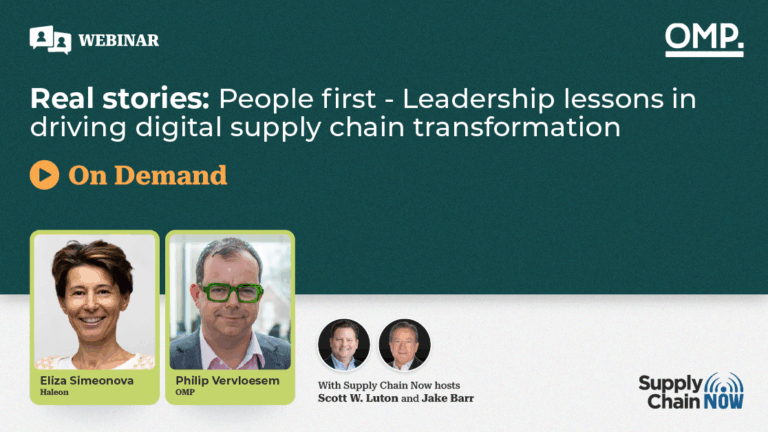
Hosted by Scott Luton and Jake Barr, this conversation brought together two powerhouse leaders: Eliza Simeonova, Quality Supply Chain Operations Officer at Haleon, and Philip Vervloesem, Chief Commercial & Markets Officer at OMP. Together, they tackled one of the most pressing challenges of our time—how to lead meaningful, people-centered transformation in an age increasingly defined by AI.

A few insights stood out:

  • Technology isn’t the hero—people are. True digital transformation begins with clarity of purpose, disciplined simplification, and leaders who stay close to the work.

  • AI amplifies human intelligence, it doesn’t replace it. The most successful organizations empower their teams to collaborate with technology, not compete against it.

  • Waiting for perfection is the biggest risk. Progress comes from experimentation, agility, and the courage to act before every variable is known.

From redefining leadership mindsets to practical strategies for upskilling teams, this discussion offered an inspiring roadmap for supply chain leaders ready to embrace what’s next.

Watch the full webinar on demand: Register to view the replay »
Download the companion resource: 5 Must-Know Planning Strategies for Supply Chain Leaders »

More Blogs

supply chain decision velocity
Blogs
February 17, 2026

Accelerating Decision Velocity: Why the Future Belongs to Faster, Smarter Supply Chain Decisions

Special Guest Blog Post written by Karin Bursa, Supply Chain Industry Advisor and Supply Chain Now Host   Here is a diagnostic question I use with supply chain leaders: when disruption hits, do your teams spend most of their time debating the data, debating the scenarios, debating the plan, or debating the decision? Or all of the above? Seriously though, in 2026, that distinction matters. Network shifts driven by tariffs, geopolitics, cost pressure, and sustainability are accelerating. Gartner’s 2025 U.S. Trade and Immigration Policy Survey indicate 77% of respondents selected network changes among their top actions in response to tariff impacts. [2] If the physical network is moving, the digital planning platform must move even faster. The environment is forcing decisions to be made faster, more frequently, and with more variables than ever before. Gartner says supply chain decisions are becoming 71% more complex, happening 52% more frequently, and need to be made 57% faster. That triple constraint cannot be accomplished with cadence-based batch planning cycles as a default operating model. This is why I am focused on a single, practical outcome for supply chain teams: accelerating decision velocity. The ability to move from data to insights to actions faster…
how to build circular supply chains in the US
Blogs
March 25, 2026

The Geopolitics of Junk

written by Deborah Dull, on site at GreenBiz 2026   I spent today in a room full of people who think about waste for a living. And the word that kept coming up had nothing to do with recycling. It was sovereignty. Here is the situation. The United States imports 95% of its critical mineral supply. Lithium, cobalt, rare earth elements, the stuff inside every battery, every semiconductor, every electric motor. We do not make it, we do not mine much of it, and we do not control the supply chain that delivers it. That is not an energy policy problem. That is a national security problem. Now here is the part that should make you put down your coffee. A ton of smartphones contains dramatically more gold than a ton of mined ore. We are talking about concentrations that make urban mining look like a gold rush compared to digging in the ground. And yet the recovery rate for those materials, once a phone leaves its first owner, drops to around 13%. We are losing roughly 80% of the value sitting in devices right now, in drawers, in closets, in landfills. E-waste is also the fastest growing waste stream…