Intro/Outro (00:02):
Welcome to Logistics with Purpose presented by Vector Global Logistics in partnership with Supply
chain. Now we spotlight and celebrate organizations who are dedicated to creating a positive impact.
Join us for this behind the scenes glimpse of the origin stories change, making progress and future plans
of organizations who are actively making a difference. Our goal isn’t just to entertain you, but to inspire
you to go out and change the world. And now here’s today’s episode of Logistics with Purpose.
Enrique Alvarez (00:35):
Good morning and welcome once again to another episode of Logistics with Purpose. Christie, how are
you doing? Good morning.
Kristi Porter (00:41):
Good morning. I am thrilled to be here. We have been anticipating this episode for a while, haven’t
taken the lid off of it and let the cat out of the bag yet. But we are here and we are so excited to be
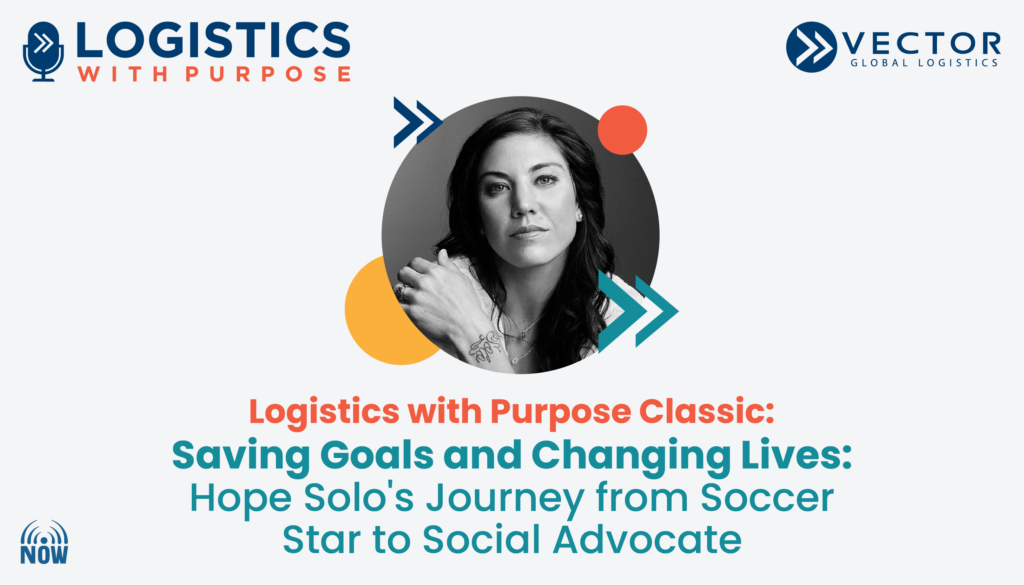
talking to Hope, solo star athlete, dedicated activist. You already know who she is, but I’m going to tell
you more about her. Anyway. She is one of the world’s top goalkeepers who helped the US Women’s
soccer team win bronze and gold at the World Cup Championships and two Olympic gold medals. In fact,
in case you didn’t know, she is the most decorated goalkeeper in US soccer history. And after her record
setting career, she’s been a tireless advocate for women’s rights and gender equality to very good uses
of her time. Hope. Thank you so much for joining us and welcome to the show,
Hope Solo (01:27):
Enrique Christie, it is a great pleasure to be here. Thanks for having me.
Kristi Porter (01:30):
Absolutely. Well, we typically start off this podcast by asking about someone’s childhood, but for
obvious reasons that will come later. We’re going to save that for a few questions down the line, but of
course we have to have you on here and we have to talk about your illustrious career. It has been so fun
to follow. I’m a huge Olympics fan, even though I don’t know much about soccer. I watch it every time
the Olympics are on. So I remember watching you and your professional journey is also one that millions
of people around the world are familiar with and actually watched unfold. Your trajectory started in high
school, college, and then you turned pro. So you’ve been at in the soccer world for a long time, and it
was evident that that was who you were going to be. But I’m curious from your side, so we know you of
course, through soccer, but was soccer always part of the plan or did you start realizing how good you
are and we’re going to go down that route? And what would you have done if soccer hadn’t been your
path?
Hope Solo (02:30):
Isn’t that the question? Yes, it’s, it’s what I have done. I’ve said a number of different things. I want to be
a beach volleyball player.
Kristi Porter (02:38):
Oh, another good one.
Hope Solo (02:39):
This transcript was exported on Mar 21, 2024 – view latest version here.
Hope Solo (Completed 03/21/24)
Transcript by Rev.com
Page 2 of 15
But no, at the end of the day, I mean, when I was 12 years old, my stepfather and my mother sat me
down and said they could no longer afford for me to play travel soccer. And it was a really difficult
conversation for them to have with me. They knew I was enjoying it. There’s club ball and there’s select,
there’s other ways to play the beautiful game, of course. But I was successful on my club teams and I
was making district ODP and I was getting the self-confidence at a very young age. And in that moment, I
just drew a fit like any 12-year-old girl could do, drew a fit, said, how could you, I am going to prove you
that I’m getting a scholarship to play soccer in college. And I started crying. I ran up to my room and my
mom and stepfather, he passed in 2012, but bless his heart because the moment they had that
conversation with me, they knew it was my passion.
(03:36):
It was embedded inside of me. I had a love for the game and I wanted to succeed. And I could see that I
put my blinders on and I was focused and they did everything to help me continue to play. And it was
very difficult on the family because we’re very middle class and how expensive this rich white kid sport
has become in the United States. So it wasn’t an easy road. We were doing car washes. I was mowing
lawns and cleaning homes and getting donations and getting grants, and I had a lot of help from my
community and my state to help me succeed and really fulfill my dreams. At the end of the day, I
needed support.
Kristi Porter (04:13):
That’s fantastic. And I feel
Hope Solo (04:14):
Like that was said. I want to tell you, please, it wasn’t an easy road. I had those blinders on, but then I
got cut numerous times from the 1999 team, the 2000 Olympic team, the 2003 World Cup team, the
2004 Olympics. I was finally the third string alternate goalkeeper in Greece, which I do have a gold
medal for. But I got cut so many times that I started to wonder, maybe it’s time to get an office job,
maybe it’s time to fall back on my college degree and which was not what I wanted it to be. I was
supposed to minor in Spanish. Enrique, you can help me.
Enrique Alvarez (04:52):
Perfect. We could actually switch this whole interview to,
Hope Solo (04:55):
I still have the biggest regret that I did not become fluent in Spanish, so I was just a minor in Spanish and
economics was my major. And because I was traveling the world trying to make the US team going to
camps, I ended up with my communications degree,
Kristi Porter (05:11):
A fellow communications degree right
Hope Solo (05:13):
Here.
Enrique Alvarez (05:13):
This transcript was exported on Mar 21, 2024 – view latest version here.
Hope Solo (Completed 03/21/24)
Transcript by Rev.com
Page 3 of 15
Well, it’s amazing. It’s such an, I was terrible, right? Because there’s so many people out there hearing
and listening to these episodes and there’s always something uplifting, something inspiring about
people that just don’t give up. And I love that about some people. And so how do you do that, right?
And you come from 12 years old playing to becoming one of the greatest goalkeepers in the history of
the sport and really breaking every single record. You still hold at least six in the US alone and you kept
being caught. How do you keep going? What kind of value system or culture or trick can you share with
us?
Hope Solo (05:49):
I wish it was easy advice. I wish there was one trick. You really are a product of your environment.
You’re kind of an accumulation of everything that you’re surrounded by, whether it’s leaders in your life,
coaches in your life, even your monetary situation, the way you were raised, your values. So there is no
one answer What we tell our kids now. And when I look back to how I was as a kid, I loved being good. I
am not sorry to say that it is fun to be great at something. And I never felt guilty, and I was a kid out
there. Coaches would take me off because I was scoring too many goals. And I find it now, it’s really
difficult sometimes for young girls and young boys to stand out. And so what we tell our kids, we don’t
care what you do, but whatever you pursue, try to be the best at because it’s fun to be the best.
(06:44):
And if you don’t succeed, maybe that’s wrong parenting advice. But it is what motivated me, but also
what motivated me. All the people in my small, small, small, urban town, rural town, I’m sorry, who
didn’t think a girl like me could make it across the mountains, could get a scholarship to make it out of
my hometown. I remember rumors about me being spread. I’d be gone for ODP camp, I’d come back
and everyone thought I went and had a baby and I was pregnant. I mean, there were rumors all over my
small town because I was successful. So in that same breath, you have a lot of people questioning,
doubting, and really not believing in you. So it was a fine balance of people telling me, Hey, be the best
you could be the best. Stay focused. Do not let your behavior off the field dictate where you go.
(07:34):
And on the other hand, I have just as many people saying, Hey, you’re just a small town girl from a small
town. You need to make realistic goals and realistic goals. For me, according to these people, including
my athletic director back in high school was telling me that these goals are too big. And I get it. I dreamt
very big, but I did the work and I stayed focused. So I don’t know what kept me motivated. There’s a
number of things, these women in my life, my incredible grandma, my incredible black belt mother, who
was the captain of her own boat in the eighties when it was only men on boats. My grandma was the
first minister in eastern Washington, female minister of course. So they were always breaking barriers
for me. And I had this strong sense of they were opinionated but kind women.
(08:27):
And so I always felt like I could ask questions and speak up. And at some point when you go through
advocacy and work, you start to realize that you’re asking a lot of questions that perhaps you don’t want
to know the answers to. But so these women, they made me speak up and stand up for myself and
believe in myself and believe that I’m a part of this man’s world. And then I have these, my father and he
was homeless and he was a huge part of my career also. He loved me and I knew and his loved and he
supported me in a different kind of way. So long answer, but what I’m saying, there’s no one answer.
You have to work hard. You have to stay committed. You have to find that love inside of you, and then
you have to try to be the best because being successful is fun. I don’t care what anybody says.
This transcript was exported on Mar 21, 2024 – view latest version here.
Hope Solo (Completed 03/21/24)
Transcript by Rev.com
Page 4 of 15
Enrique Alvarez (09:14):
Oh, thank you so much for that advice. I have two young kids, one of the employees soccer, and you’re
right, it’s like the adversity that makes good players and good people and inspiring individuals in this
world. So maybe because of that adversity is what you became so successful. And sure enough, you
broke a lot of barriers for a lot of women that came after you and after that very successful US soccer
team or football team for everyone listening in Europe, well, I guess everywhere else in the world. So
thank you for sharing that. Again, I was huge soccer fan. I wouldn’t be doing my job if I didn’t ask you.
How does it feel? I mean, I’ve dreamt many, many times of going out of the tunnel and into the pitch
and you have the national anthem, and then how does it feel to win a World Cup? It must be
unbelievable. The
Hope Solo (10:02):
World Cup victory
Enrique Alvarez (10:05):
Course on penalty kicks too, right? Wasn’t it?
Hope Solo (10:07):
No, no, no. We lost in penalty kicks in 2011.
(10:13):
It really was just a long journey in the making and it very well may not have happened. And that’s kind of
how I went into it after what happened in 2007 where our team really self imploded, horrible leadership
with our coaching, just chaos in 2007, but we still got bronze. And then in 2011, one of the most
beautiful tournaments I have ever played in hands down in Germany, pot stands and stadiums at soccer
intelligence crowd, football intelligence crowd. Nobody wanted the United States to win. They wanted
Germany, so they wanted Brazil to upset the United States. And we have that epic match between Brazil
that went into penalties where we tied into last minute. But it was just beautiful. And why it was so
beautiful is because I saw humanity in that tournament. There was the earthquake, the tsunami that hit
Japan right before the World Cup, and we were unsure if the Japanese teams were going to make the
tournament and for the morale of their country.
(11:17):
They came and they put on a display of such heart and motivation that transcended the game and really
just gave hope back to their destruction communities where there are people who are still missing and
they’re watching their women’s team play in this huge tournament outside on any television they can
find. And I do believe we were the better team in that final technically and more fit. But Japan was
playing with something that we didn’t have, and it was for the morale of their entire nation in a
devastating time. And after the game when we lost, I remember going up to Captain Amma and she
couldn’t celebrate. I had maybe a few tears, but I was happy for them. And it was the first time I was
actually happy for my opponent and she said, hope I can’t celebrate because it breaks my heart that
you’re sad. And I hugged her back and I said, it breaks my heart that you don’t celebrate. This may
happen only once in a lifetime. And we embraced and we hugged and she went on to celebrate. And it
was truly the most remarkable tournament, but yet we got silver and it sucked to lose
Enrique Alvarez (12:32):
Lose,
This transcript was exported on Mar 21, 2024 – view latest version here.
Hope Solo (Completed 03/21/24)
Transcript by Rev.com
Page 5 of 15
Hope Solo (12:33):
At least it’s to Japan, but still one of the most beautiful memories I’ve ever had in competition. So four
years later, you know that anything can happen. Whatever happened in 2007 was chaos 2011, this team
is playing with more heart and soul and for the sake of their nation. And you just know that at any given
time, any team can beat you. So going into the 2015 World Cup, I approached it like that and I made
sure my teammates understood, Hey, we may be the favorites and we’re feeling good and we’re feeling
confident, but it doesn’t matter on paper, nothing matters on paper. And that’s how I went into it. So in
that final, when all of a sudden, I don’t even, I think it was three zero at halftime, I don’t remember Carly
Lloyd’s, whereas the 50 yard goal, we go into halftime, it looks like we’re winning, but there’s still 45
more minutes and you’re up against Japan again, you can do anything.
Enrique Alvarez (13:25):
A great team too, right?
Hope Solo (13:26):
It’s really important to start believing in victory. And that was from all the lessons prior. So when that
final whistle blew, I couldn’t believe it. I mean, we very easily in my career, Abby Womack’s career,
Shannon Box’s career, the veteran’s career, Christie Ramone’s career very easily could have gone down
in history as some of the great players that never won a World Cup. So we did it. And I remember
looking at my husband and just, I was so proud after all of the, we had a very turbulent year going into
the World Cup personally. So I think I was able in that moment to walk away from the game and be okay
with it. It’s never easy to walk away from the game or be fired, but Well, you’re
Enrique Alvarez (14:07):
Still playing, I assume, or no? Are you playing seven on seven or somewhere?
Hope Solo (14:11):
No. Goodness. That’s a whole D
Kristi Porter (14:14):
Kids.
Hope Solo (14:15):
Yeah, my kids are. I
Enrique Alvarez (14:16):
Still try to play in. That’s awesome.
Kristi Porter (14:18):
And of course we have the Paris Olympics coming up in a few months. I am constantly glued to the TV
for those two weeks. What was it like playing for the US in that capacity? What is it like to play for the
Olympic team?
Hope Solo (14:32):
This transcript was exported on Mar 21, 2024 – view latest version here.
Hope Solo (Completed 03/21/24)
Transcript by Rev.com
Page 6 of 15
Well, I mean, you want all of your medals in every major tournament. You want the gold medal in the
Olympics, you want the World Cup trophy in the World Cup, but the tournaments are very different.
When you play in the Olympics, you feel so much national pride, but you also see all of the international
pride and it’s more of a circus. It’s madness. It’s celebrating every sport from every nation. It’s beautiful,
but it’s exhausting because you might be staying in the Olympic Village and walking miles to get to
lunch. And when you are in a tournament, you want to be really focused. You want to keep things
simple outside of the big game. But the Olympics, they provide a different challenge. They make you
focus amongst the madness and the chaos and the circus-like event that the Olympics is, it really shows
who’s kind of the more mature players and the veterans. And it’s a good experience because when you
get into the World Cup, it’s all focused on soccer 100% of the time. So it’s just a completely different
experience. But you want to be on both podiums at the end of the day. Sure.
Kristi Porter (15:42):
Wow, that’s amazing. I did not see the World Cup game, but I was on the edge of my seat. You should be
a sportscaster. I didn’t know where that was going. Well, as previously mentioned too, once you moved
on from soccer, well, and even during your career, you were very passionate about women’s rights,
gender equality. We saw that both on and off the field. So I’d love to know what did that look like in
practice while you were playing? Let’s talk about that section of your life first. What did those
teammates conversations with your teammates look like and those actions look like and yeah, what
were those kind of efforts like? Whenever things were really going through major changes?
Hope Solo (16:20):
Oh goodness. It was decades in the making to get the majority of our players to stand up against their
own employer for so long. We asked, we were nice in negotiating. We asked for favors. We kind of
believed somewhere in the gray. Nothing was set in stone contractually. And it was kind of the way a lot
of historically, women have really done business being scared of their male employers. Going back to
asking a lot of questions. Early on the team, I was wondering very obvious things now, but why are the
men taking charters? And we have literally economy, middle seats backed by the bathroom going to
major tournaments. We stayed in some of the most absurd hotels that weren’t even safe. And nobody
wanted to question the authority. Nobody wanted to question their employer. We just wanted to be
happy and play. And that’s what was drilled inside of us as women.
(17:22):
Hey, just be appreciative and just be happy that you have an opportunity to play for your country. And I
get that as a starting point. But in the United States, we have laws and the law is the Equal Pay Act and
Title vii. And I regret looking back because I knew things weren’t right. I could feel it in my soul almost as
much as I was passionate about soccer, I was passionate about women’s rights, equal pay making true
and lasting change within the system. And so many times we got knocked down. I mean, you’re going up
against a major corporation who’s been around for over a hundred years who use the age old tactics of
divide and conquer. They would take players out, say, Hey, let’s just trust us. Just calm down. We’ll give
you better hotels. We might see a better hotel once, but it still was not initiated.
(18:14):
So it was very difficult to get everybody. And there was one time where through years of telling our
players, we need new representation, we have to have new representation because we’re not getting
anywhere in these negotiations. Every new contract is an MOUA memorandum of understanding,
nothing set in stone. And so finally we had enough new turnover of players where they understood we
This transcript was exported on Mar 21, 2024 – view latest version here.
Hope Solo (Completed 03/21/24)
Transcript by Rev.com
Page 7 of 15
needed change. And I’ll never forget we had a vote. I brought in a new attorney from the NFL Players
Association, one of the best players associations in the world, and I bring in these attorneys to meet
with a team. We had a vote and it was a split vote, nine to nine. So we didn’t have change for another
year. And I’m telling you, it took decades. But when Rich Nichols finally became our head counsel for the
Players Association, he actually educated us on the Equal Pay Act in Title vii.
(19:06):
We are grown women at this point. How come not every girl is educated in high school about the Equal
Pay Act in Title vii? So that is one of my regrets. I should have been more in the know about my rights
and the laws here in the United States. And I wasn’t forbid that for the generations going forward, and I
think obviously the generations going forward are more educated because of our fight like ours. But we
were finally educated about the Equal Pay Act and Title vi, and we finally got players on board who knew
it would take a lot of risk. Our federation said they wouldn’t schedule any games. It would take away our
health insurance. We had moms on the team, people were intimidated, people were scared. So we still
were playing it nice. We finally, five players, me and four other players decided to file with the Equal
Employment Opportunity Commission to get permission.
(19:56):
You have to go through this channel first as government agency first to get permission to then go sue
your employer if they find evidence that they might not be in compliance with the Equal Pay Act. So it
took them because we had an administration change. It was going forward at full speed with the Obama
administration, and then funding was cut and the EEOC by the Trump administration, they worked really
hard, but they lacked funding. They lacked resources. So it took another three years and then we got
permission to sue our employer because they did find evidence. This was decades in the making. So
when everyone knew that it was
Enrique Alvarez (20:34):
Unequal, I mean it’s, anyways, keep going.
Hope Solo (20:38):
But US soccer would flood them with paperwork and documents and it would take a long time for them
to get through all the evidence. So we finally get permission. And at that point, the team didn’t want to
sue their employer anymore. It was exhausting. I mean, I understand it. It’s exhausting, it’s scary, it’s
intimidating. So at that point, I became the first athlete in the United States to sue their employer under
the Equal Pay Act and Title seven.
Enrique Alvarez (21:04):
Wow,
Hope Solo (21:04):
Congratulations. About eight months later, the team finally said, you know what? We’re not getting
anywhere. We need to follow Hope Suit. And they filed a class action. So we had a class action lawsuit.
We won millions of dollars. I dissented in the class action for a number of reasons, and I was able to get
hundreds of thousands dollars back into the pot for our class action to be distributed. But it’s been no
easy process. I have been pushed out, I’ve been on my own island. I can’t get work for sponsors within
US soccer. It’s been very difficult. I can’t get, yeah, I don’t know. I mean, I’ve been on the Board of Sports
This transcript was exported on Mar 21, 2024 – view latest version here.
Hope Solo (Completed 03/21/24)
Transcript by Rev.com
Page 8 of 15
Fans Coalition. We work closely with congressmen and women and we pass the equal pay for Team USA
at last year, which is equal compensation to all Olympians now. Not pro athletes, but all Olympians.
(21:53):
And we did that. And that was me meeting with local congresswoman in the back of a bathroom at the
Republican GOP House in a very small town and with all Trump supporters. And I’m back in the
bathroom meeting with this congresswoman to try and get bipartisan support. So these are the things
that are going on. It’s a lot of hard work. My husband, he sees my ups and downs, he sees the success
and then the failures and how much time and energy I’m putting into it, he’s putting into it to help me.
And it’s no easy road, but that is the only road to create lasting change. And I am so proud to be a part
of it.
Kristi Porter (22:34):
Thank
Enrique Alvarez (22:35):
You so, so much for what you’re doing. Yes, it’s amazing. But
Kristi Porter (22:38):
Yeah, it is. And once again, another example of your perseverance and action as well, that has certainly
taken you far, that is an incredible achievement, something to be very proud of. Are there any other
positive changes you’ve seen in the last decade or so just across the sport or professional sports in
general?
Hope Solo (22:56):
Yeah, I mean, of course the WNBA is thriving. The NIL and college is really helping athletes out to dictate
their own lives and decide from an earlier age finding success and finding monetary success and being
able to send money back to help their families. I mean, it’s a whole different era with NIL alone, name,
image, and likeness that we see now in college sports, women’s teams are getting a lot more coverage
on places like ESPN, they’re getting more pay. They’re still obviously a lot of issues, but we’ve come a
very long ways and I can only see it getting better. And actually the reason why it’s getting better, many
of it is because you see the money rolling in like FIFA and the success, the Women’s World Cup
Tournament, who wanted to turn a blind eye for so long and focus all their money and funds on the
men’s tournament. And then I think they realized you invest a little and you’re going to make a lot in
that investment. And that’s what we’re seeing now is more investment in women’s sports. Absolutely.
Well, the
Enrique Alvarez (24:02):
Women’s in particular in the us, the women’s national team has always been more successful. So that’s
just something else to add to the whole complexity of the problem because you were not only paid
unfairly, but you are definitely delivering the results a lot more than the other team. But no, thank you
so much. I have a younger daughter and I’m sure that people that are listening to this podcast are very
thankful for all the fight and work that you’ve done to make sure that we have equal rights and equal
pay. And that’s something very, very important. So hopefully everyone that’s listening continues to push
for equal pay and it’s very important for us going forward.
This transcript was exported on Mar 21, 2024 – view latest version here.
Hope Solo (Completed 03/21/24)
Transcript by Rev.com
Page 9 of 15
Hope Solo (24:41):
I do want to say one more thing though. The fight is not even close to being over because my hope in
suing our federation was to create a precedence for every woman moving forward, every woman in the
workforce, not just women athletes. And we didn’t create that precedence. We never got that because
there was a class action settlement. My hope was to move forward through the courts. But now that is
dangling fruit and motivation for the next generation. There’s going to be somebody out there who
actually moves forward to create this court precedence that everybody can refer back to, and that the
decision making for individual employers will be black and white. There will be no gray area. So that is
out there for some team, some man, some woman, to actually put it on the records.
Enrique Alvarez (25:40):
We should all kind of go and join forces to get that done. Absolutely right. And thank you once again. So
hope. Changing gears a little bit here, we were connected to you through the homeless World Cup. We
had Mel Young participating in one of our shows, an amazing organization. I’m a huge soccer fan,
football fan too. So for me, learning about this was amazing. How do you get connected to the Homeless
World Cup?
Hope Solo (26:03):
Well, I actually ran for president for the United States Soccer Federation. And for months I went around
listening to the constituents and the voters and listening to real soccer problems in the grassroots level
on the ground. And I met so many people that are just doing incredible work in the game and for kids.
And that’s what it’s all about. And it’s successful. It helps your national team at the highest level when
everything at the grassroots level is positive and good and building up. So these are the true heroes, the
ones in the youth game, the ones on the ground, the one doing these programs. And so I met Street
Soccer, USA, Lawrence Conn, in fact, one of the members. And I became a longtime supporter of street
soccer because of the works they were doing in the local communities because of the improvements
they were seeing in the kids’ math scores, social skills, emotional skills, and just the fact that these
coaches were so committed and passionate as much as the kids were and the kids were returning and it
was making the community stronger.
(27:07):
And I saw the work they were doing. And through that, I realized, oh my gosh. And it was good soccer. I
went to the tournament and everything and I was like, these players are amazing and competitive. And I
was really inspired. And then I found out, oh my gosh, the winning team is going to represent the United
States in what the homeless World Cup. I didn’t know there was such a thing. And they were so excited
to see that the passion and joy that these players were going to be able to represent their country in a
World Cup basically many times going from being unrecognized and ignored to being celebrated. And it
was just a beautiful concept. And so I was going right then and there to the next homeless World Cup,
and lo and behold, I forgot my passport on the way to Mexico City, which was supposed to be one of the
best homeless world Cups that have ever been hosted.
(27:57):
That’s what I’ve heard. I still regret that very much. I did have my passport card. I did not have my
passport. I thought it was the same kind of Anyways, I was very, very heartbroken about that. So I was
going to go to the next homeless World Cup and then the pandemic hit. So the first homeless World Cup
back after the pandemic, I was finally able to attend. And that was this last year in Sacramento. And I
will definitely be attending next year and this year in South Korea and hopefully continue forward
This transcript was exported on Mar 21, 2024 – view latest version here.
Hope Solo (Completed 03/21/24)
Transcript by Rev.com
Page 10 of 15
because the work that they are doing is absolutely irreplaceable. And it changes lives around the world.
And I’m not just talking about kids here in New York City or kids across America. I’m talking about
globally changing the impact of homelessness. The word it means the recognization, and getting people
to understand that this is a global, global problem with estimated 150 million people possibly homeless.
(28:57):
And that’s a very hard term to define homelessness. I mean, it takes different definitions everywhere
around the world. Some countries think that if you live in a shelter, you’re not homeless, if you bounce
around on couches, if you get any government aid. So that it’s very tricky to attack this global, global
problem. But that’s what Homeless World Cup is doing. It is empowering. It is educating people and
teaching people how to talk about the homeless community and really raising awareness. And so this is
just one of the few programs that I want to put my heart and soul into.
Enrique Alvarez (29:34):
I had the pleasure to go to Sacramento too, and I took my son with me. And it was just incredible. Not
only for the tournament itself, but I feel like you’re creating awareness and you’re changing the lives of
people that actually are touched by these players. And we had a chance to warm up and juggle with
some of the teams. And I think my son ended up coming into the field with the Mexican team and the
flag and just hear their stories. And I was tearing up like every 30 minutes. And these guys, you see them
and they’re confident and they’re proud. And so it’s very, very highly recommended for anyone out
there that’s listening. And we’ll put all the information about the Homeless World Cup. And you
mentioned it, there’s two events coming up that are of big importance. I feel like it’s the first one
coming up in Seoul, right in September, the first time in Asia, which will be amazing.
Hope Solo (30:28):
I mean, that’s going to be huge and I’m very excited for that. But Netflix is coming out with movie, the
Beautiful Game, which is inspired by the homeless World Cup and obviously Mill Young and all the work
he’s done. So there’s a couple of big events that’s a huge event. And then there’s a virtual run, a 5K
virtual run on April 27th and 28th. So we have a couple of events leading up to the big, big events.
Kristi Porter (30:54):
Yeah, absolutely. And so for everyone listening and watching, so this premiers on the 28th of March, it’s
the 29th of March. And when you can look it up on Netflix, wherever you are, we’re excited to see that
Bill. Nike is starring. I’m super excited to see it. I
Hope Solo (31:08):
Always it, I’ve already watched it.
Kristi Porter (31:10):
Oh good. He’s
Hope Solo (31:12):
Fantastic. I always in it.
Kristi Porter (31:14):
This transcript was exported on Mar 21, 2024 – view latest version here.
Hope Solo (Completed 03/21/24)
Transcript by Rev.com
Page 11 of 15
Yeah, I will be bringing tissues. I’m really excited about it. And then the virtual run, as Hope mentioned,
it is April 27th and 28th. So you can go to world united.com to find more about the virtual event, or you
can go either way to homeless world cup.org to find out about those two events. I want to back up just a
second because you have a very unique personal background and personal history that also ties you to
this. Cause you mentioned your father was homeless. I’m curious as a child, did you understand that and
recognize it? What was that experience like? I’m sure he had a huge influence. You said he was with you
every step of the way in your career as well. So what was that experience like?
Hope Solo (31:57):
Oh, obviously it was probably pretty tough for a young girl to not have their father around to not
understand where he was living, when I’d see him again and things like that. But to be honest, when I
think back to those moments of speaking to my girlfriend in my room about, I remember one
breakdown being like, I don’t even know who I am, and crying to her. But then it was just, I turned the
page. My mom never spoke ill of my father. I had a great stepfather who brought the sense of stable
stability into the household. But my father was homeless and my father, he coached the community
basketball team. He coached my brother growing up in baseball. He coached basketball, he coached
soccer. He was really gregarious in this big loving guy, thick Italian dark hair, tatted up tattoos, thick New
York accent. And he was a very prideful man, Italian.
(32:55):
So I don’t think he wanted his kids to know he was homeless. But eventually we found out. And when I
went to college in Seattle, I thought I was going to go to the East coast and get far away from my family
life like you do as a teenager. Again, 17, 18 years old. But I went to the University of Washington across
the mountains, and I was able to really cultivate a incredible relationship with my father. And I never
gave up on him. That’s the wonderful thing when I saw him, those few and far between times, it was
nothing but love. It was nothing but laughter. Maybe a few tears when he hugged this big old belly. But I
was able to forgive my father because I did realize that he was a Vietnam vet. He never really fit into
societal norms of being that perfect father, that perfect husband.
(33:41):
And I understood that. And I was able to take away all of his positives. And he helped me become just a
better human, not judging others, being kind to people no matter what they wear, what they look like,
their problems in life, what they smell like. Because for a long time I had to overcome those things with
my father. He’d come to my soccer games in college and he’d been living in the tent in the woods for a
week without a shower. He’d walk away putting chips in his pocket from our VIP tent. And my coaches,
everybody loved him and were supportive. And he was just a kind man. And so I learned so much in
terms of not harboring anger. I never really had that. I had so much love. I wanted to understand his
psyche, what he’d been through in life, and it helped me see things differently.
(34:32):
And he helped me be able to slow down and enjoy the simple things in life. And I think that’s why being
part of the homeless World Cup and meeting the people like you did Enrique and hearing their stories,
we don’t know people’s struggles in life. We can judge from afar. But when you go to an event like this,
you realize perhaps me, myself, I needed it. I needed to be around these people with inspiration, with a
lack of selfishness, complete selfless human beings who want to do better. And it’s empowering. And
they are the true motivators. Are these people involved in the homeless World Cup? The coaches and
the players and the administrators. I mean, these are the true heroes and the ones who inspire me now.
And it does my heart good to be around their fight for life, their fight against injustices, their, they’re
This transcript was exported on Mar 21, 2024 – view latest version here.
Hope Solo (Completed 03/21/24)
Transcript by Rev.com
Page 12 of 15
learning how to be better humans. It’s everything all of us want to be at the end of the day, but there’s
no selfishness in their journey. And that’s why I find it so inspiring. And that’s what my father was. He
didn’t get it right every time. None of us do. But he was a kind, loving human being who continued to
enjoy life despite his struggles.
Enrique Alvarez (35:47):
Sounds like a great person. Hope. What’s his name? What’s your dad’s name?
Hope Solo (35:50):
Johnny Solo. Johnny Solo.
Kristi Porter (35:52):
Such a catchy name.
Hope Solo (35:53):
Thank you for asking. I haven’t been able to say his name out loud in a long time. That feels good. Well,
Kristi Porter (35:57):
I’m curious, Enrique could talk about soccer all day. I’m still learning. I learned through the Olympics. But
let’s talk about your elite level and playing from such a young age. And so we’ve talked again about your
career. There’s so much of you outside of your career though. We’ve talked a lot about your passions
talked, but so much of it was defined for a long time by soccer. So what did you learn about yourself
since retiring?
Hope Solo (36:21):
Since retiring? Yeah.
Kristi Porter (36:24):
Or maybe I should ask. Even since becoming a mom.
Hope Solo (36:27):
Oh goodness. It was the first couple years after I got fired in my fight for equal pay. I think I was ready. I
was ready to start a family. I thankfully had earned that gold medal in the Olympics and the World Cup
trophy. So I had gotten my golden gloves and being the best goalkeeper in the world, which was very
important to me. So I had accomplished the things on the field that I strived to accomplish. I wanted
more. Every athlete probably wants more, but I was ready. And for the first three years I was pretty
good because we left Seattle at my home state of Washington to create a new life in North Carolina.
And when I got here, we were trying to get pregnant and we went through a journey with that, but
we’re also building a home. So it’s so much fun to work on your land and build a home and envision
something new for your life and your family.
(37:23):
And so I didn’t have time to mourn soccer. I really did not mourn it. Everything was so new in my life, I
didn’t have time to mourn it. I was trying to build a home and have kids and lived in a different state.
And it wasn’t really until, I don’t know. I think more recently after the pandemic hit, we had twins and
This transcript was exported on Mar 21, 2024 – view latest version here.
Hope Solo (Completed 03/21/24)
Transcript by Rev.com
Page 13 of 15
the pandemic hit as we were in the hospital with the twins. We came home and we’re in a straight
pandemic. And it was very difficult times. And I had to learn a lot about what I wanted in life. But I was
think like many of us, I was drinking too much in the pandemic after long days of parenting. We had no
help. We had no family around. It was very stressful times, but we were proud. We didn’t want help. We
knew we could do it ourselves, my husband and I.
(38:11):
And we were there day in and day out being awesome parents. But then needing a drink at the end of
the day and realizing that that got too far was very humbling. So what have I learned, man? I learned
that I love parenting. I’m an awesome parent. My husband is an awesome parent, but I’ve learned that
we need help and we need support. And moving to the east coast with no family, going through a
pandemic, drinking a little more, we had nothing but each other. There’s been a lot of good positive
change in terms of just realizing you can’t do everything by yourselves. And that’s huge because I always
could in the goal, and I always could help my team win in some capacity. Yes, you have to rely on others.
It is a team sport, I get it. But when it comes to parenting, it’s a whole different challenge.
(38:58):
And it’s wonderful to be able to rely on my family and friends again, and the community and people
around here because for so long we were isolated. And through that isolation also, I was mourning
football again, going through these losses and these victories with our equal pay and losing my work
because of my lawsuits and losing my teammates, because the federation said, hope is suing us. You can
no longer talk to her. So all of a sudden, because of the having twins, being on the east coast, being in a
pandemic, and then your teammates being told nobody can talk to you again because of her lawsuits. I
mean, I felt afraid and alone. I felt sorry for myself a little bit. But eventually I had a wake up call and I
got back up and I’m fighting again and moving forward. And that’s kind of life. And it’s basically, it is the
story of my life. Anyway, picking yourself back up and moving forward.
Enrique Alvarez (39:53):
Wow. Thank you for sharing. I mean, you’re a force of nature and clearly you never give up. And we’re
very proud to have met you and to have this conversation with you and we’re fully supportive of you
and your causes. And thank you once again for being here.
Kristi Porter (40:07):
Yes, absolutely. And this will, of course, we talked about some of your female influences earlier. This
comes out also during Women’s History Month. You are a role model. You’ve had role models. You
named a few as well. You’ve also just talked about, it was good to say your dad’s name out loud. So let’s
also list some of the, let’s name some of the women who influenced you and who influenced you today
and have shaped you. Oh
Hope Solo (40:34):
Gosh, you guys are amazing logistics with purpose. You guys do great work, especially Alicia Monte.
Yeah, I don’t even know if I said that. My grandma’s name is Elisa. She went by Alice. Everybody knew
her as Alice. She was Colombian, and I was definitely, my mom was is Judith. She goes by Judy, Judy
Burnett, and she was environmental scientist and a black belt and karate. Wow. So strange. But yes,
those were the women who influenced me. Thank you for asking again.
Kristi Porter (41:12):
This transcript was exported on Mar 21, 2024 – view latest version here.
Hope Solo (Completed 03/21/24)
Transcript by Rev.com
Page 14 of 15
Yes, of course.
Enrique Alvarez (41:14):
Well, and we talk a lot about purpose and of course you’re a very purpose-driven person. This is the
name of our podcast as well. So for you, what is purpose? What does purpose mean? Not only as an
athlete and a businesswoman, but just as a human being, a mom, someone from our community. What
is purpose to you?
Hope Solo (41:30):
Purpose. But I have learned about purpose. You can’t just have a wish, a dream or an idea. You have to
do something about it on the field. That equates to hard work physically and physical demands and
getting in shape and having ball skills and everything it takes to become a great athlete. When you’re
trained to make policy changes, you can’t just have an idea. And I’ve seen that happen so many times.
We’ve had ideas. We want to fight for equal pay, but at the end of the day, you have to have, once
again, like I learned about parenting, you have to have a support around you and not just your
teammates. You need congressmen and women. You have to have a plan. You have to have good
representation. We’ve had lofty ideas in the past, but I think you have to have a plan. And that’s what
purpose is, knowing what your purpose is and then having it laid out to have a plan moving forward to
do it and having that support around you. Of course.
Enrique Alvarez (42:28):
Absolutely. So, and for you follow up question, what does a phrase logistics with purpose mean to you?
Hope Solo (42:34):
Oh, logistics. I mean,
Enrique Alvarez (42:36):
S with
Hope Solo (42:36):
Purpose. I think that’s what it is. Have an idea. Don’t just have an idea, have a plan that goes along with
it and it has to be a long-term plan. And you, you’re going to take many losses, but you have to celebrate
those victories and you have to keep adding to the victories to eventually have that long-term plan stay
in effect to create that lasting impact and positive change for generations to come. So don’t just start
with an idea, get a plan, laid out a long-term plan and be able to face to face.
Enrique Alvarez (43:06):
Well, thank you once again for being here. It’s been a real pleasure. It’s been a masterclass in so many
different levels, and thank you so much for everything you’re doing for the community. Thank you for
everything you’re doing for equal pay and women around the world. How can people contact you? I’m
sure a lot of our listeners will like to get in touch with you. What’s the best way of doing that?
Hope Solo (43:25):
I have been off social media, and I think it’s a wonderful thing for a lot of people to take a break from,
but I still appreciate the love and support out there. So you can still find me on Instagram. And then
This transcript was exported on Mar 21, 2024 – view latest version here.
Hope Solo (Completed 03/21/24)
Transcript by Rev.com
Page 15 of 15
obviously for speaking engagements and work and things like that, most people go through Mile 44 and
Melinda Travis.
Kristi Porter (43:46):
Perfect. Fantastic. We will include all of that. And we want to remind everybody, of course, about the
upcoming Netflix movie for the homeless World Cup called The Beautiful Game, debuting on Netflix on
March 29th, and the virtual 5K run is coming up at the end of April. So just head on over to homeless
world cup.org. Hope thank you. This was wonderful. Appreciate your candor, your passion. I guess we
would expect nothing else, but we still showed up and loved it. Anyway, so thank you so much for your
time, and we look forward to seeing you out there and seeing what you’re fighting for next. So thanks
for being with us.
Hope Solo (44:24):
Of course, anytime. Thanks guys.
Enrique Alvarez (44:26):
Absolutely. Thank you. Thank you so much. I can say that I’m a bigger fan of yours now, not only for the
goalkeeper that you are, but then for the person you are. So thank you so much. I
Hope Solo (44:34):
Really appreciate that.